
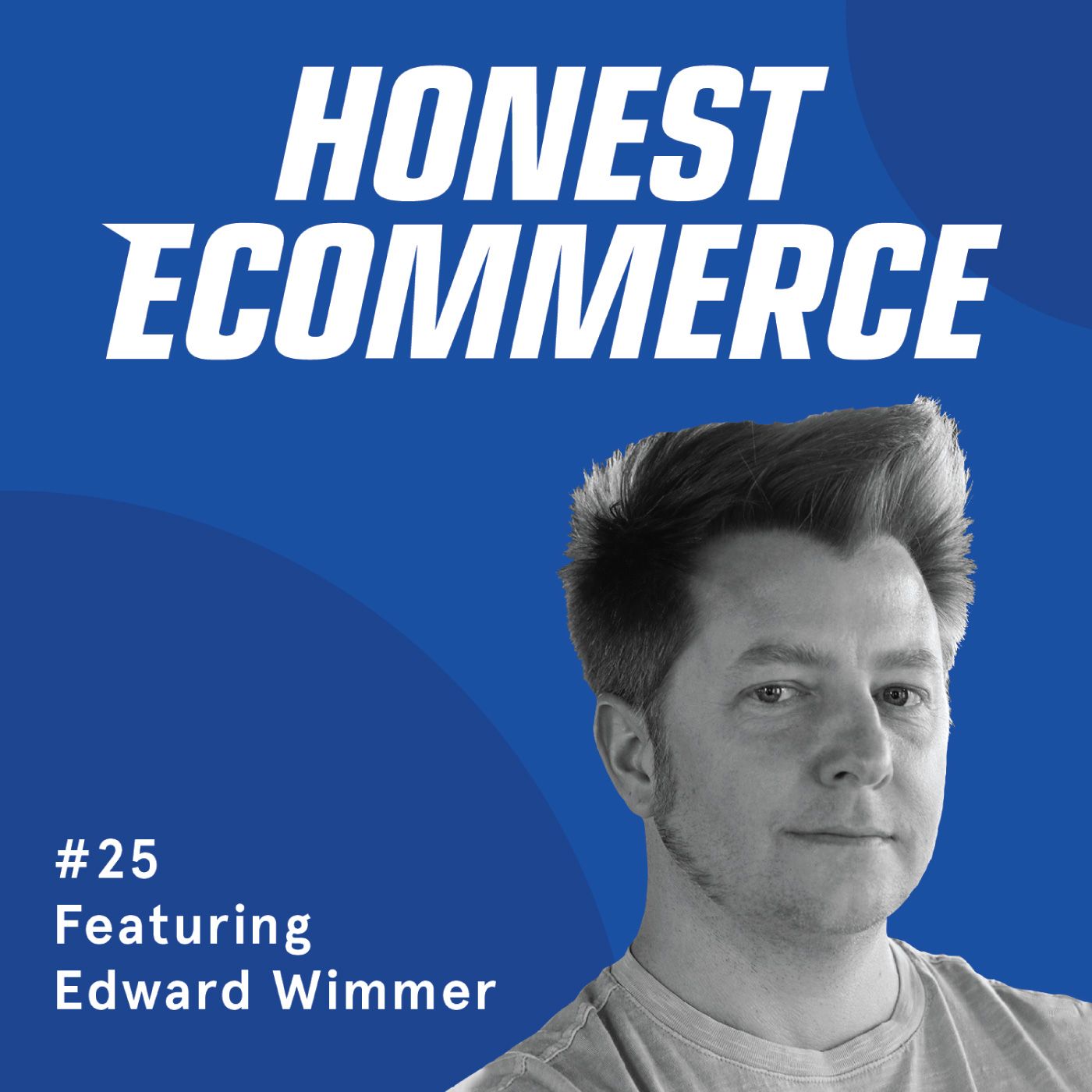
Shopify Plus Saved Road ID $1M/Year: Edward Wimmer's Story
From a Leaky Basement to 8 Figures: How Road ID Started
Road ID was born from a near-miss on a Kentucky country road in 1999. Edward Wimmer, then a college senior training for his first marathon, jumped into a ditch to avoid a truck that never saw him. In that moment, he realized no one would have known who he was if he had been hit. No ID, no contact information, no medical history. His father had actually warned him about this exact problem a week earlier.
Armed with two credit cards he had signed up for outside his college cafeteria to get free t-shirts, Wimmer and his father launched a wearable ID product for runners, cyclists, and triathletes. Their first online store went live in 2000. The first night, they appeared to process 19 orders. It turned out to be one order duplicated 19 times, which meant Wimmer's first task as an ecommerce entrepreneur was figuring out how to issue 18 refunds.
Nearly two decades later, Road ID is an 8-figure ecommerce company with around 40 employees. Every day, customers reach out to share stories of their Road ID making a difference, ranging from reuniting kids with parents at theme parks to giving first responders the information they needed at the scene of a serious accident.
Why Building a Custom Ecommerce Platform Costs More Than You Think
Road ID launched before Shopify existed. Shopify came online in 2006, Magento in 2008. In 2000, if you wanted to sell online, you built everything yourself. Wimmer's team did exactly that, creating their own storefront, order management, pick-pack-ship software, and engraving system from scratch. At one point they had six to eight engineers on staff just maintaining and extending their internal suite of applications.
For a while, being custom-built was a genuine advantage. Wimmer describes how his team implemented shopping cart abandonment email as a homegrown idea before it became an industry standard. They were moving faster than the platforms were. But by 2015, that had reversed. Features that Shopify and its app ecosystem were shipping quickly were sitting unbuilt on Road ID's internal roadmap, pushed back by more urgent priorities. Keeping up would have required throwing more engineers at the problem, and the cost-benefit math had stopped working.
In 2015, Road ID began evaluating alternatives. They explored Magento, BigCommerce, Shopify, and several enterprise solutions. They went deep on one enterprise platform and invested $300,000 before deciding it was not going to work and pulling the plug. Wimmer is direct about this: it was a mistake, but the more important lesson was having the discipline to recognize the mistake and stop rather than continuing to pour money into a dead end. Ryan Lunka of Blended Edge makes a similar case that the obsession with custom-built technology is itself the constraint holding many ecommerce businesses back.
What Shopify Plus Actually Saved Road ID Per Year
After the failed enterprise experiment, Road ID tested Shopify by migrating a small, low-priority event sponsorship store. Two days later the store was live. That result gave them the confidence to migrate their main custom-product store to Shopify Plus, which launched in September 2017.
The financial impact was immediate and significant. Wimmer estimates the move to Shopify Plus saved Road ID at least one million dollars per year. That figure accounts for reduced engineering headcount, eliminated hosting costs, removed SSL overhead, and all the infrastructure that came with running a fully custom platform. Shopify Plus starts at $1,000 per month. Wimmer admits he does not even track what they pay for it because the number is so small relative to what they were spending before that it does not register.
Beyond the cost savings, the move handed Road ID access to a platform roadmap driven by a large engineering team plus an entire ecosystem of app developers, all at no additional cost. The opportunity cost of the founder's time spent managing an internal technology roadmap also disappeared.
The Three KPIs Every Ecommerce Operator Should Track Daily
Wimmer is precise about the formula he uses to run Road ID's ecommerce business. Revenue equals Sessions multiplied by Conversion Rate multiplied by Average Order Value. That is it. If you are large enough, you track these daily. If not, weekly. The math is straightforward but the implications are significant.
Using round numbers: 100,000 monthly sessions at a 2% conversion rate and a $50 average order value produces $100,000 in monthly revenue. Move the conversion rate to 3% and the average order value to $55, and monthly revenue becomes $165,000. That is a 65% revenue increase without acquiring a single additional visitor.
Wimmer's point is that most ecommerce founders default to trying to drive more traffic when sessions are often not the actual constraint. Conversion rate and average order value are frequently the levers with the most room to move, and they cost less to improve than paid acquisition. The same three-KPI framework—sessions, conversion rate, and average order value—is the foundation of the breakdown of how $1M ecommerce brands scale to $10M.
Once those three metrics are operating with a continuous improvement process, Wimmer adds two more: customer lifetime value and referral rate. Getting an existing customer to buy again costs less than acquiring a new one, and customers who actively recommend a brand are a compounding growth asset.
Why Attribution Is Harder Than Most Brands Admit
One of the more candid moments in the conversation involves a product Road ID began promoting with paid media about four months before the recording. The product went from near-zero sales to roughly $100,000 in a single month. But Road ID could only attribute about half of those sales to a specific channel. The other half were driven by a combination of email, organic social, influencer mentions, and direct traffic that no single platform was claiming or tracking cleanly.
Wimmer's conclusion is that the customer journey is messier than it has ever been, with more devices, browsers, platforms, and channels creating attribution gaps that are difficult to close. Both Facebook and Google have an incentive to claim credit for as many conversions as possible, which means ROAS targets set on that data may be misleading in both directions. Road ID was exploring whether their paid media targets needed to be recalibrated to reflect the full picture of what was actually driving revenue.
SMS Marketing and the Referral Program Road ID Rebuilt
At the time of recording, Road ID was seeing a 70% click-through rate on SMS campaigns and generating roughly 40 cents in revenue per message sent. Wimmer was clear that this window would not stay open indefinitely as more brands flood the channel, but the current numbers justified aggressive list-building. They were using Attentive for SMS and working toward syncing that platform with their email service provider to get a unified view of customer communications and avoid sending duplicate messages across channels.
Road ID also rebuilt their referral program after losing the custom-built version during the Shopify migration. They launched with Friendbuy, citing a specific feature that stood out: the ability to generate a personalized URL for every customer at the point of purchase, sync it back to the email service provider, and include it passively in every email send. The positioning they planned to use leaned away from transactional incentives and toward the idea that sharing a Road ID link could genuinely help someone in an emergency. That framing matches the brand's core mission and is likely to convert better with their audience than a generic discount-for-referral mechanic.
Key Lessons From This Episode
- Switching from a fully custom platform to Shopify Plus saved Road ID over $1 million per year, and the monthly Shopify Plus fee became too small to track against that baseline.
- Sessions times Conversion Rate times Average Order Value equals Revenue. Conversion rate and average order value are often more movable than traffic, and a modest improvement in both can produce a 65% revenue increase with no additional ad spend.
- Pulling the plug on a $300,000 failed platform investment was the right call. The real mistake is not the sunk cost but the failure to recognize it quickly enough and stop.
- Attribution gaps are real and growing. If you can only attribute half of a $100,000 revenue month to specific channels, your ROAS targets may need to be recalibrated in either direction.
- SMS marketing delivered a 70% click-through rate for Road ID at the time of recording. The channel is still early enough to build a list before saturation sets in.
- Passion for the product is not just motivational language. It is what gets founders through expensive mistakes, sustains them through hard stretches, and gives them the confidence to tell customers clearly why they need the product.
Hear the full conversation, including Edward Wimmer's story of Road ID's origin, their customer service philosophy, and the complete breakdown of their ecommerce metrics framework, in the transcript below.
Resources:
- Learn more at RoadID.com
- Start a Simplr free trial: simplr.ai/honest
- Are you a maker, crafter, or small manufacturer on Shopify? Get easier production scheduling & inventory management with Katana. You can try it free for 14 days. By using the promo code “HONEST” you'll get 30% off your first 3 months of paid subscription! Sign up at Katana’s website here: www.katanamrp.com.
Honest Ecommerce is produced by Crate Media
Edward Wimmer
You have to love what you're selling. You gotta love it so much, that you feel like you'd be doing the world a disservice if you didn't bring it to them.
Annette Grant
Welcome to Honest eCommerce where we are dedicated to cutting through the BS and finding actionable advice for online store owners.
Chase Clymer
I'm your host, Chase Clymer
Annette Grant
And I'm your host, Annette Grant.
Chase Clymer
And we believe running an online business does not have to be complicated or a guessing game.
Annette Grant
If you're struggling to scale your sales, Electric Eye is here to help. To apply to work with us. visit electriceye.io/connect to learn more.
Chase Clymer
And let's get on with the show.
In today's episode of Honest eCommerce, we welcome the CEO and founder of ROAD ID as he shares with us how his company saved $1 million a year moving to Shopify Plus.
Hey everybody, welcome back to another episode of Honest eCommerce. I am sitting here next to Annette Grant who can't plug-in wires. And today... (laughs)
Annette Grant
(laughs) So we're delayed getting started.
Chase Clymer
Yeah.
Annette Grant
Because I messed every single wire up that we could. But we're live now. We're here.
Chase Clymer
We're back with another founder’s’ story. These are awesome. These are super fun. You get to hear from people that have a real-life business. This isn't fake.
So anyway, without further ado, I would love to welcome Edward to the show, another Ohioan. Edward comes to us from ROAD ID. It's an amazing product and he's going to give us that history right now. So take us back 19 years to the start of the business and what brought you here today, I guess.
Edward Wimmer
Chase, Annette, thank you for having me on the show. I do want to correct one thing. You called me in Ohioan.
Annette Grant
(laughs)
Chase Clymer
Oh, no...
Edward Wimmer
I am very near the city of Cincinnati, Ohio, but I am on the bourbon side of the river. So I'm on the Kentucky side.
Annette Grant
Oh okay. I did know that either. Awesome.
Edward Wimmer
I'm a proud Kentuckian and happy to be here today. Thanks for teeing up the "how it all started" conversation. That's a story I love talking about because it's pretty fun for me to look back 19 years, almost 20 years now. So in the world of eCommerce, you would consider us a dinosaur, but a dinosaur that hasn't gone extinct yet.
So we're ever-evolving and trying to continue to persevere in the world of digital commerce. It was 1999. I was a college senior training for a marathon. And because I was a good college student, I would make that obligatory call home to the folks every couple of weeks or so. And during one of those calls, I told my dad that I was training for a marathon and his first response was, "Mari-what?!"
Annette Grant
(laughs)
Edward Wimmer
And I had to assure him that it was a marathon training and his immediate reaction was, "That sounds kinda silly. You're training to run 26.2 miles and you're doing it on these country roads out in the middle of nowhere 16-18 miles at a time on a weekend." And I assured him that I was being safe and taking all the necessary precautions. But he didn't necessarily believe me.
He had a selfish concern which was, "If you have an accident while out there training on these country roads, how would I, as your father, even know about it? How would they contact me?" And he was right. When you go for a run, you pick your running shoes and shorts and a T-shirt and that's it. You're certainly not carrying any ID with you.
Annette Grant
And back in those days. You didn't have an iPhone, you had your Walkman most likely with you. So no one really knows who you are. There's no like ICE in your iPhone, that they can call in case of emergency.
Edward Wimmer
That's right. Yeah, that didn't exist. So there I was, training on a rural road in Kentucky. We got plenty of those around here. And it was an 18-mile Saturday run. It was the weekend. The Saturday after I had that call with my dad where he was worried about my safety. And he actually asked me to take an ID with me in case I had an accident.
And on a country road, (the) speed limit (is) 55 miles an hour, I see this truck coming towards me. And it keeps coming and it doesn't seem to be getting over and it keeps getting closer and still doesn't seem to be moving and it keeps getting closer.
And at the last minute, I realized, "Oh my god. This truck doesn't see me." So, to avoid being hit, I jump off the side of the road. I find myself in a ditch thinking, "Oh my god. That was close." I had two very scary realizations that day.
One was, I could have been hit by that truck. I could have been unconscious, maybe (at) the local hospital, fighting for my life --literally at a time when you would want people by your side-- and nobody would know who I was.
They wouldn't know how to contact my folks or my friends or other family members. They wouldn't know how to access medical information. They wouldn't even know what to call me. I'd be a John Doe on a local hospital and that really, really freaked me out.
Dad's idea of carrying IDs started to make a little bit of sense. Which leads me to the second and far scarier realization I had that day, for the first time in 21 years of life, I might have to admit that my dad was actually right about something.
Annette Grant
(laughs)
Edward Wimmer
So, if you've been there before, you know how scary that can be. But a few months after that. Like I said, I'm a senior in college. And I was trying to figure out what I was going to do with my life. I always knew I wanted to be an entrepreneur, but I didn't know with what. And I had that love, that entrepreneurial love because my father was one our whole life.
He's your prototypical visionary moving from one idea to the next before one would get gain traction. He wasn't necessarily financially successful, but he loved what he did. So I saw that love in his eyes every day as a kid and I knew I wanted some of that. So, armed with two credit cards --that's all we had.
We were both broke. I was a broke college student. My dad was a broke adult.-- but we had these two credit cards that we got because --I filled out the credit card applications outside the school cafeteria-- because I wanted to free t-shirts that came with them. And with these credit cards, we decided we were going to start a business.
We were going to make a product. A wearable ID that runners, cyclists, triathletes could wear, that would communicate who you are, who to contact, and how to access medical information in an emergency. So we launched our first eCommerce store a little bit after we launched the company.
So in 2000, our first store went live. And that night, we processed 19 orders. I woke up in the morning with my arms in the air thinking, "Oh my god, this eCommerce thing is amazing. We're going to be rich." But I realized pretty quickly that those 19 orders were actually one order.
Annette Grant
(laughs) I was gonna ask, how did you get that much traffic that quick in 1999?
Edward Wimmer
Yeah, so the 19 orders is just one order duplicated 19 times. So my first order of business as an eCommerce entrepreneur was to figure out how to credit a credit card 18 times.
So my dad and I sat in this leaky basement in Northern Kentucky and we thought, "Well, if we could just help one person in an accident, one person gets the right help at the right time, improve the outcome of the accident and emergency situation, then all the effort, the blood sweat, and tears, the working for no money, the working two jobs just to pay the bills, all of that would be worth it if we could help one person."
And so I'm going to flash way forward now. Here it is, almost 20 years later in 2019. And it's not an exaggeration when I say that every day, somebody is reaching out to us saying, "Thank God for my ROAD ID." and those stories range and scale from, "I tripped over a curb. I was relatively okay, but I didn't want to answer all the first responders questions when they started peppering me with them." to parents who've told us that they've gotten reunited with their children at Disney or a major theme parks because they got separated, --the kid's wearing a ROAD ID. It has the parents phone number on it.-- to cyclists that have a car collision or collision with a car and they said they wouldn't be alive today if it weren't for the information on the ROAD ID and the access that it gave first responders, to very tragic stories.
We had a mom post on our Facebook page --and these are hard for me to talk about-- but a mom post on our Facebook page because her son was wearing one when he got hit by a car, that she was able to get to the hospital to have enough time to hold her son's hand, to tell him that she loves him one last time.
And so, not to take us to a very sad place but we are very mission, "why-focused" here at ROAD ID and it's because what we are doing helps save lives. It fuels adventure and it brings lots of peace of mind to people. So that's how we started. We're 19 years to 20 years later. We are an 8-figure eCom company with about 40 folks and our stated dream or vision is to see the day when wearing ID is as common as strapping on a seat belt. If you think about it, it's a paradigm shift that has occurred in recent decades.
Not unlike wearing bike helmets. There's a paradigm shift in safety that has occurred recently. And even more recently, helmets on the slopes is a paradigm shift in safety that has occurred just in the last half-decade.
Chase Clymer
Yeah, that is a wild ride that you shared with us there. Yeah. Okay. So I'll let the listeners know that we met in Columbus, Ohio. You came out to one of our meetups. And I heard this story before and I was like, "Alright. We're starting a podcast. You have to be on our podcast. You have to share that with our audience."
Annette Grant
Yeah, I feel like we could... This could probably be broken down into six episodes because that could be an episode in itself. Just the beginning there. I do have a question. Did you finish your first marathon?
Edward Wimmer
I did.
Annette Grant
Awesome.
Edward Wimmer
It wasn't very fast. I was right at the four-hour mark, but I did finish it.
Katana Ad
Hey, if you're in the product making business then we've got great news for you. Katana is here to make your life easier. There's now a Shopify app built and designed for merchants that make their own products.
Manage your sales, orders, raw materials, production schedule, inventory, and material purchasing all from one dashboard. The name of that app is Katana.
Katana is designed for makers, crafters, and small manufacturers selling on Shopify. Until now, product makers selling on eCommerce have had to settle with messy spreadsheets or regular inventory management software.
We know they both usually suck if you need to make your own products. Fortunately, Katana is built from ground-up with the needs of a small manufacturer in mind. Production, scheduling and inventory management has never been this easy for Shopify merchants.
A recent survey shows that 93% of Katana users say they love it because of the ease of the setup and how intuitive it is.
To try Katana for free sign up at www.katanamrp.com or search Katana on the Shopify App Store. There's a 14-day free trial. You do not need a credit card. And when you're signing up, use the promo code honest to get 30% off your first three months of a paid subscription,
Check out Katana today.
Chase Clymer
So in the pre-show, somehow Edward got out of my process and we actually didn't have any notes for this episode. And we're like doing it on a whim. But you know, we're honest over here, it's in the name.
Annette Grant
(laughs)
Chase Clymer
So they are now on Shopify, but you weren't before and tell us about building your own eCommerce solution.
Edward Wimmer
Yeah. If you think about it, the year 2000, as I indicated, our first store, there were no platforms. If you wanted to sell online, you had to build it. Shopify, I think, was launched in 2006. And Magento came online in 2008. So, they weren't around. They weren't even conceived of at that time, nor was any platform for that matter.
So if you want to sell online, you had to build it yourself. So we did. And even as platforms started evolving, they weren't a great fit for us because we sell a customized product. You have to key in 5 to 7 lines of customized text that allow your ROAD ID to be produced. So for a long time, we just thought we're going to be custom bespoke forever. And it wasn't just our store.
It was our pick, pack, and ship software, it was our order management, it was our engraving software, everything that it takes to run an eCommerce business, we built from the ground up. This meant that it was highly tuned for our specific needs and for our customers’ specific needs. It also meant that it was really expensive.
As we add to a theme, if I think back to, I don't know, 2010 or so, we probably had 6 or 8 engineers on staff, building our suite of applications. And so about 2016, we started to say, "Okay. Well, maybe a platform will work for us." And we did a really deep dive into lots of different platforms from Magento to Shopify to BigCommerce. And if you can name it, we tried it.
And we went down a particular path of something that we thought was going to be really good for us and really extendable for us. And it was an enterprise solution. And it was really expensive.
I think we had $300,000 invested in it before we realized that it just wasn't going to work for us and we pulled the plug. So, $300,000 down the tubes or mostly down the tubes. We did learn a few things.
Chase Clymer
I want to stop you right there.
Edward Wimmer
Yeah.
Chase Clymer
How mad are you about spending that money to know... Right now, knowing that pulling the plug on that was the right business move?
Edward Wimmer
Oh. I don't think about it at all. If you were to tee up a question and say (something) like, "What are one of your biggest business mistakes?", that might make the list. But probably not. I mean, it's just part of the learning process of being in business.
We thought this was the right step. We went down that path. It ended up being the right step. The very important lesson for us was that you have to be disciplined enough to realize you've made a mistake.
Chase Clymer
Yep. So that's the lesson.
Annette Grant
Oh yeah.
Chase Clymer
I want to pull that out right there. That's the lesson right there. The first lesson of the episode is, "It doesn't matter how far down the rabbit hole you've gone, you can always pivot and fail fast." You don't want to be failing for five years.
You want to realize you failed and pivot and move on to the next iteration of whatever the concept or idea... But yeah, just because you've invested a big amount of money in it --if in your gut, you know it's wrong-- pull the plug.
Annette Grant
And I want to ask. Normally, when someone has a custom-built site, they never even look at a different solution. I feel like they have an ego about it. When I talk to people about Shopify sometimes they're like, "Oh, my site’s custom. It's custom."
Like, their one developer is going to be better than this, amazing ecosystem that Shopify is built. So I want to know why you even transition, to think there was a different solution, besides the custom that you worked for. --it sounded like, what, 16 years or so at this point in time-- to build. Like, why were you pivoting away from your custom solution in the first place?
Edward Wimmer
Yeah, that's an easy answer. The answer is that we were so early to eCommerce --in 2000-- that we were setting convention. I like to think that we invented a few eCommerce conventions that exist today. Like shopping cart abandonment, I'll just use that example. That came about because I walked into our senior developer’s office, and I said, "Hey, we capture email addresses for people as they move through the purchase journey, right?"
"Yeah."
"Well, if they don't finish their order, would we be able to send them a link and have them come back to the store and recreate that for them?"
"Yeah."
"How long would that take?"
"I don't know, I could probably have it done this afternoon."
"Well, let's do that."
And so this wasn't something that we saw or experienced somewhere else. It was something that just came to our minds, and I'm sure we weren't the only ones who invented it at that time. Things have a tendency of being thought about in different places in the world at the same time. But we did our own shopping cart abandonment. Which really, is an example to say that we were driving...
We were moving faster than platforms were moving. Back in 2006, Shopify comes on board. 2008, Magento. We were already ahead of that until we weren't. So then things start happening. Like, browse abandonment or “customers also love.” Yeah, we could do that. We could build all that.
But it's not on the roadmap right now and there are more important things in front of it. So then you get a few conventions to come and they pass you by and you start getting frustrated. You could say, "We could probably solve this by throwing a few more engineers at the problem. But that's really expensive."
So it becomes a cost-benefit... It became a cost-benefit analysis and the need to keep up. So your point Annette about switching to a platform where they have big teams of people working hard on the platforms to stay current and to drive convention, we started seeing that. So we knew we needed to switch because we didn't want to keep falling behind. And by 2015, we were definitely falling behind.
Chase Clymer
So is that when you made the switch? Was (it) 2015?
Edward Wimmer
2015 is when the search began.
Chase Clymer
Okay. And then so when did you guys end up on Shopify?
Edward Wimmer
We ended up on Shopify, in... We launched our store in September of '17. So it took a little while. Remember, we had that mistake, where we invested all that money on an enterprise solution. That made us a little bit gunshy. We came back in and said, "Well, maybe it's just best if we keep innovating our existing platform." And then what we did...
The real turning point for us was, we had a smaller store where we ran an event sponsorship program out of. It was really outdated but we were never going to get around to it because it wasn't forward to our business.
And what we did was to say, "Okay. Let's test Shopify with that little store." And two days later, we had a store up and running. So we're like, "Huh. That was easy. Could we possibly do our custom product on Shopify also?"
So, we became a Shopify Plus customer instead of building a store that could take our... We had to extend Shopify a bit, to do the customization of our IDs but that was relatively easy, too.
So, now we get the massive advantage of having a company with dozens, if not, more engineers working every day on innovating and extending a platform, along with a massive audience of app developers and that all comes for free.
We don't have to have a team of 6/8/10 software engineers driving it. So this would be my, perhaps the second, "Write this down" moment of this conversation which is, if you're not on Shopify, you're making a big mistake.
Simplr Ad
Support for today's podcast comes from our friends at Simplr: a new way to staff 24/7 sales and customer service on your eCommerce store.
It works with your existing email and chat platforms, so setup is quick and easy.
Simplr's network of on-demand, US-based, Simplr specialists are standing by to answer your customers' most common questions.
Set it up for free today and then turn it on or off depending on your customer volume. You only pay $2.25 for every resolution. There are no hidden fees, contracts or minimums.
Close more sales with Simplr by staffing your email and live chat around the clock with Simplr specialists. Start your free seven-day trial at simplr.ai/honest.
Chase Clymer
Can you fathom some numbers here? The savings going to (Shopify) Plus on just salaries alone for those employees. How much are you saving a year? And then you can even take out the cost of Plus a month.
And I mean also, you should probably add in the savings of not having to pay for your server space anymore, not having to pay for your SSLs and all the traffic stuff. What do you think your net gain from this move was? As far as savings?
Edward Wimmer
It's at least a million dollars minimum.
Chase Clymer
A year? Is that a million a year you were saving making this switch?
Edward Wimmer
Yes.
Annette Grant
(laughs)
Chase Clymer
That's why you don't want to do anything custom. When people come to us all the time, asking, they're like, "We got this really awesome idea that I want to do this thing on my website."
And we're like. "Cool. Yeah. We can do that. We're gonna use this to solve for it." And they're like, "Oh, why don't we do a custom?" And then I just... I'm just going to point them to this episode now.
Annette Grant
Right.
Edward Wimmer
(laughs) Yeah, no. I mean, by the time you figure in the cost of hosting like you said, and the cost of the engineering team that's needed to do it, and just opportunity cost. How much of my time as founder and CEO was spent trying to think of the roadmap? I don't have the roadmap anymore.
Yes, we still have a roadmap for Shopify, but it's a different type of roadmap. It's a lot easier. Yeah, no. If you're not Shopify, massive mistake. Get on Shopify. It's such a big disparity, Chase that I don't even know what we pay for Plus.
Annette Grant
Ha-ha! I love that! That's it.
Edward Wimmer
It's so small in comparison to what we were paying, it doesn't even register on my radar.
Annette Grant
That's when you know you're with the right solution. When you don't even think twice about what that monthly fee is. You're like, "I would pay it. It's worth every penny even if they were to charge us more." So that's a testament there, too.
Edward Wimmer
What is it? You guys probably know.
Chase Clymer
It starts at $1000 a month.
Edward Wimmer
Yeah. So a $1000 month for Plus.
Annette Grant
(laughs)
Edward Wimmer
As opposed to more than a million a year.
Annette Grant
Yeah. Insane. So you made the switch, let's talk about the current day right now. What are you excited about? Because obviously, you've chosen the right platform. You're there. You've chosen the right product. You're 20 years in. What are you excited about? How do you keep coming back to work every day? What are the technology things that are keeping you wanting to come to work and not just sell the whole company?
Edward Wimmer
Well, I think, first and foremost that's why we exist. So, we exist to save lives by the peace of mind and (to) fuel adventure and I can't understate that enough. That's what... Everybody that comes to work here, that's why they show up every day.
So we think very... If you've not seen Simon Sinek’s Golden Circle video, go watch that because it really helps you understand why you are in business. And we're a very "why" focused company.
So first and foremost, that. The other thing that makes me excited and this comes from getting off track. We were for a little while and then realizing we lost our way and had to get back. So we've been customer-obsessed since day one.
Obsessing about the customer journey. In fact, the way we state it is that... At ROAD ID, our stated goal is to deliver a product, service and customer journey so blindingly awesome, that our customers can't help but share it. This has been and will always be the most powerful growth lever that you can have.
If you think about brands --and Shopify brands-- that have seemingly exploded overnight like Allbirds or ThirdLove or Pura Vida, do they have effective digital marketing campaigns? Sure. A network of influencers? No doubt.
But they're not growing like crazy because they're really savvy digital marketers. They're growing like crazy because their customers love them. When the customers love you, they shout from the digital rooftops --social media-- and they will... I like to say they would show up to a knife-fight for you.
And like, we coined "knife-fight customer service" many years back because we had an experience where one of our customers was slamming us in a forum. Several of our customers sent (messages) into our customer service teams, "Hey, this guy is really beating you guys up over in this popular bike forum."
And I was immediately offended, having not even read it. I went over the bike forum. I checked it out. This guy, what he said was about us was emotionally painful for me. And I was getting ready to respond. But before I responded, I looked at hundreds of comments from our customers that were coming to our defense.
And they were telling this guy, "Dude, you got it all wrong. ROAD ID is an amazing company. If you have a problem with them, just reach out to them they're going to take care of it. It's that simple." And so I say, if you treat your customers right, if you stand out in the sea of vanilla, then customers will really show up to a knife fight for you.
They will solve your problems because they'll want to communicate with you and say, "Hey, I noticed this thing that didn't seem quite right for you. I want to make sure you address it." They will solve their customer... They're solving problems and help you grow your business and they're gonna tell all their friends about it.
So I think it's vitally important that you do business as people and not as a business. Because customers, they don't want to buy from a company. They want to buy from people. And so I could go on and on about that point specifically, but I started this by saying we kind of went wayward and we came back.
So, for a couple of years, we got a little vanilla. And guess what, business suffered. Because while we were still delivering a great product at a great price and delivering sound service, we weren't remarkable.
When I say remarkable, I don't mean great, I mean remark worthy. You have to do customer service so well that if they nail the journey so perfectly that people want to tell people about it.
So, "why-focused", obsessing about the customer journey, those are the top two. The thing that has piqued my interest most recently... And I'll slow down if you want me to slow down.
Chase Clymer
No. No.
Annette Grant
No. We're just quietly... (laughs)
Chase Clymer
You're taking all of my talking points away from me. I'm like, "Oh shit, that's his show now."
Annette Grant
Yeah, it's good. Keep it going. Keep it going.
Edward Wimmer
(laughs) So like my latest discovery is that the customer journey is messier than I thought it was. If you think back to 1999, people were still doing print ads a lot, newspapers a lot, radio a lot, TV a lot. And the only way to measure all that stuff was to look at revenue and say, "Did it go up?" You just measure it less.
And then digital commerce came along like, "Well, we can measure stuff now." I remember when the predecessor to Google Ads came out --this thing called Overture-- I was like, "Oh my God! I can show other people's search results? And they can click that? And I know how much money I spent? And I can also know how much I made? This is amazing!"
And things were pretty straightforward for more than a decade like you could... You knew... Attribution wasn't hard. But because the customer journey is messier than it has ever been, because there are so many devices, there's so many browsers, so many platforms, so many channels, and marketplaces.
I mean, you're not just selling on your eCommerce store in many cases, you're also on Etsy and eBay and Amazon, so attribution is nuts. I'll frame this up in a very real example that we had recently.
We launched a product. And in fairness, it's a product that we have, but we never promoted. And so it was just riding along and then doing a fair amount of, a low amount of sales for us. And we decided, "You know what, let's put some ad dollars behind." And that was four months ago.
In March, we did almost $100,000 of sales over that product. It went from almost zero to $100,000 but we can only attribute... We only have an attribution for about half of it. So as we know, Facebook, and Google and everybody else were buying ads for, they want to claim responsibility for as much as they can.
Like Facebook. It's taking credit for sales that it shouldn't be taking credit for. Google is doing the same thing. We know that is true. And we have our internal own media, we're sending out email, we have organic social working for us, we have some influencers that are talking about it. But we can only attribute about half of that.
What does that mean now? If that's real, then perhaps our paid media targets need to be lower. So we have a ROAS goal for our paid media, perhaps it needs to be lower. Perhaps there's actually... Even as far as Facebook and Google are working to take credit for every sale, maybe they're not taking credit or as much as they ought to be.
But that is my latest discovery. The customer journey is messier than I thought. As a result, attributions are harder than ever, and perhaps we're leaving money on the table.
At ROAD ID, we find it hard to talk about money because it's not about money, it's about making a difference in people's lives. If perhaps we're not making as much a difference in people's lives as we could be, maybe we need to be spending more on paid media.
Chase Clymer
Yeah, that sounds like a fun challenge. Data is confusing if you don't know what you're reading. It's the only place you can find the truth about business though.
Edward Wimmer
That's true. No. You gotta pay attention to the numbers and we obsessed about data. We have a formula here that I'm always surprised when eCommerce businesses don't understand or don't use it.
But the formula for eCommerce is pretty simple. It's Sessions x Conversion Rate x Average Order Value = Revenue. That's just simple. Every dollar value is multiplied to those things together and out the other side. You get revenue.
Chase Clymer
Okay. So you know the proposal I was working on... Annette was looking at our... That's literally the page, it's in all of our proposals. eCommerce boils down to these three KPIs.
And if you do that for your own site, you're like, "Well, these numbers don't add up." Because it averages. But it's going to be within a 20% margin of what you're doing online is that...
Edward Wimmer
Yeah.
Annette Grant
Okay. Edward go over that. Say that one more time for our listeners, though. Slow.
Edward Wimmer
Sessions x Conversion Rate x Average Order Value = Revenue and you've got to obsess on them. If you're big enough, you obsess on them daily.
If you're not big enough to spend that time on it, obsess about them weekly. And if you're not able to obsess on them weekly, you're probably just getting started and your hair's on fire and you don't know what to obsess about.
But those three metrics are vital to the enduring success of an eCommerce company. Let me break this down. I went to public school, so my math isn't all that great but let me see if I can break this down in an example.
So let's use round numbers. 100,00 monthly visitors = Sessions. If your conversion rate is 2% and your average order value is $50, the revenue is going to be $100,000. Right? So...
Chase Clymer
No one's checking your math, just letting you know. Nobody's checking your math over here. (laughs)
Annette Grant
So yes, you're right, you're correct.
Edward Wimmer
$100,00 in revenue.
Chase Clymer
Yep.
Edward Wimmer
If you were able to move that conversion rate to 3%, --from 2% to 3%- and the average order value from $50 to $55, your monthly revenue goes up to $165,000. That's a 65% increase in monthly revenue by focusing on two metrics, conversion rate, and average order value. What most of us want to do as eCommerce entrepreneurs.
We want to go out, we want to get more people in the store. "Let's tell the story to more people. Let's buy... Let's spend more money on paid media. Let's figure out how to get more people to visit us and buy our product." Sessions isn't always the problem. It's still conversion rate and average order value or 2. Sessions isn't the problem.
And then when you get those three things dialed in, you have a regular process, continual improvement process for those three metrics, then you start thinking about things like lifetime value.
Because it's all ways your customer back than it is to earn them the first time. And the referral rate. Get them shouting from the digital rooftops about you. Get them to promoting about your brand. So, it's five metrics that we think about. But far away, the most popular is that first equation.
Annette Grant
Do you have a loyalty program with your customers?
Edward Wimmer
We do and we are actually just bringing it back.
Annette Grant
Okay.
Edward Wimmer
It was... We were looking... When we migrated to Shopify, it was one of the things that we lost. We had this very finely tuned loyalty program that we custom-built like everything else. It was great. And it worked really well. We were looking at some data from 2015, 2016, and 2017, or 2015 and 2016 and some holiday data recently.
We were trying to figure out what drove the most revenue in those years. And one of the top revenue drivers in those years was our referral program, our loyalty program. I guess referral and loyalty are a little bit different, but let's talk about in terms of referral. It's one of the most... One of the biggest revenue drivers for us.
And then when we moved to Shopify, we lost that because it was custom. And we tried a few..., We tried one app that didn't work all that well for us. And we actually just recently launched with Friendbuy. And I'm really excited about Friendbuy’s capabilities.
One of the unique things that they're allowing us to do --that I didn't see with any other referral program-- was the ability to create a personal URL, --that's the thing you share-- for every customer as they buy.
So we're going to hit an API on purchase. And we're going to sync that and they're going to send back that personal URL. And then we're going to sync that personal URL to our email service provider.
And then every time we send an email to that customer, we're going to include the personal URL. It's not even bold or in your face but we're going to remind customers with every email send --whether it's transactional or promotional nature-- that, "Oh by the way, here's a URL that you can share.
But if you share, you earn something your friend earns something. But we're going to be careful not to make it about the "you get something, they get something." What we're going to try to do is lean into the fact that "You should do this because it can make a difference in somebody's life."
Chase Clymer
That's awesome positioning for a referral program.
Annette Grant
The personalization is crazy. I didn't even know that was possible. Everybody likes their name on things.
Chase Clymer
Yeah. So we were talking about... Just now, we're talking about some tips and tricks for what you guys have going on in the business.
Is there anything else that you'd want to share that you found is really working for you guys and your eCommerce success? Two or three things that you know, people that are just getting started out on their journey or they found that traction and they're trying to turn up the heat. What they should be thinking about or working on?
Edward Wimmer
Well, I talked about what's newest for me, that's the messy customer journey thing. I think the thing before the app that was newest is SMS. I would say SMS and messenger. But I really think the opportunity is with SMS.
This is another one of those things that if you're not actively building your SMS list, you're going to miss the window of opportunity to leverage that channel. Because --Gary Vee says it all the time-- but as marketers, we love to ruin things. And SMS, we're going to ruin real fast.
Annette Grant
(laughs)
Edward Wimmer
But right now, we are getting a 20% click-through rate... We're getting a 70% click-through rate that is earning about 40 cents every time we send an SMS message to somebody. It'll be... We've got some creative ways we're thinking about growing that list, but it's the thing that's happening right now.
SMS marketing is something that people are tolerating. And if you're listening and you're not tolerating... Like, you think that this is an abhorrent way to receive marketing messages, you're over 40 years old, I guarantee it.
Annette Grant
(laughs)
Chase Clymer
Yeah, I think SMS is going to be the new wild west.
Annette Grant
Mm-hmm. Agreed.
Chase Clymer
Are you using a specific app for that?
Edward Wimmer
Oh. We've leveraged Attentive. They are not... They don't... They integrate really well with Shopify. They don't have, --If you go to the App Store, I don't think you would find them there-- So it's attentive.io. We've had great success with them.
We will likely start syncing these messages with our email service provider which also gives us the capability to send SMS messages. So as this evolves for us, we may change the way that we send certain types of messages. So it won't just... Won't have the ability... Shopify tries out of the box the ability to do some transactional messages via SMS.
But we like to send all of our transactional and promotional emails out of the same platform so that we really understand the whole communication picture better. And, you know, doing SMS out of that platform will help. So that’s maybe something we do eventually.
Chase Clymer
Yeah, that's interesting to think about. You definitely want... It helps to sync the data in one place.
Edward Wimmer
You don't want to send necessarily a promotional... We got our spring sale coming up, for example. The few times we just got our product in a year. And the danger we're gonna run into is that our email service platform is not really synced with our SMS platform at this point, somebody can get our SMS notification and our email or we do SMS abandoned cart.
So you can get our abandoned cart email and our abandoned cart SMS. Now, some people would say, "Don't worry about it. That's no big deal. It's a different channel. Some people will want to see both. And it's a better opportunity to reach them if you send those in the right." But it is something that we think about.
We're very sensitive to our customers' inboxes and messenger inboxes. We don't want to barnstorm them. We want to be the uninvited guests that when we show we show up, it's welcomed in the house. Not that the lights get turned out and they hide behind the doors so they don't see it. We're very sensitive to the amount that we message.
Chase Clymer
Yeah, smart sending and making sure you're not annoying the person that is giving you the green light to communicate with them is crucial. I think it involves that when brands evolve. Yeah, so before the show, we spoke.
They don't do many sales, but they're going to do a coupon code for our listeners if you go check out their amazing product. It's gonna be HONESTECOMMERCE. It's the coupon code. No space.
Edward, this was probably one of the "funner" ones. I'm not belittling any of our other guests. But I really enjoyed this one. Is there anything else that you want to share with our audience today?
Edward Wimmer
I think something that I've known inherently for a long time that I only recently found the ability to articulate was that you have to love what you're selling. You gotta love it so much that you feel like you'd be doing the world a disservice if you didn't bring it to them. And I think that's, that's important for a lot of reasons.
Because you're going to get knocked down a few times. I mentioned the $300,000 hit that we took on the platform, that's just one of many mistakes that we've made. You're gonna make mistakes, business is hopefully going to have some great times.
But it's undoubtedly going to have some hard times. And if you don't love what you're selling, you're not going to be able to get through those hard times. And you're not going to be bold enough to tell your customers why it's so great. S
o love what you're selling. If you truly love it, it'll get you through the rough startup point. It'll get you through the lows that naturally come with the business. And it will give you the nerve that it takes to tell the customer that they have to have it.
Chase Clymer
That's a great ending point for our episode. Thank you so much for being on the show today.
Annette Grant
Awesome. Thank you, Edward. We appreciate it. Check out ROAD ID. Awesome.
Edward Wimmer
Yeah. Thanks, guys. I really appreciate it. That HONESTECOMMERCE coupon will be good for $5 off any ROAD ID you'll ever choose.
Annette Grant
Thank you.
Chase Clymer
We can't thank our guests enough for coming on the show and sharing the truth. links and more will be available in the show notes. If you found any actionable advice in this podcast that you'd like to apply to your business, please reach out at electriceye.io/connect.
Annette Grant
Please make sure to subscribe to Apple Podcasts, Spotify or your podcast app of choice.
Transcript
Read more

Tracey Wallace left a four-year run as global editor-in-chief at BigCommerce to launch Doris Sleep, a sustainable bed pillow brand. She shares how she structured product pages to rank for competiti...
Nona Lim founded the first meal kit delivery service in the US in 2006, then pivoted to build a fresh Asian food brand sold in Whole Foods, Walmart, and direct-to-consumer on Shopify. She shares ho...