
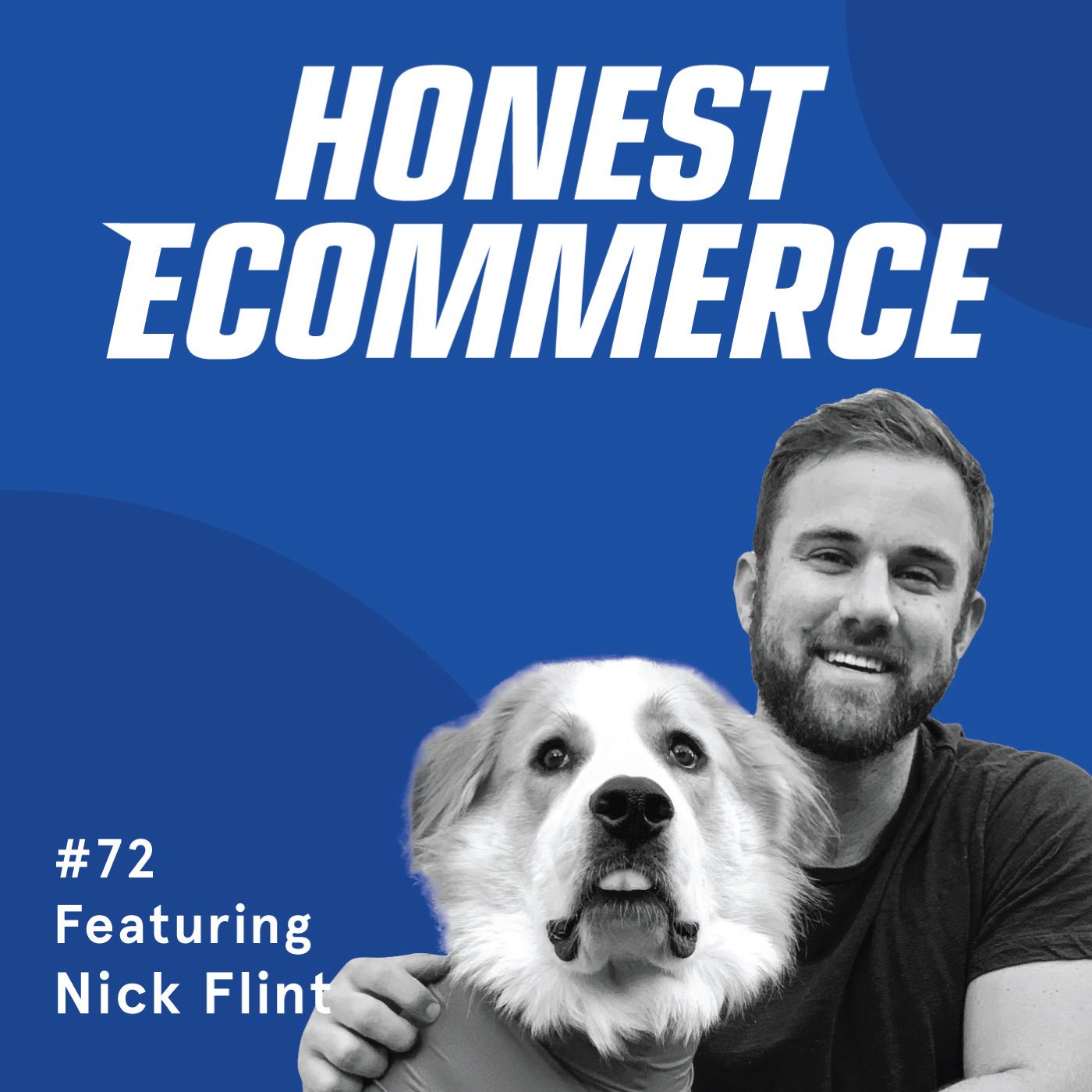
Growing Cocaine Fitness from $12K to $250K in 2 Years | Nick Flint
From $200 a Month to $250,000 a Year: How Nick Flint Bought and Scaled Cocaine Fitness
Nick Flint bought a supplement brand called Cocaine Fitness for $3,000 when it was generating roughly $200 a month in sales. Two years later, the business crossed $250,000 in annual revenue. That trajectory, from around $12,000 to a quarter million, came not from a big funding round or a viral moment, but from a disciplined stack of cheap and free tactics applied consistently from day one.
How to Buy a Small Brand Without a Broker
The acquisition itself was informal. Nick had been running a supplement sample subscription box during college and came across Cocaine Preworkout as one of the products he was featuring. He reached out to the founder to ask about sourcing and formulas. The owner mentioned he had just taken a full-time job and wanted out. Two Venmo payments of $1,500 each covered the purchase price, which included remaining inventory, the website, and all social media accounts. The transition took about a month of back-and-forth to transfer passwords, payment accounts, and email credentials.
Nick financed the ongoing operating costs using a Chase Ink business card with an $8,000 limit and 18 months of zero-percent interest. That runway gave him time to generate revenue before carrying any interest expense. The deal was only possible because the seller was motivated to exit, not because the business was listed anywhere. Anyone hoping to replicate this through a marketplace or brokerage will likely pay more, but those routes do offer verified financials, which matters when you cannot rely on a personal relationship with the seller — a dynamic Jon-Mark Craddock describes from his own experience buying La Matera with an SBA loan.
Cheap Packaging Tactics That Build Real Brand Equity
One of Nick's earliest decisions was to avoid custom-printed boxes, which ran about $3 per unit at quantities of 500 to 1,000. Instead, he buys blank boxes for around $0.50 each and uses a rubber stamp from Rubberstamper.com, which cost roughly $20, along with a $10 ink pad. The stamp changes seasonally, so a January order might read something like "Have a great start to the New Year." The result looks intentional and personal rather than generic.
Inside each box he adds tissue paper, custom stickers with original designs rather than just a logo, and a handwritten thank-you card. Those four additions generate consistent Instagram Story reposts and direct messages from customers. The cost is minimal. The retention impact is not. Nick still handles fulfillment himself rather than outsourcing to a pick-and-pack warehouse, because at early-stage revenue levels, founders have more time than money, and no third party will handle orders with the same care. Automating this personal touch at scale is something David Wachs covers in his episode on using Handwrytten to send automated handwritten notes.
The Shopify App Stack for Stores Under $30K a Month
Nick runs on Shopify and has built a lean app stack that avoids the trap of accumulating $600 to $1,000 a month in subscription fees before the store can support them. The apps he recommends at the early stage include:
- Grapevine for post-purchase surveys. This can be used to ask how customers found the store, what flavors they want to see next, or simply to add a human touch with a question like "What is your favorite cheat meal."
- Justuno for pop-ups and email capture. Nick's biggest early regret was not collecting emails from day one.
- Klaviyo for email marketing and SMS flows. Not free, starting around $50 a month, but he describes it as printing money once the automations and segmentation are running properly.
- Bold for upsells and cross-sells at the cart and checkout stages. A customer buying a preworkout might be offered a BCAA add-on, and at checkout, a shirt at half price.
- PushOwl for browser push notifications, which is free to start and delivers open rates above his email average of 20 to 30 percent.
- Tidio for live chat, because a customer with a question in the moment is more likely to buy if they get an immediate answer rather than waiting on an email reply.
- Multiple payment options including PayPal, Sezzle, Afterpay, Amazon Pay, and Stripe, because reducing checkout friction, especially on mobile, directly reduces abandoned purchases.
He also uses PostPilot to send physical postcards to past customers. At $0.50 to $0.75 per card, it is not free, but a Christmas campaign featuring his dog alongside the products and a discount code on the back drove measurable response. He imports a customer list, designs the card inside the platform, and PostPilot handles printing and mailing.
Email Segmentation Strategies That Actually Drive Revenue
Nick's approach to Klaviyo goes beyond basic welcome and abandoned cart flows. He segments by behavior to match the message to where a customer actually is. A subscriber who has opened five emails but never purchased gets a substantial first-order discount. That discount does not go to the full list because existing customers are already paying full price. Separately, he sends product development surveys only to customers who have placed five or more orders, because those people understand the brand and give useful feedback.
The principle is that the same email sent to every subscriber is a missed opportunity. The more narrowly the segment matches the customer's situation, the higher the open rate and the more relevant the offer.
Content Repurposing and Social Media on a Tight Budget
Nick shoots YouTube content in single day-long sessions with a videographer, producing one 10 to 15 minute video. From that footage he pulls two to three short clips for Instagram and extracts still photos as well. A single production day generates several weeks of content across platforms. He plans each week with a simple calendar template, targeting four Instagram posts, two Facebook posts, one content email, and one promotional email, spread across the week.
He posts manually rather than scheduling in advance, partly because being in the app means he is also responding to comments and direct messages in real time. The bigger point he makes about content is that most founders post something once and move on, when in reality only a small fraction of followers see any given post. Recycling strong content, with slight variation each time, is not repetitive to most of your audience. It is the only way they will ever see it.
Building a Personal Brand Alongside the Product Brand
Nick acknowledges that for the first year and a half he posted product shots with no personality behind them. The shift to putting himself in the content, sending emails from his personal address at the brand domain, and showing behind-the-scenes moments changed how customers related to the business. People follow people. They stop scrolling on a face in a way they do not on a product photo. The founders whose brands grow fastest are usually the ones treating themselves as the brand's primary spokesperson and content creator.
Key Lessons From This Episode
- Buying a distressed brand informally can be a legitimate path to ownership, but it requires trust on both sides and a motivated seller who simply wants out.
- Rubber stamps, tissue paper, stickers, and handwritten thank-you cards cost almost nothing and produce a packaging experience that generates organic social content from customers.
- Keep your Shopify app costs low in the early stage. Start with free or near-free tools that solve real problems before layering on expensive platforms.
- Email segmentation by behavior, not just by list membership, produces better open rates and more relevant offers. Winback discounts should go to non-buyers, not your full list.
- One piece of video content can produce weeks of social posts, clips, and photos. Post the same strong content more than once because most of your audience never saw it the first time.
- Founders who put their own face and personality into their brand marketing consistently outperform those who stay behind the product.
Hear the full conversation and read the complete transcript below.
Resources:
- Nick’s Instagram profile: @nickflintness
- Nick’s YouTube Channel: Nick Flintness
- Nick’s Tiktok: @nickflintness
- Pure Cut Supps website: purecutsupps.com
- Visit gorgias.grsm.io/honest to get your second month free.
Nick Flint
No one's gonna care for your customers and care for your products as much as you are. When you're starting up, usually, you have more time than money
Chase Clymer
Welcome to Honest Ecommerce, where we're dedicated to cutting through the BS and finding actionable advice for online store owners.
I'm your host Chase Clymer, and I believe running an online business does not have to be complicated or a guessing game.
If you're struggling with scaling your sales, Electric Eye is here to help. To apply to work with us visit electriceye.io/connect to learn more. Now let's get on with the show.
Hey, everybody, welcome back to another episode of Honest Ecommerce. I'm your host, Chase Clymer.
And today we welcome to the show --This is probably going to be the best podcast start we put out so far and we'll get into that in a minute-- but Nick Flint. Welcome to the show, Nick. How are you doing?
Nick Flint
Great. How are you doing, man?
Chase Clymer
I'm doing fantastic. So I'm sure no one knows what your name is. And I apologize for being --I don't know the right term there-- an asshole maybe.
But (laughs) you come from... Let's not tell them the brand. Let's just tell them the story and then we'll tell the brand. How does that sound?
Nick Flint
Yeah. Let's just jump right into it, man.
Chase Clymer
Yeah. When you reached out, it was very unique. And I actually liked the approach. So you're going on 3 years or so. Is that right?
Nick Flint
Oh yeah. So [I've been] owning his company for about 2 and a half years, and starting 2020, it officially became my full-time job.
Chase Clymer
Awesome. Awesome. So let's talk about [that] So, you bought this business. That's something unique that a lot of our listeners don't really do.
Most of them are...They're building it themselves. So you actually bought this?
Nick Flint
Yeah. I add an extra year and a half at the end for a little bit extra fun. And during my time at USF, I bought a startup, a subscription box company.
There are a lot of different supplement companies out there. Different pre-workouts, proteins, things like that. And the hard thing to do is to commit to a tub before trying it out.
So maybe, we can find a way to get samples out to people and customize them, and then get them to come back and buy through us.
So we had that business for about 2 years. It was not the best business model. We weren't making any money off of it. We got to maybe 200 subscribers, but we're charging $10 a month.
So, one of the companies we actually worked with was called Cocaine Fitness. And he sells Cocaine Preworkout. It was one of the better products I tried. So I reached out to the guy, who's based out of Washington State.
And I was like, "Hey. So where do you get your products made? What do you think of the formulas?" Things like that. Picking his brain.
And he was nice enough to give me all the info. And in the end he's like, "Hey. By the way, I just got a full-time job. I don't really want to do this anymore. If you want to buy up my inventory and take over, go for it."
Chase Clymer
That's awesome. So obviously, we got to say that it's just the name of the brand. It's not actually cocaine.
Nick Flint
Correct.
Chase Clymer
Because I feel like that'd be a little more expensive.
Nick Flint
Yeah. (laughs) A lot more expensive. (laughs)
Chase Clymer
Awesome. Awesome. How was the process of buying a fledgling brand?
Nick Flint
Yeah. So the price I paid was $3000. And that was for the leftover tubs he had for the website, for social media. He just wants to be done with it, because he was doing $200 a month in sales. It wasn't really worth him.
He's probably spending more just to host a website and everything, than what he was bringing in.
So I sent him 2 Venmo payments of $1500 each time (laughs). He shipped down all the products to me. And just about a week to a month of us going back and forth with transitioning.
Taking his cards and his email off of everything and transferring passwords to myself. It's a pretty smooth process. There's definitely some trust involved on both ends. Transfer all the emails, transfer the Venmo to my own name, my own car, things like that.
Chase Clymer
Awesome. Awesome. Awesome. So all right, it's been a couple of months. You've now got access to this website and you own this brand. So you [already] had some experience running a brand before that.
Nick Flint
It was all my own. I funded it with my own account. I had a decent amount of savings built up just from working in college. So that's where that $3000 came from.
And then to fund the rest of it, the general ongoings. I use a Chase Ink Card. There's an $8,000 limit, I believe and then 18 months of 0% interest, which was pretty good to help start things.
Chase Clymer
Absolutely. Yeah. Sometimes you gotta take a risk on yourself. That's not financial advice. But if that's the path you gotta take, there's a lot of options to finance these things.
Nick Flint
Yeah. Definitely.
Chase Clymer
I just think it's crazy. I bet you a lot of our listeners are gonna be like, "Whoa! You bought an established brand for $3,000."
One, they might be thinking that's a steal. But then two, some might be like, "Oh wait, like how do I spend $3,000 to get started buying a brand like what you have?"
And I guess what I want to actually get at here is that probably no one else is going to be able to find a deal like you found, mostly just because you got lucky and you found someone that wanted to sell and they were on their way out.
I think anyone that's like out there advertising a $3,000 brand might be... I see it all the time online where people are like $3,000 for... We've already found your niche, we made you a Shopify store, blah, blah, blah. I would probably argue to stay away from stuff like that. Would you agree?
Nick Flint
Yeah. There are different brokerage sites out there for people selling their businesses and they'll probably cost more than $3,000. For the same time, remember this guy was doing $200 a month.
So he's maybe even breaking even or losing money on it. So he's just wanting to get out. But if you can find one of those websites, like a brokerage to sell your business on, offer you their financial history, so you can look at it yourself. But it is hard to find, yeah.
Chase Clymer
Yeah. If you're going through a brokerage --and we've had some guests on here talking about brokerages before,-- that's like a way more legit route. It's just I, personally, myself have been targeted by some subpar ads that speak to $1,000, $500... Hell, it's been down to $25.
Nick Flint
(laughs)
Chase Clymer
Like "We'll get you a Shopify store with products that's ready to go." That is not the route to go. Which moves into our next topic of you need to know a little about a lot to get stuff started, don't you think?
Nick Flint
Yeah. The way I word it for being an entrepreneur/business owner, you basically have to be like 75% good at everything. You should be decent at financing, marketing, building a website, doing design, things like that.
And then eventually you're gonna hire people who are way better than you at that specific area. But you have to be very broad in general with your skillset.
Chase Clymer
Absolutely. So let's talk about... This is the hook that got me here. It's that you over the last 2 years, you've taken this business now from $200 a month. And now what are you guys averaging?
Nick Flint
$20,000-$ 30,000 a month last year. We did over $250,000.
Chase Clymer
Awesome. So you took it from roughly $12,000 to a quarter million in 2 years. That's some great trajectory. Everyone's gonna be asking in the comments how did you do it, if I didn't ask. So how did you do it?
Nick Flint
Yeah. So, we were starting up. One of the hardest things is you're strapped for cash. So I would recommend everyone get your pens and pencils out, get some paper ready because I have a lot of different ways that you can either have a super cheap way to help your business or for free.
Chase Clymer
All right, I got my pencil. Let's go.
Nick Flint
Alright. Perfect. So we'll start off with just something simple like packaging up your orders. I buy blank boxes. I was originally doing it on Amazon for a little less than $0.50 a box.
I found a local company that could do it a little bit cheaper, but you can get them off Amazon. You can get as low as 0.25$ at a time. And instead of having a custom printed box, I bought a rubber stamper and I still do. Rubberstamper.com, I think, is the site. And I have ink pads.
So for $20, I'm customizing each box and you think it looks very professional.
Chase Clymer
Awesome. So what's the savings on that compared to getting a custom made box?
Nick Flint
So the custom full print ones were about $3 a box. It was the cheapest I could find at least for a 500 to 1000 quantities.
And here I'm buying a $0.50 box and all it takes is my time to stamp it. The stamp costs like $20. An ink pad costs maybe $10.
Chase Clymer
Yeah. So you're upping your unboxing. You're building a little bit of brand equity into that. If it looks just a little bit better, if it seems like the effort is a little bit better, it's the perceived value along with it.
So, it's just a combination of little things like that, that really helped grow it. Alright, so you're making sexy boxes. What else can I do?
Nick Flint
So even more for the unpackaging. Some other cheap things. Tissue paper is a good one. Just give them a little bit more touch and feel when they open it. You can get some custom-made stickers.
And then for these, I don't recommend just putting your brand on there or your logo. I like to give them some really neat and cool designs for them. So it's not just "Hey. Here, put my logo on all your stuff." They want something cool. They want to rep. Some are asking about it (the custom brand stickers). If they do, that's awesome.
And the last thing I also throw in those boxes is just thank you cards. Handwritten thank you cards. It's one of the best things you can do. I get so many emails and responses in DMS about this.
People love putting up on their Instagram Stories and tagging us. So adding those 4 things is gonna make your unboxing experience way better.
Chase Clymer
Yeah, that's amazing advice right there. I think that a lot of brands want to scale in an almost backward way. That's the part of it that they don't like.
The part that they like is the marketing or the... Honestly, it's the sales that gets them interested in it.
But I love your approach here. Like "I got to upgrade my unboxing, and my product, and my experience, to help retain these customers." And now are you still doing that to this day?
Nick Flint
Yeah. Still to this day. And [we] switch [it] up monthly or bi-monthly, whatever it might be. So the stamp for January this year was "Have a great year!" or "Have a good start to the New Year!" kind of thing. And so it's extra customized then.
Chase Clymer
Yeah. That's awesome. And so I think what I was getting out a little bit earlier was people are... That's the first thing that they're looking to outsource.
They try to find a vendor that will do that for them, i.e. like a pick and pack fulfillment warehouse, because they don't like doing that stuff. And I would argue that you keeping that in-house has helped grow the business.
Nick Flint
Yeah. No one's gonna care for your customers and care for your products as much as you are. When you're starting up, usually, you have more time than money.
Chase Clymer
That is 100% true. Alright, so beyond packaging, what are some other ways that we can grow the business for free or cheap?
Nick Flint
Here are some of the Apps I use. I use Shopify, so I'll just run through a list of some of the cheap and free ones that I use on Shopify.
One good one is called Grapevine. It's a post-purchase survey. So, after they completed the order on your website, it gives them an option. And you can customize this.
You can say, "Where did you find out about us?" And then I put up one last month just for fun saying "What's your favorite cheat meal?" I had pizza, hamburgers, things like that. So just a little bit more customer experience.
You can either use it to get knowledge like what source did they come from, what flavors they want to see in the future, or just make it fun like "Tell us your favorite joke." because there's the option.
On your website, you definitely need to be using something for pop-ups. That's one thing I regret In the beginning. I wasn't collecting emails and information from my customers.
So now I use Justuno Pop-Ups for that. Small monthly fee but you're collecting all this data and this potential, and customers for the future.
Klaviyo. I believe any Ecommerce person will recommend that platform to you. This one is not cheap or free. The lowest cost is around $50 a month, I think. But it prints money once you get things up and running on it.
Chase Clymer
Yeah, I think if you've listened to more than 3 of these podcasts, Klaviyo comes up in all of them. (laughs)
Nick Flint
Yeah. And the segmentation and flows, once you get a decent understanding of those, it's crazy what it can do for you.
Chase Clymer
Is there any other apps that you want to recommend?
Nick Flint
Yeah. You should be using something to upsell people on your website or cross-sell. The one I use is called Bold. There's plenty of other ones out there, though.
So that's when they add a product to your cart, they'd throw something on top of it if they'd like. The end during checkout, they can throw in one last item to their cart if they'd like.
So, let's say you purchase a preworkout and my pop up is saying "Hey, do you want this BCAA too?" And then at checkout, I could say "Hey, how about we throw in a shirt for half-off for your order?"
Chase Clymer
Absolutely. You gotta try to get that customer when they're in that buying mindset.
Nick Flint
Yep. And then the last few I'll run through. PushOwl is a new one I started using. So the small notifications you see when it pops up.
When you go to our browser and [we ask for] notification from a website, that's called PushOwl. It's free. People opt-in and then you can send it out as a campaign.
I also recommend using as many payment process[ors] to make it easy for your customer. People have different ways of paying for things.
Some people want to do a payment plan with some like Sezzle or Afterpay. Some people want to use Amazon Pay, some people prefer PayPal, some people just want to put in their credit card via Stripe.
You don't need 100 payment processors. But maybe 3 to 4different ones through Shopify. Just give your customer options.
Because, say I only have a PayPal account and I don't want to put in my credit card number on your website, just give them that option. So the less friction at checkout, the better for you.
Chase Clymer
Yeah. And you got to think that a majority of these people are shopping on their cell phone and the Google Pays, the Apple Pays, the Amazon Pays, the PayPals, they got those one-click checkouts that make it easier for me on my phone to buy this thing when it's top of mind.
Whereas pulling out my credit card in public, I might be doing something like That sounds like [something] that I don't want to do. And you might have accidentally just lost sale.
Nick Flint
Yeah. And the last one I'll say is you should have --last two, actually-- would be you need some way to collect these reviews on your website because people look at reviews when they're making a purchase.
Again, there's a lot of different apps for this. A nice, easy, free, simple one is the Shopify Reviews option. And the last one you should have is some way for customers to directly chat with you.
Give them an instant chat option because if they have a question right then, they don't want to have to submit an email [and] wait for a response. They want that quick response and that could be the difference between getting a sale or not.
Nick Flint
And what was it? What was that app again?
Chase Clymer
The app is called Tidio. But again, there's a lot out there.
Chase Clymer
Absolutely. Yeah. That's a fantastic list of applications to use on the cheap side. I feel like... And I'll probably apologize for this, too.
I often recommend the best software or solution for things, which is usually when you're past that scaling momentum of getting... There's a big difference between a store doing $1,000 a month and a store doing $10,000 - $20,000 a month.
There's a completely big difference there. So I really appreciate you sharing with me some of the more budget-friendly apps that still solve these problems in a great way.
Nick Flint
Yeah. Because if you're not careful, the cost of apps will add up pretty quickly. Because Shopify, it says it's an all-inclusive platform, but there's a lot of functionalities that the Basic Shopify plan doesn't get for you.
So you start adding an app or two, and eventually, you're spending $600 or $1000 a month. So just starting off with something nice, easy, free ones is a great way to get things going.
Chase Clymer
Yeah. I think that's just the power of Shopify. It's marketing that it's going to solve all this stuff for you. And Shopify sells stuff online very well. Everything else, every other feature or function is usually a third-party app or some custom development.
Nick Flint
Ala carte and you're paying for it. (laughs)
Chase Clymer
Yes. Absolutely. So let's transition a bit from the secret sauce of the tools which obviously, tools can only help. They're not going to get you sales.
What were some of the tactics that you were using on the marketing front to help bring a new business or retain old business?
Nick Flint
Social media is always big for me. I mostly focus on Instagram. I prefer that over Facebook, just because I feel like I get more of an organic reach.
A few good tips for managing your social media marketing would be you want to have a decent balance over those platforms.
I know I said that I prefer Instagram over Facebook, but I'll still make Facebook posts because some of my customers don't use Instagram. They just follow us on Facebook. So finding a way to balance different platforms.
What I actually do each week is I'll lay out a little bit of a calendar template. I'll say I want to make at least 4 Instagram posts this week, 2 Facebook's, a content email, a sale email. And I'll look at my week and see where I can fit each of those in. So it's nicely spread out over that week across different platforms.
Chase Clymer
Now, are you using any sort of software to schedule this stuff out and maintain it?
Nick Flint
I don't, actually. Yeah, I've been looking into it, but I still just post myself each day. I'll click on my insights on Instagram, see what's gonna be most active for that day, and then do the post myself because also, it's a good way for me to hop on and respond to comments, respond to DMS, things like that.
So I feel like if I was scheduling these out in advance, I wouldn't be hopping on Instagram myself as much so I wouldn't be replying to people.
Chase Clymer
Yeah. It's definitely a double-edged sword. It's just we personally, here, we use Buffer to schedule things out through all of the different platforms that we are pushing out this podcast, Honest Ecommerce.
But actually more recently, we've been using Buffer and a tool called Bulk.ly. And with Bulk.ly, you can upload .CSVs of your content, what you want to say, into Bulk.ly and then you can use that to push it towards the platform.
So essentially, with a .CSV, you can knock this stuff out way faster, and you've got all your old content you can implement into a .CSV. So, you can essentially schedule out month's worth of content within a matter of a half-hour.
Nick Flint
And that was Buffer and Bulk.ly were the two you mentioned?
Chase Clymer
Yeah. So we used Hootsuite for a while and then Buffer. Honestly, it's a way better deal. I want to say we're paying around $12 a month, but we might actually need to upgrade.
because if anyone listening has noticed, we now have an Instagram that has no followers and the Twitter is about to start getting rolling again. We've moved the agency away from Honest Ecommerce, they have 2 different goals.
So now we have double the socials. Really fun. But yeah. So, Buffer is the one that we use. That's the scheduling software that integrates with all of the platforms out there, the LinkedIns, the Facebook's, and all that jazz.
And then Bulk.ly is the one that integrates with Buffer. It only works with Buffer, but it gives you the capability of uploading .CSVs. to essentially just bulk automate this stuff, you can set it to drip out this stuff over time.
So if you've got a backlog of content, you just spend the time to make a .CSV. So we're talking about a spreadsheet here.
You can do some Google Sheets. If you spend the time to do that, you can drip that stuff out daily, or hourly, or whatever cadence that you want over time. You can automate it and you can recycle that stuff, which is amazing.
Nick Flint
Yeah, it's very helpful when you can get multiple pieces of content out of one original piece. I started up my YouTube this year. So, we'll get together with my videographer, we'll film for a day, get about a 10 to 15-minute clip.
And then from that, I'm pulling 2 to 3, 20 - 30-second clips to posts on Instagram throughout the week and even some photos, too. So if you take one piece of content, do the work on that, and then repurpose it a few times. It's just more bang for your buck.
Chase Clymer
Absolutely. And then I think the one thing that most people miss here... And this is key. I will even admit that we were bad at doing this for a while, is you'll spend all the time producing that cool piece of content, [then] you'll post it once.
Nick Flint
Yep. (laughs)
Chase Clymer
Literally a third... Not a third. Great if a third of the people saw the content. That'd be amazing. No. Do you know who's actually seeing it? Maybe like 3% of the people. You need to be posting that stuff more than once. You need to keep recycling it if it's good content.
People aren't going to care that you're posting multiple times. So, the thing about content marketing, it's like the first part is producing the content. And then the second part is you still got to market that stuff so you need to put it out there.
So yeah. Posting it once, like one and done, is just a waste of that content. You should be reposting it a couple more times to try to get more eyes on it.
Especially if you think about it, if you're doing your job the right way with producing this content for whatever brand, you're gonna have new people that are in the funnel and they wouldn't have seen any of that old stuff. So when you're posting that, they're actually excited about it.
Gorgias Ad
Let's be honest today. All of your customers are going to have questions.
What are you doing to manage all those questions? Do you have a help desk for your business?
One of our sponsors of today's episode is Gorgias. Gorgias is the #1 rated help desk for Ecommerce. It integrates seamlessly with Shopify. We have installed it in a bunch of stores. It's also used by brands like MVMT and Rothy's.
What it does is it takes all of your customer insights and information, brings it into one amazing dashboard so you can solve their problem as quickly as possible. If you want to give Gorgias a try, visit gorgias.link/honest to get your second month free.
Nick Flint
Yeah. And again, you can find different ways to drive them to that original piece. So, let's say it's a 10-minute video about me talking about the diet I follow. I can post a little snippet of that from the video, I can post a picture of a meal 2 days later, I can post a picture of me working out, and mention it in the caption.
So, just finding different small ways to drive that original piece you spent so much time on. Just because people are seeing the same thing twice, you're not showing the exact same picture or header. So again, a little bit of variation there.
Chase Clymer
Absolutely. So let's move on a bit from the social stuff. I think we both learned some cool stuff out of that. What else are you doing?
Nick Flint
Yeah. So let's talk about some ways that they can learn for free. Because the biggest part of starting out is learning what you should be doing and how you should be doing it. So, here are some of the sources that I still use this day to learn. One of them is Facebook Groups.
It's great because there are a few different ones out there some focus on marketing, some focus on WooCommerce, some focus on social media strategies for Ecommerce. So just kind of pop onto that Facebook page and go to the search bar, type in a few keywords that you're interested in.
It could be Ecommerce, could be email marketing, could be social media growth, and just hop into a few of those Facebook groups and then be consistent in them, read the posts, respond to them.
That's a great way to learn because there's a huge spread of people in there. A lot are just starting out and some are more advanced and they're giving you advice. So take that free advice from those Facebook groups.
Chase Clymer
Absolutely. I think that's usually a way that people are shooting themselves in their own foot. They will attempt to hire somebody before they even understand it. It's a good way to get scammed. Or just not scammed per se, but maybe something 1 or 2 degrees off from that. It's not a good value. When you understand what you're hiring for, then you can understand what the expectation should be.
Nick Flint
So, when you've done it yourself in the past, you have some expectations in reality. So let's say email marketing, for example. Say I hire an agency. I'm a new company, I hire an agency, and they're not getting me $10,000 a month in sales.
And then as the person who hired them, I might be upset over that because I've set that unrealistic expectation in my head. Versus if I've been doing email marketing myself, and I got decent at it. I started getting some traction, I know what results I can expect, and then transfer that over to the agency when I feel it's an appropriate time.
Chase Clymer
Yeah. And then you're just like "Well, this is what I can do." And then you also need to think about "Also, my time being involved in that particular thing." (laughs)
I think people often overlook the opportunity cost of them doing an action versus having someone else do an action. So, you gotta always weigh that in with hiring either a contractor or an outsourcer or an agency or consultant, whatever.
You always need to weigh that in like, is your time best served doing that task? Or can someone get you pretty close and your time can be spent elsewhere doing something that's going to help benefit something that you're objectively better at?
Nick Flint
Yeah, a good way to put it is are you doing $10 an hour work? Or are you doing $100 an hour work for your company?
Chase Clymer
I would say $1,000 an hour is what a CEO should be doing.
Nick Flint
Exactly. Yeah. So, some other ways that you can learn. Klaviyo, the platform I mentioned earlier for email marketing, they have a pretty cool series called Ready, Set, Grow. [They are] video segments that will focus on one company for about 2 to 3 segments in about 5 minutes each.
And you're seeing what companies are doing in general and also with email marketing, and how you can implement that in your own company. And what's interesting is they're well-known brands, so you can go check out their website and you can go watch them talk about how they built that platform.
Chase Clymer
Oh absolutely. And then Klaviyo has also got an amazing tutorial base on their website, as well. You should be able to learn a lot about Klaviyo just from their website.
The one thing that I'd be like they don't do a good job of explaining is the thought process behind the tactics or strategies within what you're writing there.
And a book I would recommend to learn a bit more about email marketing, surprisingly enough, is from Russel Brunson, the guy behind ClickFunnels. He is a psychopath when it comes to marketing.
Nick Flint
(laughs)
Chase Clymer
But DotCom Secrets does a good job of explaining how to write emails that your customers will probably find valuable.
Nick Flint
One of the first courses I ever paid for an email marketing course. It was recommended by a few other owners. And after that, I'm looking at my segments way differently now. I definitely wasn't doing enough segmentation at the beginning.
So for example, Klaviyo let you break it down. So, someone who has received 10 emails, opened 5 and never made a purchase. So they're obviously very interested in your brand. But why haven't they made that purchase? So, you can break off that segment, and even send them a hefty discount for the first order.
You don't want to send it out to all your customers because they're already paying, basically, the regular price. But to get that first few customers in the door, you can send out a discount to that segment.
Or another one I do is I even consult some of my repeat customers for ideas for the company. So last night, I sent out an email to customers who were placed over 5 orders with us saying "Out of these four flavors, which one would you like to see next?"
Because I value their opinion, because they've been customers for a long time. They understand the brand. So you won't be sending the same email to your whole email list. You want to break that down. And I've definitely started doing that a lot deeper recently.
Chase Clymer
Oh yeah. Any sort of segmentation. Obviously, you set up the automations to really hit people where they're at in their customer journey. But when you can get more granular than that, your customers will appreciate those emails more and they'll respond.
Your open rates are higher. Everything is better. Have you been playing around with any of the more modern marketing tactics. Obviously, you're using push notifications. How has that been working out for you?
Nick Flint
I started building up a list a few months ago. I'm up to about 200. I'm getting better on that. Better than my email open rate, which is about 20% to 30%. on a regular basis.
Chase Clymer
Have you been looking into SMS? I know SMS is huge these days.
Chase Clymer
I use... I believe it was called Textedly or something like that, to send out the text messages. But I just started transferring that over to Klaviyo because they offer an option tto build that into your flows.
So what you can do is when they make a purchase through your website, it can send them an email saying "Thank you for your order." And then 2 days later, it can send them a text. So just different ways to hit them. So I am using it. I'm transferring it over at the moment. But again, I'm getting pretty good open rates with that.
One nice thing is your open rate isn't affected by the other users. So for email, if you send out an email and no one opens it that makes your deliverability go down in your emails, because they got less people.
But that's not the case with SMS. So you can blast out an SMS. If people unsubscribe, it won't hurt you. And then also start using something called PostPilot, as well, to send out postcards to customers.
Chase Clymer
Ooh. Tell me more about that.
Nick Flint
This isn't a cheap or free one. It's about $0.50 to $0.75 per card. I did my first campaign back in Christmas. I sent out a fun Christmas card, me and my dog with some products, and threw a discount code on the back.
And it's cool because you import a list, --so about 2000 customers or whatever it may be-- you design a postcard, and it'll go ahead and print it and send to each one. So it's a really easy and quick process.
Chase Clymer
Yeah, that's pretty cool. I'm gonna probably pitch that to some of our clients this week, just as a fun project to do. (laughs)
Nick Flint
Have you ever heard of Drew Sanocki with Nerd Marketing?
Chase Clymer
I have not. Oh, I've heard Nerd Marketing.
Nick Flint
Okay. So, he's the owner of that. He actually bought PostPilot and took it over a few months ago.
Chase Clymer
Absolutely. Now, are there any other tactics that you're using to help scale this business? The growth. You're at 10X to 12X growth [in] over 2 years. That's nothing to shake a stick at. So what else were you doing?
Nick Flint
Customer service is a huge part of it. The golden rule back to elementary school, "Treat others how you would like to be treated." So whenever I'm talking to a customer via email, or even on the messaging on the website, my little trick in my head is... Do you know the show, Undercover Boss?
Chase Clymer
Yep.
Nick Flint
I always pretend like that it's an undercover boss trying to trick me somehow [as] this customer.
So someone says "Hey, I didn't get this with my order?" I try to think of it. If that was my boss, how would I respond to them? So I go above and beyond for every customer. And I'm also as fast as possible when responding.
Because again, your response time, it matters to these customers. It's easy to look at them as a whole, just your customer base. But they're individual people behind these purchases and behind [their] actions.
They took the time to send you an email, so as fast as you can respond is always better.
And then another thing I'll do for my website, my emails, everywhere I react to my customers has always tried to be personal with it and throw in a little humor, too.
There's one quote. I remember it said, "No one ever remembers how professional you were. They remember your personality and what you brought to them [as] the brands."
Chase Clymer
Oh, absolutely. I think that you can be professional but you can also be personable at the same time. You don't need to be stiff.
Nick Flint
Exactly. Again, people are gonna remember these funny [things]. The punch you put in there. For example, I had a t-shirt launch. Instead of just posting pictures of the shirt, I put the shirt on my dog and I put that up saying "This is our new clothing. Come check it out." People loved it.
Chase Clymer
Absolutely. Now is there anything else that I forgot to ask you today that you think would be valuable to share?
Nick Flint
If you're younger, especially, just start to work right now doing anything. Any kind of part-time job. I know in high school and in college, I wasted way too much time doing nothing. You don't have to be diving into Ecommerce.
But as long as you have a job banking away money, you'll have that money on hand for whenever an opportunity does present itself in the future. And then on the other side of that, start tracking your expenses too just for your personal life.
Because if you can spend less money, it's a lot easier to make Ecommerce your full-time job when you're spending $2500 a month on your expenses versus spending $5000 a month. So definitely start to save up that money.
Live an easy, maybe, lifestyle. You don't need a brand new car. Buy one a few years old. You don't need the nicest house. If you could afford it, get something a little bit cheaper you can rent.
Chase Clymer
Yeah, I think that's often something that people overlook. Your lifestyle can change. But does it need to change when you're either starting out or when you have found a little bit of success?
Just think about how many career athletes you hear about that are broke when it's all said and done.
Nick Flint
Yeah, exactly. And then another thing you can do is start setting up a daily task list and schedule. I still do this every day. I use the BulletJournal for it. So every time I come to the office, I look from yesterday, what did I not get to? And that's the first priority.
And then start to look over what needs to be done today and write that out. Because it's easy to let days slip away from you, especially if you're working at the same time, a full-time job. In the afternoon, you might not remember the ideas you had in the morning.
So if you're writing all that down, you can assess how much progress you got that day. You're not just like "Oh yeah. I think I did a decent amount of work. I can go home." So I have a task list and set up that schedule for yourself.
Chase Clymer
I think that's great advice.
Nick Flint
And then the last bit of advice I'll drop on them would be to start building your personal brand, as well.
Because whatever you go to in the future, you'll [still have] some kind of following already. So, let's say you own a skateboard company today, and then you sell that. You're gonna go on to something else. You want to have that personal backing of your friends and followers behind you.
So definitely branch out onto different platforms. Start making posts on Instagram or Stories a little bit behind the scenes so people start to associate you with Ecommerce and business. Hop on TikTok, see how that goes. Start a YouTube channel.
Just build up that personal brand across these websites so you'll have a nice backing no matter whatever you end up going into.
Chase Clymer
Be a guest on a podcast, right?
Nick Flint
Exactly.
Chase Clymer
I think that's something that a lot of founders don't realize [that's] so important. People want to do business with people.
And the brands that are successful, their founders are the face and they're out there doing the marketing. They're out there doing the content. They're out there producing stuff for people to enjoy.
And if you take a look at the brands that aren't making it, you might not even know about them yet because there's no reason to know about it. Stuff doesn't happen overnight for no reason. There's a reason that this stuff happens.
And it's usually because of just the effort that's put in from the founder on the marketing side of things. Or maybe there's someone like in the leadership team that's super charismatic that's doing this stuff. People want to do business with people. And those businesses are the ones that are winning.
Nick Flint
Yeah. The first probably a year and a half, I definitely didn't do this well enough. I would post pictures of the tubs or things like that.
And now I'm incorporating a lot of my own personality into it. Like, I'll send an email from nick@purecutsupps.com. People will start to get to know me and they want to see me and the company succeed. And they're used to talking to someone instead of this nameless corporation.
Chase Clymer
Yeah, absolutely. It's insane because I feel like once people start shifting... Even if you're looking at your Instagram feed, if you just see a product, you're not going to stop. Bu] when you see a face, it's human psychology.
You'll stop on a face but you won't on something else. It's just wired into our lizard brains. So it even goes beyond that. You would rather hear a familiar face talk about something like a brand you're familiar with versus like a no-name.
Nick Flint
Yep.
Chase Clymer
Not even a no-name. More just like just a voice over a picture. Like that's not really that cool.
Nick Flint
Yeah, that's why these big brands hire famous actors and celebrities to come rep their products because [once] you see that face, you want that product.
Chase Clymer
Absolutely. And then, probably at this stage, you can't afford an influencer of that level. So just, unfortunately, you just became your biggest influencer for your product.
Nick Flint
Yeah, exactly.
Chase Clymer
Awesome. Nick, thank you so much for coming on the show today.
Nick Flint
Yeah, no problem. Thanks for having me.
Chase Clymer
You're welcome.
Chase Clymer
I cannot thank our guests enough for coming on the show and sharing their journey and knowledge with us today. We've got a lot to think about and potentially add to our businesses. Links and more information will be available in the show notes as well.
If anything in this podcast resonated with you and your business, feel free to reach out and learn more at electriceye.io/connect. Also, make sure you subscribe and leave an amazing review. Thank you!
Transcript
Read more
In this podcast, we talk about the rising traffic of online customers exceeding BFCM rates, the extreme importance of adjusting your fulfillment and messaging, and preparing your customer support t...
Paul Rajotte from Shoelace breaks down customer journey retargeting, why showing the same ad for 30-60 days destroys performance, and what 10,000 campaigns in 2019 taught his team about creative, a...