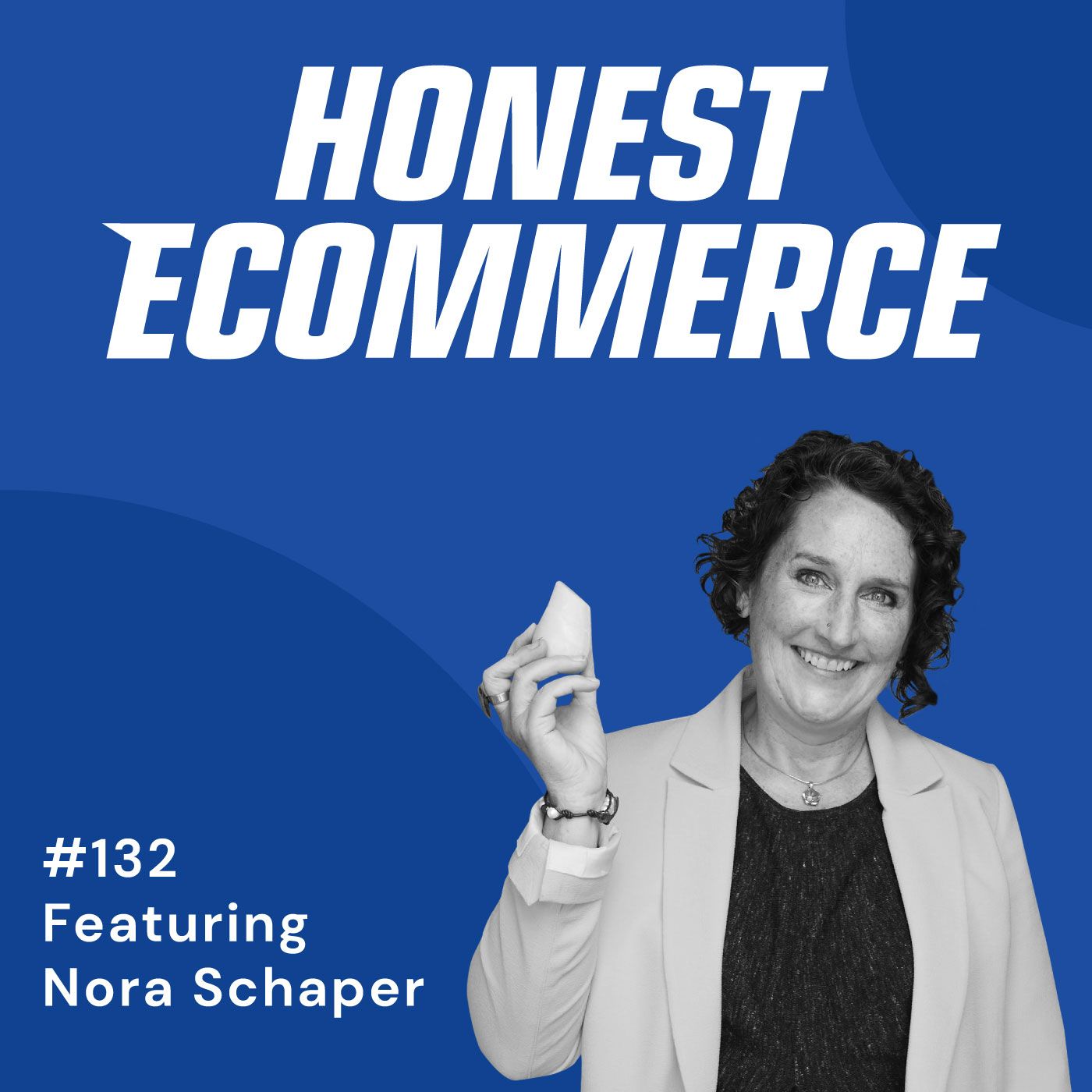
Nora Schaper
One of my favorite lessons learned is that: Experts may tell you no. But if you believe in your idea, it can happen.
Chase Clymer
Welcome to Honest Ecommerce, a podcast dedicated to cutting through the BS and finding actionable advice for online store owners. I'm your host, Chase Clymer. And I believe running a direct-to-consumer brand does not have to be complicated or a guessing game.
On this podcast, we interview founders and experts who are putting in the work and creating real results.
I also share my own insights from running our top Shopify consultancy, Electric Eye. We cut the fluff in favor of facts to help you grow your Ecommerce business.
Let's get on with the show.
Hey everybody, welcome back to another episode of Honest Ecommerce. I'm your host Chase Clymer. Today, welcome to the show a very special guest, Nora Schaper coming to us from HiBAR. How are you doing today?
Nora Schaper
I'm doing great. Thanks, Chase.
Chase Clymer
Well, I guess you're coming to us from Minneapolis. And you are the owner of HiBAR. So let's clarify a bit there.
Nora Schaper
(laughs) I am. Yep, we actually have a factory space in St. Paul. But all the founders are from Minnesota... Are from Minneapolis.
Chase Clymer
That's amazing. So for the people that are unfamiliar with the brand, can you give them a quick kind of synopsis on the products that you guys are bringing to market?
Nora Schaper
Absolutely. So HiBAR is the world's first salon quality, plastic-free shampoo and conditioner.
So we've eliminated water from our formulas, and we were able to package the product without a plastic bottle. So it's a concentrated shampoo and conditioner set that's a solid product.
Chase Clymer
That's extremely interesting, especially as a... For those listening, I guess you don't know what I look like anymore. I didn't cut my hair off on all of COVID. It is very, very long.
And I forgot how much maintenance my hair was.
Nora Schaper
(laughs)
Chase Clymer
So I'm curious to learn more about it. Maybe I'll get a sample after this and test it out for everybody.
Nora Schaper
Absolutely.
Chase Clymer
Awesome. Alright. So you... First of all, product innovation. That's an amazing thing. I just want to give you props there. That's really cool to me, just the technology behind that.
But you have been doing this not too long, compared to some of the other founders we have on the show. You officially launched back in October 2018.
But were you, I guess, in product development for 2 years? You got the conversation started in spring 2016.
Nora Schaper
Yes.
Chase Clymer
So you just want to take us back there and we can walk through it?
Nora Schaper
My husband's a serial entrepreneur --his name is Jay-- and I have benefited from that. So we had prior business before HiBAR. And it was a body care product.
We were making bath bombs and soaps. And we were selling them to the natural food market. So while we were doing this, we realized we were using all-natural ingredients and really simple formulas.
And we were like, "We can make really great products and we don't need to put it in a plastic bottle." So my husband and I were --Jay-- we're starting to figure out like "We can reformulate this stuff. And I think this is a big idea."
So we were starting to think that way. And then there's 4 co-founders of HiBAR. And we're all parents. We all had children at the same school and that was how we knew each other. So we knew each other through our children.
And Ward, who was our current CEO, he... I knew he had a previous business with HiBAR as well. It was a natural pet food business. And he had built it up and sold it. And I knew he had recently sold it. And I knew he was a successful businessman and entrepreneur.
So I tracked him down in the school parking lot after I found out he sold the business and I'm like, "Ward, would you consult with us and help Jay and I figure out... Get our business squared away." And he agreed. And he started working with us.
And we told him our big idea that we're gonna start formulating without the need for a plastic package. And he was like, "That's fantastic. Yeah, I want to be part of that." So the 3 of us, yeah, we were excited about it and talking.
And we went to a housewarming party of mutual friends, and our fourth co-founder, Dion, he had just returned from a trip to Mexico, and was at this house warming party. And he asked us what we were up to.
And we said "We're reformulating products without the plastic bottle and we're working with Ward. "And he said that he had just come back from Mexico at this remote beach. And they had... It was... The property line, he'd go out in the morning on the beach and they would have raked the property line.
But as soon as you hit the end of the property, it was just plastic as far as the eye could see. So he was devastated.
He came back from this trip and was taking a shower and looking in his shower thinking "Oh my god, I'm part of the problem." So when we saw him at the house warming party, and we told him that we were working on this, he just knew he had to be part of it as well.
So the 4 of us banded together and started thinking this through.
Chase Clymer
That's an amazing story. And I think that something that we don't talk about much on the show is finding co-founders. And what in... And how to.. how do I put this poetically?
How was that a co-founder? Are there any considerations for people out there that are thinking about getting started? Or maybe are thinking about co-founders things that they should keep in mind?
Nora Schaper
Well, one thing that I've really learned through running HiBAR is that having a mission-based company, and really knowing your "why". Everything goes through that "why" filter.
So when Jay and I came up with this idea and we're talking to Ward, I don't think Ward would have been interested if he wasn't into the mission too. And then that was totally true, again, for Dion.
We were all really passionate about this idea and this "doing something." So like I said at the beginning, we were all parents at the same school. So we all have children.
And we're looking at our current world thinking, "We need to do something about this. This is a really important thing". And so I think that having that mission to filter everything through is hugely helpful in almost every decision.
Chase Clymer
Oh absolutely. I think finding the "why" gives you clarity on the vision of the future that you want for your company.
And if you think about filling the seats on the bus, --if you know that analogy-- make sure you have the right people on your team. If you know where the bus is going, it's a lot easier to get the right people in the right seats.
Nora Schaper
It totally is. And another thing for me is having a prior business that I was working with, with my husband.
So our prior business, both of us had had outside jobs, as well as running this business because it didn't make enough money for both of us to be doing it all the time. But every time that one of us would, at temporary times, we had both of us.
And every time that happened, I thought, "Oh my god, we're getting so much more done." Having more than one person makes a huge difference. Trying to do everything yourself is really, really difficult. And that's entirely true with 4 people too.
So now we have 4 people. And we have a really great broad range of skill sets. Like I had said, Ward comes from, he'd built up a business and it was a manufacturing business. aAnd he knew how to manage people.
And he knew how to build benefits and how to bring in HR. And then Jay and I... Jay knew how to formulate products. And I knew how to sell products. And we were already in the natural market.
So I had some contacts and experience there. And then Dion, our fourth co-founder has a branding and marketing background. So the 4 of us are really an awesome team. As far as covering a lot of ground.
Chase Clymer
Yeah, I think when you are looking for a co-founder, you want someone that fills voids in your skill set. You want to be very complimentary. I have never...
I would love to be proven wrong here. But I've never met a successful company where both founders are really, really good at the exact same thing.
Nora Schaper
Right? Yeah. And we don't stand on... Step on each other's toes either. It's very clear that delineation of who's the decider on things, because it's not my skill set.
So we obviously all listen to input from the other but it's very clear on who's in charge and deciding on things.
Chase Clymer
Yeah, I think you need a very clear delineation of who is responsible for what things. That's something I learned early on with the agency: 2 people cannot be responsible for one thing because you assume the other person's doing it.
You're absolutely wrong on that assumption.
Nora Schaper
(laughs) One of the hard lessons...
Chase Clymer
(laughs) Yeah, I think it's establishing "swim lanes" --it's the business-y term-- is what you need to do.
Nora Schaper
Yeah. Exactly.
Sponsor: Electric Eye
If you're struggling with scaling your sales, maybe Electric Eye can help.
Our team has helped our clients generate millions of dollars in additional revenue through our unique brand scaling framework. You can learn more about our agency at electriceye.io. That's E-L-E-C-T-R-I-C-E-Y-E.io.
Sponsor: Mesa
Mesa is the easiest way to integrate any top Ecommerce app or service with your online store designed exclusively for the Shopify ecosystem. Yes, that includes Plus.
Mesa's automated workflows can get back your time spent on repetitive tasks while growing your business all at the same time.
Join other merchants that have embraced the simplicity of Mesa's no-code approach to building workflows.
You can create new ways to improve customer engagement. Encourage repeat purchases without lifting a finger, reduce manual data entry, and much more through a simple point-and-click interface.
And with Black Friday, Cyber Monday planning around the corner, now is the time to ask the question: Is my online store prepared?
Optimizing every step in the shopping experience is the only way to create a lifelong customer.
Get Mesa and capitalize on one of the biggest commerce events of the year. Visit get mesa.com/honest for a 14-day free trial. That's G-E-T-M-E-S-A.com/H-O-N-E-S-T.
Sponsor: Rewind
Our partner, Rewind, can protect your Shopify store with automated backups of your most important data.
Rewind should be the first app you install to protect your store against human error, misbehaving apps, or collaborators gone bad. It's like having your very own magic Undo button.
Trusted by over 80,000 businesses from side hustles to the biggest online retailers like Gymshark, Gatorade, and MVMT Watches.
Best of all, merchants like you can get 1 month of automated Shopify backups for free by visiting rewind.io/honest. That's R-E-W-I-N-D.I-O/H-O-N-E-S-T.
Sponsor: Gorgias
Hey everybody, do you want to win back valuable last time for your support team?
Gorgias has machine learning functionality that takes the pressure off small support teams, and gives them the tools to manage a large number of inquiries at scale, especially during the holiday season.
Gorgias combines all your different communication channels like email, SMS, social media, live chat, and even phone into 1 platform and gives you an organized view of all of your customer inquiries.
Their powerful functionality can save your support team hours per day and makes managing customer orders a breeze.
They have allowed online merchants to close tickets faster than ever with the help of pre-written responses integrated with customer data to increase the overall efficiency of customer support.
Their built-in automations also free up time for support agents to give better answers to complex product-related questions, providing next level support, which helps increase sales, brand loyalty, and recognition.
Eric Bandholz, the founder of Beardbrand says "We're a 7-figure business and we have, essentially, 1 person on customer support and experience. It's impossible to do it without tools like Gorgias to help us innovate."
Learn how to level up your customer support by speaking to their team here. Visit gorgias.grsm.io/honest. That's G-O-R-G-I-A-S.G-R-S-M.I-O/H-O-N-E-S-T
Sponsor: Klaviyo
Businesses are the most successful when they own their own data, customer relationships, and their growth. That's why more than 50,000 Ecommerce brands, big and small, trust Klaviyo to deliver their ideal customer experience.
Klaviyo is the ultimate ecommerce marketing platform for online brands of all kinds and all sizes with email automation, SMS marketing, lists growth tools, and more.
You'll get everything you need to build strong relationships that keep your customers coming back. If you're tired of relying too heavily on paid advertising or third party marketplaces for your sales success, you're not alone.
It's time to take back control of the customer experience. More and more online businesses are moving to Klaviyo to grow higher value customer relationships through personalized email and SMS marketing. And the results are staggering.
Ready to drive future sales and higher customer lifetime value with a marketing platform built for your long term growth? You should get a free trial of Klaviyo over at klaviyo.com/honest. That's K-L-A-V-I-Y-O.C-O-M/H-O-N-E-S-T
Chase Clymer
What was happening between spring when you guys first got together and ideated this, to October 2018 when you launched? What was happening?
Nora Schaper
Oh so much. So at that time... Well, one we had to develop a formula that had never been developed before. So like I started in the conversation with you, we're the world's first salon- quality shampoo and conditioner that's solid. So we really had no template to go to.
And this is where Jay, my husband, being a rule breaker and not being from the industry probably helped us out. But when we first did that, the formula was a big part of what took so long.
And we actually went out to experts, chemist experts. We're... Like you'd mentioned earlier, we're in Minneapolis. So Aveda and Horst is... That's in our backyard.
So we had a chemist, an Aveda/Horst chemist, who was one of the partners with Horst and he... And she said you can't do it. You can't make a salon quality product in a solid.
Chase Clymer
"Watch me."
Nora Schaper
And I think that... (laughs) That is exactly what Jay was like, "Oh yes we can." But that really took a long time. And it was going back to the drawing board a lot and testing a ton of different products.
So a ton of different iterations of the formulas until we really felt like we had something that was going to make it out there.
So being mission-based, again, we knew people are not going to give up a plastic bottle unless the product we make is more effective or as effective as what they're using currently. They can't have...
The dark green customers will give up great hair for a product, but the masses won't. And we need to achieve mass in order to achieve our mission. So we kept going back to the drawing board and coming up with a formula.
And finally, we hit on one that even the chemist who had said it won't work was like... [She] grudgingly said, "It worked. I liked it." So that was fantastic.
But that did take a long time. The name of the company took a long time. And the shape of the product... I'm not sure if you've seen the product, I'm looking for one around here, But the shape is very unique.
Chase Clymer
It is. It is.
Nora Schaper
And that took us a really long time. And this is where 4 partners is probably challenging, because we all come from leading businesses, and then we're trying to decide on one thing together.
But that also proved to be really great in the end, because you have all you really keep going until you get something that all four of you agree is the one to go with.
Chase Clymer
Yeah. So how many iterations of the formula did you go through?
Nora Schaper
Oh gosh. Well, 2 years worth. So I want to say a hundred.
Chase Clymer
Oh man.
Nora Schaper
And we'd get them out for testing. And then once we found a base formula we liked. We're like, "Okay, now we need to add on different formulas. So how are we going to do that? And will that work?"
That was our next challenge. "Are all the formulas gonna feel the same? Or are we able to cater them for different hair types." So then it was going back to the drawing board, because we knew we wanted to launch with at least 3 different formulas.
Chase Clymer
Okay. So you spent almost 2 years working on the formula and developing this product that didn't exist, which is awesome. You guys gotta go to the website. You just got to look at the actual bars.
Nora Schaper
(laughs).
Chase Clymer
I don't want to belittle it. I don't want to boil it down to soap, but it's like. It's here. It's shampoo and conditioner. But it's a fancy looking soap shape. It's very cool.
But so you do that. So what is... Now that you've got a product and you're ready to sell, how did you go to market? That's probably where a lot of our listeners are at right now. They've got an idea on a product.
Or they've got their product and they're just like, "Well, how do I get that first initial sale?"
Nora Schaper
Yeah. So we imagined when we launched that we were going to be a direct-to-consumer product. So we focused on our website and getting our website up and running.
And we also knew that we were asking people to change behavior. This is a product that's going to ask for a lot of changes. So we also thought about how... What training are we going to have to have ready and what collateral pieces to help people understand what this is.
So we really thought about those pieces. And when we launched, we just sent out an email to... Again, this is where 4 people help out. We sent it out to everybody we knew in our 4 letter community.
And was like, "Try this out, give us some reviews, tell your friends." So we really started that way. But what really helped was, again, my experience in the natural market. Being in Minneapolis and St. Paul, we've got co-ops all over this area.
It's a fantastic grounds for a natural, eco product. And so I started reaching out to my contacts at co-ops and saying, "Will you give this a try? Because I had previous relationships, I think the entry was a little easier than it would have been otherwise.
And so we started selling direct to a few co-ops and that started going really well. And we were balancing... When we launched it with almost all sales on our website, but as time went on, it was like 50-50 sales. And now our wholesale is actually outpacing our online sales.
Chase Clymer
That's amazing. And you guys launched...
Nora Schaper
October of...
Chase Clymer
...a little over 2 years ago.
Nora Schaper
Yeah.
Chase Clymer
So [on] what technology did you launch on? Are you guys on Shopify?
Nora Schaper
We're on Shopify. Yep.
Chase Clymer
Awesome. We're big fans of that over here. Where you start doesn't matter, eventually you're gonna end up on Shopify (laughs).
Nora Schaper
(laughs) Well, it really is an easy platform to work with and to grow on. And there's a lot of plugins and the commerce function of it works really well.
Chase Clymer
Absolutely. So after you reached out to your network and started building out some B2B with the wholesale opportunities, where did you find growth for the direct-to-consumer stuff? Where were you focusing your time or energy to acquire new customers? Or even before that, to just expose the brand to other people?
Nora Schaper
Well, honestly, social media. (laughs) We love social media. And we do... So it's mostly Instagram and Facebook. Now we're trying to expand beyond that, you know, we have a little bit of a Twitter presence.
And we're, of course, looking at Tiktok because a lot of action is happening on TikTok. But Facebook and Instagram, especially with a product that has a unique shape; It's a beautiful, sculptural, unique thing to show.
And so we started rolling out things on social media like, "Show us you're using your HiBAR, and if we like the picture, we'll send you some free stuff and publish it. And so we started getting a lot of pictures of people using our product.
And that was super motivating for us as a team to see all the different people out there. And I think it was motivating for other people. And that's a great tool on social. It's referring, your friends and family and recruiting people that way. So that's worked really well for us.
Chase Clymer
Oh, absolutely. Getting that UGC, as they say --user generated content. I think that everyone just needs to build that system out within their email flows, or their win-back campaigns or whatever.
You just ask for it. And it's free content. And I think getting into creating content is a big struggle with almost every brand, I think.
Nora Schaper
Yeah, having enough content. Because really, to keep the audience engaged, you need to be regularly posting and that is really hard. Another thing that we're trying to do is be inspiring, because plastic pollution is... It's an ugly, awful problem and we don't want to focus on that.
We want to help people, make small changes to inspire people to use less plastic in their lives. So we want to keep positivity and keep it beautiful. And it's hard when the content can be really ugly. (laughs)
Chase Clymer
Yeah, you got to definitely make sure that the quality of the content elevates the look of the brand. Obviously, with user generated content, it can be a little less and people get that because it's coming from your actual customers. But...
Nora Schaper
Right.
Chase Clymer
...you want to put your best foot forward, sometimes.
Nora Schaper
It has the authentic factor...
Chase Clymer
Yeah.
Nora Schaper
...from real users, which was important to us, too.
Chase Clymer
So I've been browsing around on the website a little bit. And I noticed that you guys also have a...
Well first of all, for an inside scoop on how nerdy I am when it comes to like products and Ecommerce, I love consumable products.
Nora Schaper
(laughs)
Chase Clymer
So I was like, "They have a subscription. I guarantee it."
Nora Schaper
Oh yup.
Chase Clymer
So I went and proved my suspicions. So let's talk about that. And about why that's important.
Nora Schaper
Well, it's totally important in part because... Well, one thing that we always talk about is that that's our core. Those are our customers.
The people who are subscribing are obviously champions of our brand. So, on one hand, that's part of why it's important. And on another hand, the ongoing sale obviously, those are your favorite customers, too.
Someone that's repeatedly buying like that. And then also with our current world, so much is going to the subscription aspect of it. And that's gaining popularity --I'm sure with COVID too-- that people just want to get what they need sent to them.
One of the features of our brand --again, this goes back to our mission-- is every single shipment of ours contains zero plastic.
So I think the subscribers know that if they're buying it that way, it's not going to come with any plastic either. And that really helps to keep their footprint down.
Chase Clymer
Yeah. I think the predictable revenue helps in general offset any sort of capital investment you need to make as well. You're like "Well, we know this is coming this month." So you can...
Nora Schaper
(laughs)
Chase Clymer
...get a little creative on how you want to spend money per se.
Nora Schaper
That's true.
Chase Clymer
Every business is unique, but it's cool to know you have that cushion.
Nora Schaper
Yeah, we'd love that subscribing aspect of it. We also thought that it would be a great gift. A plastic... Give somebody 3 months of plastic free shampoo or something.
And we thought, what a great gift subscription that could be. So we were trying to go down that angle too. I'm not sure how many people have taken that up or not.
Chase Clymer
I think gifting is very... Gifting campaigns are very season out. It's very seasonal. So this is gonna make me look really bad.
But I don't know which ones coming up" Mother's Day or Father's Day? (laughs) But that one
Nora Schaper
(laughs)
Chase Clymer
That one would be that one would be a good campaign.
Nora Schaper
Mother's Day is May. Father's day is June.
Chase Clymer
They both loved me though. I can say that. (laughs)
Nora Schaper
(laughs)
Chase Clymer
Even if I missed the day.
Nora Schaper
Well, you have an advantage then.
Chase Clymer
Yeah. And then I think that.... Yeah, subscription is wonderful. If you have a product that makes sense. I think it's a little harder to do if you have something like a t-shirt company.
Got a little more creative with that. Thank you so much, Nora. You've shared so much with us today. And I'm sure I forgot to ask you something. What's like standing out to you that you think would be helpful for our listeners.
Nora Schaper
I think one of my favorite lessons learned is that experts may tell you no. But if you believe in your idea, it can happen. Experts don't know what you know. So just keep going at it. Keep plugging away.
Chase Clymer
Oh yeah. You gotta have the gusto to just keep moving forward on your idea. If people are interested in learning more about the product, where do they go? What's the website?
Nora Schaper
It's www.hellohibar.com
Chase Clymer
Awesome. We'll make sure to link to that in the show notes. Nora, thank you so much for coming on today.
Nora Schaper
Thanks a lot for the invitation, Chase. I appreciate it. It was fun.
Chase Clymer
Alright. I can't thank our guests enough for coming on the show and sharing their knowledge and journey with us.
We've got a lot to think about and potentially add into our own business. You can find all the links in the show notes.
Make sure you head over to honestecommerce.com to check out all the other amazing content that we have. Make sure you subscribe, leave a review.
And obviously if you're thinking about growing your business, check out our agency at electriceye.io. Until next time.