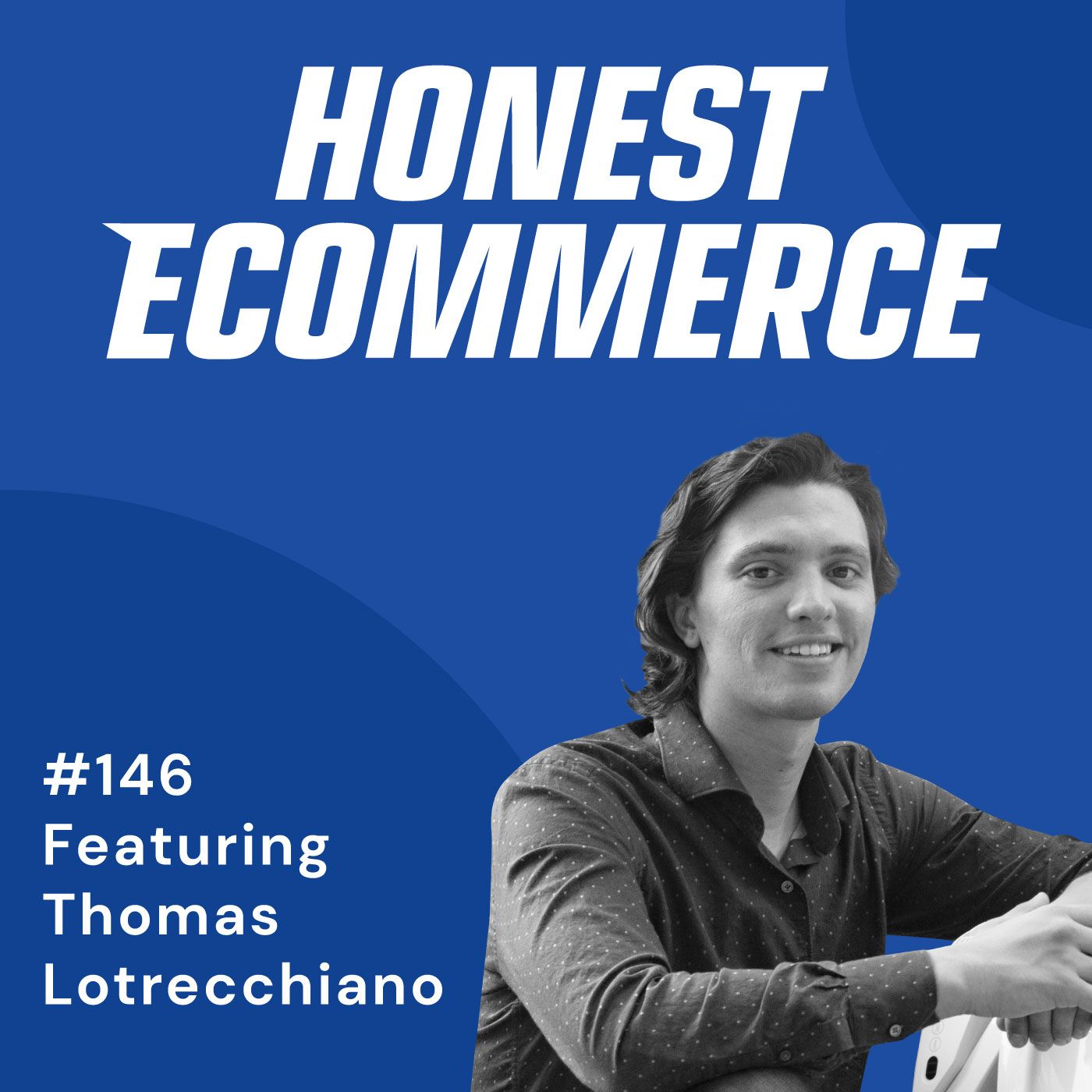
Thomas Lotrecchiano
One of the most important parts is not getting discouraged and not quitting because you're not getting rich quick.
Chase Clymer
Welcome to Honest Ecommerce, a podcast dedicated to cutting through the BS and finding actionable advice for online store owners. I'm your host, Chase Clymer. And I believe running a direct-to-consumer brand does not have to be complicated or a guessing game.
On this podcast, we interview founders and experts who are putting in the work and creating real results.
I also share my own insights from running our top Shopify consultancy, Electric Eye. We cut the fluff in favor of facts to help you grow your Ecommerce business.
Let's get on with the show.
Hey everybody, welcome back to another episode of Honest Ecommerce.
Today, I am welcoming to the show the founder of Omigo, Thomas Lotrecchiano. They are modern bidets that help you get perfectly clean. Welcome to the show.
Thomas Lotrecchiano
Chase, thanks so much. Happy to be here.
Chase Clymer
Awesome. So let's just go right back to the beginning of... First of all, you aren't... You are a co-founder. I mispronounced it. And it's a unique situation.
Not a lot of businesses are built with their father. So let's go back to the beginning. Let's talk about where this whole idea came from.
Thomas Lotrecchiano
Yeah, absolutely. Really fun and unique operation with my dad and I. And it started probably back in 2015. The idea came when my dad actually sat down on a modern bidet.
He had moved into a new apartment and they had this Japanese toilet in there. He had never seen it. And he told me that he was hesitant at first for a month. He was like, "Oh, toilet paper is fine."
Chase Clymer
(laughs)
Thomas Lotrecchiano
"I don't need to use this." And he just used it as a toilet seat. One day, he actually used it for the wash function. And I think angels [were] saying behind him and a heavenly light was glowing, and his life was changed forever.
And that's where the idea was put into him. And I have used bidets traveling through Southeast Asia and some European countries.
So I was familiar with the concept, but not with the Japanese toilet seat, which is far more advanced than what you see these big porcelain beasts all over Italy and the like.
Chase Clymer
That's amazing. So your father had the concept. When did it evolve into the idea of "Hey, let's build a business around this."
Thomas Lotrecchiano
So I have worked with or for my dad in some capacity pretty much my entire life. He's been an entrepreneur in the .com space since 2001.
And I worked for one of his businesses all through high school and college seasonally in summer when I wasn't in school. And so we've always been pretty close in that capacity where we get along great. We work together great.
And even if I wasn't side by side with him, being a part of something that he had built was always a really fun and unique way to spend time
and be connected to your dad. And it's an experience that a lot of people don't get to have. So we have this foundation, him and I, more so than the rest of my siblings.
I'm the youngest of four [siblings]. And we've always had the idea in our head that we wanted to start a business together. We kicked around a couple bad ideas --I can't even tell you what they were-- until something like this came along.
And I was in a place where my career wasn't going in any very poignant direction. And so I was thinking about going back to grad school to get an MBA. And he said, "Thomas, I don't think you need to go back to school right now.
I think that we should start this business together." "You're going to A not pay to go to school, B learn more in real experience than you would going to school and taking classes and C, we can actually earn money this way instead of going in the opposite direction."
That got me really excited. I was in. I moved from Denver back to Raleigh, where we're based now. And that's how the journey started. And that's like the base layer of the father and son story.
Chase Clymer
Yeah, something I want to really highlight there. And I've actually seen multiple people say exactly what your father said just then, which is “If you want to learn business, you do not need to go to school. Do not waste your money. Start a business. You'll learn more in the first 6 months to a year then you would in a 4 year degree and then some.”
The real world experience is like a crash course in an MBA. So I guess what I'm trying to say there if you're a listener out there and you're thinking about starting a business, and you're like, "Well, I have to go to school first."
That's just a belief that you need to get over to start the business.
Thomas Lotrecchiano
I couldn't agree more. And luckily, I took my dad's advice this time. As a parent, sometimes you don't listen... Or as a child, you don't listen to your parents. But this time, it seemed like really sound advice.
And yeah, for anyone out there that doesn't have a business background, it doesn't matter. You can... If you have the willingness to try something new, learn, and fail, then you can go out there and start your business.
So it's been a great learning experience. And I now after... We're coming up on 3 years post launch. This month I've probably learned more than 2 or 4 year degrees at this point and can go off and run another business or help people with theirs and feel really confident in that.
Chase Clymer
That's amazing. So one thing I wanted to ask is [whether] partnerships are always very unique. So how do you and your father divide up the responsibilities of running a business?
Thomas Lotrecchiano
Great question. So my dad is definitely the big brain of the operation. So he's got the vision. And he has the industry experience to guide us in the right direction.
He has big ideas for our marketing campaigns and the structure of where we should be going and spending our money.
And then I run the nitty gritty of our customer acquisition. So I'm more hands on, day-to-day, doing the work, pulling the levers, coordinating with our agencies, our creative agency, Facebook ad partners, affiliate partners, working on the websites, working with our UX designer and developers.
So I'm really in the business there. And he guides the general ship and then gives me feedback on everything. We collaborate on a lot of stuff.
So he's there every step of the way. And I'm there bringing this stuff up to him.
Chase Clymer
Yeah, that's funny. It's very similar to what me and my partner do. I'm focused on the future. And he's focused on the present. He's making sure the things that we are supposed to be doing are getting done.
And then I'm thinking about how do we grow this thing? What's the next step? So I think that's a common way that partnerships are divided up. And the one thing that I like that you highlighted there is you guys collaborate on things.
But it's not that you both are responsible for one thing. It's like somebody is responsible for it, but you can get input from the other person. That's something that we...
When we were first getting started, we would both be responsible for something and we would assume the other person was doing it. And then it just will never get done.
Thomas Lotrecchiano
Yeah, and it didn't click immediately for us. Being a father and son didn't give us as much of an advantage as someone might think because growing up, you don't really have that communication style that a business needs.
You have more of an emotional and personal communication style. And so it took us some time to realize our roles and how to communicate with each other outside of the familial unit.
But then once we did get it, it definitely has its advantage of that innate connection of being the same person in [those] times.
And the way we work together so well is... One of us will come up with a concept and we just call it "throwing it over the fence." So we just throw it over the fence of the other person, they work on it, tool it, and then we throw it back.
Do that a couple times, get together, see where we're at, and usually we have a pretty good product by then.
Chase Clymer
Awesome. That's a fantastic way to work. And then just another thing: A good partnership is built on just having difficult conversations.
And I guess that's definitely a learning curve for a lot of entrepreneurs and putting off those difficult conversations just makes it way worse when you finally have it.
Thomas Lotrecchiano
Yeah. And I have, I guess, a disadvantage and advantage of having to speak sternly to my father (laughs). That's a funny situation to be in.
To be like, "Hey, what the heck is going on? We need to talk about this right now." And then I think he's got the leg up there. If he needs to bring something to my attention, he's been able to discipline me in the past, so... (laughs)
Chase Clymer
(laughs)
Thomas Lotrecchiano
But yeah, having those difficult conversations [are] super important and not letting something kind of sit back in the back of your mind and fester.
Don't make the assumption that the other person understands your perspective and why you're upset or even that you are upset. So that's not only good for business, it's good for personal relationships too. But that's different (laughs) It's different...
Chase Clymer
That's a different podcast. But I agree with you on that as well. So let's go back to launching the brand. So your father has this concept, you guys agreed to partner on this.
And you're attacking the direct-to-consumer market. What was launching the business like? What was the go-to-market strategy? How are you acquiring your first couple of customers?
Thomas Lotrecchiano
Like I had said, my dad had been in the .com space for about 10 years. And he has been a consultant for the past 8 maybe 6 years.
And what we came to the table with was our ecommerce playbook. And it was a solid foundation of all the things you have to go do immediately, just to make sure you're in a good place before you even launch.
So we went to a branding agency, and we got all of our branding in place, all of our creative, and they helped us in the initial cut structure of our copy and voice.
We took that and then we used it to build a fast, easy to navigate, modern Ecommerce site on Shopify. Really low bloat, very clear navigation.
You see 1000 Ecommerce sites and they're all coming from the same core base right now. A lot of people lose their way.
But we had a really good idea of what was working at the time online. So we went out with a good development agency and a UX designer, built this website, got it up and running, did a bunch of QA to make sure that when visitors came it wasn't...
It was going to operate as we wanted to. We put into place all of our email flows. So [we] set up our email capture, all of welcome series, our post purchase series, browsing abandoned, shopping cart abandonment...
Like I said, so when those first customers did come through the door, we had these passive channels in place. And then we went out and acquired a lot of creative...
So mostly still photography. And this was in an effort to have a hopper full of creative for Facebook, which was our big push first, for customer acquisition to get those first people onto the site.
And this was 3 years ago. So we're talking about a different Facebook than we're talking about today.
Chase Clymer
I love that you highlighted that. I love that you pointed that out.
Thomas Lotrecchiano
So that's not necessarily how someone could go about it right now. But we did and it worked well. And when I say Facebook, I mean Facebook and Instagram, just as a combined entity.
And we also had the idea about bidet specifically needing to be something that was a recommendation from a friend, because talking about washing your butt...
Looking at an ad online and saying like, "Hey, you should wash your button instead of wiping with toilet paper. I know you've been wiping for 20-30 years, however old you are, but you should wash instead."
Not a super trustworthy source. So our concept was, "Oh people might need to hear this from people they trust. How do we get that?" We went into the podcast space.
Because if you have a dedicated audience, a smaller audience, who we thought that source might be somewhere where you could at least get our name in your head and then come to our site, and we'll be able to remarket to you and build audiences that way.
So those were 2 of our big pushes right out the gate.
Chase Clymer
Yeah. That's awesome. And so I just want to talk about the launching with Facebook and Instagram, like paid acquisition. You don't have to give me any numbers. But what was that, I'm gonna say, "battle" like?
Thomas Lotrecchiano
Yeah. [It was] really disorienting because we didn't know it was gonna work. And we put a lot of different types of creative out there. And I had no idea what the winner was going to look like. And it was the most bizarre creative that we had produced.
It was a woman with a toilet in a living room. And she wasn't sitting on the toilet. It was just unattached and she was leaning over and just looking at it lovingly looking at this bidet and it got hundreds of comments.
And just all that energy, made it our best performing creative because it was so bizarre. So it was a battle to get it right. And we've been working with a Facebook agency from the beginning. We've switched multiple times.
But we were very hands on and still are with the strategy that goes into that. So a lot of trial and error and definitely didn't come easy.
Sponsor: Electric Eye
If you're struggling with scaling your sales, maybe Electric Eye can help.
Our team has helped our clients generate millions of dollars in additional revenue through our unique brand scaling framework. You can learn more about our agency at electriceye.io. That's E-L-E-C-T-R-I-C-E-Y-E.io.
Sponsor: Mesa
Mesa is the Shopify expansion pack to level up your brand.
By turning all your internet connected apps into your business epicenter, Mesa can lighten your workload and tame the day-to-day chaos of running your store.
Join the other successful brands that have learned how to balance clever workflows with a solid infrastructure to get more done without additional overhead.
Whether you need to order data in Google Sheets, add products on Etsy, or get customers added to HubSpot, Mesa has you covered.
Peace of mind is right around the corner when all your apps are working seamlessly together.
To put it quite simply, mesa is a better way to work.
Search Mesa --that's M-E-S-A-- in the Shopify App Store and download it today.
Sponsor: Gorgias
Is your store holiday ready? Now is the time to make sure you and your team are prepared for the busy season ahead.
Gorgias, an omnichannel help desk built for Ecommerce has machine learning functionality that takes the pressure off small support teams and gives them the tools to manage a large number of inquiries at scale, especially during the holiday season.
Gorgias combines all your different communication channels like email, SMS, social media, live chat, and even phone into 1 platform and gives you an organized view of all of your customer inquiries.
Their powerful functionality can save your support team hours per day and makes managing customer orders a breeze.
They have allowed online merchants to close tickets faster than ever with the help of pre-written responses integrated with customer data to increase the overall efficiency of customer support.
Their built-in automations also free up time for support agents to give better answers to complex product-related questions, providing next level support, which helps increase sales, brand loyalty, and recognition.
Eric Bandholz, the founder of Beardbrand says "We're a 7-figure business and we have, essentially, 1 person on customer support and experience. It's impossible to do it without tools like Gorgias to help us innovate."
Learn how to level up your customer support by speaking to their team here. Visit gorgias.grsm.io/honest. That's G-O-R-G-I-A-S.G-R-S-M.I-O/H-O-N-E-S-T
Sponsor: Rewind
Our partner, Rewind, can protect your Shopify store with automated backups of your most important data.
Rewind should be the first app you install to protect your store against human error, misbehaving apps, or collaborators gone bad.
It's like having your very own magic “undo” button.
Trusted by over 100,000 businesses from side hustles to the biggest online retailers like Knix, Gatorade, and MVMT Watches.
Best of all respond to any of their welcome emails and mention this podcast, Honest Ecommerce, to get your first month absolutely free.
Sponsor: Klaviyo
Getting an online business off the ground isn't easy.
So if you find yourself working late, tackling the to-do list that's a mile long with your 5th cup of coffee by your side, remember, great email doesn't have to be complicated. That's what Klaviyo is for.
It's the email and SMS platform built to help Ecommerce brands earn more money by creating genuine customer relationships.
Once you set up a free Klaviyo account, you can start sending beautiful branded messages in minutes thanks to drag and drop design templates and built-in guidance.
And with Ecommerce specific recommendations and insights, you can keep growing your business as you go.
Get started with a free account at klaviyo.com/honest. that's K-L-A-V-I-Y-O.COM/HONEST.
Chase Clymer
Can you share anything, as far as what the first month or 2 look like? What was the return on ad spend?
If that's probably an easier number that you could share, trying to find that winning creative. All I'm trying to do is highlight here how hard it is (laughs).
Thomas Lotrecchiano
Yeah. It was slow to say the least. My dad and I made a promise that we weren't going to shave until we got 100 sales. I don't grow facial hair very well so I have [mine] looking real scraggly and my dad grew a big white beard.
And it took so long that we couldn't take it any longer so we had to shave. It was slow in the beginning.
And figuring out who you need to be talking to, what you need to be saying, and having the patience and persistence to get to that level of return on ad spend that's better than a one because we weren't there for the first couple of months.
It is hard work. So it definitely takes a long time. And it takes a lot of creativity to define that niche.
Chase Clymer
Yeah. And you also had the secondary remarketing stuff in place with your email automations to try to get the flywheel kick started.
And it takes a long time to get that thing going. But once you do, it's awesome.
Thomas Lotrecchiano
Yeah, absolutely. If you can get people in the door and you can build those audiences for remarketing on paid channels. And if you can figure out what people want to hear in your email flows, it's a passive form of income.
You still have to work on it A/B testing. But it's totally necessary to keep a business afloat, especially early on when you're trying to figure out how you're talking to people and what's working.
Chase Clymer
Yeah, so the highlight here of all this is: It's really hard if that is your go-to-market strategy. But if you understand it and understand the investment, it can work.
So we're talking about investment here. If you have a $500 paid media budget, you're not going to see any results.
I don't think you're gonna see results, especially today in 2021 with a $10,000 --that's our budget-- to get started with trying to break a new product. That's not going to work.
Thomas Lotrecchiano
Yeah, I agree. It's hyper competitive now on these traditional channels that people used to go to and just... It would work to go to Facebook and find your audience and let the algorithm figure it out for you and serve those ads.
And it just doesn't operate [like] that anymore. Facebook [doesn’t] operate that way anymore.
Later on, we figured out that YouTube was great for us. And it still took a lot of time for us to get there and money to get to the place where we were actually seeing success.
So yeah, it's not a small budget anymore. There are ways to go out and get some eyeballs to your site that are less expensive.
And I'm thinking specifically of some sort of guerilla style product giveaway, but that's still costing money, because it's the cost of goods sold there. So it's not cheap anymore.
Chase Clymer
(laughs) No. No, it isn't. But I'm not trying to... I want people to still do it. It's great. I love seeing new brands in the space.
Entrepreneurship is the best thing that's ever happened in my life. So I'm not trying to say don't do it. I'm just trying to be... It's difficult, especially if... If your go-to-market strategy is paid acquisition, that is probably [the] steepest hill to climb.
Thomas Lotrecchiano
We were always in the mindset that when we're spending on these paid channels YouTube, Facebook, Instagram, that we have as much money as we can earn back.
So if we can hit a 1.2x then that is... We're not making money on the business but it's enough to keep learning, keep figuring things out. So if you can get to this breakeven point, it'll allow you to build that momentum.
And not saying that you're going to become rich from getting a 1.2x ROAS because it's not going to cover your cost of goods sold and all of your other overhead.
But it's going to give you enough energy to continue on that path, which is one of the most important parts: It's not getting discouraged and not quitting, because you're not getting rich quick.
Chase Clymer
Absolutely. So you went really in depth with your guys's go-to-market strategy. And I appreciate that so much. Let's talk about the future. What are you excited about over the next 6 months?
Thomas Lotrecchiano
Yeah, absolutely. So it took us about a year and a half to realize that long form media was a better form of advertising for us. So I'll just give you... It's a build up to where we are now.
We started making long-form media, a lot of funny videos, and then we broke into more educational founder spots and got onto YouTube.
So YouTube has just been great for us for the past year and a half. And I'm still excited about YouTube for the next 6 months, especially since we have been continually making new creative, and I'm really excited.
We're headed in a more specific gender... A gender specific area that we haven't been before, targeting women and their needs when it comes to cleanliness with bidets and that's something that we haven't explored.
But I'm really excited to start speaking to an audience directly about what they need instead of having a general idea or a general concept that bidets are great for every butt.
They're great for vaginas and people who are pregnant and who just had a child. And so there's a lot of benefits for that demographic. And I'm excited to talk to them and excited for half to half the day because everyone needs one.
Chase Clymer
Now, when you're speaking about YouTube and the opportunity with long form content, are you putting... Producing this and putting it out on your own YouTube channel? Are you producing this content and then doing paid placement?
Thomas Lotrecchiano
We do paid placement. So we don't count on organic or this type of content. This is all... It's unlisted, most of it. And it's all paid placement. So that's where all of our eggs on YouTube go.
Chase Clymer
Absolutely. Awesome. And then now, is there anything that I forgot to ask you that you want to share with the audience?
Thomas Lotrecchiano
No, I don't think so. I mean, I don't know if you... I have another thing that I'm excited about for the future? If you want to hear about that real quick?
Chase Clymer
Oh, absolutely.
Thomas Lotrecchiano
Okay. So, by the time this podcast comes out, we will have run multiple weeks on television. So we're running on Linear TV, which is Spectrum Cable, and not like over the top streaming like Netflix and stuff.
And we just launched and so I'm really excited about that prospect because you can just reach so many people and find your audience, I think, very quickly. Yet to be proven, but I'm very optimistic about our chances with television and what that's gonna look like for us.
Chase Clymer
Yeah, it's kind of funny. Now, I've been in this game for 7 to 8 years now in advertising. And it's...
Things are going full circle where digital is getting as expensive if not more expensive than traditional, because you can...
Well, you used to be able to track all the numbers very easily. But now, people are starting to experiment --in the direct-to-consumer space-- experiment with these more traditional media buys like billboard placements, magazines, and TV. So it's really exciting.
Thomas Lotrecchiano
Yeah, it's very exciting. And it is funny. I never thought "Oh, cable is the place for us." But I think it's gonna be something that's really good for our brand.
Chase Clymer
I think it's gonna be great. And hopefully I see it because I have Spectrum Cable, so maybe I'll see it and I'll shoot you an email like "I just saw it!"
Thomas Lotrecchiano
Yeah. Awesome.
Chase Clymer
Thomas, thank you so much for coming on the show today.
Thomas Lotrecchiano
Yeah, Chase. It's been a lot of fun. Thanks for having me.
Chase Clymer
Alright. I can't thank our guests enough for coming on the show and sharing their knowledge and journey with us.
We've got a lot to think about and potentially add into our own business. You can find all the links in the show notes.
Make sure you head over to honestecommerce.com to check out all the other amazing content that we have. Make sure you subscribe, leave a review.
And obviously if you're thinking about growing your business, check out our agency at electriceye.io. Until next time.