Chase Clymer
Before we get started, if you're enjoying this content, you can do us a favor by subscribing to our YouTube channel and ringing the bell.
That will let the algorithm know that you like this content and it will help us produce more.
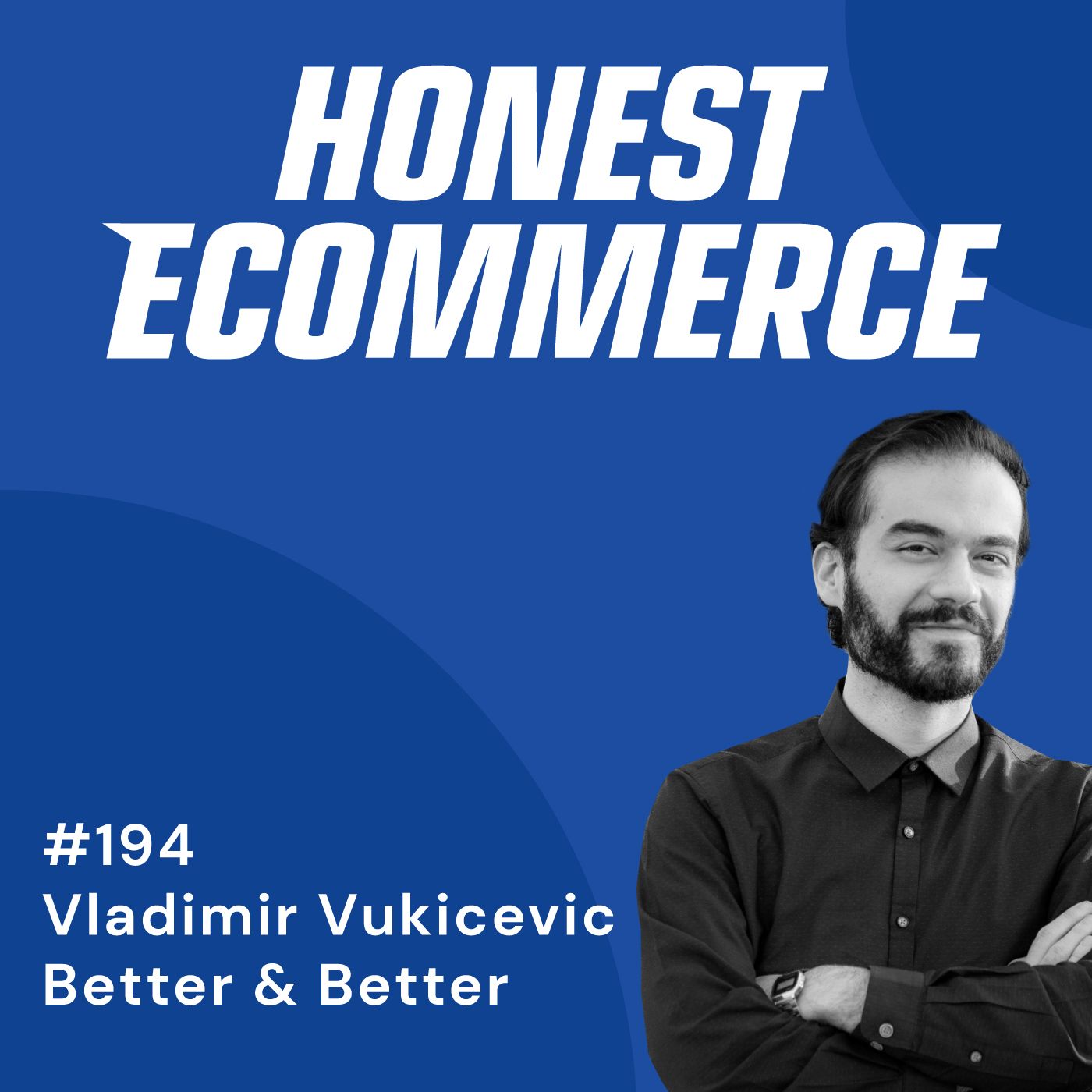
Vladimir Vukicevic
Don't try to fit your company into the right investment thesis of someone else because that is always going to lead to either a bad company or bad relationships with investors.
Chase Clymer
Welcome to Honest Ecommerce, a podcast dedicated to cutting through the BS and finding actionable advice for online store owners. I'm your host, Chase Clymer. And I believe running a direct-to-consumer brand does not have to be complicated or a guessing game.
On this podcast, we interview founders and experts who are putting in the work and creating real results.
I also share my own insights from running our top Shopify consultancy, Electric Eye. We cut the fluff in favor of facts to help you grow your Ecommerce business.
Let's get on with the show.
Hey everybody, welcome back to another episode of Honest Ecommerce. I'm your host, Chase Clymer.
And today, we're welcoming to the show the CEO and co-founder of Better & Better; A company that develops and sells personal care products that are fundamentally better for our health and for our environment.
Welcome to the show, Vladimir.
Vladimir Vukicevic
Thank you very much. It's great to be here.
Chase Clymer
Awesome. So for those that don't know, can you just quickly tell me what are the products that Better & Better is bringing to the market?
Vladimir Vukicevic
Sure. Our high-level thesis is that existing habits are really powerful and they should be leveraged to create more health and wellness for us as human beings. And so what does that mean?
Our first product is a 2-in-1 toothpaste that provides clean teeth, whitening, fresh breath, all the things that toothpaste typically gives you.
But in addition to that, you get a micro dose of vitamins and other nutrients. So we packed it in a special way where when you brush...
Just through brushing you absorb through your mouth and your gums, vitamin D and vitamin B-12. And you can get anywhere between 30% to 50% of your daily dose per brush, just through the normal sublingual, transmucosal absorption methods in your mouth.
Chase Clymer
It's fantastic. These are super interesting products for everybody. So make sure you go and check out the website. And we'll give you the link to that in the show notes.
So take me back in time, though. Where did... Nah. Let's go a little bit further back. This isn't your first rodeo. So where do you want to start the story?
Vladimir Vukicevic
We can start from the beginning. I'll be relatively brief.
So I am Vladimir, a first generation immigrant. I moved to the US when I was 6 years old, grew up in New York, did a little bit of corporate work for a few years but then I realized the entrepreneur in me had to come out.
So I started my first company, which was a marketplace, a crowdfunding marketplace called RocketHub.
We were helping other entrepreneurs raise money. So I got to see both the idea of starting a startup, but also seeing other entrepreneurs at work. And we grew that from a napkin idea to acquisition and about 3 and a half years.
My second company was an actual physical product. It was an electronics product called Meural, which was to bring art and photography to people's lives through a beautiful digital art frame. And not only that, but we would connect it to museums and galleries.
So that was my first foray into kind of B2E Ecommerce, building out a brand that actually sold physical goods. And we took that from a napkin idea and we raised about $10 million in venture funding and then we were acquired, as well. So that was my second kind of exit.
And now with Better & Better, I would say this is my most personal company. So I mentioned I came here as a kid, I came here because when I was a kid, I had cancer.
So I was diagnosed with bone cancer when I was 6 years old. And I went through extensive treatment; Chemotherapy, radiation, for 5 or 6 years, almost 10 years. Here in New York.
Thankfully, everything was successful. And I've been in remission for a few decades now. But as you probably know, there are a lot of long-term effects for cancer patients.
One is major vitamin nutrient deficiencies, particularly vitamin D, which all of us are deficient in, but in particular, cancer survivors. So I've been taking a fistful of vitamins for most of my life. And it's this personal hatred for pills that has really pushed me towards starting Better & Better.
And we believe that we can create a line of products that replace the need for pills over 2 - 3 - 4 - 5 years. And we're starting with toothpaste because it's the most kind of consistent habit that people use and do.
And sublingual is a very powerful delivery mechanism. But we'll roll out other products that kind of increase that idea of micro dosing your vitamins.
But if you have 5 or 6 things to help you microdose you get to 100% of a dose in a day, 2 days, etc. So that's where we're going. And it's really like... It stems from my personal desire to not have to take any more pills in my life.
Chase Clymer
(laughs) It's a very, very amazing story. So this is a question that is very... You're uniquely qualified to answer this.
Vladimir Vukicevic
Sure.
Chase Clymer
This being your third startup, what advice would you give the first time entrepreneur to like, "Don't do this. This is a waste of time." or "Focus here."
Vladimir Vukicevic
That's... We can go on for hours without one. But I think fundamentally, it's... Number one is Team.
So I think solo entrepreneurship is really, really hard. So even just having one co-founder or two has helped me survive from a mental perspective.
So if I'm down, --which I am, sometimes-- if I'm in a funk in some way, usually my co-founder or co-founders are not. And so that idea of the waves of like, emotion and feeling and inspiration, that's going to vary over time.
But if you have a team of 2 or 3 people, it stabilizes that. So I think, number one is like co-founders, team.... Going at it alone is possible but I think it stacks the deck against you. So I think that's the number one bit of feedback.
Number two is look at the market and see where it's heading. Because I think a lot of our success in the past has been tying my products and ideas to grow in markets.
So first was crowdfunding and a marketplace around microfinance. That was 2010 - 2011 - 2012 when that concept was really starting to blossom and grow. If I started to do...
[If I] tried to do crowdfunding now, I think it'd be a little bit late unless there's some new twist to it. At that point, the odds are so long when you're a founder that implementing that idea within a growing market really helped us a lot and led us to an acquisition.
Same thing with Meural. Connected hardware was really interesting and the big companies were looking at Google, Apple, Facebook, mid 2000-teens... It was a growing market.
And that's why we were acquired by Netgear, because they wanted to move into kind of the IoT, Internet of Things.
And I think now with Better & Better, I think health and wellness...
We started the company before COVID. But with COVID happening, I think the idea of embedded, personalized, almost in a way passive health and wellness is huge. And so we've seen a big boost to everything that we do, not because...
Not only because our products are incredible, but because it's within a world that is ready for this concept. So I think, team, market, and then finally, investors and support.
I think that there's gonna be different types of investors. So I think the biggest lesson for me is find the investors that fit your company, don't necessarily do the reverse.
Don't try to fit your company into the right investment thesis of someone else, because that's always going to lead to either a bad company or bad relationships with investors.
So I think the idea of finding investors that fit your company or supporters that fit your companies has been key for me in terms of success.
Chase Clymer
That is amazing advice. Alright. So let's go back in time, though.
So ideation. You've got this idea for this product. How long did it go from "I got this thing that's mulling around in my head." until you've got a sample in your hand?
Vladimir Vukicevic
Yeah, so I started developing the idea for better and better even during my previous company during Meural.
So I was tinkering in my own home with blending toothpaste, traditional, just off-the-shelf toothpaste with vitamins and nutrients and supplements...
Chase Clymer
How'd that taste?
Vladimir Vukicevic
And it was like... It was a mess, but it started to get me going. And so when my previous company was acquired, I was like, "Okay, I have some baseline here but we need to take this to a lab, to biochemist, chemists, manufacturers, mixers, etc."
So it took from when we said, "Let's do this fully." to launching the first product, it took about almost 2 years from 2019 to 2000, early 2021 because there was a good deal of R&D. I think this is a product...
Obviously, toothpaste has been around for 100+ years. But the idea of embedding vitamins within it isn't just like you pour vitamins and toothpaste, you have to mix it and match in a way that that makes it absorbable and I think that's where the secret sauce is and making it absorbable and palatable.
And so that took a long time: 400 - 500 different permutations. We went through a couple of partners that weren't good fits for us so we had to keep switching.
And then also it was during COVID, so we couldn't go to the lab and talk to someone. It had to be all shipping FedEx.
It was a much more remote process which slowed us down, but we got there. After 2 years, we launched the V1 of the product in late 2020, early 2021.
Sponsor: Electric Eye
If you're struggling with scaling your sales, maybe Electric Eye can help.
Our team has helped our clients generate millions of dollars in additional revenue through our unique brand scaling framework. You can learn more about our agency at electriceye.io. That's E-L-E-C-T-R-I-C-E-Y-E.io.
Sponsor: Mesa
Mesa is the easy to use answer for automating the everyday challenges of running a Shopify store.
Find more "aha moments" when you're spending less time in the weeds and can focus on the bigger picture.
With automations, you have all the power of code without the learning curve. You can easily customize how Shopify and your apps work with one click integrations.
From auto tagging orders to sending order details to a Shopify customer database, Mesa connects your data where it's needed most.
To put it quite simply, Mesa is a better way to work. So find your peace of mind and kick up your feet with a simplified workload to manage the everyday stress of running your Shopify store.
Search for Mesa, that's M-E-S-A, in the Shopify app store and download the app today
Free plan available with a no cost setup included.
Sponsor: Rewind
Our partner, Rewind, can protect your Shopify store by automatically backing up your business critical data.
Rewind should be the first app you install to protect your store against human error misbehaving apps or collaborators gone bad.
It's like having your very own magic undo button.
Trusted by over 100,000 businesses from side hustles to the biggest online retailers like Knix, Paul Mitchell, and Pampers.
Best of all, visit rewind.com/honestecommerce to get your first month absolutely free.
Sponsor: Klaviyo
Getting an online business off the ground isn't easy.
So if you find yourself working late, tackling the to-do list that's a mile long with your 5th cup of coffee by your side, remember, great email doesn't have to be complicated. That's what Klaviyo is for.
It's the email and SMS platform built to help Ecommerce brands earn more money by creating genuine customer relationships.
Once you set up a free Klaviyo account, you can start sending beautiful branded messages in minutes thanks to drag and drop design templates and built-in guidance.
And with Ecommerce specific recommendations and insights, you can keep growing your business as you go.
Get started with a free account at klaviyo.com/honest. that's K-L-A-V-I-Y-O.COM/HONEST.
Chase Clymer
So you've got the product and you're going to market with it. What was that go-to-market strategy? How were you trying to acquire your first round of customers?
Vladimir Vukicevic
I think how...
So the first production batch was pretty small --It was like 10,000 units or so-- and we needed more as an experiment where we wanted to answer 2 things: One is "Could we actually make this... Could this be real?" Because it's a cool [as] an idea, but can you make it?
And two is "Do people actually want to buy it?" And so we viewed that first production process and first go-to-market is really like answering those 2 questions. And so everything that we structured; marketing, the positioning was around experimentation, testing...
And we had that luxury of doing that for the first batch. And so when we sold out that first batch in about 6 months or so, we were like "Okay, now we have this product that people apparently want. And we can do it. We've done it well enough."
So now we just launched V2 of the product. And this is like... I would call this like the "market ready" [version]. [It's] what I wanted V1 to be, but it's really good based on feedback, based on iterations, etc.
So I think the trick with us here now with this V2 market ready product is education. That's number one, because people don't know you can absorb things through your mouth.
Generally, it's not a strong market concept yet. And so I think what our go-to-market has been focused on so far is really about just knowing, teaching people that this is possible.
And then once they grasp that they're like, "Oh well, how do I do it?" Okay, then we give you a product that meets that need, it meets that kind of knowledge that you've just gained.
But I think our job for the next 12 to 24 months is all going to be about education, infotainment, and the credibility that's necessary to be able to tell that story.
Chase Clymer
You said something interesting there that I want to ask a very direct question about: You wished that you launched with this new version 2?
Vladimir Vukicevic
Yes.
Chase Clymer
Why didn't you wait?
Vladimir Vukicevic
Oh boy. I think I'm a very impatient person. I'll be honest, I can't just sit for too long without getting feedback.
And so at a certain point, it was almost like a software-driven decision for a consumer product which was like, just get customers to use it and tell you what they think about it.
So within cooling, we were working with a manufacturer that had very low minimum order quantities.
So we were able to --with relatively low risk-- test the earlier formulas, and so we learned a lot from that. And so I think my impatience led to a better product that maybe we wouldn't have met...
V2 would have never been as good as it is if it was V1. So at some point you gotta get real people to use it. And you have to get real people to give you real feedback that is not your friends and family.
Because friends and family are great, but they're never going to be as real as real customers are. And customers were like, "This is great. I love this. I hate this. Change this."
And so based on that, we were able to really build a good current product.
Chase Clymer
Yeah, you answered my follow up question like within your first answer. So we're on the same page here.
Vladimir Vukicevic
Good. Good.
Chase Clymer
All right, so you got Version 2 of it and you're putting that out to the market? How are you advertising this? How are you getting in front of [customers’] eyes?
Vladimir Vukicevic
Yeah, so early... V1, the test was mainly digital, like digital marketing, traditional funnel, Facebook, Instagram, Google, etc.
Retargeting, that's fine. That's almost like hygiene. You need to do that. But as you know, as your listeners probably know, at this point, the ROI and arbitrage opportunities are not what they used to be even 3 years ago, let alone 10 years ago. So what we're really... What we've...
What we're seeing a lot of success with is third-party credibility. So that means from the bottom up. So our customers who love it, we want to amplify their voices. So recording them, documenting their experiences, really amplifying what they're saying.
The second level to that credibility is influencers, celebrities, people who are for better or for worse, well regarded as legit in the industry. So we're starting to collaborate with different athletes with different health and wellness professionals, etc.
And then the third level of the pyramid is like hardcore scientists, biotech chemists, and people who aren't necessarily considered influencers, but when you listen to them, you hear like, "Wow, real, real information."
So we're starting to do a series of interviews with scientists --people who are known in this world-- who have developed either technology or products for sublingual absorption, and transdermal absorption of nutrients.
So it's we're really going to go multi-level credibility hierarchy and then amplify that wherever we can: podcasts, video, and beyond.
But again, it's answering that question: "Does this really work?" And we need to answer it affirmatively at every level: customers, influencers, and experts.
Chase Clymer
Absolutely. Now, is there anything I haven't asked you today that you think would really resonate with our audience?
Vladimir Vukicevic
Yeah. I think our product is really interesting, because it's relatively low average order value. So from the get go, I think we've been really focused on building a long term relationship with our customer trying to go for that subscription, LTV approach. And that's...
We found that to be quite successful. We have a very high reorder rate/subscription rate over... Most of our customers start off just with the subscription, which is incredible. So I think that...
My previous company, Meural, was a $500 product. So there was profit embedded within the product. The average order for toothpaste is $20 to $30. It just went from $20 to $30. So it's much, much smaller. So there has to be [an] recurring element to it.
So I think we really view our customer as an investment over a longer term period. And because of that, I think we're gonna have multiple products. We're going to have a whole portfolio of products that leverage existing habits to deliver vitamins and nutrients. So I think...
We've had to approach it a little bit differently. But I think, so far, it's been the right approach for us.
So I think [to] anyone maybe that's listening who's launching a brand with a smaller price point or a lower price point, I think there are different tactics to that, compared to a higher price point, profitable from the get-go types of products.
Chase Clymer
Absolutely. Now, you mentioned earlier that "Make sure that your investors are in line with your vision and don't change to be in line with theirs."
Vladimir Vukicevic
Yeah.
Chase Clymer
If someone was going to launch a product these days and go that route of doing the testing and acquiring customers for that first round of stuff, what kind of budgets should they bring to the table as far as paid [marketing] to really get the ball rolling?
Vladimir Vukicevic
For us... You can start testing with a few $1,000. But really, we were starting to get real data once we started to approach like six figures.
So once we got to like a few $100k --or about $100k spent over 3 or 4 months-- that's when we really started to see some of those tests bear fruit. Because early on, we were testing a couple of different angles.
One was more of an eco story because we are very eco-friendly. But we realized that eco friendliness is almost like table stakes at this point. It's not a differentiator that necessarily leads to [profound returns]. So we were testing the eco story.
We were testing the design story, so it looks and feels pretty. That works, but it wasn't the killer angle.
And then the third angle for us was the vitamins, like you get your vitamins by brushing your teeth. And that's where we saw returns at a much higher level.
So I think once we got to like 6-figure spend, that's when we were able to really see that third bucket, be the hero in terms of our output. But I think there are different ways of doing it.
I think even a few $1,000 could be enough just to get the ball rolling, especially if you have a pretty strong thesis.
And maybe you're only A/B testing 2 things, as opposed to us A/B testing 3 big buckets. I think that complicated matters.
Chase Clymer
Absolutely. It's just... The reason I ask is I just want to set the expectation that it is expensive to pay to play these days. And if you...
Vladimir Vukicevic
Yes.
Chase Clymer
...can start a business and do something with a more organic growth at the beginning,..
Vladimir Vukicevic
Yeah.
Chase Clymer
...go all in on that.
Vladimir Vukicevic
Yeah. I think that's absolutely right. And I think like, there's nuance to our product that requires --I mentioned before-- explaining. And I think it's that nuance that will lead to long term success for us but is a short term pain.
So it's short term pain from having to explain something new but it gives long term gain, because we want to be the Coke or the Xerox of this category, of alternative supplement delivery, without having to eat something or swallow something. So if we can be that in 5 years, the pain will be well worth it. I think there's similar examples.
If you look at Athletic Greens, it took them a while to ramp up and to become market aware because it was such a... It's green, but it goes in liquid. And it's like, there were a lot of nuance... There was nuance to it.
And I think now, like the market knows about Athletic Greens and they're dominating because they laid that groundwork. So I think it all depends on how much explaining there is to do, and how much introduction the product needs.
Chase Clymer
Absolutely. Now, we've talked so much about the product. So if someone's curious and they want to go check it out, where should they go?
Vladimir Vukicevic
Yeah. Our website is probably the best; betterandbetter.com. Just a full "better and better". And because I think... We're starting to...
Also, as I mentioned before, we're starting to do interviews with scientists, the people who are using the product and are experiencing it in a meaningful way. And so I think our website is probably the best place to go. Betterandbetter.com.
Chase Clymer
Absolutely. Vladimir, thank you so much for coming on the show today.
Vladimir Vukicevic
Thank you very much for having me.
Chase Clymer
Alright. I can't thank our guests enough for coming on the show and sharing their knowledge and journey with us.
We've got a lot to think about and potentially add into our own business. You can find all the links in the show notes.
You can subscribe to the newsletter at https://honestecommerce.com/ to get each episode delivered right to your inbox.
Make sure you subscribe, leave a review. And obviously if you're thinking about growing your business, check out our agency at electriceye.io. Until next time.