Chase Clymer
Before we get started, if you're enjoying this content, you can do us a favor by subscribing to our YouTube channel and ringing the bell.
That will let the algorithm know that you like this content and it will help us produce more.
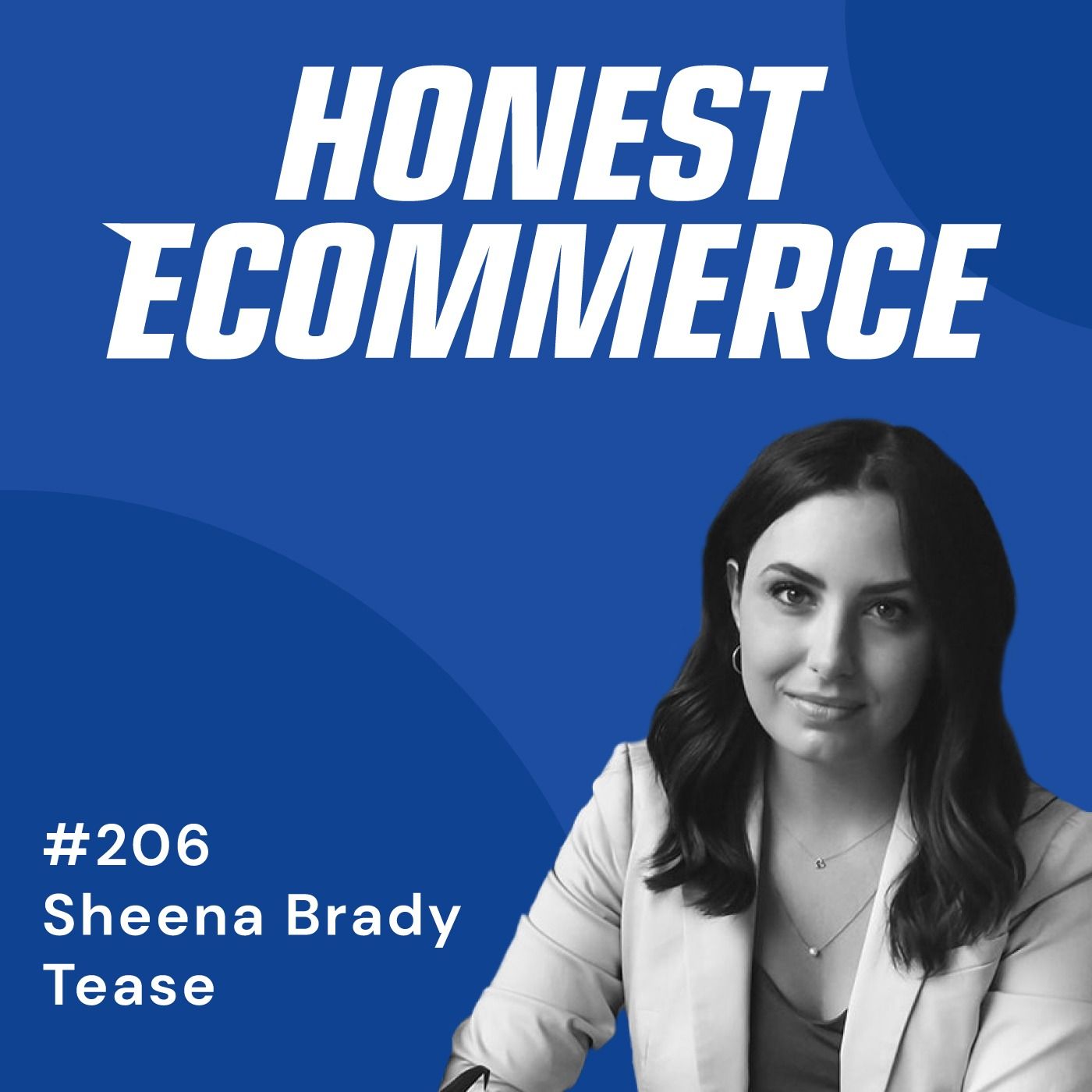
Sheena Brady
Some advice that I would have for the listeners today, especially founders who are more in an early stage journey, just know that done is better than perfect.
Chase Clymer
Welcome to Honest Ecommerce, a podcast dedicated to cutting through the BS and finding actionable advice for online store owners. I'm your host, Chase Clymer. And I believe running a direct-to-consumer brand does not have to be complicated or a guessing game.
On this podcast, we interview founders and experts who are putting in the work and creating real results.
I also share my own insights from running our top Shopify consultancy, Electric Eye. We cut the fluff in favor of facts to help you grow your Ecommerce business.
Let's get on with the show.
Hey everybody, welcome back to another episode of Honest Ecommerce. I'm your host, Chase Clymer.
And today we're welcoming to the show, the founder and tea sommelier behind Tease, Sheena Brady.
It's an all-natural tea and botanical based tea blends and beauty staples to support your everyday rituals without compromising convenience, sustainability, and impact. Welcome to the show.
Sheena Brady
Thank you so much for having me, Chase.
Chase Clymer
Absolutely. I can't believe I didn't goof on that intro. There were some hard words in there.
Sheena Brady
(laughs) Fair enough. And believe it or not a tea sommelier is a real thing.
Chase Clymer
I believe you. So let the people know what are the... A little more in depth, what are the products that you guys are bringing to the market there?
Sheena Brady
Yeah, absolutely. So at Tease, we focus on wellness-centric blends that are formulated with all-natural tea and botanical ingredients to really support your everyday wellness rituals.
And we do that with sustainability in mind. And this past year, we launched the world's first fully biodegradable and refillable tea collection amidst a supply chain crisis, which was no easy feat but something that we're super proud of.
And in addition to that, we also branched out into beauty adjacent products as well, that are also infused with tea and botanical ingredients.
So things like coconut chamomile bath treatment soaks and beautiful Earl Grey energizing body scrubs, Macha masks... That sort of thing.
Chase Clymer
It sounds like you've always had a thing for tea. So take me back in time. Where did the love of tea come from? And then when did it start to evolve into more of a business?
Sheena Brady
Yeah, so my background before doing what I do now in this life, as I say, was in hospitality. I went to school for hospitality. I wanted to own a restaurant one day. That was my big dream.
And that career led me on an incredible journey to work in some great cities under some Michelin star chefs and some luxury resorts throughout New York, California, and then eventually ended up in Toronto.
And when I started working at the Shangri La Hotel in Toronto, specifically, I was a service manager. And I was about 2 weeks on the job when my boss asked me, “Hey, Sheena, we want you to build the biggest tea program in all of Toronto.”
And not only that, but it needed to be a minimum of 75 different teas and blends sourced from around the world, but then also be able to train the staff on cultural ceremonies that are different based on where home is for you.
And so that was an interesting challenge, because I'm actually a wine sommelier by trade. And so just to prove a point I said, "Yes."
But the plot twist at the time is that I didn't even drink tea so I knew I had my work cut out for me.
And just to give you an idea of how much I didn't drink tea, I was very much a subscriber of coffee culture. Really getting through multiple cups of coffee a day to kind of just get through the daily grind.
And if anyone listening has ever worked in hospitality before ,you especially know what I'm talking about. You're working, you know, 10 to 15 hours a day: Nights, weekends, holidays, essentially to please strangers.
And the only way you know most people get through this are copious amounts of coffee, which is not great for you.
Obviously too much of anything is not great for you. But that amount of coffee actually lead to anxiety, insomnia, and digestion issues. I really wasn't living a healthy lifestyle, to say the least, and [I was] just really trying to climb that career ladder.
So when I was asked to create this tea program, mostly to prove a point, I thought, "Okay, well I need to actually walk the talk because I don't even drink tea."
So that's where I enrolled to become the certified tea sommelier that I am today, which was an 8-month journey.
And through that journey, I learned everything from you know how to blend tea, cook with tea, bake with tea, tea-infused cocktails, importing tea, exporting tea, general health and safety regulations and everything in-between.
So the entire industry from garden to cup, basically. But what I didn't expect in addition to proving that I'd be capable of learning about the vast world of tea and implementing a peer-worthy program for the hotel was that I would completely fall in love with tea.
Because what I learned about tea is that however you're feeling, there's usually a blend to support that goal or desire. And that's when it clicked for me.
Next thing I knew, instead of reaching for my second or third cup of coffee in the afternoon, I was transitioning to a Mate, which had a scientifically different strain of caffeine that would give you this clean energy and focus and not give you the jitters and crash.
Or in the evening when needed to wind down I'd have the beautiful cup of "worry loss" or Valerian root. And so that's when it clicked for me. And I started to have some fun blending tea out of my condo in Toronto.
I launched a Shopify store with $500 and a Shopify store in inventory. That was it, like it was so scrappy, and just for fun, and it was really more of a creative escape from this demanding career than a business and in its early days.
So that's the early day story.
Chase Clymer
Okay, what year were you challenged with creating this program?
Sheena Brady
This would have been in 2013.
Chase Clymer
And then what year and what year did you launch the store?
Sheena Brady
That same year, late 2013. So in December of 2013, I officially launched Tease. And when I was first... You have to keep in mind, like I was barely 24 when I started this so I had no business starting a business.
The first time I went to college, it was for business. And I dropped out before I went to hospitality. And I did Grade 9 math three times, so I'm just stereotypically not the person that generally you would think would go into business, let alone succeed and thrive in business.
So when I first started the business at 24 years old, I thought, "In order to be competitive against all these tea companies and every shopping mall and everything else that's going on, I'm going to make tea sexy."
And so that's where the name Tease came from. T-E-A-S-E. It was a little cheeky, a little provocative. And I had all of these, like, really sexy, cringy tape early on and hot pink fonts.
And I used to package my tea with boas instead of bubble wrap, just to really make a statement. And I remember my most cringy moment was...
Back in the early days of influencer marketing when it wasn't as difficult as it is now. But I sent some products to a YouTube influencer back in 2013 and I remember opening up the box and this big pink, poofy, boa comes out and there's like feathers everywhere.
And she's all upset because now she has to vacuum her floor and it was the whole thing. So fortunately, I did pivot the brand very early on from that hot pink boa mess. And, yeah.
But one of the things that's always stayed with Tease since our early days is or is our investment in women. Even in those very early days in 2013, we were a social enterprise.
I say "we". It was obviously just me in those days. But we were a social enterprise before I even knew what that word meant.
I just knew from my own complicated and dynamic upbringing, which is a Dr. Philip Show for another day, but that I wanted to be a part of investing in an ecosystem of supporting other women. So whether that was, product donation, volunteering...
And if the profits made sense cutting a check in the early days, we were well-aligned with different non-profits and charities before we got a lot even more intentional about our social impact today.
Chase Clymer
Absolutely. I know that one thing that our audience loves me asking is you built a story, threw things up online.
What'd happen next? How did you get those first couple of customers? Or what was that journey like?
I know there's a lot of entrepreneurs out there that are right there about to launch or have launched, and that's their struggle: Finding that first round of customers.
Sheena Brady
Yeah, so for me, it was a painful amount of trade shows. I did just as much offline as I did online. And I think that was really important.
That was one of the big things. So finding the right trade shows that were aligned with my demographic. So I would go to The Healthy Brain and Body Show, The Women's Show, The Wedding Show...
Anything [that] is aligned with my demographic, I was there. But further to that, PR. I really hit the ground running, doing my own PR early on, by simply being consistent and relentless. And if we talk about that very general law of conversion in Ecommerce where 3% of checkouts...
If you have 3% of your customers checking out you're killing it obviously that depends on industry and whatnot. I looked at that general law the same as PR: Expect to reach out to 100 leads.
And if 3 reach out and actually want to feature you on this local TV show or a national platform, then that's great. And so I kept that mindset and we've always had exceptional PR since the early days from local TV, to national broadcasting...
We've been featured on Dragon's Den, which is our version of Shark Tank here in Canada. We've been on The Ellen Show, Good Morning America, The View...
So that was a really big focus because...
Especially now and today, it's harder than ever to attain new customers. And doing your own PR takes a lot of work, and a lot of consistency, and an endless amount of follow up, but it can be worth it.
Chase Clymer
I love that you shared that conversion number. That's something that no one's really hit the nail on the head with when it comes to outreach and doing PR.
It is like you said a lot of work. And there's gonna be a lot more strikeouts before you hit the ones that work out. But when they do, you can change things.
Sheena Brady
Definitely.
Chase Clymer
So when you're building this business and you're doing all this stuff yourself. Are you still...
Now, are you still working at your previous job? And how long was it before you went all in on Tease?
Sheena Brady
Yeah, so I actually grew Tease as a side hustle in parallel to a career at Shopify. So I worked at...
So, I should rewind a little bit. After about, I'd say, a month or so having the business at the hotel, I got fired.
Candidly, I got fired because I think my internal misery ended up catching up with me. Like I said about the hospitality industry, it is a really difficult one.
And you're sacrificing so many relationships with friends, families, and otherwise in the process. And so I think, at the time, it was devastating when I was fired. But looking back on it, it was the best thing that ever happened to me.
Because I think logically most people would say, "Okay, well, I'll just get another job in hospitality. It's what I know, and pay the bills and work on my side hustle."
But I knew my lifestyle still wasn't fully working for me yet despite discovering tea and how it could support me in my everyday wellness rituals. So I decided to leave the industry entirely. And I got a job in Shopify as a support person.
So in the early days, I think... I don't know.
It was like $17 an hour. It's a very entry-level role very different from what I was paid as a service leader at this beautiful hotel.
But for me, it was just an opportunity to like, "Okay, I know when to clock in, when to clock out. I can work on my business at the same time."
And let's be clear here, there's no better Ecommerce school on this planet than to actually be on the phone every single day with hundreds of merchants or live chatting with them and just like figuring out shit in real time.
And so it was a really cool experience getting to start in Shopify support.
And then I grew my career in parallel, and I grew my side hustle into a 7-figure company while working at Shopify and only very recently have gone all in on Tease, 8 years later.
Chase Clymer
Oh, that's fantastic. And you are correct. There is no better school than Shopify itself and interacting with merchants.
And I hear this from people that work in the SaaS industry as well, like salespeople, learning what problems people are trying to solve.
It's just like, just get on the phone and don't even try to sell people things. Just let them complain...
Sheena Brady
Mm-hmm.
Chase Clymer
...you're gonna learn so much cool stuff. Yeah, absolutely.
Sheena Brady
And for anyone listening who isn't ready, who can't necessarily pay the bills yet on their business and they need to have that full-time income or whatever income, I think sometimes it might take a bit of sacrifice.
For me, what was comfortable was hospitality. I was making really good money. It was great. It was more than paying the bills. But I was miserable.
And I knew I wasn't getting the hours I needed to focus on my business because of how demanding the industry was. And so I had to take a step back into an entry-level job. Yes, in my opinion, one of the best companies in the world.
But I think what does that look like for you, if you're trying to get your business off the ground? Is there a place that you can work that might be a bit of a pay cut, but the benefit is learning something similar to your craft that you're trying to focus on in your business?
Go for it, and I believe you'll win every time. And I also don't subscribe to this idea that you have to go all-in within your first year or two as well. I think it can be a beautiful progress, progressive journey and also more sustainable.
Because if I had quit my full-time job years ago, would Tease be bigger today? I don't know what I don't know. Possibly.
But I'd like to think that a lot of the operational leadership and fundamental commerce skills that I've learned has only helped me in growing my business and being here today's 8 years [of Tease].
Chase Clymer
Yeah, I can't agree more. And I think that anyone out there that wants to get into Ecommerce and be their own boss someday and run a brand or maybe be on the other side of things like run a service business, go work for someone else that's doing it and just learn the playbook.
I failed my way to do this, 7 years later. And I know for a fact if I went and worked under someone else, I could learn all this stuff in 2 years and cut a lot of corners.
But sometimes, you have to take the hard road in life and figure stuff out on your own.
Sheena Brady
Absolutely.
Sponsor: Electric Eye
If you're struggling with scaling your sales, maybe Electric Eye can help.
Our team has helped our clients generate millions of dollars in additional revenue through our unique brand scaling framework.
You can learn more about our agency at electriceye.io. That's E-L-E-C-T-R-I-C-E-Y-E.io.
Sponsor: JSON-LD for SEO
Struggling to get your Merchant Center ads approved by keeping running into a price mismatching error?
Wondering how your competitors are showing reviews, price delivery, and product availability directly in search results?
What if there's a way to get more traffic without fighting for rankings?
Well, that's where JSON-LD for SEO comes in. It's an app that gets you more organic traffic to your Shopify store, qualifying you for over a dozen search enhancements, and provides all of the structure data you need for Merchant Center.
JSON-LD for SEO automatically adds the structured data needed, and it's updated regularly as the rules changed by Google.
It's a hands off SEO app that you don't need to monkey around with to get working.
It's the safest, easiest and most effective way to stand out from your competitors in search results.
Contact us to get your free structured data audit for your store. Find JSON-LD for SEO in the Shopify app store to get started.
That's J-S-O-N-L-D for SEO, or go to jsonld.app.
Free plan available with no cost setup included.
Sponsor: Wayflyer
Q4 is the main event for commerce and DTC brands.
All those months of preparation, managing inventory, and balancing your cash flow are about to pay off. But how can you use this holiday season as a springboard to make 2023 your best year yet? The answer is funding.
Funding opens doors for your business. It enables you to place larger inventory orders, invest more in marketing and ultimately grow your business.
Plus, now is the best time of the year to secure funding as you can unlock the best rates.
Revenue-based finance from Wayflyer is fair, faster, and more flexible than traditional funding options out there.
Get approved for funding in hours and cash in your accounts within days.
There's no interest rates or personal guarantees, just one simple fee.
Most importantly, you keep full ownership of the rocketship of a business you've worked so hard to build.
To learn more about funding from Wayflyer, and how you can unlock growth for your business, and turn the main event of Q4 into a record year in 2023, visit wayflyer.com/ecomm/honest
That's wayflyer.com/ecomm with two M's /honest
Wayflyer. Funding a better way.
Chase Clymer
You mentioned that you finally went all-in on the brand. Was there any light bulb moment like "Alright, this is the time I gotta go."
And [was] anything happening in the business where you're like, "Alright, this has to be my true focus."
Sheena Brady
Yeah, that's a great question. When I felt I outgrew my job and it outgrew me, if that makes sense. And I don't want to be careful with what I'm going to say because Shopify is a company that has been nothing but exceptional to me over the years.
But, I think the moment anyone starts opening up their laptop, they have that mindset of "Oh, I have to do this" versus "I get to do this." That's one of those really important moments to consider making a change.
And I think I'm very lucky and blessed for as long as I had been for years at Shopify, were opening that laptop, it was like, "I get to work with amazing people. I get to help our merchants directly and indirectly succeed every single day."
And then it just sort of just slowly feels like, "Oh, I have to do this". And so that was a moment for me for sure.
And obviously making sure that succession planning-wise that I had the ability to make sure I could pay myself obviously, in a way that was going to pay the bills before I quit that job.
And I think even leaving that full-time job, let's be real, that is a pay cut for anyone that's going into full time founder mode versus what they were making with their full-time job.
But it's also knowing that like that's okay, I think like progress is this like eventual spiral up. And with that spiral up, you sometimes have that little bit of progression or a setback, but it's ultimately progress in the bigger picture.
Chase Clymer
Absolutely. So you already mentioned earlier that one of the key avenues for growth was PR. Was there anything else that you were using to help scale Tease throughout its lifecycle?
Sheena Brady
Yeah, hyper-personalization was a big one. And again, like sometimes, there are some tools that can automate personalization in the commerce experience for customers.
But sometimes it just means rolling up your sleeves and doing it the manual way. In my earliest days with Tease, I took the time to write a personalized email to every single customer that purchased from me and not in a like "unsubscribe here" at the bottom type...
I know that automation exists, obviously. I can set up the triggers to do that. But I know customers are intelligent enough to see through that today.
And so just taking the time if it was their first time purchase, just saying "Thank you, it means a lot as a small but growing brand. I'm curious, how did you discover us in the first place? Thank you for your trust." Etc.
And opening up that dialogue, just making that customer feel so connected. And I can't tell you how many customers are still loyal to this day 8 years later, because I took the time to write those emails in the first place.
So I think that hyper-personalization was a big one. And even on social media, right? If people are going out of their way to post about your product or talk about it organically, don't just do a little double tap like.
Actually DM them and just say, "Hey, thank you so much for posting your unboxing. Which blend was your favorite out of curiosity?"
Or "Did you know that one happens to make a fantastic iced latte? Here's a quick recipe."
Always offer a little bit more value than people expect.
Chase Clymer
Oh, yeah. That fantastic advice is something that's kind of a commonality with interviewing founders.
It's like, "Do this stuff that doesn't scale at the beginning. And you're gonna get all that feedback from customers to help with product innovation, or better marketing messages, or help improve the experience of the website at times.”
People just tell you straight up, "That thing's broken."
You're like, "Great. Thank you. Now, I'm going to fix it."
Sheena Brady
You're right. And like, I can't tell you how many UX issues, or even just like product feedback that people shared with me in those emails that...
How would they have shared it with me otherwise? So it's just great, to your point.
Chase Clymer
Awesome. Looking back on your journey, is there anything that stands out to you as like, maybe a mistake or just something that you learned that you want to help some of our listeners try to avoid?
Sheena Brady
Great question. Some advice that I would have for the listeners today, especially founders who are more in an early stage journey, just know that "Done is better than perfect."
And I know that that sounds like super cliche and we all know what that means, but I fundamentally believe in it.
At Tease, like I said, with our social impact, we have a sister organization called Founder’s Fund that basically helps support underrepresented women entrepreneurs, gain access to mentorship, resources, and funding.
And so within that community, I get to talk to early stage women founders all the time, particularly. And the amount of times that I get on these mentor type conversations...
And they are just full of analysis paralysis. They're like, "What, if this? How do I do that?" And to the point where many founders seem to worry about problems that don't even exist yet. And that is just not helpful or productive to your mental health, your energy, your business...
So really focus on the things you can control and just get it done. I joke about my packaging, having more updates than iOS over the years. It's truly embarrassing when you look back. I've had so many iterations of my packaging.
In the early days, like I said, they were really, really cringy and awful. They were such a mess.
If you were making tea, and you accidentally spilled some water on my packaging in the early days, it would smear off all the font because I was printing it with my own ghetto printer Avery labels and not using the right type of labels, but they were cheaper.
But the point is, I had a product. I had it done. I had an MVP. I got it out there. And you don't know what you don't know. And all you can do is keep getting better as you go.
And so if you're questioning "Should I launch that thing? Should I ship that product? Is this ready yet?"
Just take a step back and say "Is this the best that I can do right now? Okay, great. Get it out."
Done is better than perfect any day.
Chase Clymer
Oh, absolutely. And if you read, I believe, it's the Lean Startup, there's a quote in there. It's like "If you're not embarrassed by your first version of your product, you waited too long." And it is.
And analysis paralysis is so real. And it's quite often people are building out systems as if they're an 8-figure business.
And it's like, "No, just go get sales. Go get customer feedback. Spend 90% of your time trying to get sales in the first year of your business. Everything else will come later, because the sales will support it and you'll need it."
Sheena Brady
Well said. I couldn't agree more.
Chase Clymer
Awesome. So is there anything that I forgot to ask you about today that you think would resonate with our audience?
Sheena Brady
The only thing that I'd like to add is... And I think we're seeing this more and more. It's the importance of an omnichannel strategy. So just make sure where your customers are.
And for, again, for early stage founders. They're maybe "What does omnichannel even mean?" It just basically means selling where your customers are. And I think that's the important thing.
I think gone are the days --long gone, in my personal opinion-- where you can survive just off of Ecommerce or just B2B through retail, or just friendly market pop-ups.
I think it's almost like a hybrid in combination of everything and being able to be equipped to sell online on social media, to have a loosely-structured influencer campaign and just keep refining it as you go...
To work on co-partnerships with other brands, to work with subscription boxes, if it makes sense with your brand... To be in retail, to be online...
And don't get me wrong. That's a lot. That's a lot of channels to navigate. But I think that if there's anything we've learned at Tease in the last 8 years, it's that it's super critical to be where your customers are, and they're not just in one place.
Chase Clymer
Absolutely. That's great advice. Now, we've talked a lot about tea. If I now want to try these, where do I go? Where should I buy them?
Sheena Brady
Yeah, absolutely. So you can check us out at teasewellness.com. So T-E-A-S-E wellness.com.
And we actually have this beautiful evergreen promo for our first time customers. So if you buy 3, your 4th is free, so you get an opportunity to just have a complete collection out of the gate.
And like I said, we created the world's first fully biodegradable and refillable collection. And so what I'm most proud of about our products is that not only is the packaging super Instagram-worthy and just beautiful, and stunning, but I always hated the idea of throwing out beautiful packaging.
There's nothing that would hurt my soul a little bit more than getting this gorgeous product that has a box that I then just toss or recycle.
So our packaging is fully refillable and it's kinder to the planet and your wallet as it's a lower price point per serving when you refill too.
Chase Clymer
Absolutely. Thank you so much for coming on the show, Sheena and sharing all of that awesome information.
Sheena Brady
My pleasure. Thanks Chase, for having me.
Chase Clymer
Alright. I can't thank our guests enough for coming on the show and sharing their knowledge and journey with us.
We've got a lot to think about and potentially add into our own business. You can find all the links in the show notes.
Make sure you head over to honestecommerce.com to check out all the other amazing content that we have.
Make sure you subscribe, leave a review. And obviously if you're thinking about growing your business, check out our agency at electriceye.io. Until next time.