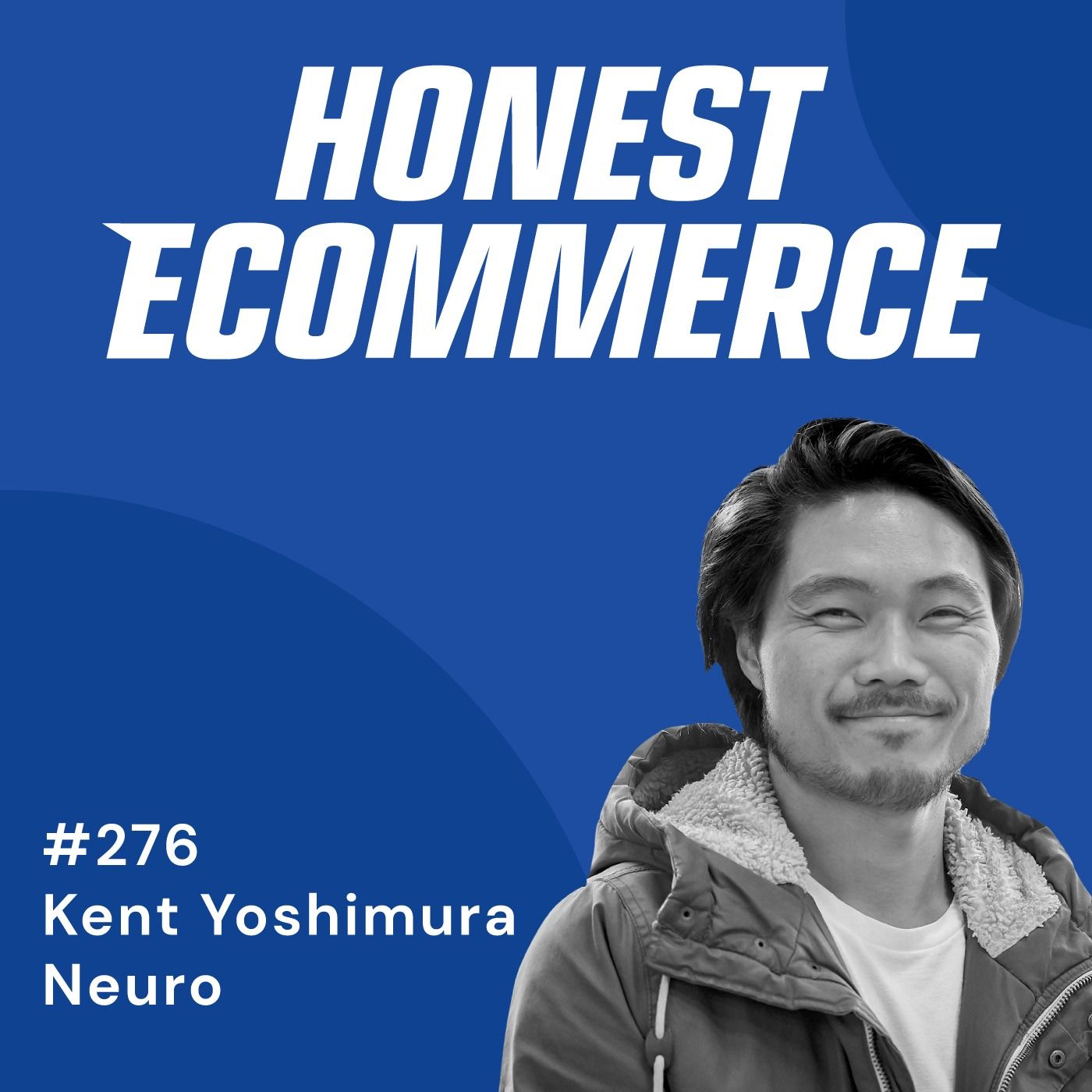
Kent Yoshimura
Business is people at the end of the day. It's not just a project. It's people. It's the people you sell to. It's the people that work with you. It's who you are.
Chase Clymer
Welcome to Honest Ecommerce, a podcast dedicated to cutting through the BS and finding actionable advice for online store owners. I'm your host, Chase Clymer. And I believe running a direct-to-consumer brand does not have to be complicated or a guessing game.
On this podcast, we interview founders and experts who are putting in the work and creating real results.
I also share my own insights from running our top Shopify consultancy, Electric Eye. We cut the fluff in favor of facts to help you grow your Ecommerce business.
Let's get on with the show.
Hey everybody, welcome back to another episode of Honest Ecommerce.
Today, I'm joined by Kent Yoshimura. He is the co-founder and CEO of Neuro who are creating the future of gum and mints.
Kent, welcome to the show.
Kent Yoshimura
Thanks, Chase. Happy to be here.
Chase Clymer
I'm super excited to chat.
Quickly, for those that aren't familiar with Neuro, you make gum and mints, but give us a little bit more. What's so cool about your product?
Kent Yoshimura
So when we first started the company, when we first came up with the idea over 10 years ago, supplements, first of all, were so badly regulated that you didn't know what you were getting. I was one of the first people to jump into this nootropics trend that was picking up.
Ryan and I, when we were on a scuba diving trip, realized that taking pills in public, even if they're better for you, it's not necessarily a good look. So if we can make it much more accessible and much more approachable, while also completely transforming an industry that hasn't been innovated in hundreds of years. People have been chewing gum forever.
Can we create supplements and health and wellness products that are way more approachable and accessible and easier for people to take? I guess that idea resonated with people because here we are. Still around and kicking and growing.
Chase Clymer
Absolutely. So if I was going to repeat what you just said for an idiot, A.K.A. myself, the product itself is gum or mints, but it has supplements included to offset the stigmatism of popping pills in public.
Kent Yoshimura
Yes. I think you put it more concisely than I did. We basically make gum and mints more functional.
Chase Clymer
That's awesome. That's awesome. Alright. You already took me there. So you were on a trip and you had this aha moment.
How long from that scuba diving adventure until you really got into like, we're gonna build products here, we're gonna do something?
Kent Yoshimura
You know, I didn't have a business background, but I did have a science background. And so did Ryan. We were both athletes training pretty seriously.
I was training for the Olympics every year from 16 till 22. Ryan was captain of his cross country and track team, but he got injured in a really bad snowboarding accident that left him paraplegic. So he went on to train with the pair for the Paralympics.
Taking that experience and using ourselves as guinea pigs, we started just developing the product ourselves over a course of, like, I guess my sophomore year of college where I was mixing these things by myself, all the way until maybe like 24, 25.
Until we finally realized, “Hey, how do we turn this into a product that other people may start enjoying? How do we turn this into what every entrepreneur thinks?” We’re like, “It can't just be us.” That could take advantage of the benefits of a functional gum and mint. It could be the masses.
From that point, it was about a year of research and development to turn into an actual product.
Chase Clymer
Absolutely.
So were you just, like, in the kitchen, making gum?
Kent Yoshimura
We tried to do that. It's not as easy as you think it is, but it's also not as easy as you think it is to make gum and mints in America by finding a co-man because there's about 3 companies that own everything in the confectionery space. The 3 that you would assume: The Mondelez, The Hershey, and The Wrigley.
Very fortunately, we're calling around all these people and found a mom and pop gum and mint manufacturer that was barely doing, I think, $10 million in business at that time. They took us under their wing and we quickly became their biggest brand.
Chase Clymer
That's amazing. There's a bit of a thing here and I really want to go back and highlight it.
How long were you ideating and trialing on the product before you got something that you were going to have a co-manufacturer take to the market with you?
Kent Yoshimura
We knew what active ingredients we wanted to put into it. With anything that we developed, we wanted to have clinically backed trials for the ingredients themselves.
With that being said, the hurdle that we ran into when we put them into a gum and mint format is when you're chewing on something for 10 minutes, 30 minutes, three hours, it better taste good. And a lot of active ingredients don't.
So when we started hitting those hurdles of mixing those ingredients and just making them in powder format and seeing how they taste, we realized that we needed a flavor chemist, an actual ingredient chemist that also could come together and make these active ingredients in as potent, efficient and efficacious format as possible.
Chase Clymer
Gotcha. So if you had to guess, what was this whole R&D life cycle? How long did it take?
Kent Yoshimura
About a year. It was a whole year.
Chase Clymer
Gotcha. Then you finally got the first versions of these things and you're ready to go to market.
How do you do that? How did it go from a product that you made with a co-manufacturer to something that you're selling to the masses?
Kent Yoshimura
Yeah. Outside of all the compliance stuff that I think every business needs to go through, we had a little bit more of a difficult time because gum is categorized as both a food and a supplement, depending on how you present it to the masses.
When we're approaching the big mass and drug retailers, they were looking at us as a nutrition label and they’re like, “I don't know what to do with this. We've never seen a product like yours before,” which is a gum product with these ingredients that typically fit on a supplement shelf.
We're the only gum to my knowledge that has a supplement label, and we went through the entire process of compliance to make sure that we could go out and sell it to the public. There was a little bit of a legal back and forth that had to happen because we’re not like beverages where there's so many beverage commands and different heat fill pasteurization processes that are backed by different compliance laws.
We were inventing a new category and had to come up with ways on how we were presenting ourselves and being compliant to be able to sell across all these platforms. To answer your question directly, the year of R&D was trying to get that product right.
But going from just being a DTC brand to a brand that can actually sell into all these places was probably another year and a half.
Chase Clymer
Oh, that's amazing. I definitely want to ask about both of those adventures.
I do just want to highlight something that I think a lot of our listeners need to understand. You are taking a product that exists... And please, I'm not trying to oversimplify what you're doing here, but you're just adding cool shit to gum, right?
You didn't invent gum. You didn't invent the cool stuff. You just took two things that existed already and put them together. And that's enough to make a multi-million dollar business, right? That's the concept I want our listeners to understand.
Kent Yoshimura
Oh, yeah. But people weren't doing it.
Chase Clymer
Yeah. It's good to be first. It's good to have that aha moment. But I think just for all the listeners out there that want to get into entrepreneurship, or maybe they have a product and they're working on understanding, you don't have to be the next Zuckerberg. You just have to do something that you already know that sells just a little bit better.
And the way that you're doing it better is by introducing these active ingredients.
Kent Yoshimura
I say, like, a year and a year and a half, and those might seem like long timelines, but they're all iterative processes while we were figuring things out and already selling and then learning that, “Hey, we can sell more, we sell better, we could be more compliant if we add these things on.”
I don't want those timelines to hold anyone back per se, to launch an idea because there's so many opportunities to do it. And now that we've been in business for about eight years, like the motto of KISS, keep it simple, stupid, is so much more relevant than ever before.
And it all starts with simplicity and being able to present it in the easiest way possible.
Chase Clymer
Oh, absolutely. I love that too, and it's a motto that I think all businesses need to run by, especially what we do at the agency. I think every annual meeting, we're like, “What can we not do anymore?” It's like a question we truly challenge ourselves to figure out.
Going back, though.
Do you remember when you first started selling this thing online? What happened then? How were you getting your first customers that weren't like friends and family?
Kent Yoshimura
Yeah. Actually, we're in the era of when crowdsourcing was a really big thing, and crowdfunding was a really big thing.
Kickstarter and Indiegogo were in their heyday and Kickstarter did not take ingestible products. so we launched on Indiegogo.
I remember the day we launched, I used to be a really big contributor to the Reddit r/Nootropics thread and I posted about this product that Ryan and I have been working on for the last year.
It became the number one post in all of r/Nootropics at that time in less than five hours. In that time period, we had this influx of just people that wanted to buy Neuro Gum, which bolstered us up. Also, in the Indiegogo rankings. We became a front page product. Two days later, Time Magazine wrote about us. Three weeks later, Dr. Oz invited us to his show.
We just kept riding that momentum. This is something that we talked about in the company all the time - in physics, there's this law of motion. A body in motion stays in motion, a body in rest stays at rest, unless there's an external force that acts upon it.
So whenever we pick up these moments, like two months ago, Joe Rogan made a huge call out about us on this podcast. Taking that momentum and being able to capitalize on it over and over and over until you reach that next stage where you could increase the size of the snowball, increase the speed of the momentum is a super valuable ideology that we try to maintain in the company, which has started since the very beginning.
Chase Clymer
Absolutely.
I've had a lot of guests on the show that have launched through a crowdfunding-esque avenue. Some had an agency or a team behind it and some did it on their own.
How did you guys approach it?
Kent Yoshimura
100% all on our own. Shot the video in our warehouse... Or not our warehouse, my apartment at the time, which was a warehouse because we had all of our products in there with my roommate, Ryan.
There's pictures from that era where we're just up all night just shipping products out because we had no idea that it was going to blow up that quickly.
Chase Clymer
Absolutely.
And I want to talk about the reaction of Reddit and posting the thread and it going viral for lack of a better term.
You mentioned, and I want to point out, you were already active in that community, right?
Kent Yoshimura
Yeah. Yeah.
Chase Clymer
So you came in with an authentic message from someone that knew what those people would like to hear.
Kent Yoshimura
I posted in a very genuine way. It wasn't trying to pitch a product. It wasn't trying to necessarily sell Neuro Gum and advertise to them. It was authentic, asking for their feedback, I gave them a very specific Reddit code, which might be the one salesy part. It just caught on.
And I think that authenticity and that genuineness is what probably resonated more than anything.
Also me being already part of that niche group of people. We're talking about this 24/7.
Chase Clymer
Yeah, I think that's a really crucial call out on getting that first buy-in from the market. Don't just go and try to sell something to a market that you haven't been in before and understand the problems or the questions.
The way that you probably worded that post was a reflection of just your knowledge of the ecosystem in and of itself, and that's why it resonated with people because you were speaking their language, talking about problems that they wanted to solve.
Where it's really obvious... This happens all the time, especially on Reddit because it's ruthless there. You will see people just get destroyed when they know it's a marketing play.
Kent Yoshimura
Oh, and it's pretty obvious when it's a marketing play. Reddit is a scary place in that regard. But it is also where you will find your strongest supporters, your strongest followers. And there are people from that Reddit era 7, 8 years ago that are still consumers of our brand. And it's still being talked about within that community. So it's very cool.
Chase Clymer
Hey there, merchant. Are you tired of trying to navigate the wild world of ecommerce on your own? Are you looking for a partner to help you achieve your goals?
Look no further than the Shopify Plus agency, Electric Eye. Our team has a proven track record of helping our clients make millions with strategic design and development.
Whether you're migrating from a legacy platform to Shopify, designing a new theme for your store, or just looking to optimize what you have, Electric Eye is the perfect partner for you.
Electric Eye are true Shopify experts.
Not only is our Shopify knowledge unparalleled, but we have partnerships with all the best tech in the Shopify ecosystem.
And don't worry, we're easy to get a hold of. Our clients rave about our fast communication.
So here's the deal, if your ecommerce business is doing over $1 million dollars a year you can receive a complimentary Shopify Diagnostic from our team of experts.
That's free, personalized, strategic recommendations to improve your store and grow your business.
To get started, head on over to electriceye.io/connect to schedule an intro call with one of our experts.
That’s electriceye.io/connect.
You have an amazing viral moment. Obviously, you weren't planning for that. And then it continues with you getting some major PR. You guys didn't have a PR team, I'm assuming.
Kent Yoshimura
We emailed... I remember it's just staying up, me and our current COO, who was my roommate at the time, emailing every single reporter that talked ever about nootropics, productivity, focus, whatever keywords that wouldn't match ours. And in one bit, we just used that as a social credibility point.
And then we emailed the next journalist and the next journalist. It was very strenuous.
Chase Clymer
If you could guess, just for a number's sake, how many people did you email? And then how many articles do you think happened?
Kent Yoshimura
Oh my gosh. Hundreds. I'm not even kidding when I say hundreds. And if I were to do it again, I would do it in a different format. But yeah, we went to Google News and we scraped as many journalists as we possibly can, even if they were adjacent to the topics we were looking at.
And I would probably say maybe 5% of them responded. But that's all it took to get to the next phase.
I remember one, which was like GearDiary, who's been a long supporter of us. They're not a big publication, but when they wrote about us, we took that testimonial that GearDiary wrote, sent it to Time Magazine.
Then when Time Magazine wrote about us, the floodgates opened.
Chase Clymer
Yeah, that's an amazing story.
So you have this moment, right? There's traction for sure.
How do you not lose grip? How do you not fumble the bag, as the youth would say?
Kent Yoshimura
I mean, I will say nothing's perfect. We definitely, I think, fumbled the bag in terms of the timing that we could have raised, the people we could have hired during that time to keep expanding and targeting the right consumers. Because when you sell to everyone, you sell to no one. And I think we tried to expand too quickly.
But, you know, I think at the end of the day, there was a genuine, authentic vision to what we wanted to do with our product and to try and to continue to try to keep making our product the best it could possibly be. Because neither Ryan, Tyler or I were business people at all. We were people that were taking these nootropics supplements that we knew worked really well and we wanted to put them into an even better format so that we could take them wherever we went.
Again, I keep using the word genuine and authentic, but I think that genuine approach to create a product that I would absolutely love myself - we never strayed away from that.
Chase Clymer
That's amazing. Now, there's obviously like an 8-year history of the company. All this stuff happened in the year 1, 2, and 3.
Looking back, are there any other mistakes or waited-too-long things that just stand out to you, or things that you could share with the audience that might help them maybe cut some corners. Not cut some corners, but some shortcuts within their business journey.
Kent Yoshimura
I think hiring well is incredibly important. And I think there's an ego that perhaps I had as an entrepreneur to be like, “Hey, as a founder, I am…” Most founders are passionate, as they should be, and they feel like they should be involved in every aspect of the business.
But now that we're a bigger company with 20 plus employees and people on the VP level that have that decade long experience building CPG brands, the amount of knowledge, direction that they're able to bring is so invaluable. And that would have sped things up way, way more. And they're worth every penny.
Chase Clymer
Yeah. I always tell people to hire the most expensive person you can afford. Because that's going to just get you to the next level. Have you read Buy Back Your Time by Dan Martell by any chance?
Kent Yoshimura
No, I know of the book though.
Chase Clymer
I am currently in the middle of it, and there's a lot of what you're saying here that resonates with it. The book is all about delegating and getting out of your ego.
The takeaways from it are 80% is awesome. If you can get someone to do 80% of what you can do, it's awesome. And good is better than perfect are the big takeaways of the book.
As a CEO, a lot of people hire for jobs that they are creating instead of hiring to get stuff off their plate that allows them to actually do the things that inherently make infinitely more money for the business.
Kent Yoshimura
Yep. There's another book called... Oh, it's right here. Who? Which is a hiring book that one of our investors who founded RXBar recommended to us while we were going through this hiring phase.
And he was like, “This is the most important book.” Start not just building culture and an employee count and streamlining operations, but finding, like you said, those people that can do at least 80%.
But then have a development plan to over exceed and to exceed what you would expect from them.
Chase Clymer
Absolutely. Yeah.
I think that in the zero to one stage of a business where you're just rubbing sticks together to make fire, trying to get some money, just doing what you can, you're never thinking about hiring.
There's a point where it becomes harder to hire people to help you than it is to sell your product.
Kent Yoshimura
Yeah. It's true.
Chase Clymer
The sales element, and it's any business. On my side of the thing, on the agency side, and yours on the product side, it's like, I know I can go and sell the thing we're selling. That's not the hard part anymore. The hard part is fulfilling the thing, getting the stuff done, getting people to do the motions that need to happen to make the business do the thing.
Kent Yoshimura
Yep. And staying with the trends and staying with riding the wave of business. Business is people at the end of the day. It's not just a product. It's people. It's the people you sell to. It's the people that work with you. It's who you are. So, I agree.
Chase Clymer
Absolutely.
Now, obviously, you didn't just stay in Ecommerce. You have expanded a bit into more of a traditional, I guess, omnichannel is the buzzword people like to say these days. When did that come into play?
Kent Yoshimura
Probably 3 years into our business. We had a huge opportunity with CVS, who wanted to bring us in. I think we rushed that a bit on the retail side and we're in over 12,000 points of retail, I think now, which is, in my opinion, a little bit too much.
You know, it was just kind of a different beast. And if anyone that's listening is trying to take an omni-channel approach: If you are a DTC brand but you don't have brand strength or don't do the right consumer insight research and surveying, make sure you do all those things before you go to retail because you're going to be fighting an uphill battle almost every single day when you need to sell to the masses and you can't directly communicate with them.
Chase Clymer
Sage words, Kent. I can't thank you enough for coming on the show today and sharing all your wisdom with us. You know it's a good episode when I didn't even broach sharp pink, so I'll have to have you back and we can talk a little bit about that.
If I'm listening to this thing and I'm like, well, this product sounds cool. Kent's obviously very passionate about it. Where should I go to check it out?
Kent Yoshimura
You can go to neurogum.com or amazon.com. We're a number one product in our category.
Or you could go to, I guess any of those 12,000 points of retail including Whole Foods, Walmart, Aeroon, Sprouts, almost every single natural store that you could think of. We're in. So go. Go buy us at retail. We always fight for velocity.
Chase Clymer
Awesome.
Hopefully, the listeners out there will pick up a pack of gum and leave some feedback. Kent, thank you so much for coming on the show today.
Kent Yoshimura
Thanks, Chase.
Chase Clymer
We can't thank our guests enough for coming on the show and sharing their knowledge and journey with us. We've got a lot to think about and potentially add into our own business. You can find all the links in the show notes.
You can subscribe to the newsletter at honestecommerce.com to get each episode delivered right to your inbox.
If you're enjoying this content, consider leaving a review on iTunes, that really helps us out.
Lastly, if you're a store owner looking for an amazing partner to help get your Shopify store to the next level, reach out to Electric Eye at electriceye.io/connect.
Until next time!