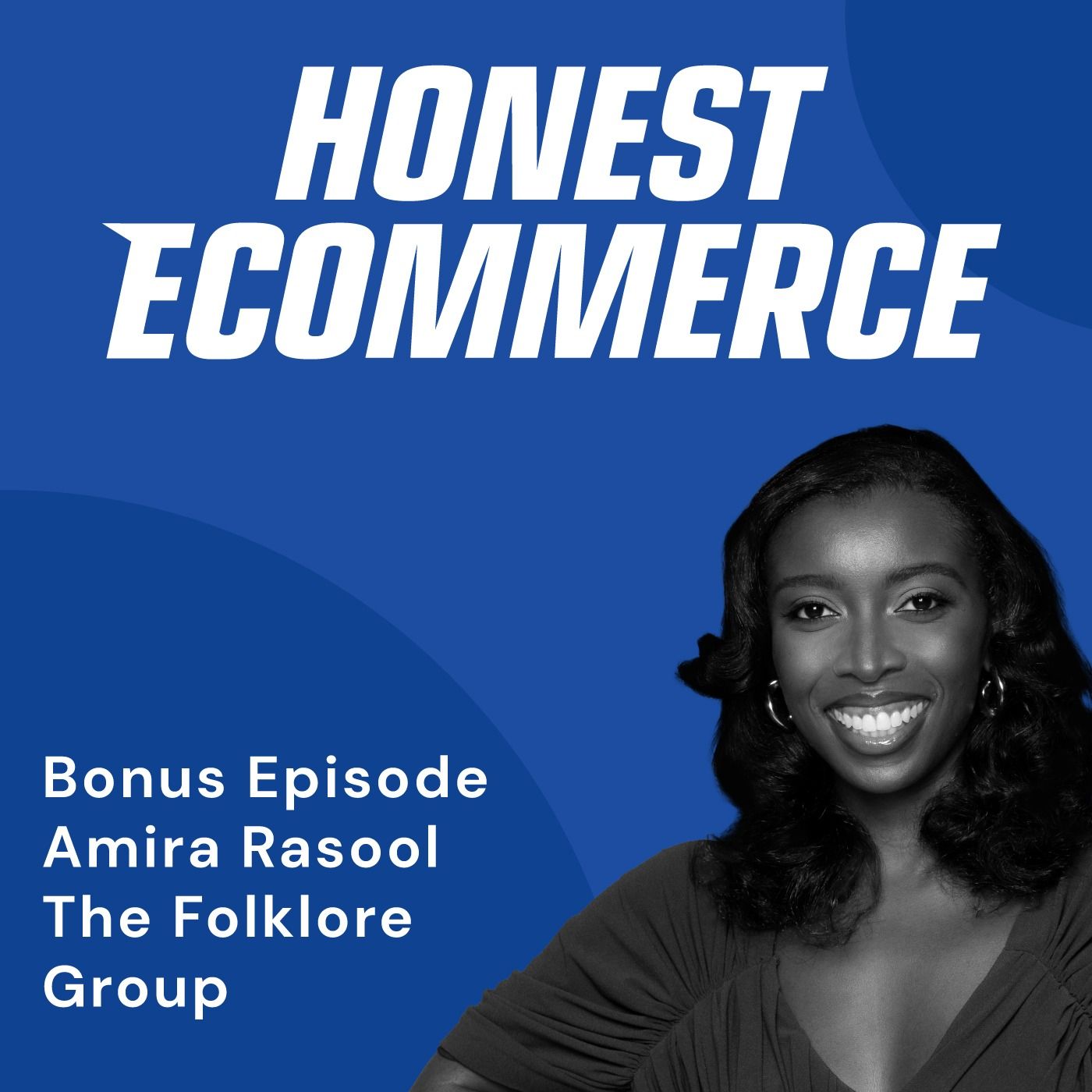
Amira Rasool
What we've done is simplify things and also provide people with the resources to know how to do these things.
Chase Clymer
Welcome to Honest Ecommerce, a podcast dedicated to cutting through the BS and finding actionable advice for online store owners. I'm your host, Chase Clymer. And I believe running a direct-to-consumer brand does not have to be complicated or a guessing game.
On this podcast, we interview founders and experts who are putting in the work and creating real results.
I also share my own insights from running our top Shopify consultancy, Electric Eye. We cut the fluff in favor of facts to help you grow your Ecommerce business.
Let's get on with the show.
Hey everybody, welcome back to another episode of Honest Ecommerce.
Today, I'm welcoming to the show Amira Rasool. She is the CEO and founder of The Folklore.
Welcome to the show.
Amira Rasool
Thank you for having me. Excited to be here.
Chase Clymer
Oh, I'm excited to chat.
So for those that don't know, can you quickly tell us what The Folklore is?
Amira Rasool
Yeah. The Folklore. We're a membership community for independent brands, providing them resources for them to learn, connect, sell, and grow. So really what we focus on is technology, education, and community. So we have a technology platform that's available to our members where they can sell in our wholesale marketplace and also manage their wholesale business.
They can source freelancers and manufacturers that are vetted by us and book their services. They're able to also access capital. We have the Capital Matchmaking Service for P.O. Financing and Working Capital.
And then we also have our new consumer marketplace that we just launched where brands can now sell their products to customers in over 220 countries and territories. That's really focused on supporting brands that are diverse, that are sustainable, that are making innovative products.
So really helping, you know, connect consumers with brands that are in Africa, South America, Asia, the Caribbean, as well as just brands that are doing good for the community. So that's the tech side of things.
Then on the education side, we have The Folklore Hub, which is our content center. You can find downloadable business templates. You can find business guides. We have monthly webinars. So all of those recordings are there. So it's like for those people who didn't go to a school on how to create a beauty brand or how to create a home brand or a fashion brand, we are providing those resources.
And then the last part being community. So we really focus on being able to bring together brands. There's never been a platform or a membership that's specifically for brands. And so we are that. We have a WhatsApp channel where there's different subgroups where brands are communicating with one another, asking questions, and finding ways to plan meetups themselves.
And then we do events ourselves. So we've done events in Accra, Ghana, we've done events in London, LA, New York, bringing together these entrepreneurs who are on the same journey, but sometimes in the same city or participating in the same fashion shows or trade shows, but they've never gotten a chance to actually connect.
Chase Clymer
That's amazing. It sounds very, very busy over there. But I'm sure...
Amira Rasool
It is.
Chase Clymer
I'm sure there's a little more humble beginnings. So take me back in time. Do you remember what was going on where the idea for the folklore came from?
Amira Rasool
Yeah, it was after I took a trip to South Africa in undergrad. It was my senior year. I'd gone just with two of my friends. And it was my first time going to Africa in general. And I just fell in love with all these brands that I discovered while I was there.
And when I got back to the States, I realized I couldn't access them from back in New York where I was living. But people would stop me on the street when I was wearing something that I bought there, like, “Where'd you get this from?” So I started to do some research to see why I couldn't access them in the way that I wanted to, and realized that the brands just didn't have the infrastructure in place back then.
This was about 2016. And so I wanted to find a way to be able to bridge that gap for brands in Africa.
Then it then grew into The Folklore being a multi-brand direct to consumer e-commerce platform where we sold goods from Africa and the diaspora across four categories, apparel, accessories, homeware, and beauty. And we ended up running that business for about four years before we transitioned to be more of a B2B solution. And it's actually a full circle moment.
So it became a B2B wholesale solution, then really grew into being a more like end-to-end solution for brands from education to technology community. And now we are back to our roots of also still offering that consumer element because it is something that was definitely missing a lot of our customers that we have before. We're like, “Oh, we're so glad that it's back.” So it's good to see the evolution.
It's like we understood that the major reason that we wanted to launch this business is to economically uplift brands that are typically marginalized from being able to enter certain spaces, whether that be retail stores or whether that be certain markets because they're either geographically disadvantaged, they're racially disadvantaged.
At the end of the day, our whole purpose was what are going to be the functions and the things that we can do to be able to empower these brands?
Initially, it was that D2C, then we got into B2B wholesale. Then we got into the educational resources, the sourcing. And it was important for us to make sure that we were doing one thing at a time well before we added something in. So that's where we kind of started and where we are now.
Chase Clymer
It sounds like you're doing a lot of help with brands, not in America. I know a lot of our listeners are here in the States.
Is there any... I know you've got the content resources. Is there any opportunity for them to partner with The Folklore and find some growth?
Amira Rasool
Yeah, so about I would say 40% of our brands are actually based in the US. So we really provide opportunities to people globally as well as within the US. So all of those resources are open to two brands in the US as well.
What we found is that the brands that gravitate to us in the US are independent brands. They're usually owned by people of color who typically don't have access to other additional resources, whether it be because of financial situations or just lack of resources, lack of access, lack of mentors, being in a city in Kansas.
So we find it from the people who are not in the core fashion cities or the place where it's like, “Oh I know the person who owns L'Oreal so they can help me with my beauty brand.” So it's kind of like we're that destination for the masses to be able to come and get educated on how to run a business and then get provided the tools in that community to help them out.
So we do a lot of events in the US. We are actually doing a two week pop-up in LA where we're gonna have about 40 of our brands selling direct to consumers there. We're teaming up with a place there called Pop-Up Home. And so that's a great opportunity that we're gonna have there. We're also gonna do workshops for our brands that are in the area as well.
And we're going to do the same thing in New York in November. And then we're going to actually do a CRO in December. CRO got it in December.
Chase Clymer
That's amazing. That's amazing.
Now, when a brand joins The Folklore, I'm sure you've got feedback forms and whatnot.
What are some of the things that they're saying about the value that they're seeing from this community and platform?
Amira Rasool
Yeah. One of the biggest things is the actual educational content because I think that one of the biggest questions I get when I still talk to brands on a weekly basis is, “Can you tell me how I can grow my business,” or “Can you tell me how I can market my D2C business better, how I should do this on social media?”
So I think the webinars have been something they've been very well attended and then we've seen a lot of people watching them after the fact.
So that education piece has been super crucial and it's been great to see brands take advantage of it because you have Google, but Google is a sea of different information. So being able to know that it's being provided by people who are really knowledgeable about the business and it's curated in a way that's easy to understand and digestible is great.
We've also seen line sheet generators. So we have a line sheet generator where all the products that you've uploaded, you can generate a line sheet automatically without having to sit on Canva or doing Illustrator for a few hours. You can just click download and all the necessary details are on there, imagery. So that's been something that people really loved that we've seen them utilize a lot.
And then definitely the events that we host. We do two showrooms every year. We’ll do one in New York for fall-winter collections in September and then one in February. And that allows retail buyers to come and actually see the brands in person. And now we're doing that same thing with the pop-up shops on the consumer side.
So we really recognize that brands really like to be able to have that in real life experience. And so we are able to provide that from a sales perspective, but also from doing dinners. We've done dinners around the world. We're just connecting those brands.
So I would say those are of the most valuable things that we've been able to provide them is that face-to-face interaction with potential customers, the face-to-face interaction with other brands, and then things that simplify and make things easier to do and quicker to do like that line sheet generator, as well as that education piece.
Chase Clymer
That's amazing. Now you already mentioned that you relaunched your consumer platform back in September.
What else is in the future for The Folklore? Where are you guys going to be investing your time and energy for growth?
Amira Rasool
Yeah, we're definitely going to be investing our time and energy in growing our membership more because we feel like the more members that we have, the more valuable that we can be to all of our members because it's not just about what The Folklore as a company can provide. It's about what our community of people can also provide.
We want to encourage brands to be collaborating and sharing resources with one another. So something that we want to definitely work on is growing the amount of members in our community.
And then being able to know what each member needs. So kind of grouping those members and saying, “Okay, this is the type of resources that we want to make sure that members at this stage have. And that these are the opportunities for them versus what members at this stage would need.” So being able to really like to create those silos to be able to best cater to, because it's not a one size fits all.
Businesses are at different stages, have different needs. So being able to really understand the needs of those members.
Also growing out like the resources. So growing outsource, having more manufacturers, having more freelancers that these brands can hire for services. It's been something that brands are always coming to us and saying, “Hey, I need help with this or that.” And we're like, “Hey, here's this resource.” So being able to grow out that community that can support them from a manufacturing perspective.
And then, really, it's about growing out what we currently have. I think we've done a lot of things like pivoting and trying to see what works. And I think we finally found our groove, like these are the things that they need the most, like the ability to have a place to get visibility, to be able to get sales and the door, whether it be D2C or B2B.
And then they need the education. And then they need access to people who can help them on that journey. And so I think we've now found the formula. And now it's just about making those things better and strengthening that.
Chase Clymer
That's amazing.
Now, I know we've talked about this a little bit, but I really want to just directly ask it for our listeners.
If I'm listening to this, what are some things that would be going on in my business or my life where The Folklore might be a great opportunity to help my business and life improve?
Amira Rasool
Yeah. So I would say if you're someone who's just thinking about starting a brand, you don't even have a full name. You don't even have products yet. I think The Folklore is great for that person because you can now use that education piece and that community piece to be able to learn what you would need to get to even launch a business.
And not only would you be able to use the education piece to learn, you would also be able to use source to be able to find who that manufacturer is going to be or to be able to find a business consultant who can also aid you in helping you know what to do next.
You can also tap into the community. You can create a whole group on our WhatsApp community. New brands, put everybody in a group, “Hey, everybody, this is for brands that have been in business for under a year.” And that'll be the people that you can make friends with that can help you on that journey.
That's for somebody who doesn't have a brand at all.
But now we can talk about a business which might be established for five years. They're out in St. Louis. You know, they're interested in being able to get outside of the St. Louis bubble. And they want to start growing more of their consumer sales.
That's them then uploading their products to our consumer marketplace, being able to have that visibility for more global customers outside of that St. Louis bubble. Or that's them saying, “Okay, I also want to get help with wholesale or already have a flourishing wholesale business. Small boutiques are already ordering from me, but it's very manual.”
They have to, I send them a line sheet and then they wire me money. And sometimes I have to chase for the balance. You don't have to do that through The Folklore. They could create their own wholesale storefront. They can invite all of their retailers onto the platform for free. 0% commission for all the orders processed from retailers they already have.
And now they can operate all of their wholesale business in one place. They can generate those line sheets if a retailer still wants to see it. But if not, a retailer can go in, add items to cart and check out.
So that's really what we've done is simplify things and also provide people with the resources to know how to do these things.
Chase Clymer
Now, is there anything that I didn't ask you about today that you think would resonate with our audience?
Amira Rasool
I think one of the biggest things that we always like to emphasize is our why and who we're really catering to. Our why is very much to be able to economically empower, again, those marginalized groups or even people who are just doing very innovative things that have put them on the fringes of what makes mainstream success.
When you are supporting the brands that we have here, it's like you're supporting a community that's really focused on diversity, equity and inclusion. That's really focused on sustainability. That's really focused on innovation and giving brands an opportunity to be able to be as creative as possible.
And then who we're doing it for is the maker that's in Zimbabwe and has these beautiful bags but no one would ever know because they just haven't been given the visibility.
Or somebody who is based in Atlanta, didn't get to go to SCAD, but wants to be able to have the knowledge to build their own fashion business.
So we're very much a purpose-driven company where we are really here to change and who has access to this industry and who has access to be successful. And that's really the number one mission of what we're doing is how we can be as supportive as possible to the large masses that typically don't have access to these things. There's more people who don't have access to these things than there are that do.
Chase Clymer
Absolutely.
Now, if I'm listening to this, and I am aligning with a lot of the stuff you say, and I'm excited and I want to learn more, what should I do?
Amira Rasool
You should go to thefolklore.com. If you're a brand, go to request membership and fill out a short little form. It takes less than 25 seconds. And we will review your application and hopefully get you on board. So that's the way to join.
If you're a brand, if you're a manufacturer or service provider, you can always also join, you can actually join for free if you're one of those, or if you're a retailer, join for free. It's also a short little application and then we will review all of those.
Chase Clymer
Awesome. Thank you so much for coming on the show today and sharing all those insights and obviously introducing a lot of us to The Folklore.
Amira Rasool
Thank you so much for having me. I appreciate it.
Chase Clymer
We can't thank our guests enough for coming on the show and sharing their knowledge and journey with us. We've got a lot to think about and potentially add into our own business. You can find all the links in the show notes.
You can subscribe to the newsletter at honestecommerce.com to get each episode delivered right to your inbox.
If you're enjoying this content, consider leaving a review on iTunes, that really helps us out.
Lastly, if you're a store owner looking for an amazing partner to help get your Shopify store to the next level, reach out to Electric Eye at electriceye.io/connect.
Until next time!