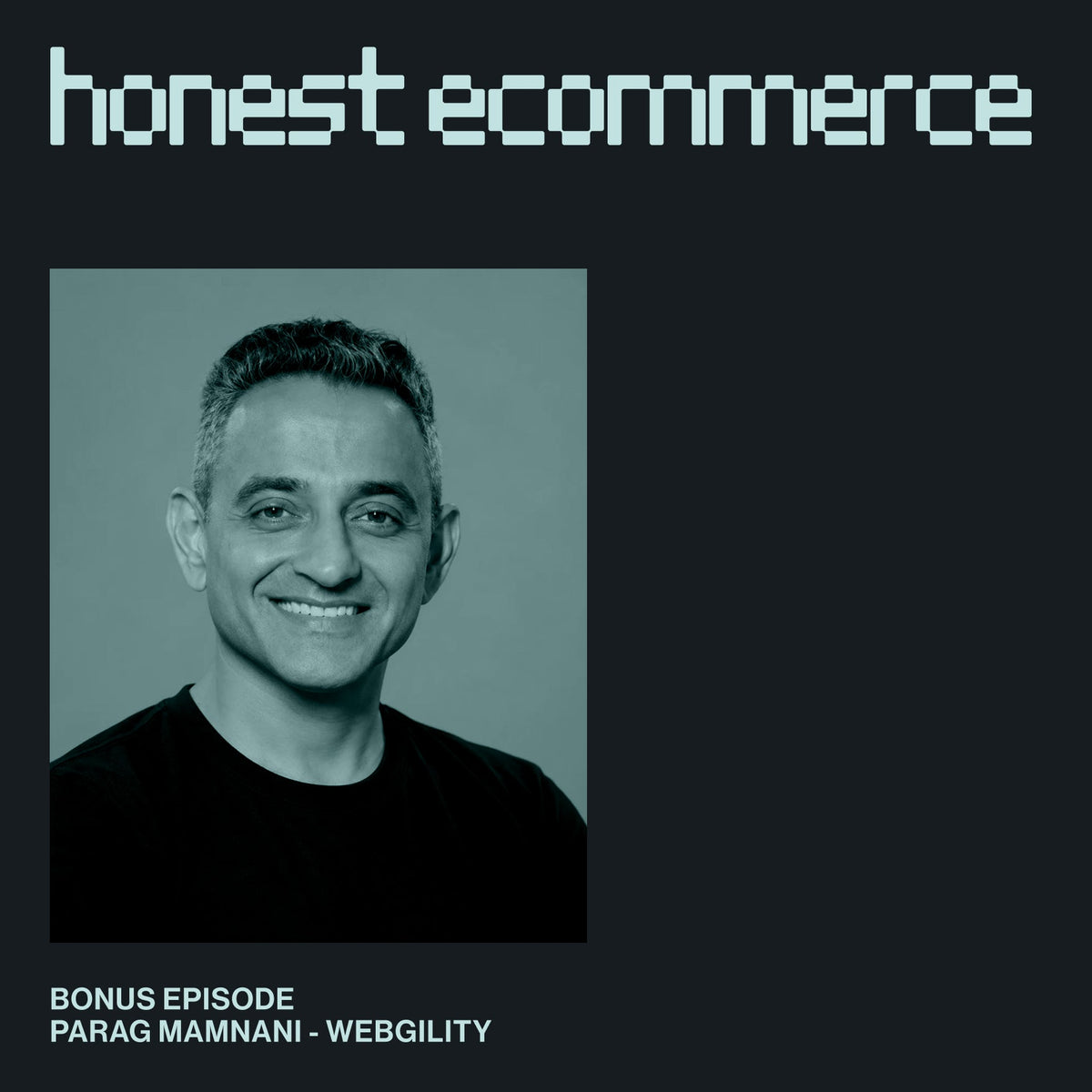
Parag Mamnani
You wanna be pointing at the bullseye. You wanna be constantly looking at where your... what your cash flow looks like, what your channels and SKUs are profitable. And to really stand out, you wanna double, triple down on your winners and really cut your losers fast. I don't like to think about it as a shell game, if you will, but I think it's really financial engineering.
Chase Clymer
Yeah, that does sound scammy.
Parag Mamnani
It's really all about do you understand the mechanics of how you're making money?
Chase Clymer
Honest Ecommerce is a weekly podcast where we interview direct-to-consumer brand founders and leaders to find out what it takes to start, grow, and scale an online business today.
Hey everybody, welcome back to another episode of Honest Ecommerce. Today we're welcoming to the show Parag Mamnani. He is joining us as the CEO of Webgility. He has spent 25 years in the ecom industry and he has built an accounting automation platform sellers have trusted for over 19 of those years. And now, obviously, with the rise of AI, he's taking it agentic. Parag, welcome to the show.
Parag Mamnani
Awesome. Thanks for having me, Chase. Great to be here.
Chase Clymer
I'm excited to chat. So twenty-five years in the game. That is nothing to shake a stick at. What were your first one or two gigs or projects, however you want to... what got you into ecom? How'd you end up here?
Parag Mamnani
Yeah. It's fascinating. In the markets today, we're comparing the AI boom to the '99-2000 internet bubble. So I come from that era. I actually graduated right when the ecommerce bust... internet bust happened, and there were no jobs to be found, and so my first training wheels was really building a small business and helping merchants get their online presence going, selling online.
So ecommerce platforms are very close and dear to me. Small businesses are very dear to me. And yeah, those are all of my early learnings about how to build a business, what channels, what platforms matter.
At the time it used to be that businesses were skeptical about actually putting their stuff online and ecommerce payments were just taking off and marketplaces were just in their nascent stages.
So we've come a long way since then and certainly lots of learnings. I've also had not only a bunch of years helping businesses get their presence online, but I've also got some experience working at Amazon. So I've seen platforms and selling at scale. So definitely lots of learnings over the past couple of decades.
Chase Clymer
Absolutely. When we do this show, oftentimes I like to highlight just the growth along the way of figuring out how to build a business. You just have to make choices and you have to pivot and you have to start to identify where there's gaps in the market and where to double down.
So I guess in the history of Webgility, from what it looks like now to what the idea was when you first launched, how different is it?
Parag Mamnani
It's fascinating. In some ways it's completely different, in some ways it's almost the same. When I think about what's identical, if you rewind back twenty years ago, merchants were still trying to figure out how to make sense of all of their ecommerce data. They were trying to figure out which channels to sell, where they would actually make money.
But the problems were very basic then. It was really about “How do I get my products online?” and “How do I sell?” Fast forward a couple of decades, now it's less about how do I sell, where do I sell? It's actually “How do I make money doing it?”
And so certainly the problems shifted, but at its very core, what was true then is still true now. You have to find new opportunities for growth. You have to sell in new channels and marketplaces. You now have multiple ways in which you can collect payments, multiple ways in which you can do fulfillment. You have to think about cross-border. You have to, of course, now think about sales tax.
So as businesses have started selling more online, the complexity has only gotten greater and the margins have only become smaller, which makes the problem of finance and accounting as important, if not more so now. I think it's one of those unsexy things that people really need to pay attention to.
And what I see most often is businesses that win and get to seven, eight figures are the ones that have figured out and mastered their data and their financials.
Chase Clymer
Absolutely. And you came in and you wanted to speak to this idea of why an ecommerce seller's bank balance never matches what is in QuickBooks. So let's dive in a bit there. Now, is Webgility a QuickBooks partner or competitor? How does that work out?
Parag Mamnani
Yeah, we're definitely a QuickBooks partner. Over the years, we've been their preferred and strategic partners all the way from their early product of QuickBooks Point of Sale to QuickBooks Enterprise. And now we're a gold certified partner with their QuickBooks Online product suite, including the enterprise suite. But we also cover Xero and that suite. But QuickBooks has always been a core platform we've supported.
If I go back again to my early days, why QuickBooks? Well, even fast forward 20+ years, QuickBooks remains one of the only systems of record that most small businesses have that actually has clean data.
Chase Clymer
Is arguably pretty easy to get set up and to get going. So they did a great job of lowering the barrier of entry for small businesses.
Parag Mamnani
Absolutely. But as complexity is rising, so are the tools. And now, starting with something basic as a general ledger, now you start to tack on payroll and sales tax and AR/AP. You start to add layers and layers of complexity, and that makes it obviously more and more challenging and you have to really learn the system.
But we focus primarily on multichannel brands, and my real emphasis over the last couple of years has been really “How do we make life easy for these merchants?” Because you don't become a founder to become an accountant. You become a founder because you're passionate about your business. You want to grow, you want to find products, you want to engage with your customers and build your brand.
And ultimately most founders look at accounting and finance as this compliance necessity and they think about it really late. And most often, I don't want to say they wing it, but they kinda do. They're really looking at their top level revenue data and their sales channel. They're keeping a close eye on their bank balance periodically and doing some math in Excel to figure out, “Hey, what's roughly my margin, what's roughly my cash flow, where should I be spending a little bit more or less?”
And what we really find is that, to a certain scale, you can succeed by looking at those things in a lump sum periodic way. But really as you start to scale, especially if you're going to build a high growth brand and expand it to multiple channels and geographies, you have to really dial down your numbers and that cash flow, the amount of money that's tied up in your inventory, how much you're paying in storage, how much racking up in all your marketplace and your other selling fees, ultimately all of that expense line item, the bottom line is where that makes or break, I think, success. Too often I think people look at just the top line revenue from their sales channel and think that that's where all the story is.
Chase Clymer
Yeah, I agree with you. You can get away with it for a certain time. And I'd even argue from zero to a million dollars a year for an ecommerce direct-to-consumer business, probably focusing on one channel. Maybe you've got a backup. You're probably focusing on one marketing avenue, maybe two.
But at that point it is like, this number is bigger than this number. We are growing to a certain extent, and you don't have enough money to hire experts or put the right products or tools in place, which is okay and that's fine.
And I think also there's something to be said about not over-engineering things at the start to where you do need to just go out there and sell it and make sure you have product market fit and make sure you have a viable business.
Then as you get past a million, you're tracking towards 10, becoming an eight-figure business like everybody wants to be, then it does become more about you have to know your numbers, you have to know where your profitability is. Especially, like you said, once it gets more complex with different markets and different channels.
The rates that Amazon is taking are different than the rates from your own online store versus the rates that you're getting from getting put onto your wholesale partners' shelves. Also, it is more expensive to sell in certain countries based upon other criteria, taxes, tariffs, etc.
So all of these things, you definitely need to have tools in place. And luckily, a lot of these are just rules that exist and it is pretty straightforward math, but it is... unfortunately, it is pretty unique to each individual product and company at the end of the day. So...
Parag Mamnani
Yeah, I'd love to believe that it's straightforward. What we find that it's not. That it's also a moving target. You think about the ever-changing landscape of marketplace fees, new fees are getting tacked on and new ways of selling are emerging. And I'll give you a simple example.
Just last month Amazon announced that you can pull in all of your non-Amazon orders. For the first time ever, Amazon opened up its marketplace and Seller Central, so you can pull in data from your Shopify, your TikTok, your Walmart stores. I'm not quite sure who wants to do that, but let's just say you decide to.
Now you've got Amazon actually capturing revenue data from other channels. And if that starts to appear in your settlement fees, boy, when you get that feed every couple of weeks, don't be surprised. We've already talked to a few customers that have tried it and are seeing duplicates show up because now they're double counting their revenue.
So just the way you handle your data, what you plug in, where you're looking at your chart of accounts and how money is flowing across the different channels, that level of complexity, especially for a multichannel merchant. So I totally agree with what you're saying about the early stage, if you're sub one million, you're just getting started. At that point, really it's a game of do I have a viable business?
And once you're past that stage, that's when you start to think about growing your brand and expanding to multiple channels. And every channel you add creates another layer of complexity. Every new payment method you enable, every new fulfillment mechanism, new vendors you bring on.
All of these aspects start to compound the complexity, and that's what we try to untangle. And we've been working on this problem now for a while and the puck keeps to seem... keeps moving because we get some things right, but then the complexity continues to increase.
Chase Clymer
Absolutely. I think that everybody talks about top line revenue. We're an X million dollar business, et cetera. But I don't care about that. And I think you, being in this game long enough, know that that number is very... it can be deceiving at the end of the day.
So the real number we should be looking at is profit. And so most sellers think they know their profit. What do you think they're usually missing in that calculation and in margin, and how far off are they usually?
Parag Mamnani
So I think the first place where things break is when sellers don't do something as simple as looking at all of the deductions, the fees, the returns, their reserve accounts from their marketplaces. So just looking at the net deposit from your marketplace is the number one place where early stage entrepreneurs go wrong. They think that that's their revenue, which is categorically wrong because your net deposit is just the net of fees. Your top line revenue minus all of the expenses that were deducted is what you should be recording in your financial system to get a true sense of what your margins are.
The second place where I see a lot of confusion and misses is not taking into account your channel level profitability. So you might be looking at aggregate at your overall business and have some sort of a quarterly close period, maybe, and looking at lump sum at, okay, total money in, what's in my inventory asset, what was my cost and payroll and so forth.
But the moment you start to unpack and actually look at it on a channel by channel basis, that's when the second unlock happens because you realize you're maybe miscategorizing certain expenses to certain channels, and that would dramatically change what your profitability is by the channel.
Similarly, I see that since you're helping a lot of merchants, I'm assuming also with advertising, that's another place that things go awry. You start to look at your advertising expenses in aggregate, that'll paint a very different picture versus putting your advertising expenses by channel to really figure out what's happening.
The third layer is then where the true unlock is, do you actually know your SKU level margins? And can you try to attribute by SKU by channel what you're making money on? And by the time you get to that level of math, there's definitely a level of sophistication that's needed of how you organize your financials and your books.
But that's when I think businesses that dramatically scale and see exponential growth, because they can go in with confidence and start to put dollars to work. They understand what their unit economics are for every SKU. They understand what the payback period is on the advertising spend, so that they're not shy of putting that money down because they know they're going to get their returns.
They also have a good handle of their chargeback rates. They're understanding what the attribution is for all of the different advertising channels as well for those SKUs so they know what to dial up and what to dial down.
So it could get complicated in a hurry, but at various stages of the merchant's journey, you have to add a layer of sophistication to understand the flow of money and where you're truly making it in a profitable way so that you know which levers to dial up and dial down.
Chase Clymer
Hey everybody, just a quick reminder. Please like this video and subscribe if you haven't. We're releasing interviews like this every week. So don't miss out. Now back to the interview.
Chase Clymer
I feel that zero to one, you're figuring it out. One to ten, you're rebuilding the systems that got you to one million. But beyond that, it does become, unfortunately, and this is what some founders like and some founders don't like, it is truly just math at a certain point. And it's how well can you invest money in the right things to return a profit? And that's all it is at the end of the day.
You could argue, well, there's all sorts of things to running a business. But once you find product market fit and you know that if you put advertising dollars or energy into this thing, it will produce profit, that's what things distill down into.
Then it becomes a money shell game of how quickly can I get this money back? How long can I go to not pay this money? Because any investment you make in inventory, it just sits on the shelf. It's arguably money. So then it just becomes this money shell game in a certain sense. And you gotta know those numbers to be able to make the right choices.
Parag Mamnani
Hundred percent, hundred percent.
And people often think about SaaS as also software subscription process. You collect revenue, you have a payback period. But this is so different from what ecommerce is about because in ecommerce as well, you're having a turn of your inventory. And so your inventory is your asset and the faster you can sell it... now you're also incurring a ton of storage related fees, even if you were to, say, place your goods on Amazon. So the faster you turn your inventory, you can make a better margin.
And especially when I think about the time that we are... we haven't spoken about AI much, but when I think about what is truly differentiating for merchants now, for them to scale, you have to get velocity. And so how do you pick up speed if you're not confident and comfortable in your data?
I actually posted on LinkedIn once, just a couple of months ago, that every one degree that you're off in your calculation, the faster you go, the farther away you are from your target. And so you want to be pointing at the bullseye. You want to be constantly looking at where your... what your cash flow looks like, what your channels and SKUs are profitable.
And to really stand out, you want to double, triple down on your winners and really cut your losers fast. I don't like to think about it as a shell game, if you will, but I think it's really financial engineering.
Chase Clymer
That does sound scammy.
Parag Mamnani
It's really all about do you understand the mechanics of how you're making money? And by the way, if anyone's thinking that this is...tricky and complicated. The fact of the matter, this is how you win. This is the proven playbook of Amazon.
Amazon for decades had negative margins, made no money in practically so many of their businesses, so that they captured market share. And at some point, now they just have to turn the dial. They capture the market, they figure out that they've got the customer base and the scale. So now you start to really uncork and start to get the profit engine moving.
And I think right now, especially with AI, it's so easy now to go look for new products. It's so easy to get products shipped in at low cost. You can generate so many ad campaigns. Let's not talk about all the AI slop out there, but there's definitely a lot of crazy, cool, interesting things people are doing to generate content and videos and social, the influencer campaigns.
But ultimately all of that power means you need to have the confidence to know how... where you're going to deploy your money. And how can you run a lot of rapid experiments? And so I think knowing your financials and understanding those unit economics is more essential now than it's ever been because you need to place your bets and there's a window of opportunity and all the categories are getting crowded. So you have to continue to really understand your numbers if you're gonna find that path to growth.
Chase Clymer
Absolutely. Obviously we can't not have this conversation without talking about AI. And I know that that's affected the service and the product over there. So how have you and the team been adopting it and how are your customers and clients seeing the benefits of AI? And obviously, how rapidly is it changing stuff?
Parag Mamnani
It's changing everything. I like to think about AI in two ways. One is what's it doing for our business, and number two, what's it doing for our customers. So how can we really leverage AI to improve the quality of our operations and serve our customers better? And what can we do with AI to really empower our customers and help them be more successful?
And so internally we're incredibly AI-pilled across all parts of our business. We're very methodical about content and what we do with marketing because there's definitely just tons of AI slop out there. But across the board, from our engineering to our customer support teams to our sales teams and product, we're using AI prolifically to build new capabilities into our software, develop optimizations, be able to respond and manage customer support stories, build new capabilities in the product at a lightning speed pace.
In terms of our customers, we see quite a bit of interesting diversion. When you think about accounting and financial data, on the one hand, I love how creative AI can get and the power that it brings, but its accuracy, across any benchmark on accounting and financial data, is still in the 80s or low 90 percent. And nobody wants their books to be 95% right. You want your books to be 100% right. You can't miss those numbers.
And so what we like to think about and do with AI is we empower our teams to leverage AI to do analysis and help build better products.
But what we launched this past summer is actually what I would call our response to how someone should deal with AI in today's world, is actually to build more human accountability. So we've got a team of accountants that we've been adding to Webgility that provide the human element where we not only give you our core platform where you can certainly manage your financials, look at your real-time stats across all your channels and close your books, but we now provide an accountant, which gives you the confidence that along with the software, you get the human expertise and the accountability that your data is not 90, 95% right. It's 100% right.
And so we have added a layer of human accountability to our service in response to what we believe is actually just a lot of noise and complexity. Everyone's selling some sort of an agentic solution. But businesses don't just need agents, they need accountability. They need someone that guarantees that what they're seeing in their books is accurate. So we back what we provide, our core platform, with now a human layer.
And behind the scenes, obviously our team is doing a lot of agentic capabilities and we have our own AI closing agents internally, but we're continuing to streamline all of that and shield a customer from that complexity, but give them the confidence that they can rely on us to manage and close their books.
Chase Clymer
Absolutely. Now, if I'm listening to this episode and I'm curious to learn more about Webgility and see if we might be a good fit to work together, where should I go? What should I do?
Parag Mamnani
Yeah, it's pretty easy. Just go to Webgility.com and we actually have an Ecommerce After Dark clinic that I'm excited about that's coming up here shortly. It's probably gonna be before this podcast is published, but we'd love for you to check out the recording.
We also have... I publish routinely on LinkedIn, so you can follow me, Parag Mamnani, for ecommerce-related small business and AI. I'm really a big fan of all of these things and I'm a big advocate for SMB, so I spent a lot of my time thinking about what we can do to help these small businesses win.
Chase Clymer
Awesome, Parag, thank you so much for coming on the show today and sharing all those amazing insights.
Parag Mamnani
Awesome. Thanks so much for having me, Chase.