Lauren Barker
One of the things that's scary about Meta is you have to spend to learn. But then once you get there, it's somewhat pretty flexible in terms of ramping up and ramping down. But yeah, probably at least 5k to 10k. And I remember that being a very scary number.
Chase Clymer
Yeah, that's what I set expectations with younger entrepreneurs these days. “If you don't really have 5k or 10k a month for a single channel, do not even try to spin that across TikTok, Google, no. All into one.
Lauren Barker
All into one. Yeah, for sure.
Chase Clymer
Honest Ecommerce is a weekly podcast where we interview direct-to-consumer brand founders and leaders to find out what it takes to start, grow and scale an online business today.
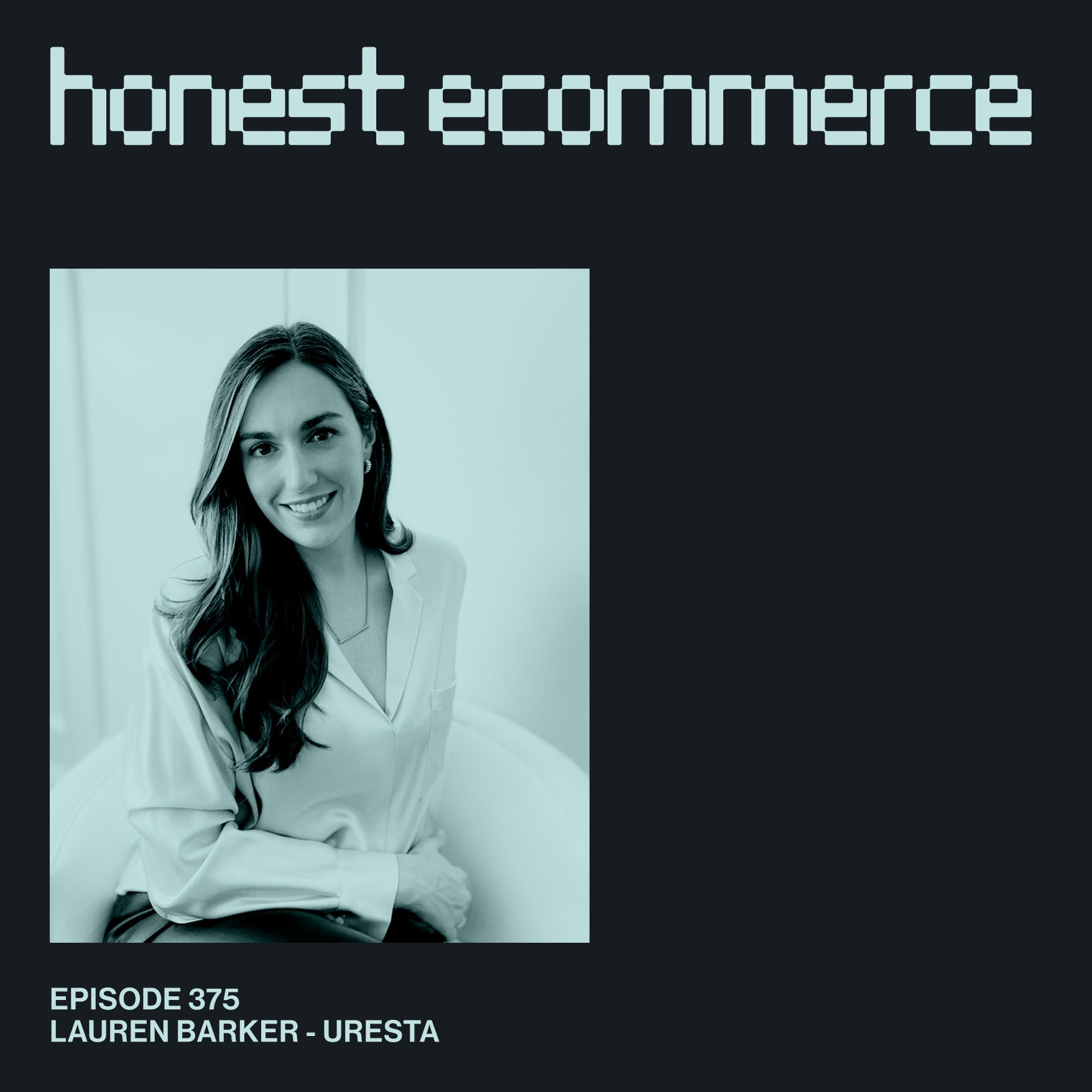
Hey everybody, welcome back to another episode of Honest Ecommerce. Today, I'm welcoming to the show Lauren Barker. She is the CEO and co-founder of Uresta, the support bra for your bladder, where she's transforming a taboo, underserved category into a rapidly growing pillar of women's health innovation. Lauren, welcome to the show.
Lauren Barker
Thank you. Happy to be here.
Chase Clymer
I'm excited. For those that don't know, what is Uresta? What's the flagship product that you are bringing to market over there?
Lauren Barker
So Uresta is a solution for bladder leakage. Leaks that are caused by coughing or sneezing or jumping. If you've ever seen a woman cross her legs when she's about to sneeze, she has bladder leaks. And basically what's happening in the body is the muscles that are supporting your bladder have become weaker and damaged. It could be because of pregnancy related or you just started getting older, hormones as well.
And we say we are a sports bra for your bladder because we actually help support the bladder to prevent those leaks from happening. This is our product here. And it essentially is a vaginally inserted product that will just support your bladder from within the vagina. I know that sounds very confusing.
But it will prevent the leaks from happening, but you don't have to take it out to pee. So this is like, like I said, a sports bra.Or say if you sprained your ankle, you might wear an ankle brace. Think of it the same way.
Chase Clymer
Absolutely. Yeah. And I remember from when we chatted a while back, little inside baseball for all the listeners. We do a pre-interview for all these things. You mentioned that this is a very common problem that isn't talked about much.
Lauren Barker
Yeah. So it is very prevalent. It impacts about 1 in 3 women after the age of 30. And then as many as 1 in 2 by 10 in menopause. Obviously, no one wants to pee their pants. It's embarrassing. But I think it also, and I've talked to thousands of women this point.It's something that makes them feel old. It makes them feel gross.
They might worry in a social setting or a work setting. I hear this all the time, “Oh, I smell like urine. Can my colleague smell that I just leaked? So it's a huge confidence issue. But it's incredibly common. And I think because it's so embarrassing, women don't necessarily talk about it. So I think they often feel very isolated.
Chase Clymer
Absolutely. Now, where did the idea [come from]? Is it the chicken or the egg? Was it the problem or the solution? Where did the concept... Maybe there's a product here, a business here. Where did that start?
Lauren Barker
So it is a bit of an interesting story. I started my career in investment banking and private equity. So I was on the investing side or buying businesses. And I just kind of by fluke, met the inventor of Uresta. So he was actually a urogynecologist. So he was actually doing bladder surgery to prevent leaks. And there's a lot of limitations when it comes to surgery. And I mean, obviously it's invasive, it's not always successful.
And I think he was also just finding that a lot of women were trying to find a non-invasive solution. And so he came up with the idea. And as you can imagine, a medical product is very expensive to go through the initial clinical studies, regulatory approvals, and then just not really having the right experience or background. He was a full-time physician to properly market the product.
He had invented it, gotten it through those initial regulatory hurdles, and then was just roadblocked. And didn't really know where to go next and had personally invested a fair bit of money. I got connected with him, like I said, I was working in private equity. There's not a lot of females in private equity.
And someone sort of put us in touch and had said, would you just take a look at this business and see if maybe you could provide any advice? It wasn't the right fit for say my firm necessarily to invest in. But it just really sparked an interest in me. I feel like at the time it was probably like 2018, 2019.
I feel like we'd seen so much disruption in the menstrual space, for example, like menstrual cups. But then if you looked at the incontinence space, you were really just seeing, I think it was [limitation]. We did a survey and some research. About 80 % of women were using pads to manage their leaks. And it just felt really archaic.
And also starting to understand that women were so dissatisfied with that solution. And then you also realize that this is such a common issue, like one in three women. That's a lot of women and the pad industry is huge. It just felt right for disruption. And I basically, it was one of those things. It was kind of like a bug in my ear. I thought about it for about two years. I was helping Dr. Farrell on the side of my desk, just purely out of passion.
And then finally, one day I was like, it's now or never. And I don't want to wake up in 10 years and be like, “Wow, I really wish I quit my job.” And I didn't want to regret not partnering with him. And so yeah, I jumped in like 2 feet in.
Chase Clymer
Hey everybody, just a quick reminder, please like this video and subscribe if you haven't. We're releasing interviews like this every week. So don't miss out. Now back to the interview.
Absolutely. And that was one of the things that I really thought was exciting about your story and something I don't know if we've covered on the podcast before was you aren't the inventor of the product. But you were there from the very [beginning]. Not the very start, but pretty close to the beginning. And this is just another path which you can take in Ecommerce.
I think one of my goals with this podcast, I guess, would be to show there's a bunch of ways to build a career, a life, and to do what you want in this space. You pointed out here that there are certain people that have great ideas, and then they don't know what to do next. And so if you are a person that is good at helping with some of these skills that we'll probably get to talk about here in a minute. Like marketing, branding, wholesale, distribution channels.
If you're just an Amazon expert, you just have to go find someone with a smart [idea]. With a cool product, right? There's a bunch of ways to do it. So that's my little soapbox moment for everyone. It's like, you don't have to have the next best idea, but you got to find someone that does.
Lauren Barker
Yeah, totally. I think like Dr. Farrell, he's our chief medical officer. I love him. He's a great guy. But he really struggled on how to build a business and how to properly market it and have a successful go-to-market strategy. And he's smart. He obviously developed a very unique product. He required that medical knowledge. But yeah, I think it was lucky when we met, it was like the right time, right place.
But I think to your earlier comment, entrepreneurship can take so many different angles. I think we see a lot and so I grew up or started my career in finance. And so it's somewhat common to buy a business instead of starting a business. And so I always like to say, we were a hybrid between a true startup from the ground versus buying an established business. So yeah.
Chase Clymer
Do you know what's going on with Klaviyo? When was the last time you explored what it can do?
Klaviyo has been shipping tons of new AI, data, and automation features designed to help ecommerce teams move faster, personalize better, and automate more of the work that used to take entire teams.
Most brands are only using a fraction of what is already inside their Klaviyo account.
Klaviyo is not just email and SMS anymore.
It is your customer data platform, your lifecycle marketing engine, your analytics layer, and now your AI-assisted execution layer, all in one place.
That means your customer data updates in real time.Your segments stay current automatically.Your flows and campaigns all run off the same source of truth.And now AI can help predict churn risk, forecast spend, recommend next best products, generate campaign content, and optimize send timing across channels.
The big unlock is speed and efficiency.
Fewer tools to manage.Less dependency on engineering.Less time moving data between systems.And lower total cost of ownership across your marketing stack.
And brands are seeing real results from leaning further into Klaviyo.
Dollar Shave Club has reported over 30 percent reduction in total CRM stack cost after consolidating onto Klaviyo. Brands like ThirdLove have seen 15x ROI from SMS after consolidating channels. And companies like Corkcicle have grown flow revenue over 90 percent after bringing email and SMS together inside Klaviyo.
Across our customer base, every single brand we work with today is using Klaviyo. That is just where serious ecommerce customer data and lifecycle infrastructure lives now.
If you are already on Klaviyo but feel like you are not getting everything you could out of it, or you are running multiple tools and want to simplify without losing power, this is worth your time.
Go to klaviyo dot com slash honest to learn more.
I could also just imagine that it was possibly hard for the good doctor to speak to women in the way that they want to be spoken to as a male.
Lauren Barker
Yeah. I mean, he's doing surgery for this. He was talking to women. It's very... Marketing is so different. And our product is very interesting in the sense that it's a product that women really need, but don't necessarily want. And there's just so much shame. And to be honest, probably a lot of denial. So it's very different from a lot of other products out there that are being marketed.
Chase Clymer
Yeah. And marketing, surprise, surprise, has nothing to do with the medical benefits. It has to do with how it helps the selfish little things that drive human nature. So I'm sure that's something that's been fun to explore. So just to get back to the journey. You're like, “Screw it.” You jump in, like you said, both feet first. You don't want to miss this opportunity. What's going on in the business? And what were some of the first things that you started to give your full attention to?
Lauren Barker
So when I first joined full time, we were generating almost no sales. We had a couple things. We had been through Health Canada approval to sell over the counter so we could sell directly to consumers in Canada. In the US, we were prescription only. So in order to get Uresta, you would need to go to your doctor and get a prescription. So the first thing out of the gate is we started doing a ton of customer research and competitor research.
And what we realized is that a lot of women weren't actually talking to their doctor about it. So less than 50 % would actually bring it up with their doctor. I think because it's a quality of life issue, it's not necessarily, “Oh my god, something's wrong with me. Maybe I have cancer." I think a lot of women would be, “Oh yeah, I pee when I sneeze but so does my mom. So I know it's okay.”
So yeah, we were finding a lot of women weren't going to their health care provider. We were also finding a lot of them were buying pads or reusable leak proof underwear. So we're like, okay, the majority of women are already buying their products the direct to consumer route. And so we really felt like we needed to be DTC. We needed to cut out and that was something I thought initially.
The thought that we go more like the medical sales route, like educating physicians who would then tell their patients and then it would be sort of a prescription model. But I really felt strongly that we needed to take down that barrier of the prescription in the US. And as you can imagine, like going through an FDA process even though we had been FDA cleared, but just to remove that prescription requirement was incredibly expensive.
We didn't have the capital to do it and it would take a lot of time. So my first kind of gut reaction was, “All right, well, we have the ability to sell directly to women in Canada. Let's test it here.” If you haven't figured it out, we are Canadian based. So we started in Canada. Under this like direct-to-consumer strategy. And we saw traction almost immediately. And that little bit of traction allowed us to raise the capital we needed to start the FDA process.
So we knew we were going to have to raise capital. But yeah, we basically did that kind of building a case study in Canada. And then as we went through the FDA process, which was almost three years. We continued to grow in Canada and just like to learn as much as we can. Built our market strategy here so that when we are ready to launch in the US, we were better equipped, obviously.
But then also could again, use Canada as a case study to then raise money to really go out of the gates in the US quite as aggressively as we can. Or with as much success as we could.
Chase Clymer
Hey Store Owners -
Do you know how profitable your last BIG decision was on your Shopify store?
Most testing tools make it easy to measure design changes - small tweaks. Headlines. Layouts. Button colors.
But what about the decisions that really move the business?
Pricing changes. Shipping rates. Discount strategy. Even new apps and tools.
Those are usually left to gut feel.
Intelligems brings CRO-level clarity to decisions that live beyond the page.
Brands like Ridge, Jones Road, and True Classics are using Intelligems to test pricing, offers, shipping, and more, and see exactly how each choice impacts profit.
Momofuku used Intelligems to test multiple promotional offers ahead of Black Friday and identify the version that ultimately increased profit by about 28 percent.
Mott & Bow used Intelligems to run structured pricing and offer tests that helped drive roughly a 30 percent increase in incremental profit.
Dossier used Intelligems to run sitewide testing that resulted in about a 7.4 percent increase in profit per visitor across their store.They have a bunch more case studies on their website.
I’m a big fan of Intelligems. We use it with almost every client at our agency, Electric Eye.
We use Intelligems to test major site changes, new theme launches, and throughout ongoing CRO work
So when we are making decisions around design, pricing, offers, ETC, we can be confident that those changes are actually driving more profit for our clients.
So, before you start changing pricing, promos, or major site experiences across your store all willy-nilly, you should test it first.
If you're ready to decide confidently and grow profitably, head on over to intelligems.io and use code "honest" for 10% of your first 3 months. That's intelligems.io Use code “honest.”
Absolutely. And this is my favorite…
Lauren Barker
Yeah.
Chase Clymer
Topic. Not really. All right. What was that aggressive go-to-market strategy in the States? What worked in Canada that you were trying to replicate here in the States once you got that barrier of that prescription out once you could just start selling online?
Lauren Barker
Yeah. So a couple things. One thing to note is we did also launch during the beginning of COVID in Canada. So I think you're somewhat limited. For example, we started on Meta. I feel like there were a lot of conversations around women's health happening on Meta. So there were a lot of allied healthcare professionals.
One, a big one was pelvic floor physiotherapists, for example, who were not working, who were honestly bored. They were at home. They were starting to post content online. So we started partnering with them to be like, “Hey, we want to send you a product. Can you do a review? Can you talk about it?”
So we started to build trust that way and spread the word that way online. And then we started with Meta ads too, I think also because we were super eager to just get traction and show the product works.
We knew trust was going to be huge. We knew we needed to get reviews. We knew we needed to get testimonials. So we knew we had to get sales. So we were like, “Okay, let's just get sales.” Not at any cost, but started with Meta. And then once we started to get the ball rolling on Meta, we were able to then just start. We started interviewing customers who bought it, doing surveys, really understanding what was in an ad that drew them to purchase.
And just really just started to learn as much as we could so that we could just improve our messaging. And we honestly grew pretty much mostly through Meta initially in Canada. And I know it's a challenging platform for a lot of people. But I think because it is a pretty large market size, we saw a lot of success. At the same time, once things started to open up, we had a big cohort of runners.
So we started doing... If you're running a marathon, there's often an expo before the marathon. So we would go to a marathon, we'd have a booth. So we started to do in-person events. And then when we launched in the US, it was a lot of the same stuff. We have started to tap TV, which has also been a huge one for us as well. I think there's cool platforms like Tatari.
There's ways to test TV in a very measurable way at a much smaller scale than I think you would think. It shocked me. But yeah.
Chase Clymer
That's amazing.
“I have been in business for nearly 20 years, and very few companies I have hired in that time have performed as well as Electric Eye. They have knowledgeable staff, and our project was delivered on time and on budget. Electric Eye has exceeded my expectations, and I look forward to working with them again.”
That is a direct quote from one of our clients at Electric Eye.
Electric Eye is a Shopify Plus partner that has helped over 100 brands migrate, redesign, and optimize their stores since 2016.
If you'd like to increase your conversion rate, average order value, and revenue per session, we are the true Shopify experts you've been looking for.
Right now, we're offering a free diagnostic to qualified brands that reach out and mention the podcast. Visit electriceye.io today to schedule a call and send us a message. Find out why we have over 50 5-star reviews in the Shopify Partner Directory. Again, that's electriceye.io. E-L-E-C-T-R-I-C-E-Y-E.io
Just because I want to set expectations for brands when it comes to paid ad spends and stuff. You don't have to give us the exact down to the penny. But do you remember when you were ramping things up, what you were spending a day or a month? Or when was it a scary number that now looking back, you're like, “Wow, I can't believe we were even spending that little?”
Lauren Barker
Oh, that's a good question. I remember early days being like, “Okay, do we have $5,000 this month to put into Meta?” That felt like a really scary number. I think one of the things that's scary about Meta is you have to spend, to learn. But then once you get there, it's somewhat pretty flexible in terms of ramping up and ramping down. But yeah, probably at least 5k to 10k. And I remember that being a very scary number.
Chase Clymer
Yeah, that's what I set as expectations with younger entrepreneurs these days. I was like, if you don't really have 5k or 10k a month for a single channel. Do not even try to spin that across TikTok, Google. All into one.
Lauren Barker
All in one. Yeah. For sure.
Chase Clymer
Absolutely. Yeah. Then something I just wanted to point out about you guys going after the Canadian market while trying to figure out what you could do in the US is once you had that email list and you had that pixel in Canada. Some people like to call it seasoned or whatever.
Lauren Barker
Sure. Yeah.
Chase Clymer
When the US opened up, you could just make a lookalike audience with all that weird data that Peta has on everybody. These are the exact customers. So I'm assuming being able to branch out into that market was infinitely easier than going from zero to one on Meta in the first place.
Lauren Barker
Yeah, I think it was for sure. There were a few different things we leveraged. One, we had our existing customer base. So we had a pretty good idea of the types of women who were purchasing Uresta. We had different cohorts. So we had our Canadian personas. We did a fair bit of research prior to launching in the US. So we did surveys and customer interviews as well with women who suffered from bladder leakage. And we found them to match up quite well with what we were seeing in Canada.
It is interesting. I did hear from a lot of other Canadian brands who first launched in Canada and then launched in the US that would tell me the US market is very different. Your personas will be very different. An ad that works in Canada won't necessarily translate in the US. I will say that has not been the case for us.
Chase Clymer
Yeah, maybe in Montreal.
Lauren Barker
Yes, maybe. But I think maybe a little bit right now, there's definitely probably stuff in Canada that's Canadian-specific or Canadian-made product, for example. So that's something that is important to Canadians right now. But generally speaking from a persona and a messaging standpoint, I think we found it to be pretty similar. And then something that was initially recommended to us was actually to split out our ad accounts.
So we'd have a US account and a Canadian account on Meta. But we have really strong engagement on our ads. So we'll have women who will be like, “I use this product. I love it.” Or people will ask questions about it. And then it'll get a lot of engagement, which obviously also helps with ad performance. And so we were able to leverage some of those high engagement ads by relaunching them when we started in the US.
So and I kind of agree with my earlier point, trust is really important. Building social proof was critical for us. So yeah, being able to just leverage all that social proof from Canada has been really important in our US launch.
Chase Clymer
Absolutely. Now, is there anything I didn't ask you about that you think would resonate with our audience?
Lauren Barker
I think it's because I always think about a couple different things. I think with Uresta, I touched on this, but it's a product that I think women don't necessarily want to accept that they have to purchase. I speak with a lot of our customers. It's like one of our [SOP]. If you're not in regular contact with your customers, you should be because you learn so much.
Currently, right now, I am reaching out to women who have expressed interest in filming a video testimonial. So when I reach out to them, we usually start the call off on getting to know them and their purchase journey and all that. But I've heard this from so many women now, “Oh, I knew about your rest, but I was on the fence for like eight months because I didn't want to accept that I needed this product.”
And so I was like, “Okay, this is really interesting.” It wasn't the price that was holding them back. It was truly denial and them feeling like they were old and accepting that they had the issue. So I don't know. It's been really interesting because I think there's so many products out there where you want to buy that product. But you don't necessarily need it. And we're like the total opposite.
And I think just really leaning into trust and education and finding ways to destigmatize bladder leakage has just been really important in our marketing journey. Because I think I've had so many people along the way being like, “Oh, this should be like a slam dunk.” And I'm like, it's not necessarily a slam dunk.
Chase Clymer
Yeah, but writing the ads. You interview your customer and then talk about that transformational moment. That is just hook, line and sinker. Easy ad copy right there.
Lauren Barker
Right. Yeah, for sure. Exactly. Yeah.
Chase Clymer
That's amazing. Now if I'm listening to this, and it potentially resonates with me, maybe I'm not there ready to accept it, but I want to get on your retargeting pixel. So what website should I visit to check things out and learn more?
Lauren Barker
Yeah, it would be uresta.com. So uresta.com.
Chase Clymer
Absolutely. We'll link to that. We'll link to your Instagram as well in the show notes. Lauren, thank you so much for coming on the show today and sharing that amazing story.
Lauren Barker
Awesome. Well, thank you for having us.