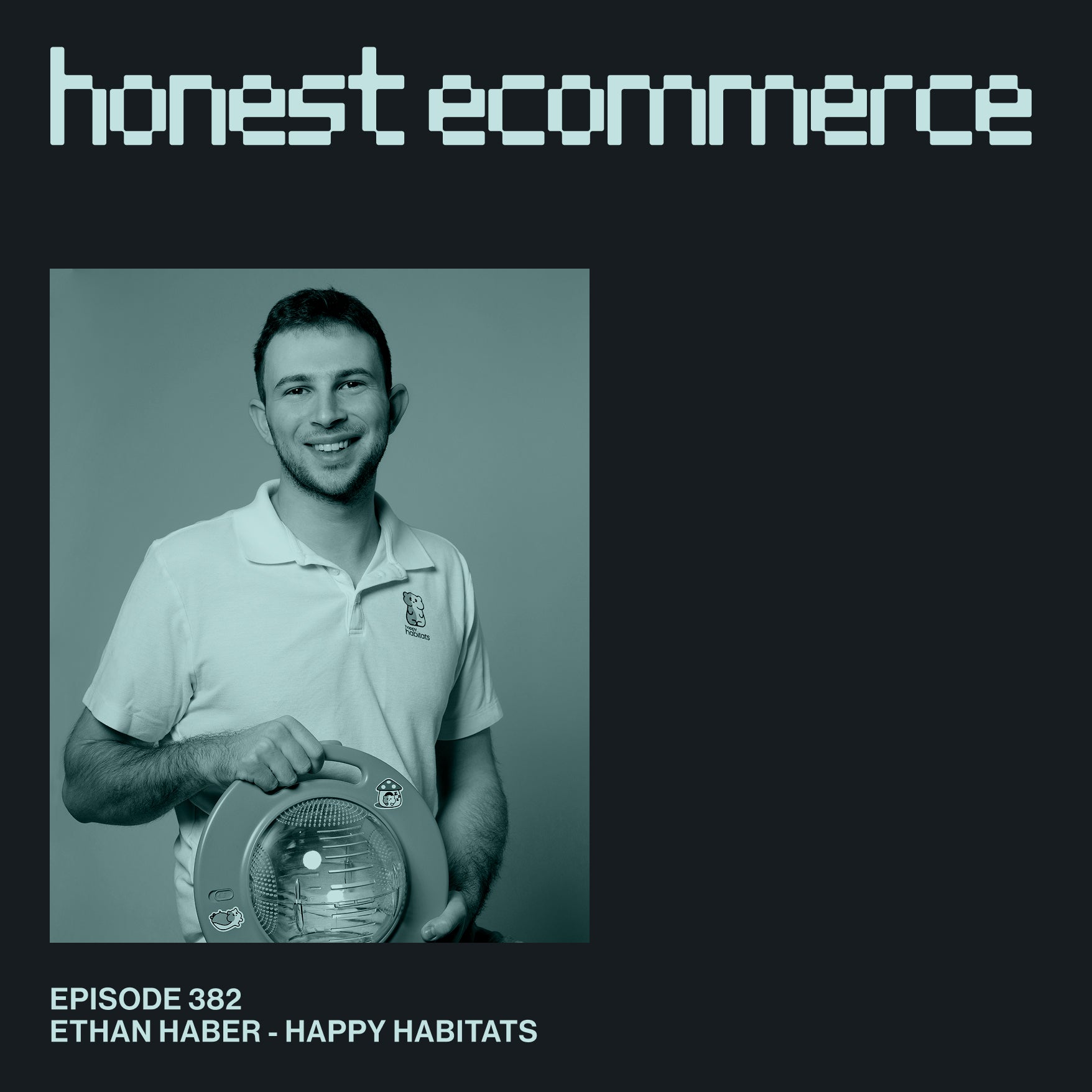
Ethan Haber
To design a quality product as cheaply as possible as opposed to create the best possible product within a budget. And we budgeted to put all these extra bells and whistles into it within that threshold that weren't necessary. They were just cool.
Chase Clymer
The way I think about this is when there is a timeline on a project, it's like, this project is 16 weeks. It's going to take 16 weeks. But if we go, if we're getting this done as fast as possible, somehow we just did it in 5 weeks. And it's like, well, why can't we do every project in 5 weeks?
Honest Ecommerce is a weekly podcast where we interview direct-to-consumer brand founders and leaders to find out what it takes to start, grow and scale an online business today.
Hey everybody, welcome back to another episode of Honest Ecommerce. Today, I am welcoming to the show the man who started a hamster ball business from nothing and grew it to scale. Here is the CEO and founder of Happy Habitats, Ethan Haber.
Ethan Haber
Hey, Chase. Thank you so much for having me. I'm excited to talk with you.
Chase Clymer
Absolutely. This is going to be a fun one. take me back in time. Where did the idea for this business come from?
Ethan Haber
So when I was 19, I got a “emotional support” hamster named Mooksy. He's the first small pet I ever owned. I loved him a lot. And I wanted to bring him to college and to have him come with me to university, I had to have a therapist to register him as an emotional support animal so I could keep him in my dorm.
But so Mooksy and I were on the quad one day and he was in his hamster ball and I was just chasing him in circles. And I turned and I saw a woman walking her dog and I thought to myself, why can't you walk your hamster? And that was the idea that literally and metaphorically got the ball rolling.
Chase Clymer
Absolutely. Alright. So what year was this? Does the month matter?
Ethan Haber
So we incorporated in October 2019. And is that like the same time that you had the idea for this product? I probably had the idea the spring before and did some homework and groundwork before that. And then when I decided this was what I wanted to do, I made actionable moves that next fall.
Chase Clymer
Gotcha. So it was just floating around in your head for a while and you're thinking through it. What was really the impetus to be like, “All right, I'm gonna do something with this. I'm gonna try to make a business out of this,”?
Ethan Haber
So after I had the idea, I did some homework. And I recognized that I'd stumbled onto a niche space with stagnant innovation. So there was a lack of new items in this space with not a lot of players, but still had sizable purchasing power from the consumer. People are regularly buying these items.
And that's really where you want to hone in on if you're an entrepreneur seeking to create an innovation. Because if there's a high barrier to entry and few competitors, you have a great opportunity to capture some market share.
Chase Clymer
So, you are like, going all in on this. How long does it take you to get the first version of the product?
Ethan Haber
So we had prototypes that we showed at the SuperZoo trade show in August 2022. That was, [they] labelled this their 2021 show, which was pushed back because of COVID. So like I had said, we incorporated in 2019, but we didn't have a product until the fall of 2022. And that was because of supply chain issues and manufacturing problems. To kind of, you know, get specific, the biggest issue we faced is we manufactured our molds in China.
And then they were shipped by ocean freight to the port in California. We manufacture in Mexico. And during the government relief when no one was working, our molds were just stuck on a boat waiting to port for no joke. Eight, nine months. And we literally couldn't manufacture products.
So it took a while to get where we were going. But to get back to answering the question. We incorporated late 2019, we had a product late 2022. Now, did you design the product yourself?
Chase Clymer
Did you figure out CAD or whatever the modeling tool was? Or did you reach out to other folks?
Ethan Haber
So I have two partners. There's three of us involved in Happy Habitats. One of them is my father who provides high level advice and capital. And the third partner is P9 Design, a design firm in Edgewater, New Jersey. And they [have an] idea to market in-house design firms for major brands like Honeywell, Swell, Vicks, Oxo.
There's something in your house that P9 has designed. And they have been an extremely valuable partner in getting this product off the ground and getting it on shelves.
Chase Clymer
Most brands outgrow their legacy choices long before they switch.
Bad platform decisions do not fail all at once.
They fail slowly. Then suddenly.
First, it is one workaround.
Then another tool.
Then another integration is duct-taped on top.
And eventually, your team is spending more time managing the stack than actually marketing to customers.
Eventually, rebuilding is less painful than staying - usually when it starts to show up on the P&L.
This is when scaling brands simplify and standardize on Klaviyo.
Klaviyo is the AI-first B2C CRM. It combines your customer data, email, SMS, analytics, and customer experience tools into one platform, so you are not stitching together five different systems just to understand what your customers are doing.
Your database updates in real time.Your segments update automatically.Your flows, campaigns, and personalization all run off the same source of truth.
And that shift is why so many brands are moving to Klaviyo.
Brands like Dollar Shave Club have reduced total CRM stack costs by over 30% after consolidating onto Klaviyo. Multi-brand operators like Marc Fisher have migrated multiple brands and dramatically reduced the time required to execute CRM marketing. And brands using email and SMS together inside Klaviyo are seeing massive ROI compared to running channels in separate platforms.
The big unlock is simplicity and scale at the same time.
Klaviyo is built for marketers, not engineers.It is built for online businesses just like yours.And it is built for where ecommerce is going, not where it was five years ago.
If you are running email and SMS across multiple tools, or you are on a legacy platform and thinking about your next phase of growth, it is probably time to look at Klaviyo.
Go to klaviyo dot com slash honest to see why hundreds of thousands of brands have already switched. That's klaviyo.com slash honest, K-L-A-V-I-Y-O dot com slash H-O-N-E-S-T.
How did you come across them?
Ethan Haber
My father has worked with them in previous ventures. And I pitched my idea to them and they were interested and they are a Swequity partner. So they put in hours in exchange for ownership of the company, partial ownership of the company. And were three legs of a stool.
Chase Clymer
Absolutely. Alright, so you have the product and you mentioned earlier and I don't want to kind of overstep this that you were showing it at a trade show. Talk to me about trade shows in your industry and why this was a good foray into the market.
Ethan Haber
So there are two trade shows in the United States that happen every year that all the big players go to. I think one of them is labeled as a national trade show and the other international. But they are the Global Pet Expo, which happens every March in Orlando, and Super Zoo, which happens every August in Vegas. And a trade show is a great place to go because all the buyers in your space [are there]. At least historically.
The landscape is starting to change a little bit with everything moving online. But that's where everyone would go. And it's the easiest way to get your product in front of a PetSmart or a Petco or a PetSupplies Plus or a Walmart or a Target even. Anyone who sells pet products and has a national presence or regional presence is going to be at these trade shows.
Chase Clymer
Yeah, absolutely. I myself go to trade shows to find awesome people to interview on the podcast. There are so many great brands there showcasing their items. And there are trade shows in every category. It isn't just PET. But yeah, there are people walking around these trade shows and their literal job is to find new and cool things to put in their stores.
Ethan Haber
Exactly.
Chase Clymer
So a little point of clarification. This whole time, pre-revenue, you guys aren't really making any money? Even at the trade show, you haven't really sold anything yet?
Ethan Haber
Yeah, because it took us so long to get the product. [We] didn't get our first... We had a website that we were getting a few orders here and there. But we didn't get our first wholesale partner until late 2022. And then we picked up a few more. And now, fast forward to 2026, our brand is launching in Petco's across the country. And we're debuting a new item with them called Burrow Bricks, which we're really excited about.
Chase Clymer
Absolutely. Obviously, we'll talk about that here in a minute. But we're not allowed to skip those couple years because the audience will get mad. So you are hopping into these trade shows. You're finding these wholesale partners. What about selling online either through your own website or through the marketplaces like Amazon? What was your experience with those?
Ethan Haber
So selling online was an extremely difficult uphill battle. We tried everything, every lever we could pull, every avenue to explore for doing social media marketing and bringing people onto our site. And it was extremely difficult for a host of reasons. We then tried Amazon, the first partner we had worked with. We were spending $3 to make $1. They weren't familiar with the pet space. They were telling us their pricing was the issue. And it just didn't work out great.
We have a new partner now, Marknology, which is an amazing marketplace affiliate who helps us with Chewy, Walmart.com, Amazon, and now it's the opposite. We're spending a dollar to make three. And they've been able to grow us to the point where about 60% of our sales are Ecomm and 40% are wholesale.
Chase Clymer
Hey Store Owners -
Do you know how profitable your last BIG decision was on your Shopify store?
Most testing tools make it easy to measure design changes - small tweaks. Headlines. Layouts. Button colors.
But what about the decisions that really move the business?
Pricing changes. Shipping rates. Discount strategy. Even new apps and tools.
Those are usually left to gut feel.
Intelligems brings CRO-level clarity to decisions that live beyond the page.
Brands like Ridge, Jones Road, and True Classics are using Intelligems to test pricing, offers, shipping, and more, and see exactly how each choice impacts profit.
Momofuku used Intelligems to test multiple promotional offers ahead of Black Friday and identify the version that ultimately increased profit by about 28 percent.
Mott & Bow used Intelligems to run structured pricing and offer tests that helped drive roughly a 30 percent increase in incremental profit.
Dossier used Intelligems to run sitewide testing that resulted in about a 7.4 percent increase in profit per visitor across their store.They have a bunch more case studies on their website.
I’m a big fan of Intelligems. We use it with almost every client at our agency, Electric Eye.
We use Intelligems to test major site changes, new theme launches, and throughout ongoing CRO work
So when we are making decisions around design, pricing, offers, ETC, we can be confident that those changes are actually driving more profit for our clients.
So, before you start changing pricing, promos, or major site experiences across your store all willy-nilly, you should test it first.
If you're ready to decide confidently and grow profitably, head on over to intelligems.io and use code "honest" for 10% of your first 3 months. That's intelligems.io Use code “honest.”
And you mentioned something there. These are marketplaces. You're putting the Happy Habitats products onto Chewy's website, onto Walmart's website, and selling through basically to their customers. Which is the same situation with Amazon where it's always Amazon's customer. So they take a little off the top, but you don't have to build up that infrastructure or pay to acquire that customer, technically.
Ethan Haber
No, you still pay. Amazon takes 15 % of your sale automatically. It's their affiliate fee for having your product on their site. And then they've figured out really geniusly, obviously. They're such a big business. How to squeeze every penny, nickel and dime out of you along the way. Between fulfillment fees, convenience fees, affiliate fees. But keep you there because that's where the sale is.
Chase Clymer
Yeah.
Ethan Haber
And you make just enough money that it's worth it for you to continue.
Chase Clymer
I see stuff on LinkedIn all the time. We don't play in that space. Obviously, it's a big component to Ecommerce. But we like to be in our way. We're Shopify, on-site specifically. That's our lane. But I do see stuff all the time where it's like, “Oh, here's the new fee that Amazon invented.” That you can look at and be, “Well, that logically makes sense. But why?”
Ethan Haber
Yeah, no, I don't know. You could look at it and be like, “Why do I have to spend money, give money to Amazon for them to sell my product when I can sell it on my website for free?” But we still do sales off our site. But all our ad spend goes towards marketplaces as opposed to social media ad spend or Google search terms. Our website is SEO optimized. Any traffic we get from that is either organic or from email marketing.
Chase Clymer
Absolutely. Alright, now let's go back to the products that you created that are unique. I believe the flagship products have patents on them?
Ethan Haber
Yeah. Our debut products, the Halo and the Roam. The Roam is an award-winning utility patent-protected hamster ball that's significantly safer than anything that came before it. If you actually go on ChatGPT and type in, what's the safest hamster ball? Ours comes up, which I'm really happy about.
That's not something we paid to play. That was just the organic algorithm spitting back the answer, which is a really great proof of concept. So our debut items are the Halo and the Roam. I just told you about the Roam. The Halo is a carrier that the Roam snaps into. It's also utility patent protected. And it's an orange ring the hamster ball goes in.
And it allows you to take your small pet for a walk. I can carry the ring while the hamster runs inside it. And all of a sudden, I'm walking around the block with my hamster instead of chasing them in circles.
Chase Clymer
Hey everybody, just a quick reminder. Please like this video and subscribe if you haven't. We're releasing interviews like this every week. So don't miss out. Now back to the interview.
And everyone listening, you got to go check out the products on the website. What you're envisioning is kind of what it is. And it's super, super unique. But talk to me about [Petco]. We talked about it like 10 minutes ago, with this partnership with Petco. How did that come about? And obviously, you're debuting a new product.
Ethan Haber
So I met Petco at a trade show back in 2023. Flash forward to spring of 2026. We're finally going to be in their stores. And that is just a lot of groundwork, a lot of elbow grease, a lot of staying in touch, sending samples, going to meetings. And they'll be interested in you, but not super interested.
And then they'll say, “We don't have shelf space and they'll kick you out next year.” And then they'll say, “Oh, well, our buying period is, you know, August and it's only September.” And then we had this new item, Burrow bricks, which are three by three plastic squares that you can snap together to create hides, mazes and permanent enclosures for your small animals.
And they have been very well received by everyone who's seen them. Petco saw them. They're like, “We want those immediately.” And we worked with them to get all of our product line in store for an April 27 launch. So by the time you're listening to this, you can go into a Petco and you'll see our products on shelves.
Chase Clymer
That's amazing. Now, Ethan, is there anything that I forgot to ask you about that you think would resonate with our audience?
Ethan Haber
Something I've been asked on other podcasts are lessons you've learned and things you can share. You've been asking great questions. But if you want me to share the things I've learned from hard knocks, that's always a good thing to let people know about.
Chase Clymer
Well, I mean, the name of the show is Honest Ecommerce. So hope you're not lying to me.
Ethan Haber
I physically can't lie.
Chase Clymer
Awesome.
Ethan Haber
I'm like the woman from Knives Out who throws up if she lives. I wouldn't throw up but I am one of the most honest people I know.
Chase Clymer
“I have been in business for nearly 20 years, and very few companies I have hired in that time have performed as well as Electric Eye. They have knowledgeable staff, and our project was delivered on time and on budget. Electric Eye has exceeded my expectations, and I look forward to working with them again.”
That is a direct quote from one of our clients at Electric Eye.
Electric Eye is a Shopify Plus partner that has helped over 100 brands migrate, redesign, and optimize their stores since 2016.
If you'd like to increase your conversion rate, average order value, and revenue per session, we are the true Shopify experts you've been looking for.
Right now, we're offering a free diagnostic to qualified brands that reach out and mention the podcast. Visit electriceye.io today to schedule a call and send us a message. Find out why we have over 50 5-star reviews in the Shopify Partner Directory. Again, that's electriceye.io. E-L-E-C-T-R-I-C-E-Y-E.io
What are some of the lessons learned? What are some mistakes you've made?
Ethan Haber
So the biggest thing I learned. And this is a sentiment that I've carried throughout product development after my first item, is to, there's nuance here. But it's to design a quality product as cheaply as possible as opposed to create the best possible product within a budget.
And to elaborate on that, our first item, the halo is this orange ring that I told you about. It had like 12 magnets in it because we designed it within, we wanted our manufacturing costs to be, let's say $8.
And we budgeted to put all these extra bells and whistles into it within that threshold that weren't necessary. They were just like, cool. And we could have gotten the same value proposition across much cheaper if we did like molded in snaps or hang pegs, something like that, that you could have the legs on. But we went with magnets.
And then COVID hit, the cost of manufacture went up like 100%. And all of sudden, instead of costing $8 to make this product, it costs $16 and we can't viably manufacture it. So the solution we decided on was to remove the magnets and now the legs just exist in the standing feature on the product. And we haven't had any real issues selling it with that. So we were lucky in that regard.
But then when we designed this new item, Burrow Bricks, I decided, let's not sacrifice anything. Let's get everything we want in the item. But we have to design it as cheaply as possible as opposed to setting a budget and then trying to fit that budget.
Chase Clymer
Yeah. I mean, the whole ad of the fish will grow to the size of the tank. It's like, if you're looking to take up time or take a budget or etc. It's like, when there's a will, there's a way. But when you come out at a different angle— So the way I think about this is like when there's a timeline on a project, [say] “Oh, this project is 16 weeks. It's going to take 16 weeks.”
But if we go, we're gonna get this done as fast as possible, somehow we just did it in 5 weeks. And it's like, well, why can't we do every project in 5 weeks?
Ethan Haber
Yeah. No, if you give yourself a budget or a timeline, you will work to have it done within that threshold. As opposed to just getting it done ASAP or as cheaply as possible.
Chase Clymer
Yeah. And what you're saying [is that] the cost of manufacturing went up. So your cost of goods sold. So on every product, if you went back and thought about this product from the way that you're doing it now. Instead of taking $8 a manufacturer, maybe it took $4 a manufacturer. And then it doubles to 8. You're still profiting on each thing. You don't have to iterate on the product. And you don't have to sacrifice the value prop that you made in any original stuff.
The more margin you have in manufacturing these things, the longer you can wear the market. And you don't know what's going on with the economy. Or no one knew that manufacturing was going to get that ridiculous.
Ethan Haber
Yeah. No, it's definitely a lesson learned. And I like to say everything that [happened], I like to say we failed upwards. Wecause everything that could go wrong has gone wrong, but we're still here. We're getting our product in 2,000 stores across the country. By the time it's in Petco, they have 1,500 stores. It’s already around 1,200. So add that up. And now it's 3,000 plus and we're still here. But there were plenty of moments along the way where we could have folded.
Chase Clymer
Absolutely. Now, if I'm listening to this show and I have a hamster or another small animal and I'm like, go check these products out. Where should I go? What should I do? So you can find it on our website, www.happyhabitats.net. You can find it on Amazon. You can find it on walmart.com. You can find it on Chewy. You can find it in Pet Value if you're in Canada. They're the largest specialty pet retailer in Canada.
You can find it in Petco Mexico. Like right now, if you're in Mexico, you can find it in Petco. You can find it in Petlands.You can find it anywhere you look.
Chase Clymer
Awesome. Ethan, thank you so much for coming on the show today.
Ethan Haber
Thank you so much. It's been great to talk with you and I very much appreciate you giving me this platform.