Chase Clymer
Whatever job you're hiring for, the two things you should keep in mind is one, never hire someone that's never done it before. Have them prove to you they've done it before. And then two, hire the most expensive person you can afford. That's usually going to get you the best result within your budget.
Kate Voyten
As you grow, what is the thing you need to anticipate that you're going to hit up against? And that's where the expert and advisor really makes a difference to help you and make sure you get there faster.
Chase Clymer
Honest Ecommerce is a weekly podcast where we interview direct-to-consumer brand founders and leaders to find out what it takes to start, grow, and scale an online business today.
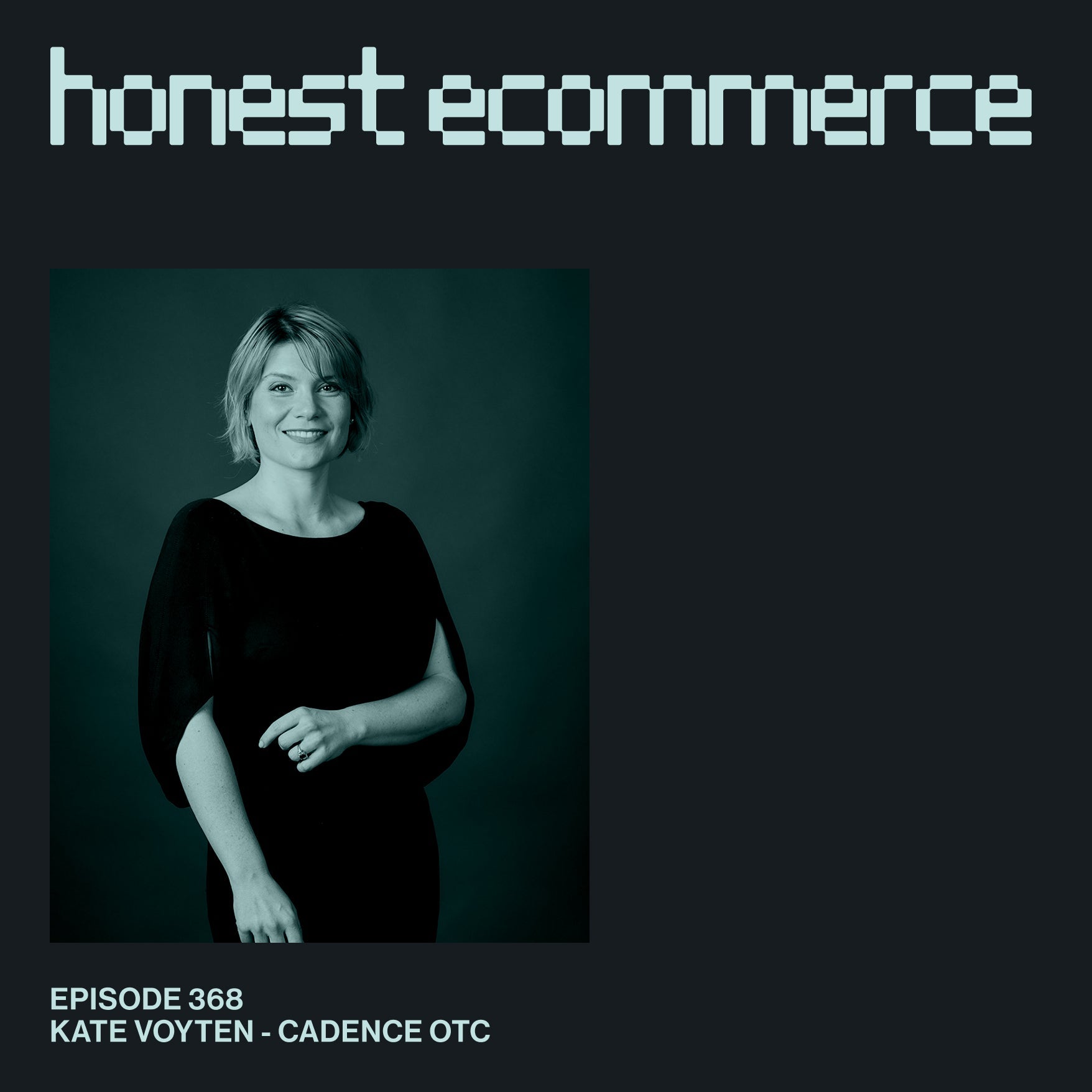
Hey, everybody. Welcome back to another episode of Honest Ecommerce. Today, I'm welcoming to the show the Senior Vice President of Commercial Operations at Cadence OTC, Kate Voyten. Kate, welcome to the show.
Kate Voyten
Thanks, Chase. It's great to be here. I'm excited to chat.
Chase Clymer
So for those that are unaware, what are the actual products that you and the team are bringing to market over there at Cadence OTC?
Kate Voyten
So we were founded with the idea that it's really important to improve access to contraceptive care. So specifically products for women. And the product that we're focusing on today is the morning after pill, which is an emergency contraceptive that came over the market about 15 years ago. And we're trying to make it easier for people to access that all across the US.
Chase Clymer
Absolutely. Take me back in time. This product has been around for a while. But the business, Cadence OTC, I believe was founded in 2016. Where do we want to start this story?
Kate Voyten
Yeah. Well, we had a really interesting and passionate group of people who, about 10 years ago said, there are 40 % of all pregnancies in the US that are unintended. And the reason they're unintended is because access to birth control is very difficult in some places. That's because you have to have a doctor's prescription, you have to have insurance in many cases, and sometimes the product is still very expensive.
And so their mission was, let's take the most popular birth control product that's out there today and bring it over the counter. So it's going through a very complex FDA approval process to make it available and off prescription so you can walk into any drug store and purchase it without having to go see a doctor. And that's still our destination. That's what we're really focused on and want to make sure we provide in the future.
But in the meantime, there was an opportunity to say, okay, well, there is a product out there today. It's called the Emergency Contraceptive. It went over the counter in 2009. Despite being in the market for quite a long time, it is still very difficult to get. And that's because there are populations across the United States that live in areas that either don't have drug stores or don't have clinics or stores that don't open late.
And what's unique about this product for women is that you have to take it right away. So the faster you take it, the better it works. And so we said, “Okay, well, how do we do that?” And I think one of the natural places that many people get to is they say, “Oh, well, set up an Ecommerce business, send it to them.” And there's many, many brands out there today that have an affordable emergency contraceptive that you can buy online.
But they all have one little problem. If you live in a dense metropolitan area, you can probably get a delivery today. But if you live 25, 30, 50 miles away from a large city, you're not going to get it in time to make it useful. And so we really took a step back to understand the consumer and the journey and said, “Okay, what can we do so that you can get this product when you need it?” And usually when you need it, it's a bit of an emergency, hence the emergency contraceptive name.
So last year, we actually spent quite a bit of time looking at the consumer journey. And I think this is something that many of your listeners will probably understand, which is what problem are we trying to solve? So there are many solutions out there that are available online. But really, really the conversation was how do we get the product to someone that lives in a neighborhood that doesn't have a pharmacy?
And where we landed was a solution that is to go to where a third of all condoms are sold, which is convenience stores. So your 7-Elevens, your Circle Ks, usually they're open late. And we created a new go-to-market model. And this model is buy an emergency contraceptive, get women's healthcare products in convenience stores. And that was kind of our distribution push to see, we get it into this space and make it more affordable? But we knew we couldn't do it without an Ecommerce component.
Partly because this is not a typical shopping journey. And it goes back to talking to women and saying, what do you do normally when you go look for this product? We absolutely knew they needed a destination to go and find more about where I can find it. And so our Ecommerce strategy sort of evolved from being, yes, we offer a product that could be affordable and shipped to your home.
But if you do live in an area where you can't get it right away, how do we help you find the store that does carry the product so you can get it tonight or tomorrow morning? And so it's been sort of an ongoing business uh learning on how to make accessibility a real, a real difference and a true thing that everybody can get access to.
Chase Clymer
Absolutely. And that was one of the things that was so very interesting and eye-opening to me when we did our pre-interview a couple months ago was the concept of, yes, we have this online store and we are selling this product directly to consumers through our store and you can purchase it. But there is more of an impetus. It's like if you need it now, we are going to show you exactly how to buy it.
So you're driving... To translate this to any other model would be like if you have your products in Costco or Target or whatever. The way your journey works on your website is almost set up to how do we get this product in the hands of the customer as fast as possible, as opposed to buying it from our website is the main goal, which I thought was super interesting.
Kate Voyten
Yeah, you know, it's an interesting shift in thinking for what an Ecommerce website's job actually is. Because a part of it would be, of course, you're making accessibility easy by purchasing it. But our job, and I'm saying it's a job because it's almost a service that we're looking to offer, is to find the product.
And I think that causes a lot of interesting things to happen when you start thinking about that job differently. So even things like marketing. So how do we help you find the product earlier? We focus a lot of our attention on just talking to women in a very small area around those locations where that product is available.
You can run a billboard on Times Square if you'd like, but that's not going to help the person that is living 45 minutes outside of Harrisburg, Pennsylvania, they're not going to know that that product is at their 7-Eleven. So that insight, a really good understanding of the consumer and what they need, when they need it, and how they need to go get it led to a really big evolution of how we talk to women today. So we focus a lot of our attention in marketing to be geofenced.
And it is all about the message of, “Hey, you live in this neighborhood. And in this neighborhood, you can find this product. Because when you need it, you're going to look for it right away.” And so that's a slightly different service that we offer as part of our communication and part of our Ecommerce business, in addition to the traditional selling it directly to women so they could purchase and plan ahead.
Chase Clymer
Absolutely. I'm so glad you brought up marketing and the geofencing stuff because the question I had is how do you measure marketing effectiveness if you can't have that pixel on the website? You can't necessarily track your customer into a 7-Eleven and purchase this product. How does that make… I know that makes your job harder. So how do you try to understand that?
Kate Voyten
Well, I think there were two things that we did really early on. And that is to try to find patterns of things that were measurably important, not easy to measure. And I think that's often a really big difference because I can measure a lot of things on my website. But the thing that we sort of landed on was this idea of how many people actually put in a zip code to find the location.
So you can measure impressions, of course. You can measure length of time or how many people come to your website, some of the basic KPIs that you look at or how long they stay on your website. But really, really what we landed on is the one key indicator of interest is did the person do the action of putting in a zip code where they live?
It's likely what they will do is if they put in a zip code, they'll find that the stores are actually in their neighborhood, which will then drive the action for them to go and get the product. And we've been fortunate. The data in terms of consumption of how many people buy at the store is quite limited. So we can't often get it. What we do is we get some signals on reorder. So are those stores buying more products?
And you can know that if they're buying more products, it means someone's shopping. And we always want to feed that zip code as a, “Okay, this is a good signal for us. If people are looking in this area, they're likely going to go and buy the product.” So I think what I learned through this process is having a more narrow dashboard and saying, “Okay, these other things are good and they're sort of leading indicators.
So how many people come to my website, of course, impacts how many people put in a zip code. So I kind of look at this to say, “All right, we're not feeding enough people to come to our website.” But really, at the end of the day, it's all about, are they putting in the zip code? Have we converted them as a potential purchase opportunity?
And of course, then there's this other moment of, did they convert to buy? So that is something that we're looking at how to shorten the journey, how to remove all that friction so they can buy it really easily. And I'd say one of our biggest debates for a while was do we send them to Amazon? So, I think the cost that you have to acquire someone and then to push them to a different partner was a good discussion for us because we're a public benefits company.
At the end of the day, what is really important is, yes, we have to be profitable, but what we also have to do is we have to solve the problem. And I can't ship as fast as Amazon does. And so we made the decision for the women who do shop to say, “Actually, if you do have Amazon, here's the link. You can buy us on Amazon.” Because they can, of course, many of them can deliver the same day or have overnight shipments.
So if you do truly need this product and there is no physical location in your neighborhood, that's a better place for you to shop. It's one of those things that I probably would have never waited in my life before because you never want to divert traffic to something else. But it was the right thing to do for the consumer journey and the right thing to do for our customers.
Chase Clymer
Hey everybody, just a quick reminder. Please like this video and subscribe if you haven't. We're releasing interviews like this every week. So don't miss out. Now back to the interview.
While maybe some listeners aren't in a vertical that is similar to yours, but the way that they're approaching building their business might be. So if you're trying to get into more retail doors going that route, optimizing for that zip code search is something that they could straight steal from your playbook and from this episode.
So now that the optimization isn't, I guess traditional CRO is to get this thing in the cart, get it purchased.
Kate Voyten
Right.
Chase Clymer
Now you're like, “How do we optimize for them to put in that zip code search to go... Hopefully, now you're putting into their hands like, “All right, well, now you need to make the action of getting in the car or on the bus or whatnot to get to this particular location to find this product.”
Kate Voyten
Yeah, it is a departure from what I traditionally grew up with, which was more about this large scale, trying to blanket as many people as possible to get down to much more of a localized approach. And that local approach for us is solving a very specific problem for the consumer, which is “I need it today. Where can I get it today?”
And hopefully when you build that loyalty and what you'll see with us as we build out other products in our portfolio, is that they trust that we have their best interests in mind. So they'll shop for this product in their convenience store. But we have other products that we're coming in, that they'll come back to us and purchase those.
Which of course builds a different set of expertise of understanding how to build loyalty, how to really get the most out of your email campaigns. How do you really build that base of folks that come to you as a resource for finding this information? So it's part of the long-term game plan to make sure that we have a really strong connection with women and service their needs when they need them.
Chase Clymer
Absolutely. Now, are there any other, I guess, unique to the business that you're building over there that wouldn't be apparent from first glance?
Kate Voyten
I thought a lot about this question when you asked me this before. And there's one that comes to mind, which is understanding how to advertise in healthcare.
Chase Clymer
Oh, yeah.
Kate Voyten
And, this topic is particularly difficult for us because reproductive care is a really hot topic. And we really had to work with advisors and experts to help us to make sure that we didn't trigger any issues across advertising platforms. And this is one piece of advice I would give to your listeners that are in healthcare or regulated spaces. That you find a really good advisor and you find a really good legal and regulatory partner.
Because otherwise, and we did this at the beginning of our journey, you're going to spend a lot of time petitioning Google, TikTok to put you back on. Honestly, we were frozen very quickly for a bunch of reasons. We couldn't advertise on those platforms. One, it's making sure you're really familiar with the regulatory environment. And you're familiar with experts that actually understand that industry and how it works across the advertising platforms.
And then secondly, continue to stay up to date on this because actually this industry is very active and moves quite a bit in terms of changing its rules in what's acceptable and not. And I'll give you a really good example. When we started a year and a half ago, Amazon, you couldn't advertise emergency contraceptives on. So they would not allow it as a category. It was a block category and you could advertise condoms and lubricants, but not ours.
So that basically limits you for things like sponsors and keyword purchases. So it really, really kind of shrinks the space of what you can do to influence that space. And about six months ago, they lifted that rule and changed it. And we're seeing that the same type of examples are happening with Google, Meta, and TikTok, where they are adjusting their rules as they're learning more about the categories.
And this is where you need that partner to really, really work with you to help and guide you through that space and make sure that you have good sponsorship so you can get those appeals and get back on air.
Chase Clymer
Oh, absolutely. They have their ears to the ground. And I would say that that's good advice across the board for business. Because you can spend a lot of time spinning your wheels. And I feel like every platform out there from Shopify to Facebook says it's easy to use. But it's so hard to become an expert in. And so there's that delta of like, is it worth you... And we've seen this a bunch of times working with brands.
Do you want to spend 6 months noodling around? Or do you just want it done in the next 2 months? There's that opportunity cost. And that's why I say this. Whatever job you're hiring for, the 2 things you should keep in mind are 1. Never hire someone that's never done it before. Have them prove to you they've done it before. And then 2. Hire the most expensive person you can afford. That's usually going to get you the best result within your budget.
Opportunity costs and just like I see oftentimes, we're talking about website designs here. But you just mentioned getting you back online with TikTok being banned from there. The people that know what they're doing, they get it done quicker. And we've seen people want to do it alone for various reasons.
Maybe it's outside the control of the person that you're talking about. But then they come back again and they're spending again to do it the right way the second or third time. As opposed to like, we could have been there, done that, and you could have had six months of this working for you already. So that opportunity cost is something.
Kate Voyten
Chase, you're so right. Spending time upfront, doing it right the first time and then going into that process is a huge cost saving, especially for a small company like ours. If we are still very much in the startup phase. Agility is a strength, but being humble and saying we need somebody who has this expertise that can help us and set us up for success is really, really important.
In particular, we talked about going into convenience stores. So part of our challenge going into these areas and what we had to figure out on the marketing side was that states all have different regulations. And this category is regulated at a federal level. But as we go into each state and we're in 16,000 convenience stores across the US, so every state's except Hawaii. So I'm working on that one.
But all of those states and people who work there ask us the questions as we create these pages for them and say, “Hey, know, this 7-Eleven in Oregon, am I okay to sell this product?” So we had to be really flexible and make sure we knew the regulations of every state. And that is a complexity that I wished for no one. I really hope that you never have to go do that.
But it's good learning to say, “Okay, so as you grow, what is the thing you need to anticipate that you're going to hit up against?” And that's where the expert and advisor really makes a difference to help you and make sure you get there faster.
Chase Clymer
“I have been in business for nearly 20 years, and very few companies I have hired in that time have performed as well as Electric Eye. They have knowledgeable staff, and our project was delivered on time and on budget. Electric Eye has exceeded my expectations, and I look forward to working with them again.”
That is a direct quote from one of our clients at Electric Eye.
Electric Eye is a Shopify Plus partner that has helped over 100 brands migrate, redesign, and optimize their stores since 2016.
If you'd like to increase your conversion rate, average order value, and revenue per session, we are the true Shopify experts you've been looking for.
Right now, we're offering a free diagnostic to qualified brands that reach out and mention the podcast. Visit electriceye.io today to schedule a call and send us a message. Find out why we have over 50 5-star reviews in the Shopify Partner Directory. Again, that's electriceye.io. E-L-E-C-T-R-I-C-E-Y-E.io
Is there anything else that I didn't ask you about that you think might resonate with our audience?
Kate Voyten
I was looking at the interviews that you had and one of the things you touched on and what's so important for us is making sure that you solve for a problem that actually exists. And why I say that is because I get the benefit of speaking to really bright people that come to us and offer different kinds of services. And they'll say things like, “Oh, I can do your email 10 times faster, or I can do 10 times as many emails and some of the time.”
Most of the time I have to take a step back and say, “Okay, this is a great solution. Is it solving a problem that I have?” And I think this is one of the parts that's exciting about being a startup is that you have all these resources you can get tapped into. But it's very easy to get pulled away in many different directions and just do activities for activity’s sake.
I'll tell you a little story about when we started this year. There are a lot of chat bots that are out there that help solve questions or answer questions when people come to your website. And I have to say, many of them are not very good. But you go away and you kind of get canned answers.
And someone came to us and said, “Hey, I have this AI solution for you that we call our Maya. It's kind of a bespoke chatbot that we have on your website and would you want to give it a try because the learning model and the response model is a little bit different. And at the onset of it, I was a little bit skeptical because I think part of it was really, “Do we need another one of these solutions available?”
But I'm a huge proponent of AI and we've been really delighted to see the interaction that we have with this solution with Maya on our website. And part of it is it's actually given us a benefit of not only going in and really helping answer questions that people have at the moment. And so we actually have competition or people who buy competitive products come to our website and ask these questions of Maya.
But it also gives me insight as to what problems we can solve for them in the future. Because really these prompts that are being put in are so rich because they tell us, “I have this problem or I don't understand this.” And that actually gives us insight into innovation or other solutions or other ways we can come to market for them that aren't available today.
And so I think as a startup, you kind of have to look at how do I focus my resources? But when you do find something that works really well, really dive into it. Because I think the benefits for us have been fantastic. So it's now not only kind of like a consumer panel for us because we get really good questions.
I think it is a really good service that we offer, which builds on to what we do today, which is findability. Help me find the product when I need it. But it also inspired us to get closer to that consumer journey and see where other places we could do to remove that friction. So I'm so glad that we did it. And I will say AI has been an awesome tool for us to use. And I hope that folks don't shy away from it.
Chase Clymer
Yeah. It's funny. We're doing a lot of CRO activities at the agency lately. And we do a lot of customer interviews and we do a lot of UX research around how customers are interacting with the website. And something we have talked about is everyone is going to have a chatbot or some sort of support button in the near future. And we're probably going to need to start scraping that for ideas.
Because like you said, all conversion rate optimization is just answering questions that people have. And if people are just asking those chat box questions, if it's not answered on your website, or if it's not apparent, or if it's just not in the language that your customer wants it to be in. Or expects it to be in, that's just an easy opportunity for a split test or your customer is already telling you they want it, you should probably just make that change.
But yeah, that's just... When you were talking about that in my head, I was like, man, we probably need to revisit that.
Kate Voyten
It's surprising how well it does. Another part of it for us that made it easier is its multi-language. So we have women that come that only speak Spanish or they actually prompted in Spanish or any other language. And it's not as often, as I don't want to say it happens all the time. But we still get a pretty good understanding of even the kind of language that they use. So how do you describe the product or the problem?
The better you can frame your responses, make sure that your communication is really clear in that space, the better the outcome is going to be in total. So I think it's a great tool. We can spend another half an hour talking about all the other problems I see with AI that misinformation can cause. But in this particular instance, and this is something that I always ask when people come to us with solutions, what problem are you solving for me?
And we can't figure out what that problem is. And in this case there were really specific questions about the usage of the product that you can't write every case in a blog. So this is a great way for them to really get the support that they need in a quick, very human way.
Chase Clymer
And I think that there's something to how AI plays into those conversations about... I think maybe they're a little more comfortable talking to a robot than a human being.
Kate Voyten
Yes. Yes. I think it can be really embarrassing to ask. And one of the data pieces that we have is that roughly one in four adults don't really understand emergency contraceptives. They don't know that they're legal, that you don't have to get a prescription, where to get them. And so the resources of where you can go, there's many, different options. But one of the things you have to really be comfortable with is how you ask the question.
And does the person that's going to give you that response make you feel comfortable about being asked? And so we're trying to focus on education that's not forcing it down on people and saying, “You should know about this.” Because nobody walks around every day going, I want to learn more about the mechanism of emergency construction.
But when you do use it and you buy the morning after pill, you want to know that it's safe, that it's trusted, that it's going to help you in that time of need when you do need it. And that's the kind of solutions that we want to provide and support with.
Chase Clymer
Absolutely. And then before we go, I just want you to again, talk about the products that are currently available, the products that are coming and where they should go to learn more.
Kate Voyten
Yeah. So what we were excited about is this month, actually, we were able to secure a partnership with Kroger and they launched the Morning After Pill in their distribution. So it's a grocery store. So it's another distribution point, not only convenience stores, which are local, but also the distribution points in grocery stores. But what also made this exciting is that we're really trying to offer a product price point that's more affordable than what's out there today.
So for the folks that don't know this category, but there really are no branded solutions that are under $30. This product typically is about 50 bucks which is a really high price point. And so we're trying to make it more accessible and available. We also offer a pregnancy test and we are working on bringing in a uh urinary tract infection kit.
Again, all products that you want to get right away. And that goes back to the core of what our website service offers, which is you can plan ahead and you can buy it and have it in your medicine cabinet. But more importantly, how do you get the products when you need them and when you need them quickly? And you can come to our site and see where you can find them.
And that's a service that is a complement to what you get in Google with a little bit more insight and detail into the category.
Chase Clymer
Absolutely. And that website for everybody is cadenceotc.com. Kate, thank you so much for coming on the show today and sharing all those amazing insights.
Kate Voyten
It was a pleasure. Thanks for the time, Chase.