Chase Clymer
No doesn't mean never. It usually means not right now. And that's something that people really need to understand and not take stuff personally. Timing is everything and some of this stuff. It's awesome to hear that some of these original no’s came back, I'm assuming, in the next round or things like that to help you guys get to even higher heights.
Jordan Nathan
Exactly. And every time I got a no, I asked for an introduction. So it's just like a chain of meeting people.
Chase Clymer
Honest Ecommerce is a weekly podcast where we interview direct-to-consumer brand founders and leaders to find out what it takes to start, grow, and scale an online business today.
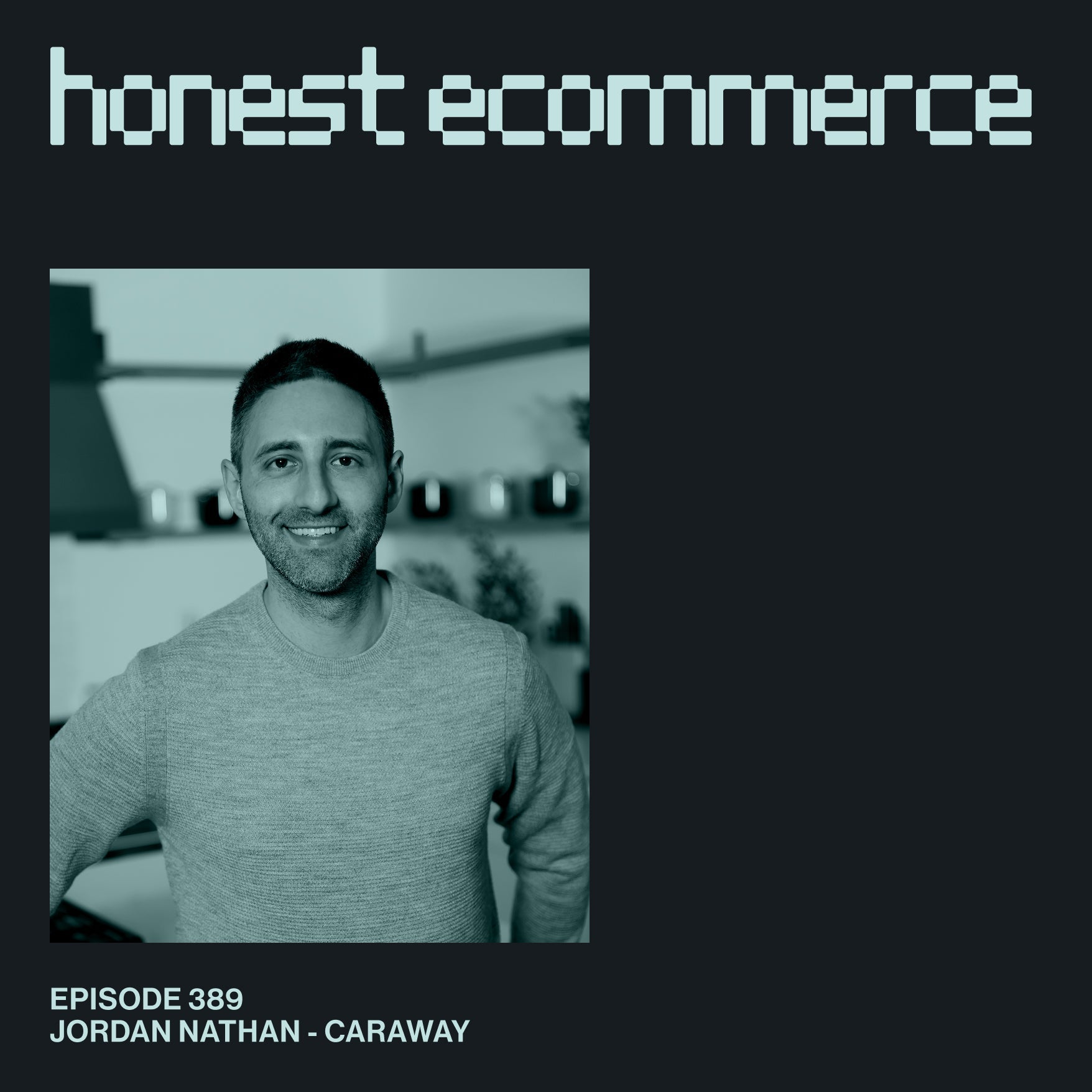
Hey, everybody. Welcome back to another episode of Honest Ecommerce. Today, I'm welcoming the show Jordan Nathan. Jordan is the founder and CEO of Caraway Home. This episode has been a long time in the making. I'm so happy to have you here. Jordan, how are you doing today?
Jordan Nathan
Doing great. So excited to be on here. Thanks for the time.
Chase Clymer
Absolutely. So for the subset of folks that aren't familiar with Caraway Home in the audience. Why don't you quickly let them know the types of products you and the team are bringing to market over there?
Jordan Nathan
Caroway is a non-toxic kitchenware brand. We started in the cookware category, selling a ceramic non-stick, non-toxic product. And today, we're a full home and kitchen brand. So we've expanded to bakeware, cutting boards, [and] food storage. We just launched a trash and recycling bin. And our mission is to make all homes non-toxic homes.
Chase Clymer
That's an amazing mission. So take me back in time. Where did the idea for this business come from?
Jordan Nathan
Carraway was launched in 2019. Out of college, I actually tried to start my first startup, which was an Ecommerce marketplace. The whole idea around it was you had Amazon, which had a bunch of products that you needed and the whole Ecommerce industry was booming. so I wanted to create a marketplace for D2C brands. Which is funny enough, there still is no core place to go for them today outside of your website.
That was a really cool experience. Got to work more on the tech side, but got to speak to a lot of brands. And after a failed fundraise attempt, ended up at this company called Mohawk Group, which owned a bunch of Amazon brands. And I had the fortunate experience to be one of the first 10 hires. They brought me in to run a brand called Vremi, which was their kitchen business.
And when I first started there, they had a few SKUs, but they weren't doing so well. I actually ended up teaching myself product development. We then needed a big rebrand. So we went through that process. And at the time, all Amazon was in the category was all black and stainless steel products. So we took a very colorful approach and had the fortunate experience to really run the full business there.
So I ended up launching 200 products in two and a half years. I did a rebrand. When we launched the products, they all sold out. So then I needed to learn how to forecast. I really got to run the full gamut, which is awesome. I think the thing I realized in my time there was I really got to see the industry from the inside out.
I spent a lot of time in Asia, traveling the world to different factories. And we were selling a lot of cheap products on Amazon that competed on price. Color was definitely a differentiator and something that I brought into Caraway. But I didn't feel great about putting just more plastic junk out into the market. I had a really scary experience during a product test where I overheated a Teflon pan accidentally and actually got sick from the Teflon fumes.
Kind of following that experience started diving a bit more into materials. [I] was at my like two, two and a half year mark there and really felt like there was a big opportunity to marry that design that I had built into Vremi and color with modern materials. So I think I left somewhere in 2018, started working on the brand and we launched 12 to 18 months later in November 2019.
Chase Clymer
Absolutely. I got a few follow-ups about your time at Vremi. Obviously, I don't need dollars and cents here. But I'm assuming that it was a job. You weren't necessarily seeing the upside of the amazing value you're creating for, essentially your boss or however you want to describe it. Did I read into that the correct way?
Jordan Nathan
Yeah, I mean, to start, [I] was 23 or 24 and I essentially was given full reins to run a brand, which was amazing. As a venture-backed business, I was one of a couple brands and I did eventually get promoted to CEO of that business and got to do a little bit of everything. So it was kind of a once in a lifetime opportunity. [It’s] definitely challenging being in a broader organization when you have multiple brands.
There's always a fight over resources. And then when you're building something you're really invested in, but you don't actually own it, that can be very challenging. I think in a perfect world, I would have maybe spun it out of the business and run it separately. And I think that was the vision at the time when they were building brands.
Yeah, as much as I was in charge of this brand, it still wasn't my own. And it's a really challenging situation to be in when you put the blood, sweat and tears into building something essentially from scratch.
Chase Clymer
Yeah. But the learnings on someone else's dime though, that was a once in a lifetime opportunity, like you said. It needed to happen. You cut your teeth and you learned all these amazing skills. And obviously, you were the CEO of Vremi. And something that I've learned on the show and I like it. CEOs know a little bit about a lot and their major skill is delegating.
Jordan Nathan
Yeah, it was invaluable. Funny enough, there was me and one or two other people working on the brand. And then we had accounting, design, [and] essentially every function. We're like a support agency inside the company. Built a lot of systems, a lot of project management to delegate a lot of those tasks to people that kind of service the full business.
And I think on the invaluable side, this was a very venture scale business. Profitability was not a goal at first. And then we had to flip the switch at a certain point. And coming into Caraway, that was just a great opportunity where I started Caraway with the intention of this is going to be profitable from day one. And I'm not going through that process again of burning cash to then have to try to flip it around, which was chaos at the moment.
Chase Clymer
Hey everybody, just a quick reminder. Please like this video and subscribe if you haven't. We're releasing interviews like this every week. So don't miss out. Now back to the interview.
Let's talk about that transition. And you said it was about an 18-month window to get all of your ducks in a row to actually launch the brand and launch the products?
Jordan Nathan
Yeah, it might have been a little shorter. I think I started ideating in early 2018. I left my role at Mohawk around June or July of 2018. And I just made a fundraising deck and immediately started raising. So it was just me. It was a deck. I took a cookware set from Google, threw it in there. And that was really challenging because there were six other cookware brands who actually had fundraised already before I got there. So everyone kind of picked their winner.
And that first raise took about 10 full months to close. I think we raised 1.8 million. There were 50 or 60 total checks in that round. So if you do that math, it's around 25k a check. Cookware is a really hard product to develop. There's a lot of cost that goes into it. There's tooling, the inventory is expensive. Essentially, as checks rolled in, I started building the product and the brand. And that process took probably 12 to 15 months. And the product was the first thing that we really started focusing on.
Chase Clymer
Yeah. You said that there were 52 checks. So how many meetings do you think you had to get those 52 checks?
Jordan Nathan
Yeah, I've thought about that before. I wouldn't be shocked if it was close to a thousand. I literally think every day for 10 months, I was doing like five to eight investor meetings. And I just took an approach of there's infinite capital out there. I'm going to get to my number probably at some point.
I think what was actually really great through that process is even people who passed… Those were like our first customers and they're people who are still champions of the business today. So I had gotten to build a really big network. And through that process too, there were a lot of folks who passed early on. And then as we started making more progress, they saw the product, they saw the brand, they came in later.
And it's funny when you're in those early stages of the brand. You think you're really busy but you're sitting around a lot of the day, waiting for the brand to be developed and the product and you're getting prepared. And so it was a really good use of time to make that many connections. And a lot of those, whether they invested or not, have been such big supporters of the business to date.
Chase Clymer
Yeah, I think that's something really worth pointing out. It's just because somebody says no. And this is even beyond fundraising. This is like sales, job opportunities, etc. No doesn't mean never. It usually means not right now. And that's something that people really need to understand and not take stuff personally.
Timing is everything and some of this stuff. And it's awesome to hear that some of these original no's came back, I'm assuming, in the next round or things like that to help you guys get to even higher heights.
Jordan Nathan
Exactly. And every time I got a ‘no’, I asked for an introduction. So it's just like a chain of meeting people. Yeah, it was a tough experience, but a great experience. And we actually raised another round shortly after launching, which had like another 60 to 100 investors in it. And a good chunk of those all came from prior conversations of people who passed before we launched.
Chase Clymer
Yeah, asking for an introduction after a no is such a smart thing to do. Like I understand it's not the right fit for you. Like you know anyone that this might be a good fit for? Is that basically what you said?
Jordan Nathan
Exactly. Do you know a potential partner we could work with? And it is hard to fundraise when someone who said no is passing it along to someone. They're naturally gonna ask for the reference. It's really hard to network into the angel market, which is where we mostly raise from. And that was really the best way to do it.
And actually, our first checks came from just cold emails that I had sent out. AngelList doesn't exist in the same way that it did back then, but [I] used to be able to go through. And there are lists of angel investors [that]I used to just mass send to all of them. And I got a couple answers here or there and that's how we kind of kicked off the race.
Chase Clymer
Do you know what's going on with Klaviyo? When was the last time you explored what it can do?
Klaviyo has been shipping tons of new AI, data, and automation features designed to help ecommerce teams move faster, personalize better, and automate more of the work that used to take entire teams.
Most brands are only using a fraction of what is already inside their Klaviyo account.
Klaviyo is not just email and SMS anymore.
It is your customer data platform, your lifecycle marketing engine, your analytics layer, and now your AI-assisted execution layer, all in one place.
That means your customer data updates in real time.Your segments stay current automatically.Your flows and campaigns all run off the same source of truth.And now AI can help predict churn risk, forecast spend, recommend next best products, generate campaign content, and optimize send timing across channels.
The big unlock is speed and efficiency.
Fewer tools to manage.Less dependency on engineering.Less time moving data between systems.And lower total cost of ownership across your marketing stack.
And brands are seeing real results from leaning further into Klaviyo.
Dollar Shave Club has reported over 30 percent reduction in total CRM stack cost after consolidating onto Klaviyo. Brands like ThirdLove have seen 15x ROI from SMS after consolidating channels. And companies like Corkcicle have grown flow revenue over 90 percent after bringing email and SMS together inside Klaviyo.
Across our customer base, every single brand we work with today is using Klaviyo. That is just where serious ecommerce customer data and lifecycle infrastructure are living these days.
If you are already on Klaviyo but feel like you are not getting everything you could out of it, or you are running multiple tools and want to simplify without losing power, I think this is worth your time.
You should head on over to Klaviyo dot com slash honest to learn more.
That’s K-L-A-V-I-Y-O dot com slash honest to learn more about what Klaviyo can do for you today.
The fundraising is a whole conversation. But let's pivot back to building a brand. So while you're fundraising, what were some of those key moments and key projects prior to launch that were also taking up a lot of your time?
Jordan Nathan
Yeah. So first would be the product development. We are a product-based company at Caraway. And we put a lot of attention into every little detail of the item. We knew when we started the development of the product, we wanted something that was timeless, that would look amazing. We wanted something that was app-esque.
And we were doing a lot of R&D on the coding itself to make sure that we had something that was free of PFAS and safe to use. But also high performance. So a lot of the time went into R&D and brought on a branding agency to help build the brand. That's such a fun process to go through, choosing the name, etc. And then building the team. When we launched, there were 4 of us.
So I brought on essentially a head of growth, a head of operations and a head of brand. So we had a nice variety of skill sets there. And the hiring process was incredibly challenging because you're essentially pitching people from top brands to come to a brand that's got a deck with drawings and unfinished branding.
And we were lucky enough to find 3 amazing individuals, 2 who are still with the company. A lot of my time went into how to build that early team. And I'll just say we got lucky. We had 3 amazing first hires to launch the brand with.
Chase Clymer
Absolutely. Hiring is the hardest skill to learn, but it's the most valuable. Once you get out of that first we're selling stuff, the stage happens. And then it's like, “All right, now we need people to do all this stuff that needs to happen to actually make this business a business.” And get the flywheel actually going. interacting with people and learning their strengths and their weaknesses.
And then, I don't know about you, but we're on the EOS system over here. So make sure you get not only the right people on the bus, but the right people in the right seats on the bus. That's always an interesting conversation. You can definitely hire the right people, but maybe for the wrong thing. And you got to think through that stuff.
Jordan Nathan
For sure. My biggest learning, I think being an entrepreneur is you can have the best product and brand and distribution, but you're not going to be successful without the right people there. And especially as a first time founder, it does take you time to figure out what do you value as an employee and what do you need at each stage because that does change over time.
And so we have just an incredible team here at Caraway. We've got really refined values. And I think we do a really good job of placing people in their areas of strength. [While] also keeping it super lean. We're 6 or 7 years in, only 100 people. And we try to keep things as efficient as possible.
Chase Clymer
Let's talk about your go-to-market and how you made your initial splash. The first question was, Vrimi was very much like an Amazon first endeavor. Did you take that to Caraway too? Or did you really want to go all in on D2C first?
Jordan Nathan
It's interesting. Coming from Amazon, that was the natural easy path. But funny enough, I wanted nothing to do with Amazon at the beginning. I think I actually said we'll never sell on Amazon. I was just so immersed in New York City, like the D2C culture of Casper and Warby and Harry's and wanted to be like them.
So we went D2C first. actually just had one product, which was the cookware set, which is still our best seller today. And we launched in a pretty unique way. So prior to launch, we built a 150,000 person wait list. Which we started building like six months prior. Throughout the R&D cycle, we'd send them updates, maybe some like 3D print images, and kind of kept them engaged.
And then for our launch and credit to our PR firm at the time for coming up with this, we had 200 or 300 influencers post in the first week, which was a really powerful way to get us out there. So we had this list of people who were waiting to buy. We also had 60 investors who we got sales from and then we had this influencer list.
And we had a ton of press around launch and that was kind of the initial launch strategy. I don't think we actually started running Meta or Google Ads for a couple of weeks. And one of the main focuses of that launch period, still true today, but every brand in the space was focused on cooking and food and we actually went the complete opposite direction.
All of our photography was products built as sculptures. We only worked with interior design and lifestyle influencers. We didn't touch food. We didn't show food. And that was a really refreshing approach for the category that really got us started.
Chase Clymer
What is the next big idea that could change your business?
A pricing change. A new bundle strategy. Adding subscriptions. Tweaking your shipping offer.
Most brands make these decisions based on gut feel.
They roll out the change, hope for the best, and have no real idea if it helped or hurt their business.
Intelligems fixes that. It is an AI-powered testing platform that brings CRO-level clarity to the decisions that actually move the needle. Not just button colors and headlines, but the big stuff.
Pricing, offers, shipping, new apps, even major site changes.
Brands like Ridge, Jones Road, and True Classics are using Intelligems to test their most important decisions and see exactly how each one of those impacts profit before they commit.
Momofuku used it to test promotional offers ahead of Black Friday and found the version that increased profit by about 28 percent.
Mott and Bow ran structured pricing tests that drove roughly 30 percent more incremental profit.
We use it at Electric Eye with almost every client we work with.
And now Intelligems has a free AI-powered audit that gives you three specific ideas you can test on your store today. No commitment, no credit card, just three opportunities worth exploring.
Head to intelligems.io/audit and get your free audit in just a few minutes.
That is intelligems.io/audit
intelligems.io/audit
That's such an interesting differentiator in the way you got the product out there, which I actually never put that together. So it's funny to hear that from you, straight from the horse's mouth. Now obviously, we're coming up on 8 years, I believe, since the launch, roughly.
And there's a lot of different things that have happened in those 8 years. But if you could look back, are there any key moments where things definitely were this is now we're moving into another tier of a business.
Jordan Nathan
Yeah. So COVID obviously was a very challenging time for most of us. We didn't know what was going to happen when that hit and it was three months after we launched the business. Everyone was trapped at home. They were cooking and definitely was a growth accelerant period. We launched Amazon in 2022 after a lot of debate and that's become a really good channel.
I think something really interesting that [we] did early on, even pre-launch, was we started talking with retailers. So I remember talking with Bed&Bath and Target and Crate&Barrel and Zola. And all of our competitors were focused just on D2C. We knew we wanted to be omnichannel. And that was really important to the business and the model.
And so very early on, Creighton Barrel was our first partner. I think we launched with them in the first 12 to 18 months. And that was a huge boost for the brand. And so there's all these moments throughout the years, whether it's product launches or channel launches that have really scaled us. But I think the one thing we've done really, really well is execute the marketing calendar.
So if you go on the site, we now have a huge array of products and we're typically launching two products a year. And then in those months where we're not, we always have marketing campaigns. We've got color drops. We did a really cool color drop, I think, in 2023 with Tan France from Queer Eye. And so that just always-on marketing engine has really carried us through the years.
Chase Clymer
If you had any advice for yourself when you got started about basically the decision to go back on your word and actually move into Amazon and you know, this is actually more advice for the listeners out there. People that are sternly against Amazon as a channel for their business. What would you say to them?
Jordan Nathan
I don't think it's right for necessarily every category. I do question it on fashion or think textiles. At the end of the day, 50% of Ecommerce happens there. And so I think Amazon's done a phenomenal job of allowing your brand to come through with A plus content. You can build storefronts. There's a lot more flexibility today than back in 2015, 16, when I started on it.
And it just makes it easier for customers to shop. I think a lot of people talk about getting customer data. If you still are primarily due to see you're going to know who your customer is, you're going to get that data. You really want to make it as easy for customers to purchase as possible.
So, well, I don't think it's necessarily right for every category. I think it's definitely something that you should explore at some point. The question is when. And when you do launch it, you will see some like cannibalization. And I can tell you this for sure at this point, because I've seen this happen across many moments at Caraway [where] Meta is driving a lot of our Amazon sales.
So if you can convert them there faster and better, and that's where they prefer to shop, I say set it up and it's just another distribution channel for you.
Chase Clymer
You have prepped all year, and that hard work is paying off.
Your store is converting, the ads are working, and this is shaping up to be your best holiday season.
But your 3PL can't keep up.
Orders are backing up.
Customers are asking where their stuff is.
The reviews are starting to turn.
All that work, all that momentum, undone by a fulfillment partner that can’t scale with you.
This is a nightmare scenario, and it happens to brands every holiday season.
eFulfillment Service is the 3PL that scales with you.
They are family-owned, 25 years in the business, and built specifically for growing DTC brands.
There are no setup fees, no minimums, and no long-term contracts.
You only pay for what you use.
If you are scared your 3PL can't keep up this holiday season, now is the time to reach out to eFulfillment Service.
Go to eFulfillmentService.com/honest and get up to 8 weeks of account fees completely waived.
That’s E-F-U-L-F-I-L-L-M-E-N-T-S-E-R-V-I-C-E dot com slash h-o-n-e-s-t
efulfillmentservice.com/honest
Chase Clymer
I think that's what I usually tell folks, like, “Look, your personal feelings aside, it's more about your customer and where are they most comfortable with pressing buy at. And if that happens to be Amazon, you're just essentially leaving money and growth and velocity on the table by turning [it] off. Which essentially is a big lever for growth for your business.
Jordan Nathan
You also get to take advantage of two additional major shopping holidays every year, which is both Mid-Year Prime Day and Fall. And so if you're not on Amazon for those, they're not as big as Black Friday. But you get two smaller Black Fridays throughout the year, which are great moments to build around.
Chase Clymer
Absolutely. Now, Jordan, is there anything I didn't ask you about that you think would resonate with our audience?
Jordan Nathan
I think one thing we didn't really talk about and this was a learning from Mohawk was like, Caroway's built a very sustainable brand. We're a business that wants to be around in a hundred years and we take that approach with everything. Since the first day we launched, we've been profitable.
And so, I think we've built a really strong foundation in business and we run the business to very specific ROAS targets, gross margin targets. And I won't flex below those to achieve growth. We really care about maintaining a strong business that can last for a very, very long time.
Chase Clymer
Yeah. I think that is definitely a big difference between some of, even the brands that you mentioned earlier that you were idealizing in the DTC space. Where it was growth, for the sake of growth and will find profitability later. I'm of the opinion. just depends on your risk factor and the type of person you are, which way to run your business.
Sounds like you just wanted it to be right out of the get-go. Right in quotes, profitable. But I don't know. Do you think there's a right way or a wrong way?
Jordan Nathan
No. mean, I think it depends on what you want. I've seen businesses just go for straight growth. And if there is an exit in three years, and that's how to get there, that can be a great strategy. A lot of lower AOV products with higher subscription rates. If you feel confident you're going to get to that LTV, that can be a great strategy. But I think having positive unit economics is a huge moat.
It's not easy. And I do think there's a fallacy of a trade-off between profit and growth. I do really think those two things grow together if you do it correctly.
Chase Clymer
Absolutely.
Jordan Nathan
Big profit allows you to avoid needing to fundraise as much. So if that's not a path you want to go down, you can set your own destiny. Not chasing growth.
Chase Clymer
Yeah. And it allows you to be a little bit more picky about the types of partners that you take on. Because when you are doing that type of fundraising, and the more money that you take, the more strings that are attached to that money.
Jordan Nathan
Right. Yeah.
Chase Clymer
Awesome. Now, if I want to learn more about you, learn more about Caraway, or if I'm interested in getting an awesome set of non-talking cookware, where should I go? What should I do?
Jordan Nathan
You can check us out at CarawayHome.com. And I actually only have a LinkedIn. So look me up there. I have no Instagram, no X, no TikTok. I'm off all the social platforms.
Chase Clymer
Well, I am jealous of you for that. Jordan, thank you so much for coming on the show today and sharing all those amazing insights.
Jordan Nathan
Thank you. I appreciate it.