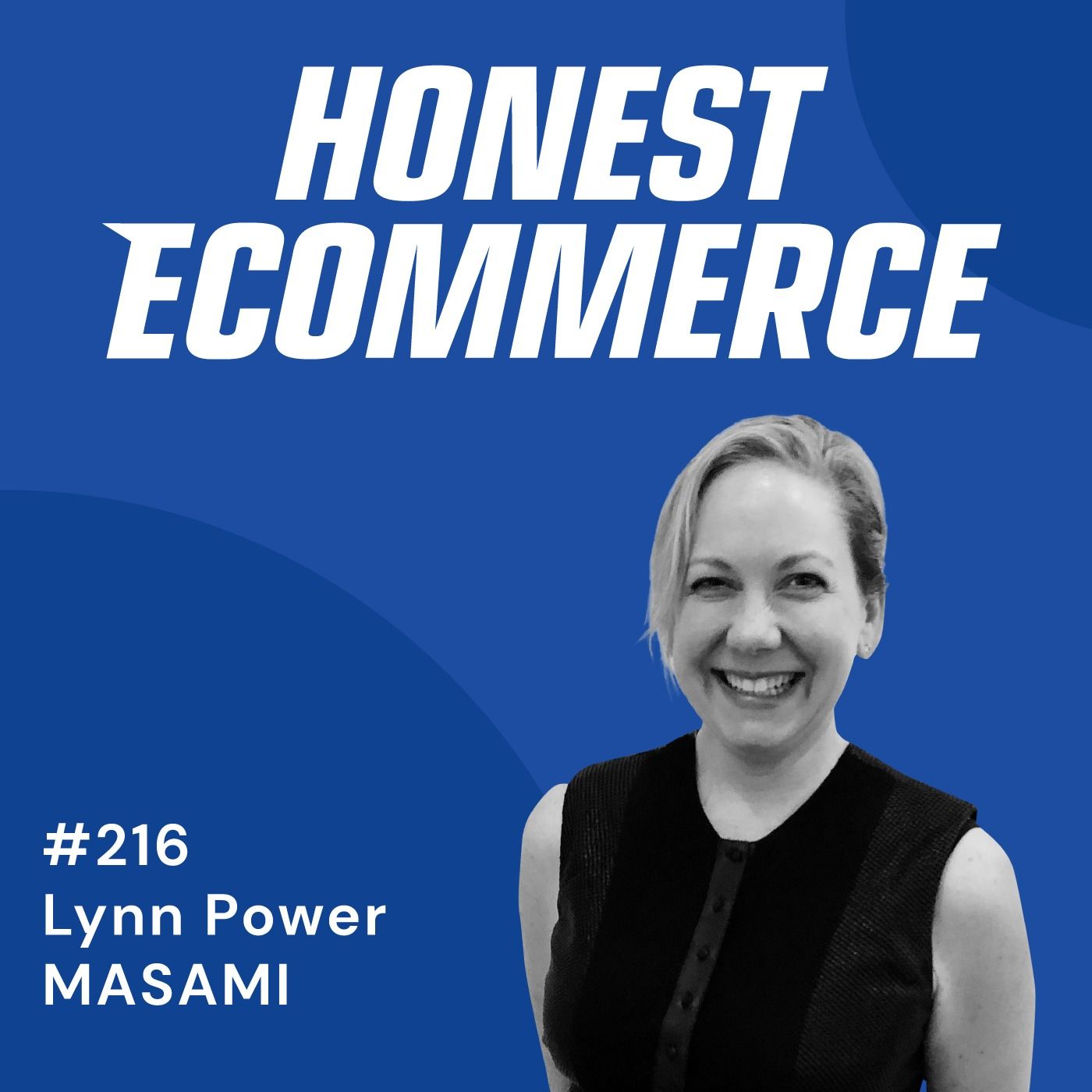
Lynn Power
The amount of naiveté by many founders thinking: 'Oh, I can just launch this business.' --which I sort of said earlier-- is astounding.
Chase Clymer
Welcome to Honest Ecommerce, a podcast dedicated to cutting through the BS and finding actionable advice for online store owners. I'm your host, Chase Clymer. And I believe running a direct-to-consumer brand does not have to be complicated or a guessing game.
On this podcast, we interview founders and experts who are putting in the work and creating real results.
I also share my own insights from running our top Shopify consultancy, Electric Eye. We cut the fluff in favor of facts to help you grow your Ecommerce business.
Let's get on with the show.
Hey everybody, welcome back to another episode of Honest Ecommerce. I'm your host, Chase Clymer.
And today I'm going to show an amazing founder of not one but two different brands. Lynn Power, welcome to the show.
Lynn Power
Hey, thank you. Thanks for having me.
Chase Clymer
Absolutely. I'm excited to dive in. You've got such a fun history here and then you're a workaholic with launching 2 brands in the same year and I can't wait to dive all in there.
But I guess quickly let's talk about the 2 brands: We got MASAMI and then Isle De Nature.
Let people know what types of products and businesses that you're building right now?
Lynn Power
Yeah, sure. And yes, I guess I am a workaholic. We'll talk more about that and maybe you can do some counseling for me. I don't know. But anyway...
So yeah, MASAMI is clean, premium hair care. We have a luxury, sort of unique Japanese ocean botanical that makes our products really high-performing. And we solve the number one hair issue: weightless hydration.
Well, hydration. We just do it weightlessly which is our unique offering. And then my other business, Isle De Nature, is a luxury beeswax candle business inspired by the island of Dominica.
That's the whole story. But anyway.
Chase Clymer
Awesome. So I know you didn't wake up back in 2020 and just go, I'm gonna launch a direct consumer brand, which will probably let the listeners know that you've got a pretty cool history in this industry.
So where do you want to take me back in time? Where do you want to start this conversation?
Lynn Power
Well, I actually fell into the advertising industry. I actually wanted to go into the FBI. So that's just a little fun fact.
But here I am launching DTC brands, pretty far removed from Clarice Starling, I'd say. But anyway.
So yeah, I spent 30 years in advertising and marketing and really loved it. And like I said, I fell into it. I didn't go to school for it. And I found that when I was running agencies, I often would hire people like me who really didn't study advertising.
And the reason I would do that is because it's such a quirky business in the sense that the logical things that people should do are almost never the things that people actually do. So you always...
You have to be really open minded and scrappy in the way you think about advertising because if everyone just followed the rules, everything would look the same if you think about it.
All the advertising would be the same. There'd be no campaigns that would surprise and delight you.
If Dove followed industry conventions about beauty, they would have never launched Real Beauty. Never shown real women. So anyway, I think sometimes school or studying a craft can teach you to stick in the lanes.
Chase Clymer
I think, to that point, you know, the whole concept of best practices is knowing enough to know when to break the rules.
Lynn Power
Yes, I'm a big believer in that. Because again, [when] you follow the rules, they'll get you so far but only so far.
So anyway, that's my way of justifying the fact that I didn't have an advertising degree or really any reason to go into it other than I fell into it and I loved it. And it was fortunate to work on amazing brands throughout my career.
I've worked on virtually every category, but I did a lot of beauty. And that's the thing I kept coming back to and hence why now my brands really are rooted in, I guess you could say, beauty and wellness. And that just seems to be what I really love.
Chase Clymer
Well, that's fantastic. I think that something that I see a lot: There's a lot of entrepreneurs online in various states of their life and their careers and everyone wants to be their own boss, right? Everyone wants to launch a brand.
Lynn Power
Yes.
Chase Clymer
Let's be real. That's such a fun and exciting opportunity out there. Now, would you say that you would... I don't want...
There's no way I can't say this without it being a loaded question.
Do you believe that you know your history in the agency world allowed for you to have a better outcome in launching your businesses?
Lynn Power
Well, look, I don't know if I have a better outcome actually. So there's that.
But it definitely prepared me for a lot of the things that many founders that I talked to don't think about like thinking about your brand and your values, and making sure that your storytelling is consistent, and making sure you have a content strategy, and thinking through the customer journey, and knowing that it's going to be like "Somebody's going to need to run into my brand 7 times before they buy."
There's so many founders that I talked to, who are like "We launched 3 months ago, why is that not super successful and flying off the shelves?" And I just...
I'm like, "Seriously? Wow, do you really believe that just because you put a product out there that people are just gonna flock to it?"
But the amount that actually do believe that is shocking, because they don't know anything about consumer behavior, advertising, and marketing.
The other thing I'll say is, before I launched my businesses, I was actually doing some consulting and where I worked with a bunch of startups, a lot of tech startups.
And the other problem I saw was these tech startups would fall in love with their product. Like love, love, love their product but not think at all about the brand.
And so you'd start digging around to see what their presence looked like online, and it would be a dog's breakfast because they weren't thinking about how it all hung together.
They were just putting out the latest cool feature and that's a problem too, because then people have a hard time... It's too hard.
You have to make it easy for your customers to know how to think about you. And when you make it hard and they have to piece things together, it's just too much work. So that's another problem.
So okay, so my background has helped me solve those problems, I guess you could say. Not all the other problems, though.
I definitely have learned a lot about things I did not know a ton about including supply chain, shipping from China during a pandemic, formulations...
Lots of those logistic things that are not where my brain naturally goes, but I've had to learn.
Chase Clymer
Yeah, the creative side of launching a business is definitely where a lot of people want to hang out.
But it's the boring side of it like your P&L, that is where you actually end up spending most of your time and where a lot of your learnings need to be to drive your business forward.
Understanding the things that your customers actually care about, because then they'll actually buy it, and then you actually have money to reinvest back in the business.
Lynn Power
I know, it seems so obvious. But you're right. It's just not the place that people want to spend time with, including myself. I have to make myself go into those... The Google Analytics, Facebook analytics, because it's just not what I enjoy. But it's so important.
Chase Clymer
Absolutely. So you alluded to it a little bit.
You launched in 2020, 2 separate brands, probably 2 stories.
But do you believe that your go-to-market strategy that you used to launch those two brands just two years ago --by the time this podcast comes out about be about 3 years from the launch of the first brand-- Do you think that those same strategies would work today?
Lynn Power
Yes and no. We launched thinking…
So [for] my haircare brand (MASAMI), we launched thinking that salons were going to be a big part of our business plan. And that was in February of 2020, which we launched in New York Fashion Week.
And then like a month later, it's like, "Wait, what do you mean things are locked down in New York. And then the salons were closed for a year?"
So we basically had to really go back to the DTC playbook, which our brand is a DTC brand at heart, so it's like clearly we're set up to do that.
But we had to lean even harder on the content strategy, our customer loyalty, making sure that we have things in place to get our repeat purchase up and all those things. So I do think that... Those are like fundamentals [to me].
So launching today, you still need to think about all that stuff. That's not going to change. But I think the reality is today, most brands want to be omnichannel.
I am much more comfortable being omni... I call it "DTC+" plus, plus, plus because I don't think you can just be DTC. And the good news is it's a little bit easier now than it wasn't 2020. There are more brick and mortar options.
I launched a pop up store with 32 other brands, by the way, while I was going through all this other stuff. And the reason for doing that --we launched in April of this 2022-- was to have more presence.
Have people be able to interact with our products, us being able to interact with the customers, having conversations, real conversations, not just like in the chat... So that's been fantastic.
But I think that is where people are going to want to go: Find as many of those touch points as possible.
Sponsor: Electric Eye
Hey there, merchant.
Are you tired of trying to navigate the wild world of ecommerce on your own?
Are you looking for a partner to help you achieve your goals?
Look no further than the Shopify Plus agency, Electric Eye. Our team has a proven track record of helping our clients make millions with strategic design and development.
Whether you're migrating from a legacy platform to Shopify, designing a new theme for your store, or just looking to optimize what you have, Electric Eye is the perfect partner for you.
Electric Eye are true Shopify experts.
Not only is our Shopify knowledge unparalleled, but we have partnerships with all the best tech in the Shopify ecosystem.
And don't worry, we're easy to get a hold of. Our clients rave about our fast communication.
So here's the deal, if your ecommerce business is doing over $1 million dollars a year you can receive a complimentary Shopify Diagnostic from our team of experts.
That's free, personalized, strategic recommendations to improve your store and grow your business.
To get started, head on over to electriceye.io/connect to schedule an intro call with one of our experts.
That’s electriceye.io/connect.
Sponsor: JSON-LD for SEO
Struggling to get your Merchant Center ads approved by keeping running into a price mismatching error?
Wondering how your competitors are showing reviews, price delivery, and product availability directly in search results?
What if there's a way to get more traffic without fighting for rankings?
Well, that's where JSON-LD for SEO comes in. It's an app that gets you more organic traffic to your Shopify store, qualifying you for over a dozen search enhancements, and provides all of the structure data you need for Merchant Center.
JSON-LD for SEO automatically adds the structured data needed, and it's updated regularly as the rules changed by Google.
It's a hands off SEO app that you don't need to monkey around with to get working.
It's the safest, easiest and most effective way to stand out from your competitors in search results.
Contact us to get your free structured data audit for your store. Find JSON-LD for SEO in the Shopify app store to get started.
That's J-S-O-N-L-D for SEO, or go to jsonld.app.
Free plan available with no cost setup included.
Chase Clymer
Now with, I guess, taking the flip side of that question, were there any tactics that you tried that you've figured out after the fact weren't really worth it?
Lynn Power
Facebook ads (laughs). Yes, they're. And I say that laughing because I still do them but I hate them. I feel like you have to do them as sort of a necessary evil, but they really don't work. And when I say they don't work, I have tried 3 or 4 different consultants, I've had numerous calls with the Facebook experts.
It's just really difficult, I think, when you don't have a lot of money, because we're bootstrapped. We don't have outside investments.
So when you're a small brand, to get your ROI to be competitive, is very challenging.
So for us, we have places that have been better, things like Google, Pinterest, believe it or not, because you can get a lot of eyeballs and generate traffic to your site.
And then what I started doing is using Facebook just to retarget the Pinterest people because at least it was like it had a purpose. But I still hate it.
Chase Clymer
It's such a difficult and expensive route to take to launch a brand, specifically on paid ads. And we've talked about it on the podcast a few times now.
And most of the brands that made it work were people that were ex-Facebook buyers at agencies that knew how to do it and understood the investment and had that financial backing.
Not only is it the targeting but it is the volume of your spend, which is usually something that most bootstrap brands just can't get around that. If you cannot afford to play at the level that you need to to hit those numbers, you just have to find a different solution to get that traffic and to build the brand.
Lynn Power
Yeah, and it is interesting because the Facebook experts, the number one recommendation is to always spend more. And I'd be like "Well I'd spend more if I was getting the ROI. Then I'd feel comfortable spending more." And they go "But you can't get the ROI unless you spend more." And it would be this chicken and egg discussion and I just finally said "You know what, I have to find other places." It's just...
Chase Clymer
Yeah. It is frustrating and when people ask me my opinion on it, I'm like, "Honestly, you build a way better brand if you did no paid advertising before you sold a million dollars [worth] of products. if you can figure that out, you're going to have a home run."
So that's a better challenge, in my opinion, too. And that's what I tell a lot of brands to do. But obviously, basically what it comes down to...
All advertising, in my opinion, is gasoline.
Lynn Power
Yeah.
Chase Clymer
But if you don't have a fire to pour it on, you're just pouring gas on the ground. It smells bad. You're not gonna see anything happen.
Lynn Power
I like that analogy a lot. You're so right about that you have to have something that people want to begin with. And I think the currency these days is community.
So being able to build a community and have people talk about your brand so you're not the one talking about your brand, that's gold.
And that's, I think, was one of the sort of blessings and curses of COVID is that we did focus on our customers, and that did help us get more traction.
Chase Clymer
Oh yeah, that's... I think the number one thing that I've heard from... I don't know how many founders I've interviewed. so far. Over 100, right. And it's always, there was some sort of....
At the beginning, they were having conversations with customers about their product, about their offer, about what their customers wanted to see, and it was something that wouldn't scale.
And you can tell that the people that put in that work, they're building some crazy cool businesses.
Lynn Power
Yeah, absolutely. But it... Okay, let's be real though, it is not easy. It's not for the faint of heart. The amount of naivete by many founders thinking, "Oh, I can just launch this business --which I sort of said earlier-- is astounding." It really is.
And it's like, No, it's a lot of work. And it is a grind. And it's day in and day out. So you just have to mentally prepare yourself for that. Because if you're not going into it, knowing like that is what you're signing up for, it's not gonna work.
Chase Clymer
You know, I still don't think that naivete like that, not knowing how much hard work it is lowers the barrier of entry for some people. And then the sunk cost fallacy of that.
It's like sink or swim. And some people will figure it out.
Lynn Power
Yeah.
Chase Clymer
That's the name of the podcast: Honest Ecommerce. I tell everyone it's hard and people still don't believe me. And they go out and they'll do it.
But you know, I think I gotta respect the people that just ignored what other people are saying. They're like, "I'm gonna do it anyway." I gotta respect that.
Lynn Power
Yeah, I do, too. Absolutely. But where I kind of scratch my head is when you have those people, and they just are looking for the silver bullet. Because they just...
Chase Clymer
Oh yeah. That's...
Lynn Power
Right? They assume that there's something that I'm doing. Some little trick. And I'm like, "No, it's these 50 things I'm doing."
Chase Clymer
To your offer, to your customers, retargeting, it's your bundling, you know what I mean?
Lynn Power
It's all of it. It's not just this one little trick that I just flipped a switch on Instagram and suddenly my business took off. And that's what people think. And it's crazy to me.
Chase Clymer
Yeah, this it's a really fun world to be in, though, once you start to learn these things, you start to piece them together for brands.
And that gets to that point in my opinion, like brands are usually working on finding product market fit between zero and a million dollars. It's like where I draw the line in the sand.
And a lot of that comes down to it's just like, "How does your customer think about your product in regards to the solution you're trying to solve?" And that's just a big...
You got to scramble some things around. It's always the same result. It's your product. But how you're presenting it is often different. And it's a lot of long weekends and sleepless nights trying to figure out, trying to crack that code.
But I'll tell you, once you crack that code, it makes the next step of scaling your business just infinitely "funner", more fun, and probably a little bit easier because now you know the language that your customers want and you know where those customers are hanging out. And you can start to...
Product-market fit, I would be like, is getting that...
Once that fire started, you figured it out, and now you can get into these more scalable, paid solutions or whatever avenue you want to take for your marketing and advertising.
It doesn't have to be paid. I know a lot of brands that are really pulling back on their paid these days.
There's a bunch of different ways to do it. Direct response is always just like the...
Lynn Power
Yes.
Chase Clymer
Humans are impatient, they want that direct response and that's really what the paid gives a lot of people.
Lynn Power
And we've become more impatient too. I feel like... Yeah. People wanted everything yesterday. So there's that part of it. So you do have to think about the whole thing.
If you are a founder of a physical product, it's like, you have to think about your shipping strategy, your return strategy, how do you make that painless for people?
All those different parts that can derail people if they don't get it fast enough and they get antsy. So yeah.
Chase Clymer
Awesome. So we're recording this at the end of 2022. Black Friday is 3 days from now. I can't believe Lynn gave me her time right now.
But like what's top of mind for your brands right now? What are you guys going to be working on towards the end of the year coming into 2023?
Lynn Power
Yeah, that's a really good question. So obviously, Black Friday is an exciting time for us. Busy. Then we launched our Black Friday sale last night. Well, really, yeah, midnight. Because we started to see all... It's like all the holiday...
People would put out their holiday stuff earlier. And earlier every year. It's like that with Black Friday, we saw all these other beauty brands starting to launch their Black Friday sales last week and we're like, "Oh shit, maybe we got to do that, too."
So anyway, so that's Black Friday. But moving into next year, I'm really looking at leveraging the Conscious Beauty Collective more, which is this, this group of indie beauty and wellness brands that I put together. We're going to be moving...
We're at the Natick Mall outside of Boston now, but we're going to be moving probably to Dallas or Houston in the spring there for a few months. But beyond just the pop-up store, we're doing a whole bunch of other cool things together.
We're co-exhibiting at trade shows, we're doing marketing, direct mail pieces, giveaways, just a whole bunch of other things to try to pull our scale and resources.
So that's been really exciting, because it was this realization that as a small brand, I have, as MASAMI, I think 30,000 Instagram followers roughly.
But as the Conscious Beauty Collective, we have, like 750,000. So suddenly, that starts to make a dent and we can leverage that scale, because otherwise, it's really hard to compete with the big brands. [They could] squash us like a bug.
Chase Clymer
Yeah. And to unpack that a bit for our listeners, the types of things that you're doing, it's cold marketing at the end of the day. And you're...
Lynn Power
Yes.
Chase Clymer
Either your brand or other brands within your collective for my understanding are like that direct mail piece.
I'm assuming that you're sending out one piece of mail as 2 brands or maybe more on it to both audiences to both try to A make some more money from the direct response ads, or B more importantly just to grow the audiences with similar products?
Lynn Power
Yeah. The whole idea of connecting with like minded brands that share your values is great. It's really helped us grow organically and find the right customers. So it really is about getting your brand exposure to other customers. And how do you do that?
Well, if you can find another brand that has customers that you think will like your product, too. So even things like gift with purchase exchanges, so we started giving away samples from other Conscious Beauty Collective brands with any...
Chase Clymer
That's awesome.
Lynn Power
Yeah, anyone that buys from MASAMI will get a sample from another brand. Throw them in there and vice versa. So that kind of stuff, I think, has really been effective. It's really helped us grow our email list and our audience and...
And I was doing a lot of that when we launched but more one on one. I was doing these giveaways, and blogs, and live streams, but with one brand at a time. And when I...
Last year, I was going through breast cancer, actually. And I was sitting there having my chemo treatment. And I realized, "Wait a minute, if I could scale that and not just be doing it one on one...
Because it's really working. But how can I do like 30 and not just one?" And that's how this idea of the pop up store was born. Because now I have all these brands collaborating, not just a couple. So that's what I'm working on next.
But I got to just your point, add gasoline to that, because we already have a little flame going. And so I just want to maximize that. And in a perfect world, if I had my way, I would have some of the founders --the other founders that are part of it-- launch their own pop ups under the Conscious Beauty Collective brand in other locations.
So it's not just me doing one at a time but it's a crap ton of work. So I don't know how many other founders have the stomach for doing that. But we'll see.
Maybe I can convince a couple of them to try it.
Chase Clymer
Absolutely. I can't thank you enough for coming on the show and sharing all these insights with us. Now, is there anything I didn't ask you about that you want to share with the audience?
Lynn Power
Boy, there's so many things we could talk about, but I think you covered the big stuff, which I think is probably the most valuable for people.
But look, I'm always willing to go really deep into anything: marketing tactics, branding, beauty, clean beauty, why clean beauty, any of that stuff. So if anybody wants to hit me up for more specifics, I'm always open to that.
Chase Clymer
Awesome. And we'll be sure to include your contact information and the brands that we've mentioned today all in the show notes. Lynn, thank you so much for coming on the show.
Lynn Power
Thank you. That was really fun.
Chase Clymer
We can't thank our guests enough for coming on the show and sharing their knowledge and journey with us. We've got a lot to think about and potentially add into our own business. You can find all the links in the show notes.
You can subscribe to the newsletter at honestecommerce.com to get each episode delivered right to your inbox.
If you're enjoying this content, consider leaving a review on iTunes, that really helps us out.
Lastly, if you're a store owner looking for an amazing partner to help get your Shopify store to the next level, reach out to Electric Eye at electriceye.io/connect.
Until next time!