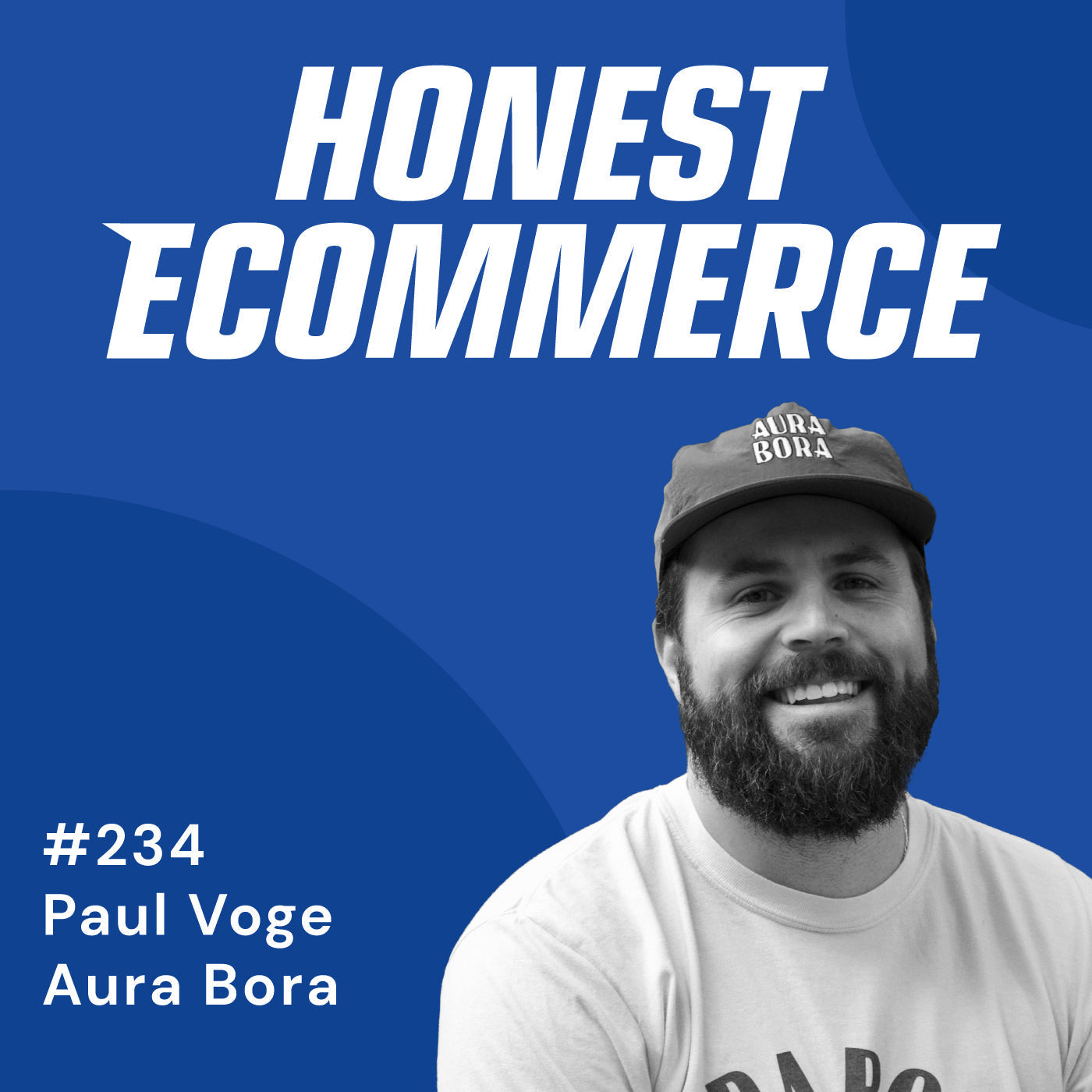
Paul Voge
I don't really wanna lie. My first step into Whole Foods… And I was like, "Yeah, Darcy was at the show and I've got samples." Like, didn't connect the --two thoughts-- two separate thoughts. And they're like, "Okay. Yeah her office is [the] second door on the left, why don't you drop them off on her desk."
Chase Clymer
Welcome to Honest Ecommerce, a podcast dedicated to cutting through the BS and finding actionable advice for online store owners. I'm your host, Chase Clymer. And I believe running a direct-to-consumer brand does not have to be complicated or a guessing game.
On this podcast, we interview founders and experts who are putting in the work and creating real results.
I also share my own insights from running our top Shopify consultancy, Electric Eye. We cut the fluff in favor of facts to help you grow your Ecommerce business.
Let's get on with the show.
Hey everybody, welcome back to another episode of Honest Ecommerce. I'm your host, Chase Clymer.
And today I'm welcoming the show, Paul Voge. He is the founder and CEO of Aura Bora, a sparkling water company selling unique flavors online and in more than 8000 stores around the country.
Paul, welcome to the show.
Paul Voge
Thanks for having me. Great to be here.
Chase Clymer
You know what, I just want to go out and say it on air, I'm getting so good at these intros. And I'm so excited. It only took me like 300 episodes to get here. But I'm feeling really good and confident about my intros these days.
Paul Voge
Good.
Chase Clymer
Awesome. So for those that are unaware of Aura Bora, can you quickly [tell] what are you guys selling?
Paul Voge
Sure. We sell craft sparkling water made from herbs, fruits and flowers. So think LaCroix, Waterloo, Polar, whatever your normal daily driver sparkling water.
It's a choice, but give it differentiated flavors, upscale ingredients, and hopefully a brand you resonate with a little bit more.
Chase Clymer
Oh, absolutely. And I'm a huge sparkling water fan. I've got a bunch of these in my fridge. Thank you so much for sharing them by the way.
Paul Voge
Of course.
Chase Clymer
Where did this idea come from? What was going on?
Paul Voge
Yeah. So I am a big sparkling water drinker, I probably drink 10 to 12 cans a day and I have for many years. I grew up in one of those homes that did not allow soda. So this was our soda.
Myself and my four older siblings always looked like little pretentious kids with our LaCroix or Pellegrino.
My wife, Maddie grew up in a similar kind of health oriented home, so we were making a lot of sparkling water at home with our Sodastream.
And then I was working in this office building that had a fully stocked pantry area. So at work, I mow through 10 or 11 cans of Lacroix every day.
And it felt odd to me that we had Jeni's ice cream and Justin's peanut butter, and Kettle potato chips, and Purely Elizabeth granola and all these challenger brands that are super disruptive to very commoditized categories in our pantry area.
And then we just had a bottom shelf, sparkling water: Lacroix, your private label. And it made sense because there really wasn't an upscale sparkling water in that same way.
So we're like, "Okay, somebody's gonna do a craft version of this, why not me?" I've always been an entrepreneurial type of person and really liked sparkling water.
And if you're gonna drink a gallon of something a day, you might as well like it.
So use that same SodaStream to make our first few recipes. And we launched just before Thanksgiving in 2019.
Chase Clymer
Wow, that is fantastic. So you have this idea, you start to do some test products. How did you make sure that the market actually wanted this?
Paul Voge
Gosh. Yeah, I knew... And this is a problem a lot of entrepreneurs have: Obviously, you're probably really passionate about the thing you're building or making or selling.
And probably will always be the most passionate. I have yet to meet someone who is more passionate about sparkling water than me. I've come close a few times.
But you just want to make sure there are some people that are in the same realm or at least it's a large market. So obviously, we knew "Yes, it's a very large market."
There's billions of dollars worth of sparkling water purchased in the US every year.
And my favorite fact at the time was we still drink sparkling water less per capita than Canada and Western Europe. So we're still such a soda dominated country that there was room to grow.
And it felt like "Okay, growing into a competitive category is really challenging, but growing in one that is growing and it's competitive..."
It means you can own a little niche and hopefully more and more people come in through your niche.
So for us, it was "Hey, we want to be this premium herbal-based sparkling water that people that are tired of normal sparkling water can trade up. Or if you're coming from diet soda, you can trade down. And I'm saying down in price, not necessarily in quality."
There's not a lot of high-quality things in diet soda. So [it's] a long way of saying to make sure that people wanted our differentiated flavors, I felt like "Hey, to me, I drink a lot of this. So I'm tired of lemon, lime, and grapefruit. Let me go see if other sparkling water diehards feel similarly."
And I bet we, I don't know, sampled with 80 maybe 90 people in Denver, Colorado --This is the summer of 2019-- out of these little plastic bottles and I had them tried Lacroix and Waterloo and Polar and all these brands and hours and said, "Hey, is this meaningfully different? Is this something you would pay more for than you do, you would the prior ones?"
And we talked about bubble size, and carbonation amount, and how strong the flavor should be. And is lemongrass a good thing to mix in?
And anyway after many, many months of that we felt like we were ready to launch in November.
Chase Clymer
That's great. So you went out and you talked to what you believe to be raving fans of the category and you're like, "Here's a newcomer..."
Paul Voge
Yes.
Chase Clymer
"...what's your thoughts on this?" Did you take those learnings and iterate on the product from that?
Paul Voge
Yeah, it was funny is I tried to only listen to those that were... This will sound a little snobby but I'll say it.
I gave a little quiz to everyone. So we would ask, "Rank these sparkling waters in order of carbonation level." And if you didn't get this right, I didn't look at your feedback.
I wasn't really interested in building a product for you. It's like, "Hey, I'm making this product for true top tier sparkling water drinkers."
So that quiz said, "Hey, what has more carbonation like Topo Chico or Lacroix?"
Anyone that's had those two products knows that Topo Chico is more carbonated than Lacroix. And if someone gets that wrong, their test is immediately eliminated from the pile.
So we had some way of saying "Okay, of the 90 people we talked to, there are probably 25 that we trusted because they knew 'Hey, Waterloo has more flavor than Lacroix. And Spindrift is more acidic because they have juice in it.' And there's a little bit of sugar in these few brands. And there's minerality and Pellegrino and Perrier'"
Those are things you would know, if you drink a lot of sparkling water. You probably wouldn't know if you're just kind of a casual fan.
So we wanted to kind of verify, "Hey, these serious drinkers." And then yes, to your point. "What kind of new flavor experiences are they looking for?"
They definitely agree they were tired of lemon, lime and grapefruit. But does that mean they want to go necessarily to lavender, lemongrass, and basil? We weren't so sure.
Chase Clymer
Absolutely. So with... You've got some feedback from some potential customers.
Obviously, in food and bev, it's a little bit of more work to actually get a product you can take to market. Can you talk about that?
Paul Voge
Yeah. Thankfully.... I use this analogy a lot, because I just was so lucky that I didn't know it, which is often the case in life. I was living just outside of Boulder, Colorado at this time.
And it's a little like saying, I was living in West Hollywood and I wanted to be a stuntman. And it's like, "Man, everyone I ran into as a producer or director or an actor and I get all these connections."
So I didn't know that at the time but Boulder is the home of natural products.
Bobo's, Justin's, Hain Celestial... I can name 40 brands that started there. IZZE, ONE Protein Bar... And these are all... This is the birthplace of natural products. You could say second place is probably Berkeley, California.
So everyone I ran into around town, I'd say "Hey, I'm looking for cans." And someone said "This guy sells cans." "And I'm looking for a small manufacturer."
And in Colorado, there are tons of breweries that have a lot of line time or you can jump in if you're willing to pay the fee.
So that was the beginning: [I] found a food scientist, found a small [company], and found somebody to sell me cans.
My co-founder and wife Maddie is an amazing creative. So she had, I think, nailed both brand and branding, and packaging.
So we felt like "Okay, we've got the recipe, we've got the packaging, we've got a place to fill the cans, we have a food scientist that can make sure we're not poisoning anyone and everything is coming out right on the big 1000 gallon tank."
And we did our first production run like October something 2019.
Chase Clymer
I need to ask because you guys had so much going for you at this point in time.
Paul Voge
Yeah.
Chase Clymer
What was your backstory before this? Obviously, your wife had the familiarity with branding which is fantastic.
Everybody go check out their website. I was talking about [that] before we got actually recording.
But what was your history and how did that help level you up to actually dive in here and start a business?
Paul Voge
Yeah, so I did not have one industry I was behind. I'll say what I did.
Immediately prior to the show, I was working at a small investment firm called Saturn Five. They both invested in new ventures and acquired unsexy cash flowing businesses.
So a concrete company, and a curb manufacturer, and corporate cleaning business and all of these EBITDA positive businesses, unlike most food and beverage businesses.
But before that or during that, I always had some sort of side hustles. So I sold Christmas trees, or socks, or t-shirts or all sorts of things from 15 onwards.
Never raising money, but always having either a side hustle or in-between jobs, finding some way of being entrepreneurial.
So that was my background. Otherwise, I was 24 when I started this business, I didn't have much of a background at all.
Chase Clymer
So just a lot of faith.
Paul Voge
That's right (laughs). Yeah.
I always joked "Hey, I drink a lot of sparkling water. So if this doesn't work and we just ran our credit card for the first production run, I'll probably mow through this in like 5 or 6 years. no big deal. And I've just got my own personal supply."
So I did feel like the barrier to entry is low and the worst case scenario is pretty great. So we've got nothing to lose.
Chase Clymer
That's a great outlook on it. It's like "You know what, worst case, I just bought a lot of soda."
Paul Voge
That's right. That's right.
Sponsor: Electric Eye
Hey there, merchant.
Are you tired of trying to navigate the wild world of ecommerce on your own?
Are you looking for a partner to help you achieve your goals?
Look no further than the Shopify Plus agency, Electric Eye. Our team has a proven track record of helping our clients make millions with strategic design and development.
Whether you're migrating from a legacy platform to Shopify, designing a new theme for your store, or just looking to optimize what you have, Electric Eye is the perfect partner for you.
Electric Eye are true Shopify experts.
Not only is our Shopify knowledge unparalleled, but we have partnerships with all the best tech in the Shopify ecosystem.
And don't worry, we're easy to get a hold of. Our clients rave about our fast communication.
So here's the deal, if your ecommerce business is doing over $1 million dollars a year you can receive a complimentary Shopify Diagnostic from our team of experts.
That's free, personalized, strategic recommendations to improve your store and grow your business.
To get started, head on over to electriceye.io/connect to schedule an intro call with one of our experts.
That’s electriceye.io/connect.
Sponsor: Sendlane
Alright, I want you to picture this: You're an Ecommerce merchant juggling multiple platforms to manage your email marketing, SMS campaigns, AND product reviews.
It's a time-consuming and costly ordeal. But with Sendlane, those days of chaos are long gone.
Sendlane brings together the power of email, SMS, and reviews all in one convenient place. So you can say goodbye to the hassle of separate tools and hello to simplified operations, increased efficiency, unified customer experience, and huge savings.
And I haven’t even gotten to the best part; with the all-new FREE Sendlane Reviews, you can leverage social proof to build trust and credibility with potential customers.
Let me say that again: Free. Product. Reviews.
With Sendlane, you pay for email and SMS and you get reviews for free!
Sendlane understands that customer feedback is essential for the success of any Ecommerce business. That's why they've made it an integral part of their platform without any additional cost to you.
By unifying these key components of your tech stack, Sendlane helps you save time and money, all while generating more revenue.
Don't let your Ecommerce tech stack hold you back. Embrace the unifying force of Sendlane and take your business to new heights.
Sign up today and experience the power of streamlined operations, increased efficiency, and revenue growth.
Visit sendlane.com/honest to learn more and schedule your free consultation with a Sendlane expert.
Chase Clymer
Awesome. Alright. So you guys are launching this. You're taking this to market. What's that strategy? How did you do that?
Paul Voge
Gosh, this is obviously... We all know now that November 2019 was just a few months before COVID started. I obviously didn't know that at the time. If I had, there's a lot of things I would have done differently.
There was a small tabletop show --which means it's not a very big trade show, it's kind of a local thing-- called Naturally Boulder.
And the Naturally Network is all over for natural products. So if you make a clean sunscreen or a delicious aspartame-free soda, like Naturally Network is for you.
They've mostly on the West Coast, but they just started opening up East Coast offices as well. They had a trade show called Naturally Boulder.
I applied to be one of the tables and got in. And it meant they were doing a pitch slam on stage. But in between each pitch people would sample up and down the rows.
Now what they didn't know was I was timing everything perfectly, because at that point, my wife had gotten a new job in San Francisco. We thought it'd be a better place to launch the product anyway.
And I wasn't making any money, I'd quit my job for this. So I was flying back and forth between Colorado and Northern California.
So I had timed everything such that I could land that day, finished the production run for the next day, and then the day following would be this trade show.
So actually, the day the trade show started, people were opening up these cans not knowing that I'd closed some of those cans like 45 minutes earlier. We had I think 1000 cans in the world at that point.
We did the trade show and the reaction was really great. And I have heard that the forager for Whole Foods was in the room. And a forager is someone that just tries new products and each local market for Whole Foods.
I got her name. Her name is Darcy. And I think I knew which one she was in the auditorium and she never came by my booth.
And Whole Foods buyers, whenever they get a nametag, they'll always flip it around, so they're not getting harassed by people like me.
Anyway, feedback was good. I take my 1000 cans back into the rental car.
And the next day I drove to the Whole Foods office. I say, "Hey, Darcy was at the show yesterday and I've got some samples for her."
And the person on the desk said "Okay, Darcy wanted you to drive samples here?" And they asked very directly like that. I was like, "I don't really want to lie, my first step into Whole Foods."
And I was like, "Yeah, Darcy was at the show. And I've got samples." I didn't connect the two thoughts, two separate thoughts.
And they're like, "Okay, yeah, her office is the second door on the left. Why don't you drop them off on her desk?"
So I did, I dropped off like a couple of cans of each flavor on her desk.
And then the person on the desk was like, "Hey, why don't you shoot her an email so she knows you're here".
And I figured "It's such a big trade show, she probably met everyone or so she thinks. I'm just going to shoot her an email and say, 'Hey, so great to meet you yesterday. Samples are on your desk.'"
And assume that she'll just think "I must have met him and I didn't realize it." But I know for a fact she didn't meet me.
And sure enough, she replied within 20 minutes and [said] "So great to meet you. Thanks for dropping off the samples." And it worked.
Two weeks later, I got a call and they said, "Hey, we love the samples. We'd love to get it in Whole Foods in Colorado and Utah, New Mexico."
And that was our first big retailer was Whole Foods in the Rockies.
Chase Clymer
Oh, that's such a good story. And I hope that listeners out there just understand you miss every shot you don't take. Let's use the Michael Jordan analogy. Alright. Alright.
Actually, it's Wayne Gretzky. That's the quote.
Paul Voge
Yeah. (laughs)
Chase Clymer
So with the launch, were you guys going wholesale first? Was that the play?
Paul Voge
That was the idea. Yeah, and to be honest, I said at the time like "Hey, these are heavy 10 pound boxes. Our case of water is 10 pounds. There's no way you can make money on the internet. Let's just sell to stores."
And I put up like a 10-minute Squarespace site just so people could read about it if they saw it in a store. But there's no way to buy on the site.
And then COVID happened.
And at that point, we were probably in like 100 stores in the Bay Area. And then these Whole Foods in Colorado. And I was going back and forth between the two. And I just started in this accelerator in Texas.
So it's flying off in between Denver, Austin, back home in San Francisco for probably 4 months in a row before March of 2020.
And from there, it felt like "Okay, well, gosh, I can't really go to the store as morally. Let's just turn this website into something you can buy."
And I have a lot of older cousins and older siblings. So it started with like... I think they're just doing me a favor of "Wow, what a horrible time to start a business. Let's just buy a case from Paul."
And it was once a week I'd drive to the post office, drop off all the boxes, whatever. And then it became twice a week, then 3 times a week, then every day, then twice a day. And this thing happened organically.
I couldn't even tell you what ad spend was. I didn't know what Facebook's Ad Manager looked like.
We were just selling well online until we got a random call in May of 2020 from a guy that was claiming to be a producer at Shark Tank.
I thought "That's total bullshit. That can't be right." And sure enough, it was.
And they were looking for innovative food and beverage products because they had a guest shark named Daniel Lubetzky, the founder of Kind Bar. And they needed more food and beverage entrepreneurs.
So he went out looking specifically for food and beverages. And he said, "Hey, I read some of your stuff online. I tried one of your products at a store in LA. Why don't you come out in August and we can do this thing?"
So we drove out in August, we were in a hotel room for 10 days in Shark Tank and that kickstarted the Ecommerce side of our business.
But just to directly answer the question. It was wholesale from November of 2019 till essentially the end of 2020.
And then beginning in 2021, is when the episode actually aired and we became a D2C business despite the 10 or 20 pound box.
Chase Clymer
That's such an awesome story. Now with... Everyone knows there's the Shark Tank Bump when the episode goes live.
What can you tell me about how you guys worked on the business to make sure you were ready for that?
Paul Voge
So yes, we did have a big Shark Tank Bump. And thankfully, we were ready with inventory. It is...
CPG businesses are almost impossible to finance because there's a huge gap between when you need to make the product and when you get paid by distributors.
For us, we felt like "Hey, we already had 3 really fortuitous events in a row: the Whole Foods buyer/trying our samples, getting into Shark Tank, this pandemic brought more people into grocery stores, as ugly as that sounds to say."
It probably did help a lot of new food beverage companies, us included.
So I felt like "Hey, we're not going to manage our risk here. Let's just buy as much inventory as we think we could possibly need. And then double it and make sure we're ready for Shark Tank."
So sure enough, it was a massive night. Both D2C, the 800 stores we were in all sold.
We saw a great pull through from the shelf. And then probably the thing we weren't expecting that I foolishly should have expected was plenty of grocery buyers watching that show.
So we were ready with a ton of inventory. We got to do a lot of new stores as a result.
And I probably mentioned Shark Tank 4 times a week on sales calls where conventional grocery stores say "Hey, wait a second, I think I've seen this product before."
And it's always a great way of saying "Hey, they do 2 or 3 reruns a year." That's marketing that I truly can't afford.
But a couple million Americans see our product every quarter on reruns. So that helps us for sure.
Chase Clymer
Absolutely. Now you are selling this heavy product...
Paul Voge
Yeah.
Chase Clymer
...online.
Obviously, at first, "You're like this is not going to work out. "And these are cans. They could be damaged quite easily. So what did you guys?..
Paul Voge
Totally.
Chase Clymer
What did you do to try to circumvent those risks?
Paul Voge
I can't tell you the number of times I have dropped a box from a ladder to see what's the best way of packaging a box both for speed and for not damaging the can.
We also use these sleek cans that we really like.
But if linebackers get injured a lot less than wide receivers, then it's pretty clear. They're shorter, they're more stout, they're just less aerodynamic.
Whereas our sleek cans just get damaged way more than a normal squat coke sized cans. So we have plenty of damage stories.
I can't tell you the number of people we've refunded. "Hey, great. You damaged your cans, here's $3 back. Here's $4 back." I've done that thousands of times.
I think now we finally have a good system but it took a lot of trial and error. And the truth is there wasn't like 20 years of research to look at the way there was for wholesale things.
Very few beverage companies were selling online before the second week of March of 2020 because it's a really heavy box, and there's a lot of damage. So we all figured it out together.
So eventually I had 4 or 5 friends that also sold things in 12 oz sleek cans. And when one of us figured out , "Hey, you can put these cardboard things for 10 cents on the corners." We all quickly bought those cardboard things.
So it was fun in that respect. If they were all locked inside, we're all figuring out "How do we make this thing work?"
Chase Clymer
Oh, that's amazing. Alright, Paul. So is there anything I didn't ask you about today that you think would resonate with our audience?
Paul Voge
Probably our new, newer line of business. We have online and in stores. I can jump into where we're currently sold in the summer of 2023.
Today, we're selling both single serve cans in stores, full 12-Pack cases on our website. We do a new flavor every single month.
So if you have a sparkling water friend of yours that you feel like you want to give them an awesome gift, our Flavor of the Month club is the second Tuesday of every month.
They'll get a shipment of a new flavor. This month, it's raspberry vanilla. Next month, it's mango chili. We're redoing one we did last year. And 12 times a year they'll get a new case of sparkling water.
And then we sell multi-packs and single serve cans in Publix, Wegmans, Kings, Balducci's, a few divisions of Albertsons, Safeway, a few divisions a Whole Foods, Sprouts all over the country, Imperfect Produce, Misfit Foods, Thrive Market…
And I always joke, we're in so many natural stores that if you have a grocery store near you, that's a coop or they have oats in a barrel, we're probably in the fridge.
So that's where you can find Aura Bora.
Chase Clymer
Absolutely, Paul and I need to directly ask you this because everyone on the show knows that margin is super important.
And if they want to support you directly, what is the best way to buy from you?
Paul Voge
Oh, thank you. Gosh, that's a great question. Right now the best way to buy from us is a 6-pack in Publix or Wegmans are Kings Balducci's so you'd have to live in the Northeast Mid Atlantic or Southeast.
If you're listening to this show, we make the most from our website now in terms of actual dollar margin. Now we had to institute a $60 minimum online to get there.
So you have to buy 2 cases. But if you don't like it, and you listen to this episode, shoot me a note and I'll refund those cans.
Chase Clymer
And what's the website?
Paul Voge
Website is aurabora.com ura A-U-R-A-B-O-R-A.com.
Chase Clymer
Absolutely. Paul, thank you so much for coming on today sharing your amazing story.
Paul Voge
Of course. Thanks for having me.
Chase Clymer
We can't thank our guests enough for coming on the show and sharing their knowledge and journey with us. We've got a lot to think about and potentially add into our own business. You can find all the links in the show notes.
You can subscribe to the newsletter at honestecommerce.com to get each episode delivered right to your inbox.
If you're enjoying this content, consider leaving a review on iTunes, that really helps us out.
Lastly, if you're a store owner looking for an amazing partner to help get your Shopify store to the next level, reach out to Electric Eye at electriceye.io/connect.