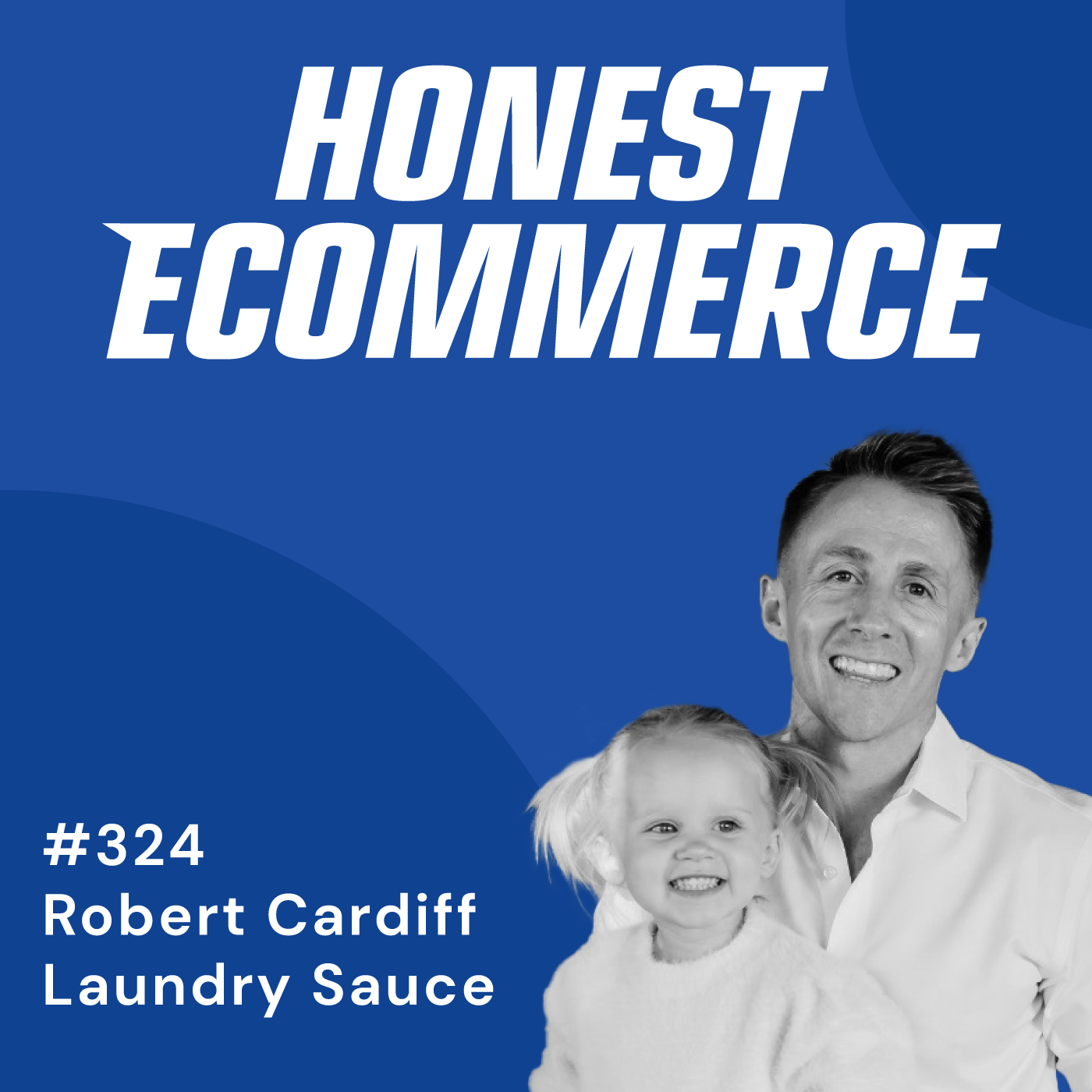
Robert Cardiff
Why would I buy your product versus what's already on the market? It's a fundamental question that everybody should ask.
Chase Clymer
Welcome to Honest Ecommerce, a podcast dedicated to cutting through the BS and finding actionable advice for online store owners. I'm your host, Chase Clymer. And I believe running a direct-to-consumer brand does not have to be complicated or a guessing game.
On this podcast, we interview founders and experts who are putting in the work and creating real results.
I also share my own insights from running our top Shopify consultancy, Electric Eye. We cut the fluff in favor of facts to help you grow your Ecommerce business.
Let's get on with the show.
Chase Clymer
Alright everybody, welcome back to eTail. Today I'm bringing to you better late than never and I fully will take the responsibility there. Google Meet is hard. Calendar invites are hard. But an amazing CEO and founder, Robert Cardiff of Laundry Sauce, COO, let me clarify myself there. An 8-figure DTC brand. Welcome to the show.
Robert Cardiff
Yeah, no. Thank you for having me. It's been a big shout out to ETAIL-S. It's been a great event. First time here and met a lot of amazing people and technologies. Thanks for having me on the show.
Chase Clymer
Absolutely. Yeah. eTail is great. They connect me with a bunch of amazing brands. Not only that I'm interviewing here, but this is going to trickle down for a couple months of content for my show. So I'm always thankful. Shout out Jody. Where's she at? But yeah.
So for those that aren't familiar with laundry sauce, quickly, what are the types of products you guys bring to the market over there?
Robert Cardiff
Yeah. Laundry Sauce is the world's best smelling laundry detergent. There's nothing like it on the market. It's hands down. Once you try laundry sauce, you just can't go back to the generic stuff.
Chase Clymer
Well, I'm excited to try it. So where did the idea for this business come from? Take me back in time.
Robert Cardiff
Yeah. So I give full credit to my business partner, Ian. He's the CEO. But we started this about four and half years ago. And we just wanted to create a white space Ecommerce business. And what I mean by that is like, where was the gap in the market? And then go create an amazing brand that people could really fall in love with. And he was doing some research one day and he came across this meme called Laundry Sauce. And so the name Laundry Sauce comes from a meme that was viral for a period of time. And that's how it all started.
Chase Clymer
So you mentioned you were looking for a white space Ecommerce business to get into. I guarantee there are listeners out there that are starting a business. What were some of the activities or where are you looking to try to get inspiration to start a brand?
Robert Cardiff
Yeah, I think that's always the question. It's like, I really want to start an Ecommerce brand. But like, how the hell do I start? And everyone's like, well, I can test a bunch of products. And it's like, I'd say one of the things I learned from this whole process is like, what's your company thesis? What are you hypothesizing for the company that you're working for? So, and what I mean by that is it's like, for laundry sauce, we were like, the white space was everybody has to do their laundry, right? You can't opt out of that.
Chase Clymer
We hope they do.
Robert Cardiff
And if they don't do it, they probably smell like shit. So we don't want that. That's the anti Laundry Sauce goal. But everybody's got to do laundry and they're really warning the inspiring brands in the category. If you walk down a grocery aisle today and it is the laundry aisle, it's pretty awful. I mean, there are a couple of main brands that we're all very familiar with and we all have bought that for our entire lives because that's what our mom or grandma used. And so from a white space perspective, we're like, wow, like how is this laundry category overlooked? It was ripe for disruption. And so then we really started digging in and said like, okay, like how do we want to differentiate this product? And that's kind of phase two. So the thesis was it's a consumable good that everybody can't opt out of and that there's no strong brand affinity. which made it ripe for disruption by a brand that people could fall in love with.
Chase Clymer
Absolutely. And I think that the main bullet point I want to pull out is to walk around your grocery store, see what is lacking innovation, see what's stale, where there's no new players in the space on those shelves. And see if you are interested in that category too, because you kind of have to love what you do.
Robert Cardiff
Yeah. mean, just a big shout out to a new company called EZ Bombs. I'm not associated with it, but they've had like an insane amount of growth in like a 12 month period. If you haven't checked them out, you have to check them out. And essentially what they do is like, it's a little ball of ingredients that you throw in a crock pot. And that's all you have to do. It's like water, ball of ingredients and chicken, and you're done.
Chase Clymer
I'm sold already.
Robert Cardiff
I mean, it's delicious. They've done a really great job. So it's just like, you got tons of ingredient packets in the store. How do you make that just a little bit different?
Chase Clymer
Yeah, but I already know it's the gelatin that they're using to contain those ingredients. Now we're just doing a podcast about this thing that we both are interested in. I'm sure that gelatin makes the flavors congeal to the thing. This sounds great. I'm going to try it.
Robert Cardiff
You got to check it out. It's like walking around the store, going to Walmart, going to Target, finding something that looks boring as hell. And then the next thing you have to do is do research. So many people have these ideas in their head and I'm definitely a victim of that where I've like, oh, I got this great idea and I tell people about it. And the first question I always ask people, have you researched if that exists already? And it just helps you as a next step. Research competitors, what's their pricing?
And I think that one of the funniest things that happened when Ian and my other business partner, Austin, we're starting a business is we were like, we're going to do laundry detergent.
And it's gonna be called Laundry Sauce. And we for sure wanted it to clean your clothes. Because we were all guys and we played hard, did crazy stuff.
And it's like, it has to clean your clothes. That was a non-negotiable. But then if you look at the competitors, it's like you got tied, you got gained. Like their primary focus is to clean your clothes. And so one of my buddies I was telling about the idea to and he's just like, well, how are you? How are you going to differentiate? Like, how are you different? How are you better?
And the question was, why would I buy your product versus what's already on the market? It's a fundamental question that everybody should ask. Could be the price. It could be a unique differentiator brand like Liquid Death. Yeah, Liquid Death is water and they differentiate through brand and creative. So like that, just know how you're differentiating.
And my buddy is like, how is it different? And we were all obsessed with fragrance. And so we decided over a period of time to combine high-end fragrance with really easy to use powerful laundry detergent and boom, laundry size.
Chase Clymer
That's amazing. So how long did it take you to go from ideation of this new product to samples?
Robert Cardiff
Yeah. So it's a great question. Basically from when we first started working on the idea until when we launched is probably a better one. It took almost two years.
And we didn't know anything about laundry detergent. And so we had to find a laundry expert, which is an absolute hack in product development. Like everybody listening, if you have an idea and you're like, don't know anything about this category, go find somebody on the internet that worked at P&G for 30 years or whatever it is. We got really lucky. We found an expert and we kind of set out to develop an amazing product with the support of that expert. But it almost took two years and we iterated on a bunch of different brands.
We basically came out with like three different brands for laundry sauce and finally landed on where we're at now. So it was an iterative process. We didn't get it right the first time. Then manufacturing is a tough thing. It's like, you get it manufactured overseas? Do you get it manufactured domestically? Who are those partners?
They're all used to working with you know, Tide and these larger companies. And so just trying to convince them to work with us was really hard. And then you have to raise money. And that was probably the hardest part, but probably the most exciting part when we were able to convince people that we had a great idea that they should invest.
Chase Clymer
Hey, Shopify store owners. Have you ever wondered if your store is leaving money on the table? Imagine increasing sales without spending more money on ads. Sounds too good to be true. Well, it's not.
I'd like to introduce you to StoreTester. StoreTester is a done-for-you conversion rate optimization service for Shopify merchants.
Could your store benefit from increased conversion rates, higher average order values, and improved revenue per visitor? StoreTester could be the perfect partner for you. From ideation to implementation, this full service A-B testing service takes all of the guesswork out of improving Shopify stores.
Stortester does all the work for you while offering month-to-month transparent fixed pricing. It gets even better. They believe in their service so much they're offering the first test for free for qualified merchants.
Let me repeat, the first test is free for qualified merchants. Curious to see if you qualify for a free test? Reach out today. Visit storetester.com to schedule an intro call.
That's www.S-T-O-R-E-T-E-S-T-E-R.com. Schedule an intro call today to see if you qualify for a free test.
Hey everybody, today's podcast is brought to you by Intelligems, the ultimate profit optimization tool for Shopify merchants. I'm telling you this, obviously, you know I own an agency. We use Intelligems when we're running split testing and CRO stuff for all of our clients.
Are you looking to maximize your profits? Intelligems offers data-driven solutions to optimize your content, prices, discounts, and shipping rates. Join over 500 happy clients who have seen significant improvements.
With Intelligems, you gain control over your Ecommerce economics, boosting your profit per visitor by an astonishing 36%.
But that's not all. Intelligems users report a 54.62% increase in revenue per visitor and a remarkable rise in conversion rates.
How does Intelligems do it? Through a suite of tools that allows you to A-B test everything on your Shopify store, from landing pages to product prices and shipping rates.
Imagine testing new layouts, offers, even a new Shopify theme with ease.
We're testing a new landing page for our client on a new theme versus an old landing page on their old theme right now.
Intelligems empowers you to find the perfect price point for your products and optimize your shipping strategy.
But there's more. Boost your average order value with customized campaign offers and discover if your customers prefer free shipping or a lower list price.
With over $100 million in incremental profit generated, billion transactions ran through their software. They have over 400 million shoppers that have gone through their tests.
Intelligems is not a tool. It's a game changer for your business.
Are you ready to transform your Shopify store's profitability? Book a demo today at intelligems.io. Empower your brand to reach new heights.
Again, that's intelligems.io. Intelligems, giving superpowers to your customer acquisition, retention, and overall profitability.
You guys have a great product development resource helping you with the product, you got some money to back this. What's the go-to-market strategy though? How are you getting in front of potential customers?
Robert Cardiff
Yeah. Well, I have to talk about the investor part.
Chase Clymer
Yeah.
Robert Cardiff
Hack one, find an expert. Hack two, when you're starting a company off, test creative. Big shout out to Raindrop Marketing Company. They're out of San Diego. They've done like native Dr. Squatch, like they do high production like videos. They're amazing. And so we had a mutual friend with Raindrop and they got us connected and we're like, well, we're going to just, we're going to do an anchor video.
We had the brand, we had the product in development and we're like, we need to raise money. So let's create an anchor video that can tell the world about what our product is. And so we spent like $40,000 and that was before we ever sold a dollar product. But as soon as we made that video called an anchor video asset. It's like a high production ad, essentially.
Chase Clymer
Yeah.
Robert Cardiff
Everybody instantly got it. And we raised like a couple million dollars just on that video. So it's like the best $40,000 we ever spent.
Chase Clymer
Yeah, it got the story down, succinct, with great video footage to back it up. And I mean, honestly, you're probably prepping all these investors beforehand and be like, if you haven't been watching this before we get there.Now they're just excited and they're in tune with the vision that that video is trying to explain.
Robert Cardiff
Yeah, it brought the brand to life. And it brought the product to life. I would tell my parents and my wife's parents and they're like, laundry detergent? What? And I was like, Yeah, laundry sauce. And nobody got it. And then we did this professional anchor video. And it was like, the gates opened up and everyone was like, Oh, this is legit. And that helped us raise a couple million dollars. So then your next question was like, how do we go to market?
Chase Clymer
Yeah.
Robert Cardiff
Yeah, that's a good one. So we took a really big leap of faith. You know, and it was based on our thesis. It was like, we know that everybody does laundry and if we can make it better, then would they buy our product? And that was like the leap of faith. And so we invested quite a bit in product development. And then the first place we were going to test is to have our own website, not launch Amazon, just do our website and really figure out our messaging, whether people even wanted to buy our product, and then really be able to like hone if there's any negative feedback that we needed to correct.
And so we spent the first two years of our business just on our website. Like we didn't have Amazon, we didn't have retail, nothing else because we wanted to control that entire feedback loop with the customer. Eventually, we ended up going on Amazon and now Laundry Sauce is available on Amazon. And then we're in some very boutique retailers just to test that out. But first things first was, we invested in creative, set up our website, and then we started running paid ads on Google, YouTube, and then Meta, Facebook and Instagram. And about two months after we launched, we did about $150,000 in revenue in that third month. And we were like, got something.
Chase Clymer
Now, as much as you're allowed to share when it comes to numbers, how much were you investing in those channels to see those returns?
Robert Cardiff
Yeah. So I'm definitely not a paid media expert. We hire agencies that have expertise in any particular channel. We have a team that helps us with Amazon. And they have a whole ad buying team and then we have.
Chase Clymer
I’m gonna circle back to Amazon versus Shopify or you know, just your standalone site here in a second.
Robert Cardiff
Yeah, 100%. I love talking about that. So the ad buyers that we originally started with, it's like, you've got to be able to build up enough audiences. And so one of the things I don't think brands do out of the gate is they don't invest in enough creativity. They're like, Oh, just do some UGC or they'll do like some performance ads.
But ultimately, like the EZ Bombs company in 12 months, they did like 18 million dollars. Insane. And if you kind of like to pull back the like, how did they do that? They launched it on TikTok. They had creative every single day that they were pumping out organic creative and anything that worked on organic. Then they would run paid media behind it. Which was amazing. But you have to have that kind of structure set up from the beginning.
So with us, we raised money and so we had money to invest in paid media. And so within a very short period of time, within a couple of months, we were spending like 50 to 100,000 a month on ads. And a lot of people just want to spend like, hey, what's your ad budget for the month? It's like $5,000. And that's one way to do it. And that's not the wrong way to do it. It's just we wanted to grow fast. We had an amazing product, differentiated. And it's like, how do we get more people to try this out.
Chase Clymer
But I think that it goes to show like your goals as a team, collectively, the vision was to grow quickly. And that's why you went the investment route. Whereas some people would rather bootstrap it and go, it's a little bit of a slower clip. And there isn't a right or wrong answer.
Robert Cardiff
I mean, I was talking to a guy yesterday and he wanted to build, he wanted to launch a company for $20,000. And I was like, that's awesome. And so he did a luggage business, bought the minimum amount of luggage inventory and set up a website and did it all with AI and red runs like a little bit of ads, but mostly organic stuff. And he said he's doing like around $5,000 a month in sales. I mean, that's amazing.
Chase Clymer
Obviously, your skill set, your risk, all plays into the choices that you're going to make as you grow a business. Just the one thing I wanted to highlight again is there isn't a right way to do it. And there's a million ways to do it. All it is just to continue to focus on the one thing and just make decisions. Don't get caught up. Whether it's the right or wrong decision, just make one and you'll quickly find out.
Robert Cardiff
Yeah. So I've got a story about another business that I helped launch recently. And it wasn't the same success story as Laundry Sauce. We sell candles. And the company is called Havilah and Company and it's a candle company and it's like 100% natural candles. They're really nice. I mean, you just go to the website, givehavilah.com and we invested a lot.
We were kind of similar to Laundry Sauce’s style where we're going to invest a lot in ads, a lot in creative. And, I didn't listen to my own guidance, my own feedback, where it's like research, to find out how many competitors there are.
Candles is a very crowded space and I think we spent too much. We didn't. We weren't scrappy enough and we went in two different channels, went retail and DTC right out of the gate. And if I were to look back on that very recent experience, the business is still operational. The product is amazing. But we really weren't scrappy enough on the organic side.
And we tried to go and several big channels right out of the gate. And I don't know, my opinion on it is like we did it right with Laundry Sauce. We focused on our DTC channel, which was Shopify. And we just got really, really clear on what our customers said about our product. And then we iterated from there.
Chase Clymer
Absolutely. I want to circle back before we end this here. We've got 5 or 6 minutes left. The difference between Shopify expert versus an Amazon expert. I feel like a lot of brands are looking for a unicorn that can run their entire business for them if they have a good idea. What's your experience with just subject matter expertise and hiring the right people?
Robert Cardiff
Yeah. I really like hiring people that just do that one thing really well. We work with an agency called Darkroom and they're based out of New York. Big shout out to the Darkroom team. They've been phenomenal for us and they have a number of different services, but they do have a team internally that just focuses on Amazon and we work with them.
We also do other things with them. They do our email retention so I don't think that it's a one size fits all, but make sure to evaluate the expertise in that part of the business and like what other brands that they're working with. But for TikTok, we have one agency that helps us run our TikTok ads. We have another agency that does our Facebook and Google ads.
We have another agency that does our website optimization. And then we have Amazon and we have a web development team. And so we have a bunch of different outsourced fractional resources. You know, and I'd be surprised if there's one agency that can do them all and dedicate the right mind share to make you successful.
Chase Clymer
Absolutely.
Robert Cardiff
But maybe. I don't want to say no.
Chase Clymer
But I feel they do exist. But also, it's like you mentioned, too. These are teams. These aren't individuals. And I think that a lot of young entrepreneurs get caught up in trying to find one person that can fix their business when they're not. Maybe if I'm going to backpedal here. Marketing will never fix a product problem.
Robert Cardiff
Yeah, you have to have a good product for sure. And you have to have a good product market fit. I think with the candle business, there's a lot of competitors. I think that the price point was that it's a premium candle. Originally, the price point should have been lower so more people could try it. Laundry Sauce has a premium fragrance. That's what excites me the most. We have high, high-end fragrance. And because of that, it's a premium price product. The fragrance can justify the high end product.
So it really goes back to knowing your differentiation and listening to your customers. Make sure you have the right product market fit. I mean, if you have a thousand customers, survey them. Figure out like, what do they love about your product? What are they not? And then what are the products that you should come out with?
Chase Clymer
That's amazing. Now, Robert., you've talked a lot about the premium product that is Laundry Sauce, the amazing fragrances that you have. If I'm listening to this and I'm trying to check them out, where should I go? What should I do?
Robert Cardiff
Oh, yeah, absolutely. Thanks for that plug.
Chase Clymer
It's my job.
Robert Cardiff
LaundrySauce.com. We have a great offer too. If your first time never tested Laundry Sauce, you get 40 % off your first purchase. So go to our website, check it out, LaundrySauce.com. And I just want to warn you, if you try it, you're never going back to generic stuff. So you're just worried.
Chase Clymer
Well, I hope we send a few listeners your way. Robert, thank you so much for coming on the show today.
Robert Cardiff
Thanks a lot. Appreciate having me.
Chase Clymer
We can't thank our guests enough for coming on the show and sharing their knowledge and journey with us. We've got a lot to think about and potentially add into our own business. You can find all the links in the show notes.
You can subscribe to the newsletter at https://honestecommerce.com/ to get each episode delivered right to your inbox.
If you're enjoying this content, consider leaving a review on iTunes, that really helps us out.
Lastly, if you're a store owner looking for an amazing partner to help get your Shopify store to the next level, reach out to Electric Eye at electriceye.io/connect.
Until next time!