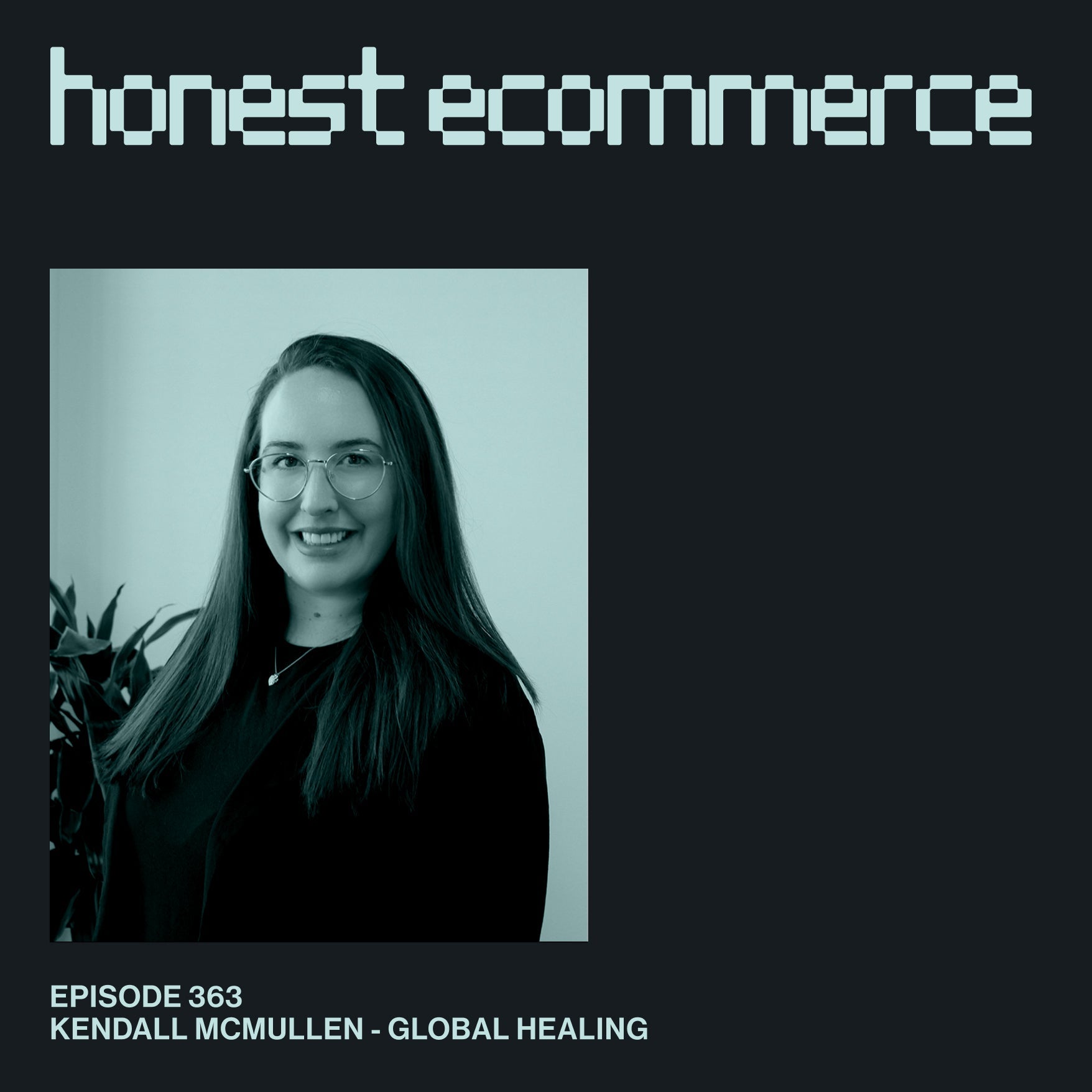
Kendal McMullen
Get on Reddit, get on YouTube, watch every free webinar that you can sign up for. Go get an HTML textbook at the library and learn basic HTML. And all of those things, basically, you can put together a portfolio. And that's how I got where I'm at.
I can tell you I can make you more money, I can make you more efficient, and I can make your systems smarter. And I can also turn around and teach other people how to do it without a big fancy degree.
Chase Clymer
All this stuff is readily available on the internet. And if you want to sit down and learn any skills, you can.
Honest Ecommerce is a weekly podcast where we interview direct-to-consumer brand founders and leaders to find out what it takes to start, grow and scale an online business today.
Have you hit a wall with performance marketing on Google and Facebook? It might be time to think about where your next customers are spending their time online.
That’s where Realize comes in. Realize helps thousands of D2C brands to tap into more ad placements across hundreds of premium websites - reaching audiences you just can’t find on traditional social channels
With intent-based, contextually relevant ad placements, you can drive real conversions, not just impressions, and expand your acquisition strategy with better data, more control, and higher ROI.
Realize helps you build high-performing AI-powered ad experiences, backed by 17 years of data.
And simple to set up, no bloated dashboards or complicated onboarding so you can start scaling fast.
You can also leverage your own first-party data to retarget people already in your funnel.
So if you’re ready to go beyond Facebook and Google and start reaching new audiences, head on over to discover.taboola.com/honest and we can start the new year with a new performance channel. That's discover.tabula.com/honest D-I-S-C-O-V-E-R.T-A-B-O-O-L- dot.COM. H-O-N-E-S-T.
Hey everybody, welcome back to another episode of Honest Ecommerce. Today, I'm welcoming to the show Kendal McMullen. She is a Gen Z leader challenging the corporate model and breaking down the barriers built between the brand and the customer. Kendal, welcome to the show.
Kendal McMullen
Excellent. I'm so excited to be here, Chase. Thank you.
Chase Clymer
Absolutely. Absolutely. Alright. So quickly, I guess, let's talk about... Just so the listeners are aware, the brand, brands you are working with these days and the types of products that they're bringing to market?
Kendal McMullen
Yeah, absolutely. So our Rolls Royce, our premium brand, the big girl, is Global Healing. So we do vitamins, supplements, detoxes, most known for our detoxes. But within Global Healing, we have a couple other sister brands as well that fall under my purview. So that would be CLO, as well as Organic Heap and a few others.
Really, our goal is to bring natural wellness to as many people as possible and whatever flavor that looks like. But all at an upscale, premium quality.
Chase Clymer
That's amazing. And just to establish your title, is it an Ecommerce Manager across these 3 brands?
Kendal McMullen
Yes. So I am the Ecommerce Manager. And just as in marketing, every title means something totally different. For all Ecommerce managers it would encompass anything and everything that comes out of the doc.
So that would be front and back end, dev, email, SMS, social influencers, affiliates, really the full funnel of marketing as well as the backend, a dev side. So I know the different companies have different ways of titling that or splitting that up into departments. But for us, that's what it sounds like.
Chase Clymer
Absolutely. And so if you want to walk me through, I guess, your day to day, are you managing teams? Are you putting out fires yourself? What does it look like?
Kendal McMullen
Yes. Yes to all of the above. So managing fires myself, absolutely. So I do manage a very talented team that works in niche specialties. So they are truly the experts of their field. So I would look to my email SMS specialist for anything and everything. Email, SMS, I won't be hands on keys in any one of their platforms, but I do directly oversee that. So kind of orchestrating the whole channel.
There's always going to be little fires here and there in e-commerce because we work on the internet and the internet is on fire. So we just have to sort that out as the day comes. So each day is a little bit different in that element of it. But we try to stay ahead as possible. So any given day I can be having one-on-ones with those team members.
We prioritize that just so they can chat with me and let them know anything that's going on as a roadblock in their specific niche. And then hearing that, I'm able to loop in other team members. So typically following a one-on-one, there will be like a two-on-one or a three-on-one, depending on what the challenge is or the roadblock that they're facing. So I spend a lot of my day doing that.
And then the rest of the day is in the back end of Shopify, like everything data-driven, looking at our MMM models. So it's really half analytic, half brainstorming, spaghetti at the wall, see what sticks.
Chase Clymer
Running an Ecommerce business means wearing a lot of hats; founder, marketer, customer service, logistics… and let’s be honest, sometimes even therapists.
But one thing you shouldn’t have to stress about? Business insurance.
That’s where Next Insurance comes in.
Next is built specifically for small businesses, including Ecommerce brands, making it simple to get the right coverage entirely online, in just minutes.
Whether you sell handmade candles, athletic wear, or subscription boxes, Next helps protect you from the unexpected, from product liability to shipping mishaps and everything in between.
And here’s the best part: you can save up to 30% on your business insurance and get peace of mind for as low as $1 per day, knowing Next has your back.
With transparent pricing, flexible plans, and instant certificates of insurance, Next gives you the confidence to focus on what matters most - growing your store.
So if you’re ready to protect your business while scaling your brand, head over to nextinsurance.com/honest to get covered today. That’s nextinsurance.com/honest. N-E-X-T-I-N-S-U-R-A-N-C-E dot C-O-M slash H-O-N-E-S-T
Now, how did you end up in this position. What is the fast and quick story of your career? Did you go to school for this? How did this happen?
Kendal McMullen
Yeah. So this is one of my favorite things to chat about because it's nonlinear. And it's not one of those things that just happened overnight. I did not have my degree until a couple months ago. And so I was in management before I finished my bachelor's degree. So one thing that I think is really cool about Ecommerce is you absolutely in 2025 can still bootstrap it.
And what I mean by that is get on Reddit, get on YouTube, watch every free webinar that you can sign up for, go get an HTML textbook at the library and learn basic HTML. And all of those things, basically you can put together a portfolio. And that's how I got where I'm at.
I can tell you, I can make you more money, I can make you more efficient and I can make your systems smarter. And I can also turn around and teach other people how to do it without a big fancy degree. So that's kind of how I got started is I just learned every principle that I now manage.
So that I'm able to turn around and help them and guide them based on my actual experience. And that doesn't take a degree, that just takes being nimble. And then of course, having a company that believes in you when you're doing the application process, but that portfolio is the most important part. So I just like to give people like, if you're not a founder and you don't want to be an entrepreneur or don't have the resources right now to be an entrepreneur.
There are so many skills that you can learn that will slingshot you forward in your career. That is basic HTML, important. Learning how to make money online. There's a lot of different ways to do that. So be nimble in advertisements and then be able to tell people how to do it. So if you can't look at your boss and say, I know how to do it and this is how, then you won't. But if you can articulate that, you'll find yourself exactly where I'm at.
Chase Clymer
I love that you kind of just figured it out yourself. Your first job in the Ecommerce field? Was it more of a freelancing engagement where someone took a chance on you? Or was it full, like, I got a full-time job working for this company?
Kendal McMullen
I would love to have a full-time job when I first started out. But no, yeah, it was more of freelancing. And I was just doing anything and everything. And I would tell them like, Yeah, sure. I know how to do that. And then immediately I'm on Reddit, how to xyz. So it was one of those. But building websites was so helpful.
So, you know, 19 year old Kendal sitting there on Reddit getting eaten alive on these threads, because we all know how people respond to things on Reddit. But I'm there learning how to build out a website. What's a blog? What's all the different elements of a website? And then once I learned how to do that, I'm like, “OK, well, now I can optimize it because this isn't working and I know how to fix it.”
And the next natural step is, I need more eyeballs on my website. Let me learn how to do advertising. And then back then it was AdWords. Now it's Google Ads. Just getting on YouTube and learning how to do little things, little bit steps at a time. And then once I was able to say, can build your website, I can optimize it, and I can get eyes on it, that's when I landed my first full-time role.
Chase Clymer
Absolutely. And I think the one thing I really want to highlight here is that nothing she said was gated by paying to do anything. Well, sure, some people do collect a lot of this information into paid courses and they could be good or they could not be good. Do your own research on that. But all this stuff is readily available on the internet. And if you want to sit down and learn any of these skills, you can.
I don't really talk about it much here because I guess it hasn't come up. I dropped out of college to play in a punk rock band. I learned all of this stuff in the last 15 years just by being curious and wanting to learn about it. And also, like you said, it was well, now I know this. This is the next hurdle. How do we do this? And now we're doing it for clients.
Kendal McMullen
Yeah, absolutely. The work ethic just looks different now than it did in generations before us. It's digital. You're not out there sweating, swinging a hammer, building something. But you're inside, shaped like a shrimp, doing your research and things like I was. But I have a very hard time accepting excuses. You know, these days, especially as a leader, because everything on the internet is free. And it's right there.
If I can sit there and just Google and find an answer in two seconds. We need to be like in this generation, we need to be able to do that. So yeah, I mean, Reddit and YouTube, general Google searches, I didn't even have AI.
Chase Clymer
I know.
Kendal McMullen
That would be so smart right now. I'm starting and I had to actually like where our grandparents say like, I had to go in an encyclopedia. I've said, “Well, I had to Google it. I couldn't just put it in chat. She beat you down.” So I mean, we just have a plethora, an over plethora of resources. So I find it very hard to have excuses. Like, well, I couldn't get started. Well, why not? It's free. If you have internet access, you have Wi-Fi, you are 10 steps ahead.
Chase Clymer
Hey everybody, just a quick reminder, please like this video and subscribe if you haven't. We're releasing interviews like this every week. So don't miss out. Now back to the interview.
To put it out there, like you and I talked a little bit before we started recording, one of our goals of this episode collectively is just to tell any listener that wants to get their foot in the door in Ecommerce, just do it. Just get started.
Kendal McMullen
Yeah.
Chase Clymer
And just focus on one thing and try to master it as best you can and then try to help other people with that skill that you've just learned.
Kendal McMullen
Yeah. It costs $0 to get started. $0 to get started in Ecommerce. It's one of the only careers where you could make a bunch of money starting with zero.
Chase Clymer
Absolutely. And like you said, with ChatGPT or your favorite AI model, it is pretty easy to basically learn quicker. You could essentially almost see ChatGPT as your own free mentor because the models it's trained on is a lot of this information that's out there for free. So when you do get stuck or you have something that is confusing to you, you could just in a natural conversation style, just ask one of these AI models to dumb it down for you.
Kendal McMullen
Oh yeah. That's what I'd be a corporate weapon if I had that at 19.
Chase Clymer
Yeah. But to something you said earlier too, I guess, if you are either trying to get your foot in the door or level up in this world, this is what your managers want, is you not to come to them with like, I'm stuck here. They want you to come to them with, “I'm having an issue with this. Here are 3 solutions I think that we could do. Now I'd like your advice”, right?
Kendal McMullen
Yeah.
Chase Clymer
Because you've already taken that initiative to do that initial Google or that initial ChatGPT prompt and come up with some solutions to this blocker. But now that blocker might be above your pay grade.
Kendal McMullen
Mm-hmm. Yeah, absolutely. I think the key word there is initiative. And that's the biggest thing now. It doesn't matter how old you are, who you are, what resources you have. Initiative in 2025 is really all that it takes.
Chase Clymer
Absolutely. So you start leveling up your skill set, Kendal, and you're moving up into your career paths. How long did it take you from, I'm flailing on Reddit, to have a full-time role?
Kendal McMullen
It took me less than 2 years. Less than 2 years. Just because like I said, the access of information there, there's so much of it. So it's really just in the amount of time that you're able to learn how to articulate your knowledge.
And so that was the biggest barrier for me. It's like, “Hey, I know how to do basic level code. I can do all of these things. I'm such a resource for a company.” Well, they don't care about your resume. So the hardest part for me was to be creative enough to find ways to be visible in the sea of talent. And the best way to do that was I was able to prove it instead of putting all these accolades on my resume that everybody has transparently.
It was submitting their portfolio before my resume. You know, things like that. In two years, I learned the hard way through, you know, probably 100 applications or more, like everyone, you know, we've all been there. Being so young doing that, that I was like, you know what, this is not working. So I'm not just going to keep beating my head against the wall doing the exact same thing.
So within the last six months of that two year period, I really just buckled down and made a really good portfolio and spent the time when I applied to companies and I shouted them out on LinkedIn, you know, I was like following everybody in HR. And sending them that paid for the premium. That was really the first thing that I paid for to get my first initial job was premium LinkedIn so I could send out as many messages as I wanted to.
And I was getting my portfolio out there and that's how I landed my first full-time role. And then from there, I became the attractive candidate.
Chase Clymer
“I have been in business for nearly 20 years, and very few companies I have hired in that time have performed as well as Electric Eye. They have knowledgeable staff, and our project was delivered on time and on budget. Electric Eye has exceeded my expectations, and I look forward to working with them again.”
That is a direct quote from one of our clients at Electric Eye.
Electric Eye is a Shopify Plus partner that has helped over 100 brands migrate, redesign, and optimize their stores since 2016.
If you'd like to increase your conversion rate, average order value, and revenue per session, we are the true Shopify experts you've been looking for.
Right now, we're offering a free diagnostic to qualified brands that reach out and mention the podcast. Visit electriceye.io today to schedule a call and send us a message. Find out why we have over 50 5-star reviews in the Shopify Partner Directory. Again, that's electriceye.io. E-L-E-C-T-R-I-C-E-Y-E.io
And now I want to pivot back into your role as an Ecommerce manager because I do believe that's where some people want to get. And you mentioned your job was half managing the team and half in the data trying to figure out how to grow the business. You're not the head of growth. You're not the marketing leadership. But still, with an Ecommerce, all eyes are pointing towards that North Star, which is we need to grow these sales.
Kendal McMullen
Yes.
Chase Clymer
So my question for you would be, these days, if I'm getting into this industry, what are more attractive skill sets to understand?
Kendal McMullen
I would think getting into it, you have to understand P&L, profit and loss, and understand expenses. Because it doesn't matter if you are amazing at Google Ads, you're the best media buyer there's ever seen. That is one portion of the whole landscape. So, you know, being a media buyer is great in acquisitions, but you have retention and you have a bunch of other different things.
So to level up outside of an individual contributor, you have to understand how the full picture works together and what that can look like. Applicable is if you are an individual contributor and you want to move into management, start co-collaborating with your people on your team and the different channels that are there and establish working partnerships and then show your manager or show leadership how your idea worked cross-functionally.
And then that way they know like, “Hey, you're more nimble than just being in your one niche.” And that's kind of how it lights that spark to move up into higher because once you get out of the individual contribution, you have to understand cross-functionally how everybody plays together and then the spend and the revenue that's associated with that.
So naturally, if you're working cross-functionally and you're seeing like, I'm pulling in this channel and I'm pulling in this channel, now our expenses have doubled, has our revenue doubled to follow that. Okay, well, no, well, let's cut back here. You just start naturally already doing it. And then that's how the best way to learn a P&L is to be a part of the P&L.
And then as a manager, like, or at least in my position, that's my number one North Star is top line revenue growth, profitability margin. All the other meat and potatoes in the middle of that is for those two numbers. And so as an individual contributor asked to see them.
How is my contribution affecting top line and profitability, and then make optimizations from there just so you can really show your leadership. I'm part of the bigger picture. I'm not just in my little bucket.
Chase Clymer
Yeah. And then it's so important with Ecommerce these days too. I'm probably going to get some flack for this. Sales don't matter. Top line revenue doesn't matter. What matters is profitability, especially in this economy. So if you're making $50 million a year, but you're losing $10 million because you're overpaying to acquire customers, you're not long for this world, right?
But you could have a $10 million a year brand that's running on super lean margins, just banking $3 million a year in profit, right? So those are vastly different growth sales, but the profitability is what matters.
Kendal McMullen
Yeah. Profitability is what keeps you a business. Growth sales is what moves your business forward. And so those two numbers, we pay a lot of attention to them. So we can get some PE money injected and have half a million dollars or whatever, buy a bunch of ads and the top line looks amazing. But you just wasted half a million dollars for the year following because you're not going to grow year-over-year if you don't have half a million dollars consecutively.
Chase Clymer
Absolutely.
Kendal McMullen
So, scaling responsibly is what's important. And that's why I feel very lucky to work for a private company. So we don't accept those huge influxes of funds because I think that's where a lot of people get squirrely. And e-commerce specifically. I can't speak to marketplaces or retail.
But to e-commerce specifically, if you inject a ton of funds all at one time, well, when you're looking back year-over-year, you're going to show a loss. Then you start cutting things, cut, cut, cut, cut, cut. And then what do you have left? You know, so that's one of those things it's really important to pay attention to. Scaling reasonably, you don't want to see huge spikes in sales. You want to see the up and to the right.
And then if you have a steady up and to the right margin will follow. If you're doing things just to get those big spikes chasing that cloud, so to speak, your profitability is going to hurt. And that's how we're seeing a lot of e-commerce businesses fizzle out. Because of that, you can do a massive sale and that looks amazing on that month's P&L. All right. Well, next month sucks. you don't want that EKG machine effect.
And so that's why it's really important to keep both numbers tangible together. They should rise and end up together, not one way or the other.
Chase Clymer
The thing we touched on at the beginning, but I want to circle back to is you're not working essentially. While it is all under the one umbrella, you are working and managing multiple brands. And you said something before that I thought was really interesting. People have more capacity, and they can do more for more brands with how just this industry works. And I would love for you to explain more.
Kendal McMullen
Yeah, absolutely. So to beat the dead horse is when you optimize AI, your team becomes a lot more effective. And so in the past, they would be spending, you know, let's say we have 40 hours to play with a full-time employee. If they're spending 15 hours on content, or just copy. For instance, by email, SMS, it's 15 hours.
It's almost half of their work week spent on one thing. Whereas now, if they get really good at using AI as a template where they can humanify it, they use the AI. But for that initial spark. And you cut that 15 hours into five, that's 10 more hours now that they have. They can either make three times as much content or they could pivot to something else within their channel.
So it's just as a manager, that's something I'm constantly paying attention to is bandwidth. Because yes, we work on multiple brands. And every single principal inside of my team works on all of those brands. So they pivot around from completely different branding, look, style, feel, different products, different messaging, different demographics, seamlessly.
Just because they're able to use those tools and they're savvy with the technology, that it makes them more nimble as employees. And so that's something I push them pretty hard on, is to be flexible and to learn from each brand. So if we launch something in global healing and it's a huge success, copy paste for the other two brands.
And it takes a third of the time than it did to implement it on Global Healing because we've already done it. So now you have three brands doing something great. Or if we, on one brand, we do something and it's a total flop. All right, well now I'm not going to do that for the other two. I'm not going to waste my time. So it's all about managing those hours and then letting them also have autonomy over their schedules.
Because if they have X, Y, and Z that's required to be done by the end of the week, they'll figure it out. Like if you let adults be adults in their role or in their specialties, they have to make that deadline. And so they're going to use the tools and they're going to be as effective as they can in order to do that.
So I think it's a really healthy relationship as a manager to make sure we have those constant conversations about roadblocks. Is it tech? Is it IT? What's in your way that's not allowing you to optimize as effectively as you wish that you could? Let's fix it now before it comes to a review.
And that's why we meet every single week with every single person because there's always something little we can tweak the software we can update or we can lean on a rep for something. Outsource something and it keeps them functioning at a very high level. We're able to run a middle market company with four people, myself included. So we don't need a huge team to do what you see at other companies. It will have 20, 30 employees, I can do four or five.
Chase Clymer
Absolutely. I'm assuming...
Kendal McMullen
Yeah, a couple good agencies.
Chase Clymer
That was my next question. You are part of some good agencies there. But how involved are you in the hiring process?
Kendal McMullen
Very involved. Yeah, very involved. I write all my own job descriptions because as a manager, I oversee it directly. I know best. And I lean on the rest of the team to do some new jobs or formed out of a need. So if I'm seeing a pattern within my existing team, that's going to be bullets on the job description for the next person. It's a puzzle that all feeds together.
And then I make sure I'm in every interview to talk through the whole process with them. I do have parameters that I'll give to HR like, “Hey, like this is an absolute hard requirement.” And then I will see who filters out from that. So I wanna make sure that I know that person. I've talked to that person. Team culture is incredibly important for us. Like to be as effective as we are, we all have to get along.
You know, obviously you don't wanna come to work and work as hard as us, like push as hard as we do and not feel comfortable with your team or not feel comfortable to make a mistake. So I have to make sure that the culture of the team reciprocates that in all new hires as well. And so we also do the 60 day probationary period.
I want people to come in and be a part of the team and get started on some things before they're full time. And then that lets me know like, hey, this is our bar. It's set pretty high. Rise to the occasion. We'll make sure you're equipped with everything that you possibly could ever need to get there. If you see a hole, fill it or let me know.
But yeah, that whole process from application or job description all the way through the end of the probation period, I'm very hands-on. So that can be more hands-off after that's all said and done.
Chase Clymer
Absolutely. And so if a potential employee came in through that process and they said, “Oh, in my last job, I managed multiple brands.” Would that be like a gold star for you? Like, “Oh, they already get it.”
Kendal McMullen
Yeah, I would love that. I'd be like, so you understand how to pivot. That's the biggest thing in e-commerce. If you work on the internet and dot com is the internet, you have to be able to pivot. You have to. The internet, like anything, can happen at any point in time. Anything could go viral for good or bad reasons. And you have to be able to navigate that. So someone who's been able to do it with multiple brands at one time, they get it.
They're already in that space. It's the one that's like, I worked at this one brand for 12 years. I built this whole thing. This is my baby. I'm like, “Okay, well, that's great. Everything that there is to possibly know about that brand, scrap that entire thing. Because we're going to be constantly changing.” Things that were implemented 12 years ago are dead and gone now because we're going to be updating everything.
So I want people that are able to go with the flow like that and are never shy away from upgrades or optimizations. Because 12 years ago versus now, we're in a completely different world.
Chase Clymer
Absolutely. Now, Kendal, is there anything I didn't ask you about that you think would resonate with our audience?
Kendal McMullen
I think we had a lot of good questions. I would say another thing would be, try your product. If you are in Ecommerce, you are in sales, whether you like it or not, no matter what position you hold inside of an Ecommerce product, you're in sales.
So when you write that email or you write that script or whatever you're doing, you are putting it in front of somebody so they would buy it. And that's personal. So if we are in consumables, we're in supplements. So I think it's very important that my team and myself have an experience with our product because that really does resonate. It's not just a job. As much as we want to say like, “Hey, clock in, clock out, it's just a job.” Not really.
You're spending 40 hours of your life here in this brand. You're putting your creativity and your analytical or whatever your skills are into building that brand. There is personal buy-in and there should be. You should care about your job.
And so I say, try the product, whatever it is that you're selling or the company you're a part of, try it, be familiar with it. If you don't like it, talk to R&D. And they're like, “Hey, I have ideas.” To make sure that you are a part of the brand. Even though we're not founders, it's important for us to feel stake in ownership in what we do, because it does translate. And if you're using all AI content, because you don't know what to say, because you've never tried it.
Customers are going to pick up on that. They're savvy. And so managers are also looking for personal stories in their employees. I love it when I have my door open and I hear my team talking about how they took vitamin C because they were not feeling very well. I'm like, “Write that down.” Tell people about that because if your team has buy-in, it'll be so much easier to communicate that with an audience.
Chase Clymer
Absolutely. That makes perfect sense. We even know that the agency... I'm probably going to put in our onboarding now. Like, “Hey, can you send us some samples so we can be more familiar with this product?” And it's funny.
Kendal McMullen
Yeah.
Chase Clymer
It's come up organically the last couple of onboarding calls. More recently, we have an amazing client that has awesome pizza and he sent us all pizza and we're just so much more excited to work on that product after we got it.
Kendal McMullen
Yeah. Wholeheartedly. I do it with all of my agencies. I spot check them too. Because on an onboarding call and send me all of your mailing addresses, I'm going to send you a care package from Global Healing and they'll get like four, five or six products. And on our next call, I'll be like, “How'd you like it?” And I'll just show up and wait. They're either going to squirm. If they squirm, they don't try it.
But most of the time, it's excellent feedback. I “Oh my gosh, I'm obsessed.” And then they want stuff to send to their families and I'm happy to do that. Let me give your brother-in-law whatever, some OxyCaut, I'll ship it to them too. It's about creating that community as agencies really are the left hand of the company. They're an extension of your team.
And if I have my team trying it, my agency, better be trying it as well because they're part of the team. And they're hands on keys communicating it. So yeah, that's a great point. Absolutely.
Chase Clymer
Awesome. Kendal, I can't thank you enough for coming on the show. Now, quickly again, shout out the brands that you work with and point our listeners to them. If they want to check out some of these products, where should they go? What should they do?
Kendal McMullen
Yeah, absolutely. So if you're wanting the Rolls Royce Premium Biohacker best supplements on the market, Global Healing at globalhealing.com is where you'll find those. CLO is for women on the go that need it simple. It's 3 daily supplements. that's clodaily.com. And then if you're a hemp user and you like organic hemp, high, high quality MCT, you can go to organichemp.com.
Chase Clymer
Kendal, thank you so much.
Kendal McMullen
Yeah. Absolutely, Chase. Thank you so much.