Jacques Spitzer
I'd rather have a $10 million brand that has two channels than a $20 million brand with one channel .I'm telling you,when you get into the $15-$30 million space and you're like 80-90 % one channel, I've never seen that play out well long-term. That's a scary place to be.
Chase Clymer
Honest Ecommerce is a weekly podcast where we interview direct-to-consumer brand founders and leaders to find out what it takes to start, grow, and scale an online business today.
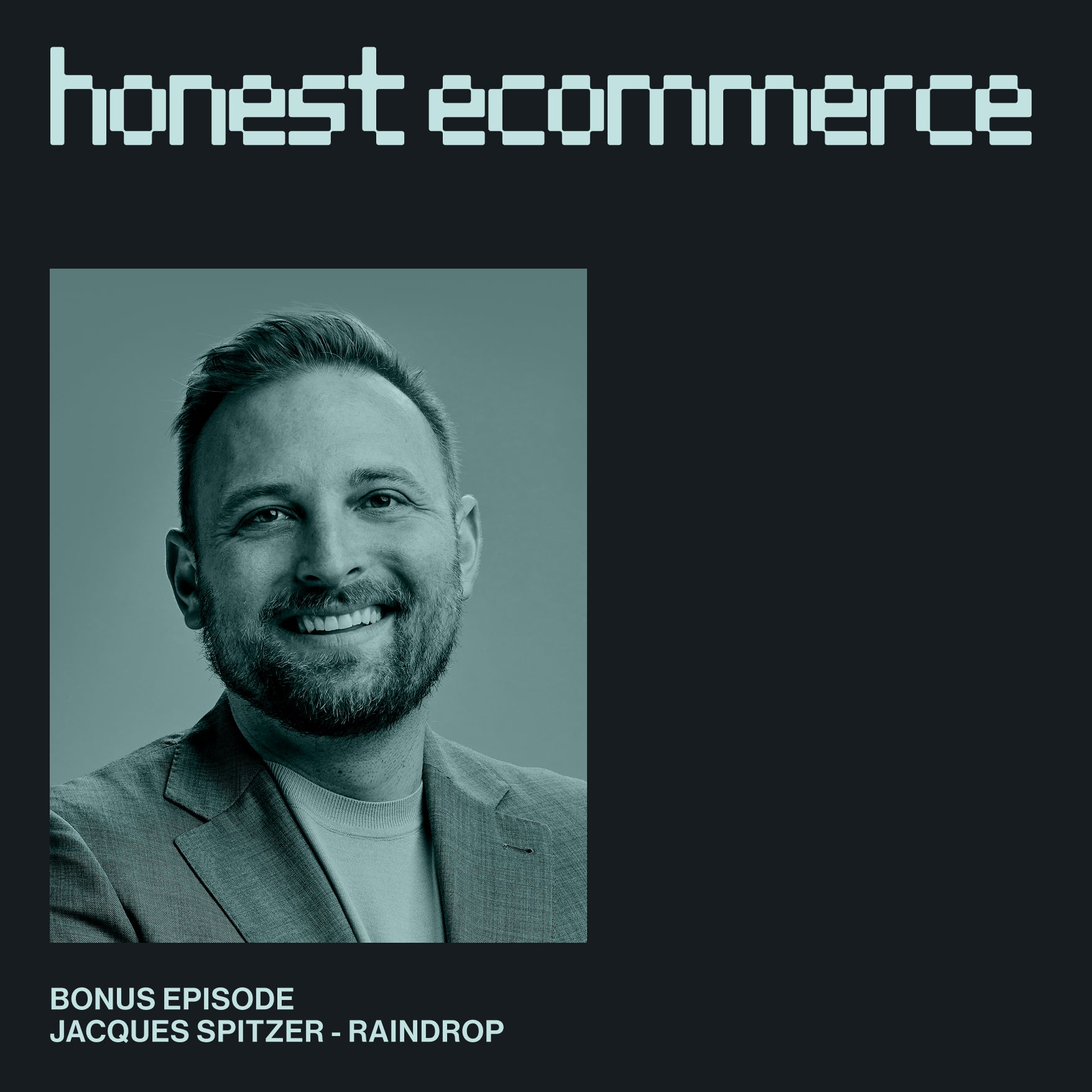
Hey everybody, welcome back to another episode of Honest Ecommerce. Today, I'm welcoming to the show an amazingly smart gentleman, the CEO and CCO of Raindrop, Jacques Spitzer. Welcome to the show.
Jacques Spitzer
Oh baby. Here we go. I hope to bring all of the energy and all of the insight to anyone who's taking the time to listen to us here today.
Chase Clymer
Absolutely. Now, just quickly at the top, what is the type of work that you and your amazing team over at Raindrop is doing for brands in the space?
Jacques Spitzer
SoI think the best way to tell a very quicksnapshot of where we're at is, Bain & Company comes out with a list of the most insurgent brands every single year. And there's roughly 50, 60 brands on that list. And last year, we worked with about 15 of them. So we work with a ton of brands who are trying to make creative that's going to break out and break through. Who are looking to tell their story in a way that can help them punch harder.
Some of those brands, like we did the largest launch in Procter & Gamble history with Spruce. It's a new weed and grass killer we launched about 15 months ago. They're doing extremely well.We worked with Native for years and years to grow them within that Procter & Gamble ecosystem. And then we've also worked with startups and smaller brands to make them very large.
We're most known for Dr. Squatch and Grüns in terms of the impacts that we've had on their growth journeys. And so we primarily focus on making creative that creates a story market fit. Because you have that product market fit, but you got a story market fit that gets people buying faster than ever. And that's what we've been working on for the last 15 years. So it's been a journey.
Chase Clymer
AndI just want to ask, when you mean creative, are you talking about videos and images for Facebook. Are you talking about YouTube videos? Are you talking about long form short term? You talking about campaign landing pages like what is creative and tail?
Jacques Spitzer
Yeah, a great question. So I would say the best way to think about it is when we talk to any brand, we're typically trying to solve what channels have the biggest impact to either grow your current audiences or find new audiences. And we're always thinking about it as a well-rounded campaign.
And so I think uniquely we create everything like we create everything from Super Bowl level ads. All the way through to the thread of creating our own UGC pieces or working with third parties for UGC, static advertising. So really the entire umbrella, I think intuitively. I think a lot of people are catching up.
You used to be able to just make a TV ad and make a radio ad and then like the internet fractured everything. Social media fractured it more. Short-form video fractured even more, all of the streaming services even more. And so now we're like, how do you get one big idea that you can work, get to work in a couple of channels?
So those channels tend to be, you name them, they can be television still. They can be YouTube. We've seen a ton of success, more success than any other agency on YouTube because it's an underutilized and misunderstood channel. And then of course, Meta and your TikTok and others.
And so that's where we see people finding the biggest scale is when they can get a story that really resonates and connects. That they can keep spending behind and predict predictably to drive more and more revenue back.And so everyone's trying to figure out how to do that.
Chase Clymer
I really want to highlight, as you said, a singular story. I think a lot of entrepreneurs have a really bad habit of failing fast and pivoting. But sometimes it's like,you just got to keep trying the same thing a few different ways. What we would always see with brands would be, they will find initial success through a certain channel and then they'll want to branch out to a completely separate channel.
And I'm like, “You haven't even really...
Jacques Spitzer
Scratch the surface.
Chase Clymer
Seen this thing to its limit here. You're barely trying. And it's like, this is working. You've got all these leading indicators that this is working. Why are you going to go build something from scratch?
Jacques Spitzer
Yeah.Same thing happens with different SKUs and solutions within brands, right? We see that a lot as well. I mean,that happens all the time. And look. The bottom line is, everyone's trying to find the same thing. And I know this is a more Ecommerce focused podcast. And so I really want to speak to people in the Ecommerce space because I always think about it like almost if you can't see this clip, I think about it.
I'm turning a dial like when you click in, 1, 2, 3. I remember my gym locker growing up and then pulling down on that lock. And I feel like a lot of times what we're trying to dial in is people are like, “Okay, well,I need to have a product that people want and need.” So we got to have that. And then it's like, great. But then, “I also need to have a way of capturing that demand. I need an offer that makes sense.”
And so you change your PDPs, you change your offers, you change the way that that looks. You're trying to dial that in. Then on top of that, you have the creative and the channels.So it's like, all of these are different knobs that you can turn along the way. It's always hard.
One of the things to always try to figure out based on the information I'm getting back is, “When am I getting into a place of diminishing marginal returns by tweaking one of these levers? Or when is it time to maybe blow up the whole lever and start over?”
“Or is it time to look to a different pasture?” Every brand is a little different, but you do see there are certain indicators that say, “Hey, it's time.” In fact,one of the biggest things I've seen actually is brands who go too long on the channel that works and they know it's almost like skipping leg day.
They look jacked, but then they're like, “I'm so beholden to one channel that if that one channel has a bad day, a bad week, a bad month, my whole business is in jeopardy.” And so every single brand that we have grown by hundreds of millions of dollars always figures out two channels. You have to.
To me, I'd rather have a $10 million brand that has two channels than a $20 million brand with one channel. I'm telling you, when you get into the $15-$30 million space and you're like 80%-90% one channel. I've never seen that play out well long term. That's a scary place to be.
Chase Clymer
Absolutely. I would say the same thing. And it's funny having the idea of skipping leg day and them all being focused on one thing. They are really good at acquiring customers, which are super expensive to get. And it's like you're just missing out on the remarketing, the retargeting, the retention, which is a cheaper customer. And so when you put all your focus into one area, you can leave some easy money on the table too.
Jacques Spitzer
Yeah. It's very true. Over and over again, brands are just like people. When I say just like people. Let's say you're running a brand. Maybe you're a founder listening to this. You have so many plates you're trying to spin and you have to spin. And something's always grabbing and moving your attention.
The reality is that as someone that's trying to build an Ecommerce brand, you can't just do one thing. You can't just do acquisition and not do retention. You can't just do retention and not do acquisition. It's like it all has to be attended to and work. The one thing that I, again, I see over and over again is trying to figure out how to get those combinations happening in as many channels as possible.
It just helps to weather the ups and downs of how things can perform. Because it's a scary place to be when you, when your dominant channel is starting to slip and you don't know what to do. And I hate getting that phone call after someone's already reached that point. It's not a fun conversation. Because it's like, “Okay, it's time to pivot. SharePoint. That's not coming from a place of momentum.”
Chase Clymer
Yeah. Let's talk about the range. One of Raindrop’s claims to fame here.The Dr. Squatch partnership as a client. I don't know how you guys like to refer to stuff. You worked with so long, I would say partners at this point. How did that relationship start? What were the three things you did? And let people know what happened if they haven't heard the story, they haven't seen the case study online.
Jacques Spitzer
Sure. So when we first started working with Dr. Squatch, they were about six years into the business. They were doing just around $3 million a year in sales.And at the time, the big audacious goal was to get it to $10 million. We did a lot of strategic work upfront that ended up,once we took the big swing to start putting out bigger pieces, which I'll go through.
It really ended up being the thing that made all the difference and connected. One of the things that we've done over and over again is we had this belief, even a decade ago, that people don't buy why you sell something as a brand or even as a founder. They buy their own reasons.
People have either something [or] who they believe they are today or who they're trying to become. And so when we first started working with Dr. Squatch, their founder, Jack, was so passionate about what all natural soap can do. I mean, it can literally heal your skin. A lot of people are using products that are, I believe, psoriasis or something along those lines.
And he's like, these products out there are literally just chemicals and they're ruining your skin, you all the things, right? And, and so I'll never forget where I was. I was sitting there, we're in our conference room. I'm just thinking, you can buy a 30 pack of soap from Costco for $13 or $14. We're selling $9 bars of soap to men through the internet.
If we're selling soap, like we're done. And I wish I could have articulated this well. I think some of these things are a little bit hindsight. But I realized that when we stopped thinking about it from this “soap is worth it,” to “you're worth it”, that shift instead of convincing people that the soap is worth it in their life, that no, no, no. You're worth better.
So, you’re worth a better product. That shifted everything. And so when we started making this educational comment, we called it edutation or edutainment. Because it's educating, but it's not in a shamey way. It's fun. It's engaging. And we started storytelling. All of a sudden, people were like, “Oh, yes, I want to try that. I'm in.”
And that brand started growing by tens of millions of dollars. Eventually by hundreds of millions of dollars as we continue to expand into new product lines. We helped them launch toothpaste, haircare, beard oil, lotion, and deodorant. It was a really big breakthrough. And we ended up doing a Superbowl commercial with them.
AndI think the Star Wars launch was another massive moment in their product history. It opened them up to a female audience that could buy it and gift it to men in their life at scale. SoI think one of the big confusion points that people have. And you and I chatted offline about this. A lot of people are like, “Oh, I don't have Dr. Squatch money so I can't succeed doing blank.”Or “I don't have Phil, blank, Groon's money, whatever.”
And it's like, well, no. They created content that is scalably sold in real time so they could continue to spend more money behind the advertising and bring in more customers, scalably, or profitably. Or as many might know on consumables, we're like, “Okay, at month 3 or month 6, we need to be profitable.” It might not be right away. And that has to do with how brands are built and structured.
But finding that big idea that connects and then being able to turn it up through multiple channels. That's how they went. And they were one of the first to really pioneer YouTube at scale. They did billions of views behind these ads. And then they also continued to lean into meta. They were very early and first to TikTok and leaning in there, reaching an even younger demographic of young men.
They ended up selling for $1.5 billion to Unilever. And we were with them for,man, 8 or 9years of that journey. And it was a life-changing journey to see what's possible with a big creative idea that can break through.
Chase Clymer
Hey everybody, just a quick reminder, please like this video and subscribe if you haven't. We're releasing interviews like this every week. So don't miss out. Now back to the interview.
We did chat before this and when we first met around the concept of it does take an investment to build a brand of that scale. But then you challenged me. You're like, “Well, it doesn't need to be all at once.” So I don't want to talk a bit about that. But we can't overlook the most important part, which I would love to get your take on it.
You have to have a product. You have to have a good product. The best advertising in the world can't fix a bad product. It’s probably a hill I'll die on.
Jacques Spitzer
It's interesting because here's what I'd say.There are a lot of great products that just never,never break through or see the light of day. What I fundamentally would ask, what is the difference between a brand? Dr. Squatch was doing $3 million a year in sales, six years into the business. And all of a sudden, a couple years later, they're doing $200-300 million. Same product, right?
And so it's like, yes, the product had to be good, if not great. But honestly, I think the bigger issue out there is I really don't think the best product wins. I hate to say that. But I'm like, they wouldn't be drinking Coca-Cola. They'd be drinking something else. Coca-Cola is a bad example.
Chase Clymer
Well, I didn't say the best product. I just said it can't be a bad product.
Jacques Spitzer
No. It can't be a bad product. But I would say that having a product that people actually want and need.
Chase Clymer
It lives up to the expectations. That's what it needs to do.
Jacques Spitzer
Yeah, absolutely. Let me ask you. Let me ask you a question back.
Chase Clymer
Okay.
Jacques Spitzer
Because we meet a lot of different brands and it's it's amazing to me to see how many of them are succeeding in their own way in their own lane. And it's actually something that I had to question myself. Temu would not have existed if everyone wanted quality products. I'm just saying.
I got like three things from Temu and all of them were so bad. It was just like, “Why did I do this?” And so what percentage of people do you think that are out there in business have products good enough to win? Or how many of their products are getting in the way? Or how much of it's like, “No, they have the right product but everything else is off in the equation.”
Chase Clymer
It's usually limiting beliefs from the founder or leadership team. I can't say too much, but there's a conversation I had this week. One, raise your prices. Two, they have such a blue sky opportunity, but they have limiting beliefs just based upon the niche that they're in. And just historical agreements they believe they've made to their customers. And it's like your customer doesn't know anything that you're telling me right now.
Jacques Spitzer
Oh my gosh. Yes.
Chase Clymer
Their product is the best in the market for what they do too, which is wild. So it's like you guys could easily get 10X, but they don't want to. I’m like, “Look, guys, you should do X, you should do Y, you do Z. You can crawl, walk, run, but there are a lot of opportunities here. So self-limiting beliefs, I think, is a big one. Also, maybe even that conversation earlier around budgets for creative and for advertising.
The first time you throw out a six figure. This is going to be a six figure investment, just in the creative. And then you're probably going to want to spend at least that on the Meta ads, right? Let's just use some real words here. A lot of brands are like, “No, can't afford that.” So, it's the self-limiting beliefs and understanding how much exposure something like that could do for you.
Jacques Spitzer
Yeah.
Chase Clymer
What does that exposure translate into sales and into growth?
Jacques Spitzer
Yeah. That's so well put. I'm going to give my best possible answer. Because it's one of the number one questions that we get. We get like two or three questions all the time. And one of them. And I can feel it from people. They're like, “So is there a way to test this? Is there a way to kind of swing for a single and accidentally hit a home run?”
That's the feeling that people are asking, “Can I take a small risk and get a really, really big reward?" I want to be very clear. We never push people into a risk that we don't think they're well positioned to take. I mean, we truly only say yes to about 1.5 to 2 % of brands we talk to. It's that small.
I shouldn't say ‘talk to [them]’. Who reaches out to us. Because we can't talk to everyone that reaches out. At the end of the day, certain brands are in a position... I talk to brands all the time where it goes back to earlier discussion where it freaks me out that they haven't made this type of swinger investment yet.
Because they're already spending $500k, $700k, $1M, $2M, $3M, $4M a month in their advertising. And they're like, “Oh yeah. We've never really done anything like this.” And I'm like, “Okay, well. You have product market fit. You have store market fit. You have stuff that you can lean off of and go big off of.”
And so for me, there's actually the opportunity cost of not figuring that out is greater than the potential of taking a swing and missing. It's like, no, no, no, no. The bigger existential threat is not figuring out how to diversify your media mix. And figure out how to tell your story in a compelling way beyond UGC and stat.
You have to do that. It's the only thing that's going to get you from where you are today to a place of just growth, but stability in multiple channels. But the second piece of this is we do launch brands from the ground up. And every year we launch four, five, six brands. Gruns is a great example where they went as big as possible right out of the gate.
And I think you'll see that. I'm really proud of the work that we did for Gruns and continue to do for them. However, a different operator would not have been as successful as Chad because Chad had understood the math. He understood, his CAC to LTV ratio, all the things that everyone always said, like he truly understood it.
And he understood from the get-go, “I'm, I'm going to get the best partners, I'm going to do this right. And I'm going to swing hard and fast and go." And he just kept going, going, and going. I've never seen anyone move as fast and as hard as he did. And I'm like, I constantly think to myself, 99 out of 100 brands would have languished and the whole thing would have been like a $10M brand.
Because they would have been like, “Oh man, I'm still trying to get my back down by $10.” instead of, “Oh wow our three month LTV is this. We should be spending infinitely or we should go raise money to acquire as many customers as we can because this is working super well."
And he just made all the right moves. So watching people operate like that challenges me to ask myself, “Am I thinking big enough about what I see out there?” So it's hard. I started this by saying, I get it. I operate my own brand. Everyone wants to not take that big of a risk and get a huge reward.
But that's just, I think about even football. It's like, there's big pass plays and then there's run plays. And yes, every once in a while, run play breaks through. But if you want to break off 40 yards, you probably need to pass the ball. And creatively, that is true as well.
Chase Clymer
Yeah. I forget where this comes from. But the concept of a moonshot. It's like, do the-
Jacques Spitzer
Yes.
Chase Clymer
Do the block and tackle that work. But you need to, once a quarter, once a year, try something new and weird and different. Is that a different channel? Is that completely throwing the brand out the door and just doing some weird, creative concept for a campaign? We're apparel but we're going to try this product because it really aligns with our customer, we think.
So try these moonshots. And the funny thing about them when they fail, it doesn't really matter. Just move on. But when it works, [it works.]
Jacques Spitzer
I think what you nailed there is [to] take a risk that's proportional to what you can actually withstand. But don't get scared and undercut taking the swing big enough. Until recently, I'veheard the term moonshot marketing more and more. And the more I hear it, the more I love it because it's just so damn true.
It forces you out of your comfort zone to think in a different way. And when it connects, it just can really, really be transformative.
Chase Clymer
Absolutely. Now, Jacques, if there's one thing that I forgot to ask you about today that you think would really resonate with our audience, what do we want to say to them?
Chase Clymer
That's a great question because you've asked good questions. When I look at Ecommerce, I see a game where the fundamentals haven't changed over decades. But the tactics change daily. Right? I mean, it's true of advertising, too. When I see companies and brands truly breakthrough, it's not because they figured out [everything]. It wasn't like all of a sudden there was this one or this one thing.
It's like they thought in a quantum leap manner of like, “Oh, you know, ultimately, what I see over and over again is, we figured out what people's why is. It's not our own why, but their why. And we were able to make that connection faster so that they went from seeing it to buying it quicker.”
I mean, the number of times that people think about storytelling through the lens of like top of funnel versus bottom funnel. And somehow there's a version of advertising that doesn't convert in real time. It's like there is a version of that and you can't do that. You can't spend that kind of money.
You have to spend the kind of money that gets attention, tells your story, gets people to convert. If you're in Ecommerce, that is the only game. That's the only game. So I just think about it the same when people go, “Should you go in-house for an agency?” It's always an and not an or. And you can tell your story and convert at the same time.
Finding when you can do that, I'm telling you, I've seen it literally a dozen times now. I was counting how many brands have we grown by more than $50 million. And it's a dozen. And I'm like, “When it works, it goes.” And it doesn't go incrementally. It's not like I did a couple hundred thousand dollars at creative and spent $100k on the media.
It's like, no, no, no. I spent millions and tens of millions of dollars on the media. And it expanded us. And so hopefully, that's helpful. I just think everyone always wants to know how it really works? Did it just go viral? No, it never just went viral.
Chase Clymer
No, it's a lot of customer research. It's a lot of smart people in a room brainstorming. It's a lot of trying stuff. And then looking for those indicating factors like there's traction here. How do we pivot or iterate on this to get more traction?
Jacques Spitzer
Totally.
Chase Clymer
And more. And the next thing you know, Dr. Squash is at 10 million. So the goal goes from, “All right, we were now at 10. Let's go to 100.” You know what it means? Now we're at 100. Let's go to a billion.
Jacques Spitzer
Yep. You nailed it. Yeah. And eventually, it'll be 3 billion.
Chase Clymer
Yeah. With those dozen brands though, this is a question that I thought of just here. With those dozen brands, did their path, did they look similar or was it completely different ways to get to the same result? Which was what we would all argue is a successful direct consumer brand?
Jacques Spitzer
So what they all shared is they all shared when we're talking about those dials, peep, peep, peep. Looking at the dials. What every single one of the most successful Ecommerce brands that we've worked with have is they've dialed in the offer. The story that they're telling and the math. Or their understanding of how much they can truly spend to acquire.
We would probably have 10 more brands that we would have grown by that much if they really understood their math. The number of times that we've been talking to somebody and they're like, “We need to be first purchase profitable,” and they're a consumable brand, for example.
Or they're like, “Oh no, we can only spend this much because our average order value is $110. And you're like, “Well, why don't you just bundle it with a double thing? It's like buying one, a gift. And if 20% of people buy it, now you can spend an extra $20 in acquisition. And they go, “Oh, I never thought about that.”
They do that. And they can grow by $30M. It really is just math plus storytelling. When you say it has to be a great product, you're right.
Chase Clymer
It's table stakes to get to that scale level. Yeah.
Jacques Spitzer
It's don't pass go. But I say that to say an all shade intended liquid IV is 75% sugar. 75% sugar. I'm like, they're selling flavored sugar packs. They're selling a billion dollars worth of flavored sugar packs. No one's out there saying they're the best product. I'm like, “they're not.” Their flavor sticks are flavored sugar packs. And I'm like, if they can get to a billion dollars selling health through flavor sugar packs.
I'm sitting over here drinking a liquid death water, maybe just for the fun of it. But I'm like,“There's nothing holding you back.”
Chase Clymer
Yeah.
Jacques Spitzer
I mean, it is good water. Don't get me wrong. But it's water.
Chase Clymer
Yeah. Absolutely.Jacques, thank you so much for coming on the show today. Sharing all those amazing insights. If I'm listening to this, I want to learn more about Raindrop. Potentially follow you around on the internet. Where should I go? What should I do?
Jacques Spitzer
I am one with the internet. You can find me everywhere. You can find me on TikTok. You can find me on X. You can find me on LinkedIn. And I also have my own podcast, Marketing People Love, where I try to have meaningful conversations like these. So yeah, you can find me, unfortunately, everywhere.
Chase Clymer
Absolutely. We'll link to all that stuff in the show notes. Thank you so much for coming on today.
Jacques Spitzer
Thanks, Chase.