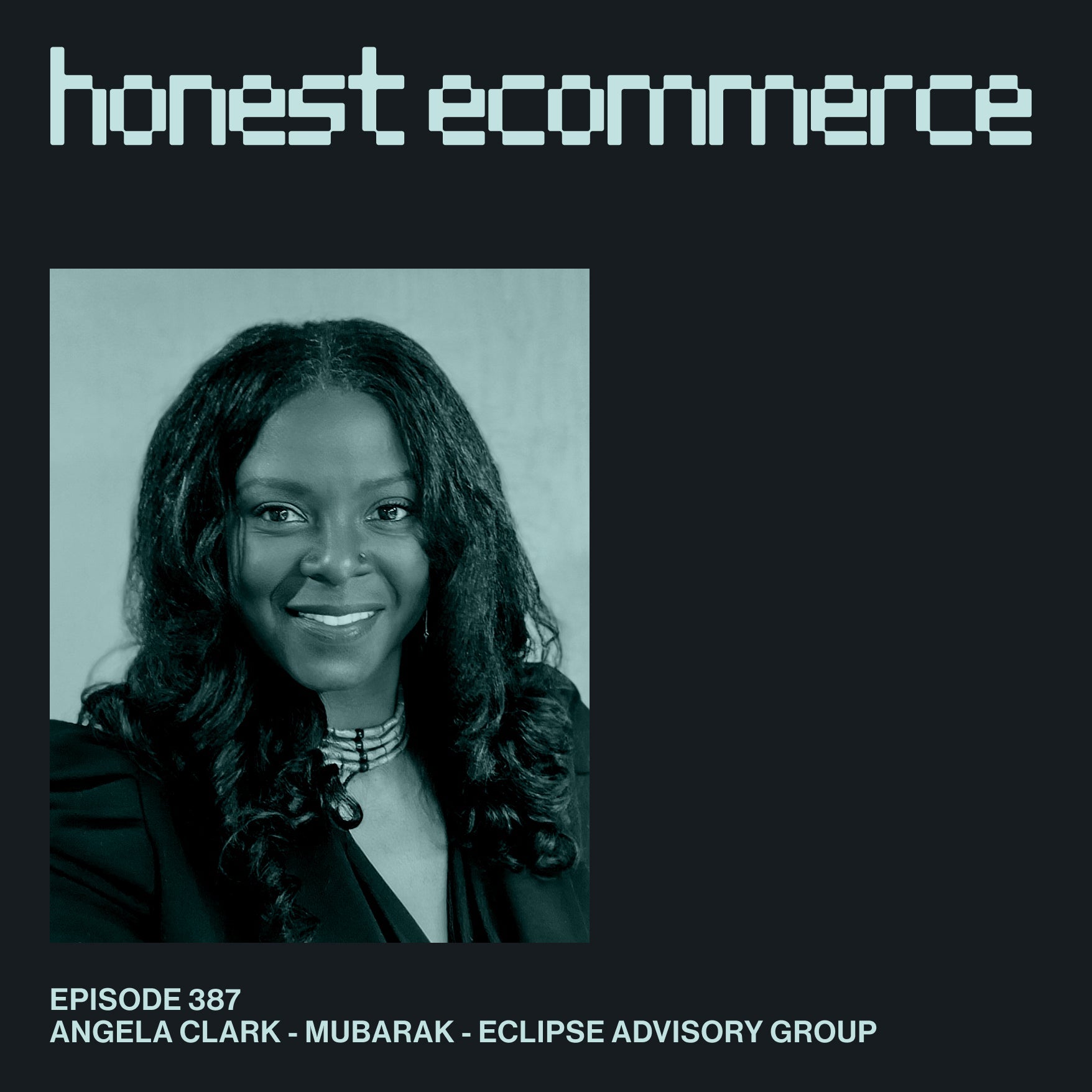
Angela Clark - Mubarak
Where are the things that they're really strong in that we can lean into? What are those wins? And so sometimes that might mean walking away from something that everybody else is doing, but it doesn't make sense for your brand. Patagonia is a great example. They don't have a loyalty program, but guess what? They have some of the most loyal customers out there.
So it wasn't urgent for me to build that out because that wasn't really a problem for us. It's like not just assuming that what everybody else is doing is right for everybody and really trying to surgically decide what's your short-term game and long-term games? And where are you really trying to go overall?
Chase Clymer
Honest Ecommerce is a weekly podcast where we interview direct-to-consumer brand founders and leaders to find out what it takes to start, grow and scale an online business today.
Hey everybody, welcome back to another episode of Honest Ecommerce. Today, I'm welcoming to show a 30-year veteran in the digital and ecommerce world. She's helped lead digital transformation at brands like Patagonia, Levi Strauss, eBay, e.l.f Cosmetics, and Williams Sonoma to name just a few.
She now brings that Fortune 500 playbook to all brands that are looking to scale through her consultancy eclipse advisory group. Angela Clark, welcome to the show.
Angela Clark - Mubarak
Thank you. Thank you for having me. I'm excited to be here.
Chase Clymer
I'm excited to chat. We've crossed paths a few times now. And I'm really excited to get into it and have you on the show here. But every story has a beginning. So let's go back. Where did you cut your teeth in this world? How did you foray into retail and then into digital?
Angela Clark - Mubarak
Yeah. So my foray into retail really started with my passion for fashion. I was a fashion girlie as a child. I used to sketch my own clothes. I thought I'd go to design school and all that. But I was a child of the 80s. I decided to get a degree in finance, I thought I was going be an investment banker. And the banking industry was a huge turn off once I graduated.
And then someone told me that having a business degree and knowing fashion was a great thing for a buying job. So my first buying job was at a department store that is now Target Corporation. Before that, it was Dayton Hudson's. And so what was great about that era, was they had these programs that really taught you every element of merchandising and buying.
And so that's really what I kind of really learned the game. I would say my first job I didn't love. I was so heartbroken. I thought I'd never have a career in retail. And then I kept going. And then I fell in love with it once I found catalog and digital.
Absolutely. Do you remember your first job? was... Did you... Have you heard the word the internet before? I guess that's a phrase.
Angela Clark - Mubarak
It didn't exist. That's how old I am. I was five years old when I got my first corporate job. There was no such thing. It was just catalogued with DTC at that time. Which actually was an amazing experience because what I learned there was telling stories through images and copy. Getting feedback from catalog, that was the earliest data we had.
Honestly, the internet at that stage was like modems, slow, there was no video. It was kind of like, yeah, right after I got out of college, that's what was going on. And when I was at Spiegel Catalog, they had their first sale online outside of the earth. They actually, an astronaut from Russia made an online purchase.
Which they never marketed, which I thought was such an amazing story, as we're talking about it before 95 or something. So quite the experience. But yeah, I absolutely fell in love with that. The imagery, photography, seeing customer feedback. I'm a numbers person. I love being in Excel. I love being in spreadsheets. So it was a perfect little match of my right brain, left brain personality for sure.
Chase Clymer
How did it... It's a long track record you have here. But we want to leave our listeners with some tips and tricks of the trade that will work now. I know a lot of this stuff is just doing the same thing with a different... It's the same strategy with a different medium.
Angela Clark - Mubarak
Yeah.
Chase Clymer
Right. And we'll get into that in a little bit. But give me the quick evolution of, well, the internet's here and now ecommerce is here. And now this is what the job is.
Angela Clark - Mubarak
Yeah. That's such a great question because I would say, I really started to see the job role change when I was at Levi, which is probably the early 2000, 2005, 2006, maybe.
Chase Clymer
So MySpace is big.
Angela Clark - Mubarak
Yeah, MySpace, my MySpace account. Facebook was not coming. Advertising on digital was not a thing, really, outside of display ads. That's really all you had. But what evolved from the work perspective was, you still had that pure merchandising where it was about the product. You were looking at sell-throughs and performance. You didn't really have the KPIs that we looked at today.
And I was starting to see a great divide from those people who had gotten a merchandising degree, maybe who had more of like a business degree. Because the merchandising people, nothing gets, they're definitely people who understood numbers. But a lot of them didn't have like, beyond retail math, they really didn't have the acumen to really understand the KPIs and analysis. And know like conversion and traffic relationships and those type of things.
So the business went from just understanding what's selling and customer engagement to really the full business acumen that you needed to have and to be able to understand lifetime value and understand the play between the different KPIs. And that started to be a different mindset shift.
So you now start to see more specialists who are kind of like digital marketing experts. Or they understand social. Or they understand these sort of things where I feel like early in my career was a lot of generalist and you just kind of maybe you loved apparel or you loved home furnishings or you had this sort of specialty in that way. But as far as the skill set perspective, it was kind of broad.
And then I found myself as I was becoming a leader that I needed to find people who [are] kind of strong in this area, but then I had people that fill in for other specialties. And now it's interesting because I feel like there's a little bit of a full circle moment. There were times where I would be interviewing and are like, “You know, you've had so many different jobs. I don't know what to do with you.”
And now the generalist is kind of coming back as somebody who like has seen a lot of different things. And now that's my value is that “I've played, I've been in product development. I've done planning. I've done merchandising. I've managed digital marketing. I've managed product development for site experience.”
So now I kind of have all these different tools. I understand the full ecosystem. And now it's made me more valuable than before where they were just like, “Well, I don't know where to stick you because you're not specific enough.” So it's an interesting journey. So to anyone, there's your moment in time. There's always your moment in the sunshine.
Chase Clymer
I think the generalist role is not necessarily good at the start of your career. But filling out your knowledge base and heading towards the end of your career, or heck, you can speed run it and just be really good at a lot of stuff. There is a job it makes you really good at. It's in the C-suite. Because you need to know what you're talking about to hire to know what good looks like.
Angela Clark - Mubarak
Absolutely. 100%.
Chase Clymer
Do you know what's going on with Klaviyo? When was the last time you explored what it can do?
Klaviyo has been shipping tons of new AI, data, and automation features designed to help ecommerce teams move faster, personalize better, and automate more of the work that used to take entire teams.
Most brands are only using a fraction of what is already inside their Klaviyo account.
Klaviyo is not just email and SMS anymore.
It is your customer data platform, your lifecycle marketing engine, your analytics layer, and now your AI-assisted execution layer, all in one place.
That means your customer data updates in real time.Your segments stay current automatically.Your flows and campaigns all run off the same source of truth.And now AI can help predict churn risk, forecast spend, recommend next best products, generate campaign content, and optimize send timing across channels.
The big unlock is speed and efficiency.
Fewer tools to manage.Less dependency on engineering.Less time moving data between systems.And lower total cost of ownership across your marketing stack.
And brands are seeing real results from leaning further into Klaviyo.
Dollar Shave Club has reported over 30 percent reduction in total CRM stack cost after consolidating onto Klaviyo. Brands like ThirdLove have seen 15x ROI from SMS after consolidating channels. And companies like Corkcicle have grown flow revenue over 90 percent after bringing email and SMS together inside Klaviyo.
Across our customer base, every single brand we work with today is using Klaviyo. That is just where serious ecommerce customer data and lifecycle infrastructure lives now.
If you are already on Klaviyo but feel like you are not getting everything you could out of it, or you are running multiple tools and want to simplify without losing power, this is worth your time.
Go to klaviyo dot com slash honest to learn more.
I guess let's just step back and talk about your most recent job. And I believe it was at Patagonia. What did the day in the life look like there? What were you responsible for? What were the problems you were hired? The fires you were putting out when you were over there?
Angela Clark - Mubarak
I was hired in a newly created role to bring a digital pillar together. So I had seven different teams when I first started. I had Consumer Insights and Analytics. And that was for the entire organization. But obviously, heavily driven by digital experience. I had digital experience teams, so UX/UI design, as well as digital product teams, so private management, product design, QA, all of that. I had an operations team.
It was kind of the people that helped execute the site experience work. I named my site merchandising team, which is a little weird. I had to kind of build that team out. I had a digital marketing team, so demand gen, acquisition, retention. And then I also had a secondary brand called Patagonia Action Works, which is their non-for-profit arm. So it's a different URL and it's really about activism and helping grassroots organizations.
So I had the main patagonia.com, thisother.com. And I believe that was all the teams that I had. So was really sales performance I was responsible for, managed the P&L there. I was responsible for customer experience, customer journey onto the platform. And drove some omnichannel conversations, especially having, Ecommerce and having the Consumer Insights team.
So a lot of data management, I kind of worked on our CRM program. Yeah, a lot of different things. So my day to day changed constantly depending on the time of year, depending on where those fires were. My first two years was really just building the bench strength. So I had an amazing team. I inherited one the most incredible teams I've ever had in my career as far as talent's concerned.
Where people really struggled was just being able to allow them to use their talents for what they're hired for. And not being dragged down into remedial stuff. Just because everything was very, a lot of those processes were very manual. A lot of people, because they've been there for a long time, may not know what really good looks like because there's Patagonia standards and Patagonia is a unique animal.
The way people find their roles there is very unique and nothing against that. But there were moments in time where you needed somebody who understood what good looks like at another brand. And so trying to build that bench strength of like, this is what a robust CRM program actually looks like. This is best in class for retention. That's a great example.
Retention was a small channel compared to any other brand I'd worked for. And I knew that there were just disciplines that we need to put in place. So the first two years was a lot of that. Cleaning up data, which is never fun, but it's really important. Because I knew what we needed to do long term, people understand the customer view and know all these different customer types. You've got seven different sports we're talking about.
You've got women's, kids, men. You've got all these different people coming to the brand for various things. Entertainment, they're coming to watch a full and feature film. Maybe a short clip. They're coming to donate. And to do all that on one platform, I had to be able to understand how people were getting there. What they were doing and then to be able to build a model, be able to understand, to be able to capitalize on that and grow from there.
So I've launched a project to basically create our own KPIs that went beyond lifetime value, that looked at engagement with content. That looked at involvement in store events or stores or community centers. People show up there to listen to a book reading, to help clean a river, to do a community run.
So I wanted to be able to capture all those different data points that meant things to Patagonia and to be able to say that, “There's a customer for us”, I use customer broadly, that's really valuable to Patagonia. They might not spend $5,000 a year. They might actually just engage in activism and they're just as valuable to Patagonia as somebody who spends a bunch of money.
And so how do I measure that? You can't grow something you can't measure, right? So how do I build something that I can measureall those different levels of engagement? And then start to cultivate customer journeys that we can really be smart about that are happenstance. That are really like, “I want somebody who's coming to activism, have this journey of Patagonia.”
“I want somebody who I can influence who only cares about the stories that we're telling to maybe either engage in product or engage in activism.” What does that journey really look like? And that was a multi-year long project. And that's what made that role really interesting and actually quite fun.
Chase Clymer
Hey Store Owners -
Do you know how profitable your last BIG decision was on your Shopify store?
Most testing tools make it easy to measure design changes - small tweaks. Headlines. Layouts. Button colors.
But what about the decisions that really move the business?
Pricing changes. Shipping rates. Discount strategy. Even new apps and tools.
Those are usually left to gut feel.
Intelligems brings CRO-level clarity to decisions that live beyond the page.
Brands like Ridge, Jones Road, and True Classics are using Intelligems to test pricing, offers, shipping, and more, and see exactly how each choice impacts profit.
Momofuku used Intelligems to test multiple promotional offers ahead of Black Friday and identify the version that ultimately increased profit by about 28 percent.
Mott & Bow used Intelligems to run structured pricing and offer tests that helped drive roughly a 30 percent increase in incremental profit.
Dossier used Intelligems to run sitewide testing that resulted in about a 7.4 percent increase in profit per visitor across their store.They have a bunch more case studies on their website.
I’m a big fan of Intelligems. We use it with almost every client at our agency, Electric Eye.
We use Intelligems to test major site changes, new theme launches, and throughout ongoing CRO work
So when we are making decisions around design, pricing, offers, ETC, we can be confident that those changes are actually driving more profit for our clients.
So, before you start changing pricing, promos, or major site experiences across your store all willy-nilly, you should test it first.
If you're ready to decide confidently and grow profitably, head on over to intelligems.io and use code "honest" for 10% of your first 3 months. That's intelligems.io Use code “honest.”
Now when you are just getting started with a brand or consulting for a brand, I'm sure you see a lot of patterns that go around here. So we're thinking about Ecommerce strategy.
with these brands? Is there a common mistake that you're seeing from in the PE-backed world or direct consumer world, where they're trying to grow maybe too fast?
Angela Clark - Mubarak
Yeah, absolutely. For some brands, that's their DNA. Build a plane as you're flying it is the saying. I've worked for one of those brands. For me, I find that oftentimes they're going so fast and they're trying to like check a bunch of boxes that sometimes just the fundamentals get missed.
So I like to just start with the basics. And even in today's world, there's so many solutions. Your tech stack can go on for days and days and days. A lot of times I'm looking at like, how's a team functioning today? Where are they spending their time and energy that is not impactful? Where are the things that they're really strong in that we can lean into? What are those wins?
And so sometimes that might mean walking away from something that everybody else is doing, but it doesn't make sense for your brand. Patagonia is a great example. They don't have a loyalty program, but guess what? They have some of the most loyal customers out there. So it wasn't urgent for me to build that out because that wasn't really a problem for us. It was more problem for us was retention, right?
So for frequency of purchase, let's focus on that. How can we improve that? So I think for me, it's like not just assuming that what everybody else is doing is right for everybody. And really trying to surgically decide what's your short term game and long term games and where are you really trying to go overall. And then sort of stepping back and saying like, where can we win?
A good example coming from merchandising? I'm like, “Do we know what how high, high is?” That was an old school retail serve stack the table, stuck at high watch a fly. Levi was a good example. We thought we knew how many 501s we were selling online. We didn't really know. Because we never owned the full size range as much as we could own. And until we did that, I grew the business by 25% in a year just because we owned more inventory.
And we thought we knew how much we could sell, right? That 501 is a big bet. Like, I'm not going to risk, that's not a risky challenge to say I'm going to over inventory on a 501. Now something that might be new product category, I would have a different strategy. Like when we introduced Petite and Plus Size. We thought that'd 8% of the business, instead of being 15%. Again, just those early indicators, we need to buy more, we need to buy more.
And that's just retail 101. That's basic merchandise. It has nothing to do with technology. And that's what to do with the AI innovations of the world. Sometimes those basic things can actually help you scale your business.
Chase Clymer
“I have been in business for nearly 20 years, and very few companies I have hired in that time have performed as well as Electric Eye. They have knowledgeable staff, and our project was delivered on time and on budget. Electric Eye has exceeded my expectations, and I look forward to working with them again.”
That is a direct quote from one of our clients at Electric Eye.
Electric Eye is a Shopify Plus partner that has helped over 100 brands migrate, redesign, and optimize their stores since 2016.
If you'd like to increase your conversion rate, average order value, and revenue per session, we are the true Shopify experts you've been looking for.
Right now, we're offering a free diagnostic to qualified brands that reach out and mention the podcast. Visit electriceye.io today to schedule a call and send us a message. Find out why we have over 50 5-star reviews in the Shopify Partner Directory. Again, that's electriceye.io. E-L-E-C-T-R-I-C-E-Y-E.io
I mean, forecasting is, especially in fashion, because there are so many variants.
Angela Clark - Mubarak
Yes.
Chase Clymer
Which are your sizes, your colorways, etc. Forecasting is still bit of soothsaying. It's still a bit of magic and science. But it is also, there are leading indicators, right? To where you can start to buy a lot better. Seeing how fast you're moving through stuff. So I would assume that increasing the allotments of certain sizes, which I'm assuming scaled to the more extremes that you weren't usually doing.
And seeing those sell through rates, like, “Oh, well, now this has a trickle down effect where we're going to do this in other sizes as well. We're not going to have this bell curve that we normally have. It's going to look more like a different shape that I can't think of right now.” But there's a lot of learnings to be done there.
Angela Clark - Mubarak
Yeah, absolutely. Then I think, even in the new, we're talking new space, new technology. The promise of personalization is something we've been talking about what for like 10 years now. And I think we're getting better with AI. But I'm reading a lot about, know, some brands that are feet first into it. The boards like you guys need to jump on this train and they're they do that.
They let go of people and they're finding themselves kind of having to pull back. So test and learn, I think that's the most fun part of Ecommerce and digital overall. Nothing's permanent. You can always keep testing and learning things. And that's the incrementality. think that's a big part of what makes it fun for me. Those are those indicators that give you where you're going in the right place and where you might need to pivot and change a little bit.
Chase Clymer
Yeah. think that personalization is super interesting. But I think that unless you're truly vertically integrated and you're producing 2SPEC on the back end of the purchase. It's a little smoke and mirrors-y.
Angela Clark - Mubarak
Yeah.
Chase Clymer
I don't know if you can ever actually get there. And then it's also just like that investment of technology to produce and ship that product in a timeframe that a customer isn't annoyed about. Even if you're fulfilling it. You're like, “we're building this for you.”
Angela Clark - Mubarak
Yeah.
Chase Clymer
Everyone's still very, just don't have any patience these days.
Angela Clark - Mubarak
Yeah. Yeah.
Chase Clymer
It's an interesting thing. I remember I was on a panel. I hosting a panel and learning about how men's warehouse, have some crazy technology that does that now. And while it is truly producing something to spec, it still takes a couple of weeks to get there. So the only thing that's doing [great] is their margins because they're not having, well, I guess their cash is great.
They're not having to sit on a shelf. But the 3 weeks until they get it isn't really the best customer experience.
Angela Clark - Mubarak
Yeah, absolutely. And sometimes you just have to lean into what your strengths are and make it part of your brand story. That's to me, a great opportunity to tell the story in a way that people are like, “Okay, I get it”. I'm not going to get it the fastest. But it is like, again, when people go to get a suit, they expect to be able to get it and a lot of times people aren't planning a month ahead. So there are challenges there.
Chase Clymer
Speak to the value of this bespoke, tailor-made experience you're getting. Like this thing's, “I'm going to be the best looking guy in the room because this thing fits me. It doesn't fit a guy like me. It fits me.”
Angela Clark - Mubarak
Yeah. Yeah, absolutely. And you're right. I think sometimes if your brand is a little smaller or if your audience, or you have a smaller subset of product categories. You don't have to over invest in things like personalization. You know who your customer is. You understand them and your money might be spent better elsewhere. Doing pop-ups or whatever it might be. Yeah, I think that's the fun part of our businesses.
Chase Clymer
Looking through your career, one of these is not like the others. Very obvious. Well, there's a few. But one is very specific to me, which is e.l.f Cosmetics. It isn't apparel and it doesn't run into those problems that we were just talking about with just sizing being something that's insane. What were some of the big differences and then maybe some of surprising similarities with that type of product line?
Angela Clark - Mubarak
Yeah. It was a big shift for me because I went from Levi to e.l.f Cosmetics and I was like, I don't know how to talk about how to sell mascara. How do I talk about that? What do I do? What I learned at e.l.f Cosmetics though, and this is probably this before they even went public. So I'm a huge fan, afar from them right now. They're doing amazing things from a customer engagement, customer journey perspective.
But they were one of those brands that was like build the plane as you're flying it. So moving fast, testing things out. They always have products in the pipeline. And honestly, I worked for one other brand that some people might not even know of called Red Envelope back in the day. And they were a brand like that too.
You always had to have multiple products just ready to go because their trend line was so short that suddenly if it was too big, it didn't feel special enough for that brand. So we had to drop it and you had to find something else to make your sales. And so I think there at e.l.f it was really about, it's a lot more personal of a product.
You're talking about complexions, you're talking about skin types, and at that time, we were still the early stages of SEO. So I built a brush guide of like, what makeup brush works for what purposes, why you would buy this versus this brush. Honestly, that was just simple. I was like, I don't know. How do I help somebody?
I have all this stuff I need to sell on the platform. I don't even know how to navigate it. And I work here. How many times do you have that as you're going to do a brand? Same thing at Pedicone. There's so many outward pieces. I don't know how to navigate one from the other. So they're like, how do I solve that for myself? Or how do I solve that for your family members? What are your website? I can't figure this thing out.
So we built a guide, which now and people do all the time. But back then, was one of those things that like you built this guide and then all of a sudden became one of the number one landing pages. But I think a lot of brands are still missing that opportunity to educate their customers and having those pages will quickly become like some of the benchmark pieces, especially now of AI. Like this is what they're searching for.
All the bots are searching for this type of information. And so Reddit's looking for this information. So the more you can invest in sort of like, what's that type of information that your customer is looking for that will help them either understand a product. Or just support your community in a way, it pays back in spades.
And so I think for them, I was always sort of learning and iterating really rapidly. Products, we're launching new products every week. So that's a pace from an econ perspective that's pretty rapid. There's always something new to talk about. But I think my biggest impact at that time was changing the promotional strategy.
Their promotional strategy was bonkers back then. It was like we were giving away so much money. I was like, there's no way we're making money on Ecommerce because everything was $5 and then you did a bundle where you get like 30% off and you spent 30 bucks. I was like, time out. One promo is enough. And you had multiple promos all going on at the same time.
It was a little crazy. I've been hired multiple times to take a brand away from their sort of like promotional drug. It takes time. Once you've trained a customer for that discount, they're going to be looking for it. And the minute you start to pull that away, it's going to be a pain point. Same thing with True Religion.
Like they were on sale every single day, deep discounts. And we changed the promotion and actually the CEO I reported to was brave enough to say $25 million of our sales is because we're promoting a product. So let's just take that off of our top line. And now our sales goals are lower because we're not going to be on sale as much. And your conversion is going to drop and all of that.
But at the end, we're going to be a more profitable business at the end and more sustainable. That didn't really go as planned because the pandemic happened and we were on sale. But the infrastructure we built for a less promotional business paid off in the end. Because now when we were on sale, we actually were making more money because, we booked, taken a lot of the fluff out of the business.
So yeah. So that's, I think pricing strategy is a really, really important one. Just know that if you've gone down a path, it's going to take time to redirect the customer. But you can get there.
Chase Clymer
Hey everybody, just a quick reminder. Please like this video and subscribe if you haven't. We're releasing interviews like this every week. So don't miss out. Now back to the interview.
I alluded to it at the beginning. But these days, you planted your own flag. You are now running your own consultancy. What is it that you are helping brands do these days? Maybe the first question is like, what types of brands are you best suited to help?
Angela Clark - Mubarak
Yeah, I would say I'm probably best suited to help more... Well, my specialty, where I love to spend my time and energy is more smaller brands, startup, not necessarily startup, a little established. Looking for like they know what their brand is, they're making that money, they've got profitable business, they have a customer subset, but then they're trying to figure out where to scale next and how to scale.
And I think that's really where my expertise is. [It] is sort of kind of looking at the whole ecosystem, marketplace, how you position a brand, and where can you take that brand next. Does that mean product assortment? Does that mean strategy, marketing, performance, all of that? And that's sort of where my specialty is.
I've obviously spent a lot of time in apparel, home furnishings, cosmetics, not so much CPG. So I would say that those are my areas where I probably have the most experience. And then, digital, obviously, that's the game that I love. But also Omnichannel.Sometimes [they] might have one or two locations and they have an online business and they're trying to figure out how those two kind of marry together more.
And sort of getting that customer journey be really comprehensive. So that's really where my specialty is. So I'm excited. It's a new chapter for me. I'm just like, I have all these years of experience and I have a lot more energy to do more. And I just wanted to give back more than working for a singular brand. So I'm excited to see what the future has.
Chase Clymer
Yeah. Not to draw a super hard line in the sand, but just for size expectations of where it might make sense to bring on an advisor like you or a consultant or some other type of relationship. What would you say? And I always say this to other people. Like, “Our floor is around 5 million. But if you're a cool brand or I like you, they're my rules. I’ll break them.”
Angela Clark - Mubarak
Yeah. I'd probably say, honestly, the sweet spot for me is probably $50 million to $500 million. Realistically. Yeah.
Chase Clymer
Yeah. Startup is a very wide range.
Angela Clark - Mubarak
Yes, it is. It is. And depending on your product, a $50 million business could be, I don't know. A few units versus some other brand. might be and dozens of units. Who knows?
Chase Clymer
Absolutely. It's funny. 50 million is what Shopify considers mid-market, according to their partner program. So then I am fully indebted in that right now with some fun stuff. Maybe I can announce here in the near future. But amazing. Now, if I am listening to this and I'm like, “Oh, Angela knows her stuff. And I think she might be able to help us with this problem.” Yeah. How do I go find you? What do do?
Angela Clark - Mubarak
I have a website established called eclipsemedia365.com. You can also find me on LinkedIn, Angela Clark. Yeah, I live and breathe on LinkedIn. I'm on there every day. I'm posting all the time. That's probably the easiest place to find me. I always reach out. I'm managing it myself. You'll hear from me directly. So I'd say, yeah, come find me on LinkedIn.
Chase Clymer
Absolutely. Angela, thank you so much for coming on today and sharing all those amazing stories and insights.
Thank you so much. Thanks for having me. This was fun.