Chase Clymer
The world isn't black or white. It is shades of gray. And the reason things aren't happening probably have nothing to do with what you're thinking about. It is something completely different. We need to focus more energy on this 3PL expansion. It has nothing to do with this landing page you want to test. Right?
It's more about how much thought and just brainpower can be spread across the various things that these brands need to do.
Laura Cantor
Yeah. Thank you for summarizing. That would probably be the core skill that I've acquired over the last 3 years or so is understanding how to move organizations and make change and particularly around AI.
Chase Clymer
Honest Ecommerce is a weekly podcast where we interview direct-to-consumer brand founders and leaders to find out what it takes to start, grow and scale an online business today.
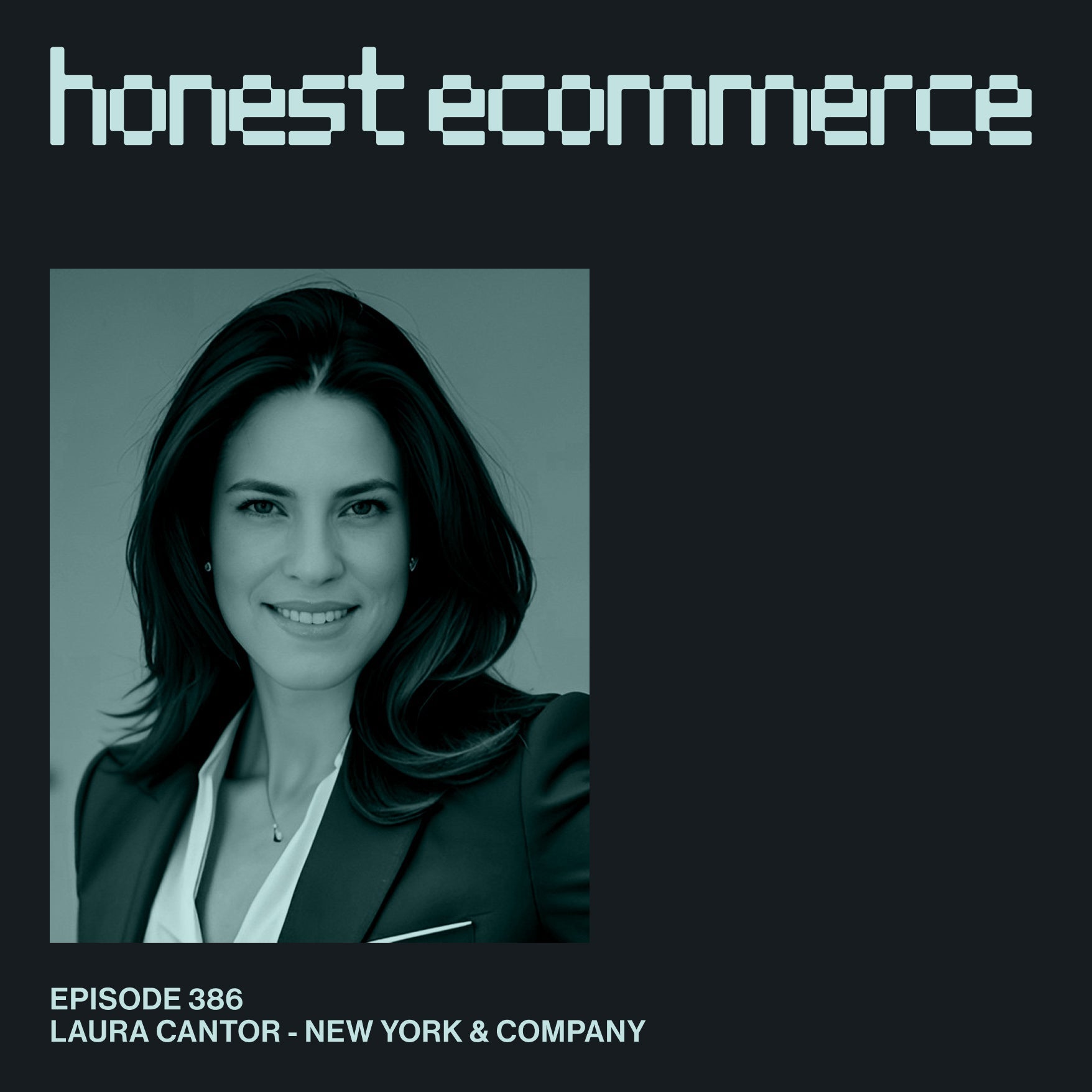
Hey everybody, welcome back to another episode of Honest Ecommerce. Today, I'm welcoming to the show the marketing and ecommerce leader at an amazing brand, New York & Company. They are at the forefront of AI-driven commerce. She is helping the brand win with an increasingly personalized digital-first approach, Laura Cantor. Welcome to the show.
Laura Cantor
Thank you, Chase. That was a nice introduction.
Chase Clymer
Absolutely. Well, you helped me write it by writing it for me. A little inside baseball for everybody else out there. People definitely share a lot of details with me as we do these episodes. But yeah, let's just talk a little bit about New York & Company. What are the types of products that you are bringing to market over there? The things that you guys are selling?
Laura Cantor
Yeah, we sell women's apparel and footwear. Classic Ecommerce play. It has a lot of help with you being up at night, needing a new outfit, seeing something you like, clicking and purchasing. So, we use a lot of tactics around making those clothes look really attractive and filling a need for a woman where she needs to be.
I really like about New York & Company is that serve so many different occasions in a woman's life and in particular apparel. I've just always been drawn to the way an outfit, a piece of clothing, can really change who you are.
As a woman, as a person. Beauty is a wonderful play in Ecommerce. I am jealous sometimes when you run out of a product, you go and buy a new one. There's something about apparel that is a little bit compulsive, which I like.
Chase Clymer
Absolutely. Now, talk to me about your journey in Ecommerce. How did you end up at New York & Company?
Laura Cantor
Yeah, it's kind of a fun story. I was always in apparel. I worked at J.Crew and Ralph Lauren and I've always been drawn to that world. And as soon as I saw influencers come into the picture in 2012, my little enterprising self was like, things are changing here, right? So we had a whole team of consultants come in and tell us this is a new thing that's happening.
And I should have just picked up and become an influencer at that point. But I just knew that there was something online that was going to change the way people bought and sold things. And I got really into digital marketing as the next phase of my career. [I] ended up working at a leggings brand that at the time became one of the first Shopify plus brands. It was a little bit of a darling in the yoga or yo commerce world as we used to call it.
And I just fell in love with seeing the amount of people you can reach at once. Versus having stores or having, you know, I was doing magazine advertising. When I worked at Ralph Lauren and in-home shopping, right? So this was a new way of doing business. And I just understood the scale really well. Left there when they decided to sort of close down the business. It was so successful that the owner retired and is still retired to this day at the right age of 32.
So I was like, they didn't think that could be me. For instance, but I saw the money and the opportunity there through working with this amazing founder and ended up starting an agency. So I had all these partners, right? I had the whole full funnel. Now it worked a lot easier back then, right? Because you could get 10x ROAS on Facebook, no problem.
Put a couple of UCG on your site and you're good to go. But then an opportunity to work with a housewives in the Housewives franchise on Bravo came about and I took that up and started that in parallel, which became a huge success. So I got to build a ground, a brand from the ground on up. And put my entrepreneur hat on and learn everything by doing it myself.
I think that's just the perfect way to understand the complexities of all the things that need to happen in an Ecommerce storefront. [It’s] by experimenting with that on your own. started by listening to 20-year-olds selling personalized bracelets on Shopify courses. And then I understood drop shipping. And then I started importing directly from China and selling and using strategic partnerships. And all of that was going great. And I was getting into stores.
And it was a wonderful partnership we had there. Then everything ended with a personal challenge in my life or change, let's say, and I ended up needing to get a job for the first time. And I think it was like 10 years. And I was like, jobs? What is that? I knew Ecommerce from, you know, I had about 100 clients in the boutique Shopify agency world. And, you know, knew it from that end. But wow, getting my hands in at New York & Company, I was at Lord & Taylor as well.
That was just a really unexpected pivot from having my ability to make all the decisions on my own to working within a larger organization.
Chase Clymer
Most brands outgrow their legacy choices long before they switch.
Bad platform decisions do not fail all at once.
They fail slowly. Then suddenly.
First, it is one workaround.
Then another tool.
Then another integration is duct-taped on top.
And eventually, your team is spending more time managing the stack than actually marketing to customers.
Eventually, rebuilding is less painful than staying - usually when it starts to show up on the P&L.
This is when scaling brands simplify and standardize on Klaviyo.
Klaviyo is the AI-first B2C CRM. It combines your customer data, email, SMS, analytics, and customer experience tools into one platform, so you are not stitching together five different systems just to understand what your customers are doing.
Your database updates in real time.Your segments update automatically.Your flows, campaigns, and personalization all run off the same source of truth.
And that shift is why so many brands are moving to Klaviyo.
Brands like Dollar Shave Club have reduced total CRM stack costs by over 30 percent after consolidating onto Klaviyo. Multi-brand operators like Marc Fisher have migrated multiple brands and dramatically reduced the time required to execute CRM marketing. And brands using email and SMS together inside Klaviyo are seeing massive ROI compared to running channels in separate platforms.
The big unlock is simplicity and scale at the same time.
Klaviyo is built for marketers, not engineers.It is built for online businesses.And it is built for where ecommerce is going, not where it was five years ago.
If you are running email and SMS across multiple tools, or you are on a legacy platform and thinking about your next phase of growth, it is probably time to look at Klaviyo.
Go to klaviyo dot com slash honest to see why hundreds of thousands of brands have already switched.
That's klaviyo.com slash honest, K-L-A-V-I-Y-O dot com slash H-O-N-E-S-T.
If you could, and we don't need to belabor it, but I just want to talk about it. What were your titles going as you were bouncing around and ending up to where you are now?
Laura Cantor
Yeah. I've never been into titles becauseI don't necessarily like hands-on keys, but I like operating. And I like the magic of Ecommerce. I like knowing that if I flip the switch here, I can immediately see the impact it makes. I think I came in as a director, went up to a VP. I didn't care because I was like, I've already done $10 million last year in revenue. I needed to learn. So I looked at it as an opportunity to get paid while understanding Ecommerce at a larger level.
Chase Clymer
I was talking about even way before this as you left your magazine placement job and got into your first role in Ecommerce. I think that climbed just to let everyone else out there know like, is possible.
Laura Cantor
Yeah. I started as Director of Marketing when I went to school. And you did a certificate again, you can't really teach these things.
Chase Clymer
Yeah, oh no.
Laura Cantor
You had a lot of autonomy and a smaller brand and a lot of experimenting and I had a small budget. It wasn't, you know, it was a budget. It wasn't anything crazy. But I got to form those early relationships with some of the early vendors that have been bought and sold and pivoted many times. So, I've seen the arc of all the technology that gets associated with the store from around 2015 on.
So it's been almost like 11 years now, which seems like not that long of a time, but it's completely changed. Right. And I think, yeah, having left and then founded a really successful business, an agency, an app, I had an app at one point. And then coming back, I didn't care. I knew that I wanted to get my hands on all the different budgets and technologies that serve even larger stores as we have today.
Chase Clymer
Absolutely. Yeah. I think there's something fun. Obviously, on my side, agency side, we're working with a dozen brands at a time. Yeah. There's always... If we could focus and put all of our effort into one thing, it'd be a lot of fun just to see what the output of that would be for a while.
Laura Cantor
Yes. All agencies should run their own brands, right? Because they know so much more than the people sitting in seats like mine, right? We only know what we know. I always thought, like, I would look at the brands and be like, I have all the shared wins. You know, I know it works. But now that I'm on the buy side or the brand side, I understand things to be so much more complex.
The way decisions get made is, through a series of different or orgs or silos. And that's why sometimes I notice agencies and brands sometimes have that friction between them.
Chase Clymer
Yeah. I like to tell clients as early in the sales process, it's our knowledge. We have compounding knowledge. We're learning 12 times faster than you guys will be. But that doesn't mean that what is going on in the brand isn't important. And that's like, there's this thing where everyone involved needs to understand that the world isn't black or white.
It is shades of gray. And the reason things aren't happening probably have nothing to do with what you're thinking about. It is something completely different. It is, we need to focus more energy on this 3PL expansion. It has nothing to do with this landing page you want to test. Right? It's just such... It's more about how much thought and just brainpower can be spread across the various things that these brands need to do.
Laura Cantor
Yeah. Thank you for summarizing. That would probably be like the core skill that I've acquired over the last three years or so is understanding how to move organizations and make change and particularly around AI. Because that's the hardest one, or the newest and greatest one that is necessary. People do need to change the way they think and do business. And that's been so exciting to be a part of in an organization.
Chase Clymer
Hey Store Owners -
Do you know how profitable your last BIG decision was on your Shopify store?
Most testing tools make it easy to measure design changes - small tweaks. Headlines. Layouts. Button colors.
But what about the decisions that really move the business?
Pricing changes. Shipping rates. Discount strategy. Even new apps and tools.
Those are usually left to gut feel.
Intelligems brings CRO-level clarity to decisions that live beyond the page.
Brands like Ridge, Jones Road, and True Classics are using Intelligems to test pricing, offers, shipping, and more, and see exactly how each choice impacts profit.
Momofuku used Intelligems to test multiple promotional offers ahead of Black Friday and identify the version that ultimately increased profit by about 28 percent.
Mott & Bow used Intelligems to run structured pricing and offer tests that helped drive roughly a 30 percent increase in incremental profit.
Dossier used Intelligems to run sitewide testing that resulted in about a 7.4 percent increase in profit per visitor across their store.They have a bunch more case studies on their website.
I’m a big fan of Intelligems. We use it with almost every client at our agency, Electric Eye.
We use Intelligems to test major site changes, new theme launches, and throughout ongoing CRO work
So when we are making decisions around design, pricing, offers, ETC, we can be confident that those changes are actually driving more profit for our clients.
So, before you start changing pricing, promos, or major site experiences across your store all willy-nilly, you should test it first.
If you're ready to decide confidently and grow profitably, head on over to intelligems.io and use code "honest" for 10% of your first 3 months. That's intelligems.io Use code “honest.”
Obviously, AI is huge and hot. I'm guessing this is just part of your job now is to implement this into but how do you do it for a company that's technically over 100 years old?
Laura Cantor
Yeah. With the caveat that New York & Company is pivoted more towards like a startup that's scaling because it's different than it was when I had stores and it was not just a D2C entity. So that makes it almost more aligned with what I did in my startup days. So I feel like I get to use a lot of the skills that I got from, being more experimental, being more agile and applying them to a larger company now only because of the need for AI, right?
And the fastness and the fast pacedness around it. When I first joined it, it was much more difficult to create any types of change. But we had to peel back the layers of an onion. I think a lot of it was re-platforming to a liquid platform, getting things more integrated and then redoing the tech stack.
And so I have that confidence going into it because I kind of built something already, right? I think it would be hard if you haven't seen that you can do this, you can take risks and you can pull back, right? If something doesn't work. I think there's a lot of status quo in organizations, like we just follow the easiest thing and you don't want to own anything that could potentially cause harm.
So you're not going to go forward and take on projects that maybe weren't a great decision. I think I've come into it with a lot of like everything forward is still a good decision as long as we're learning from it. I think it's getting to know the people that work with you as almost like we work in tandem almost. We're all involved in each other's roles in some way, which is a special way of operating.
I don't know if it would work for every organization, but I think that AI gets us closer to understanding everyone's responsibility. And we all have a part to play in that. And then we all get a part to play in the win. I think that it's not like I own AI or I own this part. And if it wins, it's going to be me that gets the credit. We all get it as a team.
Chase Clymer
Yeah. I'm gonna follow up on the AI part. But you just said something that was amazing. And I need to highlight it. Which is like you came in, you helped modernize the tech stack and basically build the Shopify experience. That I'm assuming you just did what you did before that worked at your previous successful business.
I need you to explain to the audience how hiring people that have done the thing before that you're looking to do just makes things easier.
Laura Cantor
Okay. So yes, a lot of the staff had come off large brands. Because in retail, we look at brands, right? We're like, oh, if you worked here, you're going to be a good fit here. But they all come off a Salesforce Commerce Cloud, every one of them. Working in a Shopify environment is almost the opposite of what the Salesforce environment is.
Having worked in both, but specializing in Shopify, to get the most out of it, you'd want someone who knows how the Shopify partners account understands the different components. And with like the app and the integrations, the payments, all the CS to the ERP and all how all those things are connected. And has a good hold in the community that supports Shopify and the vendors that really work best with the Shopify ecosystem.
Versus, just vendors in general who are really highly regarded in retail.
Chase Clymer
Yeah, I think that this even goes beyond just like they hired you because you knew you could make these decisions for modernizing that stack. But it's like when you're hiring... Maybe some of these listeners are even on the brand side and they're hiring for people to do stuff. Either agency, consultant or full-time.
For any small team, and I have learned this the hard way, for any small team, you have to hire the person that's done the job before. And if you can't afford the person that's done the job before, you're probably not there to hire them yet. And you have to do it yourself. But you are hiring someone to take something off your plate.
If have to train them how to do the job, so you have to learn how to do the job, and then you have to train them to do the job that you just learned how to do. That is just a really backwards way of thinking about it. You just need to hire someone that's done it before and then empower them to do it.
Laura Cantor
Yes. You need to cut through that knowledge base. There's so many institutional things about Shopify that aren't visible on the outside. And understanding how those components work together is going to set you up for getting the benefit because there are limitations to Shopify in a lot of ways. But there are so many more benefits using that platform.
And that's just what I've been on for most of my career. So I'm excited to see either more brands that are larger get on Shopify or whatever's next. There's a lot going on in that space as well.
Chase Clymer
Yeah. I still am of the opinion and we've been Shopify partners forever. It's like if there is a limitation, I think your business model is wrong. Or it isn't like you just shouldn't be on Shopify in the first place.
It's got its quirks for sure. And you've got to solve for things in ways that are different than other platforms. But that's just a process situation. That's not necessarily one platform is doing it the right way.
Laura Cantor
When you're a $300 million, $500 million business on Shopify, things get really, really, really hairy. And that's one thing I didn't have any visibility at all. I mean, we're talking about like, whether it's the cloud for connection, whether it's, you know, using a private label credit card, and you can't change the payments. There's, there's a lot of things you can't, you can't know beforehand. And a lot of situations you just have to go through.
But there's the bottlenecks are unreal. And I'm sure that's in any organization, right? But having pared back our structure and complexity, without those bottlenecks, now we're so much more lean, so much more agile. We're positioned well for the age of AI that's here and only getting bigger.
Chase Clymer
“I have been in business for nearly 20 years, and very few companies I have hired in that time have performed as well as Electric Eye. They have knowledgeable staff, and our project was delivered on time and on budget. Electric Eye has exceeded my expectations, and I look forward to working with them again.”
That is a direct quote from one of our clients at Electric Eye.
Electric Eye is a Shopify Plus partner that has helped over 100 brands migrate, redesign, and optimize their stores since 2016.
If you'd like to increase your conversion rate, average order value, and revenue per session, we are the true Shopify experts you've been looking for.
Right now, we're offering a free diagnostic to qualified brands that reach out and mention the podcast. Visit electriceye.io today to schedule a call and send us a message. Find out why we have over 50 5-star reviews in the Shopify Partner Directory. Again, that's electriceye.io. E-L-E-C-T-R-I-C-E-Y-E.io
Let's talk about that. So by modernizing the stack, getting everything talking togethe streamlining these processes. So basically, you have a bunch of data that you can now feed into these cool technologies. I guess a two-part question or just answer it however way you'd want is like, how are you now using AI? What is a specific problem it's trying to help you solve? Or is there something that you've implemented on the website that's superpowered by AI at this point?
Laura Cantor
Yeah. Getting discovered and relevant inside of any agentic AI platform is going to be really important moving forward. But there isn't a lot of revenue there currently. A quarter of my brain is thinking about that at all times. Like that's going to be that's important. We have to keep working on our agentic storefront. Shopify has made that easier than possibly other platforms to at least dip your toe in and and improve.
But tactically, we’re working on using AI for chat mostly. And implementing a post purchase, you know, customer service widget and pre sale as a secondary phase and assisting people and how they buy. I think that is really the stair step between what we're going to be discovering on ChatGPT on Gemini. We're not completely there yet. You know, how can we bring that experience into the storefront is really where we're focused.
Chase Clymer
Absolutely. Yeah. And I mean, anytime that you can be asking your customers questions, like pre-sale, you're just gonna learn more and more. And then all those learnings compound to help you make better recommendations. And even if you take a step back from there, make better purchasing in the future where you're like, “You know what, yellow outsells everything else, so we should buy more yellow.”
All this information is just super useful to have now that you have all these components talking together. Before I let you go, is there anything that I didn't ask you about that you think would resonate with our audience today?
Laura Cantor
Yeah. I think another way you could look at AI and how it's servicing commerce is just the fact that all platforms have more data and have access to the AI. So another vendor [we’re] working with is Rocked, for instance. And we had previously worked with them in the past and had parted ways. And this round coming, we noticed that they serve ads.
So one channel for us, you know, other than just paid media, CRM loyalty is retail commerce channel. So getting to be monetized off of our traffic in any way possible so the store can maintain another revenue source and serve post purchase ads. And also some network ads on other retailers through Rocked has been a really different experience this time around because the AI is that smart.
It understands the recommendations. Like it didn't have as much, I guess, a great experience with the customers maybe before. But now we are like, what can we do to use AI to bring back former ways that we used to monetize on, that are better experiences for our customer?
Chase Clymer
Hey everybody, just a quick reminder. Please like this video and subscribe if you haven't. We're releasing interviews like this every week. So don't miss out. Now back to the interview.
Rocked is, I believe they bought Aftership and they are a post-purchase solution in the Shopify... Well, in all the ecosystems. But Shopify really went in on it. But from my knowledge, it's something that they do that really is different than anybody else in the ecosystem. It isn't just like a post-purchase upsell for another widget on your store.
This is now offering you things from other stores. And you're getting paid when people click on those offers. So it's helping you generate income if you have the traffic to support it. So I just wanted to explain that to the audience. That is like, this is like a different thing.
Laura Cantor
Yeah. No. Three things about that. The partner with AfterSell, not AfterShip, who we love AfterShip as well. That's another thing we could talk about is we use a Checkout Plus. So they allow you to charge customers a little bit extra, but have a package protection and free returns in most cases. Which is another great outcome for both the brand and both the customer.
So in the case of Rocked, with AfterSell, you can upsell your own products in conjunction with upselling offers from complimentary brands. Not any competing brands, but vice versa, the new products that we're going to be baiting with them. Now we can sell our products on big box stores like your Targets or JC Penniesor stores that we know our customers do also shop at.
We can serve ads from our store that are so relevant to what they had purchased in the cart. And I don't think it makes sense to pay for ads in a store like that, before the AI could serve those recommendations properly. But now the opportunity is to be able to be visible to have top of mind in a huge audience that we don't have access to and only pay per performance. So it's like another win-win that AI is bringing to us.
Chase Clymer
Oh yeah, absolutely. It is a super interesting channel to explore if it makes sense for your business. Now, Laura, is there anything else that I forgot to ask you about before I let you go?
Laura Cantor
Oh, partnerships. Working with a group of folks in the retail industry. A lot of them are veterans. And they started an organization to pair vendors and partners, in which brands and vendors would partner together and have conversations about how to better work together. How to win on both sides, how to go through RFPs, how to respect each other's processes and economics around getting deals done so that we can learn off each other, right?
There's a lot going on on the vendor side. They have also a ton of shared wins and understandings and a lot oftheir fingers on the pulse of what's coming down the pipeline for AI that brands don't have. Because we're trying to drive revenue at all times. We're not looking out in the future as much.
I think as we move forward this year into next year, if things get sold more so on AI platforms, we're going to need to rely on each other more and more. As we may lean out, we may expand at different times as these changes are happening so quickly. And I love being a part of this organization. It's called Vendors in Partnership. And they host a gala and they award vendors for exemplary service. I mean, where do you see that?
Where, you know, a lot of the times they get shoved to the side and the brands get all the spotlight, right? So we want to cheer on the people that are championing AI and new in different ways and changing the landscape of commerce because we're right alongside them, right? We're working in tandem.
And it's going to become more and more important because it's the people that are going to make the decisions. The AI is going to do a lot of the fundamental work. But the people behind those are going to be going in the right direction because they're relying on each other.
Chase Clymer
Absolutely. Yeah. You know what? think that we would love to win an award. So now I'm going to join this program and get up on that stage. Laura, I cannot thank you enough for coming on the show and sharing all those amazing insights. If people want to get ahold of you, where can they find you online?
Laura Cantor
Yes, you can find me on LinkedIn, Laura Cantor. I'll leave in the show notes the Vendors in Partnership information as well as the Rocked information. You can get up with on Rocked really, really quickly and start making money while you figure out what new AI tool you want to buy with it.
Chase Clymer
Awesome. Thank you so much.
Laura Cantor
Thanks, Chase.