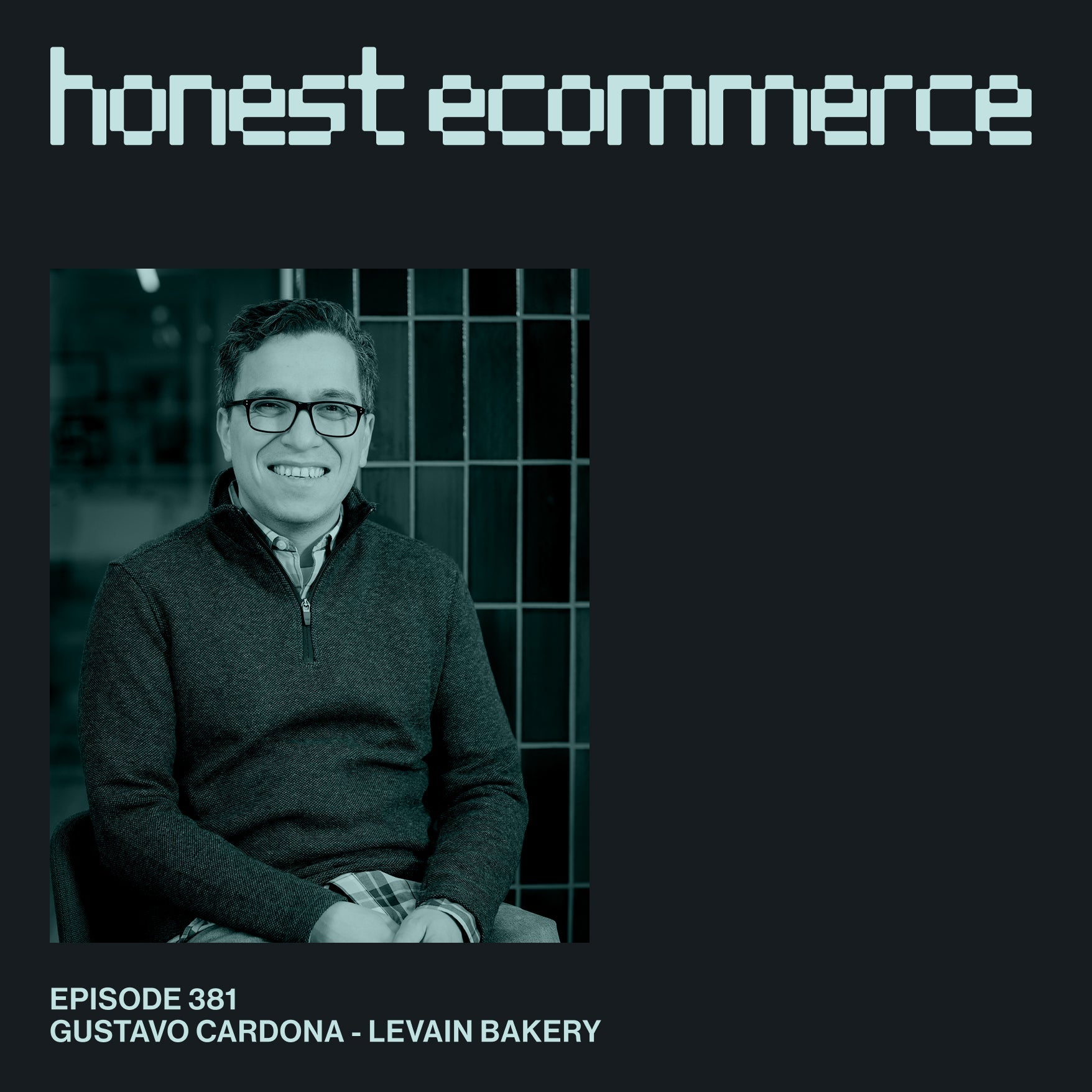
Gustavo Cardona
Success is not about having advantages. It's about adaptability and resuorcefulness, and the willingness to learn. That's the most important part. That willingness to learn. That's why scaling up technology is like a craft in itself. Not just necessarily something that you pick up a book and start doing.
Chase Clymer
Honest Ecommerce is a weekly podcast where we interview direct-to-consumer brand founders and leaders to find out what it takes to start, grow, and scale an online business today.
Hey everybody. Welcome back to another episode of Honest Ecommerce. Today, I'm welcoming the show Gustavo from Levain Bakery. He is the VP of Technology over there. He leads the IT infrastructure and the data strategy. He helps bridge the innovation with technology to the operational reality. They're building an amazing business over there and selling quite delicious products. Gustavo, welcome to the show.
Gustavo Cardona
Hi, Chase. Thank you so much for having me. This is a pleasure to do.
Chase Clymer
If people are living under a rock and they're not familiar with what you guys are doing over there. What are you guys selling? What's going on?
Gustavo Cardona
Well, Levain. When you hear that, it's all about our cookies. That's our core product. That's who we are. It's a six ounce delicious cookie that you're supposed to break and it's just filled with oey gooey happiness, I would call it. And that's the core of our product.
But, you know, I think what we are known for is also the experience in the bakeries. People are able to come there and remember the first time that they went to the bakery. How did they feel, the smells, the attention for everything that we do with our customers. The team that works there. It's all about that sense of being part of the community. And that's what Levain is all about.
Being able to create a sense, a memory that will last. But also being able to just bring some sort of happiness to like a good or a bad day. Or at any simple day, just trying to remember who we are. And that's what Levain is. It's a whole experience that comes into a cookie. But now, you know, it also comes into loaves, coffees, sandwiches, flatbreads.
We're trying to always keep our menu simple enough. But I would say in the sense that the simple ingredients that we use, anybody can copy those recipes for us. It's not about having a unique recipe with a secret ingredient. It's about being able to create that memory for somebody.
Chase Clymer
Absolutely. Now, I know that obviously the in-store bakeries are kind of where the business got started, but the direct consumer part of it is really. There's been bit of innovation there. And you mentioning the sandwiches and I'm assuming the coffee, you can buy that online. Are there some things that you cannot buy online, I'm assuming?
Gustavo Cardona
Pretty much online, you can buy our cookies, you can buy the coffee, the ground coffee that we sell at our stores. And you can buy the merchandise that we do for all of our stores. Everything else is an in-store experience when it comes to the sandwiches, the flatbreads, the loaves, the muffins, and the breads. All that still an in-store experience. It's not available online.
Chase Clymer
Absolutely. I'm gonna have to get into the in-store experience. I've only been lucky enough to experience the cookies at a trade show, which we met at. I believe, Shop Talk in Chicago last year. And then we reconnected just in Vegas not too long ago.
Gustavo Cardona
That is correct. Yeah. That's the first time we met. Yeah.
Chase Clymer
I always like to point out to people that are younger in their careers or maybe even in their business, the power of trade shows. Do you have any opinions about trade shows or conferences for folks?
Gustavo Cardona
It's a two-sided, I think, approach. There are the vendors and the brands. I think when you come as a vendor, you have to be open to rejection. You have to be prepared. I'm surprised people ask you for your time. And it's like a 15-minute time. You have a small window for an elevator pitch. This is who we are. It's like that.
They don't come prepared at all. Even now with Levain , I am surprised when people come and say, “What is it that you do?” And like, you didn't even research. So that's the thing I think about preparing for that. And then for the brands is the ability to be able to connect to vendors, but peers. There are so few opportunities this day and age to be able to connect to peers unless you call reaching somebody to LinkedIn or like somebody introduces something like that.
Ability to have different events throughout these conferences where you can meet with peers. And it's not just a time to chat, but it's also like an ability to be able to understand people. And how they're approaching a problem, how they're like working on a solution. And then maybe you can share that information. I love doing that. I don't think in the sense of the day, there's like the competitors that I will never share anything with. As an engineer, I love to find solutions.
And the best way to do it is to talk to people to figure out what they're doing and to get new knowledge and to share that knowledge as well. Somebody else can figure out a way to do things better with your solution that you have. And that's something to be proud of as well. And that's the beauty of conferences. So don't ever discount it.
But don't ever attend too many and prepare yourself. Because sometimes you end up over-scheduling yourself, which I did in Chicago. At the end of the day, you just wanna go home.
Chase Clymer
Yeah, I always make sure that I schedule my lunch. I'm like, “If I don't do this, I won't eat.” Then running around all day only on coffee is just not good for you. That's what I did for Vegas. For Vegas, I made a schedule, “This is the time when I'm gonna eat.” And that's the way. Then after that, it was, “When am I gonna eat?” That's the only thing I didn't plan. So now the next one is, “What time am I gonna eat,” and “Now this is what I'm gonna eat,” to be more efficient.
Chase Clymer
Do you know what's going on with Klaviyo? When was the last time you explored what it can do?
Klaviyo has been shipping tons of new AI, data, and automation features designed to help ecommerce teams move faster, personalize better, and automate more of the work that used to take entire teams.
Most brands are only using a fraction of what is already inside their Klaviyo account.
Klaviyo is not just email and SMS anymore.
It is your customer data platform, your lifecycle marketing engine, your analytics layer, and now your AI-assisted execution layer, all in one place.
That means your customer data updates in real time.Your segments stay current automatically.Your flows and campaigns all run off the same source of truth.And now AI can help predict churn risk, forecast spend, recommend next best products, generate campaign content, and optimize send timing across channels.
The big unlock is speed and efficiency.
Fewer tools to manage.Less dependency on engineering.Less time moving data between systems.And lower total cost of ownership across your marketing stack.
And brands are seeing real results from leaning further into Klaviyo.
Dollar Shave Club has reported over 30 percent reduction in total CRM stack cost after consolidating onto Klaviyo. Brands like ThirdLove have seen 15x ROI from SMS after consolidating channels. And companies like Corkcicle have grown flow revenue over 90 percent after bringing email and SMS together inside Klaviyo.
Across our customer base, every single brand we work with today is using Klaviyo. That is just where serious ecommerce customer data and lifecycle infrastructure lives now.
If you are already on Klaviyo but feel like you are not getting everything you could out of it, or you are running multiple tools and want to simplify without losing power, this is worth your time.
You should head on over to klaviyo.com.onest to learn more. That's klaviyo.com/honest to learn more about what Klaviyo can do for you today.
When does your story start with Levain?
Gustavo Cardona
I will say this, but I'll check a little bit. I was an engineer from the start. I came to the United States as an immigrant almost 26 years ago. And my goal was to do physics and astronomy. This is my background, I wanted to be teaching and researching. Halfway through this journey, I saw this as more of a hobby than a realization that this is what career I wanted to be. And then I realized I wanted to switch. I started going into the engineering field.
Working small jobs like learning on the job type of deal. I think my first job halfway was administrative engineering, but that's a way for me to be able to start. And then I work in different companies from education companies to publishing companies to beauty companies. And then that was the last one before I came to Levain to work at a beauty company where I met the chief marketing officer at that company. They moved to Levin.
They had a position available and I was very curious to work there. Because again, my first memory of going to Levain was when my now wife, at that moment my girlfriend, brought cookies to us. And I was like, these are the best cookies. And the next day I walked all the way from Harlem down to 74 because I wanted to experience them again. So I remember that memory.
This is something that inspired me. Is this still the same type of company? And I went and they were that. And my goal to be at Levain was we have this Ecommerce world at Levain. It's small, but could be powerful. Can you help us get it to the next level? And you know, this is not like my own effort, like doing everything that. But just bringing my knowledge from all these previous experience and engineer,
Bringing my previous knowledge from startups and then applying it to Levain. How are we going to be able to create that Ecommerce world where we can do anything that we want to and treat it.It was funny because we treated it like a startup inside a company that was already at that moment 26 years on the making already. So it wasn't a startup event, but the Ecommerce itself was. And that's how we treated it. And that's why we kept growing and growing and growing.
And, it became more of a sense of like, all right, the Ecommerce is set up. And then there was an opportunit in me to be like, now can you lead technology for the whole company? And that opportunity was given to me and I jumped. By the way, it was like the next step. You always are in a company trying to figure out what is my next step here? Where would I want to go once I'm done with this part?
And this was an opportunity that shows up to me and, and allows me now to like lead the whole technology for the company. I have a great team under me that I can completely trust on anything. And it's always a cooperative environment. There's never like, I am the one making decisions. You are applying them to me. I think they're smarter than I am. So I trust them.
It's always a conversation for me to learn from them, but not necessarily to tell them what to do, but just to understand it. Because eventually as I grow into the position, I have to go to the dealership and let them know this is what we want to do. This is everything that we want to do and back it up for them. And that's pretty much where I'm at right now.
Chase Clymer
Hey Store Owners -
Do you know how profitable your last BIG decision was on your Shopify store?
Most testing tools make it easy to measure design changes - small tweaks. Headlines. Layouts. Button colors.
But what about the decisions that really move the business?
Pricing changes. Shipping rates. Discount strategy. Even new apps and tools.
Those are usually left to gut feel.
Intelligems brings CRO-level clarity to decisions that live beyond the page.
Brands like Ridge, Jones Road, and True Classics are using Intelligems to test pricing, offers, shipping, and more, and see exactly how each choice impacts profit.
Momofuku used Intelligems to test multiple promotional offers ahead of Black Friday and identify the version that ultimately increased profit by about 28 percent.
Mott & Bow used Intelligems to run structured pricing and offer tests that helped drive roughly a 30 percent increase in incremental profit.
Dossier used Intelligems to run sitewide testing that resulted in about a 7.4 percent increase in profit per visitor across their store.They have a bunch more case studies on their website.
I’m a big fan of Intelligems. We use it with almost every client at our agency, Electric Eye.
We use Intelligems to test major site changes, new theme launches, and throughout ongoing CRO work
So when we are making decisions around design, pricing, offers, ETC, we can be confident that those changes are actually driving more profit for our clients.
So, before you start changing pricing, promos, or major site experiences across your store all willy-nilly, you should test it first.
If you're ready to decide confidently and grow profitably, head on over to intelligems.io and use code "honest" for 10% of your first 3 months. That's intelligems.io Use code “honest.”
I want to ask a specific question. What you went to school for has nothing to do with what you're doing now. Did you have any formal education in coding or computer sciences? How did you learn those skills?
Gustavo Cardona
There were three or four classes. No, two classes that I took. An undergrad and graduate when it comes to computer science and coding. The rest was just learning on the job. I did research during my grad student period and I learned how to code in Python and C++. And then when I came to be an engineer, I just took online courses on HTML, CSS, and Java. And then kind of started developing the skills.
Then after that became data, SQL, NoSQL, things like that. And then it's just pretty much learning on the job. Having the ability to learn on the job, spending the off hours of the job, still teaching myself and then I started applying that. It was just an effort of doing. Truly I love, I love coding, don't get me wrong.
I get to do it less now because of my position, which sometimes I miss. It's just being in front of a code and like seeing the realization of it. It's a beauty, it's a work of art. But that's pretty much how it ended up coming to be for me to be coding tonight, now leading this group of technologists.
Chase Clymer
Absolutely. I asked because I want to highlight that even with non-traditional paths and non-traditional education, you can still end up as the VP of a well-known brand. And what matters now more than ever is taking action and just learning the skills, less if you got a piece of paper that says where you got it from.
Gustavo Cardona
I think the main part here is you have to be adaptable. You have to be resourceful. I think being an immigrant gives me an outside perspective and an outside advantage. Like not thinking it from the focus of tech coming from the same country is just giving me that. You know, it taught me that, the success is not about having advantages. It's about adaptability and resourcefulness and the willingness to learn. That's the most important part, that willingness to learn.
You know, that's why, scaling out technologies is like a craft on itself. Not just necessarily like something that you pick up a book and start doing.
Chase Clymer
Absolutely. Now let's talk a little bit about, obviously, some of those projects that you were hired, essentially, to help solve particular problems. Do any come to mind that you helped lead up? And what were some of the pain points within the business? And how did you guys think through them?
Gustavo Cardona
I think one of the first problems that we ended up having in eCommerce was our shipping solution. We ended up being very customizable on how we do it. People pick whenever they want their cookies delivered. And for us, we will never charge you until we bake that order and we ship it. So it's a little bit, we kind of place a hole in your order, on your cart to be able to charge you.
But the idea was, we want to be able to make sure we know how many cookies we're going to bake, how many for that day. And it's never like we run out of ingredients. Our team, our supply chain team is amazing. I've always stayed on top of everything, but we need to have those ideas. That kind of projection is, for this day, we're going to bake this many cookies. We're going to this many stuff.
And it's like, setting up the oven, setting up the team, how many people are to be packing the orders and things like that. The solution that we had at the moment was very set in their ways, I will call it. And it just, it just didn't work. It was very clunky. We had to have a lot of custom jobs on the flow. And then we work with Shopify Plus at the moment. And we still do.
But there was no way to connect them. So if we were to update something on Shopify, we'd never see it on the system. So we're still working with like, we have the team working with like two or three windows at the same time for like one single order. So it was working, trying to find a solution where we can say, “This is the company or this is the solution that we wanna work with.”
There was this company called Pretty Damn Quick, PDQ. And they came to us like, “we have the solution for you.” I'm like, “All right, let's test it.”
Chase Clymer
Sure you do.
Gustavo Cardona
The beauty of this with working with them was we went for like six months just testing their system and for them to get feedback from us. For them to update things we asked to see. The holiday time at Levain is beautifully insane. It's just the amount of cookies that we bake, I cannot tell you. The numbers are crazy and[gets] crazy every year and it's the beauty of it.
But it's very complex and they worked with us on a testing period during that time, the holidays. To understand the capabilities of their system to be able to hold the amount of changes, the amount of orders that we did. And on the background testing, they survived that. And then we kept moving and then we launched with them. And it's a continuous partnership.
That's what I think. The best way to work with a vendor is the continuous partnership. It's sad sometimes when a vendor's like, you're sad. Here is your customer manager, I gotta go. And then like the customer manager is like an email that will respond like two, five days, something like that.
With them, we have a constant open Slack channel talking like, “Hey, we have this issue with this order. Or, you know, we have recently a new partnership with another vendor and we wanted to launch a custom code on the application.” And they told us like, “You know, they look at the code like, ‘Okay, we'll take us a month to be able to develop it, to be able to test it, to launch the production.’”
I mean like, that's fine. I think as long as we work with time. We have never been delayed or something like that when we have worked with them. And that's kind of like the type of partnership that I wanted to look for. And something that is a solution that is not set as a solution and then go. But it's a solution that can grow and be, ever changing as the system and as our stores and as our business changes.
Chase Clymer
“I have been in business for nearly 20 years, and very few companies I have hired in that time have performed as well as Electric Eye. They have knowledgeable staff, and our project was delivered on time and on budget. Electric Eye has exceeded my expectations, and I look forward to working with them again.”
That is a direct quote from one of our clients at Electric Eye.
Electric Eye is a Shopify Plus partner that has helped over 100 brands migrate, redesign, and optimize their stores since 2016.
If you'd like to increase your conversion rate, average order value, and revenue per session, we are the true Shopify experts you've been looking for.
Right now, we're offering a free diagnostic to qualified brands that reach out and mention the podcast. Visit electriceye.io today to schedule a call and send us a message. Find out why we have over 50 5-star reviews in the Shopify Partner Directory. Again, that's electriceye.io. E-L-E-C-T-R-I-C-E-Y-E.io
Yeah, you mentioned that the old system people were pretty stuck in their way. How do you challenge these established processes that give friction to... Let's be real. Computers are so stupid and they have to do exactly what you tell them to do. So sometimes processes that are taken from how it works in real life when you try to make it work on a computer, you get a bunch of friction.
So how did you push back against everyone and say, we have to change this process to get a fundamental better result to digitize this thing?
Gustavo Cardona
That's a good question. I think the main two complications when you try to do something new is finding that new thing to be able to solve it, but then the adoption that the company has to do for it. And adoption is the number one risk of the technical failure of something that you want to do. How do you shape that approach?
I think the first thing that you have to do is understand the problem. The problem has to be visible and fixable. If you say there's a problem, but you don't understand what's happening, then it's pretty much a stop from there. And then being able to understand, or like being on the ground with the people. Not just email and chat with them. Be on the ground with people.
Understand where their pains are. What are their suffering? What are the changes that they want? Like what are the complications that you're having? And then once you start understanding that and come up with a solution, I literally took everything that you gave me and I found a solution that is going to give us everything that we need.
Maybe sometimes it's everything, maybe sometimes it's most of it. And then we still have to work in a couple of workflows as the application grows. And then let them know there's going to be training on it. It's not like we're going to release it and check. Like the same thing, I'm a customer success manager for the whole company. If I release a technology, I have to understand how I can help them work with that technology. Not like, that's yours, good luck.
That's not how I do it. I will just pretty much be with them. I understand how the technology works. Let me train you with it, work with it. And then at the end, they even work with [it and}, they do things with it that [suprise me], “Oh, I didn't know we could do that.” That's great to know that you already explored that part.
So it's just working back to like what the original problem was to be there with the ground with them to understand them. To present the solution. To train them and then to kind of like pretty much almost like a kid. I raised you. You're free to go. But I'm still here. You need me. That's pretty much it.
Chase Clymer
Hey everybody, just a quick reminder. Please like this video and subscribe if you haven't. We're releasing interviews like this every week. So don't miss out. Now back to the interview.
Now, I don't think that we can have a conversation these days talking about technology, talking about ecommerce, and we don't talk about AI. So how are you guys looking at AI? How are you separating what is actually possible versus just the noise that people are making? Are you guys trying anything new?
Gustavo Cardona
We are already trying a couple of new things with AI. I think we have what I would call it a 3-Pillar strategy. What is the operational efficiency of the solution? What are the product innovations that we can do with the solution? And is there a decision intelligence to it? So are we getting any insights that are faster than the human decision?
And that's kind of like the sweet spot. If those insights are fast enough that it will take us more than that, than a human experience to be able to accomplish them, then that's where you want to be able to find it. I think when it comes to AI, the first red flag is like somebody says, “We're using AI.” I'm like, Okay, thank you. That's great. Bye.”
Chase Clymer
Everybody's using AI.
Gustavo Cardona
Everybody's using AI. So you're not telling me anything. It’s almost like you're telling me you're using computers.
Chase Clymer
Yeah, Gustavo. Guess what? I've got a computer.
Gustavo Cardona
Exactly. Chase Clymer
Have you heard of calculators?
Gustavo Cardona
Yeah. It's that. So I think the first thing that I asked them, “Show me messy data. And then this is the solution that I wanted to apply because it's a demo data… If it's a brand new product, definitely you have to work with demo data. But it's not a brand new product, so here's the messy data. Here's what you can end up accomplishing. How is it learning? Is it generic? Is it industry standards that you're teaching your application to do?
Because if it's generic, then it can change with us, which is great. But the industry standard still has to be based a little bit on that. So you can tell me, I can find these solutions for Levain, and then this is how you're going to show the data. But if you don't apply that to other technological industries, then it's so custom to us that it's just very narrow-fine.
That tunnel-focus into just Levain instead of seeing the whole spectrum of the businesses in general. And where is the human in the loop? I still think that AI complements humans, it [should not] not take over humans, so there has to be a human in the loop. And if they can’t explain a human in the loop for that part, then that's another red flag for me.
Because if you just have a system that said it and let it go as well, then what is it doing for us? We are a company run by humans, led by humans, approached by humans. And humans come to us for our product, for our cookies, and for everything that we do. If [there are] not humans in the loop, then it's not a solution that we want to be able to try.
Chase Clymer
Yeah, we can shout out to someone that I think is doing AI the right way. Test Party. I think that their approach is pretty smart. And how they're pushing pull requests to GitHub to be looked at by a real human. That is the perfect blend of, like you said before, efficiencies, but also keeping that human in the loop.
Gustavo Cardona
And the start point for them is they don't come like, we're gonna take our AI and run it into your system. They actually come like, “Okay, we're gonna take a human and look at your system.” Page by page, location by location, and then try to understand what your misses are. What are the things that you have to update to be compliant, to be able to serve all your customers the same way, regardless of who they are?
And then after that, we're going to apply an AI solution, but we still have the human on the loop. This is your hip-hop repo. Can you review it? Are you good with it? Let's push it live. And also the other part is not just said and done. Every month [they] will come back to your site. [Is] our AI tool still running just in case you see any red flags that we can put out right away.
And if not, every month, if needed, you'll get a new repo that you can review and push into your site to maintain that compliance that you want to have.
Chase Clymer
Yeah, think AI truly is just an efficiency multiplier when used well by subject matter experts.
Gustavo Cardona
It's a solution? No it's a methodology, a method to be able to get things done.
Chase Clymer
Absolutely. Now, Gustavo, is there anything I didn't ask you about that you think would resonate with our audience?
Gustavo Cardona
I think we have brought all the aspects that I wanted to talk about. I think technology is never the hero of the story for us. The cookies are. But we understand where that balance we have to find between technology and what we are offering to our customers. The beauty of it, I think at the end, is that, technology becomes invisible.
It's running there. It's there. But the cookies are what always brings people out here to our website, to our stores. That's the beauty of it. If you are seeing technology first and then the cookies, then we're missing the point of having the company done.
Chase Clymer
Yeah. No, that's such a great insight. I think a lot of young entrepreneurs get lost in thinking that they need the best stack, which may be the most custom thing, the most well-designed thing. And they over invest in technology at the beginning when [what’s] more important than that is just getting in front of customers. And I think that your point is pf you notice the technology, something's probably wrong.
Gustavo Cardona
Yeah, exactly. I mean, I know when there's issues without technology because somebody will bring it up. But if people are calling me to just tell me, “We have great reviews or like there was something wrong. There was something wrong with an order for a customer.”
Now that's like, “Okay, the customer is here for us, about our cookies, and our product. How can we make it better for you? That's what I want to do to maintain that people connection. If it just works with technology, people can focus on what they do best. And it's pretty much serving our customers and making the best cookies in the world.
Chase Clymer
Absolutely. If any listener is lucky enough to be close to an actual bakery, go check it out. But they do ship all over the place. You can get the delicious cookies delivered. Gustavo, I can't thank you enough for coming on the show and sharing all those amazing insights.
Gustavo Cardona
Chase, this was a pleasure. I'm always down for a good conversation about what we do and how we can help everybody out there.