
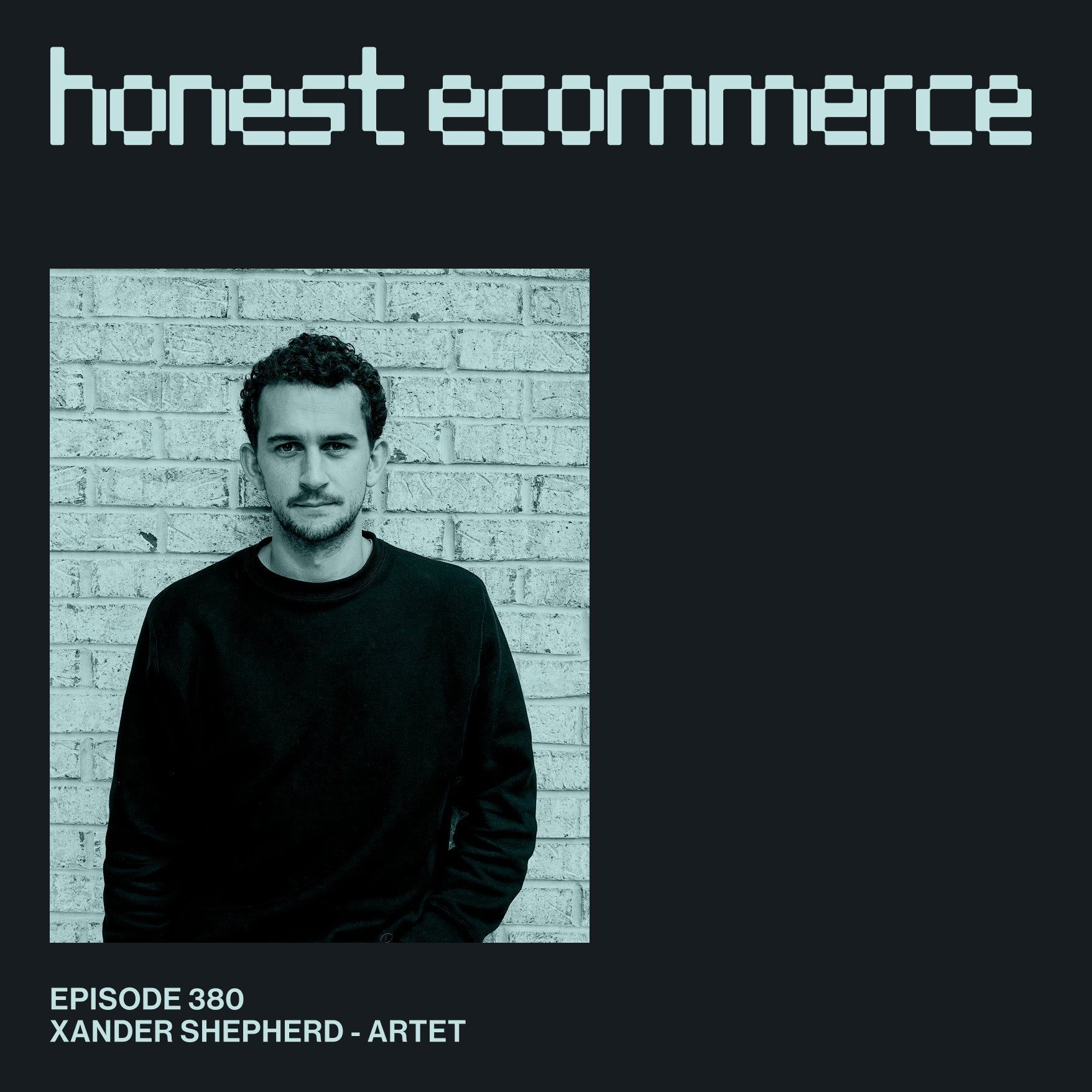
THC Beverage Brand Artet on Overcoming Purchase Friction Online
Nearly Sold Out Before the Launch Announcement Even Went Live
Artet turned on its direct-to-consumer Shopify store quietly on a Friday, planning a formal announcement the following Monday. By the weekend, they had nearly sold through their entire first batch of hemp-derived THC beverages without a single paid ad or press mention. That moment, three years into the company's life, was the signal that all the friction they had been fighting through in the dispensary channel was a distribution problem, not a demand problem.
How a Family Thanksgiving Became a Product Category
Xander Shepherd and his cousin started Artet almost a decade ago with a simple, selfish goal: find a more elegant way to bring cannabis to a family gathering in Vermont without standing outside in the cold. Their families were New York City food and beverage people who loved cocktails. They wanted something that fit that context rather than fighting against it.
The concept they landed on was a THC aperitif, a multi-serve large-format bottle modeled after products like Campari or Aperol, meant to be enjoyed on the rocks or used as the base of a non-alcoholic cocktail. To get family buy-in, they asked their grandmother, a successful entrepreneur and accomplished painter, to do the bottle artwork. If she cosigned it, the rest of the family would follow. She did.
From that first conversation to an actual product took two full years. Working after hours in a Manhattan apartment, the two founders bought fruits, vegetables, and vinegars from the supermarket to develop flavor instincts before they had any professional formulation support. They learned what does not work early, including the discovery that blending cannabis in a Vitamix is not how infused beverages are made. Eventually, through constant travel to markets in Los Angeles, San Francisco, and San Diego, and what Xander calls hanging around the hoop, they found food scientists, infusion specialists, and the pieces needed to produce a food-safe, commercially scalable product.
Getting Into Dispensaries When No One Wanted a Beverage
Artet launched in California dispensaries with a product that faced immediate structural resistance. The stores were built around high-potency, small-format products. Artet was low-potency and large-format. Most dispensary customers arrived with a specific purchase intent, a flower or edible, not a curiosity about beverages. Transactions required cash, which added friction at a time when nearly every other retail category had moved cashless. And customers had to show ID just to enter, eliminating any window shopping.
To get their first placement at The Pottery in Los Angeles, Xander reframed the conversation for the buyer. When the buyer said the product was too low-potency for his personal taste, Xander pointed out that a wine store buyer who only stocked bottles he personally drinks does not have a store, he has a private collection. The argument landed. The store took a chance.
From there, Artet stayed close to the shelf, watching customers, listening to questions, and iterating on how they described the product. They learned quickly that calling it a THC aperitif confused people who did not know what an aperitif was. That kind of real-time feedback loop, which they deliberately chose over fast scaling, helped them sharpen positioning before expanding. When that first Los Angeles store performed well, it was part of a small regional network, and the group invited Artet into additional locations, including being designed into a new store opening in Santa Barbara.
Eventually they expanded into Illinois, where they now carry between 100 and 150 dispensary placements across their bottle and ready-to-drink canned spritz products.
The Hemp Pivot That Made Nationwide D2C Possible
The regulatory wall that blocked interstate commerce for cannabis-derived THC does not apply to hemp-derived THC. As extraction science improved, it became possible to produce a 2.5-milligram-per-serving bottle and a 5-milligram can using THC pulled from hemp plants rather than cannabis plants. The THC molecule is identical. The percentage of THC in the plant is what determines the legal classification.
That change allowed Artet to centralize warehousing, work with traditional alcohol distributors, enter liquor stores and on-premise accounts in markets where regulations permitted it, and launch a genuine D2C ecommerce operation. It also opened up a consumer base that had always been interested in THC beverages but had no interest in, or legal access to, a dispensary. A comparable challenge of selling a regulated beverage product through DTC and traditional distribution channels is explored in Tip Top Proper Cocktails' story of navigating BevAlc compliance online.
On the tech side, one of the more complex compliance requirements Artet has navigated is age verification. For a regulated product like theirs, a simple age gate checkbox is not sufficient. They have tested plugins that scan a customer's uploaded ID and match it against the billing address or credit card on file, building a verification layer that holds up to responsible retail standards.
Navigating a Regulatory Environment That Can Change Overnight
In November of the prior year, federal guidance championed by Mitch McConnell proposed new limits on THC milligrams per serving and per container for hemp-derived products. If implemented as written after a one-year grace period, those limits would effectively wipe out most of the products currently on the market, including products from brands that have built real revenue and real teams.
Xander's read on the situation is that the category was too slow to self-regulate, which gave bad actors, products with 100 milligrams per 12-ounce can sitting in gas stations, room to become the public face of the category. His argument is that responsible brands need to champion examples of good behavior loudly: child-resistant packaging, potency accuracy verified through certificates of analysis, 21-plus age verification, and per-serving guidance built into the packaging itself. Artet's large-format bottle includes a push-and-twist child-resistant closure and a shot glass on the cap to help customers measure a serving. The challenge of building trust and credibility for a regulated consumable brand from scratch is something Jones Nicotine Mints faced when rebranding a regulated product for modern consumers.
He draws the comparison to the three-tier alcohol distribution system, a regulated framework that has successfully managed adult-use products in retail for decades. The argument being made to regulators is that similar pathways can exist for responsible hemp-derived THC products.
Key Lessons From This Episode
- The idea has no value on its own. Execution is the business. Talking openly about what you are building expands your surface area for luck and connections, and no one is going to steal an unbuilt idea.
- Starting in a constrained, high-friction channel like dispensaries, while painful, forced Artet to find product-market fit before scaling, which protected them from overextending capital on an unproven model.
- The buyer objection is often about personal preference, not market demand. Reframing a product as a new revenue channel for an underserved customer is more effective than arguing over taste.
- The hemp-derived THC pivot was not just a legal workaround. It fundamentally changed the business model, enabling central warehousing, traditional distribution, and real D2C ecommerce for the first time after four years of state-by-state dispensary operations.
- Regulatory risk is manageable if you build compliance into the product from the start. Child-resistant packaging, third-party COAs, and verified age gating are not just legal requirements; they are the category's best argument for continued existence.
- Soft-launching an ecommerce store before the official announcement is a low-risk way to stress test demand and fulfillment. Artet nearly sold out before telling anyone the store was live.
Hear the full conversation with Xander Shepherd, including the details on formulation challenges, dispensary expansion, and what the current regulatory environment means for THC brands, in the complete episode and transcript below.
In This Conversation We Discuss:
- [00:00] Intro
- [02:17] Finding Ecommerce ideas in daily life
- [05:48] Experimenting in small, safe spaces
- [10:29] Sponsor: Migrate
- [12:27] Reshaping customer perspectives
- [18:22] Callouts
- [18:32] Navigating customer purchase friction
- [21:11] Presenting your product as opportunity
- [25:05] Sponsor: Intelligems
- [27:05] Navigating state-by-state THC rules
- [31:50] Protecting customers with age checks
- [36:22] Sponsor: Electric Eye
- [37:31] Setting high standards for the industry
- [47:10] Connecting customers to buying paths
Resources:
- Subscribe to Honest Ecommerce on Youtube
- The original THC aperitif artet.com/
- Follow Xander Shepherd linkedin.com/in/xandershepherd/
- Migrate and grow more klaviyo.com/honest
- Book a demo today at intelligems.io/
- Schedule an intro call with one of our experts electriceye.io/connect
If you’re enjoying the show, we’d love it if you left Honest Ecommerce a review on Apple Podcasts. It makes a huge impact on the success of the podcast, and we love reading every one of your reviews!
Xander Shepherd
The idea is not the business.
Chase Clymer
Yeah, it's worthless.
Xander Shepherd
Your willingness to execute on the idea is the business. And those were the things early on for us that were really important.
Chase Clymer
It's a sign of a young entrepreneur. I've done this before too. Asking someone to sign an NDA for an idea that isn't even real yet.
Xander Shepherd
Yeah.
Chase Clymer
It's like, no one's going to do your thing. Trust me. They do not have the time.
Honest Ecommerce is a weekly podcast where we interview founders and leaders to find out what it takes to start, grow and scale an online business today.
Hey everybody, welcome back to another episode of Honest Ecommerce. Today, I'm welcoming to the show, Xander Shepherd. Xander is the co-founder at Artet. They're doing some awesome stuff in the THC beverage space. Xander, welcome to the show.
Xander Shepherd
Thank you for having me.
Chase Clymer
Yeah, I'm excited to chat. You guys have a couple of products over there that you're bringing to market. Can you just talk me through what it is that you're selling, what people can buy from you these days.
Xander Shepherd
Yeah. So we make THC beverages for the cocktail occasion. So we have a large format, the core style of the product. All of our products are non-alcoholic and infused with THC and or CBD. And they're all meant to emulate the most romantic or aspirational elements of cocktail culture or drinking culture. So flavor profiles, botanical profiles, use cases where alcohol may have a disproportionate grasp on the drink in hand for those occasions.
And just reimagining what that looks like through the prism of a THC drink that makes you feel a little differently but still delivers on a lot of the semiotics and things that people aspire to when they think of a cocktail. So we have a large format of the core style product that can be enjoyed on the rocks or with seltzer, tonic water, ginger beer, you name it.
And then we have ready to drink canned spritzes, which are essentially just sparkling THC cocktails that use that liqueur and we add fresh juice and other chemicals and sparkling water too. All natural ingredients are meant to be made to low potency, so sessionable and social. And I like to think it is quite delicious.
Chase Clymer
Absolutely. Now, take me back in time. Where did the idea to start this business come from?
Xander Shepherd
Yeah. I tell people pretty frequently that the motivation for our tent was really born out of a selfish endeavor. So I run the company with my cousin. Our goal was to just figure out a more elegant way to bring weed to Thanksgiving. We grew up in New York City. We grew up comfortable, smoking, and being around weed. We grew up in a very vibrant food and beverage culture and environment.
So our families are very much into getting together and eating and drinking. But we're also much more hesitant around the social acceptance that existed around THC. So it was Thanksgiving probably at this point, almost pushing a decade ago. We have been in Vermont. It can be pretty brutally cold in November up in Vermont. We were smoking a joint outside and we're like, all right, this sucks.
We're hobbled in the corner. We're getting blown over by wind. The food's inside. The good vibes are inside. Our family's inside. How do we bridge this gap? We weren't going to smoke inside. We weren't going to infuse the turkey. So we're like, okay, well, what if we made a beverage? We like to drink. Our family likes to drink.
And it just created this spiraling sort of mission for us to think about what would that look like to bring THC into a family gathering in a way that was elegant and believable and seamless. And there's so many THC beverages that exist out there today. At the time when we got started, we were one of the few pioneering this idea. So it was a little bit more pie in the sky to just think through the idea around it.
And for us, we aligned on this notion of a THC, a pair of teeth because our family likes to drink. They like cocktails. And we're like, well, what if we could make a Campari with THC?
And that was the very low-level objective. We made sure that we were going to not get in trouble with our family in the only way we knew how, which was to ask our grandmother to do the artwork for our bottle. She was, in her own right, a very successful entrepreneur. She is an incredible painter. We felt like it was a major part of our family. If she was willing to cosign the project, then we might get more buy-in from our family.
We made the product. We really liked our taste. We were really moved by how it made people feel and how it changed people's relationship to drinking and also their perception of THC. And we felt like those two catalysts were incredibly powerful to potentially build a brand around the space of an entirely new category.
That was all we needed as motivation to really think about scaling this beyond just our family and to, as we used to say, every bar cart in America. Or in this case, now we say every bar cart and back bar. Because we are actually fortunate in some states to sell our products in bars and restaurants and be on menus where people like to drink and socialize.
So yeah, I started with our family and got them stoned for Thanksgiving. And the next thing you know, had a nationwide beverage brand.
Chase Clymer
That's amazing. Let's walk through the timeline between that first Thanksgiving where you're freezing your butt off. Did you have a product by that next Thanksgiving? Did you guys just figure it out yourself? What was that process?
Xander Shepherd
So it took us two Thanksgivings. That's the first thing to call out. It pretty much felt like a long journey for us because there was so little infrastructure set up to be able to understand what it would mean to make a beverage. Alone one that was infused with THC. Finding the Venn diagram of people who we could speak to about beverages formulating.
And also infusion of what was at that time and still is in certain ways a federally illicit substance was a very interesting as I said, Venn Diagram to try to find people who fit perfectly into any one piece of that. So what we did, frankly, was after work, we would go back to my apartment. I was living in the East Village at the time in New York City. And my cousin and I, we would just go to the supermarket and we would buy fruits and vegetables and vinegars.
And we would just start making shrubs and drinking tonics and things. And try to, at the very least, get sharp and smart on flavor profiles and ideas for what wanted this thing to taste like. I had the good fortune of working in brand strategy and product development at this time.
So I was learning really great fundamental skills of how to think about a brand. And think about product formulation in terms of how you tap into meaningful insights that motivate behaviour. Not just create something in abstraction and figure out how to market it to people.
So a lot of what we were doing was really trying to look at insights and think about what was happening culturally amongst consumers within interesting adjacent categories. And using those insights to help us navigate things like, what do we want to call this? What should it look like? What should it conceptually taste like?
And all of that was slowly moving the ball forward in terms of making progress. But there wasn't some giant leap where we were able to just call up a flavor house and be like, “Hey, this is what we're looking to do.”
It required a little bit more MacGyvering on our end. Which I think, frankly, for at the time, young first-time founders was a really great training ground for us to make mistakes. For us to learn with, frankly, also low stakes and piece layer by layer like the sediment that ultimately became the foundation of Artet.
But we were fortunate enough at a certain point to just through a sheer will of traveling to markets where these dispensary channel categories existed. Start to meet people, talk about what we're trying to do. One person connects you with another person, connects you to another person.
Next thing you know, you start to find the pieces that help bring this to life. Whether it be on the formulation side to work with real, legitimate, fantastic food scientists to make sure we can make a product that didn't just come out of our refrigerator here and say, “This is what we would give to our friends at a dinner party.” But a product that could be made at scale that's food safe and legitimate, and also infuse it.
I'm not ashamed to say that we legitimately thought that the way we would infuse it the first time we made it was putting weed in a Vitamix and blending it. I had to explain to my mom why I broke Vitamix. That is not how you make an infused beverage. There are really great scientists and companies that help you infuse products in ways that are stable, consistent, and work is advertised from first drop to last.
So there's no anxiety around how potent something might be. All of those things were just hurdles we had to get over and meeting one person after the other and layering those things together to get to a point where we felt like we could have a bottle ready to manufacture and sell. But we talked about as a company, we had this little mantra that was just one bottle.
In our mind, we were like, getting from zero to one was such a momentous milestone for us in terms of launching a product that had never existed before. We weren't making our own take on a tequila or our spin on coconut water. We were creating something that never existed before and or in a commercial sense.
And that was the objective. Can we just make one? Once we've made one, we can figure out how to go from one to thousands or millions or whatever it might be. But yeah, that was a 2-year journey of really just burning the midnight oil and working after work.
Chase Clymer
Most brands outgrow their legacy choices long before they switch.
Bad platform decisions do not fail all at once.
They fail slowly. Then suddenly.
First, it is one workaround.
Then another tool.
Then another integration is duct-taped on top.
And eventually, your team is spending more time managing the stack than actually marketing to customers.
Eventually, rebuilding is less painful than staying - usually when it starts to show up on the P&L.
This is when scaling brands simplify and standardize on Klaviyo.
Klaviyo is the AI-first B2C CRM. It combines your customer data, email, SMS, analytics, and customer experience tools into one platform, so you are not stitching together five different systems just to understand what your customers are doing.
Your database updates in real time.
Your segments update automatically.
Your flows, campaigns, and personalization all run off the same source of truth.
And that shift is why so many brands are moving to Klaviyo.
Brands like Dollar Shave Club have reduced total CRM stack costs by over 30 percent after consolidating onto Klaviyo. Multi-brand operators like Marc Fisher have migrated multiple brands and dramatically reduced the time required to execute CRM marketing. And brands using email and SMS together inside Klaviyo are seeing massive ROI compared to running channels in separate platforms.
The big unlock is simplicity and scale at the same time.
Klaviyo is built for marketers, not engineers.
It is built for online businesses.
And it is built for where ecommerce is going, not where it was five years ago.
If you are running email and SMS across multiple tools, or you are on a legacy platform and thinking about your next phase of growth, it is probably time to look at Klaviyo.
Go to klaviyo dot com slash honest to see why hundreds of thousands of brands have already switched.
And if you want our help migrating your list, moving your data, and configuring your Klaviyo account correctly from day one, we are happy to help.
I talk about it a lot and I keep doing it because sometimes advice is just great and you have to hear it a couple of times. But this concept of your surface luck area, right?
Xander Shepherd
Okay.
Chase Clymer
And the more that you're talking about the things that you want to do or are doing, the more likely that luck will find its way to you. And some examples of this. In my real life, I was looking for a home. The market was weird. And I was looking for a specific type of home. And I was talking about it. Place here and there, friends, family, etc.
I was put in touch with four or five opportunities that were all off-market to buy potentially exactly what I was looking for.
Xander Shepherd
Yeah.
Chase Clymer
And it was only because I was talking about it and going to places where this might be a thing. And it also is the whole concept behind why you produce content as any sort of service provider or as an agency. Do you think that you guys talking about this idea and going to these markets was... You already said it, but I want you to repeat it loudly for the people in the back. Was Paramount to you getting this thing done?
Xander Shepherd
Yeah. No, absolutely. I can think about the coffee date, if you will. The person I had the coffee with at the coffee shop in Los Angeles, that was that accelerant that we were looking for that came from an introduction from somebody else. 100% like we were always and are motivated by sports analogies.
But I think the one that for us really resonated and also reflects what you're talking about. We always used to say that we just want to hang around the hoop. And so for basketball people out there, for those who aren't familiar with basketball. Our thought was like, you hang around the hoop, it's scrappy and get the rebound. Maybe put it back up for an ugly 2-pointer.
You kick it out and get an assist. But that scrappy nature over the course of a game or a season, you might turn around and say, “Oh my God, have a double-double or triple-double. We've put up great, great numbers.” But it was these non-flashy small things that again, guess, your sense, you create a broader surface area for luck to find you.
That was our way of thinking about that. And absolutely. I was living in New York. I'm from New York. I've always lived here. But we were going out to Los Angeles constantly, going to San Francisco, going to San Diego just to get in the game and meet people and figure out how to materialize this thing.
And a lot of times, it comes from feeling confident in your ability to execute, given the opportunities to execute and not and feeling comfortable sharing and feeling comfortable sharing that with other people, right? Not sharing your idea that they're going to do it, but believing that you can be open about what you're trying to do and not assume that everyone around you is trying to steal your idea.
Chase Clymer
Yeah.
Xander Shepherd
Right. That was one of the things as well that I think was really helpful. Being able to talk open about what we're trying to do and have somebody be like, “That's cool. I would love to drink that.” Or, “I'm not going to do that, but I know somebody who might help.” All of those things really helped accelerate it. I think that's sometimes something that it's a natural instinct.
But that people can get wrong, which is like the idea is not the business.
Chase Clymer
Yeah, it's worthless.
Xander Shepherd
Chase Clymer
It's a sign of a young entrepreneur. I've done this before too. It's asking someone to sign an NDA for an idea that isn't even real yet. It's like, no one's going to do your thing. Trust me. They do not have the time. Especially when you're asking smart people who are like, I'm not going to talk to my lawyer about this. You're not going to get free advice because you're putting up walls to have...
Xander Shepherd
Yeah.
Chase Clymer
What should just be a genuine connection. To your sports analogy, it's a little bit different. But I always like to say, “You can't be in the conversation if you're not in the room.”
Xander Shepherd
Yeah.
Chase Clymer
So it's like you got to go to these places where these people are if that's what you really want to be doing.
Xander Shepherd
Yeah. And I think for us in our category. And we were not alone in this. There were a few other people having similar realizations for different reasons. I don't think they were also trying to get their family stoned at Thanksgiving. But they saw different opportunities and ways to present the notion of like a drink that was inverting the traditional perception of an edible or something.
Because you talk to people, lots of people say, “Oh, have you ever had edibles before?” And they say things like, “I had one in college and it sent me to the moon and I'm not even sure if I will come back yet.” And that sentiment was born out of the fact that people were making brownies in their oven with no science, no understanding and no consistency and no quality checks. And all these things.
For us, all of these different brands collectively were trying to invert that idea of like, what if it was? What if it was a lot of volume and a little bit of strength and it mirrored the way you might feel after drinking a beer or drinking a glass of wine. Or whatever it is. The thinking and the way we've spoken about it has become more nuanced since then in the ways of just being like, “Oh, it's like one glass of wine.”
But to your point, we also needed to get into the room. Because we actually had to prime people to think differently about the types of products we were looking to bring to the market. Because most products at the time in the market were super small, super high potency. And that was what everybody was convinced was the only thing that would sell because it was the only thing that had historically sold. Because it was the only thing that historically had been presented.
So there was lots of confirmation bias around opportunities or things that were like our products. And we had to be there to reshape people's perspectives of who could be a customer, who would want this thing. And maybe it's not what you would personally consume, but that doesn't mean that it's not something you would want to buy.
And all of those things became, again, really important in the early days of our company fighting for not just a reason for our brand to exist, but fighting for our category to exist.
Chase Clymer
Hey everybody, just a quick reminder. Please like this video and subscribe if you haven't. We're releasing interviews like this every week. So don't miss out. Now back to the interview.
Now, you said it took 2 years to come back to Thanksgiving with the product. Now, was this a beta version of the product? Was this product ready to get released to the masses? How far along was this version of it?
Xander Shepherd
Yeah, we were at that point, we were pretty certain that this was going to be a good idea. So those 2 things coincided more or less. We launched at the time in California in dispensaries with our large format aperitif-style product. Actually, I have a bottle sitting next to me. It's sort of for those looking at this on YouTube. This is what it looks like. It's a multi-serve product the way you would imagine Aperol or Campari or Saint Germain.
Something that, as I said before, you could enjoy on the rocks with a twist. You could add seltzer or tonic to it, or you could use it as the base of a non-alcoholic infused cocktail. Lots of versatility, really beautiful blend of botanicals. Cardamom, ginger, allspice, chamomile, grapefruit, juniper, gentian.
I don't always remember them but I think I nailed it. And we launched in California in dispensaries with this product and it was admittedly a very uphill battle. Because of the fact, as I mentioned, we were a big product, we were low-potency by comparison to the rest of the product market. And also we were in a channel that is not best set up to distribute beverages.
We looked at it as an opportunity to learn and to find and identify product market fit with just consumers, even if there was a tremendous amount of friction to get the product to the customer. If you go into a dispensary, for the most part, you have to throw your ID upon entering. So that removes most window shopping. You're going in with an intent to purchase already.
So that's an uphill battle, number one, to say like, “Hey, maybe you've come in because you're looking to smoke something or to eat a chocolate. Can I interest you in a beverage?” So that's challenging. You also have to get people and they have to be willing to more or less pay cash.
We have, for the most part, in just about every other industry, moved to predominantly cashless. So here's a retail experience that requires cash. So those friction points were complicated for us. And we knew that. But we also made sure to never get out of our skis in the way that we produce products or raise capital or whatever. We were like, let's just learn. We're young. We've never done anything like this before.
We believe the future state is one in which we might be able to sell this online through Ecommerce channels. We might be able to sell this in bars and restaurants. We might be able to sell this in liquor stores and work with traditional beverage distributors. But let's make all the mistakes that we're going to make in this smaller environment where the stakes are lower relative to all of that. And be prepared for that occasion and that moment.
Now, I'm accelerating and jumping forward a little bit.
Chase Clymer
I got one question before we hop forward because I know a lot of your story. There's a cheat sheet for these things, everybody. How did you get in those stores? How did you get in those dispensaries? That just doesn't happen. So what did you do to get that distribution?
Xander Shepherd
We were polite or I should say professionally relentless, maybe to make a term, right? Some of it was just like, just got to keep trying. You got to keep talking. You got to keep helping yourself get in the game, as you said. And I remember we were talking to the buyer of one of the very first stores that ever brought us on.
It's a store called The Pottery in Los Angeles. It's a dispensary. It's really cool. It's really got great branding. The buyer looked at our product and the potency of it and he was like, “I could drink this whole thing in one go.” And I remember reframing from him something. Something to the effect of, “If somebody who owns a wine store only stocked the store with things that they personally drink, it wouldn't be a store, it'd be a private collection.”
And he laughed and he was like, kind of chuckled at himself. And he was like, “Yeah, I actually didn't think about it that way.” And I think that little subtle reframe to him, which maybe this isn't for me. But actually, that might mean that there's incremental customers who may come into our store because the products that I want are super high potency.
But the products that this represents in a customer base, maybe looking for something else. And that's potentially a new revenue channel. That was part of how we were able to frame the reason why they should take a chance on us. And then beyond that, we basically told them, if they let us, I would bring them frankly, a pillow and a sleeping bag and I'd sleep in the store and just look at every customer who tries it, who buys it, who asks questions.
Learn as much as possible. So we could ourselves iterate as quickly as possible on how we talk about it, on how we change the way we would maybe have to make the packaging. We technically refer to our product as a THC aperitif. We learned pretty quickly. A lot of people had no idea what an aperitif is.
So not only are we now educating people on the fact that all of a sudden there's cool THC beverages. We're explaining to them THC beverages and what an aperitif is and trying to meet them in the middle of that. It was like, okay, it's too many words. We're going to lose people. So we can be less precious. Why do we call it a liqueur or just a THC beverage?
Some of the branding that was maybe branding for branding sake was not relevant at the time of just trying to get up to altitude. Yeah, a lot of it was, start in one store, really do well in that store. And if that store is a part of [a bigger network]. And then the store we did well in was a part of not a conglomerate, but have 6 or 7 other stores in their network. They reached out.
They're like, “This is going well for us in Los Angeles. I know we're opening up a store in Santa Barbara. Let's put you up in our store in Santa Barbara. And actually, why don't we have you be part of our opening set. So we'll design you into the store a little bit more with a little bit more purpose.”
And then these things slowly snowball and go from there. But yeah, it was just... We positioned it as a chance to give these stores a new revenue stream with a new customer. It made sense to us. We didn't know if it was actually going to come to life. And in some ways, it did. And obviously, there were a lot of challenges that we had to confront as well.
As I mentioned earlier, just the friction of selling products like these in dispensaries versus selling them in a liquor store. Or something where there are different rules and regulations around how you can merchandise and how much product you can have at any one time. Which just leads to more efficiencies for pricing and whatnot. But yeah, that was really just trying to help frame them, frame to them that our tech represented opportunity, not nuisance.
Chase Clymer
Hey Store Owners -
Do you know how profitable your last BIG decision was on your Shopify store?
Most testing tools make it easy to measure design changes - small tweaks. Headlines. Layouts. Button colors.
But what about the decisions that really move the business?
Pricing changes. Shipping rates. Discount strategy. Even new apps and tools.
Those are usually left to gut feel.
Intelligems brings CRO-level clarity to decisions that live beyond the page.
Brands like Ridge, Jones Road, and True Classics are using Intelligems to test pricing, offers, shipping, and more, and see exactly how each choice impacts profit.
Momofuku used Intelligems to test multiple promotional offers ahead of Black Friday and identify the version that ultimately increased profit by about 28 percent.
Mott & Bow used Intelligems to run structured pricing and offer tests that helped drive roughly a 30 percent increase in incremental profit.
Dossier used Intelligems to run sitewide testing that resulted in about a 7.4 percent increase in profit per visitor across their store.
They have a bunch more case studies on their website.
I’m a big fan of Intelligems. We use it with almost every client at our agency, Electric Eye.
We use Intelligems to test major site changes, new theme launches, and throughout ongoing CRO work
So when we are making decisions around design, pricing, offers, ETC, we can be confident that those changes are actually driving more profit for our clients.
So, before you start changing pricing, promos, or major site experiences across your store all willy-nilly, you should test it first.
If you're ready to decide confidently and grow profitably, head on over to intelligems.io
That's I-N-T-E-L-L-I-G-E-M-S.io and use code honest for 10 % off your first 3 months. That's IntelliGems.io. Use code honest.
Now we can fast forward a little bit. You get one store, you get two, you get seven. Where does branching into other states? Where does trying to get online come into play?
Xander Shepherd
Yeah. We tried online in the best ways we could through those dispensary channels. And it really wasn't effective. And there's a lot of great companies that did a lot of really cool work to try to make it happen. It's just, again, Ecommerce is about efficiency and almost at times, out of mind, out of sight, just like things happening. Imagine creating an Ecommerce shelf for your product or your brand.
And then they're still like, but you have to have cash. You have to have your ID. There was still so much friction that there was some convenience that got added to it. And I should also just caveat that one of the things that we were able to... I don't want to say take advantage of it because obviously, it is a very traumatic time for everybody.
But it was just a side effect of the reality of how things played out. The cannabis sector was deemed a central business in California during quarantine and COVID. And most of the deliveries and things that were happening were home delivery. So there was a brief moment where people were becoming accustomed to ordering and getting it delivered. It is still basically retail shopping, but they would just bring it to your store, your door and you would pay with cash.
But there were glimmers and glimpses that we saw of the idea that if we got it to customers, we could bypass a lot of that friction that was existing in retail. It didn't ultimately pan out that way for us in the dispensary channel. We pushed Ecommerce for a period of time away because it just didn't make sense within the regulations.
We did expand into other markets. We expanded into Illinois where today we have anywhere from like 100 to 150 dispensaries that carry our products, our bottles, as well as our ready-to-drink cans, as I alluded to earlier. And that's been great. That market, one of the challenges and why we didn't expand everywhere all at once.
And for me, living in New York, it was really frustrating. I have all my friends and family looking at me working on this brand and they've never been able to engage with it or see it for years because we were in dispensaries in California. We were in dispensaries in Illinois. We had to produce, distribute and sell the product within the walls of the state that we made it in. And it's a requisite of working in the capital C, cannabis THC space.
You can't cross borders, state borders because those are federally regulated and cannabis is not federally legal. So markets that have state-regulated markets, you can make beverages if you want. But you got to make it sell out there. There are some inefficiencies with that and it's not ideal. But at the very least, Illinois was a viable and compelling market for us.
Fast forwarding a little bit more, I think more relevant now is that there was a very meaningful transition that happened within our overall category. And admittedly, we were kind of later to the game on this than some of our peers. But we have all sort of collectively seen the value in being able to create our products at scale and introduce them to channels where more people can engage with them.
By means of using THC that is extracted from a hemp plant, not from a cannabis plant. The THC in a hemp plant and the THC in a cannabis plant, as far as I'm concerned, is identical. The quantities of the THC in a hemp plant versus a cannabis plant. The percentage of it over the overall makeup is what makes one thing cannabis and therefore federally illegal and one thing hemp federally legal.
Science got better at being able to extract THC from those hemp plants and make them viable to make a 5-milligram, a 2-milligram... 2-milligram bottles, 2.5 milligrams per serving. We were able to make our bottle using hemp. We were able to make our 5-milligram cans of our spritz using hemp.
That opened up the ability for us to start warehousing centrally, distributing nationwide centrally. Selling into wholesale distributors who distribute alcohol and therefore selling us into liquor stores. Therefore selling us in markets where the regulations allow it into bars and restaurants. And also more importantly, launching an actual D2C Ecommerce site.
So that probably is coming up in three years for us now. And that was the radical inflection point, if you will, within the life cycle of not just our business, but would argue the category at large.
Chase Clymer
Absolutely. Yeah. The category has definitely seen explosive growth by just identifying that and running with it. Yeah. As you guys can now ship across state lines and distribute through these larger channels, what technology do you have running this? Are you on a Shopify site? And is it just plug and play? Or what are still some of the things you need to know about nowadays, 2026, building a brand similar to this?
Xander Shepherd
I think the first thing is when we started. When we reoriented our website to go from being more of what I would think of as just so much like a window dressing magazine for the brand. And to be something that was more transactional in terms of your ability to actually purchase products of ours and have them sent to you.
Everybody's like, “Ecommerce is like a nightmare. Ecommerce is dead. DTC is dead. Shipping beverages, good luck.” And we were like, well, we've been through the wringer. So if we've been able to make all these other versions of our business work, I'm sure we can figure this out. One of the things that was so fascinating from the moment we just turned it on before we even announced it, right?
We made small batches of hemp products from our bottles and cans because we just wanted to see. We didn't want to get out over our skis. We were very mindful. We've always, as I said, right? We've never lost sight of that mantra of hanging around the loop, even as the game board has perhaps expanded and opportunity has grown. It's just scaled into relative terms of what that means.
We almost sold through everything in one weekend before we even announced it. Like, we're going to announce this on Monday, but let's turn it on on Friday and just run trial tests and things. And lo and behold, we didn't realize that. We just had so much traffic coming to our website and we weren't alone in this regard. There is so much interest in the idea of alternative drinking.
Whether that be, again, non-psychoactive alternative drinking alcohol, like more traditional NAB-ers and things like that. Or in the context of Artet, like non-alcoholic psychoactive. And I think there's a beautiful overlap of those two things. Some people can exist in both those camps, some don't and that's fine.
But very clearly, we're like, “Oh, time to actually get smart on digital advertising and digital commerce because we haven't done that for the first 4 years or 3 years of our business.” So now this is like a whole new frontier for us. And one of the things I keep coming back to is, in a way, it doesn't surprise me that there's been such a media growth for THC beverages in this channel.
Because as far as I'm concerned, your weed guy was Ecommerce before Amazon was Ecommerce. Every movie, every cliche example of buying weed is always like the weed guy comes to your house or you go to the weed guy's house. That transaction is about convenience and sort seamlessness.
So it didn't surprise me that we all of sudden saw people who were really willing to engage with these products in that format who maybe would never go to a dispensary. They've always been interested in the idea of THC beverage, but they've never had any interest either behaviorally to go into a dispensary.
Or they've never had permission to because they don't have them legally in their state. So those are really interesting things for us. And yeah, we learned very quickly how to compliantly do all of this. Like what you can say, you can't say. How to be safe and responsible around things like making sure that you're not sending these products to children.
Safeguarding 21 plus, not just opting in on 21 plus. And this has been a time that's been a huge friction point for us. Having people upload their ID, there's great plugins that can literally scan someone's ID and match it to the credit card or match it to the address or things like that. So we've tried stuff, just again, to make sure that we're responsibly moving products like these to people.
But the general consensus and takeaway is that people want them and that people are looking to them to enhance their life. Not sort of distract them or whatever. That was a little soapboxy, that last response there. If anything, it was sort of, I think, encapsulating the reinvigoration me and my cousin had once we sort of removed a few of those friction points that we had historically become so accustomed to.
Chase Clymer
“I have been in business for nearly 20 years, and very few companies I have hired in that time have performed as well as Electric Eye. They have knowledgeable staff, and our project was delivered on time and on budget. Electric Eye has exceeded my expectations, and I look forward to working with them again.”
That is a direct quote from one of our clients at Electric Eye.
Electric Eye is a Shopify Plus partner that has helped over 100 brands migrate, redesign, and optimize their stores since 2016.
If you'd like to increase your conversion rate, average order value, and revenue per session, we are the true Shopify experts you've been looking for.
Right now, we're offering a free diagnostic to qualified brands that reach out and mention the podcast. Visit electriceye.io today to schedule a call and send us a message. Find out why we have over 50 5-star reviews in the Shopify Partner Directory. Again, that's electriceye.io. E-L-E-C-T-R-I-C-E-Y-E.io
Awesome, Xander. Now before we go. There's obviously risk in a category like yours that has some interesting legalities to it. I'm in Ohio.
Xander Shepherd
Yeah.
Chase Clymer
And just last week, we passed some laws, right?
Xander Shepherd
Sure did.
Chase Clymer
How do you deal with what we're doing over here or in any state and federally?
Xander Shepherd
So I think there are so many brands that have entered this space that probably would answer this question differently based on when they entered into this overall journey. Because we've been involved in this journey from what feels like for me like the beginning. Starting in dispensaries, learning to scale into multiple dispensary markets and just making that even viable. It has taught us a lot about how to be nimble, to pivot.
If you look at the world of beverages, Can you look at all of these exits and things that go on in and around, whether it's functional beverages or energy or soda. The inclination is like finding things that work and then just scale it as quickly as possible and hopefully you exit, right? Raise a ton of money or whatever it is. I think we've never approached… Our ambitions, me and my cousin, are quite large for what we would like our tech to be.
Our timeframe for how we execute that is constrained to the reality of what we feel like the market can support within the reality of everything from consumer interest, regulatory landscape, etc. We've always felt like, why play all your pieces before you see the whole game board? And I think there are brands who have played a lot of their pieces, not knowing the game board, anticipating the game board, ending up one way, and it ended up differently.
And some that have probably timed it and done it perfectly. We always understood and recognized that there were aspects of the expansion of this category that were built on rules, federally legitimate rules and regulations that could be amended or changed. In November of this past year, championed by Mitch McConnell.
There was a meaningful shift in the definition and framing of hemp and THC percentage and milligrams that could exist in a pack, in a serving or a container. For all intents and purposes, if it goes into effect in November, they gave one year of grace period for this to be implemented. If it goes into effect, it will virtually take all of the products that people have become accustomed to consuming or seeing or whatever. It'll wipe them out.
So you'll lose brands, you'll lose the people who work for those companies, stores who have built meaningful revenue selling these products responsibly to people will lose money. They may go out of business themselves. It will be somewhat catastrophic. But if you take a step back. And understand how and why this all happened to begin with.
There's a lot of hope and a lot of people pushing and lobbying and framing the safe, sensible ways around how to sell these products in the market. A lot of this was easily drummed up. Some are just like the existing war on drugs, like hangovers that still exist. But a lot of it is also from the fact that there are in any market where there's sort of new growth opportunity, there are good actors and there are bad actors.
It's way easier to make public examples of the bad actors even though there are plenty of good actors out there who are saying, “First of all, let's regulate the bad actors out. And also, let's focus on the things that the good actors are doing.” So as an example, our bottle, right? This bottle has 15 servings, 2.5 milligrams each. In order to open this bottle, it is a push and twist. No different than medicine.
It has child-resistant accreditations and it is child resistant. That is safer from an opening standpoint than any alcohol that more or less exists in the market. How do we celebrate and champion those things more? We also don't have it in this one I showed you, but we have a shot glass on top that helps people also identify what a serving is.
So people don't have to feel concerned that they're going to overconsume if they're not accustomed to it. In the absence of elevating and celebrating these types of behaviors, we're not alone in doing these types of regulations. But in the absence of that, it's way easier for governors, attorneys general, etc. to point to the product that's in a gas station that is 12 ounces and has 100 milligrams in it.
Maybe that doesn't deserve to exist in a gas station. Maybe it should only exist in a dispensary where there's tighter regulations and requirements around how somebody can get their hands on that and get access to it. What has happened and obviously at the federal level and certainly more recently, as you mentioned in Ohio. At the state level is like fear-mongering has allowed for those types of bad-actor examples to be the focus point around why this shouldn't exist at all.
Instead of, “Hey, we want to create safe regulations, whether it be potency caps, potency limits per can or per container. Child-resistant protections that don't allow children to engage with it. 21-plus requirements for all products that have THC in it.” And I think the category was a little naive and a little bit overzealous that it was just going to be like, growth, growth, growth. Nobody was going to hold anybody accountable. And that was that.
November was a fairly sobering moment for all of us. But what's been really encouraging is that you see people from the world of THC, you see people from the world of non-alcoholic. You see people from the world of alcohol. Kind of all rallying together saying “Hey, you know there are 3-tier systems that allow for alcohol to be regulated safely and distributed safely to retail stores.
Can we create pathways that allow products like Artet to exist in those channels? And feel comfortable and confident that, like all of the alcohol that exists, whether it be your grocery store, whether it be your local liquor store, etc. There are mechanisms that prevent kids from getting their hands on them or that when you bring it into your house, it sits in your liquor cabinet or whatever and children are told not to consume it.
That makes it safe and viable. So a wandering statement here, but the fact is, a lot of these laws are dictated by antiquated, regressive fear-mongering. Then looking and responding to, one, what do consumers want? What are they signaling they are interested in? And two, based on those demands and interests, how can we look at examples of safe, responsible self-regulation to inform industry regulation?
So, as it relates to things like Ohio. Ohio was a little bit surprising. There was language that would have codified the protection of beverages and it was bipartisan approval and the governor just at the last second had a line item veto that crossed it all out and that's politics. What are you going to do? You can't really compete with politics at the end of the day.
But what we can do is continue to champion and speak about how we can safely distribute responsible, safe products that have [self-regulation] Every single one of our batches we make has a COA. That COA lets people know everything from microbial content to mysotoxins to the potency. Things that you don't think about when you go in and grab a soda out of the deli or whatever it might be.
Those are things that we're saying before we can sell any of these products, we are making sure that all of those things I just mentioned that sound scary are either advertised as they're meant to be in the context of potency. So you don't buy a can that says 5 milligrams and it actually, accidentally has 50. And also that there aren't any bad things in the product because perhaps it was made in a facility that doesn't have high quality standards.
There are so many safety regulations already involved that make our category safer than some of the things we regularly consume. How we communicate that. How we advertise that. How we champion the examples of good behavior and collectively call out the bad actors. I think, is to make our break between whether this time next year, we are still able to be selling our products online and continuing to see category growth.
And continuing to be a part of the introduction of non-alcoholic beverages to bars and restaurants and making those spaces and places more inclusive. And safe for all parties, for people who want to socialize but for whatever reason can't consume alcohol and so forth. So, I think growth and change is never linear and it's never without friction because people are resistant to change.
But it also tells me that we are a part of something meaningful that is asking people to reconcile with questions of what social drinking looks like. And what it means to unwind with a drink and how you can unwind and what feelings can be elicited when unwinding. Whether it's just inebriation through alcohol or an opening of your mind and mood by virtue of THC.
Chase Clymer
Absolutely. Now Xander, before we go, hopefully I'm in a state where I can purchase your product.
Xander Shepherd
Yes.
Chase Clymer
And if I can do that, where should I go? What should I do?
Xander Shepherd
Yeah. I mean, look, if you are somebody who likes to have things delivered to your front door, you should go to Artet.com and you can order our beverages on our website. And we will ship them directly to you and I'm certain you'll enjoy them. We have great recipes for our bottles. Our cans are easy to enjoy straight from the can. Whether it's cold, drink it straight or pour it over ice.
And also, we have really great retail partners. So if you go to our website and you look at our store locator, we do a pretty good job, I think, of regularly updating the retail partners who actively have our products in stock. And yeah, I think that's another great way to find it. And also, again, some of those places are bars and restaurants.
And it's amazing how many people I've seen have the realization of like, “Wow, I didn't know this was something I could order out now that I know I have permission to or that this is on offer. This is what I would prefer to drink.” So if you're in a part of the country where we've done, I think, a decent job of getting out into bars and restaurants.
I'd say probably Nashville is a really good example of a market where we've got awesome, whether it be a dive bar, a restaurant, a cocktail bar. Where we've been able to position Artet as an elegant premium alternative to what you might otherwise order if it was alcohol. But yeah, go to our website, artet.com. Either check out our offers that we have direct to consumer or find a store close to you by using our store locator.
Chase Clymer
Awesome. Xander, thank you so much for coming on the show.
Xander Shepherd
Yeah, absolutely. I really appreciate it. Thank you so much for the time and letting me talk to you about Artet from its inception till now.
Transcript
Read more
Scott Dancy built Azuna from $10K/year in prototype sales to a multi-million dollar per month natural odor elimination brand by rejecting conventional patience advice, betting on subscriptions earl...
Gustavo Cardona, VP of Technology at Levain Bakery, breaks down how he rebuilt the brand's ecommerce shipping solution, drove internal adoption of new tools, and developed a 3-pillar framework for ...