Chase Clymer
With the pandemic, it drove everyone to buy online, but it also drove customer acquisition costs up and they just never went down.
Scott Dancy
No, it never has and it never will. And that's why if you don't have a business in my mind that doesn't have a substantial recurring customer rate and a really good AOV, I don't know how somebody does an online business.
Chase Clymer
Honest Ecommerce is a weekly podcast where we interview direct-to-consumer brand founders and leaders to find out what it takes to start, grow and scale an online business today.
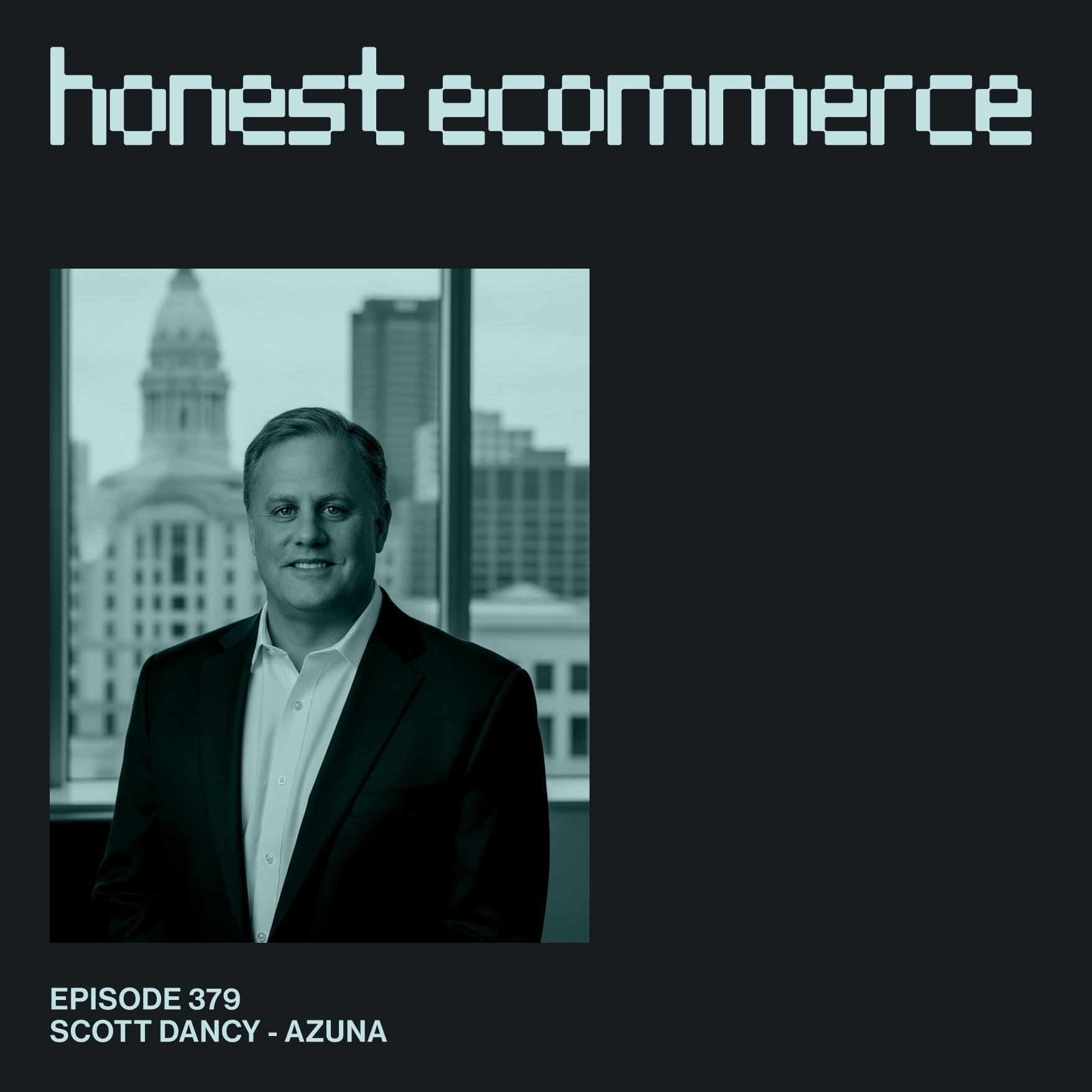
Hey everybody, welcome back to another episode of Honest Ecommerce. Today, I'm welcoming to the show Scott Dancy. Scott is the CEO and founder of Azuna, a fast growing challenger brand in the at home odor elimination space. Scott, welcome to the show.
Scott Dancy
Thanks, Chase. Pleasure to be here.
Chase Clymer
I'm excited to chat. For those that are unaware, could you quickly just talk about what are the actual products that you're bringing to market over there?
Scott Dancy
Yeah. So we started Azuna 6 years ago. And basically, it's based on an Australian Tea Tree Oil. So Australian Tea Tree Oil is a natural antimicrobial. And we figured out a way to make it airborne. So we started with these gels where you basically take a um gel and put it in a glass or at a time plastic jar.
You just let it open {in] your room and basically absorb the causes of the odor, the sources of the odor. And then we've brought it into sprays, wipes and we've just got our million-dollar order from Shopify recently. And we have another close to that on Amazon. So now we're doing a couple hundred thousand orders a month.
So it's been growing at a really good level the last couple of years, it has been pretty much tripling in revenue every year. It's gonna get harder to triple again as we get bigger, but we should at least be able to double our 2.5X this year. And those are the main products. So it's an all-natural order limit here.
Chase Clymer
That's amazing. Now take me back in time. Where did the idea for this product strike you?
Scott Dancy
So I got separated in 2014, I believe it was, from my first marriage. And in 2016, I was living in a rental and a friend of mine's son was playing basketball. My son went to pick him up, he came to my house, my washing machine broke and it smelled horribly. And he's like, I've got this product that my family has been working on. They are a contract manufacturer and it was the original Azuna.
It called something different at the time and they really weren't doing much with it sales wise, but it works. I put it in the laundry room and got rid of the smells. Then it worked in my car, my kid's room. I would kid around with them and be like, “There was a movie that came out just before that called Envy with Jack Black and Ben Stiller where he created Poop-B-Gone and all of a sudden you sprayed on the dog crap and it was gone.”
[I told them] you got a poopy gone and you're not doing anything with it." So a couple years later, I asked him, “Do you do anything with it?” And he said, “No, not really. We're doing about 10,000 a year in sales.” So I said, “Let me take it over and I'll figure out a way to sell it.” And we did.
Chase Clymer
That's amazing. Can you share any more about buying a business? I know that you had some previous exits. So you got a little bit of experience there.
Scott Dancy
Well, we didn't buy anything from them. I just said basically, you guys can manufacture the product and I'll take it over. And I gave him a little bit of equity for being one of the original partners in the business. So there wasn't, I bought businesses before and eventually we'll probably sell Azuna at some point.
So, but that was a whole different process. This was truly entrepreneurial. There was really nothing there. They were doing maybe eight to $10,000 a year in sales. We do that for more than an hour.
Chase Clymer
Yeah, but I still think it's definitely something that people should be aware of. It's because the way that I assumed it happened wasn't the way that it happened, but it worked out for everybody. So this was a manufacturing company at its heart. They had built a product but they weren't going to do anything. But what they were best at was manufacturing it. So they're still doing what they're best at.
Chase Clymer
Yes.
Chase Clymer
You're just running with what you're good at, which is expanding the marketing and sales and really putting some growth behind the product.
Scott Dancy
Yeah. And I knew nothing about the consumer product good space. So the story is pretty cool. First, we had a good product, then we had some good ideas. And then quite truthfully, 2020, April 2020, I was doing $12,000 a month in sales and I thought I was killing it.
Then May I get 105. And I think a lot of that has to do with COVID at the time. What better thing to do than have an all-natural odor eliminator that sells online to people that are buying everything online and are stuck indoors.
Chase Clymer
Yeah, they're stuck where the smells are.
Scott Dancy
Yeah, exactly. But proud to say 95% of those COVID businesses went out of business a couple of years later. And we went from 105,000 to 200,000 to 500,000, to several million dollars a month in sales now. So we kind of figured out if you have something good, we had to figure out a way not just to acquire customers, but retain them.
And more than 70% of our customers are subscribers right now. That was really the big piece as we matured. We didn't take the money and go on vacations. We reinvested in paid media and better, better products into more products into diversification into hiring some really good people. And that's kind of the basis of why the business has grown to what it is now.
Chase Clymer
Do you know what's going on with Klaviyo? When was the last time you explored what it can do?
Klaviyo has been shipping tons of new AI, data, and automation features designed to help Ecommerce teams move faster, personalize better, and automate more of the work that used to take entire teams.
Most brands are only using a fraction of what is already inside their Klaviyo account.
Klaviyo is not just email and SMS anymore.
It is your customer data platform, your lifecycle marketing engine, your analytics layer, and now your AI-assisted execution layer, all in one place.
That means your customer data updates in real time.Your segments stay current automatically.Your flows and campaigns all run off the same source of truth.And now AI can help predict churn risk, forecast spend, recommend next best products, generate campaign content, and optimize send timing across channels.
The big unlock is speed and efficiency.
Fewer tools to manage.Less dependency on engineering.Less time moving data between systems.And lower total cost of ownership across your marketing stack.
And brands are seeing real results from leaning further into Klaviyo.
Dollar Shave Club has reported over 30 percent reduction in total CRM stack cost after consolidating onto Klaviyo. Brands like ThirdLove have seen 15x ROI from SMS after consolidating channels. And companies like Corkcicle have grown flow revenue over 90 percent after bringing email and SMS together inside Klaviyo.
Across our customer base, every single brand we work with today is using Klaviyo. That is just where serious Ecommerce customer data and lifecycle infrastructure lives now.
If you are already on Klaviyo but feel like you are not getting everything you could out of it, or you are running multiple tools and want to simplify without losing power, this is worth your time.
Go to klaviyo dot com slash honest to learn more. That's K-L-A-V-I-Y-O.com.onest to learn more about what Klaviyo can do for you today.
Drew the whole owl for me if you're familiar with that meme. But I need to go back in time. You mentioned previous owners before you got involved. They were happy to be doing like 10k a year. $10,000 US in sales.
Scott Dancy
Not previous owners of Azura, to be clear.
Chase Clymer
Okay. Okay.
Scott Dancy
They just basically had, they became our manufacturer. They had, I'm going to call it the equivalent of a prototype that they were selling at hockey tournaments and boating events, right?
Chase Clymer
Mm-hmm.
Scott Dancy
Which we sold to those too. But our target market of 30 to 55 year old women is 89 % of our customers. So while that's hockey moms and some boaters, it wasn't really the demographic that this prototype that they had was working on.
Chase Clymer
Absolutely. So obviously, Prototype becomes the actual product. There's now branding. There's a brand name behind it. How did you go from what they showed you what they could do their best to now you're doing 10X that? Let's just talk about when you get to 12K a month and you thought you were doing great.
Scott Dancy
Yeah.
Chase Clymer
How did you do that? How is that zero to one? How did that happen?
Scott Dancy
So I built a website. Well, I didn't build it. I hired somebody to build the website. I taught myself how to write ad copy. I am really bad at grammar and spelling. So I think that actually benefited us because some of the ads I wrote got a lot of engagement because people were making more fun of my spelling and my grammar than they were thinking about the product. But then that tricked the algorithm to basically get us a little bit more engagement.
I learned how to write ads. I set an alarm every two hours for two years to make sure that I was doing all the customer service and basically answering people's questions so that there was engagement. I literally packaged everything myself and went to the mailbox every day. I most inefficiently run business at 12K a month and slightly better at 100 when we moved into a 3PL.
But we've gone through. The one thing I can tell you about owning a CPG is you're going to have… If you're not making mistakes, in my opinion, you're not doing it right. We've been through a number of agencies, you pay media agencies, now we do it in-house. We've been through a number of 3PLs and now we have a really good one.
We have diversified our manufacturing. We still have the same manufacturer for some of it, but we've got some others as well and we're basically packaging everything ourselves. We've got a 50,000 square foot facility in Buffalo that we're doing everything out of now. I think everything's in evolution.
We went from just me doing it to now we have a 40 person team that is working on everything from PR activations and big partnerships. [This is] with everything from sports teams to heavy influencers to 3,000, 4,000 orders a day being packaged and shipped all over the country.
Chase Clymer
Yeah, that's amazing growth. And I know there's some people out there that they're like, “Well, I just want to get to this 12k number.” Do you remember what you were spending on? I'm assuming it was meta ads back then?
Scott Dancy
You know, it was crazy. There was before iOS 14 or 16, whatever it was where they had the 30 days, 70 look back. We were super efficient. I was only spending three grand a month at that point. So maybe a couple hundred, a hundred dollars a day. And then it was growing up to four or five hundred. I mean, I started spending once Facebook gave me a line of credit.
So I was like, “Wait, I don't have to pay this thing for 60 days. Let's go.” So there were a couple key inflection points. That was one. Another was we got involved with a company called Raindrop, which is a big agency for content. I found them because I love the Dr. Squatch ads and I love the Lumet ads.
I called the CEOs of both the companies and they both were working with Raindrop. Now, we have a bunch of ex-Dr. Squatch employees working for us, including the guy who was the second employee there.
The beauty of our story [was that] I knew nothing, right? I was a business owner. I owned staffing businesses. I was involved in some financial services businesses, everything from a ticketing business for touring bands. So I knew what it was like to have some really good successes and really good failures.
And I think CPG, assume you got it, everything's going to work and you're lucky if 2 out of 10 ads work out. I mean, I think that'd be really good if I can get that good. So I tried everything. I tried every different aspect of how to do it. I think delusion was really my biggest trait at the time. To me, 12,000 was like, I can't pay any bills with this. And then we got to a hundred and I'm like, all right, now we can actually go out and maybe get a little bit of capital.
We raised a couple hundred thousand dollars, friends and family. And now we've gotten to the point where we're very profitable. And as I said, I look back, I think it was just a combination of all those things. You have to try everything to get there.
Chase Clymer
Absolutely.
Scott Dancy
But it's definitely harder than it was then to get that type of efficiency. There's no doubt.
Chase Clymer
Hey Store Owners -
Do you know how profitable your last BIG decision was on your Shopify store?
Most testing tools make it easy to measure design changes - small tweaks. Headlines. Layouts. Button colors.
But what about the decisions that really move the business?
Pricing changes. Shipping rates. Discount strategy. Even new apps and tools.
Those are usually left to gut feel.
Intelligems brings CRO-level clarity to decisions that live beyond the page.
Brands like Ridge, Jones Road, and True Classics are using Intelligems to test pricing, offers, shipping, and more, and see exactly how each choice impacts profit.
Momofuku used Intelligems to test multiple promotional offers ahead of Black Friday and identify the version that ultimately increased profit by about 28 percent.
Mott & Bow used Intelligems to run structured pricing and offer tests that helped drive roughly a 30 percent increase in incremental profit.
Dossier used Intelligems to run sitewide testing that resulted in about a 7.4 percent increase in profit per visitor across their store.They have a bunch more case studies on their website.
I’m a big fan of Intelligems. We use it with almost every client at our agency, Electric Eye.
We use Intelligems to test major site changes, new theme launches, and throughout ongoing CRO work
So when we are making decisions around design, pricing, offers, ETC, we can be confident that those changes are actually driving more profit for our clients.
So, before you start changing pricing, promos, or major site experiences across your store all willy-nilly, you should test it first.
If you're ready to decide confidently and grow profitably, head on over to intelligems.io and use code "honest" for 10% of your first 3 months. That's intelligems.io Use code “honest.”
Chase Clymer
With the pandemic, it drove everyone to buy online but it also drove customer acquisition costs up and they just never went down.
Scott Dancy
No, it never has and it never will. And that's why if you don't have a business in my mind that doesn't have a substantial recurring customer rate and a really good AOV, I don't know how somebody does an online business. If somebody came to me, because I invest in a lot of businesses and they said, “I got a $25 average order value. I'm selling mine.”
I'll be like, “Then you have to have a 3X at least return and you have to have about $15 to $20 cost of acquisition.” Our cost of acquisition is anywhere from 55 to 75. Our average AOV is 80. So we'd barely make money on the first order. But because we have a subscription, we kill it on the second, third, fourth, and so on order. So I don't know.
I just think from anybody that's in the business, if you don't know your numbers and specifically you don't think that you can become. If you can't be first order profitable, you better make sure you got a really good LTV. Otherwise it's just you're wasting your time and your money.
Chase Clymer
Absolutely.
Scott Dancy
No matter how good the product is, to be honest with you.
Chase Clymer
Having a good product is a cheat code to success in this industry, though.
Scott Dancy
Yes. But there are so many with good products that don't make it either.
Chase Clymer
Yeah. But you know what? That also helps you understand you can see competitors with good products and you can get almost uninspired by what you believe is success on their end. But you don't know their numbers at all. I think a lot of people make a lot of assumptions about their competitors.
And make a lot of decisions based upon their competitors, when the game they're playing and the numbers that they have are absolutely in no way correlated to what you're doing. And I see this with people overspending to acquire customers and not following the numbers like you said.
Scott Danc
Yeah. And we've been guilty of that. And now we've got a pretty strong board of directors. We have a big KPI piece. We've gone from this completely entrepreneurial company to somewhat corporatey. We literally set out our first organizational chart last week. There were a lot of internal company surveys and people were begging for direction.
So, be careful what you wish for. But I think that's kind of what we had to do. And now I tell everybody, “We'll probably have some sort of exit in the next couple of years.” And I tell everybody, “You should be working at this to make your career the best thing.”
It's one of three things. You should be able to be at a higher level at a bigger company. You should try and find another Azuna, or you should be able to build your own brand. And if you don't know your numbers, you're never going to get much higher than being pigeonholed into a certain job.
Chase Clymer
We talked about getting to 12K and then obviously scaling up to 100K. Was that just doubling down on what was working and obviously all the eyes going online?
Scott Dancy
Honestly, that was purely luck. That month was purely luck. After that, there was a lot of hard work and skill. But we had an ad that ran that did very well. Again, some misspellings, but it talked about us versus candles versus plugins versus other types of odor eliminators. And I think it resonated. But I just think that was the month that the world spun on its axle and that propelled us.
Chase Clymer
What were some of the decisions that were made that took you beyond 100 grand a month? What were some of the things that I guess, what I noticed with a lot of entrepreneurs that are looking to break through.
There's something just wildly aspirational and hard about becoming a million dollar business and going beyond that. That seems to be where people get stuck at times. So what do you remember that took you from that eight-figure business up to a nine-figure business?
Scott Dancy
I started getting some stuff or discussions with people who were smarter than me, but that didn't make sense. Which was, you got to focus on the returning customer. I agreed with them, but how do I get a returning customer if I don't get new customers? And they wanted me to be super-ly patient with the new customer acquisition.
And one, that's just not me. And two, it didn't make sense for the timeframe. I knew that if we didn't become a $10 million business by say 2023, we were never going to be where I want to be. Which is $100 million plus, which we're on track for. So if we couldn't acquire the new customers, and I kept looking at them, being like, “Man, these new customers keep coming back.” Everyone tells me there's this 40% returning customer rate is the golden standard.
And we're above that. And this is when we were little with not a know, small business with not as much data. I'm like, if we can do that now, I could see it at scale. So if I was spending $5,000 a day and getting $9,000 a day in sales, well, maybe I was inefficient. But a $3,000 subscription to me was really a $14,000 day and the lifetime value. And then I just said, “Screw it, we're going to go all in.”
I raised a little bit of money. We ran at a deficit for three years, but the numbers, I knew the numbers and I knew that they kept getting better and better and better as far as the retention rates and the subscription. And then it was all about dialing things in. Then we would get our SEO, our CRO in place. And all of a sudden, everything's starting to come together.
Now I could tell you in the morning when I wake up what we're going to do that day. What we're going to spend and what we're going to do based upon [it.] We have a certain amount of subscription revenue before we even wake up. What I think we're going to do on Amazon, and what our daily budget is for that day.
And I'm within $3,000 every day. So it becomes a very predictable business. And we don't have to rely on ever going viral, which we've never done. I love Dr. Squatch, one of my favorite brands, but they had an ad go absolutely insane and that propelled them. We've never had that. Everything's been a grind. So that's what I'm honestly kind of most proud about with our businesses. Nothing came easy.
Chase Clymer
“I have been in business for nearly 20 years, and very few companies I have hired in that time have performed as well as Electric Eye. They have knowledgeable staff, and our project was delivered on time and on budget. Electric Eye has exceeded my expectations, and I look forward to working with them again.”
That is a direct quote from one of our clients at Electric Eye.
Electric Eye is a Shopify Plus partner that has helped over 100 brands migrate, redesign, and optimize their stores since 2016.
If you'd like to increase your conversion rate, average order value, and revenue per session, we are the true Shopify experts you've been looking for.
Right now, we're offering a free diagnostic to qualified brands that reach out and mention the podcast. Visit electriceye.io today to schedule a call and send us a message. Find out why we have over 50 5-star reviews in the Shopify Partner Directory. Again, that's electriceye.io. E-L-E-C-T-R-I-C-E-Y-E.io
And I think that that's something that is obvious, Dr. Squatch was lucky in that regard for that ad going viral. But you also mentioned, hired a bunch of their ex-employees. You know that there was a lot of hard work in place. Going viral was more of them putting in the work and then seeing a result of it.
Scott Dancy
Yeah. And they worked hard for years before that. They were a slow grind too. And then it went pretty big. And we've had a similar trajectory. Not as big, but pretty damn close. And a lot of it is just constantly refining. We used to say a 1% change would equal... Oh, that's going to equal an extra thousand dollars a week. Now it equals an extra million dollars a month, or more.
Now it's all to the bottom line. Basically, these little changes, if we see something on the site, like a naming function or a better piece of content that's going to convert a little bit better or anything that's going to work together. Little changes mean millions now. We just hired a company to do our save rate from our subscriptions.
And basically did an amazing job and saved... It was an extra $200,000 that first month. That was well worth whatever the fee was to him.
Chase Clymer
Absolutely.
Scott Dancy
I've also spent a lot of fees on crap that never worked too.
Chase Clymer
Yeah. Hiring is very hard, be it an employee, a contractor, an agency, etc. You kind of, I mean, I just don't have any... You kind of just got to see what type of work they produce.
Scott Dancy
Yeah. I hired an agency in October because I was very happy with what we were doing internally. But in my mind, and that's part of my issue as an entrepreneur, like, “We can do better. We can do better.” And it cost us millions of dollars. The agency tried, but they started changing everything. They broke something. My only directive was just don't break it. You can be even. Just don't break it. You can be down a little bit. But they broke it pretty damn bad. So now we're back to in-house and we're in a much better spot.
Chase Clymer
Hey everybody, just a quick reminder. Please like this video and subscribe if you haven't. We're releasing interviews like this every week. So don't miss out. Now back to the interview.
Earlier, Scott, you mentioned something that I think is worth chatting about here is that you are looking potentially to have an exit here in the next couple of years. How soon into the company did you know that that's what you wanted to do? And how did that change how you built or ran the business?
Scott Dancy
The day I incorporated it, I knew that's what we wanted to do. I've been an entrepreneur. I've sold a couple of businesses. I've been involved in businesses that were really good that then went downhill and you didn't get out at the right time. And this is an amazing, fun family business and everybody in the company has options for equity.
And we've had some early stage and later stage investors. We haven't raised anywhere near the amount of capital that most have to get to our point, but I still respect capital. Especially since I've been in that situation on the other side of it. So I've treated it, I won't say I treated it from day one as there'll be an exit that was in the mine, but now everything is not geared towards that.
We want to build a sustainable, fun, profitable business that builds a community within our customer base. And I think that's how everything really gets to that strongest value point. But there's definitely looking at key performance indicators and making sure you're tracking them. There's actual budgets which we maybe didn't have in the timeframe. There's hiring people, there's governance, there's all those things in place.
So that when people come to us, and they come to us now, but we're not ready, that we're ready. And we can say, here's the bible, the Azuna bible that is. [They can] look at it and be like, “Okay, cool.” Have them ask for less because you've already anticipated having that in place. And, that's knowing your numbers. That's making sure that we're doing things that are adding value for the future.
And pretty much everything we do right now has at least a thought process on that. We don't make the crazy decisions we sometimes did in the past. There's no more Hail Marys. And honestly, as the founder, there's a lot of pressure because it's not just my own money at stake. It's my employees and people are like, “Wait, I put in what and you're doing what? How much should I get?” I never answer because it's who knows.
But at the same point, it could be significant. And I want every one of our people that work really hard to not just get a good experience, but get a paycheck too. And then if they have both, their career will be 10x what it would have been without Azuna. And that's going to be really rewarding as well.
Chase Clymer
Oh, that's amazing. Now, is there anything I didn't ask you about today that you think would resonate with our audience?
Scott Dancy
No. The story of Azuna is really probably not different from a lot of high growth businesses. But we've done this with some amazing internal people. Some have had really good experiences. Some have had none and they've all contributed and they all continue to contribute. When we did that employee survey, 96% of the people said they saw themselves working at Azuna in 12 months.
That was cool to see, and generally the survey was positive. It was a little bit more like, “Well, I need direction.” I need this, I need this. Because I forget that people are not coming from the same crazy place that we have. But it was cool. It's fun. We're in Buffalo, New York. There's not a lot of crazy successful entrepreneurials in Buffalo, New York. Even though it's a great city and it's hard working and we're proud to be from there. We've kept everything in-house.
Our customer experience team is all in-house. We've never outsourced it. And they did a presentation to the company and it's unreal. And they've done a great job of not just being an advocate for the customer. But also an advocate for the company and helping to upsell and keep people and, being sleuths and finding out when people are trying to scam us.
And we have a lot of fun with that too. So, everything from our product development to our marketing, to our packaging, to the customer experience, it's all equally important. And it's, I've been involved in a lot of businesses. This has been the most fun one by far. And that's why there's a little bit of pressure to make sure that it's monetized correctly in whatever way at some point.
Chase Clymer
Absolutely. Well, let's try to get you a little bit more money. If I'm listening to this podcast, and I'm curious about the product, where should I go? What should I do?
You should go to azuna.com. A-Z-U-N-A.com. We have a number of different offerings i you look. And we make it easy. If you want a two-room kit, you can get that. If you want a four-room kit, you can get that. We have all the different scents. We have all the different sprays, wipes. We always have new products coming out. If you subscribe, you'll get 30% off that first subscription and 20% after.
And that way you can set it, forget it, and don't even have to think about it. But I think that there's almost a new scent every month. That's a specialty scent. We've got our core scents that have been there for a long time. And we've got, if you're a pet owner, we partner with the American Kennel Club. We have Azuna Pet. Amazing product. Sold really well. Then a lot of other different branding opportunities are in there as well.
Chase Clymer
Awesome. Scott, thank you so much for coming on the show today and sharing all those amazing insights.
Scott Dancy
Yeah. Thank you, Chase. I appreciate it.