Chase Clymer
You're giving it away for free.
Cleo Davis-Urman
You're giving it away for free. And it is a cost. But I always think of it as I would prefer to eat the cost of a free product than necessarily pay a fee to somebody without that product component. The product will do its job. All we have to do is get it to the person. And when they try it, the product speaks for itself.
Chase Clymer
Honest Ecommerce is a weekly podcast where we interview direct-to-consumer brand founders and leaders to find out what it takes to start, grow and scale an online business today.
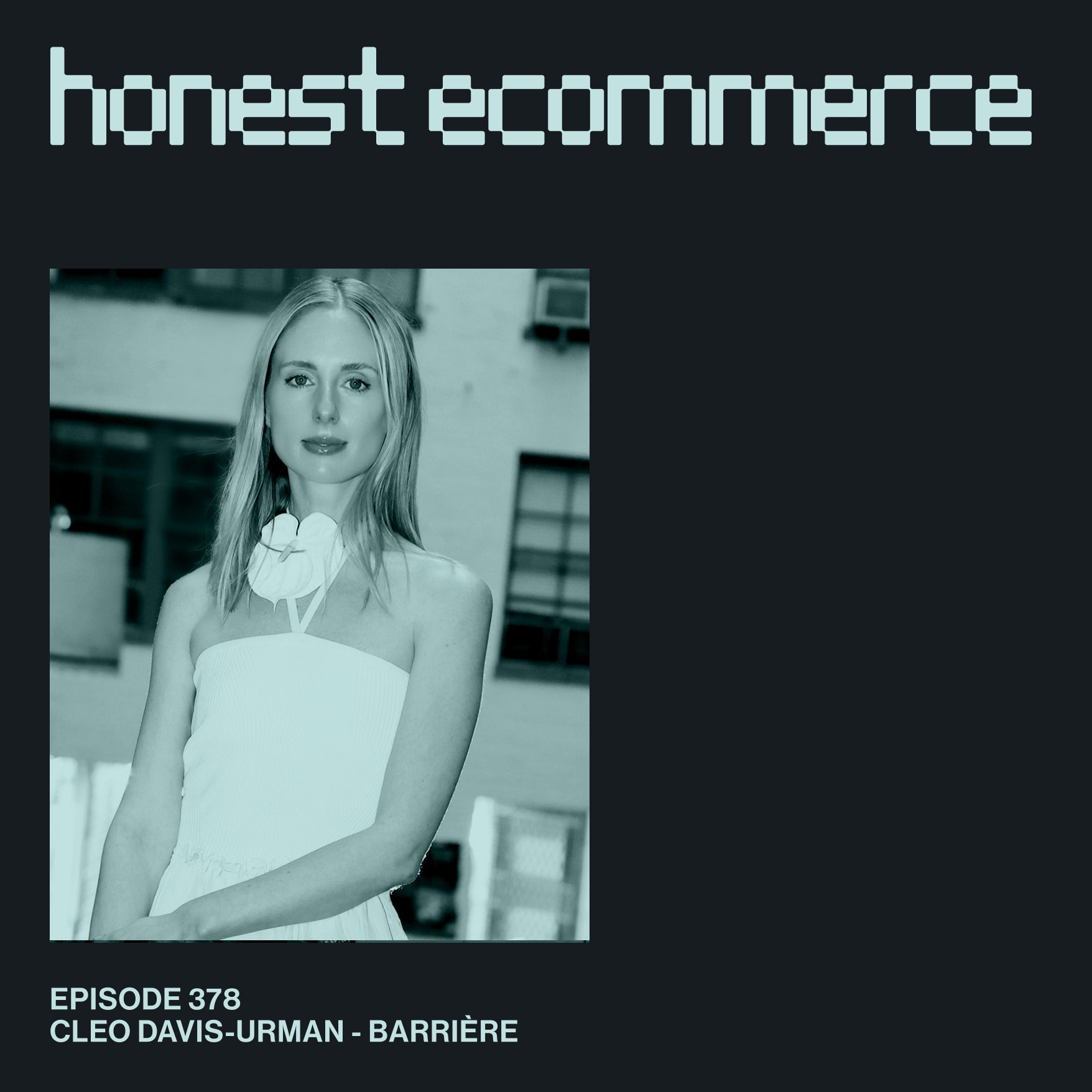
Hey everybody, welcome back to another episode of Honest Ecommerce. Today, I'm welcoming to the show the CEO and co-founder of Barrière, Cleo Davis-Urman. She is the driving force behind the viral wearable vitamin brand who has led it from a successful DTC company to an omnichannel powerhouse. Cleo, welcome to the show.
Cleo Davis-Urman
Thank you for having me. I'm so excited to be here.
Chase Clymer
I'm excited to chat. So for uh listeners that are unfamiliar with Barrière, could you quickly talk about the types of products you're bringing to market over there?
Cleo Davis-Urman
Yeah. So Barrière, we produce a wearable vitamin patch for those with the video. I'm showing one right now. And these are transdermal vitamin patches that look like stickers or temporary tattoos but deliver powerful blends of vitamins, nutrients, antioxidants directly into the bloodstream. With the goal of building self-care routines that stick, pun intended.
Chase Clymer
That's amazing. And I love meeting new entrepreneurs with new innovative ideas. Every once in a while, “I go, that's just such a good idea.” So that's what I'm feeling when I first learned about this brand.
Cleo Davis-Urman
Thank you. No, mean, the vitamin aisle hasn't really been disrupted in quite some time. And that's even if you consider something like a gummy innovation. So I'm always excited when people look at our product like, “Why hasn't that existed before?” Because that's exactly what we were hoping to achieve.
Chase Clymer
Oh, yeah, absolutely. So I guess, take me back in time. Where did the idea for this new approach to taking vitamins come from?
Cleo Davis-Urman
Yeah. So it actually came from my own personal wellness journey. About 4 years ago, I was diagnosed as dangerously deficient in iron, B12 and vitamin D. Despite having taken capsules with those ingredients in a vitamin for years. That was the first time that my doctor explained to me that not all vitamins are created equal and that so much of the ingredients in a traditional supplement gets broken down in your digestive tract.
So I was spending time every week going to the doctor to get injections and infusions to get my levels up. And once they were up, I was looking for a way to maintain them. And that's when I first learned about transdermal vitamin patches. They're very common in healthcare and medical settings.
They're also common in nicotine cessation patches, estrogen patches. They've been around since the 70s, but there hasn't really been a big trend in the consumer space. The products seemed like a huge solution for me, but they didn't tick all of the boxes. They were bulky. They caused skin irritation. They really felt like a medical device.
And I knew it wasn't a product that I would be excited about using every day. And that's really where the idea for Barrière was born. Can we take all of the positives of this innovative and proven delivery method, remove all of the negatives and really think about what a customer would be looking for in a product like this? And so that's what we spend years doing.
Chase Clymer
Forgive me if you mentioned this, what year did you guys start really focusing on exploring the marketability and the viability of this as a consumer product
Cleo Davis-Urman
So in 2021 was really when the research and development phase of this started. And then by November of 2023, we had a website and a beta version of the product available for sale, knowing that we were going to want to iterate with consumer feedback in mind. So it was about 2 years of research, development, and testing to get the initial product to market. And then from there, we iterated and iterated until we had what you see today.
Chase Clymer
Most brands outgrow their legacy choices long before they switch.
Bad platform decisions do not fail all at once.
They fail slowly. Then suddenly.
First, it is one workaround.
Then another tool.
Then another integration is duct-taped on top.
And eventually, your team is spending more time managing the stack than actually marketing to customers.
Eventually, rebuilding is less painful than staying - usually when it starts to show up on the P&L.
This is when scaling brands simplify and standardize on Klaviyo.
Klaviyo is the AI-first B2C CRM. It combines your customer data, email, SMS, analytics, and customer experience tools into one platform, so you are not stitching together five different systems just to understand what your customers are doing.
Your database updates in real time.Your segments update automatically.Your flows, campaigns, and personalization all run off the same source of truth.
And that shift is why so many brands are moving to Klaviyo.
Brands like Dollar Shave Club have reduced total CRM stack costs by over 30 percent after consolidating onto Klaviyo. Multi-brand operators like Marc Fisher have migrated multiple brands and dramatically reduced the time required to execute CRM marketing. And brands using email and SMS together inside Klaviyo are seeing massive ROI compared to running channels in separate platforms.
The big unlock is simplicity and scale at the same time.
Klaviyo is built for marketers, not engineers.It is built for online businesses.And it is built for where ecommerce is going, not where it was five years ago.
If you are running email and SMS across multiple tools, or you are on a legacy platform and thinking about your next phase of growth, it is probably time to look at Klaviyo.
Go to klaviyo dot com slash honest to see why hundreds of thousands of brands have already switched.
And if you want our help migrating your list, moving your data, and configuring your Klaviyo account correctly from day one, we are happy to help.
With vitamins, was there an approval process and some hoops you had to jump through with the government as well?
Cleo Davis-Urman
So there were hoops, but they were not dictated by the government. They were our own standards. In the US government, the US government doesn't regulate supplements. So FDA has requirements around labeling but not production. That was a huge red flag to me. And so we produce our products in a medical lab in the UK. There are more rigorous testing standards, certifications required.
It's MHRA uh regulated. it's just something that I think we [need]. If we're expecting customers to trust us, I think we really had to start with the highest production quality and standards that we could hold ourselves to. And so it did take a little bit longer and it was probably more expensive to develop and get the product to where it needs to be. But it's a better product for it.
Chase Clymer
Absolutely. And how did you test the viability of a product like this in the market? Were you doing surveys? How did you validate that this was something to invest more time and energy and potentially fundraise too.
Cleo Davis-Urman
Yeah. So at the end of 2023, we had something that we felt really good about, but we didn't know if there was a customer for it. We anticipated that many people like myself were frustrated with the solutions that were available on the market. They were looking for things that were more convenient that felt like they didn't have to change their entire lifestyle to sustain that behavior.
People are tired of taking pills. There was just a lot of frustration. So from a utility standpoint, I thought that there was an opportunity with this product to solve a lot of those problems. I also saw that there was this big trend thanks to brands like Starface and other patches that are not vitamin or transdermal patches.
But that really started to come out and people started to embrace wearing these products for wellness, whether it was a patch to cover up your pimples, an Oura ring to track your sleep. And so it just felt like the market was ready. But we weren't sure. And the best way to know is to ask the customers themselves. So we put four products up on our website and we gathered information.
We monitored every question, pain point, suggestion, piece of feedback. We followed up the surveys and offered customers free products for their responses. We stood in grocery aisles and gave things out. We just wanted to get as much feedback as possible. And then from there, we iterated and had enough proof of concept to go to potential investors and retail partners saying, “There's something here and do you want to help us grow?
Chase Clymer
Absolutely. Was there anything when you were learning from customers and potential customers about the product that was surprising to you that really helped shape what it became today?
Cleo Davis-Urman
Oh, 100%. I would say one of the biggest pieces of valuable feedback that we received early on was don't underestimate the customer. So we were formulating for customers that we thought didn't necessarily know what they needed. They didn't have a blood panel. They didn't necessarily know all the vitamins that they needed, but they were more focused on a benefit.
So we created these multivitamins that would have six to eight ingredients inside and would help you achieve an overall goal. Let's say immunity or something. But customers are so discerning and knowledgeable. They know that they need 200 mcg's of vitamin D. They're looking for biotin, they're looking for targeted support.
And so we quickly got back with the lab and put out single ingredient mini targeted patches that have the daily recommended dose of these specific ingredients. Because customers really want to feel empowered to create their own stack, their own routine based on their needs. They don't necessarily want a one-size-fits-all multivitamin.
So we quickly expanded the assortment to really be flexible and empower customers to meet them wherever they are in their wellness journey. And to evolve with them as their needs changed. And so don't ever underestimate the customer and their knowledge about when it comes to their health and wellness because one-size-fits-all isn't going to work in 2026 for sure.
Chase Clymer
Hey Store Owners -
Do you know how profitable your last BIG decision was on your Shopify store?
Most testing tools make it easy to measure design changes - small tweaks. Headlines. Layouts. Button colors.
But what about the decisions that really move the business?
Pricing changes. Shipping rates. Discount strategy. Even new apps and tools.
Those are usually left to gut feel.
Intelligems brings CRO-level clarity to decisions that live beyond the page.
Brands like Ridge, Jones Road, and True Classics are using Intelligems to test pricing, offers, shipping, and more, and see exactly how each choice impacts profit.
Momofuku used Intelligems to test multiple promotional offers ahead of Black Friday and identify the version that ultimately increased profit by about 28 percent.
Mott & Bow used Intelligems to run structured pricing and offer tests that helped drive roughly a 30 percent increase in incremental profit.
Dossier used Intelligems to run sitewide testing that resulted in about a 7.4 percent increase in profit per visitor across their store.They have a bunch more case studies on their website.
I’m a big fan of Intelligems. We use it with almost every client at our agency, Electric Eye.
We use Intelligems to test major site changes, new theme launches, and throughout ongoing CRO work
So when we are making decisions around design, pricing, offers, ETC, we can be confident that those changes are actually driving more profit for our clients.
So, before you start changing pricing, promos, or major site experiences across your store all willy-nilly, you should test it first.
If you're ready to decide confidently and grow profitably, head on over to intelligems.io and use code "honest" for 10% of your first 3 months. That's intelligems.io Use code “honest.”
As I led the episode with, at a certain point along the journey, you guys went viral. So can we talk about how social media has played a part in the growth of the business?
Cleo Davis-Urman
Yeah. So I think one of the really unique parts of our brand and the real differentiator with our product is the visual component. Most supplements, as you can imagine, you ingest them. There's no visual nature. There's no community around the product itself.
And so what's really easy for us to spark conversation, somebody sees the patch, they're like, “Oh, what's that? Is that a tattoo?”
And so our customers are immediately elevated to brand ambassadors that can share the message and more about the brand. And so we've tried to leverage social media in a way that mimics that behavior. So seeding the product out, because even if people weren't talking about it, if they were wearing it, it was captured as a part of their routine. And that's almost even a better endorsement than something where someone is explicitly talking about your product.
So it started with seating and education and really just leveraging communities to learn, share information, what are the biggest pain points in their wellness routine, what kinds of things are they using in their lives. And that community has become the sounding board for everything that we do. And that same community has also become our biggest source of information sharing and network effects and promoting the brand in their day-to-day lives.
So social media has really just been a great way for us to echo what we try to do in person or to capture that virality of what a patch can spark in real life.
Chase Clymer
You mentioned a few times now, product seeding. And I want to talk a little bit about that for some of the younger entrepreneurs listening to the show. What is that? And how did it help you?
Cleo Davis-Urman
Yeah. So product seeding can look like a number of different things. But essentially, it's just getting the product out there into the hands of a desired target customer. And so that can be sending products out to influencers or potential customers. It can be standing in a grocery aisle and giving people products. It can be partnering with like-minded brands just to get that product.
Chase Clymer
And this is-you're giving it away for free.
Cleo Davis-Urman
You're giving it away for free. And it is a cost. But I always think of it as... I would prefer to eat the cost of a free product than necessarily pay a fee to somebody without that product component. The product will do its job. All we have to do is get it to the person. And when they try it, the product speaks for itself.
When you're confident in your product, there's nothing better that you can do than to just get the product in the hands of people who might be willing to use it. And it doesn't have to be influencers. And it doesn't have to be this big fancy, PR package. It can be samples in doctor's offices, in our case, or gyms and studios, places where people are more likely to be thinking of their health and wellness.
And it's just leaving them there, like amenities. Just finding the right moments where someone might be thinking about how they want to improve their own health and wellness routine. And so seeding, when it's done strategically, can be the most effective way to sell your product and generate awareness because there's no better way to know if something works or if it's going to work for you than to try it yourself.
Chase Clymer
If you would like to guesstimate how much product do you think you've given away in that effort? Either total units or dollars?
Cleo Davis-Urman
In terms of total units, I could estimate at this point probably over 100,000 products over the course of 4 years. Yeah, I would say so.
Chase Clymer
And what has that done for the awareness and the growth and the sales of the business on the return?
Cleo Davis-Urman
That is a return on investment. It's hard to quantify, but I believe it's one of the more valuable. And again, they're not all full-size products and samples are sometimes just one or two patches. But the amount of first time customers that have come to us from various sampling initiatives, those customers’ lifetime values are some of the strongest LTVs that we have.
And people still write in, “I first saw this product at Happier Grocery. Somebody was, somebody met me, was handing out free samples and I've been a subscriber ever since. So I think that when you can get the product to the right people. And even better, get the product to the right people and educate them in that moment, whether that's in person or digitally. That's more powerful than something that's maybe just a compelling marketing hub.
Chase Clymer
“I have been in business for nearly 20 years, and very few companies I have hired in that time have performed as well as Electric Eye. They have knowledgeable staff, and our project was delivered on time and on budget. Electric Eye has exceeded my expectations, and I look forward to working with them again.”
That is a direct quote from one of our clients at Electric Eye.
Electric Eye is a Shopify Plus partner that has helped over 100 brands migrate, redesign, and optimize their stores since 2016.
If you'd like to increase your conversion rate, average order value, and revenue per session, we are the true Shopify experts you've been looking for.
Right now, we're offering a free diagnostic to qualified brands that reach out and mention the podcast. Visit electriceye.io today to schedule a call and send us a message. Find out why we have over 50 5-star reviews in the Shopify Partner Directory. Again, that's electriceye.io. E-L-E-C-T-R-I-C-E-Y-E.io.
In this day and age, a lot of folks think that the only way to scale and the only way to grow is through paid ads, which is only getting more and more expensive. And I really like to highlight how if you've got a product where you can afford to seed it, obviously, this doesn't work if you've got $5,000 couches.
Cleo Davis-Urman
Sure.
Chase Clymer
But when it is something that you can afford to seed, this is such a viable growth strategy.
Cleo Davis-Urman
And that's such a good point, Chase, because I want to be clear. When we launched, we had no money. We had a product. So it wasn't like, do we do paid ads? Or do we seed? There is no way to generate awareness for this brand other than to give away products. Obviously, a lot of brands have products that are more expensive. Our products are quite accessible. Our hero products sell for $12.98 for 36 patches.
Obviously, the economics made sense. I would say to anyone, think about what your answer to that could be? What is the moment that you can create or the piece of your brand identity that you can share more widely? And see if that's something that can be replicated. Because I really do think it resonates and converts more than some of the more run-of-the-mill marketing practices.
Chase Clymer
Hey everybody, just a quick reminder, please like this video and subscribe if you haven't. We're releasing interviews like this every week. So don't miss out. Now back to the interview.
Now, is there anything I didn't ask you about that you think would resonate with our audience?
Cleo Davis-Urman
Yeah. So there are 3 areas that we see the biggest opportunity for growth in the next year or two. The first is retail expansion. For us specifically, that means going deeper with the existing partners. We started really small with sort of one partner across a number of different categories. Like a hospitality partner, a big box, pharmaceuticals, etc.
So we really want to expand organically with those and grow those partnerships. And then continue to be really thoughtful about where we're showing up next. So where are there opportunities in the retail space for us to have a reason to exist and where we can really like to tell that story and with that partner.
The second is international expansion. I think this is a huge opportunity. The demand for non-pill wellness solutions is universal. But it's specifically big and resonates in markets that are a little bit ahead of the curve when it comes to their health and wellness. And they're a little bit more sophisticated when it comes to supplements and regulation. So for us, we see a ton of opportunities there.
And then third is doubling down on direct-to-consumer. We’ve seen tremendous growth with our own website. It's the only place where you can shop all of our products. Where you can get the full storytelling and where we can own that relationship with the customer. And so we are going to be investing in a web redesign and some more optimized subscribe and save offerings.
And really just trying to make our website the digital version of how we would show up in the real world when we do. But really, all of those things, all three of those things, underscore the overall uh goal of just meeting customers wherever they are and keeping those experiences intentional and educational and fun.
Chase Clymer
Yeah. And I love it when someone gives me an amazing transition. So speaking of the website.
Cleo Davis-Urman
Yeah.
Chase Clymer
Where should people go if they want to check out the product? uh Potentially buy something for themselves.
Cleo Davis-Urman
Yeah. So it's www.myBarrière.com. And that's B-A-R-R-I-E-R-E. And if you do come check us out, the first time you come to our website, you will get a welcome discount code. And hopefully that inspires you to try a product. There's also a ton of information on who we are and how our products are made. And there's a ton of great formulas, but also great prints. And I think that that's just one thing that I'd love to touch on.
We have so many resources when it comes to our health and wellness routines, but so much of them lack joy. And this is a product I'm really proud of for all of the reasons that we've talked about. But also because it sparks joy. And sometimes you just want to look at your hand and know that you're doing what's good for you. But that is also something that you can look good while doing.
Chase Clymer
Yeah. And this is definitely to tell all the listeners out there to maybe check out the YouTube channel. Yeah, there's a lot of really, really cool designs here. From the Vitamin C sun to smiley faces for the B12 patches, all sorts of fun designs all over these patches. Cleo, I can't thank you enough for coming on the show today and sharing all those amazing insights.
Cleo Davis-Urman
Thanks, Chase.