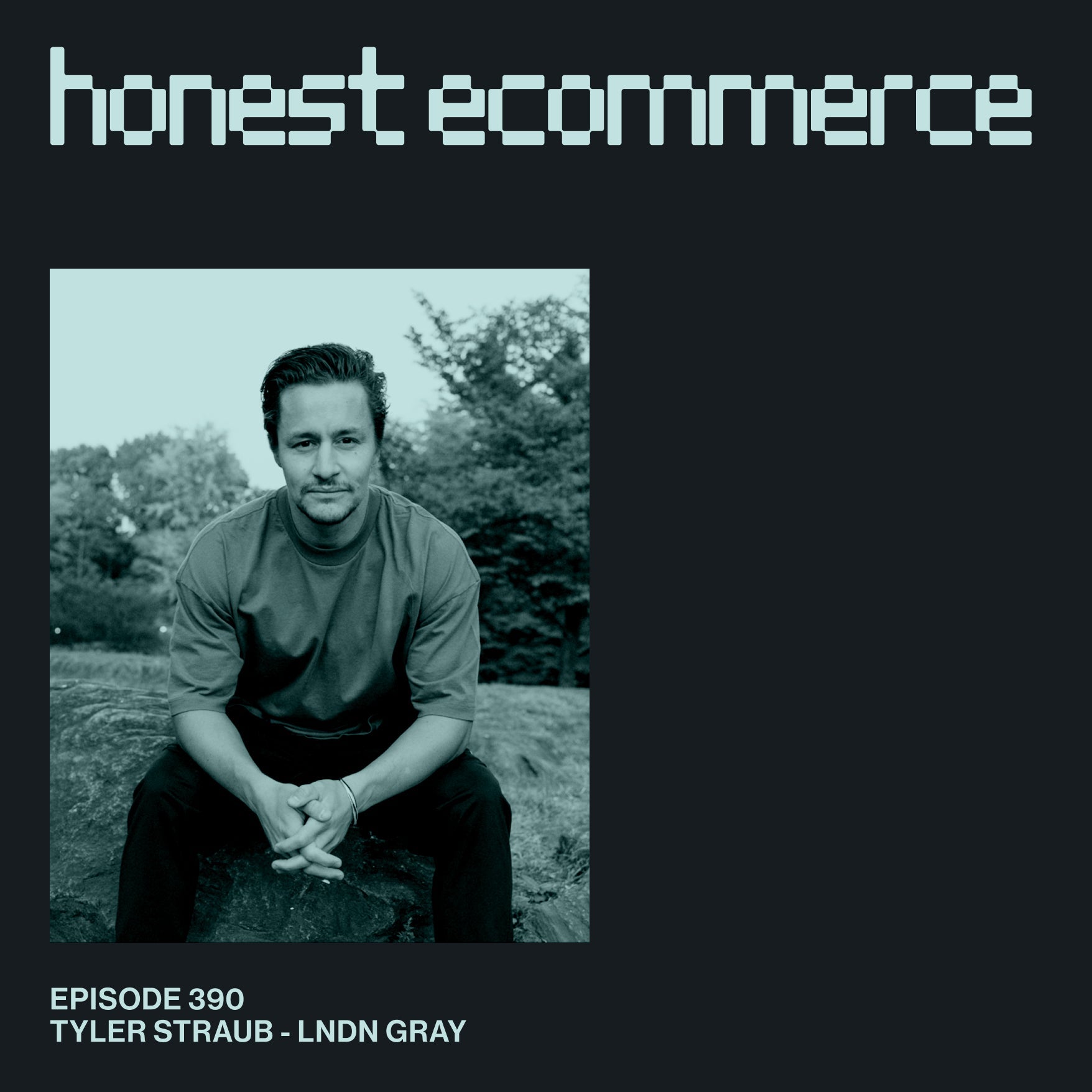
Tyler Straub
you may hit these peaks, right? And you're like, “Oh, everything's great, we're crushing it.” And then kind of take the next level, you want to bring in certain people or expenses increase, and then you kind of almost plateau. It's a battle every single day, right?
It's the life of an entrepreneur. You're celebrating one moment, you're banging your head against the wall the next. You're crying the next, and you're celebrating again. Or you're going on long runs to clear your head. But I think you have to persevere.
Chase Clymer
Honest Ecommerce is a weekly podcast where we interview direct-to-consumer brand founders and leaders to find out what it takes to start, grow, and scale an online business today.
Honest Ecommerce is proudly produced by Electric Eye, a Shopify Plus partner helping Ecommerce brands sell more with strategic design and development. Visit electriceye.io for more information.
Hey everybody, welcome back to another episode of Honest Ecommerce. Today, I'm welcoming to the show an amazing gentleman, a creative director, an entrepreneur, and a photographer. 13 years of experience building and scaling high growth brands across creative technology and consumer sectors. Tyler Straub, welcome to the show.
Tyler Straub
Chase, thanks for having me. It's a pleasure.
Chase Clymer
Absolutely. I'm excited to chat. And it's rare that I forget to mention the brand name in the intro. So these days, you are one of the co-founders over at LNDN GRAY. For those that are not in the know, what are the types of products that you and the team are trying to bring to market over there?
Tyler Straub
Yeah. So at LNDN GRAY, we're a direct-to-consumer art brand. We primarily focus on framed photography prints, as well as digital artwork and graphic prints for canvas.
Chase Clymer
That's amazing. It is a niche that I hold near and dear to my heart as a previous photographer and an old life. And as someone that has a bunch of rentals that needs artwork. I am always scouring the internet for great collections, curated collections, just to make my job easier, man.
Tyler Straub
Yeah, we got to get you stocked up. And I'm sure that you know a lot about that. For sure. Awesome.
Chase Clymer
Alright, so take me back in time. I don't think someone [goes], well, maybe you'll correct me here. But I don't think someone just wakes up one day and he goes, “You know what, I'm going to sell a curated art collection online. That's going to be my mission in life.” Where did this idea come from? Where did it evolve from?
Tyler Straub
Yeah, definitely. mean, it's years of experience and working to get to this place of starting LNDN GRAY. A little background on me. I've been, as you mentioned, 13 years working in startups. I fell in my first startup game time back in 2013 when I was still in school. I met the founder over there, Brad Griffith.
I am very grateful for the opportunity because that's where my startup journey really kicked off and worked for several startups along the way. Ultimately knowing that I wanted to create my own brand one day. And I tried a few other projects along the way and unfortunately they were not successful. But I definitely learned a lot in creating those.
When I got to the last startup I was doing some consulting. [I was looking to start another brand. One of them and my co-founder, I met him at Bird, the scooter company when they were there. He's one of our lead designers, one of the most talented graphic designers I've ever met. We always had an interesting bond there.
I've always been intrigued by design. So sometimes I would come in on a Monday after a long weekend and we'd sit in the kitchen and I would always pick his brain. “What are the next designs that we're coming out with? What else are you working on?” And then after we both left, we knew we always wanted to work on something together and build something together.
We kind of kept throwing each other work. I would go to other startups and if we needed some design work, I'd always reach out to him to help create logos or whatever other design elements we may have needed with that brand. And then along the way, we kept spitballing ideas back and forth. And it's funny because I get this question a lot, but I don't actually know where the exact ideation came from for creating an art company.
I think what happened was as we were searching for brands that we wanted to start and the kind of industries that we wanted to go in, I was moving into a new apartment. Searching for art online. I couldn't really find anything that I truly wanted or was extremely expensive. And I think I asked him. I said, “Hey, I have some ideas. Do you think you'd be able to bring them to life?”
And then we'll figure out a way to get them framed and I can put them in my apartment. And that's what we did. And as we were doing that, that's when the light bulb went off and we're like, “Hey, maybe we have something here. Why don't we try and start an online art brand? And we kind of looked into the barriers of entry. How we could get it going. It seemed like it was a pretty low overhead to get it off the ground.
We both are fascinated by design. We both come from design backgrounds and branding backgrounds. And we just had a lot of fun creating different designs together. Whether it was for previous brands or just for fun for ourselves.
Ironically, I haven't really told people this story, but one time I was joking about becoming a DJ. And he and I were sitting in the kitchen and we're designing a logo for my potential DJ journey. But never pursued that route. And it was just, again, one of those things that we really enjoyed working together and designing things together. And so we started creating art for my apartment. We started looking into what we need to do if we didn't want to go this route?
Obviously, it all starts as a joking idea. And then as we dug into it more, We're like, “Hey, maybe we have something here.” So that's where the origination came from.
Chase Clymer
Yeah, that's extremely fascinating. How long did you know your co-founder professionally before you guys officially started working on this project?
Tyler Straub
I'd say about 6-7 years.
Chase Clymer
And you guys knew you liked each other and you stayed in touch throughout different careers. I want to highlight that for the listeners out there that are pre-starting their business and thinking about co-founding. You might have already met your co-founder in your past. You and him were lucky enough to realize the power of that. I'm assuming there's also a great friendship there. But the power of that connection and staying in touch.
I think that I can remember a few other conversations in the 300 plus episodes that I've done on this podcast of people that were so adamant about trying to find an idea to do something together. But you guys also being in that startup industry probably always makes you look for that everywhere.
But I think it's very cool to point out that you guys were constantly looking for the next idea. Because I've already found the guy that we're going to work with on this together.
Tyler Straub
100%. And I've tried starting previous businesses with friends or other people. Unfortunately, it doesn't always work out and sometimes it potentially could hurt friendships. I think we just had a perfect relationship where [we have] very different lives. But we were colleagues and we just had that friendship within work and then stayed in touch outside of work.
And I think it was not someone that I've been a friend with for 10 plus years. Or someone that I grew up with. There wasn't really a relationship there to kind of hurt, I think. We didn't know each other too deeply behind the business relationship. But the great thing is when you find a great partner, we've become so close, such great friends.
And ever since we started this, we launched it in March, 2023, officially. We're probably working on it for about a year and a half, building it slowly because we both had other jobs at the time. And so that means, we're going on five years of probably being on the phone almost every single day on a Zoom or a phone call.
And just ironically, when we left Bird, he moved back to Utah. I stayed in Los Angeles. And so we actually haven't seen each other in person since starting the company.
Chase Clymer
Oh man, that's so funny. But it speaks to one of the golden nuggets of this conversation here: finding a good co-founder makes everything so much easier. But you did highlight something earlier, which was that you guys are both passionate about design. But I'm sure that your swim lanes don't overlap at all. And can you talk to the audience about how a co-founder relationship should work and how you guys delegate who's responsible for what?
Tyler Straub
Yeah, for sure. I mean, going into it, we knew he's the design guy, right? That's why I wanted to partner with him. Like I said earlier, he's one of the most talented graphic designers I've ever met. And I like to think I'm very creative in my mind, but it doesn't always translate to my hands. So I wanted to find someone that could bring my ideas to life. And he's absolutely amazing at that.
I would say our swim lanes don't necessarily overlap, but it's very collaborative. I'm creative, he's creative. When we go into these creative spurts we try to separate when it has to be operational and it has to be creative. Because I would say he's 100 % creative. I'm about 50-50. And so one of us has to kind of maintain the operational execution within the brand.
When we get into these creative modes where we're working together, I think some of the stuff that we bring to life and that we ideate sets us apart, right? That's, I think, what put the brand on the map initially.
And to your question about how important it is to find a good co-founder, we've had some conversations very early on to where I think it's set up the relationship. And I think that's very important when you go into business with someone. Understanding what motivates them and what also, I don't know if offending them is the right word, but I can't offend them.
He's a designer. He's very passionate about his work. And I understand that. And I respect that in the beginning of the business. We were building certain things and initially I didn't want to hurt his feelings and I would tiptoe around certain things. I'm like, “Hey, this is great, but maybe we should change this or maybe we should add this element.”
And then one day I just said, “Hey I love you and I know you create amazing work. That's why I wanted to partner with you. But I think it's, I don't want to necessarily tiptoe around certain things. If I feel I have an opinion on how certain things should look or should be changed. So I want to tell you.
If there's certain things I want to be very direct and say, ‘Hey, I don't like this or maybe we could change this or let's do this. Let's try this way.’ And I want you to know that it's not a jab at you. It's not offending your work at all. It's just I want us to be the best we can possibly be.” And our job is to potentially tear apart each other's work as much as we can.
Because if we don't do it, there's customers or consumers that may do it. And customers are mean. They're ruthless. They don't care. They'll rip your stuff apart if they see something wrong with it. And that's the same thing with me. And I told him with his design work, if I bring some photography to the table and I think it's an amazing piece and he hates it, he can tell me. Like, “This is the worst piece I've ever seen.”
That's kind of the relationship that I think we established very early on in the brand and the company. And I think what has kept our relationship from hitting hiccups, I will say again. We've been working on this for probably five plus years. And we've had maybe one pretty significant argument.
I've been in relationships and businesses with other founders where you're kind of going back and forth every single day. So it's just amazing to see the relationship that we've been able to build. We both appreciate each other's work. We both respect each other's work.
A little example, too, very early on in the company. Right before we launched it, we were building the website for months and I think it was about a week before we launched it. It's probably 2 a.m. We're on a Zoom. We're both tired. We're just gearing up, ready to launch. Ready to get the website ready to launch.
And I remember I was looking at it. I just had a weird intuition and kind of a gut feeling that I didn't really like it. And I told him [while] we're scrolling through the website. I [said], “Hey, I don't think I really liked the website.” And he [replied], “What part?” And I was like, “All of it.” And he goes, “What do you mean? We've been working on this for months.”
And I was like, “I don't know. Something just came over me. I think we can do so much better. I think it's not what I want to launch with. We both sat there for a minute. Like I said, it was 2am and we're both kind of on a break. He looks at me goes, “All right, f*ck it. Let's do it.” Sorry. I don't know if I could cuss on this, but…
Chase Clymer
You're fine.
Chase Clymer
Yeah. He goes, “Screw it. Let's do it.” And for the next three, four days, we barely slept and we redid the entire website. And looking back, we were both so happy that we had. I was so happy that he went with my intuition and was a good partner and wasn't like, “We just wasted a bunch of time building this website. We're not changing it.” Because even after [that] he thanked me too.
He was like, “All right, great. I'm so much happier with the new website.” And then from that moment, we kind of had a conversation of saying, “You know, I think I've always been a person that follows my gut and follows my intuition. And I think a lot of good things have come from it.”
So we had a conversation that said, “Hey, it's you and me in the business. If one of us has a strong intuition about launching a certain product or a specific design element”. A lot of times we'll try and put forth some evidence of why we think it will perform good or be good for the company. But there are some times where I just think it's hard to explain.
And if you have that strong gut feeling, again, the other person has the right to try and pick it apart and see if they can. At the end of the day, we kind of made a pact that said, “If just I want to do this we're going to say, “Okay, let's try it out. If it doesn't work, we'll revert back.” But I think we've kind of kept that motto throughout building the brand and it's worked very well for us.
Chase Clymer
Most brands outgrow their legacy choices long before they switch.
Bad platform decisions do not fail all at once.
They fail slowly. Then suddenly.
First, there is one workaround.
Then another tool.
Then another integration is duct-taped on top.
And eventually, your team is spending more time managing the stack than actually marketing to customers.
Eventually, rebuilding is less painful than staying - usually when it starts to show up on the P&L.
This is when scaling brands simplify and standardize on Klaviyo.
Klaviyo is the AI-first B2C CRM. It combines your customer data, email, SMS, analytics, and customer experience tools into one platform, so you are not stitching together five different systems just to understand what your customers are doing.
Your database updates in real time.
Your segments update automatically.
Your flows, campaigns, and personalization all run off the same source of truth.
And that shift is why so many brands are moving to Klaviyo.
Brands like Dollar Shave Club have reduced total CRM stack costs by over 30 percent after consolidating onto Klaviyo. Multi-brand operators like Marc Fisher have migrated multiple brands and dramatically reduced the time required to execute CRM marketing. And brands using email and SMS together inside Klaviyo are seeing massive ROI compared to running channels in separate platforms.
The big unlock is simplicity and scale at the same time.
Klaviyo is built for marketers, not engineers.
It is built for online businesses.
And it is built for where ecommerce is going, not where it was five years ago.
If you are running email and SMS across multiple tools, or you are on a legacy platform and thinking about your next phase of growth, it is probably time to look at Klaviyo.
Go to klaviyo dot com slash honest to see why hundreds of thousands of brands have already made switched.
That's klaviyo.com slash honest, K-L-A-V-I-Y-O dot com slash H-O-N-E-S-T.
I promise this is going be the last discussion around partners before we move on to the amazing brand that you guys built. But one of the first things I remember when I was starting this agency with my partner was our lawyer actually, who's a good friend of ours now. He mentioned something that struck me. He was like, businesses are exactly like marriages and you have to plan for the divorce right as you go into it, unfortunately.
And it's like you need to know everything about how they think about things, what drives them, what motivates them, what offends them, like you said earlier. All that stuff matters. And I was very lucky in that my partner and I evolved into being a fantastic yin and yang of what we needed to run this business successfully.
But I think a lot of people fall into a trap where they don't establish those swim lanes. And if you've got two amazing developers and nobody's doing business development, you guys are just now splitting costs and not getting any more business. That's not something sustainable. And so with a relationship with a partner and building a business, you have to have those direct conversations.
You can't tiptoe around things. Because at the end of the day, the North Star, the goals that you guys both have for that business is to make the business the best you can. Make it for your customers. And that fear and uncertainty about being direct with your partner quicker that you and your partner can move away from and understand that it isn't offensive to them.
It's offensive to your customer and you're trying to make it better for your customer. Once you see those goals together and it's you two on a team versus these problems that might be for your customer, that's the game changer.
Tyler Straub
Yeah, 100%. A point you said too is, I think establishing the swim lanes and what your priorities are and your responsibilities in the business is very important early on. I would say it's hard sometimes when you first go into the business to know exactly what everyone's responsible [for]. Obviously, we had an idea, right? He's the designer. He's going to lead design. I'm going to lead operations.
But then you quickly figure out, “What is the overlap that we have?” And I think the creative direction is very shared between us. And then as you continue to develop the brand and the business, there's a lot of unexpected elements that come up. That obviously someone has to take over and be responsible for. And when it's just you and one other founder, that's kind of what you divvy up.
And I think you can continue to have those conversations. And your roles and responsibilities will evolve over time as you're developing the business. But to your point, it is very good to understand [and say], “Hey, you're the design guy. I'm the ops guy. And then whatever else that comes up, we'll figure out together who's going to take responsibility for it.”
Chase Clymer
Hey everybody, just a quick reminder. Please like this video and subscribe if you haven't. We're releasing interviews like this every week. So don't miss out. Now back to the interview.
I'm kind of good at so much stuff just because the business forced me to learn about it. But yeah, as you mentioned earlier, and the hardest pivot ever done is this podcast. Because we're having so much fun talking about partnerships and stuff like that. You guys redesigned the website right before launch, and then you launched it.
Talk me through that go-to-market strategy. Talk to me about launching the business. What were the first products that you guys put out? And how did you get your first customers? How did you get the word out about LNDN GRAY when you guys launched in 2023?
Tyler Straub
Yeah, definitely. So initially, to take you back even a little farther, coming up with the idea is one thing. Even designing what we want to put out is another thing. But it's really figuring out you have an idea and I think a lot of people have ideas. I've had countless ideas that I've never launched. I've never brought to market that I thought were great ideas.
But having the idea is one thing.It's then figuring out, what's the to go to market. And then depending on the type of product you have. For example, us as an art company, it’s (about) how are going to get this framed? What types of materials are we going to use? Because we did want to come out with a product that was of significant quality, but also attainable to the majority.
I would say our price point is a little high. It's not for everyone, but we wanted to find that balance. We could have gone to top tier materials, the best quality, but then we’ll definitely price a lot of people out. So we wanted to find something that was great for people's homes, offices, condos, hotels, and apartment buildings. And find a product that was obtainable.
And so it took a lot of time finding out who we're going to partner with. Who we're going to have helped us frame this. And then also on top of that, it's one thing to have the idea and it's also coming up with the name. For example, I'll give you a cool little story on how we named the brand. We had the idea, we're kind of building the products.
And then one day my partner is [said], “All right, what are we going to name this thing?” And he's like, “I'll send you 30 or 50 different names. Pick the ones you like. And I remember I was going through the list, nothing I really loved. And then LNDN GRAY, I saw it for some reason it just jumped out at me. I think it was kind of ominous. You know, it felt a little luxurious.
You didn't necessarily know what it was. And so I told him, that was kind of the only one that jumped out. I said, “LNDN GRAY, I really like that one.” And a crazy story. Him being a branding expert, he's done a lot of mock brands as well. And he said he goes, “That's crazy that you picked that name. I almost didn't put that name in there because this was a women's fashion brand that he wanted to design previously. Just kind of as a mock brand.
He did it using the name LNDN GRAY, but he never ended up launching it. And then he was like, “Screw it. I'll just throw it in the list of names.” And then that's the one I picked. So I just feel it's very synergistic when certain things like that happen. I think there's little nuggets that show you that you're on the right path and what you're building and what you're pursuing.
Initially though, the name was actually the legal name is LONDON GRAY, L-O-N-D-O-N. And another thing when we were going to launch that, had that as the design elements all over the website. We were looking at it one day and we're like, “It just seems too long, right? It's just spelled out too long.” If you ever want to put it on clothing, we're just thinking a little bit farther ahead. It looked long on the website and we [asked], “Why don't we shorten it to LNDN?”
Because then it will be four letters and it looks a lot cleaner. People may not necessarily know how to say it. You know that some people [would say] Linden Gray. Some people would spell it out. And I think it just creates that conversation between people. And then, yeah, so then we got the branding. Then the next step was figuring out, “Okay, what type of artwork do we want to launch with? What do we think people are going to gravitate towards?”
And another thing we really wanted to do when we initially started the company, the goal was to create a marketplace for artists and photographers to sell their work. Because I think there's a lot of talented people in the world, especially from a creative standpoint that don't necessarily know how to market themselves. And so that was the goal.
We're going to launch the company utilizing these artists and photographers and having their work on the platform. But we were kind of thinking about it and we felt that it may be a lot of pressure to find the right artists for the initial launch. Two, make sure the artists had a lot of pressure on them. That they had the right artwork or the right photography to build the foundation for the company.
So initially we were like, “Hey, before we bring a bunch of people in and get their hopes up and sell them the world or sell them a dream. Why don't we test some of my photography, some of my partner's graphic design work. And see if this thing even has legs first.” And so that's what we did. And instead of when we were figuring out what artwork and products we wanted to put out, I think a lot of people do the market research on what type of artwork people are buying.
What people are engaging with. And for us, it was more [that] we come from design backgrounds. We love doing design. We design cool stuff. So we were [said], “Screw it. Why don't we just design what we think is cool? What we would want to put in our homes or our offices.” And, hopefully other people will like those things too. And so that's what we did.
We just started putting out some, some artwork and photography that we thought was cool. And fortunately it started taking off pretty quickly and we noticed a lot of people were gravitating towards it. And then as you put out the products and the specific artwork and the specific collections and categories, then you can identify, “Okay, who is our audience? What are they gravitating towards?”
And I think it's a combination of creating more of the artwork or more of the products that you see your consumers are purchasing and engaging with. But then also putting out some products that may be completely different or some artwork that's completely different just to test the waters. Maybe you can expand your community. And for us, starting it, we didn't want to go into the, we knew not everyone was our customer. We wanted to create some badass artwork.
We wanted to create some stuff that might push the boundaries. We never wanted to offend anyone. But we knew not everyone would agree with all the stuff that we're putting out. But that was okay with us because we knew by doing that and staying authentic and staying true to ourselves of what we're building and our visions and our branding experience. And that what we thought was cool, the community would come.
We knew there were other people like us that would gravitate towards the artwork that we wanted to create. And fortunately, that's what happened. And what I started to say was, it's a combination of creating the artwork that your people and your customers are purchasing. Creating more of that because obviously, they like that vibe.
But then also, a certain percentage putting out stuff that you've never tested before because maybe you'll find another community. Or maybe you'll be able to expand your community with different types of artwork. And you'll never know if you stay in the same categories. You stay in the same field of what you're creating because you know people like that. But how do you know you can't open up a whole new market or a whole new community by creating other products.
So I think it's finding that balance of you know allocating your time on creating the stuff that people are purchasing but then also testing other things along the way and then on top of that continuing to innovate as a brand as a website. You know every single day we're making improvements to our website. And it started as us wanting to be a wall art brand. And then we've progressed to you. We want to launch other products.
We don't want this to just be small as a wall art, a wall art company. We want LNDN GRAY to be an art company. So recently we launched candles. We opened up another collection called Badlands 13, which kind of ties into our edgy theme, pushing the boundaries. LNDN GRAY will always be artwork. And then we have the Badlands 13 collection that will be some of these other products that we're releasing.
And one of them is candles, but they all kind of tie into each other. The candles are pretty much based off of the artwork, some of our most popular artwork. And then we want to just continue expanding, continue innovating every day. We listen to our customers, we kind of follow our intuition. And I think as you continue to scale and as you continue to grow as a brand, you really start to identify your customers are your best feedback, right?
Whether they love you or they hate you sometimes, you get it all. But I think listening to that and taking some of it with a grain of salt, it will really help you continue to grow and scale as a brand.
Chase Clymer
What is the next big idea that could change your business?
A pricing change. A new bundle strategy. Adding subscriptions. Tweaking your shipping offer.
Most brands make these decisions based on gut feel.
They roll out the change, hope for the best, and have no real idea if it helped or hurt their business.
Intelligems fixes that. It is an AI-powered testing platform that brings CRO-level clarity to the decisions that actually move the needle. Not just button colors and headlines, but the big stuff.
Pricing, offers, shipping, new apps, even major site changes.
Brands like Ridge, Jones Road, and True Classics are using Intelligems to test their most important decisions and see exactly how each one of those impacts profit before they commit.
Momofuku used it to test promotional offers ahead of Black Friday and found the version that increased profit by about 28 percent.
Mott and Bow ran structured pricing tests that drove roughly 30 percent more incremental profit.
We use it at Electric Eye with almost every client we work with.
And now Intelligems has a free AI-powered audit that gives you three specific ideas you can test on your store today. No commitment, no credit card, just three opportunities worth exploring.
Head to intelligems.io/audit and get your free audit in just a few minutes.
That is intelligems.io/audit
intelligems.io/audit
And I think that there's something unique about your business model. And please correct me if I'm wrong here. But you spoke about finding the partners to help you print and frame and produce these things. And just a little behind the scenes here is I'm assuming that you guys have no holding costs on these products. Not to belittle it. But they're almost made to order in a sense. Upon launch, you guys could test a lot of things to see what resonated with your audience.
Tyler Straub
Yeah, 100%. And it is made to order. I think technically every piece is custom made to every order. The wood is custom cut, the acrylic is custom cut, the print is custom sized to that. I'm very big on [that]. I need to touch and feel every single thing before we put it out, right? We've had different framing partners. But initially I'm in there. I'm picking out the wood. I'm picking out the acrylic. I'm picking out the paper that we're using. I'll fly to wherever our partner is at that time. Because I think it's very important that I know what's going to the customer.
But to your question, fortunately, we've been able to start a brand that we can test a lot of things without it necessarily being a lot of overhead or a lot of expenses. There are certain things that other products are not necessarily made to order. For example, the candles, we take a little risk on that. But fortunately, everything that we want to put out is very high-end. So even our candles are 100 % soy wax. They're very clean. I know candles get a little bit of flack these days, but we tried to get the best quality materials and best quality wax that we could.
But again, it's kind of taking a risk with those ones and putting out that product, but we felt people would gravitate towards it. I think it accompanies the artwork well. And there's some things we've done with them too. I don't know if maybe we'll put this in, but I'll just tell you the story anyways.
So for example, when we were going to launch the candles and announce the Badland 13 collection. We're like, “Okay, how do we get this in front of people?” And yeah, we can send emails, we can put some ads behind it. But we're [said], “What's something really cool? And we were leading up to the holidays last year. And I was [said], you know what I want to do? There's some customers.
We'll be honest, I don't think we're the best at showing our appreciation to our customers initially. Especially the return customers, the ones that early on took a risk on us in purchasing our artwork and come back and purchase more. And so what I wanted to do was, “You know what we should do with the candles? Let's find all the customers that purchase from us in the first year. And then any customer that's purchased three or more times or spent over X amount.”
Because I think if someone spends over X amount, obviously, they most likely like your brand. And they're most likely fans and followers of your brand. And will probably come back and purchase more. The other reason why I did the three or more purchases is because if someone purchased from you twice, they obviously like your brand. If someone purchased from you three times, they love your brand, right? And I think not everyone.
Even if someone purchased our three cheapest pieces or lowest cost pieces, maybe they just don't have the money to buy the bigger ones. But I don't think that should separate them from someone who spent several thousands of dollars. Why should they get a gift versus the people who have purchased three times for us? That's why I really wanted to show our appreciation.
And what we did was we sent candles to every one of those customers with a handwritten note that said, “We've noticed your loyalty. We just want to really appreciate your support for the brand. Maybe we haven't been the best at showcasing it, but that's why we want you to be the first to be introduced to our new collection, Badlands 13.”
And here's one of our products from that collection, a candle to go with it. And the cool thing is we have a specific art piece that's one of our best sellers. And one of the candles is named after that. So I also separated all the customers that bought that piece. And so they receive the candle with that name attached to it. So it's just a cool gift. That, again, I think there's opportunities that you can always look back to. And kind of I wouldn't say right your wrongs.
There's brands that are really good at showing appreciation to customers, right? There's other brands that aren't the best. I think we're so focused and so early on in the company that we were trying to build the brand that kind of just slipped through the cracks, right? Showcasing that appreciation. But you can always go back, right? You can go back and showcase people, hey, and admit it. I think admitting your faults, “Hey, maybe we haven't been the best at showcasing our appreciation, but we've noticed that and we've noticed your support and it hasn't gone unnoticed. And so here's a token of our appreciation”, just a smaller token of our appreciation for them.
Chase Clymer
You have prepped all year, and that hard work is paying off.
Your store is converting, the ads are working, and this is shaping up to be your best holiday season.
But your 3PL can't keep up.
Orders are backing up.
Customers are asking where their stuff is.
The reviews are starting to turn.
All that work, all that momentum, undone by a fulfillment partner that can’t scale with you.
This is a nightmare scenario, and it happens to brands every holiday season.
eFulfillment Service is the 3PL that scales with you.
They are family-owned, 25 years in the business, and built specifically for growing DTC brands.
There are no setup fees, no minimums, and no long-term contracts.
You only pay for what you use.
If you are scared your 3PL can't keep up this holiday season, now is the time to reach out to eFulfillment Service.
Go to eFulfillmentService.com/honest and get up to 8 weeks of account fees completely waived.
That’s E-F-U-L-F-I-L-L-M-E-N-T-S-E-R-V-I-C-E dot com slash h-o-n-e-s-t
efulfillmentService.com/honest
This might be one of my last questions for you. But when you first were taking the brand to market, how did you and your partner get your first customers to the website that weren't your friends and family? What was that marketing strategy? Did you guys launch with ads? Did you guys have some other strategy to get the word out?
Tyler Straub
So a combination of things. We definitely tested some ads early on. I had a good buddy of mine that was in the ad space that said he would do some stuff for us just to run to see if we could attract some people to the website, gauge interest. And then another thing I did was I'm not a big person to ask people for favors.
I kind of saved something, and another thing, when I wanted to launch it, I [said], “Okay, how do we differentiate ourselves?” If I put this out there, I post it on my Instagram, hey, I launched a wall art company. That's cool. Maybe people will check it out. But I was like, how do we come out with something badass that people [will like]. That's a little bit different than anyone else has ever done.
And so we spitballed on it and we found [one]. Actually my partner Adams, one of his buddies, is a really good animation artist. And so we [said], “Why don't we do this? Why don't we create a really cool video?” And it's actually on our Instagram. I think it's the second post. I don't think it's on the website anymore, but we're like, why don't we create a really cool video? It's our artwork and we'll create where the artwork's coming together.
The woods being put together, the acrylics coming together, showcasing different artwork, it's showcasing it. The final product as a gallery wall in an office space. And then it'll be just like a cool video that hopefully people will like to watch. And so we did that. We created the video and I was gonna announce it on March 3rd, 2023. And I was gonna post on my Instagram and I was like, “Screw it. If there's any time to ask people for favors, this is the time.”
And I texted probably a hundred of my friends and said, “Hey, I'm launching my brand this week. If you could give me the biggest favor and post this on your Instagram story of the launch.” Or I think maybe I posted it and asked them to share it on their story. And I think that was one of the biggest things that drove a lot of traffic.
It caught a lot of eyes. Showed a lot, not only a lot of people that I knew about the next project that I was working on. But also a lot of people that maybe didn't know of me but followed my friends, right? And so they all saw them posting this art brand. I think it was a lot easier to ask them to post because it was a pretty badass video.
But that was one of the times. I think that was a huge proponent in kind of bringing that initial awareness to the brand tied to bringing in my buddy to help with the ads. And once we start taking off, you start making money and that's when you can really reinvest it into the ads and scale it. And I think that's very important early on.
We didn't pay ourselves for a very long time because we just wanted to put everything into the brand. And I also wanted to bring in the right people as we continue to scale. I think a lot of people have very good skill sets. And to your point, what you said earlier, I've learned a lot within this brand. I learned a lot of things I didn't know before that I had to do.
But then as we continue to drive specific revenue, it gives us a little money to play with to bring in people that I know are better than me in certain elements. I think I can get us to certain points within certain elements, but there's a lot of people that are a lot better than me and experts in it that can take it to the next level. And so that's what we did.
And then also, I didn't touch on this earlier. But I know I said I wanted to launch a brand with a marketplace for photographers and artists. But we didn't want to put that pressure on them or ourselves. So we launched it with ours, but that was still always in the pipeline. That was something that never left us that we always wanted to launch. And so last November, we actually launched the marketplace. It's called LNDN GRAY Legends. It's on the website as well.
We've been able to bring in artists, photographers from all over the world. Because I think, again, there's so many talented people and I'm currently traveling this entire year and kind of finding artists. For example, one of our early on artists. I was in Columbia and I found this street artist, Johnny, and he was just really talented with the work he was doing on the street.
So I talked to him and asked if he did other work and he kind of told me, this is just my commercial work that people want to buy. And he showed me some of his other paintings there and [it’s] insane, [he’s] so talented. And I asked him if he wanted to be on the platform. So we ended up bringing him on.
And it's a really good feeling because we currently only ship in the US and Australia. But it allows me to bring on people from all over the world. Because, for example, like Johnny, if he's in Columbia and he's making the commission that some of these American artists are making, that's life changing. And so that's something we're just started building out. We really want to build that out. A big focus of it as well.
And for us, I think some people focus on what is their social following to be able to bring them on the platform because obviously that drives more eyes to the platform. I think that doesn't necessarily determine someone's talent, right? I think there's a ton of people that if they have high social followings, major congrats to them and they 100 % earn that and they deserve it because they are so talented and they have amazing work.
But I think there's people that aren't as good as putting themselves out there, whether it's on social platforms or marketing their artwork in general. And those are the kind of people that we're finding. And giving them a platform and showcasing their work. And someone asked me the other day, “What happens if you put an artist on and you kind of build, build this exposure and bring this awareness to them and they get so big, they leave your platform.”
And I said, that would be a dream come true. That's our goal. That's what I want to do is bring people on, give them exposure. Because I think a lot of people have helped me in life along the way and given me platforms and given me opportunities. And it's propelled me to where I am today. And so if I can turn around and give that back to other people, it's such a good feeling. And I think what goes around comes around. I couldn't agree anymore.
Chase Clymer
Obviously, Tyler, this has been a fantastic conversation. Now, is there anything I didn't ask you about that you think would resonate with our audience?
Tyler Straub
Yeah, I mean, think just like running a business in general, right? What are some of the hard things? And it's one of those things that as you continue to grow, you may hit these peaks, right? And you're [going to say], “Oh, everything's great. We're crushing it.” And then kind of take the next level, you know, you want to bring in certain people or expenses increase and then you kind of almost plateau and it's always a battle every single day, right?
It's the life of an entrepreneur. You’re celebrating one moment, you're banging your head against the wall the next. You're crying next and you're celebrating again. Or you're going on long runs to clear your head. But I think it's just you have to persevere.
You know, there were times that we didn't know if the business was going to last and we were pretty concerned. And I think there were times where people told us other marketing people we worked with to shut the business down that it wasn't going to go anywhere. Fortunately, I'm pretty stubborn and I think a little delusional at some points where I was like, “No, that's not happening. This thing is going and we've been able to push through and persevere.”
And fortunately we have. Because we've been able to prove certain people wrong. And I think it's just continuing to do that and holding that faith. And kind of just being a good person too with the people you hire and the people that you're working with. And kind of checking in with people constantly to know if they are still happy.
Because I'm also a person that has worked in several startups before and I'm so grateful for the opportunities. They've all been in different industries, but I've always been very early on in them and I've got to wear many hats. And it's been great because I think that's the type of person I am.
I really love that zero to one, figuring out what is this product? Who's the consumer? How do we bring this to market? But then when it gets to a place where we have to kind of become more of a legitimate business. Then you get put in a role and this is kind of your daily task. For me, I go crazy and I can't do that. I feel like I'm not fulfilled, I'm not growing, I'm not scaling, I'm not adding as much value to the company as I was previously.
So that's something I try to be mindful of when I'm bringing on people to the team is making sure they feel that they're part of the family. Making sure that they're excited, but we're working on making sure that they know we appreciate them. And just checking in and seeing if they want more responsibility.
Seeing if they're happy with the job they're doing or happy in the role they're doing. And how can we be the best leaders and give them the right resources to not only perform at their best, but enjoy it too? I think we got one life to live and there's so many people that are stuck in jobs or careers that they probably don't like.
And I hear it constantly. I hear the amount of people saying, “Oh, I hate my job or I have to go to work or this and that.” And me, I'm kind of like, “Why the hell are you doing it? Make a change, you got one life to live.” And so that's just kind of the way I've always lived and it's worked out pretty fortunate for me.
It's definitely a struggle, right? You take a lot of risk in that path, but as long as you just kind of keep your head, I would like to say as long as you try and stay positive all the time. But we're all human, right? We all go through it. Just getting yourself back to it, whether that's whatever that is for you. Meditation, running, or working out, just finding something to help clear your head and get you right on the right track.
Because you can wake up and kind of choose your day, but sometimes it's not always the easiest. So it's kind of getting yourself out of that funk and just maintaining that faith and that perseverance.
Chase Clymer
Absolutely. I couldn't agree more, Tyler. Now, one last thing before we go. If I have been listening to you talk about the quality of this artwork and just the hard work that you and your team put behind curating these pieces, and I've got a blank spot on my wall, or I need my apartment to smell better, where should I go? What should I do?
Tyler Straub
Yeah. So I do actually want to touch on one thing when you refer to the quality because we had a conversation about this the other day. We are an industry, right? We do have a lot of competitors and I will say we've been, we put a lot of work into building the quality of the product that we want to put out there.
Where unfortunately there are a decent amount of competitors that go the cheap route, right? They're not using real wood. They're using lower in materials and obviously not going to name anyone. But I think one of the biggest battles for us is, let's say they have good marketing, they have a good website, they have good digital ads.
As a consumer looks at our product, you look at their product side by side, and you're [going to say], well, I kind of like art from both companies. But this company is half off. Why wouldn't I buy from them? And then maybe a consumer buys the artwork from them. And if they don't have a lot of experience in purchasing artwork, and it comes in, let's say it's not the best quality. They may just think, “Oh, this is kind of how the artwork is across the industry when I buy it online”.
When that's not the case. When they purchase ours, you drastically notice a difference. So that's kind of one of the battles that I think we're kind of going into now. Figuring out how we differentiate? How do we educate the customers on the level of quality of the product that we've spent many, many hours ideating and changing and fixing? [All] to ensure the customer gets a product that when they spend the money they're spending on it, and they're happy.
And we notice it's hard to get direct feedback from that. But we noticed that when a lot of the customers come back, their return customers. If they hated the product, I don't think they'd come back. Because there are a lot of people too, I think it's hard being a business owner and sending your product out and you see people purchasing it.
So obviously people are liking it and they gravitate towards the brand. But a lot of people don't leave reviews. And that's as the founder or as the company, you're not necessarily calling the customers all the time. I think fortunately, we do have a decent amount of reviews. But a lot of customers, I think a lot of people only leave reviews when they're upset. But it's really cool.
We've done some campaigns to generate reviews, especially photos and videos. And it's such a surreal feeling seeing the artwork, how it ends up in people's homes. Because again, we create it, we pack it, we ship it, we send it to them. And then we don't really see the end result. So being able to see when those reviews come through and just seeing the love and the joy that they have for it is such a surreal feeling.
Something that keeps us motivated and keeps us pushing. But to your question, if you want a piece to your blank wall, you go to lndngray.com, L-N-D-N-G-R-A-Y. We have all the sizes there, various sizes. You can get it unframed. I would suggest getting a frame because that's the full experience that we want for customers.
You do frame print or frame canvas. And then we have various sizes that are displayed in inches, centimeters. So hopefully, you can measure the wall and figure out what size you need and we'll be able to fill it.
Chase Clymer
Absolutely. Tyler, thank you so much for coming on the show today and sharing all those great stories.
Tyler Straub
Of course, Chase. I appreciate it. It's been a pleasure.