Chase Clymer
Just because you can doesn't mean you should. And I think the one thing that AI has introduced is it's gotten rid of the barrier of entry of trying new things. And so people are trying everything.
Alex McEachern
Anyone can build anything now, it doesn't mean that it's going to be good. And this is what I was getting at before, people can try a million different things right now. If you're trying a million different things and you never actually take the time to know what worked, you just have a million different things that you're working on. You're keeping yourself busy. You're not trying to be effective.
Chase Clymer
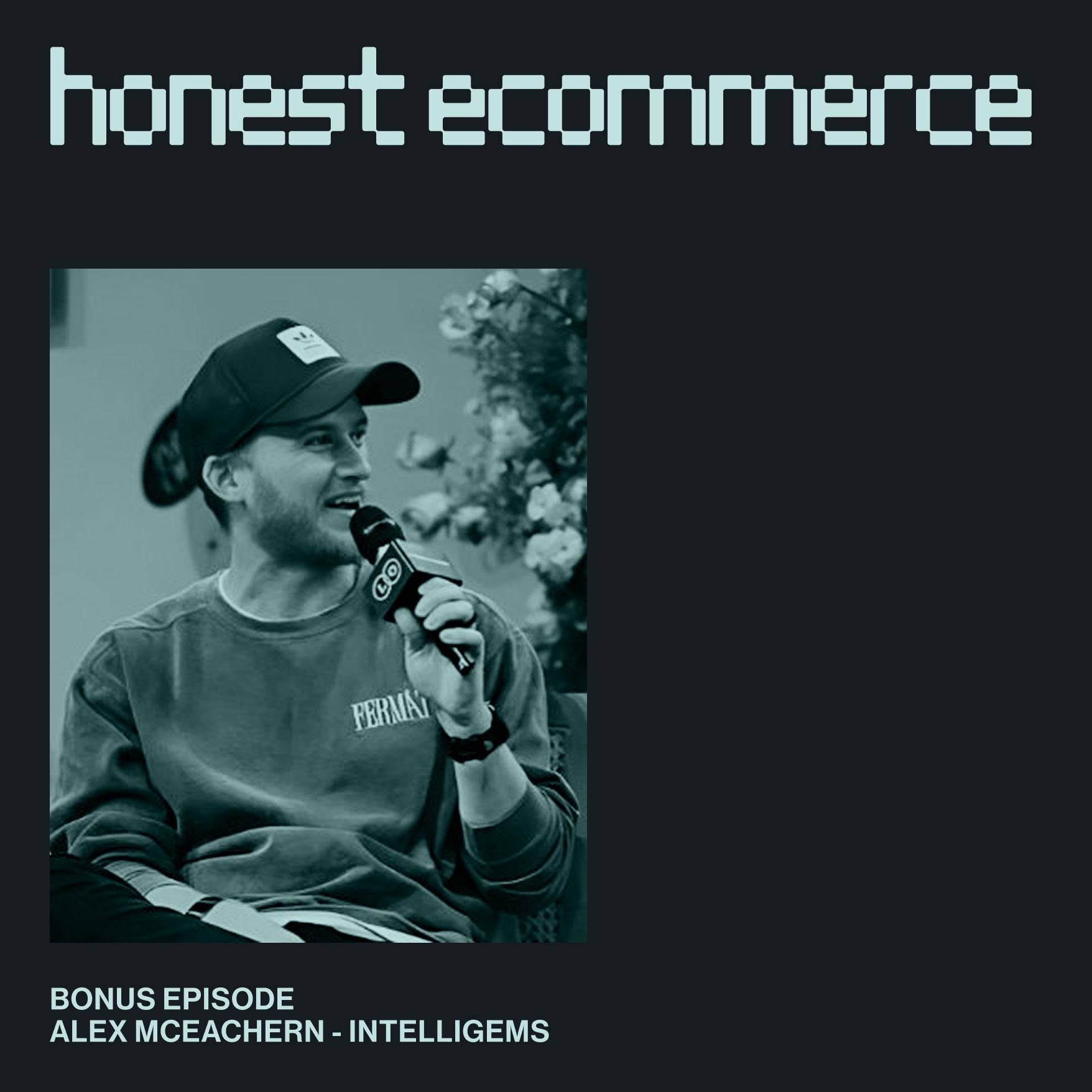
Honest Ecommerce is a weekly podcast where we interview direct-to-consumer brand founders and leaders to find out what it takes to start, grow, and scale an online business today. Hey everybody, welcome back to another bonus episode of Honest Ecommerce. Today I'm welcoming Alex from Intelligems. Alex, what is your title now over there?
Alex McEachern
Head of marketing. I'm also glad that you didn't attempt the last name, 'cause it always gets butchered.
Chase Clymer
Yeah, I've got some skill in this podcasting game. Been doing it for almost a decade now, so I can know when a word is going to defeat me when I try to read it.
Alex McEachern
Love it, love it. Yeah, head of marketing over here at Intelligems. Excited to jam, man. I feel like you and I always have great conversations. So excited to see what comes out of this.
Chase Clymer
Absolutely. So first things first, Intelligems is a huge partner of ours over at Electric Eye. This is not a sponsored episode by any means, but we use the product a lot. I'm gonna be heavily in favor of everything that they're doing over there. But you know, if you want to speak offline about my direct opinion of the product, it's probably not gonna change much from what you're hearing vocally here. They've sponsored a lot of our podcasts in the past, a lot of our events, all that jazz.
But this particular conversation is actually just us chatting. I was lucky enough to join Alex a few weeks ago on their podcast called IntelliJams, very, very great title for that. Now you can find it on YouTube, and it's also wherever normal podcast stuff is. Go—
Alex McEachern
Look for it wherever you get your podcasts, but the best experience is always on YouTube for that one.
Chase Clymer
Absolutely. And we're also, this is going out on YouTube, and we're finding some success with that. Alex and I actually chat about the YouTube algorithm and just podcasting in general, just so we can both try to make awesome content for the community out there. So Alex is a great guy, Intelligems is a great product. Enough with saying nice things. Let's get into it today.
If you couldn't guess, the overarching conversation is going to be about conversion rate optimization. And something that came up in our jam a few weeks ago that you really loved was the concept that conversion rate optimization is terribly named.
Alex McEachern
Yes. I think that I said to Chase right after we were talking, like, we could put together a full episode on this, and that's what I'm hoping that we can potentially do today. But yeah, CRO, I mean, you and I have been in space for a while. It's been the term, it's been the name for a decade in the Shopify ecosystem, in the commerce ecosystem, and I think it's time that we renamed it. I have some ideas on what we rename it to, but I'd love to go through what your thoughts are on CRO. The name, why it's not the right name. I just feel like it sells everything we do so short, and I'm getting sick of it and it needs a new name.
Chase Clymer
Yeah. It hits really close to home because we're redesigning our website right now, and the industry, and by industry I mean the customer, so at the end of the day it'd be the brands that work with our agency, they call it conversion rate optimization. They're typing into Google and into ChatGPT or Claude "conversion rate optimization." But maybe it's because we know too much. We're like, that's not actually, that's like one piece of what we're doing.
So let's see if you can remember, kind of how I explained it back in your episode on IntelliJams, what did a conversion mean historically? It kind of led into why this is named wrong.
Alex McEachern
Yeah, I think from what I remember, you were saying it came from computer programming at some point, or maybe, but conversion is just being the generalized term for "an action was taken." But in our industry, conversion has been changed to "purchase has happened." I think.
Chase Clymer
You hit the nail on the head. Yeah, that's exactly what it was. So whenever computers and the internet started, I don't know if this is pre-internet or not, but I'm assuming this is also something that would happen in just software, basically back in the day, a conversion was just the user doing whatever the heck you wanted them to do. So it'd be like clicking a button, submitting a form, viewing a page, right?
Actually a more modern example to think about this is with advertising: you can bid on a click, you can bid on a page view, you can bid on a form submit, you can bid on an actual purchase of your product, right? All of those kinds of things that you're bidding on and optimizing towards, all of those are conversion events in the grand scheme of things. So when you're generalizing and just saying "conversion rate optimization," people are only thinking about one particular thing, buying the product, which is leaving a lot of extra activity out there that specialists like us are taking care of.
Products like yours are optimizing towards it, it's hilarious, knowing what I know about your product, that you weren't optimizing towards conversions at one point. Even at the start of the product, it wasn't optimizing towards conversions at all.
Alex McEachern
Yeah. And this is one of the reasons that I don't love the name, conversion rate optimization in DTC means something very specific, and in our industry, it means "optimize for more purchase conversions." I don't like the term because when you think about conversion rate optimization, it's right there in the name, just the conversion isn't actually meaning you're getting a more successful outcome for your business.
My favorite straw man argument is: you want conversion to go up, drop your prices to zero. You're gonna have great conversion on those ads coming in, but it's not gonna be good for your business. So I think it's limiting, it's too narrowly focused, but it also needs to be broadened to include the ultimate goal for a brand, for a business, which is not just to get the most conversions I can possibly get. Everyone's gonna have their own definition of success, but it's all going to be more or less centered around growth, growth of the business. And I think a lot more often than not now, it's focused around profitable growth. Can I better my margins? Can I make sure that I'm doing this in a foundationally sound way, more than growth at all costs?
Chase Clymer
Yeah. And something that we do early on in the sales process, we ask a question, and it's not to be a gotcha question, it's to understand where this potential client is in their understanding of what CRO is, what conversion rate optimization is. We go: hey, if we increase your profit but your conversion rate actually goes down, is that a good outcome?
And they always have to think about it. We'll ask it in multiple ways, right? It's like, hey, if your average order value goes up but your conversion rate goes down a little bit, but overall your sales have increased, is that a win? Or do you purely need to see the conversion rate go up for you to consider this a successful partnership? These aren't gotcha moments, it's just trying to point out that this is one lever in a dozen or so important KPIs that you can probably optimize towards, but way less than that actually. We only care about three at the end of the day at Electric Eye.
But it's just, start to have these honest conversations up front, set proper expectations up front. And also, the perceived actions of what conversion rate optimization is is hilarious to me. I think we should get into that in a little bit. But what are your thoughts on what I just said?
Alex McEachern
Yeah, when you said, hey, we optimize the three things, those aren't gotcha moments. It's just that there are going to be people at a brand who are all optimizing for different things. If I'm on the ad side, I might want, I'm optimizing for traffic to the site, but I also want to make sure that traffic to the site is valuable to me. So, hey, I'm going to maybe be more focused on actual conversion, as we were talking about at the beginning, does the ad lead to a sale through this funnel or through this channel.
Then there might be someone who's the direct-to-consumer manager, who's more responsible for the site, and they might be like, I really care about AOV. It's my responsibility, if people are going to be sending me all this traffic, to make sure that I'm getting the most out of it. But then there's going to be a founder, or a CMO, or a VP Finance, or someone who's like, it's my responsibility to look at the P&L of this business. And all of these people care about, at the highest level, the same thing, even though they are all going to micro-optimize in different areas.
And, hey, if I try to micro-optimize on one thing, you alluded to it, something goes up, something else goes down, something else goes up. Very rarely do you run a test or an experiment where only the metric you're trying to isolate moves. Everything you do in terms of changes for your site is going to be some form of trade-off. And I love that you're asking those questions at the beginning to get an understanding of: what is an acceptable trade-off? What do you actually care about? Because I bet you it's not just "rock and roll."
Chase Clymer
Most of the time you will get people to admit out loud that it isn't, conversions just isn't the thing they're fixated on. They truly just want a more profitable business and a more optimized, let's call it a funnel, for lack of a better term, but we could probably have a whole conversation about that. They want to improve their business, and they know that their specialty lies in, they created a product that solves a problem, and it seems the consumers want it. They now are doing the smart thing of hiring experts who are good at looking at the data, looking at the surveys, looking at the analytics, to make informed hypotheses for us to test, pin an aside there about that.
They're smart to hire people like us, or many of the other dozens and dozens of partners that you partner with over there. And by partners, I mean other agencies, we're not the only people doing this in the world. But I will say we're the coolest. I don't know.
Alex McEachern
Yeah. And I think the other thing too is, even for us, you on the agency side, or us on the software side, there are some brands who are going to have people with "CRO" in their title. When you work with big enough brands, someone might have a CRO Specialist title, or they might be—
Chase Clymer
When I see that, sometimes it's, is it conversion rate optimization, or is it Chief Revenue Officer?
Alex McEachern
Yes, yes. I'm talking about the conversion rate optimizer. Usually the CRO doesn't have a "specialist" if they're a Chief Revenue Officer, they don't have "specialist" at the end, they're usually just the CRO. But I've been having a ton of conversations with people at some of these larger brands that aren't necessarily on Shopify, might not even be in commerce, and there's this kind of sentiment right now that CRO is being put into this box, that it's truly just about UX changes and trying to find small optimizations, stacking these smaller changes on top of each other to try to find a 2% here or a 5% there.
A lot of people are getting frustrated by this. It's like, the walls are kind of coming in around me, but I actually feel more like a product person, or a product manager, where I own something and it's my job to get the best result out of the thing that I'm managing. And I find that interesting, that CRO is trying to break away from these stigmas that exist from the past and trying to operate more like a product manager or a growth engineer, trying to shed this "Chase, you do CRO, and therefore you must do a lot of button color changes and headline changes," you just move a button here, you move this here, and that will completely change your business.
Those things can stack on top of each other, but you also need to try to find bigger, meatier things to go experiment with, to go test with. And I feel like CRO people, meaning conversion rate optimization people, are struggling with that right now.
Chase Clymer
Hey everybody, just a quick reminder. please like this video and subscribe if you haven't. We're releasing interviews like this every week, so don't miss out. Now, back to the interview.
I do want to talk about testing, because you brought it up and I alluded to it earlier, to burst the bubble of startups, you need a lot of velocity to actually do testing. Where we draw the line isn't even where the Intelligems product documentation draws the line, we're definitely a little bit more conservative. But when we're in conversations in the sales cycle with folks, we're like, are you doing a thousand conversions? A.k.a., are your customers buying a thousand orders a week? We want a week.
And the reason being, when you get to the point where you're doing testing, you need this thing called statistical significance. And that can happen in a vacuum over any sort of timeline, but in the real world, things change weekly, maybe even faster. You can't have politics, or Facebook's algorithm, you can't have seasonality, you can't have sales change within the timeline of you running a test. So if you're thinking about getting into conversion rate optimization, you need to make sure that you're selling enough stuff at a quick enough velocity, or you can't do testing.
You can still do optimization, and again, it's badly named. Why did conversion rate optimization just get lumped in with split testing? They're now amalgamated together. You can still optimize your store without running split tests if you're too young to do so, and you can still get a bunch of data through other apps in the ecosystem, or just other ways, to make informed decisions to make your store better. You just can't test it.
Alex McEachern
You used the term "informed decisions" there, because that's something that I actually talk about a lot, and other people at Intelligems might listen to what I'm about to say and be like, Alex, don't say that, don't say that. But yes, you need to be moving towards statistical significance if you're gonna be running a test. A lot of people think that to get to stat sig, you just need more data, more swings at the thing. That's true, the more data you have, the faster you're gonna get to statistical significance. But it's also a measure of how drastic the change is.
So if you're changing a button color, you're gonna have to wait forever to try to figure out if that's stat sig or not. But if you increase your prices by 20%, you're gonna see that mellow out faster and give you a more accurate read, because the change is so drastic. So I like the "informed decision" angle there, because one thing I always find myself saying is: ask important questions and validate important decisions. You can put yourself in a position where you feel more confident making a decision or having an answer to a question, even if it's not necessarily stating a very specific thing. You just feel like you're making a more informed decision than you were before, because you have more information, you've done it with more rigor than, I mean, most of the changes that happen in our world, which is: I made the change and I think it worked.
Chase Clymer
Yeah, I want to talk about button color, because it comes up a lot. Nobody listening to this podcast, nobody in my network, nobody in your network, which is definitely a lot of larger brands that use your product, button color won't do anything, right? Button color affects Instagram, with a thousand actions happening a second. It isn't something that's happening for conversion rate at even a hundred-million-dollar brand. I would love for someone to check me on this and be like, you know what, it actually does at a hundred million. But for a one-million-dollar, a five-million-dollar, a ten-million-dollar brand, button color, unless your button color was breaking the site, if it was just, we're gonna test red versus this other shade of red, no, it's not gonna have any real effect on it.
Alex McEachern
Yeah, someone fight us on it.
Chase Clymer
What will, one of my first coaches in teaching us CRO, one of the first things he said was: test more, test bigger things. Do complete layout changes, test those against each other. That's gonna give you a better result than, say, micro-changing one word in a headline. Okay, if that's the first thing that I'm reading, that might be a significant test. But one word in the product description, I don't think that's gonna do it. Test one product page versus another product page. If you're getting to the point where you're sending, not cold, but paid traffic from Meta to landing pages, maybe try one landing page format versus another landing page format.
Side quest here, I guess, Claude, or whatever your favorite AI, will straight up just give you a layout for your landing page based upon these formats. Just ask it, "what are some of the popular landing page formats," and then say, "well, here's my product, give me landing page designs for all these." Don't use its design though, holy, it's so bad at design. Don't have it design it, just tell it to lay it out, structure-wise, with placeholder copy. Then you and your copywriter make it better, and then give it to a real designer, and then you can develop it yourself.
I am unaffiliated with Ryan over at PageDek, but we have been playing with Pagedek with one of our clients right now. Not a big fan of "what you see is what you get" page editors, but it is kind of working, and all the data is there, so I'm not super mad at it right now. But I don't know, I'm done with my tangential side quest here.
Alex McEachern
My read on most things, or my thoughts on AI inside of experimentation, is it has become so easy to build on your own. Yeah, don't use Claude to design your stuff, but there are tools out there that help you get to a point where maybe you could port something into a Shopify template and see how it goes. And I think the build component of AI is kind of giving everyone the ability to change whatever they want, whenever they want. And you and I in our world are like, okay, but I also need AI to help me figure out what is actually worth doing, so that I don't just change a bunch of stuff constantly and constantly build to be productive.
And then I want AI on the other side of this too, to be like, "I made this change, what's going on", not just, hey, this one metric changed, but give me a read of what's happening in the business by doing these bigger things. And when you're talking about trying bigger things, you can even think bigger than some of the stuff we were talking about there. Like, what if I have live chat support on the site, can I experiment with having live chat support on and off? If I already offer live chat support, can I experiment with having the AI bot take over versus live chat? What does that do to revenue?
If I'm thinking about introducing a new flavor or scent, can I do a limited run and introduce that? Because I might think that that's going to be incremental to my business, that introducing this flavor or scent is going to get me more dollars. But maybe it just moves people to that scent from other scents, and I just have more products in my portfolio, more overhead cost of creating all this, but it doesn't actually lead to more profitability.
So when I say CRO is flawed, it's because I want people to think about all these higher-level things that you could be experimenting with, so that it's not just CRO, it's not just testing. A term I've been throwing around is "growth experimentation." You have ideas, you have hypotheses around what could change your business, what the limiting factors are, where you could go explore more growth. Go try some of those bigger things. And I'm not saying don't do the small stuff, you should always be trying to optimize, you can always find dollars in the optimizations. Do both.
Chase Clymer
Yeah. And obviously earlier I mentioned we're redesigning our website right now, and the headline copy on it is, we're definitely leaning more into our optimization shop, and, you know, "agency" versus "studio" versus another one-word kind of description, agency won out. So we're going with "Shopify Premier Optimization Agency," probably gonna be the big flagship headline on the website once it goes live. So we couldn't get too far away from conversion rate optimization, we're still using that word, but right underneath it, we're gonna have to list it, so Google likes us, so Claude pulls us up, so ChatGPT finds us in the LLM.
But the one thing I kind of want to end on here, because we are talking about AI a little bit now at the end, is AI is stupid, and I can prove it. Just because you can doesn't mean you should. And I think the one thing that AI has introduced is it's gotten rid of the barrier of entry of trying new things. And so people are trying everything. An old analogy that I've been using for years is: if everything's important, nothing is important. So you still need to slow down before you can speed up. You still need to have strategy, and AI, at a surface level, can understand strategy.
I'm not worried about our jobs. I'm not worried about anyone who's good at their job being replaced by AI. AI in the hands of someone who understands what they're doing makes them infinitely more capable. But AI in the hands of a layman just creates mediocre, if not terrible, results. So that's the end of my rant on AI.
Alex McEachern
Yeah, anyone can build anything now, it doesn't mean that it's going to be good. This is what I was getting at before: people can try a million different things right now. If you're trying a million different things and you never actually take the time to know what worked, you just have a million different things that you're working on. We said at the beginning of this, if the goal is "I'm in pursuit of more profitable growth," did doing sixteen to two hundred and sixty different things get me closer to that goal? I don't know, because I'm just making these changes and I'm not actually able to measure what's going on and tell myself confidently it was a good decision. It was just two hundred and sixty decisions that kept me busy.
Chase Clymer
Yeah, I think, a bad analogy, but one I'm gonna work on, is: I have a hammer, I have nails, I can go get some wood. Alex, I can build you a house, man. You want me to? You think it's gonna be a good house?
Alex McEachern
No. Actually, I don't know your capabilities as a carpenter or a craftsman, but I'm assuming no.
Chase Clymer
I'll tell you right now, it's not going to be good. No power of Claude, or YouTube, is going to offset the amount of time and skill it takes to actually learn the nuances of building a house and all the intricacies of every subsystem within building a house. So, obviously that sounded dumb, but that's what people are doing when they're saying that AI can build them a successful business. It can't, but it can help you along the way.
Alex McEachern
Yeah, man. Last thing I'll say is it's basically the Dunning-Kruger effect, right? AI is making people think they're better at something, but you get to a point, even a layman using AI gets to a point, where it's like, shit, I don't know what I don't know. But it accelerated the crap out of me getting to that point.
Chase Clymer
Absolutely. Alex, thank you so much for coming on the show today. If people want to hear you talk more, a.k.a. check out your podcast, where should they go, what should they do?
Alex McEachern
Yeah, best place to find it, go to YouTube, search IntelliJAMS, J-A-M-S. If you want more of me, you can find me on Twitter at Alex McEa, or just search Alex McEa on LinkedIn as well, and you'll find me.
Chase Clymer
Perfect. We'll link that stuff in the show notes. Go check out Intelligems if you're doing over a thousand orders a week and you want a cool product to help you with split testing. And obviously I'm gonna plug my agency, if you need someone to help you do the split testing, come up with the ideas, build a system that builds you an actual research-backed roadmap of what to test, that's what we're doing for dozens of brands all the time. Reach out to us at electriceye.io. Alex, thanks a lot. Talk to you soon.
Alex McEachern
Thanks for having me.