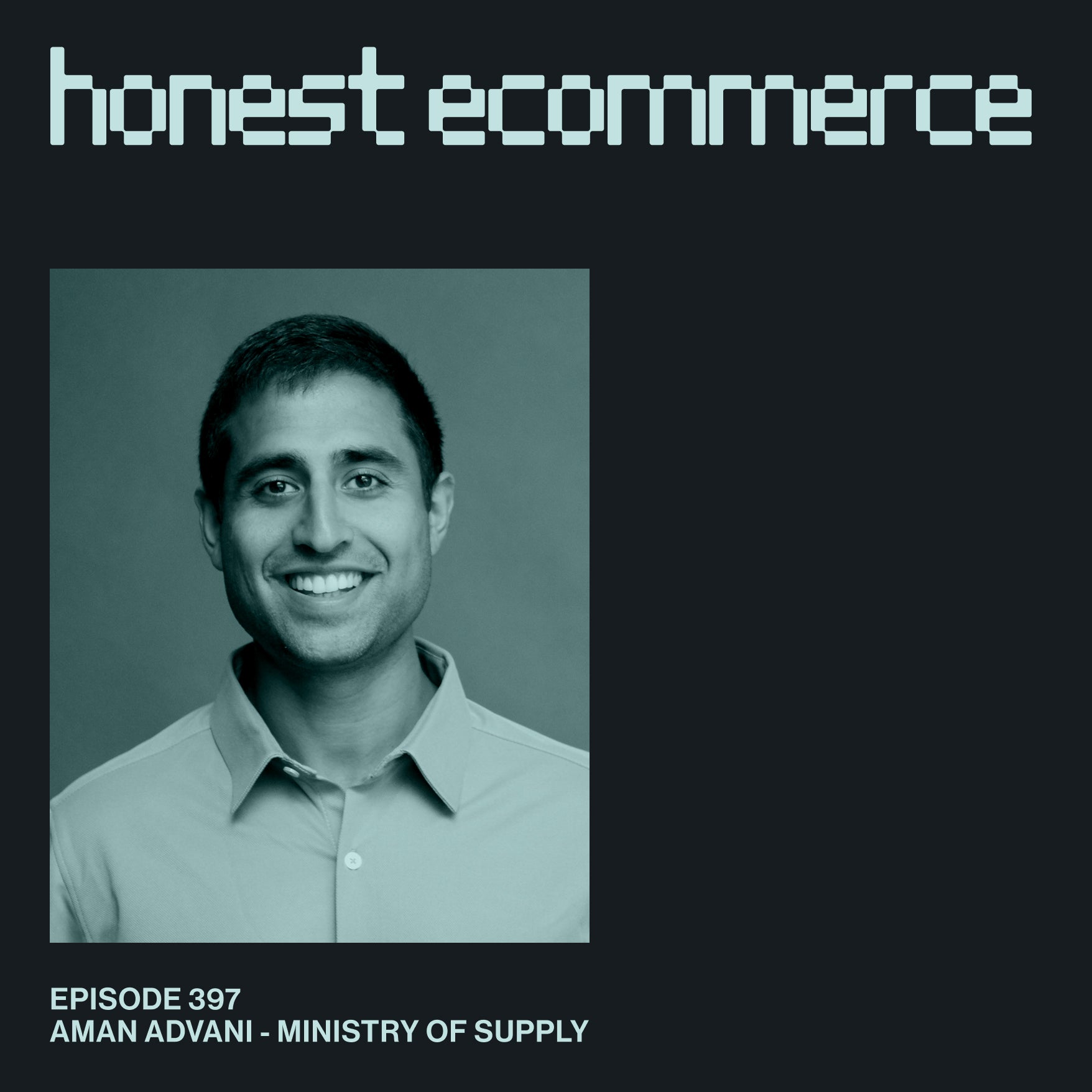
Aman Advani
Take the warm intro, ideally from someone who has had success, and then take the demo, take the trial, and decide for yourself. But the only wrong answer right now is sitting still.
Chase Clymer
What you're saying is, just take the demo on the brand side. You're gonna see some of your problems go away with AI, but you have to be open to talking to people. You also have to be direct in saying "this isn't a good fit for us" in some of those situations.
Honest Ecommerce is a weekly podcast where we interview direct-to-consumer brand founders and leaders to find out what it takes to start, grow, and scale an online business today.
Honest Ecommerce is proudly produced by Electric Eye, a Shopify Plus partner helping ecommerce brands sell more with strategic design and development. Visit electriceye.io for more information.
Hey everybody, welcome back to another episode of Honest Ecommerce. Today I'm welcoming back to the show the CEO of Ministry of Supply, a clothing brand that uses science to make the world's most comfortable clothing. Aman, welcome back to the show.
Aman Advani
Thank you so much. I appreciate you having me.
Chase Clymer
Absolutely. You were on the show, I'm gonna guess last year, but I have no concept of time, so it's sometime in the last twenty-four to thirty-six months. Just go search his name on the channel feed and you'll find that. And that episode is more of the founder's story, but Aman and I recently reconnected and we wanted to talk about something that we think is super interesting. To kind of give away the whole thing here, it's how a successful eight-figure brand is actually using AI in 2026.
Aman, I guess first talk to me about where you were when ChatGPT launched and what your first ideas were of it. That's what I want to know first.
Aman Advani
I love it. First of all, thanks again for having me for a second time. It's a true privilege and I appreciate these conversations. Can I answer a different question? Am I allowed to pivot your question?
Chase Clymer
Sure, I'll just ask a different question.
Aman Advani
I like it. Well, I'm thinking about when you said "when you first", ChatGPT certainly was everybody's first moment of "holy sh*t," right? That was my first personal moment of "this could be something professionally." A shout-out to Lovable for the actual first moment of like, "wait, this can actually change my life professionally too," right? And then eventually Claude came into the picture and blew everybody away.
But I think credit to Lovable — I think it was able to help create a vision for someone who's not inherently a designer, right? I could take my brain and put it out there, even internally, to showcase what I had been thinking about.
Chase Clymer
For folks that aren't familiar with what Lovable is or does, what does that software do?
Aman Advani
Yeah, so there are so many wonderful AI tools, and a lot of them run on the same backbone, but specifically Lovable — we've enjoyed using it, and now we use it publicly too for landing pages, sign-up forms, mini quizzes. I build all of my dashboards in Lovable now, because it's just easy to manipulate and see the outcome. Think of it as a LLM interface with a constantly updating, publicly available website.
MinistryofSupply.com, well, a section of it, is entirely Lovable-hosted. Anything you find there is something we built on Lovable using our brand book. It lets us quickly throw together an amazing campaign landing page. A friend got really sick, and we built a website for his family to keep everyone in touch with him, photos and updates on Lovable. So a ton of use cases, but I'd say: LLM meets great, quick visualization.
Chase Clymer
Yeah, I think one of the big problems with AI, and this is even pre-AI, when I figured out how to really harness Zapier, it exploded what I was doing personally and at the agency, but to dumb it down even further: what Lovable does, versus whatever AI you're using, is it just gives you code, and if you don't know what to do with that code, you've got something, but it's not production-ready and it's not on the internet, and no one can mess with it, I guess, is a simple way to put it.
But if you get Lovable and connect it to your AI, it now publishes that app to something that's just online. And as you start connecting more pieces of the puzzle, you're basically just building apps on the internet.
Aman Advani
Yeah, build on anything you want. And again, I keep saying, as a person who has a terrible ability to convey what's in my mind visually, a lot of these tools have been empowering for anyone who feels like they have a vision and can't show it. You can use AI to show your creative director what you had in mind, to give inspiration.
Chase Clymer
Absolutely. Now I've gotta ask a direct question here for the listeners. What is your technical background? Are you a full-stack developer? Do you have experience with large language models? What's going on there?
Aman Advani
None. I am an engineer by degree only. Beyond that, I would say technically adventurous, but otherwise no. I've never, I mean, the last time I properly coded was when I was like twenty-five, as a hobby. So nothing professionally or credential-wise, no.
Chase Clymer
Absolutely. So Lovable makes you notice that this is a game-changer, and then obviously Claude comes along, and the more recent Opus and Fable are insane. These things are here to stay and they are definitely impacting how people work, especially on both sides of the coin. It's fun to hear how you're using it as a brand, and I'm gonna share how we're using it as an agency as it comes up.
But I guess, what were some of the easier things that you found to give up the reins to, originally, to Claude or whatever AI you guys were using at the time? What were some of the first things to go?
Aman Advani
To be kind of pushed into the models, you're saying?
Chase Clymer
Yeah, or just, "this is no longer a human's problem."
Aman Advani
Yeah. You know what, it's really funny, because I'll give you my answer, then I'll caveat by saying I'm not sure it's the "right" answer. Early on there was a fairly strong anti-AI culture that was building within the company. I don't think we felt the need to get ahead of it, we thought it would kind of work itself out, and it eventually did, of course. But because of that, there was this fierce protection, this reluctance to use or celebrate AI early on, and this fear that it was threatening our jobs, threatening our humanity, threatening our creative abilities.
Whereas what I find, for the most part, is that it's amplifying that. And where it is taking our jobs, it's taking the worst part of it and opening up more space for you. So before anything, we had to figure out how to shift the company dynamic and culture to say: AI is not for everything, everyone, everywhere, every time, but it's got a lot of great spaces to plug into.
So, because of that, the answer to your question most directly is: analytics. We were using it very early on for taking complex data, we were running these massive Matrixify queries, dumping it into Chat at the time, and pulling out insights. That was our earliest use case of "holy shit, this would have taken me fifteen, twenty hours in Excel, and here I did it in ten minutes."
Chase Clymer
Do you know what's going on with Klaviyo? When is the last time you explored what it can do? Klaviyo has been shipping tons of new AI, data, and automation features designed to help Ecommerce teams move faster, personalize better, and automate more of the work that used to take entire teams. Most brands are only using a fraction of what is already inside their Klaviyo account.
Klaviyo is not just email and SMS anymore. It is your customer data platform, your lifecycle marketing engine, your analytics layer, and now your AI-assisted execution layer, all in one place. That means your customer data updates in real time. Your segments stay current automatically. Your flows and campaigns all run off the same source of truth. And now AI can help predict churn risk, forecast spend, recommend next-best products, generate campaign content, and optimize send timing across channels.
The big unlock is speed and efficiency. There are fewer tools to manage, less dependency on engineering, less time moving data between systems, and a lower total cost of ownership across your marketing stack. And brands are seeing real results from leaning further into Klaviyo.
Dollar Shave Club has reported over 30% reduction in total CRM stack costs after consolidating onto Klaviyo. Brands like Third Love have seen a 15x ROI from SMS after consolidating channels. And companies like Corkcicle have grown flow revenue over 90% after bringing email and SMS together inside Klaviyo. Across our customer base, almost every single brand we work with today is using Klaviyo.
That is just where serious Ecommerce customer data and lifecycle infrastructure are living these days. If you're already on Klaviyo but you feel like you're not getting everything you can out of it, or you're just running multiple tools and want to simplify without losing power, I think this is worth your time. You should head on over to Klaviyo.com/honest to learn more. That's K-L-A-V-I-Y-O.com/honest to learn more about what Klaviyo can do for you today.
Pulling the veil back on our strategy on how we run CRO — everything in our stack, I actually got some of our preferred apps to build an MCP for us privately, and then they pushed it publicly, so all of that information is available to our team within Claude. And 80% of CRO, for everyone listening, is customer surveys, analytics, and heat maps. So we dump all of those into Claude, and then, you know, we notice something that's on our roadmap and we're looking for supporting evidence, and Claude can help us find it.
But having that all in one place and being able to have a human conversation with it, it makes Dominica's job, who's our head of CRO over here, so much easier. And she is doing things that are ten times ahead of what I can even think about doing inside of it, because she's not only an expert at her job, but now she knows how to ask the right questions to get the results ten times faster, because all this stuff is in the same place.
Aman Advani
And then reallocates that time to far more important things. A good example of exactly what I just said: we launched these things called mystery boxes, which were basically a way to move a ton of inventory and still satiate and delight the customer. We had no idea they were gonna go gangbusters, I think we sold a few thousand of these things. They were a thousand bucks each, and the promise was that they'd contain something like three thousand dollars of MSRP value, and you're getting it for a thousand.
Now the challenge is: how do you allocate inventory to that? It's not an easy thing to do, there's no automation. So we ran it one time, stopped it after an hour because it was selling too much, and then prepared our CS team to run it a second time. The second time we ran it, we took all that data, dumped it all in the chat. Again, this was pre-Claude, which is funny that you have to qualify that now, and had Chat build a series of rules to allocate a massive pile of inventory and a massive pile of orders and bring the two together.
What would have taken our head of customer service, doing it manually, fifteen minutes per order times a thousand orders, it was gonna block out our next month, it wasn't quick or easy. I mean, it probably still took us two days to fine-tune it so it wouldn't just send you six pairs of pants. You have to build the rules to say: human merchandising is going to know how to make sure you get one top, one pant, one outerwear, one sock, one boxer. We had to train the model to replicate that thinking. It took some time, but still just a day or two, saving Alvy a month, which she could then spend doing much more valuable projects. So a good example of, probably, our first real use case.
Chase Clymer
I'm a huge fan of mystery boxes to help move inventory that's kind of static. Was one of the rules to allocate the random sizes of SKUs that you're not reordering, get those gone first? That's an amazing use case. Are you bringing the mystery box back for this holiday season?
Aman Advani
Yeah. It's tough, because as a receiver of a mystery box I'm always thrilled, but as a sender of them, the hit rate's not great. People have something in their mind of like, "I hope I get XYZ," and statistically you probably won't. So the feedback's always a little mixed, and I think we'll probably hold off for a little bit.
Chase Clymer
What is the next big idea that could change your business? A pricing change? A new bundling strategy? Adding subscriptions? Tweaking your shipping offer? Most brands make these decisions based on gut feel. They roll out the change, hope for the best, and have no real idea if it helped or hurt their business.
Intelligems fixes that. It is an AI-powered testing platform that brings CRO-level clarity to the decisions that actually move the needle, not just button colors and headlines, but the big stuff: pricing, offers, shipping, new apps, even major site changes. Brands like Ridge, Jones Road, and True Classic are using Intelligems to test their most important decisions and see exactly how each one impacts profit before they commit.
Momofuku used it to test promotional offers ahead of Black Friday and found the version that increased profit by about 28%. Mott & Bow ran structured pricing tests that drove roughly 30% more incremental profit. We use it at Electric Eye with almost every client we work with. And now Intelligems has a free AI-powered audit that gives you three specific ideas you can test on your store today, no commitment, no credit card, just three opportunities worth exploring.
Head to intelligems.io/audit and get your free audit in just a few minutes. That's intelligems.io/audit. Intelligems.io/audit.
As somebody that opens very expensive boxes of cardboard all the time, if you know what I'm talking about, the hit rates are very, very random. And it's the gambling part of it that people like. As we move beyond analytics, and obviously Claude shines with data sets. I love the example of how it took a big problem, allocating all this merchandise into specific things, and obviously the merchandise is a diminishing value as well, so that's something smart it had to rule out. Where else did it start to come into the Ministry of Supply's processes?
Aman Advani
Yeah, again, a lot of these things had just been shelved for lack of time, the effort would just be too hard. A good example is our return rate creeping up over time. We have all this data on what's being returned, by whom, when, and the stated reason, even if those reasons aren't perfect, they're still directionally correct. It's just a massive amount of data coming from four different sources that hasn't been triangulated.
All of a sudden our chief of staff was saying, "Hey, wait a second, this problem's been on the table forever. Every quarter we punt it and say we'll do a returns deep dive later. So this is the time." Two days later we have this magical, actionable plan on what to do, and our return rate came down something like eight points that year, I think it was like twenty-one percent down to thirteen. I always caution that a zero-percent return rate's probably a bad thing, because it means people aren't taking a chance on your product. So I don't know what the "right" answer was, but we were thrilled to see this material impact by providing a better experience.
So another good example of — it's not that it took someone's job, it's that it just wouldn't have happened. We would have never gotten the return rate down, and we might not exist today if you can't figure out things like that.
Chase Clymer
Yeah, and that eight-point difference is one hundred percent correlatable against the bottom line. Obviously you don't need to share any numbers there, but you can do some rough math on an eight-figure business, just imagine how many orders they had to pay for shipping both ways. That comes right out of the bottom line.
What about other areas of the business? You mentioned customer service a bit ago, building out these mystery boxes. Have you guys embraced the AI-and-live-agent commingling that I've seen some other brands working with?
Aman Advani
Yeah, you know, one of the things we've figured out is the line between "build it" and "buy it." I think early on our instinct was to build it, right? We can build anything now, why would we not?
Chase Clymer
I think the AI was making everybody overzealous, and then you did start building stuff.
Aman Advani
And overconfident. Yeah. There are some things we were able to build that we still use today, we have an internal tool called Ministry Production Systems, which is our forecasting tool. That was completely built in-house and it's awesome.
But more and more we figure that getting AI specialists who are right-priced given they're AI-powered, we're not paying for a human, finding software tools that were frankly ninety percent cheaper than their predecessor, but way more powerful. The example that comes to mind is a company you may have come across called Ripple. It's a layer that sits on top of Klaviyo, and they've done a lot of things really well. They've completely eradicated the concept of flows, which now feels archaic, this idea of "you abandoned your cart, right?" They completely replaced that with one-to-one journeys.
But the more impressive thing is they dropped an agent into our Slack that I probably talk to more than any other single individual. The Ripple agent controls all things email, it reports on every email after one, nine, and twenty-four hours. It runs our A/B tests, reports on our A/B tests, send-time tests, subject-line tests, sends out thousands, millions of emails a month, one-to-one with your weather forecast and your cart and your order history in mind. It's just incredible.
Why would we want to build that? It exists today, and there's no reason for us to go and build it again. If they were charging what it would have cost to buy all of that five years ago, with an eight-person agency dedicated to getting all that, we wouldn't do it. But now we can. Sorry, I cut you off, Chase.
Chase Clymer
No, no, no. You kind of got to where my question was gonna be, which was: is this tool doing it internally? Are you still running your email, or is it completely running your email for you? Does someone still own your retention and email stuff internally, or are you still working with a partner?
Aman Advani
Yeah, well, for any of these, we've got an internal representative who naturally has to control the AI here, but I would say we're probably spending seventy percent less human time deploying twice as many emails, and the quality of those emails is far greater too. We're sending out more campaigns, but to hyper-targeted segments, because now that doesn't take more time to do, a men's and women's segment, two emails a day instead of one, because we can. And that doesn't mean we're not still writing the copy, that doesn't mean we're not still doing a photo shoot in a month, we're still doing all the things it takes to make those great. But the ability to deploy them accurately, strongly, carefully, and at volume is unreal.
Chase Clymer
You have prepped all year, and all that hard work is paying off. Your store is converting, the ads are working, and this is shaping up to be your best holiday season. But your 3PL can't keep up. Orders are backing up, customers are asking where their stuff is, the reviews are starting to turn. All that hard work, all that momentum, undone by a fulfillment partner that can't scale with you. This is a nightmare scenario, and it happens to brands every holiday season.
Enter eFulfillment Service. eFulfillment Service is the 3PL that scales with you. They are family-owned, they've been in business for over 25 years, and they're built specifically for growing direct-to-consumer brands. There are no setup fees, no minimums, and no long-term contracts, you only pay for what you use.
If you're scared your 3PL can't keep up this holiday season, now is the time to reach out to eFulfillment Service. Go to eFulfillmentservice.com/honest and get up to eight weeks of account fees completely waived. That's E-F-U-L-F-I-L-L-M-E-N-T-S-E-R-V-I-C-E dot com slash H-O-N-E-S-T. eFulfillmentservice.com/honest.
Absolutely. And that's something, I mean, we're still talking with seven-figure businesses all the time where email is still an afterthought for them, and they're like, "we're lucky if we send one a month." And I'm like, we're not an email agency, and I can tell you right now, with the power of AI, you can double your business just by taking this more seriously.
But just with marketing and advertising in mind, where else have you found efficiencies that are helping to get more out of what a standard human might have been doing just twenty-four months ago?
Aman Advani
Yeah, it's so hard to answer this question without sounding like I'm a billboard for the twelve AI-powered partners we use. I just gave a four-minute commercial for Ripple, and now Lovable, I'm just a fan of all these.
Chase Clymer
Well, here's the thing, you can build these with Claude or Chat or whatever. It's the eighty-twenty rule here. You can spend less time and get it up and running, and there are reasons to buy and not build, that could be a whole other episode.
Aman Advani
Totally. But more and more I'm finding that if it's gonna be a set-it-and-forget-it, build it. If it's gonna require maintenance, upkeep, and evolution, then buy it. That's the fine line we figured out. The Ripple example, do what they're doing, not to say that I could even set it up initially, but its ability to learn so quickly and become such a big part of our stack would be impossible to do on an ongoing basis. So that's really, buy it.
Customers.ai, they do third-party identity resolution for anonymous visitors, and first-party too. Maybe we could build it once, but it wouldn't be as good as their model, it wouldn't evolve as fast as their model, and it might have compliance or legal issues. So it's, no, buy it, so long as it's reasonable. A lot of this stuff's eighty, ninety percent cheaper than it was two years ago, because they know that repricing is coming.
Chase Clymer
Yeah, it's funny talking about the tech stack, I don't know if you experienced this, but we experienced it internally as we were looking at the tools we were paying for. One of the things we decided was: if a tool can do multiple things and we're gonna get it connected into our AI stack, we should just use tools for more things. We actually invested more in Google specifically and got rid of, we were using Fathom to record calls, we were using Calendly to schedule, and we invested more in specific things just to make it easier for the AI to find all the information and to speed up anything we were doing within our own systems. Was there anything similar like that you guys stumbled upon?
Aman Advani
Yeah, that was actually the core of what I mentioned earlier, our Ministry Production System. What we needed was somewhere in between an Excel sheet and an ERP. An Excel sheet was too messy and an ERP was too heavy, but it had to be bespoke like an ERP while being quick and nimble like an Excel sheet. There was no off-the-shelf answer. For years we tested out "ERP light" or small solutions. Once we figured out we could pack these things together, we built Ministry Production Systems largely using AI tools. We kind of vibe-coded an entire production system where we could place POs, make box labels, do everything in one system.
Chase Clymer
That's amazing. I'm sure someone's gonna reach out to you after this and be like, "can I see that? That might be a problem we have too." Have you ever thought about the idea of, as folks say, "selling your sawdust," or do you think it's too bespoke to what you guys are doing over there at the Ministry of Supply?
Aman Advani
You know, we have this moment of, "can we commercialize this production system?" And actually I'd be curious to ask you the same question about your own homemade software. I think the problem is, one, I'd rather just teach you how to do it yourself and own it, because I don't want to maintain your system forever. And two, it's not our business, we sell clothes. We made this system to sell more clothes. Let's sell more clothes. So I think it's not where our heart is, but there are many reasons not to commercialize it, and that's certainly one of them. Have you guys ever come across this? I'll bounce the same question back to you.
Chase Clymer
Yeah, we have, and we've gone down that rabbit hole a few times. One of them was: we had an internal theme framework that we had built out, and we're like, "all right, let's just put this in the Shopify theme store as an agency, having a theme." Those are pretty dang close and it makes a lot of sense. But the timing was just off, because the second we really took it seriously, they announced Online Store 2.0 and sections everywhere, and we're like, "well, now we just have to start over from scratch." So that got put on the shelf and we never revisited it, we couldn't just refactor it with Claude and make our lives easier.
But to something you mentioned, it isn't our business, and we've done a good job, I mean, we still are entrepreneurs at heart, shiny object syndrome is real. There are things that take us away from what the main thing is, but I always like to keep the main thing the main thing. My partner and I have some irons in the fire on other things that are not the agency itself, but the agency pays my mortgage, and I need to focus on the agency.
Aman Advani
That's it, right? That's what I'm good at, that's what I care about. There's some level of passion, purpose, and focus, not being distracted.
Chase Clymer
Exactly. But you see all these amazing stories about how things got spun off, about how some pivot happened. There's definitely some survivorship bias there, I think some people might have tanked their successful business by chasing some "what if" and losing focus. I actually have stories about that, but I'm not gonna share them here because it's not my story to tell. So it does exist, you know what I mean?
I'd be cautious about it, but also, I think teaching people how to do it and putting that out there kind of goes back to some interesting conversations we've had lately. Obviously our clients are brands that exist in the ecosystem, assuming that because AI exists, our prices should be lower. I think it's a really interesting conversation that you and I can have, because you're obviously buying agency services all the time for random things. Our position is: our value just skyrocketed because of our efficiency and the time-to-value on the things we're doing for you. It's not necessarily gonna make things cheaper, you're just gonna get more value faster.
Aman Advani
Hundred percent. I love this phrase I heard someone use, "services of software". I don't know if you've heard that phrase used, but I loved it. I thought it was brilliant to say that now it's actually the people that matter more, because something's gotta guide and direct all this from happening. If you're just giving me a plain, straightforward, simple piece of software, I do expect that to come down in price over the coming years. But if you're providing a service layer on top of it, that just becomes more valuable. I think you're right, if there's a human involved, I value it more.
Chase Clymer
Yeah, and I don't ever like to take a rude position, but sometimes I'm like, "try to do it yourself and then come back to me", and if you can do it and figure it out, power to you, you just saved whatever that investment looks like. But I think there are people who don't actually interact with and try to use these tools, and they just assume everything is perfect and easy, and that Claude isn't dumb sometimes. The things it hallucinates are still hilarious to me.
Aman Advani
Yeah, no, I get that, and I very much agree.
Chase Clymer
Hey everybody, just a quick reminder: please like this video and subscribe if you haven't. We're releasing interviews like this every week, so don't miss out. Now, back to the interview.
What do you think the future looks like? Are you guys kind of paused on integrating AI into your systems? Are you still trying to find new ways to use it? Are you still looking to build out more tools like your internal system, or still testing new things that are coming up? I get an email every day from a new AI tool, it's a little bit wild. What do you, let's just time-box it. We're recording this in August, between now and the end of the year, Q4 2026, where do you see you guys with AI going?
Aman Advani
I think you nailed it with that last piece there, probably ten more demos, five more trials, and three more partners doing something in our stack that is extremely valuable. We just talked to Intelligems right before this call about setting up an automated, fully done-for-you CRO system, which again is a fraction of what that would have cost five years ago, where it's ninety percent AI, ten percent human, driving constant guaranteed improvement. So it's like, what a joy, let's give it a shot.
So in all these cases, just take the demo, take the warm intro, ideally from someone who has had success, and then take the demo, take the trial, and decide for yourself. But the only wrong answer right now is sitting still.
Chase Clymer
Yeah. There's a podcast out there that I am a huge fan of, there'll be maybe five people listening to this podcast where there's overlap, but it's called Two Bobs, and it's about agency owners. Blair Enns is one of the guys who wrote Pricing Creativity. He's a huge name in the consulting space. But anyways, on that show they were talking about selling productized services and what the ecosystem looks like right now, in 2026. One of the things they said is that the people who are winning are just getting the demo and showing people how they solved a similar problem for somebody else.
So I think what you're saying is: just take the demo on the brand side, and you're gonna see some of your problems go away with AI, but you have to be open to talking to people. You also have to be direct in saying "this isn't a good fit for us" in some of those situations.
Aman Advani
Yeah, yeah. I actually find that conversation is easier, the harder one is on the front side of it, getting the team on board with this concept of quick, low-thought testing. And by low-thought I mean don't overthink it, we have capacity, we can get a test live, give it a shot. We're testing Aftersell right now for post-purchase upsells, get it live, see what happens. Nothing's gonna get hurt in two days of it being on the market, as long as you installed it properly. If it doesn't work, or you get some bad feedback, reconsider it, but just push it live and test it out.
Chase Clymer
Absolutely. That's the whole startup synopsis in a nutshell, just test, learn, iterate. That's basically Startup 101.
Aman, I can't thank you enough for coming on the show today and sharing all these awesome insights. Anything I didn't ask you about that you think would resonate with our audience?
Aman Advani
No, I'd say take the demo. If there's one thing to take away, I really like where we landed on this conversation, which is, just test. I think there are a ton of brilliant creators out there doing some amazing things that I couldn't even dream of building myself. Like I said, even if we had the choice to build it or buy it, it wouldn't make sense. Reward good work through trial.
Chase Clymer
Awesome. Thank you so much for coming on the show today.
Aman Advani
Thanks, I appreciate it.