Robert Patton
The universe is challenging you. It's not just gonna open the doors to the kingdom without a few tests, if you will. But never in my mind did I say, "I'm giving up, this is too hard." A lot of people would quit at that point. And I had a lot of people telling me, you know, "It was a good run, you did great, just get a real job."
Chase Clymer
Honest Ecommerce is a weekly podcast where we interview direct-to-consumer brand founders and leaders to find out what it takes to start, grow, and scale an online business today.
[Sponsor: Electric Eye]
Honest Ecommerce is proudly produced by Electric Eye, a Shopify Plus partner helping Ecommerce brands sell more with strategic design and development. Visit electriceye.io for more information.
Hey everybody, welcome back to another episode of Honest ECommerce. Today I'm welcoming to the show the CEO of Sheath Underwear, Robert Patton. Robert, welcome to the show.
Robert Patton
Thank you so much, Chase, for having me. It's an honor.
Chase Clymer
I'm excited to dive into this. So for folks that are unaware, what types of products do you guys bring to market over there at Sheath?
Robert Patton
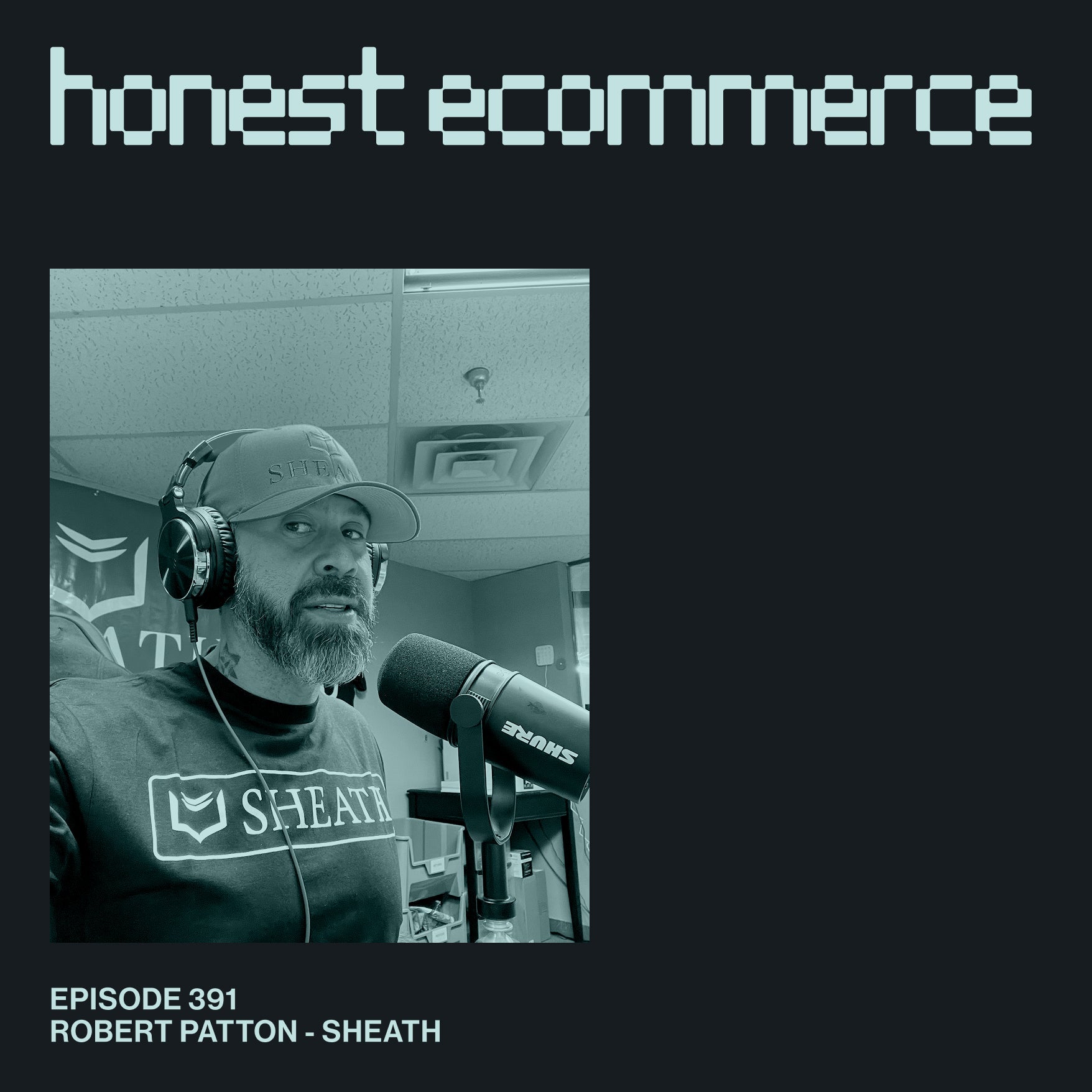
Mostly men's underwear, but we also have women's underwear, and we have some accessories like hats and hoodies, socks and neck guards, base layers, things of that sort. But the main product is our men's pouch underwear, which I can show you real quick. So it looks like regular underwear on the outside, but on the inside there's a pouch for the boys, and it isolates everything from your inner thighs to keep you from sticking and chafing. It's rather comfortable.
Chase Clymer
Absolutely. Now take me back in time, where did the idea for the flagship Sheath underwear come from?
Robert Patton
All right, well, it's a unique story. I served two tours in the Army. I did it for six years. I was a sergeant. And on my second tour, in Iraq, it's very hot. Our generator had gone down, the water wasn't working, and we couldn't shower, and it was just really hot and I was uncomfortable. The male anatomy is one of the hottest parts of our body, and I was just very uncomfortable. It was one of those necessity-is-the-mother-of-invention type things. I was like, "I need to separate the situation downstairs." I immediately went to where we lived and grabbed a towel and just kind of separated everything with a towel, because it was just that bad. I don't know if guys have experienced it to that extreme, but I know guys have experienced it to some degree.
At that moment I also had this light bulb: what if there was a pouch on the inside that just isolated everything? I actually immediately got started while I was in Iraq. We have what's called a PX, post exchange, and it's kind of like a little mini Walmart. I went and grabbed some underwear, I grabbed some pencils and paper, some scissors, and started drawing out what I was seeing in my head. We also have tailors in the Army, in case you need to tighten up your uniform. So I draw out this design, take some underwear and the drawings to the tailors in Iraq, and I say, "I don't need you to tailor my uniform, I need you to tailor my underwear." They snickered at me, they thought it was kind of funny, but they did it. I went back a couple of days later and picked up this pair of underwear with a pouch in it. The pouch was very small in the initial prototype, but the concept was there. I actually have a picture of me in Iraq holding them up, one of my fellow soldiers took a picture, and that's where it all started.
Chase Clymer
That's hilarious. So what would you say was the time between you having this aha moment in your head and having essentially the first prototype in your hands?
Robert Patton
Honestly, it was less than a week, I'd say even half a week. To backtrack a smidge, right before I left to go to Iraq, I had watched this movie called The Secret, about manifesting. One of the principles was: act fast, do not hesitate, the universe likes speed. So when you have an idea, don't wait, start moving toward it. There are so many success principles that suggest that you just take the first step and have faith that it's going to unfold in the way the universe sees fit, I guess. That was all kind of fresh in my mind while I was out there, and I had read Think and Grow Rich many times before.
I wanted something more than just to be in the Army. It was great, I did love the Army, it was actually quite fun, except being in Iraq and seeing dead people. The basic training, the shooting guns, obstacle courses, land navigation, they give you so much training, and I really enjoyed it. You're repelling out of helicopters, maybe jumping out of airplanes, it was so cool. The Army is awesome, and it's a great launch pad for young men to go from adolescence to manhood. I feel like a lot of men should join the military. The unfortunate part is that you might die, or get severely injured, or have some kind of post-traumatic stress after seeing things that normal people don't see. But it's kind of like an initiation into manhood, and I was twenty-six when I joined, so I was a little late to the game but I was still pretty immature.
I really felt like after basic training, little pat on my back, you're competing against your fellow soldiers, at least in basic training, and physical fitness is one of the main categories of determining if you want it bad enough, if you want to be in the Army. Push-ups, sit-ups, and running were the main things, and I beat everyone in our battalion in the physical fitness aspect. That gave me this little bit of confidence, like, "Whoa, I can actually compete against my peers and excel." It pushes you to a level that you wouldn't otherwise be pushed to, unless maybe you're trying to fight in an octagon, or playing sports is a similar kind of analogy.
[Ad break: Klaviyo]
Do you know what's going on with Klaviyo? When was the last time you explored what it can do? Klaviyo has been shipping tons of new AI, data, and automation features designed to help e-commerce teams move faster, personalize better, and automate more of the work that used to take entire teams. Most brands are only using a fraction of what is already inside their Klaviyo account. Klaviyo is not just email and SMS anymore, it is your customer data platform, your lifecycle marketing engine, your analytics layer, and now your AI-assisted execution layer, all in one place. That means your customer data updates in real time, your segments stay current automatically, and your flows and campaigns all run off the same source of truth. Now AI can help predict churn risk, forecast spend, recommend next-best products, generate campaign content, and optimize send timing across channels.
The big unlock is speed and efficiency. There are fewer tools to manage, less dependency on engineering, less time moving data between systems, and a lower total cost of ownership across your marketing stack. Brands are seeing real results from leaning further into Klaviyo. Dollar Shave Club has reported over a 30% reduction in total CRM stack costs after consolidating onto Klaviyo. Brands like ThirdLove have seen a 15x ROI from SMS after consolidating channels. And companies like Corkcicle have grown flow revenue over 90% after bringing email and SMS together inside Klaviyo. Across our customer base, almost every single brand we work with today is using Klaviyo, that is just where serious e-commerce customer data and lifecycle infrastructure is living these days.
If you're already on Klaviyo but feel like you're not getting everything you can out of it, or you're running multiple tools and want to simplify without losing power, I think this is worth your time. You should head on over to klaviyo.com/honest to learn more about what Klaviyo can do for you today.
Chase Clymer
Obviously I'm familiar with The Secret, I'm familiar with Napoleon Hill's Think and Grow Rich. So going into your time in Iraq, you'd already had the seeds planted for an entrepreneurial mindset. When you got back this first prototype, obviously the sizing was a bit off, but it hit the nail on the head as far as, "This is what I envisioned." How many iterations did you go through there? Did you have to wait until after your tour to get started on the actual business? What were the next steps from there?
Robert Patton
Great question. Initially I was just making it for myself, so I wasn't necessarily doing the entrepreneurial thing at that point, even though I had all this background. There were some components of "this could be something," but also it was initially for myself. When I got home, I had to wait, there was really not a lot I could do while I was in Iraq other than what I did.
Once I got home, I bought a sewing machine and converted all my underwear. I went to Ross, bought a bunch of cheaper underwear, and started making prototypes to hand out to friends and other soldiers. I remember we were on a field training exercise where again it's really difficult to shower, and explaining the concept to fellow soldiers, they totally got it. Then I told my younger brother, who was really excited about the idea. I was still in the Army though, and it's hard to start a business while you're in the Army, when you're kind of in a job, it's hard to break out of the matrix of what you're programmed for. But with a lot of prodding, he influenced me to decide to turn it into a business.
That didn't take too long. It was 2008. The first launch was actually in 2010. So between 2008 and 2010, I'm trying to figure out how you even make underwear. I didn't know what I was doing, how do you find a manufacturer? I was Googling, and I went to a website called MFG.com, which I assume meant manufacturing.com. I took a little video of myself with a prototype and submitted it, and within a few days I had about twelve different companies responding with offers and costs. This guy from Pakistan actually called me, and he spoke really good English. I explained I didn't know what I was doing, and he said, "No problem, I'll basically hold your hand through this whole process." So I went with them, and it was $5,000 for the first production. We purchased a thousand pairs, five hundred white and five hundred black, in various sizes.
I sent them the prototype, they sent me back a prototype, and I said, "This is pretty good, we need to make a couple of adjustments." They sent me an adjustment, and I was so excited that I rushed the production, which I should have actually gone through a few more iterations on, because when I got these thousand pairs, the pouch was too high, and there was pilling, where the fabric was shedding on the black pairs. I'm handing out these pairs to my neighbors, and they're just like, "It's all right, it's all right." They didn't want to be mean, and I was kind of in denial, I thought it was good enough, but ultimately I couldn't sell them. I sold a few pairs, but ultimately came to the conclusion that this was not the proper launch.
So there was a tailor in town, a Vietnamese tailor named Tony, he was the man. I asked him, "If I work your counter for free, just deal with customer service stuff, will you help me revise this and teach me what I'm doing wrong?" He was very suspicious at first, and he had these older Vietnamese ladies in the back room who thought I was trying to scam him, they were like, "What is this guy doing?" But ultimately he agreed, and we had a great friendship over the couple of years I was there. We came up with a new prototype around 2012 or 2013, right when Kickstarter came out.
I assume you're familiar with Kickstarter. I had spent my last $5,000, and now I'm out of the Army, working, cleaning golf carts, delivering Chinese food, going to school. I ended up getting my bachelor's and my master's over the course of the next five years. In 2013 we did a Kickstarter, for those who aren't familiar with it, you present your concept to the public and they decide whether or not they want to pre-order your product, knowing that you're going to pool all their money together, make a purchase, and it's going to take six months for them to get their product. It was successful, we got about three hundred people who pre-ordered, and we were able to make our first production with a new company.
There's just a lot of stuff that happened in between, I could write a book. But we were successful, we got the product, we sent it out. It was so exciting, that's some of the most exciting times of the journey, that very beginning when you get that first successful moment and you're like, "This is happening." So we get it, everyone's happy, we sell out, and I go to reorder more with all the proceeds, I wasn't even paying myself, just trying to grow everything.
[Ad break: Intelligems]
What is the next big idea that could change your business? A pricing change? A new bundling strategy? Adding subscriptions? Tweaking your shipping offer? Most brands make these decisions based on gut feel, they roll out the change, hope for the best, and have no real idea if it helped or hurt their business. Intelligems fixes that. It is an AI-powered testing platform that brings CRO-level clarity to the decisions that actually move the needle, not just button colors and headlines, but the big stuff: pricing, offers, shipping, new apps, even major site changes.
Brands like Ridge, Jones Road, and True Classic are using Intelligems to test their most important decisions and see exactly how each one impacts profit before they commit. Momofuku used it to test promotional offers ahead of Black Friday and found the version that increased profit by about 28%. Mott & Bow ran structured pricing tests that drove roughly 30% more incremental profit. We use it at Electric Eye with almost every client we work with. Now Intelligems has a free AI-powered audit that gives you three specific ideas you can test on your store today, no commitment, no credit card, just three opportunities worth exploring. Head to intelligems.io/audit and get your free audit in just a few minutes. That's intelligems.io/audit.
Robert Patton
The second production I got from that same company was botched. I get ten boxes of underwear that again I can't sell. So now we're back at ground zero, and I'm like, "Dude, what is going on?" But this is back to The Secret, the universe is challenging you, it's not just going to open the doors to the kingdom without a few tests. Never in my mind did I say, "I'm giving up, this is too hard." A lot of people would quit at that point, and I had a lot of people telling me, "It was a good run, you did great, just get a real job." My older brother in particular, which is funny, he still tells me to do that, fifteen years later. But I wasn't going to give up.
So what do you do? You don't have any money, you don't have a product. My great idea was, "Let's do another Kickstarter, because it worked the first time, let's try it again." But I needed another manufacturer, and this is where I feel like by not quitting, the universe sent me a gift. I got an email from a manufacturer who wanted to produce for us. Her name is Annie, and we're still working with her twelve years later. I sent her a prototype, she sent one back, and it was better than what I sent her. It was so good.
There was this downtime between 2013 and 2014 where I'm still cleaning golf carts, delivering Chinese food, and obviously there's anxiety, is this next Kickstarter going to work? It worked once, but it's not guaranteed to work again. I would be laying in my bed riddled with anxiety at night, freaking out, like, "What am I doing?" But when that would happen, I'd go into my closet, grab that prototype, and put it on, and it was so good, I get emotional sometimes because it was like a warm, refreshing feeling. All the anxiety would fade away when I put that pair on. I was like, "I know this is going to work, they're going to love it, it is so good." They were so comfortable.
We kept moving forward, did another Kickstarter, and it was successful, we doubled the revenue from the previous Kickstarter. Then it was off to the races. In 2013 we made $30,000, based off the sales from that original batch and the Kickstarter. In 2014 we did $60,000. 2015 we did $150,000. Then we did $250,000, then half a million, then a million, then two million, then four million, doubling revenue every year. It was actually quite easy, almost too easy, because we were one of few pouch-underwear companies at the time. Now there are over a hundred different pouch underwear companies, so it's not quite as easy to double each year as it was, but that makes it fun, you've got to get creative. And now we're in AI. We came up with an idea for a new launch for 2027 called the Black Collection, and we made all five pairs during a Monday morning meeting where we came up with the designs for this new collection, which we're excited about.
Chase Clymer
Are you saying that using AI allowed you to rapidly compress the timeline it originally took you to design these concepts?
Robert Patton
Yeah. It used to be you'd have to draw it out, then send it to your graphic designer. We used to have three graphic designers, now we have one, and he's awesome. Raul, shout out. When AI started coming out, he was very excited about it and kind of took the lead and spearheaded that whole thing. He's our AI guy now, before, he was just running our Amazon part of the company, and now he heads our AI department. He was able to whip up five new designs in a matter, basically we told him, "Okay, do a dragon scale, do topography, do a fingerprint," these various patterns, and he whipped them up, and we'd say, "That one's a little funky, redo that," or "Ooh, that one's awesome, on to the next one." It significantly compresses the amount of time it takes to create a new design.
[Ad break: eFulfillment Service]
Prepped all year, and all that hard work is paying off. Your store is converting, the ads are working, and this is shaping up to be your best holiday season. But your 3PL can't keep up, orders are backing up, customers are asking where their stuff is, the reviews are starting to turn. All that hard work, all that momentum, undone by a fulfillment partner that can't scale with you. This is a nightmare scenario, and it happens to brands every holiday season.
Enter eFulfillment Service. eFulfillment Service is the 3PL that scales with you. They are family owned, they've been in business for over 25 years, and they're built specifically for growing direct-to-consumer brands. There are no setup fees, no minimums, and no long-term contracts, you only pay for what you use. If you're scared your 3PL can't keep up this holiday season, now is the time to reach out to eFulfillment Service. Go to efulfillmentservice.com/honest and get up to eight weeks of account fees completely waived. That's efulfillmentservice.com/honest.
Chase Clymer
I do need to go back and ask a follow-up question though. You have the successful second Kickstarter launch, and then obviously the brand does 30, 60, 150, you're seeing traction, you're getting product-market fit. How did you get customers outside of Kickstarter? I know there are entrepreneurs out there who are at that phase where, "I believe in my product, I'm getting good feedback from the people I know, but I don't know how to get it in front of people I don't know." How did you make that shift, and how did you find other customers?
Robert Patton
Great question. First of all, my brother had been running people's Facebook pages for them for quite a while, he'd manage their Facebook platform and do ads and posts. So he was doing our Facebook pages and other platforms. He's also a videographer, part of a couple of different documentaries, so he made a lot of our content. And of course you use all of the traditional platforms for social media.
But growing up, my dad used to listen to talk radio all the time, every time we got in the car it'd be Rush Limbaugh or some right-wing conservative talk show, which was awesome, I always loved listening to it. And of course this was around the time Joe Rogan came out with the Joe Rogan Experience, and I was listening to it all the time. So I wanted to sponsor Joe Rogan. My great idea was: he comes to Austin for a comedy show, and when I find the right time, I'm going to throw a pair of underwear onto the stage. He's going to pick it up and say, "I want to work with this company," and the rest will be history.
What happened was I threw the underwear on stage, he picked it up, it was the perfect toss, landed right at his feet. I was way up in the bleachers in the crowd, and we were in Austin, so he's like, "What is this, an 'Austin is Weird' shirt?" He picks it up and goes, "Sheath." At the time, the packaging described what it was, so he's reading it, "A pouch in your underwear? What do you need a pouch in your underwear for? You are trying to smuggle drugs, what are you doing out there? This has got to be the stupidest idea I've ever heard of." That kind of crushed me, but then immediately after he said, "...or a billion-dollar idea." And the second part of that statement was actually true, because it is a billion dollar idea. Pouch underwear is generating billions of dollars. But he also kind of blacklisted me from working with him, he said whoever my marketing advisor was, was giving you bad advice, and that this was a horrible way to market a product.
Back to first principles, you don't give up. So what do you do? I'm still a fan, and I actually met him not too long ago, which was awesome. But at the time, I thought, okay, there are other podcasts, and a lot of them would go on his show. So while I was listening to his show, the people I found the most interesting, I decided to reach out to them and sponsor their podcasts. The very first podcast we sponsored was a guy named Kevin Pereira. I forget the name of his podcast, I don't even know if it still exists. We spent $2,000, and we thought we were going to blow up, but he put us at the very end of an hour-long podcast and did a very poor ad read. I don't think we made very much money, but again, you don't give up.
Since then, I'll name a few names, Shane Gillis, Mark Normand, Tony Hinchcliffe, and all of his comedian friends. We essentially started sponsoring Michael Malice, Dave Smith, all these guys, we were basically under the Joe Rogan umbrella, and that helped us promote our product. It was really cool, because we're selling pouch underwear, maybe it's a little weird, you're talking about male genitalia, but the fact that they were willing to take our money and promote our product was another sigh of relief, like, "Okay, these guys are willing to promote us." A lot of them actually really like the product. Michael Malice, who's not a comedian but a best-selling author and political pundit, was on Fox News about two weeks ago on the Greg Gutfeld Show. He had modeled for us a few years ago, and the host brought up the fact that he was an underwear model, they showed him in the underwear holding the American flag, and he really went to bat for us in that moment. I don't think it was planned. He talked about the product, how he wears it every day, he's wearing it right now. I text with him, and the only thing he wanted after the fact, he was like, "Did I earn an exotic plant?" He's into these plants, so I bought him a very unique plant off eBay for like $350. He's really cool like that, and we've been working with him for almost a decade at this point.
Essentially, podcasts and YouTube have been our main staple of advertising that helps us reach new audiences, because people are listening, we're in their ear, they respect you because they're listening to your show, you've built trust with them, and when you do an ad read, they assume you're giving them good advice, even though they know they're being paid. But you can tell when a host does a good ad spot. We've had so many where they're just reading off their phone, very monotone, and I'm crushed when that happens. Sean O'Malley, who's a very big MMA fighter in the UFC, I don't think he's a champion right now, but he fought on the White House card, and a lot of people probably know who he is. We sponsored his show, and his co-host did one of those types of ad reads. When that happens, we don't re-up with them. But when Dave Smith or Michael Malice or Mark Normand do their ad reads, you can tell when it's a genuine ad read, when they really actually like the product. So we stick with those guys, and that helps.
[Mid-roll reminder]
Hey everybody, just a quick reminder, please like this video and subscribe if you haven't. We're releasing interviews like this every week, so don't miss out. Now back to the interview.
Chase Clymer
Two things there I want to respond to, and I don't want to go down a rabbit hole, but I have recently learned how insane the exotic plant game is. I went down a YouTube documentary rabbit hole about rare plants, and how you can buy these trimmings on eBay. So it's funny to see you learn about something and then hear about it the next week, that's super interesting, that's what that gentleman was excited about, to get rewarded with.
But yeah, we do ad reads on this show, and I go into it wanting to talk to you on the phone. I'm only going to support products that, A, I think are good, and B, resonate with our audience too. I get a lot of interesting emails, and I'm like, "This is cool, but I don't think this is the right fit, the people listening to the show won't care about this." I think you should always go into it with the mindset of a longer-term partnership. I don't just want to take people's money to make a few dollars, I'd rather they re-up and continue, so that's the way I go into it. I can definitely see people phoning it in with other types of content I consume out there, and that's unfortunate. Hearing from someone who controls the purse of buying sponsorships, it's good to hear that when you phone it in, you definitely lose any additional revenue that could come from that relationship.
Now, Robert, we've talked so much about what you've built over there at Sheath. Is there anything I didn't ask you about before we go that you think would resonate with our audience?
Robert Patton
For people who are trying to start their own company, and maybe if you want to follow my lead in terms of marketing with podcasters or YouTubers, what I'd suggest is, like you said, maybe have a conversation with them, but also send them the product beforehand. Make sure they actually like the product, or at least are willing to be very convincing that they like it. Don't just pay them, send them a sample so they have an idea of what they're getting into, and then based on that feedback you can make a decision rather than just sending them a check right off the bat. That's what has worked mostly for us over the years, we found that to be very helpful in finding good advertising partners.
There's so many things we could get into, but save your money for a rainy day, because those hundred-percent annual growth years don't always last. When you're successful, you're going to get a lot of copycat competitors, and they're going to try to undercut you on price, just be aware of that and be prepared. That's one thing I always did wrong, I'd put all my chips back on the table and rarely save money. It was only actually last year, with the tariffs, that really forced us to rethink our entire structure of how we were doing things, one of those things being just saving ten percent of your daily sales. It's actually quite fun. Every day, if we make ten grand, I'll put a thousand in savings, and just seeing that grow, it grows really fast. Then you can use that for production, which again is the most important part, having a great product is number one. Number two, great customer service, you want to take care of your customers, treat them like they're the only one, because that's who feeds your bank account.
I guess at the end of the day, try to have as much fun as you can, because it's a blessing to be able to do this. Get out there and tell your story, like Gary Vee, get on social media, tell your story directly, try to get on podcasts, because the story behind the brand is intriguing to customers. A product is great, but having some additional context behind the product adds a little bit of extra incentive for the customer to support you.
Chase Clymer
Absolutely. And real quick before we go, obviously the whole topic of this conversation was built upon this amazing product that you've built. So if I'm curious about the product and want to go check it out, potentially support you by picking up a pair, where should I go? What should I do?
Robert Patton
Yeah, thank you so much. You can follow us at Sheath Underwear on most of the platforms, and of course our website is Sheath.com, which we purchased a few years ago, we were originally SheathUnderwear.com. So both of those, Sheath Underwear and Sheath.com. If you use promo code HonestEcommerce, you can save twenty percent off your purchase. We have a hundred percent money-back guarantee on the first pair, if you don't like it, you don't even have to send it back, we will just refund you for your order. That's how much we believe in the product, and we hope you'll give us a shot, because it's really good.
Chase Clymer
Awesome. Robert, thank you so much for coming on the show today.
Robert Patton
Thank you, Chase. Thank you, everyone.