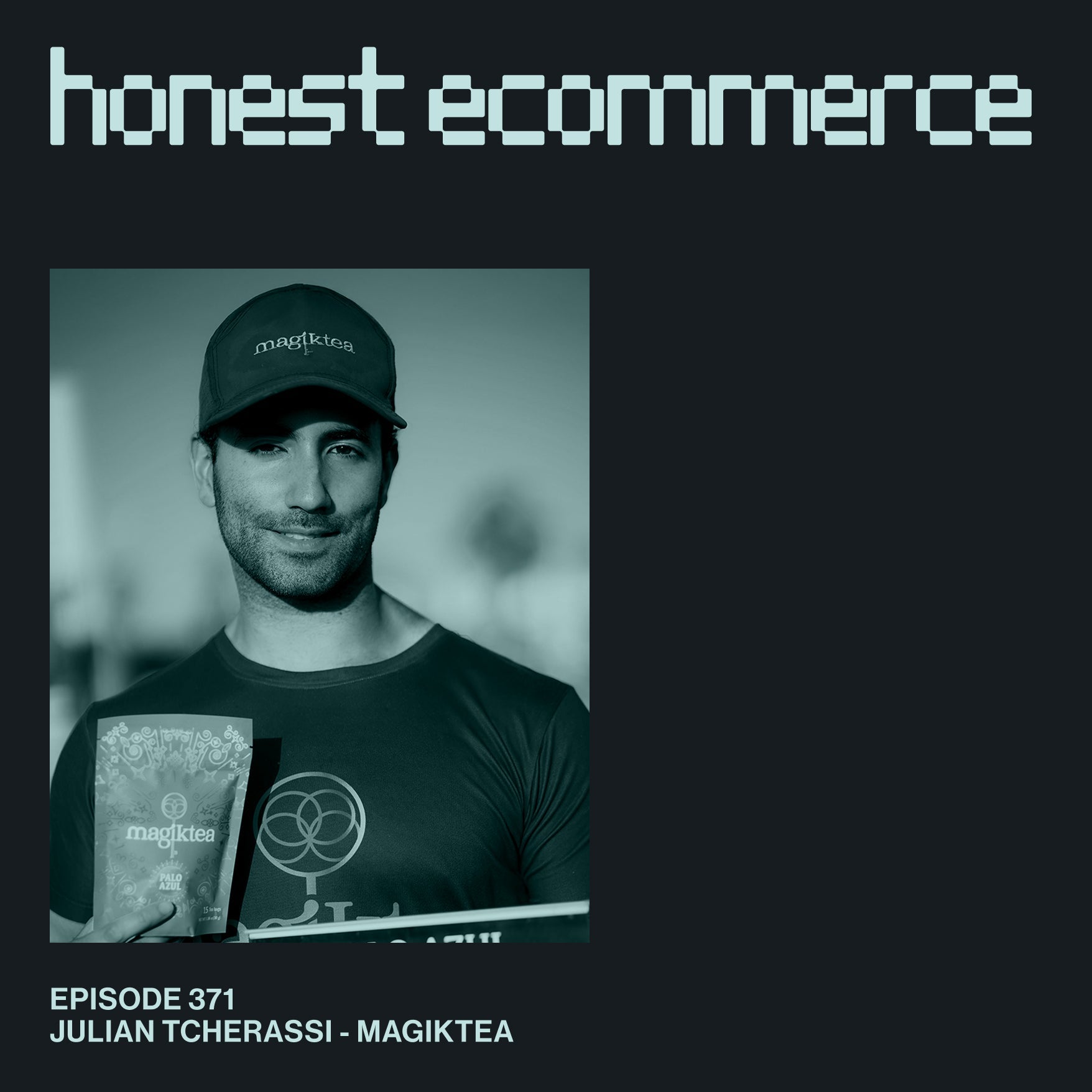
Julian Tcherassi
These ads, they'll just say, “It helps with your gut, it helps with inflammation, it helps with improving your mood and your energy.” Anything and everything you want to hear, right? But it's like, how true is it? So then you got testimonials to another, that's another tool to provide proof to back it up.
So this is why it helps a lot to have your website and Amazon because you can get those reviews from Amazon on your website. So all these things put together, they form a pretty compelling argument for why you should at least check it out. At least click on the button, go to the website and learn a little bit more about it.
Chase Clymer
Honest Ecommerce is a weekly podcast where we interview direct-to-consumer brand founders and leaders to find out what it takes to start, grow and scale an online business today. Hey everybody, welcome back to another episode of Honest Ecommerce. Today, I'm welcoming to the show Julian Tcherassi, the founder and CEO of Magiktea, the first USDA organic and wildlife-friendly Palo Azul Tea Company. They're now in over 1,000 health food stores nationwide. Julian, welcome to the show.
Julian Tcherassi
Hey, Chase. Thank you for having me.
Chase Clymer
I'm excited to chat. Now, for those that are unaware and haven't visited the website and seen how interesting and unique your tea is, let them know what are the types of products you guys are bringing to market over there.
Julian Tcherassi
So I can show it to you so you can see what it looks like. But basically it's a tea that's called Palo Azul, which means blue wood in Spanish. Because when you boil the plant's wood, it turns blue in the light. You can slightly see the blue hue there at the top, but you see it better in the sun or with a flashlight because it has fluorescent nutrients called polyphenols, which make it antioxidant. So that's why they drink it for kidney health. So it's known as kidney wood as well.
And it's just one ingredient, no caffeine, no sugar. And that's the main product we have on the website. We really just sell Palo Azul because that was the tea that just caught my attention. And I've been drinking it for so long now that I just love reading about it and telling other people about it. So that's the mission. Just sharing Palo Azul with others.
Chase Clymer
That's amazing. Now, you said you've drunk it for quite a while. When did it go from, like this tea to maybe there's a business here?
Julian Tcherassi
So I started drinking it, yeah, like 11 years ago. And in the beginning, I wasn't really thinking there's a business here. But it was probably like three years after I was drinking the tea that me and the person that showed it to me started thinking that more people should know about it. And it's hard to find in health food stores.
So it was like three years after I started drinking it that I started thinking about the idea. But it took a long time after that to start doing the research and figuring out how to make a product, how to make a business. I had no idea how to do anything. So I just started reading a bunch and it took probably 3 years of just research and until I felt comfortable enough that I felt like I could do this.
Chase Clymer
That's amazing. So obviously, everyone listening is pre-launching a business. Education, first and foremost, I think that is what a lot of people need to do. Take it upon themselves to learn. What were the first steps when you're like, alright, “I'm starting a company?” What do you do?
Julian Tcherassi
First step? Well, firstly, I was starting to figure out how to co-pack a product. I started learning about... didn’t I had never heard the word co-pack or co-man. So there's different ways that you can start a business. That's pretty much the easy route because you don't have to buy the equipment. You don't have to learn how to actually package tea bags and loose tea.
So you find the company that just does it for you and you just kind of give them the specs. You give them what you want, how you want it cut, et cetera. So I started also looking for suppliers and finding the right supplier for Palo Azul took about eight months or almost a year. Because I just had to get a bunch of samples from different suppliers, figuring out which one was organic, which one was USDA certified organic.
So doing all that research took about a year. And that's where I would say, if you're deciding to start a company, you need to go into Google and just try to find suppliers, try to find people who can help you with the production of your product. Whatever it may be. There's co-packers and commands and people that will help you produce anything, pretty much.
So in the beginning, it was just a bunch of research and education. So I didn't come from this industry at all. It was just kind of randomly put upon me. I was just playing music and then just started deciding to do this. So I started learning also about how to get into retail, how to get into stores. So you had to learn sales and marketing and all these things.
So just books are your best ally. And Google now with AI, obviously, that will help speed up things a bunch. I use AI a lot now for what we're doing today. But in the beginning, there was no Chat GPT. So it was just a bunch of reading books and Google.
Chase Clymer
Yeah, that's amazing. Now, you've got a co-manufacturer that helps you produce the product and you've got the core flagship product that you want to go to market with. And your first channel that you wanted to go after, if I heard you correctly, was retail. So direct-to-consumer was really not top of mind or just walked me through that thought process a bit.
Julian Tcherassi
In the beginning, yeah. So I thought it would be more of a retail play. And I wasn't thinking so much about the online sales. Although we started selling online, we started with a Shopify store. We actually started with a different website, it was called Webflow. I don't know if you've heard of that, but it was so tough and so complicated to just do things on it. And there were a lot of abilities and animations and things like that. So then we ended up just switching to Shopify.
So online was always a part of it. But in the beginning, I just always thought this should be in Whole Foods and Sprouts and health food stores. Where you can also find other healthy teas like Pate Arco or other things similar to this like Palo Santo. So you can buy Palo Santo in Whole Foods. And I always just thought, why can't you buy Palo Azul in Whole Foods? It's a fluorescent tea that's got all these health benefits and it's no caffeine.
And a lot of people in Mexico drink it for a bunch of different things. So that's why I started thinking, maybe we should attack or go into retail stores so that people can actually discover it first and see it on a shelf. And learn about Palo Azul. And then it was like education. That was the mission basically. And then online, we would always just sell it and promote ads as well as maybe half of the business or the main driver of the business now. But back then, it was just a retail play.
Chase Clymer
Gotcha. So going after retail, that's your first mission. How did you attack that? How did you try to get meetings with buyers or just get things on shelves?
Julian Tcherassi
That was a fun journey actually and an interesting one. So, it took me probably about a week to write a pitch and I started reading about cells and stuff like that. So, I just got my minutes pitch which actually ended up being more like two minutes. So, it was kind of tough to memorize it because what I told you in the beginning, Palo Azul is a blue wood, antioxidants, etc.
That was refined down from this whole page of information about the benefits and the story and how it was discovered. So I was telling the buyers like way too much information. So in the beginning, I kind of tried to just memorize it. So every night I would just think about it and say it like 10 times until finally I decided I'm ready. So let's just go into stores and I had this list. So it also took me a long time to write out a list, looked up all the health food stores around me.
Tea shops, herbal shops, you name it, coffee shops, Mexican stores, because the tea is from Mexico. So I just started knocking doors. I would just go into a store, take the tea in a little glass cup and show them our packaged product and just tell them about it. So that helped me get into some of the local stores around the Tampa area, which is where I began. Tampa, Florida.
And little by little, every day I would just go out.eight hours or something, drive around all over the place and do a route and get probably like one or two or three stores a day. And one thing that helped a lot was just I would tell them, if you want to give a product a shot, like we'll give it to you on consignment. So you don't have to pay me anything. If it sells, you do. If it doesn't, you don't. So they have nothing to lose.
And I would just tell them that I would stand there and do a demo and share it with their customers. So I would serve tea for their customers. So it's a win-win for him, for their customers, for them. So that's how we got into it. It was probably like 60 stores in Tampa until I decided to move to Los Angeles and then do the same thing here. But that was the initial plan. It was sometimes a lot of emailing and setting up meetings with buyers for the bigger stores.
Obviously, you wouldn't be able to just walk in and talk with the buyer or the owner. So you'd have to go in multiple times. I went so many times to some stores, like over 10 times to certain stores because I really wanted to get into some stores. So it was just a matter of persistence, going in again and again and asking for the buyer and trying to get that meeting.
And then once you have that meeting, you know you have to nail it. You got 30 seconds because these guys, getting pitched every day and they get so many emails. So you have to really just be considerate of that and try to stand out. So for me, I was kind of blessed that this tea just happens to be pretty unique. So when people see it, usually it's a yes because they see this blue fluorescent tea that also has all these benefits.
So it's kind of like a no-brainer once they discover it, once they find out about the tea, then we just get the chance to be in a store and tell their customers about it and the same thing. A lot of customers have never heard of it. So I would just stand in the store multiple times. Little by little, people see it. They learn about it. They find out about it. And then they just keep buying it. So that was the strategy.
Chase Clymer
Hey everybody, just a quick reminder. Please like this video and subscribe if you haven't. We're releasing interviews like this every week. So don't miss out. Now back to the interview.
Yeah, this is a masterclass in breaking into local retail. First and foremost, you made a list and it was targeted. It wasn't every store in the area. There were specific stores that you wanted to go after. Two, you were reaching out multi-pronged. But also, think what was most beneficial is you're like, I got in my car and eight hours a day, I was driving to these places. That effort of above all that stands out, putting in the work and actually doing it and going to where potentially your customers might be, there's that.
Then also the discipline of continuing to follow up, continuing to try. I'm assuming you've got versions of no a few times from these stores before they said yes, just because they are used to gatekeeping the buyer. That's a masterclass on how to do it.
Julian Tcherassi
Yeah, you get a bunch of no's. So you have to expect that as well. I was hitting probably 20 a day, 20 stores a day. And it was wide, so I cast a wide net. So I was going to like even yoga studios, Pilates studios, like regular grocery stores. Just little tiny corner stores. And in the beginning, a lot of it was practice.
So I purposefully in the beginning just went to stores that I thought would be like, maybe not the best stores for us, but it would be like target practice for me to get the pitch down and also for confidence. So on the first day, I got a rumor, I got two stores because I told my family finally. They were like, when are you going to start selling the tea in stores?
And then I was kind of nervous because I thought, what if I go on my first day and I come back and I'm like, I got nothing. So I thought, man, “I really need to get at least one.” So I hit like 20 stores that first day. And the second store that I went to, I remember it was a little Mexican bodega store. And the owner, she was there and she knew about Palo Azul. So she loved it.
She loved the reason why I'm doing this, the mission to just share Palo Azul with others so that it can improve people's health. And then she decided to buy some. So it wasn't even on consignment. She actually paid for it. So it showed, it gave me proof, validation that all this work that I had put into the company and money that I had spent on it finally people around were starting to see that this is actually a thing that people want and it's actually going to work.
In the beginning, you just have to get used to that rejection because obviously I got only two out of 20 the first day, like I said. So you're going to get rejected a bunch, but in the beginning people, sometimes they don't understand. They don't see what you're seeing in something. And that's the case for many other health products.
So in the beginning, I read about the story of the coconut water guys, VitaCoco and Zico. And they would get told things like it tastes like sock water. That was like a famous thing that they would talk about. So apparently to some store owners, it tasted like sock water. And to me, coconut water is delicious. So it's like, wow, like people are telling you that coconut water tastes bad and my tea. Actually that's the main point of rejection I think for a lot of stores.
Because they just don't like the flavor because it's just one ingredient. So it's kind of earthy and woodsy because it's wood. That's where the name Palo Asul comes from, blue wood. And we decided to do it with just one ingredient, nothing artificial, no sugar added. So the flavor is just as you can imagine, mild like herbal tea kind of tasting. So that's the main thing that sometimes store owners don't like about our product.
And you buy it with others like other points like people drink it for the health benefits. So you have to go in prepared and kind of like answer to their objections because I already know that people are usually going to object to the flavor.
Chase Clymer
Do you know what's going on with Klaviyo? When was the last time you explored what it can do?
Klaviyo has been shipping tons of new AI, data, and automation features designed to help ecommerce teams move faster, personalize better, and automate more of the work that used to take entire teams.
Most brands are only using a fraction of what is already inside their Klaviyo account.
Klaviyo is not just email and SMS anymore.
It is your customer data platform, your lifecycle marketing engine, your analytics layer, and now your AI-assisted execution layer, all in one place.
That means your customer data updates in real time.Your segments stay current automatically.Your flows and campaigns all run off the same source of truth.And now AI can help predict churn risk, forecast spend, recommend next best products, generate campaign content, and optimize send timing across channels.
The big unlock is speed and efficiency.
Fewer tools to manage.Less dependency on engineering.Less time moving data between systems.And lower total cost of ownership across your marketing stack.
And brands are seeing real results from leaning further into Klaviyo.
Dollar Shave Club has reported over 30 percent reduction in total CRM stack cost after consolidating onto Klaviyo. Brands like ThirdLove have seen 15x ROI from SMS after consolidating channels. And companies like Corkcicle have grown flow revenue over 90 percent after bringing email and SMS together inside Klaviyo.
Across our customer base, every single brand we work with today is using Klaviyo. That is just where serious ecommerce customer data and lifecycle infrastructure lives now.
If you are already on Klaviyo but feel like you are not getting everything you could out of it, or you are running multiple tools and want to simplify without losing power, this is worth your time.
You should head on over to klaviyo dot com slash honest to learn more.
That’s k-l-a-v-i-y-o dot com slash honest to learn more about what Klaviyo can do for you today.
Out of the gate, did you have that derisking tactic of supplying the product on consignment or did that come to you over time?
Julian Tcherassi
I'm pretty sure from the beginning, I had that in my toolkit because of the books that I was reading. So some of them, that's what they did. Some other founders of tea companies or beverage companies. So I just read about a lot of other founders and companies. That was one thing that helped a lot because you don't know what you don't know. So I started learning about things that I hadn't even ever thought of from these books.
And consignment was one of the things that some founders also did when they were starting their business. And it makes sense because if you believe in your product, you know it's going to sell, then you shouldn't be afraid or apprehensive of doing it at consignment. At least in the beginning when there's no proof because it's up to you to prove to the store that it's actually going to move.
They're taking a shot on you essentially because they could be putting anything else on their shelf and that's real estate for them. That's money that they're paying, that's rent. For you to be on the shelf, it's a privilege. It's not a right for any of our products to be on the shelf of a health food store, especially one that is already reputable. So if you want to be there in many cases, as you know, you have to pay shelf fees, which are thousands of dollars in some of these stores.
So in the smaller stores, thankfully, you don't have to pay a shelf fee, but you can just do consignment and get a chance. And then once you get a chance and you prove that your product actually sells in this mom and pop health food store, then other bigger health food stores may see it there and they notice that you are actually on the shelves already. Then you have a better chance at getting into bigger stores. It's like you're climbing up the ladder.
Chase Clymer
Yeah, it's just 1 % better every day. And now you're over 1,000 health food stores across the country. I don't want to skip to the end here, but I do want to just completely switch gears. So obviously, you're adding stores left and right. And getting on shelves was a big part of the strategy. When did the dot com start to become a bigger piece of the pie? Or when did it force you to take it more seriously?
Julian Tcherassi
Well, it began early with Amazon. So within 4 months, I think when we started selling it to the store about 4 months later. I started working on the Amazon thing and Amazon took off pretty quickly. So thankfully, thanks to Amazon, I was able to move to Los Angeles because that funded my whole venture. So the website wasn't doing that great in the beginning because we didn't really have much traffic going in there and I wasn't doing ads in the beginning.
So we just didn't have that much sales on the website specifically, but Amazon, people were already buying Palo Azul on Amazon a lot. Like I was buying it on Amazon back then. We just happened to, I just read a bunch. I had the strategies of how to get to the top of the Amazon listing. It's just basically great images, reviews, great text, just make it seem professional and just have a great product, obviously.
So in about 4 months of starting Amazon, it started doing really well. And that took off and then it just started doing better and better little-by-little. So Amazon was like 60-70 % of our business for a good amount of time, maybe like a year or so. Because some viral videos just popped off and then Amazon, I would wake up one day and all of a sudden we got like 500 sales and it's like, wow, like 500 units just sold today.
Like that's like a lot in the beginning, right? So then this year, at the beginning of this year, we started running the ads again to our website. So I'd say at the beginning of this year, online became a much bigger part of our business because finally I felt like I had enough content and knowledge about how to actually run Facebook ads.
So this year in the beginning, we just revamped the website completely so that our landing page would be optimized because back then it was kind of just basic. It's just a basic picture, some videos, and text. Now it just looks, it looks more built, more customized. It looks like a website that a lot of effort was put into it. So conversion ratios increased a bunch.
And since the conversion ratio increased a bunch on the landing page, it makes the Facebook ads a lot more profitable because it's like that's where you're sending them to. No matter how good your ads are, if your website is not great, it doesn't convert well, then your ads aren't really going to convert as well as they could be. That was the priority for me at the beginning of this year.
And then once we had that, then started really going into the Facebook ads. And that just started doing really well. In the beginning, the reason why I didn't do Facebook ads in the first year that I started was because I did try some and the numbers just weren't there. We're paying like $20 per conversion or more. And the product was about $18. So we're losing money. Now, the numbers just make sense.
So I can just keep putting money into it and the ROAS, it's just profitable. So we can just keep growing this way. Now I actually have to step off the gas because of inventory issues. So I'm having problems with co-packers. We're talking about co-packers earlier. Problems with the production, the cutting of the wood, the putting it in the pouches and things because it's wood. It's complicated sometimes for the product to flow.
The inventory is kind of slowing me down on the Facebook ads. Because I can't spend that much money even though the ROAS is there and the cost per purchase is low enough that it's profitable. Because I don't have the inventory. But once we do, it's just a matter of once you figure out your message, once you have great content, great quality content, and you get a couple of ads that get decent engagement, then it just becomes a snowball.
Then you have these like one or two or three or a couple of videos that just convert well and they keep getting more comments, more shares, more likes. So the more likes it gets, the more people think, “Oh, I should probably see this. I should probably stop and actually see this ad because it doesn't have 10 likes. It has 3000 likes.” Those are the ads that really are going to make up the majority of your business.
Chase Clymer
Hey Store Owners -
Do you know how profitable your last BIG decision was on your Shopify store?
Most testing tools make it easy to measure design changes - small tweaks. Headlines. Layouts. Button colors.
But what about the decisions that really move the business?
Pricing changes. Shipping rates. Discount strategy. Even new apps and tools.
Those are usually left to gut feel.
Intelligems brings CRO-level clarity to decisions that live beyond the page.
Brands like Ridge, Jones Road, and True Classics are using Intelligems to test pricing, offers, shipping, and more, and see exactly how each choice impacts profit.
Momofuku used Intelligems to test multiple promotional offers ahead of Black Friday and identify the version that ultimately increased profit by about 28 percent.
Mott & Bow used Intelligems to run structured pricing and offer tests that helped drive roughly a 30 percent increase in incremental profit.
Dossier used Intelligems to run sitewide testing that resulted in about a 7.4 percent increase in profit per visitor across their store.They have a bunch more case studies on their website.
I’m a big fan of Intelligems. We use it with almost every client at our agency, Electric Eye.
We use Intelligems to test major site changes, new theme launches, and throughout ongoing CRO work
So when we are making decisions around design, pricing, offers, ETC, we can be confident that those changes are actually driving more profit for our clients.
So, before you start changing pricing, promos, or major site experiences across your store all willy-nilly, you should test it first.
If you're ready to decide confidently and grow profitably, head on over to intelligems.io and use code "honest" for 10% of your first 3 months
That's IntelliGems.io. Use code honest.
You mentioned the dot com, which is your Shopify store now. isn't where you focused a lot of time and energy at the beginning. And it was Amazon. Do you think that it was, was it more purposeful or just how it happened that you stuck to one channel to focus on and figure out, i.e. Amazon at first?
Julian Tcherassi
It was kind of purposeful because I knew that a lot of people were already buying Palo Azul on Amazon. And also I knew that we could do better. I saw all the other listings. And if you look at them, you'll see that they all… I had to disparage them but they just… It's like a little plastic bag. A plastic transparent bag that doesn't look good. Doesn't have the instructions really to make the tea so that it looks blue and they're not certified organic.
And the pictures look very AI generated. Like it just looks fake. It looks like a lot of these companies, like, I don't know. I feel like they didn't put a lot of effort into it or just not as much as I would have in my situation. So I just knew that it could be done better. So I knew that if we went in there, we would just have way better pictures of the tea actually looking blue. With a lot of these listings, it's like, it's a blue tea and you don't have a picture of the tea on your listing.
So I thought, you're missing out here. So I just started taking pictures of the tea on my own and took a bunch of pictures, which by the way, now other listings use my pictures. That literally with my hand in it. Grabbing the cup with my hand and everything and you see my bracelet in the picture and they use my pictures now on their listings.
So it's like, you know, how much effort are you really putting into your business if you're just stealing other people's images and text also, by the way. So there's some listings that literally I've asked lawyers like, “Is there anything we can do about this? Because they straight up just took my website description and put it on their listing.”
So for all these reasons, I just thought like, we can do better. And I don't have to steal, I don't have to copy from anyone. So if you think there's a space, there's a gap, there's something that can be done better, then you should do it. I mean, if you think you can go into Amazon or go into some other platform. Start your own website, and you can do it better than somebody else, and you can do it with more certifications or with more sustainability.
Or in a better format, better delivery method. Also, a lot of these companies, actually all of them pretty much, sell Palo Azul in chunks this big. So they're like, you can't really make one cup of tea with a chunk this big and you can't cut it because it's a super hard wood. So there were all these issues that I started seeing in this market.
And that's what led me to decide like I know that if I get into it, it's going to be tough in the beginning. It's going to take a lot of work, learning, etc. figuring out things. But if we can figure out all these things, then it's going to do good. It's going to be successful. So that's why I went to Amazon first, because I knew that it already sold a lot on Amazon.
And some of these companies have thousands of reviews already. There's tools that you can use to look into how much they're selling. So they were selling probably like $10,000 plus a month. And I knew that if I could just get in there with a better listing, then we would have a chance to get to the top. And then that would help me fuel the other sides of the business, which is what I think is happening.
Chase Clymer
Yeah. Amazon, the velocity is there. And by velocity, mean, there are people on Amazon probably looking for your product unless it's a brand new category. What will help your business grow is more sales. And you're okay with taking a bigger hit on the margin per se because Amazon gets theirs. That's a fantastic avenue to go. Especially with validating a business as well. Amazon has customers for you to try to sell stuff to.
Julian Tcherassi
Totally. Yeah. It's like a billboard online. It's marketing. You're paying about 30 % of all your sales to Amazon, depending on how much you spend on the PPC ads and all that. But they take a good chunk. But they also give you a lot of exposure and a lot of credibility. They pay on Google basically, so they sponsor your product. And when people look up Paulo Azul, you see not just my Google ads, but also the Amazon Google listing ad.
So you see several different little thingies, different little listings with a magic tea pouch. So it gives you a lot of visibility. And I think if you can make it work, if it's profitable for you to be on Amazon, even if you're not making that much in profit margin, it makes sense. And a lot of companies that were opposed to it, like I read about AG1, who they used to only sell on their website.
Now you can find them on Amazon, even though they sell millions and millions on their website, they still sell on Amazon. It's because people are looking. So if people are searching AG1 on Amazon, they can see that. And if AG1 is not on Amazon, they're going to buy the competitor. So that's why I think companies, it just makes sense to be under. The world just functions like this. Everybody's just on Amazon.
Chase Clymer
Yeah. Yeah. It's unfortunate. No, it's not. I mean, it's just, it is what it is. It's another channel.
Julian Tcherassi
Exactly. Like it's helpful and I'm thankful for Amazon. But at the same time, like I wish there would be a day where we don't need Amazon and I can just remove my listings on Amazon and we do well enough on the website that we don't need Amazon anymore and we can just keep all the profit ourselves.
And this is the way that it would be better, I think, for small business owners. But this is the world we live in now. So it's kind of like you got to pay to play and that's the price you got to pay in the beginning at least to get some exposure. And then maybe you can decide to take your products off of Amazon.
Chase Clymer
What sucks about fees and companies that take a percentage of sales, they're never going down. And there's going to be a reckoning where soon enough, Amazon is going to make the wrong choice and it might actually affect something. But we're not there yet.
Julian Tcherassi
Yeah, the problem is they have so much leverage because they're a monopoly.
Chase Clymer
Yeah.
Julian Tcherassi
Like we're saying, everybody is on Amazon. So you have to be there. So once you're there, you have to play by their rules. If they decide to raise their fees, raise their prices and they start charging you a bunch of money for a bunch of different things that you have no idea about. Shipping fees, receiving fees, listing fees, there's all these things. So there's always just so many expenses there that you don't even know what they are because it's just so much.
And it's like a full-time job basically to go in there and look at all the reports and look at all the transactions, how many refunds you got. And as you know, Amazon, if somebody decides to get a refund from your product, doesn't matter if it was perfectly packaged and everything is fine with it. If they say it was damaged, you pay.
So it comes out of my pocket and then they keep the product as well. It's like, you just have to accept that. It's probably like 5 % of the cost basically, just getting returns and refunds.
Chase Clymer
“I have been in business for nearly 20 years, and very few companies I have hired in that time have performed as well as Electric Eye. They have knowledgeable staff, and our project was delivered on time and on budget. Electric Eye has exceeded my expectations, and I look forward to working with them again.”
That is a direct quote from one of our clients at Electric Eye.
Electric Eye is a Shopify Plus partner that has helped over 100 brands migrate, redesign, and optimize their stores since 2016.
If you'd like to increase your conversion rate, average order value, and revenue per session, we are the true Shopify experts you've been looking for.
Right now, we're offering a free diagnostic to qualified brands that reach out and mention the podcast. Visit electriceye.io today to schedule a call and send us a message. Find out why we have over 50 5-star reviews in the Shopify Partner Directory. Again, that's electriceye.io. E-L-E-C-T-R-I-C-E-Y-E.io
Julian, is there anything I didn't ask you about today that you think would resonate with our audience?
Julian Tcherassi
How to think about what's the messaging or how to refine your pitch? Maybe we can talk a little bit about that because if you're doing ads, that's a super key thing. For us, it took a while to figure that out. And there are certain things that I think now are useful and very, very helpful for us to actually have those ads that did work. So maybe we can talk a little bit about that. How to craft that winning ad.
Chase Clymer
Let's do it. And is this learning from the beginning of this year?
Julian Tcherassi
From the beginning of this year, pretty much. Learning from throughout the whole thing, from throughout the whole journey. Here's how I kind of started this whole journey. So I started just looking at all the ads that have thousand plus likes from competitors. I follow them. I look at their website, click on their things so that the pixel tracks me. And then I start getting the AG1 ads and all the other companies that I aspire to become more like.
And then just kind of look at it and analyze it. I take notes on everything and I analyze what they have here? Is it a UGC influencer? Is it a product shot? Is it like B-roll? Is it a moving shot with somebody walking and talking about it? Is it the benefits? Is it the sustainability thing that they're talking about here? Or is it reviews? So there's all these little things and components.
It's kind of like a puzzle piece that forms the entire ad. And it just becomes a text, basically just a script. So the winner ad that we have now or like some of the winners as that we have now, we start with the blue. We start with what makes your product unique. Firstly, you have to catch the attention of the person. As we all know, people are just scrolling through super quickly.
They're not going to listen to your sustainability part of your ad if it's 30 seconds down the line, unless you have that first initial catching of attention. So that's the first thing. You just have to show them or say something that's going to get them to stick and listen. So the beginning for me is always just, “Have you ever heard about this fluorescent blue tea?” Sometimes I think people will, I think most people will hear that and they're like fluorescent blue tea.
What is that? Why is it fluorescent? And why do I care? Like, is it just because it looks cool or is it because it's actually good for you in some way? Then we go into the health pitch and then just tell people what it's going to do for you, the benefits. And I show, I like to do this a lot in videos. It's showing the studies. So I'll be talking about it. And if you look at our content, this is the same strategy that I use for pretty much all the content.
If I'm telling you that the tea is fluorescent because it's got these polyphenols, you're going to see the study show up. And it's going to show, it's fluorescent polyphenols and it's got antioxidants and there's the study and it's anti-inflammatory. There you see the study. So, it's showing proof. So, it's not just me talking, it's not just some guy telling you about it. It's like you're actually seeing that, this guy, you know, they did the research.
And this is verifiable, they're sources. So it's not just words that this guy is saying, because a lot of these ads, they'll just say, oh, it helps with your gut. It helps with inflammation. It helps with improving your mood and your energy, anything and everything you want to hear, right? But it's like, how true is it? So then you got testimonials to another, that's another tool to provide proof to back it up.
So this is why it helps a lot to have your website and Amazon because you can get those reviews from Amazon on your website talking about what the benefits are. So if people say that it helped their kidneys, it helped their joint health or their UTIs. So I just kind of put those on there and they just talk about how our product helped other people.
And then there's the reviews part of the app, which has been super helpful, I think. Then there's also the retail. So retailers give you a lot of validation because if your product is in health food stores that are widely recognized. One of the health food stores that started giving us validation was Erewhon, if you've heard of them. So a lot of people know about that store. It's become like a whole thing here in Los Angeles and influencers love to go to that store.
If they see your product is in Erewhon, then you just kind of put that on your ad. Put that somewhere in the ad. We talk about stores that we are in and now Vitamin Shoppe, which is the bigger one, is like the reason we're now in health in over a thousand health food stores is Vitamin Shoppe. Because they have 700 stores.
So you put all these things into an ad and people start seeing sources. It's blue. It's got all these stores. There's these reviews. There's UGC, sustainability. We show a video of the farm with the certifications that we have. So all these things put together, they form a pretty compelling argument for why you should at least check it out. At least click on the button, go to the website and learn a little bit more about it because obviously a lot of people are liking it.
So that's what’s in the consumer's mind. You're trying to just kind of transmit that message. Why should they care? It's just people scrolling, doom scrolling all day, all night. So why should they care about your thing? And you have all these tools that you can use to express that. So for us, these are the kinds of the things that have helped. Reviews, stores, sources, and passion.
So for me, that's been the driver of this all. And my passion for sharing this tea probably emanates from when I'm talking about the tea. And I'm talking about how it helped my family as well and helped me help my dog. The story, all of these things kind of are built upon the story. So the story of how I discovered the tea and why I'm doing this is the main thing.
And then all these other tools that I use to communicate to people why they should try it out and why other people are interested in this fluorescent blue tea. That's all what adds up to a compelling argument, I think, for people to want to just click on a button and go to the website. And then when they go on the website, they learn more and they start seeing more people talk about it, more reviews.
And then that goes into the website, which we haven't talked much about. But the website also has all these sections of like things that I think are going to convince people to try the magic. And that's my mission to just get people to try the magic because it's a pretty interesting tea and I'm sure it's going to help a lot of people. So that's why I believe in it so much.
And that's why I put in all this effort to learn and read and craft the pitch and the ads and record all this content and make the website look nice so that people aren't bored looking at it. And it just looks pretty. So people just like to go on it and people tell me all the time that it looks good. That helps.
And then having a bunch of UGC content, that's also crucial. I think that's another cherry on top if you're doing CPG or anything. Anything in business, like you should give your product out for free to influencers and then just get good content. Save that content and then use it on your website, use it on ads.
That way people start seeing other people specifically if you have people with a lot of followers. Then that's even better. But if people start seeing others with your product, then that gives you more validation again. And then that's just more material that you can use on ads and on your website.
Chase Clymer
Absolutely. And speaking of your website, let's shout it out. If people are curious to learn about all this content that you've produced. To get pixeled, to see your ads that you obviously have belabored over. And just to check out this awesome fluorescent blue tea. That's a hard word for me to say. Where should they go?
Julian Tcherassi
It's magictea.com. M-A-G-I-K-T-E-A. So magic with a K.
Chase Clymer
Absolutely.
Julian Tcherassi
It's caught off in my shirt. But it's backwards anyway.
Chase Clymer
Yeah. We'll make sure to link to it in the show notes. Julian, thank you so much for coming on the show today.
Julian Tcherassi
Yeah, absolutely. Thank you so much for having me, Chase.