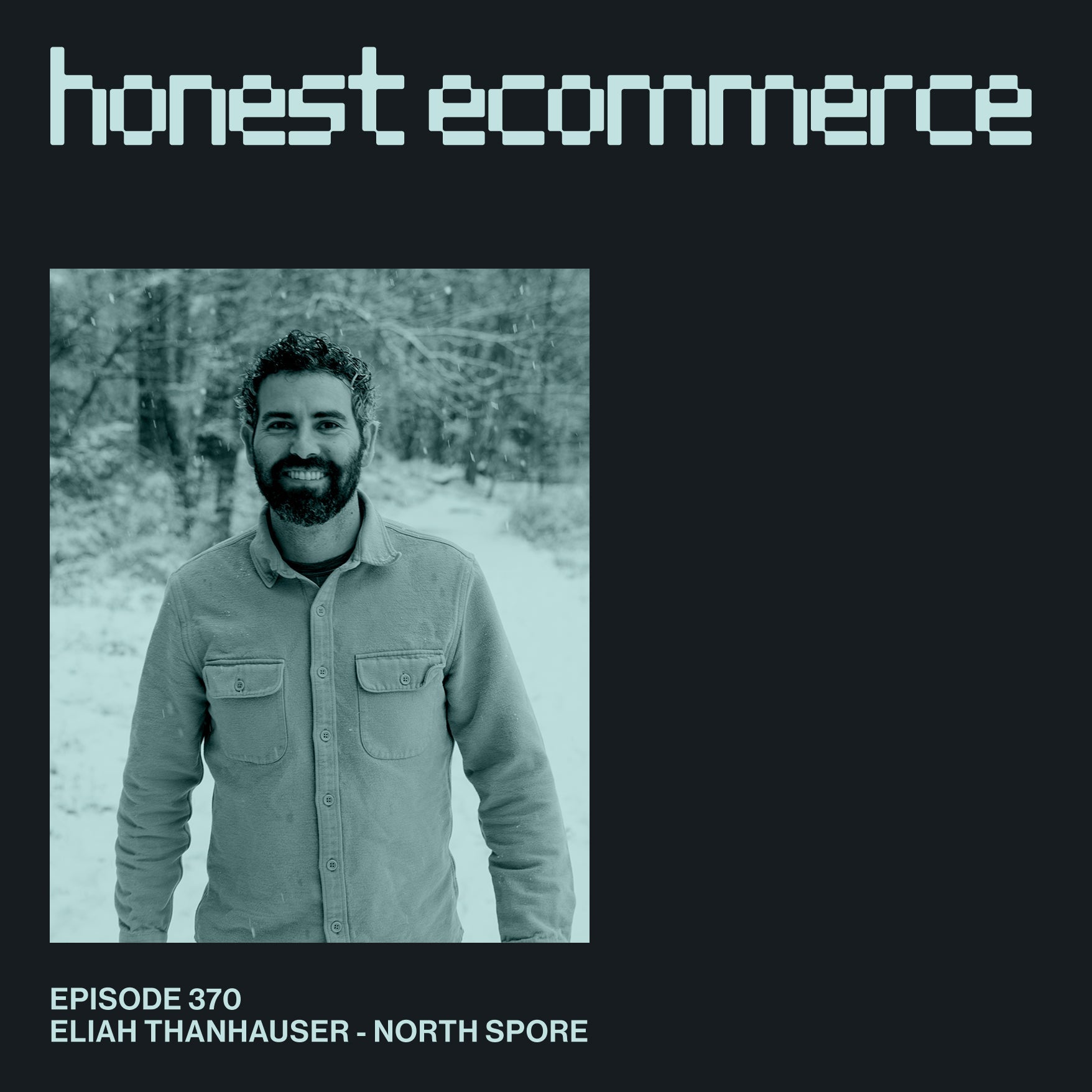
Eliah Thanhauser
We try to do so many things and we keep having to remind ourselves to focus. And it's tempting to try to do a lot too fast.
Chase Clymer
People will compare themselves to competitors or just like not even competitors, just other businesses that are maybe a couple steps ahead. You don't know what another business's story is. You don't know if they're funded or not. You don't know if they're taking a loss to acquire a customer because they're betting on something else in their business plan.
Quite often, what you see other people doing, you don't have the full story and may or may not be the best maneuver for your business.
Honest Ecommerce is a weekly podcast where we interview direct-to-consumer brand founders and leaders to find out what it takes to start, grow and scale an online business today.
Hey everybody, welcome back to another episode of Honest Ecommerce. Today, I'm welcoming to the show, Eliah from North Spore. How are you doing today, Eliah?
Eliah Thanhauser
Great. I'm glad to be here with you, Chase.
Chase Clymer
Absolutely. As a co-founder and president of North Spore, what are the types of products you guys are bringing to market over there?
Eliah Thanhauser
So at North Spore, we make the world of mushrooms accessible to all. We're a one-stop shop for all things mushroom. We really specialize in mushroom growing supplies. So we're vertically integrated. We do everything from creating our own cultures all the way up to growing and producing mushroom spawn.
So we have supplies for first time mushroom growers, people who want to grow mushrooms in their gardens outside, commercial mushroom farms. And then we also have a line of medicinal mushroom products. So we have very high quality tinctures, supplements, and mushroom chocolate.
We have a new mushroom honey, which is awesome. It's great in tea or even just to take straight as a spoonful of a medicinal honey. We have mushroom coffee. We do it all. And we have lab supplies, growing equipment, different automated grow chambers for mushrooms.
Chase Clymer
Quite a bit of an offering over there. Did it start… So, full featured or what was the flagship offer back in the day? Take me back in time to the humble beginnings.
Eliah Thanhauser
So we started North Spore in 2014. I started with two friends from college. We went to College of the Atlantic in Bar Harbor, Maine. And one of my partners, John Carver, went to grad school for mushroom biology after college. And I worked on organic farms and on boats. And Matt McInnis, our third business partner, worked in photography for the New York Times. He also worked in the restaurant industry.
And John really pitched the idea of starting a mushroom business to us. And we started off as a fresh mushroom farm. So we got the smallest space we could find. I mean, we weren't looking for small, we were looking for cheap. But that happened to be a really small garage-ish space in Westbrook, Maine, near Portland, Maine. Which didn't even have a garage door, but it was a blank slate.
So we set that up to grow mushrooms. It was extremely small, and was probably the size of two large bedrooms. We just started growing oyster mushrooms to start and we were selling them to local restaurants and starting to do farmers markets. But because of John's knowledge and kind of desire to just be innovating and pushing the envelope, we always were vertically integrated.
So we were producing our own spawn, which is the seed equivalent for mushrooms from the very beginning. Actually our first lab was a four by four stealth cannabis grow tent. It was this tiny little enclosed room that we were able to keep clean and produce spawn in a flow hood. And we started selling spawn to other mushroom farms, and other growers started producing mushroom grow kits.
And then Matt was really pushing to start doing sales online. So that was kind of his push to do that. And we were very early in mushroom growing supplies online. There were a couple older companies that had been around. One of them was actually getting out of growing supplies actually. But they didn't have that much of a presence online. And they left an opportunity to make it really customer-friendly and accessible.
So we started doing more online. We're still doing fresh mushrooms. And that was a big part of our business. But we kept adding new species of mushrooms, then kept adding medicinal products. For quite a few years, we've been a hybrid of doing really vertically integrated fresh mushrooms. All the spawn both to sell to other people for us to use internally for fresh mushrooms and selling growing supplies and medicinal online.
And that's just really grown and snowballed and expanded and we've created many, many new innovative products and expanded our offerings online. And branched into other sales channels. And we only do fresh mushrooms now just for R&D. We're no longer a fresh mushroom farm.
Chase Clymer
Hey everybody, just a quick reminder. Please like this video and subscribe if you haven't. We're releasing interviews like this every week. So don't miss out. Now back to the interview.
What year did you and the team accept Matt's challenge to take things online?
Eliah Thanhauser
So that was probably 2015.
Chase Clymer
So pretty quickly.
Eliah Thanhauser
Yeah, it was very quick. Yeah, I remember our first Amazon. I mean, we were definitely the first on Amazon. There were no mushroom growing supplies on Amazon back then. But I remember our first GrowKit sale. Matt told John and I, “We got a sale on Amazon. We got to ship this GrowKit.” And I think we were probably selling them for $25 on Amazon. And back then, it was fulfilled by Merchant.
So we go to a FedEx store to ship it and it costs $30 for us to ship it to the customer. So it's like not even including cogs or overhead or anything. We lost $5 just on the sale price for shipping. Okay, we got to get better at this.
Chase Clymer
Yeah, that's amazing. So you guys launched on Amazon. Did you guys also launch on your own kind of dot com as well around that time?
Eliah Thanhauser
We did. Wow, I think back then it might have been a Squarespace site. And it was pretty simple. But we were selling directly to consumers on our own website then.
Chase Clymer
How were you guys getting customers to this website back then?
Eliah Thanhauser
That's a good question. I don't think we were really advertising in the traditional sense back then. One thing that we have done really well, I think, and has been a big focus for us is educating people and helping them learn about mushrooms and producing content. So pretty early on, we were producing a lot of videos on YouTube. We had a blog.
So I think probably most of it was pretty organic, but also came through educational content that we were producing. Then we also did, we'd go to a bunch of different farm trade shows and flower shows and try to have a physical presence around people that were into gardening and farming and growing mushrooms.
Chase Clymer
Yeah. And I should probably do this now as a challenge to myself, especially with AI. I'm sure I can do it pretty quickly. If we look back at a bunch of these episodes, I've interviewed founders. I would guess 75 % of the successful brands, where they went to find their first initial stake of customer was... They found them where they were. And a lot of it was like farmers markets, trade shows, etc.
And it's like putting in that initial effort to get out there and to talk to them to learn what it is that is appealing about your product or vice versa, what it is you need to improve upon about their product. In the early stages of building a brand that is such a key component to setting a good foundation for a successful business.
Eliah Thanhauser
Yeah, totally.
Chase Clymer
“I have been in business for nearly 20 years, and very few companies I have hired in that time have performed as well as Electric Eye. They have knowledgeable staff, and our project was delivered on time and on budget. Electric Eye has exceeded my expectations, and I look forward to working with them again.”
That is a direct quote from one of our clients at Electric Eye.
Electric Eye is a Shopify Plus partner that has helped over 100 brands migrate, redesign, and optimize their stores since 2016.
If you'd like to increase your conversion rate, average order value, and revenue per session, we are the true Shopify experts you've been looking for.
Right now, we're offering a free diagnostic to qualified brands that reach out and mention the podcast. Visit electriceye.io today to schedule a call and send us a message. Find out why we have over 50 5-star reviews in the Shopify Partner Directory. Again, that's electriceye.io. E-L-E-C-T-R-I-C-E-Y-E.io
When you guys figured out how to actually accurately price your products and now Ecommerce is going pretty well. Well, I do want to go back to something you said. You're like, “Oh, our traffic was organic, but we're producing this content. I argue that producing content is... That is an activity that a founder can do to produce results.
So organic traffic is this weird source of traffic on the internet. And it's hard to point it back to something. But you almost said, well, it's actually because of all this educational content that we're putting out there. This show, the people listening to it. They are looking for things like, what is it that I can spend my time on as a small brand to increase awareness about and get more customers and get it out there?
The two things that if you have nothing better to do, this is how you can get people to think about you. It's producing content, especially educational content, and then going to where your customer is, trade shows or farmers markets, etc. And so I just wanted to just parrot those back again and honestly just beat it over the head for some of these listeners that need to know like this is what you do.
Eliah Thanhauser
Yeah.
Chase Clymer
You put in the work and that's how it happens. Just sitting back, building a website and hoping that someone ends up on your Shopify store. That's not... That's never gonna work.
Eliah Thanhauser
Totally. Ecommerce has only got more and more competitive and more and more nuanced now. So I think it's harder now than ever.
Chase Clymer
And the barrier of entry has gotten less and less difficult. You can spin up a Shopify store. There's a bunch of amazing themes out there. If you're technically inclined at all, you can do that. And then with the power of chat, GPT and AI, you can write your product descriptions. And you can find a product that you think is going to win. But here's what most aspiring entrepreneurs overlook in that sense is that there's no differentiation and it was arguably that easy for you. It's that easy for your competition.
So what is that edge? What is the problem you're solving for your consumer? Those are the real challenges that a lot of people overlook. And so pivoting that back to North Spore, what do you think were some of those core problems you were solving for your customers that led to that initial traction and really helped you guys get to that next level as a business?
Eliah Thanhauser
Yeah, I totally agree with what you're saying. I think now, it's hard to cut through the noise, but it's important to cut through the noise. It's so easy to produce content that most content is junk. It's so easy to produce goods having something co-manufactured. Most things are junk. I think it's actually like, obviously, Amazon is so dominant. But there's still like, you can pay for reviews.
There's so many terrible products on Amazon that are very, very low quality, regardless of the reviews. People don't know what they're going to get. And when you read something, you don't know if you can trust it. It might not be true. And so I think it's harder to trust quality and information than it used to be. And people should be more discerning than they used to be.
I think that when they find a brand that they can trust in quality and content. That is a powerful connection. And I think that we always really tried to create value for our customers and connect with them. And I think one of the value propositions we presented was the confidence to grow mushrooms. And that confidence comes from knowing you have a really good product.
Knowing there's a warranty, knowing that if you need to call or email someone, they'll get back to you and help you. Knowing that the content they're producing is informative and will help you. It's like the whole journey of that process the brand is helping you with and feeling confident about that. And knowing that you're supported where there's a lot of other stuff out there where it's hard to have any confidence in it.
Chase Clymer
Yeah. We do just a lot of CRO at the agency. And one of the things that comes up when we're just analyzing websites or even customers will even say this, etc. Are those trust factors, if I have a problem or a question, how easy does it look to get a hold of somebody? And it's honestly, it's not even that they will. It's just, does it appear easy to get a hold of somebody? So that's something that we oftentimes are telling people that they should look into.
You already mentioned some other trust factors that make things win. The warranty, the ease of getting a hold of somebody, so a phone number especially. It is rare that Ecommerce businesses have a phone number these days. But you would be surprised to learn that... You could check for a split test and have a phone number in checkout or prominently featured on your banners on your homepage.
You'll see a lift in conversion, typically, obviously, everything you have to test. But it's just those trust factors that really go a long way to help ease consumer fear, uncertainty or doubt.
Eliah Thanhauser
Yeah, that makes sense.
Chase Clymer
Looking back, obviously, shipping a product for more than it costs is a mistake. But is there anything like looking back over... You guys have been doing this now for over 10 years. Any mistakes that you guys made along the way that you could point back to and laugh about a bit? But be like, “Hey, maybe you guys, listeners don't do this.”
Eliah Thanhauser
Yeah. Oh, we've definitely made a lot of mistakes, but learned from them. I think that especially if you're a small company, it is pretty important to try to focus on a niche. Because that's a place where you can build a reputation. Really weigh in at that and be pretty clear on what the value is you're creating. How you're helping your customers, what the service you provide is.
And if you go as a company grows, it makes sense for it to have a wider breadth to reach more people, to have more offerings. But you don't want to compete with really large companies right off the bat. Or you want to be more on having a real specialty of where you're going to be able to provide a product or service in a way that no one else is.
Like if you're a small generic t-shirt company. I don't know, do really specialize in something. How are you going to compete? I don't know, I think it's important to focus and understand where your specialty lies.
Chase Clymer
Hey Store Owners -
Do you know how profitable your last BIG decision was on your Shopify store?
Most testing tools make it easy to measure design changes - small tweaks. Headlines. Layouts. Button colors.
But what about the decisions that really move the business?
Pricing changes. Shipping rates. Discount strategy. Even new apps and tools.
Those are usually left to gut feel.
Intelligems brings CRO-level clarity to decisions that live beyond the page.
Brands like Ridge, Jones Road, and True Classics are using Intelligems to test pricing, offers, shipping, and more, and see exactly how each choice impacts profit.
Momofuku used Intelligems to test multiple promotional offers ahead of Black Friday and identify the version that ultimately increased profit by about 28 percent.
Mott & Bow used Intelligems to run structured pricing and offer tests that helped drive roughly a 30 percent increase in incremental profit.
Dossier used Intelligems to run sitewide testing that resulted in about a 7.4 percent increase in profit per visitor across their store.
They have a bunch more case studies on their website.
I’m a big fan of Intelligems. We use it with almost every client at our agency, Electric Eye.
We use Intelligems to test major site changes, new theme launches, and throughout ongoing CRO work
So when we are making decisions around design, pricing, offers, ETC, we can be confident that those changes are actually driving more profit for our clients.
So, before you start changing pricing, promos, or major site experiences across your store all willy-nilly, you should test it first.
If you're ready to decide confidently and grow profitably, head on over to intelligems.io and use code "honest" for 10% of your first 3 months
And I think that goes beyond just your product offering. I see a lot of brands getting lost in their marketing efforts, getting lost in their channels. Trying to launch in Walmart, Amazon, their own Shopify store, TikTok shop, all at once with 100 different products that are in 40 different categories. And it's like that is a great aspirational goal to get to.
But a perfect example, Amazon launched with books. And that was it. And then they built their systems and then they expanded categories. And then they opened it up once everything was very well-systemized. And they opened it up to everything. But what I am learning from this show and just going back to listen to other episodes, it's like successful companies usually start in one channel and then they start to add new channels.
They start on one marketing avenue and then they stick to that. And then they start to add some more down the line. And then they start with one core product offering and then they start to add more down the line. And the reason for that is if you have dozens and dozens of things going on, nothing is actually important anymore. And there is no clear next step to work on because time is just so chaotic and spread out between all these different efforts.
And so that's one of the best pieces of advice is just focus on one core offer for one core customer. We didn't even get to talking about the customer with one channel and one marketing avenue. And if you do that for a year, you're going to find traction. You're going to learn what you need to do.
Eliah Thanhauser
Yeah, I think that's really insightful. And something we still struggle with. Still... We try to do so many things. And oh we keep having to remind ourselves to focus. And it's tempting to try to do a lot too fast.
Chase Clymer
People will compare themselves to competitors or just like... Not even competitors, just other businesses that are maybe a couple of steps ahead. You don't know what another business's story is. You don't know if they're funded or not. You don't know if they're taking a loss to acquire a customer because they're betting on something else in their business plan. Quite often, what you see other people doing, you don't have the full story and may or may not be the best maneuver for your business.
Eliah Thanhauser
Yeah, I totally agree with that. I think competition is real. And it's really important and something to pay attention to and really be aware of what your competitors are doing. But I don't think making assumptions or letting that affect you. We've had times where we've had a competitor come out of nowhere, like a startup or whatever, and be just completely outspending us on ad spend.
And I know our marketing director, other people get really nervous. It feels like market shares are getting taken away from us or their ads are out competing us. And this is a pretty rough analogy. But I'm like, just because someone else is stabbing themselves in the eye with a fork doesn't mean I want to start doing that.
And I've seen a lot of those customers go out of business. They might have raised money, but if they have a business model that is not sustainable, and they're just trying to acquire customers in a way that if they don't have a long enough runway or if they've never come up with a business model that works, they may never come up with a business model that works. Find the business model that works and that you can sustainably do and keep doing it.
Chase Clymer
Most brands outgrow their legacy choices long before they switch.
Bad platform decisions do not fail all at once.
They fail slowly. Then suddenly.
First, there is one workaround.
Then another tool.
Then another integration is duct-taped on top.
And eventually, your team is spending more time managing the stack than actually marketing to customers.
Eventually, rebuilding is less painful than staying - usually when it starts to show up on the P&L.
This is when scaling brands simplify and standardize on Klaviyo.
Klaviyo is the AI-first B2C CRM. It combines your customer data, email, SMS, analytics, and customer experience tools into one platform, so you are not stitching together five different systems just to understand what your customers are doing.
Your database updates in real time.Your segments update automatically.Your flows, campaigns, and personalization all run off the same source of truth.
And that shift is why so many brands are moving to Klaviyo.
Brands like Dollar Shave Club have reduced total CRM stack costs by over 30 percent after consolidating onto Klaviyo. Multi-brand operators like Marc Fisher have migrated multiple brands and dramatically reduced the time required to execute CRM marketing. And brands using email and SMS together inside Klaviyo are seeing massive ROI compared to running channels in separate platforms.
The big unlock is simplicity and scale at the same time.
Klaviyo is built for marketers, not engineers.It is built for online businesses.And it is built for where ecommerce is going, not where it was five years ago.
If you are running email and SMS across multiple tools, or you are on a legacy platform and thinking about your next phase of growth, it is probably time to look at Klaviyo.
Go to klaviyo dot com slash honest to see why hundreds of thousands of brands have already switched.
And if you want our help migrating your list, moving your data, and configuring your Klaviyo account correctly from day one, we are happy to help.
That's klaviyo.com slash honest, K-L-A-V-I-Y-O dot com slash H-O-N-E-S-T.
You mentioned that you guys are selling in a couple different channels these days. Obviously, we had mentioned the direct consumer store, we had mentioned Amazon, and then you guys are still selling wholesale as well?
Eliah Thanhauser
Yes. Yep. um And we're expanding into retail as well.
Chase Clymer
That's got to be a fun new challenge for you.
Eliah Thanhauser
Yeah, it's definitely a new challenge. We're really excited about it. We still love selling direct to consumers online. But it's time to just have a broader sales channel accessibility and be able to reach new customers and have our products in places where they're shopping.
Chase Clymer
Yeah. And it's also just at your scale. The conversations are different from being a startup trying to get into those types of doors. Whereas now you're like, well, I have data. I can show you. This is exactly how many customers are in that zip code.
Eliah Thanhauser
Yeah, definitely.
Chase Clymer
Awesome. Now, Eliah, is there anything I didn't ask you about today that you think would resonate with our audience?
Eliah Thanhauser
Oh, I'm sure. There's many questions. Nothing's coming to mind at the moment. I mean, I feel like right now is a little bit of a hard time for Ecommerce. I think things are changing really fast with the technology landscape, with marketing, with AI. I think that the economy is suffering and people are feeling that a lot more. I think the actual economy is very disconnected from the stock market. The stock market is only shored up by AI right now.
I’d imagine that many of the listeners that have ecommerce businesses are having harder years than they've had in previous years. I think it's time to just make it through and then there'll be better times ahead.
Chase Clymer
Yeah, I completely agree. There are a lot of interesting things going on, be it politically, economically, and just timing-wise to where if you just double down, focus on what you're good at and get through it. People don't like to talk about during an economic downturn if the businesses that do survive come out in such a better position.
So if you can just keep your blinders on, stay focused on the right things and ride this wave, it's going to work out for you.
Eliah Thanhauser
Totally. I totally agree with that. Gritting your teeth at something really hard at a time when something's really hard. And if you figure out how to perform and persist when things are hard, then when things are easy, you're going to be able to perform at a much higher level.
Chase Clymer
Absolutely. Now, obviously, we talked about your amazing vertically integrated products. But if I'm curious, I want to go check out all these awesome mushroom products that you have. Where should I go? What should I do?
Eliah Thanhauser
Go to northspore.com. We have a new website, which is really exciting. And we have medicinal mushroom products, growing products, educational videos, blogs. So northspore.com is the place to go to learn about all things mushroom.
Chase Clymer
Awesome. Yeah. We'll make sure to link to that in the show notes. Thank you so much for coming on the show today and sharing all those amazing insights.
Eliah Thanhauser
Thank you. Thanks a lot, Chase. Good to be with you.