
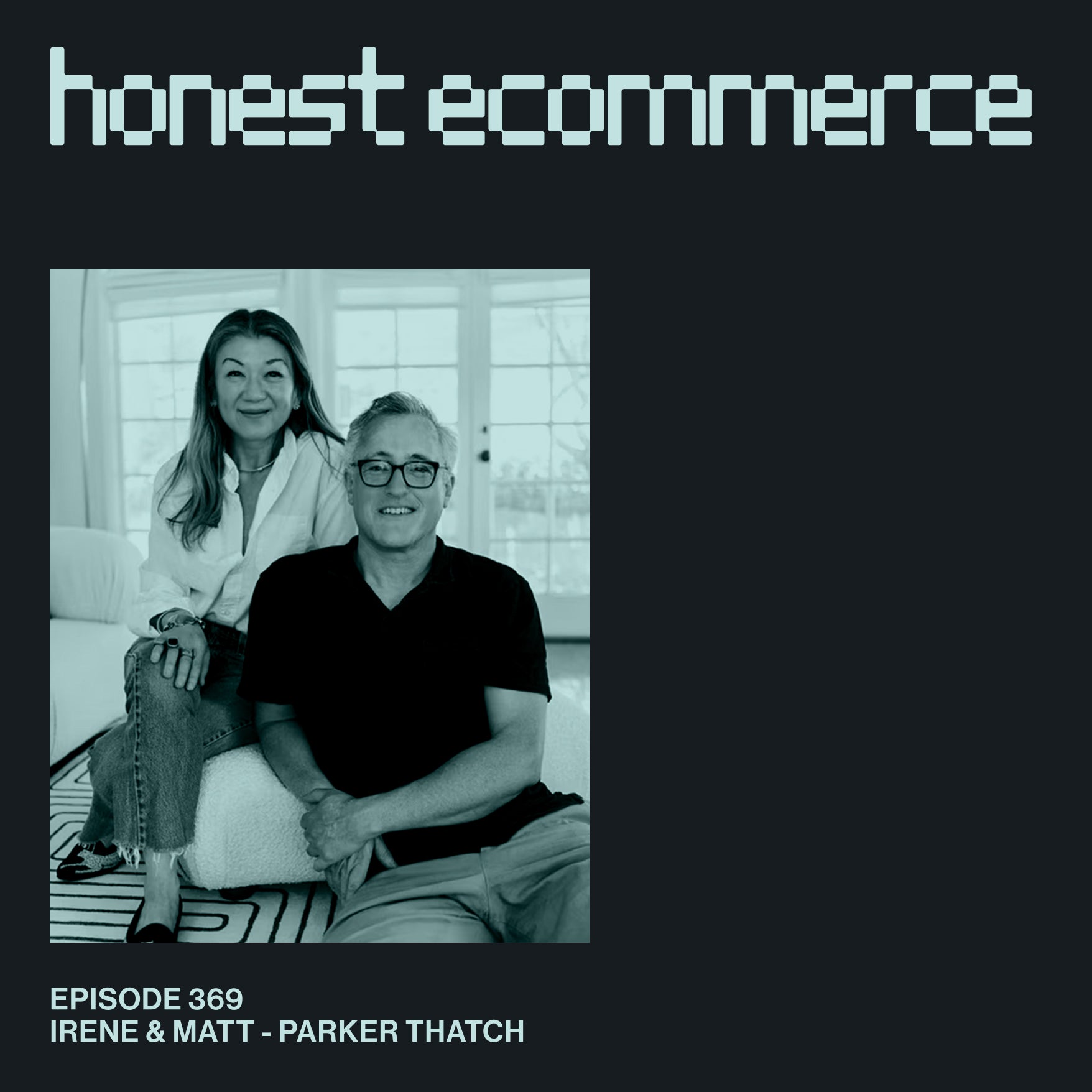
Parker Thatch's 25-Year Bootstrap Playbook: Irene Chen & Matthew Grenby
Building a Bag Brand on Zero Capital: Joann Fabrics, Cowboy Leather, and a Dry Cleaner's Pattern
The first Parker Thatch bag was assembled on a kitchen counter in suburban San Francisco, riveted together with leather strips cut from stock bought at a farm supply store that sold saddle materials. The fabric came from Joann Fabrics, purchased one roll at a time per person per day using 50% off coupons, with co-founders Irene Chen and Matthew Grenby pretending not to know each other in line until the staff eventually asked them to stop coming back. The pattern was made by a woman who worked at their neighborhood dry cleaner and had a fashion degree hanging on the wall behind her.
That bag, the Mimi, still sells in 2025. The camouflage version with a pink and red stripe is currently Parker Thatch's best-selling product. That detail alone is worth sitting with before reading anything else about how this business was built.
Why Self-Funding Forced Better Operational Decisions
Parker Thatch has never taken outside investment. Every phase of growth was funded from cash flow, which meant the team could not afford to make mistakes that larger funded companies can absorb. That constraint produced discipline that most VC-backed brands never develop.
When they landed a major wholesale order from Borders early in the stationery phase of the business, they had no warehouse, no forklift, and no pallets. They drove to the Oakland docks, bought used pallets, staged the shipment across two parking spots in front of their duplex, and handed the truck driver an address without mentioning there was no loading dock. The driver showed up, assessed the situation, and took the shipment anyway.
That problem-solving posture, finding a workable solution at whatever resource level you currently have, carried through every stage of the company. Matthew's point is that this mindset applies at every level of growth, not just the scrappy early days. A storage unit with shared forklift access is a legitimate alternative to leasing a warehouse. You do not need to buy the next-tier infrastructure until the business genuinely requires it.
The Gray Goods Inventory Strategy That Protected Their Cash
One of the most transferable operational decisions Parker Thatch made was structuring their inventory around gray goods rather than finished products. In their case, that meant holding rolls of natural canvas rather than pre-dyed or pre-printed finished bags. Designs and colors were applied on demand, which meant they could respond to what was actually selling rather than forecasting which finished SKUs to buy in bulk.
The analogy Irene uses is a blank t-shirt. You hold the blank. You produce the finished good when you have a signal. The alternative, buying into every color and style of finished product, creates markdown exposure and ties up capital on warehouse shelves. For a bootstrapped company competing against brands with real open-to-buy budgets, gray goods inventory was not just smart. It was the only viable path.
This principle applies outside fashion. Any product business that can separate a core input from a finished configuration should evaluate whether holding that upstream input gives them more flexibility than committing to finished goods.
When a 12-Year-Old Brand Name Becomes the Bottleneck
For the first twelve years, the company operated under the name IOMOI. The founders loved it. It is a palindrome, visually balanced, and has a French quality to it. It was also nearly impossible for American customers to spell or pronounce, which is a significant problem for a brand doing most of its business online.
The push to change came from Andy Spade, who told them directly that he could not remember how to spell the name and could not refer friends to the brand because of it. That feedback, from someone with a track record of building a major fashion brand, was hard to hear after twelve years of brand equity investment. They changed the name anyway.
Parker and Thatcher are their children's names. The rebrand to Parker Thatch made everything easier to remember, to search, and to share. Matthew's lesson from it mirrors what the founders of Belgian Boys learned when their own naming choices created friction with customers: nothing is sacred. Attachment to a creative decision, no matter how long you have lived with it, is not a good enough reason to keep something that is working against you.
Kate Spade's Advice That Changed Their Product Line
Kate Spade became a friend and stealth customer of the brand. She had built her own line under similar scrappy conditions, bringing materials back from Brooklyn in trash bags on the subway because she could not meet minimum order quantities through normal channels. When she looked at Parker Thatch, she saw a team that was comfortable and protected by staying in canvas and not taking on leather inventory risk.
Her advice was to take the same bag body and produce it in leather. The founders were reluctant. Their gray goods model worked. Leather meant committed inventory in a new material category. They did it anyway, starting with suede before moving into leather. The business changed materially after that decision, in the same way that Kate Spade's original black nylon bag transformed when it moved into leather while keeping the same shape.
The pattern here is not just about materials. It is about recognizing when your caution is protecting a real risk versus when it is just keeping you from the next level of the business.
Consistently Okay Beats Sometimes Excellent
The most repeated idea in this conversation is persistence structured as a daily operating principle rather than motivational language. Irene's framing is precise: consistently okay is better than sometimes excellent. That is a real operational stance. A brand that shows up every day, handles problems steadily, and keeps moving accumulates compounding advantages that a brand running on peaks and valleys cannot match.
Matthew's version of the same idea is that you have to still be present when things shift. Opportunity is not useful if you have already stopped. The worst period always eventually changes. You have to be there when it does.
After 25 years, their one-word operating motto is still the same: onward. Lovesac founder Shawn Nelson covers similar ground in his account of building a brand over 25 years, where the same emphasis on outlasting difficulty rather than outsprinting it runs through the whole conversation.
Key Lessons From This Episode
- Constraints force creative operations. Not being able to meet factory minimums led Parker Thatch to a production model that kept them profitable and in control from the beginning.
- Gray goods inventory is a legitimate cash flow strategy. Holding upstream inputs rather than finished goods reduces markdown risk and gives small brands flexibility that finished inventory does not.
- Nothing in your brand is too established to change. A twelve-year brand name that creates friction for customers is a business problem, not a legacy asset worth protecting.
- Outside perspective from people who have built bigger is worth more than internal attachment to current decisions. Kate Spade's leather advice and Andy Spade's name feedback both moved the business forward in ways the founders were initially reluctant to accept.
- Consistently okay is better than sometimes excellent. Daily presence and steady execution outperform bursts of excellence followed by gaps.
- Think bigger than your first instinct. Irene's reflection on the e-stationery era, where the data they were collecting may have been worth more than the $15 annual subscription they were charging, is a reminder to regularly interrogate whether your current model is sized to the actual opportunity.
Hear the full conversation, including more on Parker Thatch's customization bottleneck and how they eventually solved it, in the complete episode and transcript below.
In This Conversation We Discuss:
- [00:00] Intro
- [00:56] Bootstrapping growth through cash flow
- [03:23] Turning local talent into a luxury launchpad
- [07:45] Sponsor: Klaviyo
- [09:52] Applying corporate training to startups
- [12:31] Challenging traditional production paths
- [18:48] Sponsor: Intelligems
- [20:48] Standardizing core products for efficiency
- [24:47] Sponsor: Electric Eye
- [25:56] Persisting through daily business doubt
- [29:40] Callouts
- [29:50] Reinventing challenges for better outcomes
- [31:34] Leveraging community for business insights
- [32:02] Maintaining connections for future opportunities
- [36:03] Rebranding for clarity and customer reach
Resources:
- Subscribe to Honest Ecommerce on Youtube
- Luxury products for everyday ease and elegance parkerthatch.com/
- Follow Irene Chen linkedin.com/in/irene-chen-16b16823/
- Follow Matthew Grenby linkedin.com/in/matthewgrenby/
- Book a demo today at intelligems.io/
- Schedule an intro call with one of our experts electriceye.io/connect
- Get your free demo https://www.klaviyo.com/honest
If you’re enjoying the show, we’d love it if you left Honest Ecommerce a review on Apple Podcasts. It makes a huge impact on the success of the podcast, and we love reading every one of your reviews!
Chase Clymer
What is some advice if you could talk to your younger self that you've learned in this 25-year journey?
Irene Chen
Consistently “okay” is better than “sometimes excellent”.
Matthew Grenby
For sure.
Irene Chen
And that is so critical.
Matthew Grenby
And also, to be clear, I'm not saying stay stuck in a rut or stay doing something the way you always do it. Absolutely not. But I'm saying don't throw in the towel. Stay in the arena. Do whatever that next step may be, whatever that pivot has to be,whatever. Just stay at it.
Chase Clymer
Honest Ecommerce is a weekly podcast where we interview direct-to-consumer brand founders and leaders to find out what it takes to start, grow and scale an online business today.
Hey everybody, welcome back to another episode of Honest Ecommerce. Today, I'm bringing to the show not one but two amazing co-founders of Parker Thatch. I've got Irene and Matt joining me today. Welcome to the show.
Irene Chen
Hey, Chase. How are you doing?
Chase Clymer
I'm excited to chat. I had so much fun in our pre-interview. And I'm really excited now to do the real one with you and bring all this awesome, awesome learnings to them. So I guess first and foremost, or those that are unaware, what are the types of products you've been bringing to market over there at Parker Thatch for the last 25 years or so?
Irene Chen
We've been on a long journey. And I think when I answer this question. The product that we bring to bear is always something called its functional luxury is what we do. So when we first started our first business together, we did something in 2000, which is e-stationery. So we thought we wanted to bring luxury stationery to your email that early in that timeframe.
Because everything out there was just like crazy, weird cards and things like that. But there wasn't anything very luxurious in that format. That was how we started. Then just, through the time periods, we've done actual stationary home goods. But where we landed on what we're doing currently is in the year 2009, where Matt came to us.
He came to me and said, “Hey, listen, I think I could print and monogram on actual cotton goods. What do you have?” And so I was like, “Okay, finally I get to make a bag. This would be amazing.” And the idea was, okay, how can I make a functional bag that we could take to dinner and it would be luxurious, but it would have to be cotton. So we came up with this bag that was basically a tote bag, but with two leather handles.
Matthew Grenby
Just context, a large part of Irene's professional background prior to us working together was in the fashion industry. Think like Calvin Klein, Donna Karan, et cetera.
Irene Chen
And then Matt's background was heavily in design and also tech. So we kind of had like the convergence of skillsets to do what we needed to do. Especially in the year 2000 where things were changing and moving so quickly. So anyhow, long story short, we made a bag and we still, we were still, we've completely self-funded even to this day.
Matthew Grenby
The Mimi bag.
Irene Chen
Yes, that's our first bag. And so when we decided we wanted to make that bag, we had really no money to do any of this stuff. And we had no way that we could go to a factory and make their minimums. So Matt and I decided, “Okay, what are we going to do?”
Matthew Grenby
Yeah, at that point, we were completely funding the business through cash flow. So we had to make money in order to grow and to do what we wanted to do operationally.
Irene Chen
So we have the craziest story. And this is where I feel like everyone should just with this story think that, “You know what, anything is possible.” So I was like, “Okay, well, you know, Matt, I have been going to this dry cleaner and this lady's really good at hemming my pants.” Because I've worked with the most amazing Italian tailor.
Matthew Grenby
And then you noticed on the wall behind her, her degree from fashion.
Irene Chen
Yeah. Yeah. Yeah. So she was helping her parents out and I was like, “I think she could make me a pattern.” So Matt’s like, “Okay.” And this is like in our neighborhood.
Matthew Grenby
And we're in the suburban San Francisco neighborhood.
Irene Chen
I'm like, I'm gonna go ask her. So I go and ask her and I'm like, “This is my idea.” And I can't draw Chase. Like I'm a product developer, I do products. But I'm not a designer that can train to draw. And so I went to her and I said, “I have this idea. Do you think you can make me a pattern?” And she's like, “Yeah, I think I could do it.”
So that's how we did it. So she made us a pattern and she made us a first kind of shape and this is what it would look like. And then we're like, okay, let's go. And back then also you had to make huge minimums by huge rolls of canvas.
Matthew Grenby
So for people who weren't, cause I didn't have this as a background. People who aren't in the fashion industry doing a pattern is like the blueprint. So you need this pattern. You need this technical specification in order to communicate with factories or to take your vision of what you have in your head to make it reality. You have to have this pattern. And it's technical. I mean, guess some can, but generally you just can't create a pattern. You need to have technical skills.
Irene Chen
Yeah. So anyway, so long story short, we're like, “Okay, we can't make the minimums to get canvas. We decided, “All right, let's go to Joanns Fabrics and there's 50 % coupons. Let's do this.” So the two of us would every day go and buy two giant rolls as big as they can, right?
Matthew Grenby
But you're only allowed to use one coupon per person per day, right?
Irene Chen
Right. So we would stand in line and we would each break up and then we would get a roll of this fabric.
Matthew Grenby
Pretending not to know each other.
Irene Chen
Correct. Every day they're like, I think we know you. Can you please not come back? And then we would take it to her. And that's the story of how we started our first bag. And then the other thing was we had no business in making handles, like going to a leather guy to make the handles for this bag. So we made the box.
So Matt's like, “All right, let's go to a cowboy store and let's just buy leather and I'll cut strips of leather and see what we can do.” So we just made this Mimi bag. I wish I had one here, two handles. And then we would just put these rivets in, and make them on our kitchen counter.
Matthew Grenby
This was a store geared toward. I mean, because, not far from here is Central Valley. This is a store geared for farms. They're selling rough stuff for making saddles etc. So that's where we were able to find.
Irene Chen
That's how we started our first bag. And then what happened was then we started putting stripes and all of our designs that we had made when we were doing stationary and home goods. We utilize those designs and put them on the bags and we would monogram them. And back then, there was no such thing as, in order to get your product out there, it was always based on having to work with these great relationships with the magazines.
And that's how you would market your product. And so that was, it was just all timing and it was fortuitous. It was right before gift guides. And that was our big product we wanted to send out to all the editors. And everyone was like, “Oh my God, this is amazing.” And so that was how we started. And we were in every gift guide with this bag. And so that holiday was quite crazy. So we made every bag in our kitchen.
Matthew Grenby
Yeah, I mean, back then the gatekeepers were the traditional media. It was magazines, it was television. And that's our other websites, I guess. That was how you could market.
Irene Chen
Yeah. That's how we started our first bag and it was called the Mimi. And it's still to this day, it has transformed into we made the Mimi. Then we moved into Leathers. We made the same bag into other materials. And to this day, the camouflage Mimi with the pink and red stripe is our best-selling bag.
Chase Clymer
That's amazing.
Irene Chen
And this is in 2025. So this is quite remarkable.
Chase Clymer
Do you know what's going on with Klaviyo? When was the last time you explored what it can do?
Klaviyo has been shipping tons of new AI, data, and automation features designed to help ecommerce teams move faster, personalize better, and automate more of the work that used to take entire teams.
Most brands are only using a fraction of what is already inside their Klaviyo account.
Klaviyo is not just email and SMS anymore.
It is your customer data platform, your lifecycle marketing engine, your analytics layer, and now your AI-assisted execution layer, all in one place.
That means your customer data updates in real time.
Your segments stay current automatically.
Your flows and campaigns all run off the same source of truth.
And now AI can help predict churn risk, forecast spend, recommend next best products, generate campaign content, and optimize send timing across channels.
The big unlock is speed and efficiency.
Fewer tools to manage.
Less dependency on engineering.
Less time moving data between systems.
And lower total cost of ownership across your marketing stack.
And brands are seeing real results from leaning further into Klaviyo.
Dollar Shave Club has reported over 30 percent reduction in total CRM stack cost after consolidating onto Klaviyo. Brands like ThirdLove have seen 15x ROI from SMS after consolidating channels. And companies like Corkcicle have grown flow revenue over 90 percent after bringing email and SMS together inside Klaviyo.
Across our customer base, every single brand we work with today is using Klaviyo. That is just where serious ecommerce customer data and lifecycle infrastructure lives now.
If you are already on Klaviyo but feel like you are not getting everything you could out of it, or you are running multiple tools and want to simplify without losing power, this is worth your time.
You should head on over to klaviyo dot com slash honest to learn more.
That’s K-L-A-V-I-Y-O dot com slash honest to learn more about what Klaviyo can do for you today.
So the first batch of this bag was very scrappy. You stood in line at Johan Fabrics buying as much as you could every day. And then you had it actually made by the same woman that made the pattern.
Irene Chen
Yeah.
Chase Clymer
And then you self-stitched, for lack of a better term, on the leather straps that you bought at a different store all locally. How quickly did the first 100 bags move? And then how quickly? You said you’re still producing them yourself? You said you had a crazy holiday. Were you still producing them during that holiday?
Irene Chen
Yeah.
Matthew Grenby
It's funny because we were just looking at old videos from that timeframe. Just diary type videos. And it was 2am. That whole period from November through January, we up every night. Massive amounts of Starbucks lattes just to keep going. Like you said, working to have the basic core of the bag made with the help of the dry cleaner. And then here we were riveting and attaching the handles and then applying the custom designs.
Irene Chen
Yeah. And we called it sticks and stones. Like it really is sticks and stones. For us, you know, and I think that's the takeaway for people who are starting businesses. It's so important to have a very, really great training. And I think both Matt and I, before we met and before we started our businesses, we worked in corporations and we had amazing training and trained under the most amazing people.
So we learned a lot of skill sets that allowed us to think outside the box when the time came. So when the time came to make this bag, I knew how to make a bag. I knew the production process. I needed to find the people who could do it.
Matthew Grenby
And I think an important, I agree with that, an important distinction was we were in large corporations when we had that training. So you, all of the risk is removed.
Irene Chen
Right.
Matthew Grenby
Because you don't need to worry about all the other parts of running a business. You can just focus on your vertical on what you're doing. And then you have the luxury, kind of like an academia, to really push it to perfection. Or at least see or be around a team where they have that luxury, that capital support to really push the boundaries of what's perfect.
So, when you then have to be scrappy, what's possible. But then comes the whole entrepreneurial approach to things, which is a completely different thing.
Chase Clymer
Yeah.
Matthew Grenby
Like Irene said, you have that foundation.
Irene Chen
Yeah.
Matthew Grenby
So you know in a big industry with big money, what's possible, then you got to get scrappy.
Chase Clymer
Now, the scrappy part. I want to double down there because traditionally, if you talked to 4 out of 5 men or women in fashion school, they're like, “I'm going to start a line and I'm going to make a product.”
Irene Chen
Right.
Chase Clymer
The process they're probably thinking through is, I'm gonna make a pattern. So you guys did that.
Irene Chen
Yeah.
Chase Clymer
And then they're like, and then I'm gonna go find a manufacturer. And you said, we're not doing that.
Irene Chen
We can't do it. We don't have the money to do it.
Matthew Grenby
We don't have the money. But also what we needed, there wasn't domestic... Because also, from the beginning, we were very focused on making as much as possible in the US. And what we wanted to do just wasn't available at that time.
Irene Chen
Yeah. I mean, it was insane. Like I would ask to make a belt. And they're like, “Well, we don't even have the belt machines to make belts here. Like a very simple belt because they've all been sent elsewhere.” So for us to make things was really by hand. You had to think outside the box to do these things.
Chase Clymer
And that's what I want to highlight is some of the best businesses are one, it's always a good idea with a product that solves a need that the customer has. But it's also the way in which they are fulfilling the delivery or the manufacturing or whatever to produce that product. They think outside the box.
Irene Chen
Yeah.
Chase Clymer
And I know that I really wish I remembered what the business truly was. But basically, this guy owned, it was more in the construction business area of things. And he'd have to have two trucks go to each job site because one truck was for one certain type of material.
I want to say it was like the driveway. And then the other truck was like the black topping material to finish and seal it. He was just running his numbers. And he was just like, I literally just can't make any money here, even if I buy more of these things. And I have to buy more people to drive them. And then all my money, all the profits gone.
And so one day, he just cuts a truck down the middle and just puts, one half of the truck is the first material, one half the truck is the second. No one's done this. Everyone thinks he's crazy. He built it himself to do it. And that first truck is the most profitable job they've ever done. And then every other truck they own, they start to do it too.
Just because people have been doing something one way forever, it's like, no, you can do it a different way. A cheaper way, a faster way, a more efficient way.
Irene Chen
Well, you have to get it done.
Matthew Grenby
That's right.
Irene Chen
But that's so interesting because we were looking at our old photos.
Matthew Grenby
So we chose that.
Chase Clymer
Yeah.
Matthew Grenby
Yeah. Like the other route, you're talking about, well, the mindset of someone in fashion. Next, I go to a factory. It's a legitimate route. Typically you go out and you get an investor so you have the money or take debt to fund that first run. And that just wasn't our approach that we wanted to have it always be profitable and just fund from cash flow and be scrappy to do it.
Irene Chen
Well, and it's so funny that you were talking about this truck. So before we did the handbags. Because when we did the e-stationery, obviously no one understood what we were doing. It was a year or 2000. They're like, you're going to charge us $15 a year to have access to these beautiful designs that you could send via email when everything was free at that time.
Matthew Grenby
Let’s just say we're both glass half full people generally. And for us, know, when other people might call it failure, we call it learning. So it's all positive.
Irene Chen
Yeah
Matthew Grenby
Like there's learning and success. So that was a learning phase.
Irene Chen
Yeah. And so we were like, we have to survive. We didn't think about it like, “Oh, let's just go back to our jobs because no one's paying for this.” And then people kept asking, like, we love these designs. Can we just buy it on paper stationery? And we're like, all right, let's do it. So we were actually printing all these goods out of our house for a long time. Like we've always done things in their house when we first started.
So we got this huge order from Borders. I remember it was like the biggest order we ever had. And the guy was like, “All right, you're going to have to pack these orders and they have to be on pallets. There's all these specifics.” Right? And we're like, okay, we don't have-
Matthew Grenby
And note also, this is another ignorance is bliss. At this point, what Irene's talking about are these packing guidelines, these large corporations, wholesale corporations typically have these huge manuals of exactly how down to the how you must apply tape to the cartons that you sent.
It has to have six pieces of tape done this way. And if you don't conform to their manual, then you get chargebacks, which eat into what you're making on the deals. You just don't know these things when you start out and you and you overcome them.
Irene Chen
Right.
Matthew Grenby
But it's like if you knew all these things before you start, I think you might think that-
Irene Chen
Yeah, so it's like that guy. So he's like, “Well, we need pallets.” And we're like, what the heck do we get pallets? We don't have pallets. What are we talking about?
Matthew Grenby
Do you have a forklift?
Irene Chen
We don't even have a warehouse. They're thinking they're going to come pick up these giant boxes in a warehouse. So Matt and I drove down to the docks and we're like buying pallets off of the guys from the docks.
Matthew Grenby
Yeah, I drove down to Oakland to get the used pallet guy to buy pallets to conform to their spec. We're out of our duplex in suburban San Francisco.
Irene Chen
They're like, “We have to come pick up, do you guys have a forklift or whatever?” We're like, “We have none of that.” So then we're like, “How are they going to pick this stuff up?” So basically we took two parking spots and put two parking spots full of pallets and these cards. And then we had this guy give him the address. We didn't even tell him, “You're not going to a warehouse.
The guy shows up and he's like, “What the hell is going on?” Like he's thinking he's going to a warehouse to pick up these pallets. So, it worked. He's like, “All right, fine. That's cool. You got pallets. You're in a parking lot.”But it worked and we got the whole order out.
Matthew Grenby
It’s like your guy with the truck. You know, when you're confronted with these manuals or the regular way of doing it, everyone does it this way. To your point, it's like, maybe, but, or maybe we can try it this way and like to have that attitude at every juncture. And then that's how you can move.
Irene Chen
And that's how you could start what you're doing. Then you keep moving and obviously you refine it. And then now, you know, like no one's picking up pallets at our house.But that's how you start. Don't get bogged down by what you're saying, “I have to go find a factory.” There's other ways you can do things.
Matthew Grenby
But also don't assume you need to pay lease or buy a huge warehouse either when you're in the next phase. Like maybe you use a storage unit and they have forklifts available and you don't need to lease a forklift. Like just have that attitude at whatever level of growth you're at. I think that's the mindset.
Irene Chen
Yeah.
Chase Clymer
Hey Store Owners -
Do you know how profitable your last BIG decision was on your Shopify store?
Most testing tools make it easy to measure design changes - small tweaks. Headlines. Layouts. Button colors.
But what about the decisions that really move the business?
Pricing changes. Shipping rates. Discount strategy. Even new apps and tools.
Those are usually left to gut feel.
Intelligems brings CRO-level clarity to decisions that live beyond the page.
Brands like Ridge, Jones Road, and True Classics are using Intelligems to test pricing, offers, shipping, and more, and see exactly how each choice impacts profit.
Momofuku used Intelligems to test multiple promotional offers ahead of Black Friday and identify the version that ultimately increased profit by about 28 percent.
Mott & Bow used Intelligems to run structured pricing and offer tests that helped drive roughly a 30 percent increase in incremental profit.
Dossier used Intelligems to run sitewide testing that resulted in about a 7.4 percent increase in profit per visitor across their store.
They have a bunch more case studies on their website.
I’m a big fan of Intelligems. We use it with almost every client at our agency, Electric Eye.
We use Intelligems to test major site changes, new theme launches, and throughout ongoing CRO work
So when we are making decisions around design, pricing, offers, ETC, we can be confident that those changes are actually driving more profit for our clients.
So, before you start changing pricing, promos, or major site experiences across your store all willy-nilly, you should test it first.
If you're ready to decide confidently and grow profitably, head on over to intelligems.io and use code "honest" for 10% of your first 3 months.
That's IntelliGems.io. Use code HONEST.
I think that is maybe the learning of a seasoned entrepreneur because when it's starting to work, you want everything new and big and shiny. But in reality, that's just straight up taking the profit out of your pocket.
Irene Chen
Yeah.
Chase Clymer
That could be used to either fuel that lifestyle that you're dreaming about building for yourself. Or the growth of the next stage of your business. That next purchase order, maybe you finally now have to use a factory partner to do so. Pivoting back to your story, how long were you doing it yourself? When did you finally decide, all right, we are going to find a local manufacturer to help us overcome some of the challenges of, “We have a successful product and we just can't keep up.”
Irene Chen
Yeah.
Matthew Grenby
As soon as possible. But it's also one major chapter for us since we were customizing these designs and people would write in. They're like, “All right, we love this design and then we want a special inscription to our recipient on the inside of the bag.” Or, “We want our name and our monogram on the outside.”
That made it be that we had to keep that part, the finishing part of it in-house for a long time.But early on we found we were able to find partners to manufacture, they call it grayish goods. So think like a blank bag before you apply the design to it.
Irene Chen
Yeah. So we got very clever with how we were not. Because in my training, the holy grail is to have grayish goods that you could use forever. And you use it as you go and you could print on it and change the face of those grayish goods, but not have to buy like 5000 colors or something. So I used all that to figure out how-
Matthew Grenby
Cuz the alternative is buying into every single style of finished goods that you're selling. And then you run into markdowns, inevitably not all of them sell, right? So with the grayish goods, you have the fundamental ingredient that you can then create just in time or smaller amounts of inventory of the finished good.
Chase Clymer
Can you give me an example that's more general for the fashion industry of like what a grayish good is?
Irene Chen
The grayish good would be this canvas. So if I owned like rolls of this natural canvas, I could actually then, if I needed to dye this canvas in different colors as I needed it. But then I wouldn't have to buy black. Obviously, you could. But as a small company, that's a smarter way to go.
So for us, we were printing designs on the natural canvas. So what I needed to invest in was the natural canvas. And then I used it as I went by the designs that I would put on it. So it's like a blank t-shirt these days.
Chase Clymer
Mm-hmm. Yeah. And a buddy of ours just finalized the blank for their brand. They're a pretty big brand. I'm not going to talk about them here. You can probably find it on LinkedIn. But one of his big initiatives coming in helping these guys level up, they sell a bunch. But they never worked with someone that's been in the industry before. And they literally finalized their specific cut blank for every shirt they're ever gonna make again.
It's gonna be this style, weight, etc. And also then they can dye it from there for various finishes. But owning that in bulk because… A lot of people think when they look at this apparel in general, “It's just like, oh, they just have all these sizes of all these things forever.”
Irene Chen
Yeah.
Chase Clymer
Some of it's true. But owning all that in finished good and unfinished good is just money wasting away on a warehouse shelf that could be doing anything else.
Irene Chen
Exactly.
Matthew Grenby
So figuring this part of it out is a major unlocker efficiency if people can do it. And that's how it applies in apparel and fashion. But the same approach applies, I think, in pretty much any business.
Irene Chen
Yeah. But for us, this bag was our start. But it was always, the product is always grounded in like, “How do we make a product that's functional, yet luxurious?” And so that's how when we, that's how we always thought with any product that we would make. Our handbags and the ethos of what we do is truly that even to this day.
Chase Clymer
“I have been in business for nearly 20 years, and very few companies I have hired in that time have performed as well as Electric Eye. They have knowledgeable staff, and our project was delivered on time and on budget. Electric Eye has exceeded my expectations, and I look forward to working with them again.”
That is a direct quote from one of our clients at Electric Eye.
Electric Eye is a Shopify Plus partner that has helped over 100 brands migrate, redesign, and optimize their stores since 2016.
If you'd like to increase your conversion rate, average order value, and revenue per session, we are the true Shopify experts you've been looking for.
Right now, we're offering a free diagnostic to qualified brands that reach out and mention the podcast. Visit electriceye.io today to schedule a call and send us a message. Find out why we have over 50 5-star reviews in the Shopify Partner Directory. Again, that's electriceye.io. E-L-E-C-T-R-I-C-E-Y-E.io
Now, there was a challenge I set forth to both of you after our first conversation.
Irene Chen
Yeah.
Chase Clymer
Which was, what is some advice if you could talk to your younger self that you've learned in this 25-year journey.
Matthew Grenby
Okay. For me, it all comes down to one thing. And I keep going back to this and it's been 25 plus years, pretty much at this point. Which is, you just got to keep going. Everything else comes from that. If you stop, it's over. And I don't want to elaborate. I just need to let that sit for a second.
Because for me, that is like when you're sitting at 3 a.m. and you're on a heat press and you're whatever that equivalent is for your business. It's like that's what you can fall back on when you're exhausted. You're like, “I don't want to do that.” It was just easier being in a cubicle or being a corporate or everyone else took care of all the rest of these parts of business.
That's something to keep in mind. You've got to just put one foot in front of the other. Inevitably, whatever situation you find yourself in hours later, days later, maybe it's going to change. So what you have to do is still be there and be present when it does change so that you can take advantage of that opportunity. Just don't give up, keep going.
Irene Chen
And we have one motto and I always end everything I do with this one word, very simple, “Onward”. So for those days, and there are horrible days where you're just like, “This is gonna implode, what are we gonna do?” And it's hard because the two of us, we're married, we have kids. Everything we do is on the line. It's like stress every day, so we really have to believe in what we're doing.
And I really do believe it's onward, you have to keep moving. And consistency, you have to come back every day. It's not like, “Okay, this is great. I wanted to do this”, you know, two days and then you put it off for three days. I think consistently. Okay, it is better than sometimes excellent.
Matthew Grenby
For sure.
Irene Chen
And that is so critical.
Matthew Grenby
And also, to be clear, I'm not saying stay stuck in a rut or stay doing something the way you always do it. Absolutely not. But I'm saying don't throw in the towel. Stay in the arena. Whatever that next step may be, whatever that pivot has to be, whatever. Just stay at it. Don't sit down. Don't give up.
Chase Clymer
It's funny. We're obviously on complete opposite sides of the coin here. We run an agency and we're going on a decade in.
Irene Chen
Yeah.
Chase Clymer
I was talking about it the other day with somebody and I was just like, “honestly, I think a lot of our successes are just showing up every day.” Networking isn't like a thing that happens overnight. It's a thing that happens sustainably. So the relationships that we've built over the last decade, the clients we've worked with, the people that worked at those small brands now are at bigger brands.
And they're calling us in to work for these flagship names that we would have never approached originally. So it's just showing up. Kaizen is this concept of 1 % better every day. We believe that as well at the agency. And I think all of that's true.
And I think that obviously, in a lot of successful conversations, there is that confirmation bias of where they are around, therefore they are successful. And it's like, yeah, but I also go hand in hand. It's like if you just stick it out, stuff will start to… You make all the mistakes, so then only the good things are left for you to do.
Irene Chen
Exactly. And I also believe that it gets harder and harder. It's like a video game. Every level gets harder and harder. So you really, really have to stay consistent. Stay calm. And not freak out when you're like, “Okay, this is what was going on here. There's so many things coming at me.”
Chase Clymer
Hey everybody, just a quick reminder. Please like this video and subscribe if you haven't. We're releasing interviews like this every week. So don't miss out. Now back to the interview.
Oh, that's another thing I wanted to follow. It might feel stressful. Nobody's under the knife. Nobody's gonna die. We are not doctors. We're not in a war zone.
Irene Chen
Right.
Chase Clyme
The worst thing that is going to happen is you're going to send an apology email or something. You lose a few dollars, you learn a lesson that maybe it was expensive.
Irene Chen
Exactly.
Chase Clyme
It's not really that big of a deal.
Irene Chen
Exactly. And I think that we get so hyper focused on the issues and that's when you can't see clearly. And I really, just with time and what we're doing now, that's how I see things like, yes, if you don't have these challenges, you're not going to get better. You got to step into the challenge. That's how you get better.
Do you become a faster runner? If you don't do a faster time and you try to challenge yourself at those times, you'll just stay at that minute mile. Like whatever minutes you're on. So you need to push your body a little harder. And I really do believe that you have to push through it and you will become stronger. And then the next level, it's always the next level, but you got to keep, keep moving forward.
Matthew Grenby
And I'm not saying stay stuck in a futile or toxic situation. Absolutely not. I’m saying if you find yourself in that, then your challenge is how do I reconfigure? How do I reinvent the situation? Right. And to your point about the confirmation bias of the people who have survived. And, and I've been very mindful of that since the beginning. I mean, we all know the odds of a business. It's just crazy.
Those odds, like how many are still in after the first year, after five years, after 10 It's just nuts, right? But what is, I think, universally true is for the ones that are successful, they kept showing up.
Irene Chen
Yep.
Chase Clymer
Mm
Matthew Grenby
Right?
Chase Clymer
When they make a mistake, they learn from it and they pivot.
Irene Chen
Yeah.
Chase Clymer
That's how you keep going.
Matthew Grenby
And don't get stuck in, this is my vision of how it's going to be. My gosh. If we were stuck in that, we wouldn't have gotten anywhere.
Irene Chen
Yeah. And I also feel like what we're doing when we first started with the Mimi bag. We started automating a lot of the things like the blank, the bags would come in now fully made instead of us trying to put the handles on and all that stuff. Much better configuration. Everything got better. But the one thing that didn't get better was Matt and the team still had to customize each bag. And the way it was going…
Matthew Grenby
We just think of the knock on effects, right? When you do that, then you can't leverage 3PL. You can't scale because everything has to come to... That's another huge realization too, is this concept of bottlenecks. I forget what that book is, but there's that one book, we read it in business school, there is always a bottleneck.
You fix a bottleneck, then there's another bottleneck. So this became our serious bottleneck. We realized all these efficiencies, like Irene's saying, all other aspects of it, but we couldn't crack the back on that one. Then, I mean, we were on that for 10 years plus.
Irene Chen
And also, like you said, when you do your business, you're in it long enough, people come. You meet extraordinary people. And this is one of the greatest gifts. We meet extraordinary people, like we have this extraordinary community of our Parker Thatch community. And all these women are extraordinary. They're mostly women, some men.
Matthew Grenby
So Chase mentioned it earlier, and this is one of the most profound bits of wisdom that you came to this partnership with, I think more so than I did. Which is because coming from the fashion world that you came from, the way you explained it, is a pretty insular, small little world. So Irene would always say, “Look, no matter what the situation is with the people you're dealing with, keep in mind that you're going to run into that person a few years later.”
And you sort of talked about that, Chase, but it's like, that is an important, very important thing in any business. But I think really in entrepreneurs where it's like, things aren't always positive. You've got to keep that in perspective. And that's happened. Again and again and again where even people from 2002, they pop up in 2018 and you're like, “What?”
And to your point, like where they've gone on to bigger and better and now you're seeing opportunities for them that you never could have even anticipated. We've run into that again and again. So I totally agree.
Irene Chen
But the story is when we were doing the customized bags, Matt and I had the great fortune of just meeting Kate Spade. She became one of my best friends.
Matthew Grenby
She was a stealth customer.
Irene Chen
Yes, a stealth customer. And then we became friends and our children would spend summers together. And you know, but she had great wisdom. And I remember, she would watch us struggle and she's like, “You guys are so talented. But I'm going to tell you something. When I first started doing my bag, we did it in nylon and it was black nylon.” And that's all I was like, that's what we're doing.
And then. When they needed to grow and scale, they're like, “Katie, we really need you to maybe explore other materials.” So she's like, “All right, fine,” begrudgingly.
Matthew Grenby
And the reason she had done that sandbag and that nylon is they needed to be scrappy at the beginning.
Irene Chen
Yeah.
Matthew Grenby
They were very similar.
Irene Chen
We had the same story when we met.
Matthew Grenby
She was talking about going to Brooklyn and bringing back materials in a trash bag riding on the subway. Like they were super scrappy.
Irene Chen
They had all their sand. Yeah. And she couldn't even make the minimums on nylon. So she had to do her first bags out of I don't even know like jute or something.
Matthew Grenby
Right?
Irene Chen
So she was just an extraordinary human and one of our best friends. So she said, “Irene, I really need to tell you this. I know you don't wanna do it. But please try to take this bag and put it in another material like leather.” When we moved our bags from nylon to black leather, it tended to be extra business. And I was like, “All right, fine.”
And so she really was one of those people. Everything was on the line for us, so we were very comfortable just doing canvas and what we were doing. That was safe. Like we weren't going to take on huge inventory in that way. She's like, “Just try it.” And I think that's where we kind of took the leap of faith and started doing. At first it was a different color canvas. Then we moved into suede, but it was always the same body.
And that, that was what they did too. That little square black bag went from nylon into leathers, but it was always the same shape. And that was a best-selling bag. And we kind of like, “Okay, we'll try it.” And that's where our business started to really change.
Matthew Grenby
Katie and her husband, Andy, had done this from the beginning as a team and they had different strengths. Andy's focused on amazing marketing and branding and Katie obviously in product and everything else. And another huge help beyond this leather story was our name.
Irene Chen
Yeah.
Matthew Grenby
So for the first 12 years or so of our business, we had a name, we were called IOMOI, spelled I-O-M-O-I.
Irene Chen
Yeah.
Matthew Grenby
And we love that name. And one day they came to us.
Irene Chen
Yeah, no. Andy's like, “I love you guys so much and I want to share your product with my friends. But I cannot remember how to spell your name or even how to say it. This is ridiculous.” And he's like, “And you know, you do all your business online. So you need to have people who could spell your name.” So IOMOI was very difficult for people.
Because A, it's sort of French and we're in America, so this is kind of weird. So one summer we were hanging out in Napa, and they're like, we need to help you change your name.
Matthew Grenby
So I'll just say like, we were enamored of it for all these reasons, “Like it's a palindrome. It's the same forward as it is backwards, like from a design perspective, it's balanced. It's amazing.” Like we were really loving this name and invested in it. And to change a name, especially when you're 10, 12 years into business, it's a huge problem. This was another thing where it's like, you know what, got it. You got it. You have to do these things.
Irene Chen
And we would just spend all summer coming up with names. And then finally, I think it was Katie or Andy. I can't remember. They're like, what about your kids' names?
Matthew Grenby
They're no, they suggested you should do the grandies.
Irene Chen
That's right.
Matthew Grenby
And then I was like, we should do the kids.
Irene Chen
And I was like, “Okay, no one can spell the grandies. Okay, so we're going to have the same problem. So then it became our kids' names. Parker's our daughter and Thatcher's our son. And so it's Parker Thatch. And then it was so much easier on so many levels. Just everything just started to click. So they played a very large role in moving our business forward and giving us the confidence to move our business forward.
Matthew Grenby
Back to your original question, probably talking to myself, 20 plus years on don't nothing is sacred.
Irene Chen
Yeah.
Matthew Grenby
Right. Like we were really psyched about this name or really invested in it for a long time. And it's like, no, you've got to be open to this subjective outside wisdom and even though it's a tough pill to swallow, sometimes when it's the right thing to do, you have to do it.
Irene Chen
And I have one more piece of advice when we started our e-stationery. I think the other thing is we always think bigger than what you believe. Because when we first started our e-stationery, we were thinking just like I need to get $15 a year from our customers. And then that was the business model.
But if we did step back and think of a bigger picture. Actually, if we made it free and the information and the data we were receiving probably would be the, that would have been worth more. But we didn't see it that way because we were seeing it smaller. So my thing is to think bigger. We always think that we could only do 40%, 50 % of what we could actually do. And when you engage in something now like think bigger.
What I'm doing now, actually, how can I make this even bigger than what I'm thinking? And it's possible. I really do believe it.
Chase Clymer
That's amazing. And we've talked, obviously, at length about all the innovations and just the fun things and the story of your bags. If I'm listening to this and I am interested in getting a bag for myself, I'm going to pick one up for my partner for the holidays. Where should I go? What should I do?
Irene Chen
Thank you so much. It's solely on our website. So it's parkerthatch.com
Chase Clymer
Absolutely. Thank you guys so much for coming on the show.
Matthew Grenby
Thank you for having us.
Irene Chen
I really appreciate it. Thank you, Chase.
Transcript
Read more
Kate Voyten of Cadence OTC breaks down how a healthcare startup built a retail-first distribution model across 16,000 convenience stores, why their website optimizes for zip code searches instead o...
North Spore co-founder Eliah Thanhauser shares how a vertically integrated mushroom company built lasting ecommerce traction by staying niche, producing educational content early, and resisting the...