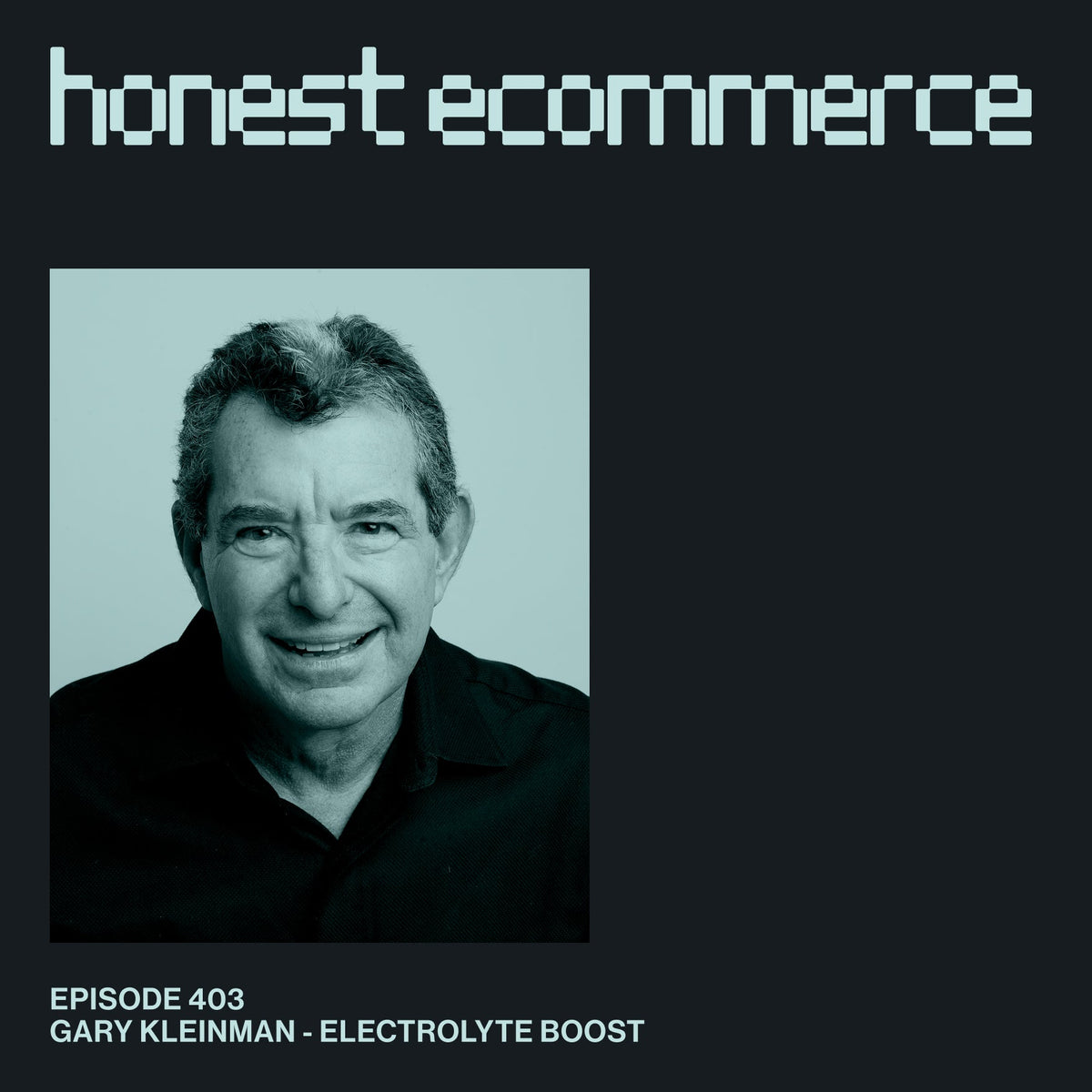
Gary Kleinman
There are moments that you go, “Why am I doing this?” And there are moments I think every entrepreneur says, even when it's successful, you go, “Why am I doing this?” Right. Because in many respects, as you're building a product and/or brand, or whatever it is that you, even a service, you have to be ready for the unknown, because it's coming. Any way you want to look at it, it is absolutely coming. And those are moments that you go, “Yeah, maybe I shouldn't be doing this.”
Chase Clymer
But I think it is having that discipline. And maybe it's the ignorance of not knowing how hard it will be allows you to just keep taking one more bite at it.
Honest Ecommerce is a weekly podcast where we interview direct-to-consumer brand founders and leaders to find out what it takes to start, grow, and scale an online business today. Honest Ecommerce is proudly produced by Electric Eye, a Shopify Plus partner helping ecommerce brands sell more with strategic design and development. Visit electriceye.io for more information.
Hey everybody, welcome back to another episode of Honest Ecommerce. Today I'm welcoming to the show a serial entrepreneur, the founder and CEO of Electrolyte Boost, Gary Kleinman. Gary, welcome to the show.
Gary Kleinman
Nice to be here.
Chase Clymer
I'm excited to chat. So for those that are unfamiliar with the product, could you quickly tell us what Electrolyte Boost is? What are the types of products you're bringing to market over there?
Gary Kleinman
Electrolyte Boost is waterless functional powder. It is the only waterless functional powder in the marketplace. You tear off the top of the sachet, pour it on your tongue, it's in your blood system almost instantaneously, and you feel the effects. The benefit is a hundred percent of the functional benefit you get right away, no dilution. And since you're not taking 16 ounces of water or other fluids, you're not running to the bathroom.
Chase Clymer
Absolutely. So when you say functional, you're saying energy, or what are kind of the problems, per se, it's helping to solve for?
Gary Kleinman
Good question. So the product that's in the market right now addresses energy and focus. So within three minutes you'll have a heightened sense of awareness. It's got electrolytes, so it'll extend your current rate of hydration or slow your rate of dehydration. When I talk about functional benefits, that's the functional benefit of that product.
We have three additional products that will be released shortly. Their functional goal and objective is, one is immunity. One is sleep, and another is a comprehensive female-based product that has bioidentical human lactoferrin as opposed to bovine lactoferrin, and a really interesting ingredient for gut health that comes from algae.
So we look at…
Chase Clymer
That's amazing.
Gary Kleinman
So we look at the functional benefit that we're trying to achieve and then find the hero ingredient, if you will, the Intel Inside that achieves that. So it's a hero ingredient to a base formula to achieve a different functional benefit.
Chase Clymer
Absolutely. And obviously it's a very unique take on the product. Take me back in time. Where did you kind of stumble across this and realize this is the way we should go with this?
Gary Kleinman
It's a good question. So my background is a discontented entrepreneurial history where I always see gaps in the market and figure out, “All right, why is there that gap?” So a long period of my time was in experiential marketing. I was doing a mobile tour for Bandai with Snoop Dogg for one of their games, and it exposed me to the gaming world, the esports and professional gaming world.
And what I kept seeing was that gamers had symptomology of cramping, loss of attention and focus, and some memory issues from long gaming sessions, but they couldn't take anything fluid dependent, water or otherwise, because they can't leave the computer to go to the bathroom. So I said, “Well, get rid of the water,” it's a delivery system. So I said, “Why is there water when the water is not really the functional benefit? The powder or whatever you're putting in it is the functional benefit.”
So I said, “Get rid of the water,” and let's just figure out a delivery system that gets absorbed right away for gamers. And as I was finalizing that for a gamer, then a surgeon that I knew said, “Wait a second, I'm in a four and a half, five hour surgery. I have the exact same issue, and I can't go in and out of the surgical suite to scrub up and scrub down. So I could take that in the surgical suite.” And then truck drivers and hikers and bikers and cyclists and the list goes on.
So that's where it came from, was literally looking at a problem that a niche audience of esports and gamers had and then realized that there was a substantially broader application for it.
Chase Clymer
Absolutely. How long did it take to go from like, “All right, there's a problem here, I think a solution is let's get rid of the water,” to you having like a prototype? Walk me through that whole, the phases of getting to the first prototype.
Gary Kleinman
Great question. So when I realized that there was probably an opportunity for it, we had to create a formula. You know, powders, generally speaking, don't taste good, right? Because if you look at electrolytes, that's basically all salt based in many respects. So no one's gonna take a handful of salt and throw it in their mouth and say, hey, that was a fun experience. So it really was about masking.
And I thought when I came up with the formula, I'd go to a flavor house, go to a manufacturer, give me two or three weeks, and we'll knock it out. I was off by a year and a half. And literally my house looked like a drug den. And my kids would come over and they go, “What are you doing?” Because basically it's white powder and all these ingredients. And I had baggies and baggies and baggies of terrible tasting masking agents and every kind of sweetener you could think of.
So it took about a year and a half to get it right, primarily because of several factors. First and foremost, the taste. Most powders, as I just said, are medicinal and bitter and not always easy to mask. Some of them have an awful aroma to it, so you can't use those.
And then the other issue with the ingredients for it to work in a direct-to-mouth solution, the dosing has to be right around four and a half grams, five grams. After that, it's too much powder to put into your mouth. So the ingredients, one, had to have an efficacious dose to fit within that overall dosing. It also needed to be bioavailable, meaning it is quickly absorbed, and water soluble so that it would break down with saliva in your mouth. And as you can check off all those boxes, then you have the foundation for a formula.
And we ran into certain ingredients needed. Like, you take creatine, it's a five gram minimum dose basically for creatine on a daily basis. If you add it to our existing formula, you're at nine grams. You can't do that. It's too much powder. And then you'll have certain ingredients, and it would either clump because of the moisture in the ingredient or it wouldn't dissolve.
So it became a pretty significant puzzle that, had I known, I probably would have said, “So they don't go to the bathroom.” Because it really was a challenge, especially when there's so many sweeteners on the market, and we didn't want to use sugar because people don't want sugar. So you gotta look at all the sugar supplements or substitutes. And some of them are frowned upon, some of them are not, some of them are better. And then the market kept changing, and there were sweet proteins that came out that were supposed to replace sweeteners. They weren't a solution. So it took a long time.
Chase Clymer
[Sponsor: Klaviyo]
Do you know what's going on with Klaviyo? When was the last time you explored what it can do? Klaviyo has been shipping tons of new AI, data, and automation features designed to help ecommerce teams move faster, personalize better, and automate more of the work that used to take entire teams. Most brands are only using a fraction of what is already inside their Klaviyo account.
Klaviyo is not just email and SMS anymore. It is your customer data platform, your lifecycle marketing engine, your analytics layer, and now your AI-assisted execution layer, all in one place. That means your customer data updates in real time. Your segments stay current automatically. Your flows and campaigns all run off the same source of truth. And now AI can help predict churn risk, forecast spend, recommend next best products, generate campaign content, and optimize send timing across channels.
The big unlock is speed and efficiency. There are fewer tools to manage, less dependency on engineering, less time moving data between systems, and a lower total cost of ownership across your marketing stack. And brands are seeing real results from leaning further into Klaviyo.
Dollar Shave Club has reported over 30% reduction in total CRM stack costs after consolidating onto Klaviyo. Brands like ThirdLove have seen a 15x ROI from SMS after consolidating channels. And companies like Corkcicle have grown flow revenue over 90% after bringing email and SMS together inside Klaviyo. Across our customer base, almost every single brand we work with today is using Klaviyo.
That is just where serious ecommerce customer data and lifecycle infrastructures are living these days. If you're already on Klaviyo but you feel like you're not getting everything you can out of it, or you're just running multiple tools and want to simplify without losing power, I think this is worth your time. You should head on over to klaviyo.com/honest to learn more. That's K-L-A-V-I-Y-O.com/honest to learn more about what Klaviyo can do for you today.
Chase Clymer
That's something you mentioned there that I kind of bring up on the show every once in a while, and I always like to highlight when I see a perfect opportunity, is had you known a year and a half later how challenging and annoying, let's say, the process would have been, do you think you would have taken the leap to try to solve that problem?
Gary Kleinman
As I think, many times I heard my mother's voice saying, “You should have gone to med school.” I don't know. A psychic, as I almost referred to earlier, said to me, I don't know, 30 years ago, I will always be kind of a disenchanted entrepreneur looking for things. So I enjoy that journey. I enjoy that puzzle of, “I know we can get it to work. Is it gonna happen?”
I am a firm believer as an entrepreneur, and as an entrepreneur, I think you have to feel it's not about if but when. So it kept me focused and saying, no, there's something there. I think we're getting closer. And then the next sample would come in and would be light years further away. And I go, well, no, we're trying to get closer. And then we'd put in, like, allulose, and somebody would say, “That'd be great,” and then that was awful.
Or we would try Oobli, which was a new sweetener at the time, imperfect as it turned out to be. But we spent months taking Oobli, which is a sweet protein from a plant, and trying to make that work. And then you get to a point that the clock is ticking. I just can't keep using this ingredient. And then sucralose worked for quite some time, but there is some backlash to sucralose in a product.
And we're going into a large grocery chain in the first quarter of twenty-seven, and they go, “Get rid of the sucralose and we'll give you shelf space.” So we went back and changed the formula that we had been playing with unsuccessfully, but that impetus made us do it expeditiously, and we were able to get rid of the sucralose and have a viable formula across our entire portfolio.
But yeah, there are moments that you go, “Why am I doing this?” And there are moments I think every entrepreneur says, even when it's successful, you go, “Why am I doing this?”
Because in many respects, as you're building a product and/or brand, even when you have it right, the obstacles you go through on a daily basis, and that's true whether your manufacturer is doing what they're supposed to be doing, your film can...
We had an issue with the film coming in that it's supposed to be printed top to bottom. They didn't look at the die line and they printed it side to side. Well, that doesn't go on the machine. Well, now you gotta go back and reprint.
So there's all of these things, even though your product has finally gotten to where you want it to be, and then Pandora's box opens up somewhere else. And I think as you're building a product, any brand, or whatever it is that you, even a service, you have to be ready for the unknown, because it's coming. Any way you want to look at it, it is absolutely coming. And those are moments that you go, “Yeah, maybe I shouldn't be doing this.”
Chase Clymer
Yeah, but I think it is having that discipline, and maybe it's the ignorance of not knowing how hard it will be allows you to just keep taking one more bite at it.
Chase Clymer
[Sponsor: Intelligems]
What is the next big idea that could change your business? A pricing change, a new bundling strategy, adding subscriptions, tweaking your shipping offer? Most brands make these decisions based on gut feel. They roll out the change, hope for the best, and have no real idea if it helped or hurt their business. Intelligems fixes that.
It is an AI-powered testing platform that brings CRO-level clarity to the decisions that actually move the needle. Not just button colors and headlines, but the big stuff. Pricing, offers, shipping, new apps, even major site changes. Brands like Ridge, Jones Road, and True Classic are using Intelligems to test their most important decisions and see exactly how each one of those impacts profit before they commit.
Momofuku used it to test promotional offers ahead of Black Friday and found the version that increased profit by about 28%. Mott & Bow ran structured pricing tests that drove roughly 30% more incremental profit. We use it at Electric Eye with almost every client we work with. And now Intelligems has a free AI-powered audit that gives you three specific ideas that you can test on your store today. No commitment, no credit card, just three opportunities worth exploring.
Head to intelligems.io/audit and get your free audit in just a few minutes. That's intelligems.io/audit. Intelligems.io/audit.
Chase Clymer
You finally get there, you have a product that you're like, all right, we're gonna take this version of it to market. What is that like? How do you go out there and get your first customers? Did you go online first? Did you try traditional wholesale? What was the path to market for you and the team?
Gary Kleinman
These days I think it's first and foremost Amazon, right? As much as they're a sixteen hundred pound gorilla, and I don't think that there's a brand on Amazon or a company on Amazon that likes Amazon. You gotta be there, right?
Chase Clymer
Yeah.
Gary Kleinman
I mean, we argue, not that we argue with them, we have issues with them frequently. Good luck. You know, you're kind of at their mercy. If you're fortunate, which we happen to find someone that runs the health and wellness aspect of Amazon, and he's been incredibly helpful when we've had issues. But Amazon is the first place to put it out there, because then you have a distribution channel for people to buy.
And while you go through that, you're also really trying to do focus groups, and not necessarily formal focus groups, but trying to find out who your persona is, who's buying it. When we look at our product, when we first started, yes, it was gamers and then some surgeons, but it was really active lifestyle customers, because that's who's out in the market, and they want convenience, and they're looking at healthy stuff and what have you.
But then we find out that the GLP-1 market is buying our product. And then we find out that there's a condition called POTS and that this addresses those people that have that condition. We find out truck drivers. I was on a call recently where at the end of the call a gentleman said, “Thank you for creating this product, because I use it,” And he goes on to tell us that he's confined to a wheelchair. So when he goes to a sporting event, he doesn't drink anything until the end of, if baseball, he was saying the seventh or eighth inning, because by the time he goes home, he knows he can go to the bathroom. He doesn't want to go to the stadium.
So you start hearing all these use cases as you're testing your product and you're sampling it at events like cycling events or running events or whatever health events that you go to, and get the feedback, and then you build from there.
It's very difficult for a young brand to get into retail. We're now doing that. That's exciting when they say “Yes, we're going to put you on the shelf and you're going to get 600 stores,” that's kind of the beginning. Because if it doesn't sell and you can't control where they put it, then they're gonna discount it, ask you to buy it back, and that can put you out of business.
I know people, colleagues, that were thrilled when they got into Target. And two months later, Target said it's not moving, “Your velocity is not anywhere near where it's gonna be.” And it was on the bottom shelf, tucked away, nobody found it, and they wanted a two hundred and fifty thousand dollar check to discount it and get rid of the product. So it's controlled growth. It's really building a foundation.
And I think today, and it's even changed in the last year, is shifting away from influencers to creators. And do you use them for TikTok and use them for Instagram? Because what that does, and I went through this yesterday very specifically with an agency, for a brand such as ours to be on TikTok, you actually lose money, which sounds crazy because it's a moving product. But when you go through all the costs and everything else, and the free product you're giving out and the ad you've got to take.
But what supposedly happens in the 90th day or the third month is the halo effect from TikTok and Instagram skyrockets your Amazon channel, because that's where everybody goes to buy. So you really need to understand the interrelationship between all these channels, and where do you drive to? And do you drive it to your website?
You drive it to your own website, you get the data, you get emails, you can, you know, retarget, you can do all those things. You can't do that on Amazon.
So you start small. We spent probably two years in beta. We went through three package changes because we saw what customers liked or didn't like. And then finally got to a message on a packet that communicated no water needed, which we weren't doing well before. So it's a long answer to how do you start? You start everywhere. And look at the data.
Chase Clymer
I agree with you. Amazon is kind of an eight hundred pound, sixteen hundred pound gorilla. But I do think it is an extremely easy place to beta test a product. There are customers there that want to buy. And that's the hardest part of building a new business, is getting in front of potential customers.
So I would love your feedback as an entrepreneur. If I had a unique or novel business idea for a product, would you be scared to test it on Amazon because of lookalikes or thieves or whatever? Or, like, do you think it's a great place to get immediate feedback about the product?
Gary Kleinman
I think it's a necessary channel. I don't know that you're gonna get immediate feedback, because the problem with Amazon for new companies is discoverability, right? Just because you're on there, nobody sees you. And if you start having to buy keywords, and you're doing ads. If you look at our product, there are electrolytes in our product. Our product is as much a brain health product as it is the extension of hydration.
We can't afford to go buy electrolytes on Amazon. You got too many others. Liquid I.V., LMNT, and all these big boys are buying that. And they're now owned by conglomerates like P&G and Nestlé and what have you. We can't compete with that. So if you've got a product that is unique, you've got to then look at what are the keywords that you can find so that people will, in fact, find you.
And that's true when you put it on your, and I love this phrase, because depending on who you talk to, they tell you that your A+ content on your page, on your Amazon site. Go to four agencies and they'll tell you that your A+ is terrible unless you use them, right? And I kind of understand that to a certain extent.
But interestingly enough, so you've got to find that. And we, in our product, have had a challenge finding the right keywords to what are people looking for? Nobody in our world is looking for a waterless solution to functional health, because nobody's doing it. So it's not a category. So the good news in our world is nobody's doing it. The bad news in our world is nobody's doing it. So where's your category?
So if somebody's introducing a product, if it's truly novel, find your category. And if there isn't one, dig in, because that's a lot. The education of a consumer is very difficult. And that's because consumers are giving you what, five seconds? Maybe five seconds. And then you gotta, hopefully you get word of mouth.
And on the Amazon platform, the way their algorithms work, from what I understand, and I am anything but an expert on Amazon, you need reviews, right? You need good reviews. If your reviews are 3.8, Amazon doesn't really promote you. So you gotta make sure that you're getting enough reviews. And what motivates somebody to leave a review? I don't know. I don't necessarily leave reviews for products that I buy on Amazon. I go, “Why? I'm using it,” I'm more inclined to do it now because I know it's a brand that needs the review. So I'll help them, because I'm in that space.
But you need to do that. And you need to get people talking, and word of mouth, and getting on social, and cross pollinating everything that you can.
So my direct response for somebody, first of all, don't be too novel, because there's no audience for too novel unless you've got a big wallet. You can be an offshoot, which we are, and it still has its challenges, but once people realize, tear off the top of the sachet, throw it in their mouth, and they have a positive experience, that goes a long, long, long, long way.
And we saw it last week in a high school. A team bought our product in Iowa, and they had a game, ninety-three degree temperature when they started the game. We knew the athletic director, he bought a bunch of sachets for the kids. They took two sachets before the game, one during halftime, and for the first time in their history they had no cramping all game. Their opponent was taking kids out all game because of cramping. That experience, now kids are buying it, the team's buying it.
You need that social proof, that actual proof, to start building your communities. So if somebody is creating or has created a novel, you gotta get people, early adopters, talking about you.
Chase Clymer
[Sponsor: eFulfillment Service]
You have prepped all year, and all that hard work is paying off. Your store is converting, the ads are working, and this is shaping up to be your best holiday season. But your 3PL can't keep up. Orders are backing up, customers are asking where their stuff is, the reviews are starting to turn. All that hard work, all that momentum, undone by a fulfillment partner that can't scale with you. This is a nightmare scenario, and it happens to brands every holiday season. Enter eFulfillment Service.
eFulfillment Service is the 3PL that scales with you. They are family owned, they've been in business for over 25 years, and they're built specifically for growing direct-to-consumer brands. There are no setup fees, no minimums, and no long-term contracts. You only pay for what you use.
If you're scared your 3PL can't keep up this holiday season, now is the time to reach out to eFulfillment Service. Go to efulfillmentservice.com/honest and get up to eight weeks of account fees completely waived. That's E-F-U-L-F-I-L-L-M-E-N-T-S-E-R-V-I-C-E dot com slash H-O-N-E-S-T. efulfillmentservice.com/honest.
Chase Clymer
Is there anything I didn't ask you about today that you think would resonate with our audience?
Gary Kleinman
I think most people in my shoes, or similar shoes, the cost of launching a product is very expensive. I think people think, “Okay, my product's gonna cost me twenty-five cents, a dollar, whatever the number happens to be, and I can throw it up on Amazon. I can get boxes in my garage and fill it and do that, or use a 3PL.” Whatever you think it's gonna cost, quadruple it. It's expensive to launch anything. And I think people underestimate the actual dollars against the timeline of time before those graphs start intersecting.
Chase Clymer
That's something actually I had a mentor tell me once, and this was obviously about building a service business with our agency and whatnot, but ten years ago, shout him out. But he was like, “All right, here's what's gonna actually happen. The money is gonna come, it's gonna be half as much as you think it is, and it's gonna take twice as long to get there.”
Gary Kleinman
100%. And then you also have to project properly. And when I say project properly, in certainly a CPG world, which I live in, you want retail. I mean, you can sell so much on Amazon. Yes, you can have a very profitable Amazon business. Ultimately, you end up looking at retail.
As you grow, and it's true even if you want to be a success on TikTok, you have to have a lot of inventory in stock to support the sales that you get. So if you think you're going to be a really successful TikTok brand and you're going to sell, I'll pick a number, 10,000, 100,000 units, whatever that happens to be, you have to invest in that inventory up front to have it to sell, because if somebody orders it and you're out of stock, you lost a customer. So I don't think people project all those costs and the tail that you have to put in before you go there.
And again, in a CPG world, to produce our product is probably, on a good timeline, six to eight week lead time to get from PO to actual product in inventory. If you're doing something new, it could be twelve or fourteen months. Well, now you're investing in inventory twelve weeks before it's in your warehouse, then you gotta get it to TikTok, and then you gotta sell it.
And you're financing inventory for six to eight, nine months before it starts coming back. And I don't think people understand when they hear, “Yeah, you'll be a success on TikTok.” You may well be, but that's really expensive to float it. So I think, and as often as I have done this, I think every single time I have underestimated the cost of actually getting to a point where you can be successful.
Chase Clymer
Hey everybody, just a quick reminder. Please like this video and subscribe if you haven't. We're releasing interviews like this every week, so don't miss out. Now back to the interview.
It is something I've talked about before. As a business evolves and a business matures, it becomes less, unfortunately, it becomes less about the problem you're solving for your customer that was probably your initial passion. It becomes more of a money shell game where you're learning how to basically do money magic and extend out timelines on when you owe people money and how quickly you can get product. It becomes like a financing thing.
Gary Kleinman
Yeah, it's a great point. It's a great point. Most of us go into it with a passion for what we're doing, and as you grow, your time is spent less and less on that passion and more on the things you don't want to do.
Chase Clymer
Yeah. And that's the unfortunate thing about entrepreneurship. If you do it good, you quickly become a boss and quickly become a CEO, which I will tell everyone, not everyone is cut out to do that, and you don't magically have those traits ingrained in you. Some people just like to start things and figure it out, and then they figure out they're not good at the scaling part, and they install a CEO or they sell the company and go back to, “I want to build something scrappy from the ground up again.”
Gary Kleinman
That raises a really good point in the entrepreneurial world, is you don't have to do it alone. Either get a partner, a co-founder, or somebody, a mentor, that's good at what you're not good at. You don't need somebody to do what you do, because then they don't need you.
And get somebody that… we have a chief executive, or a chief administrative officer, or in-house legal counsel. I mean, he crosses every T and dots every I. That's not me. I'm not… I had a conversation with him earlier about something. I said, “No, let's just take a flyer and see what happens at the end,” He goes, “No, the SEC is involved in this and that and other investors,” I go, “Well, we can deal with that at the end,” and he goes, “No, no, no, we can't do that.” So you do need people that will check your thinking.
I think there are two things that you raised. One of which is we have no ego in our company, but we have a lot of pride. Big difference. And the other thing that I say to wanting-to-be entrepreneurs, you really need to understand your risk tolerance. If you don't have risk tolerance, get a job.
Chase Clymer
Yeah, that's something I realize. I am high risk. It's why I'm an entrepreneur, it's why I do this podcast, it's why we have an agency that's ten years old. But the agency would not exist without my partner, who's the opposite of me, who has low risk tolerance and forces me to… I have to ask to do crazy things. And without that pushback from him, it's why we've sustained, it's why we've grown the team, all those things. Risk tolerance is very, very much something people need to understand about themselves.
Gary Kleinman
Yeah, I mean, you're blessed to have that, because I've got three kids. One of them is certainly like me and has no aversion to risk. The other one doesn't want to leave his room at any given time. So if you don't have it… and what's interesting is the ones that are really averse to risk are the ones that really want to be an entrepreneur. And they're the worst people to be an entrepreneur. And I say to everyone that wants to be it, I say, you gotta be comfortable with no net.
Chase Clymer
Yeah, and awkward conversations and being direct and being decisive. Being your own boss doesn't mean you don't have to respond to anybody. All of it is on your shoulders, is what it means.
Gary Kleinman
And you can't freak out if you got a bill due on Friday and you look in your bank and there's not enough money to pay that bill. You may have to call that vendor and say, “Hey, I need some help,” And so you gotta take your ego out of it and make sure that you are growing responsibly. I'm a firm believer in testing and tweaking everything. Everything. Just because you think it's a good idea, doesn't mean it is.
A dear friend of mine gave me a quote that I use frequently. It's easy to find a gap in the market. It's really hard to find the market in the gap. And it's pretty profound, because everyone says, “Yeah, why isn't that there?”
And one of the best examples of that has nothing to do with CPG, is when, who was it, David Katzenberg, they did, god, what's the name of, during COVID? They created a network and raised two billion dollars for short term video. And they invested a billion five, and they got money from Universal and Fox. And they found out nobody wanted a short term video. Yeah, there's a huge gap in the market.
Chase Clymer
I remember what you’re talking about. It was a vertical specific video for your phone.
Gary Kleinman
It was for your phone with high, high produced content. Major directors and producers and stars. I'm literally drawing a blank on what the name of the company was. And they put in a billion and a half dollars. And these are people that are Hollywood iconic legends. And they bottomed out in four months.
Chase Clymer
Yeah.
Gary Kleinman
And they were right. There was a gap in the market, a massive gap in the market. Nobody wanted those. There were no high-quality short, two minute episodes of a quality series. And there was a gap. They didn't realize that nobody wanted it.
So you gotta pay attention to a good idea on a dining room table doesn't mean it's gonna work outside. And so you really do need to say, “Okay, there's a gap for what I do, but more importantly, is there a market for that gap?”
And to that end, I'm shocked when I see another hydration drink come into the market. Or another energy drink, or another whatever. Go, “How many tequilas do you need on a shelf? Or how many vodkas?” I mean, you go to a bar and you see eighteen tequilas. I don't know how they distinguish themselves. Some of them do, some of them don't. Forget celebrities and influencers.
There might be a gap for a certain distillation of a tequila, but that doesn't mean there's a market for that two thousand filtered distillation. So I think entrepreneurs fall in love with their idea without putting in enough work on whether that idea actually should exist.
Chase Clymer
Absolutely. Well, pivoting back to your idea that definitely exists...
Gary Kleinman
Thank you.
Chase Clymer
If I'm listening to this and I wanna try the product, check it out, either buy it online or potentially in store on shelves. Where should I go? What should I do?
Gary Kleinman
You can go to Amazon, or better yet, go to, you know, www.electrolyteboost.com. And if you want a discount, use GARY10. You'll get a discount and you'll get it in a couple days.
Chase Clymer
Thanks. Awesome, Gary. Thank you so much for coming on the show and sharing all those amazing insights.
Gary Kleinman
Hey, it's a pleasure. Thank you, Chase.