Chase Clymer
A lot of people that reach out through customer support, like the answer exists on the website and they could just search for it, but they're kinda just being lazy. And I know this firsthand experience, 'cause we run CS on an app that we have, and it's oftentimes just pointing them towards the documentation.
Aleksandra Kacperczyk
Yeah, definitely. I also know that firsthand because I'm the lazy customer sometimes. And yeah, you can automate a lot of those situations where the customer is that either doesn't want to search for something or is lost. Because a page can be extensive, can have a lot of subpages. So let's get those questions out of the way. And if that works properly, maybe the AI can help us sell.
Chase Clymer
Honest Ecommerce is a weekly podcast where we interview direct-to-consumer brand founders and leaders to find out what it takes to start, grow, and scale an online business today.
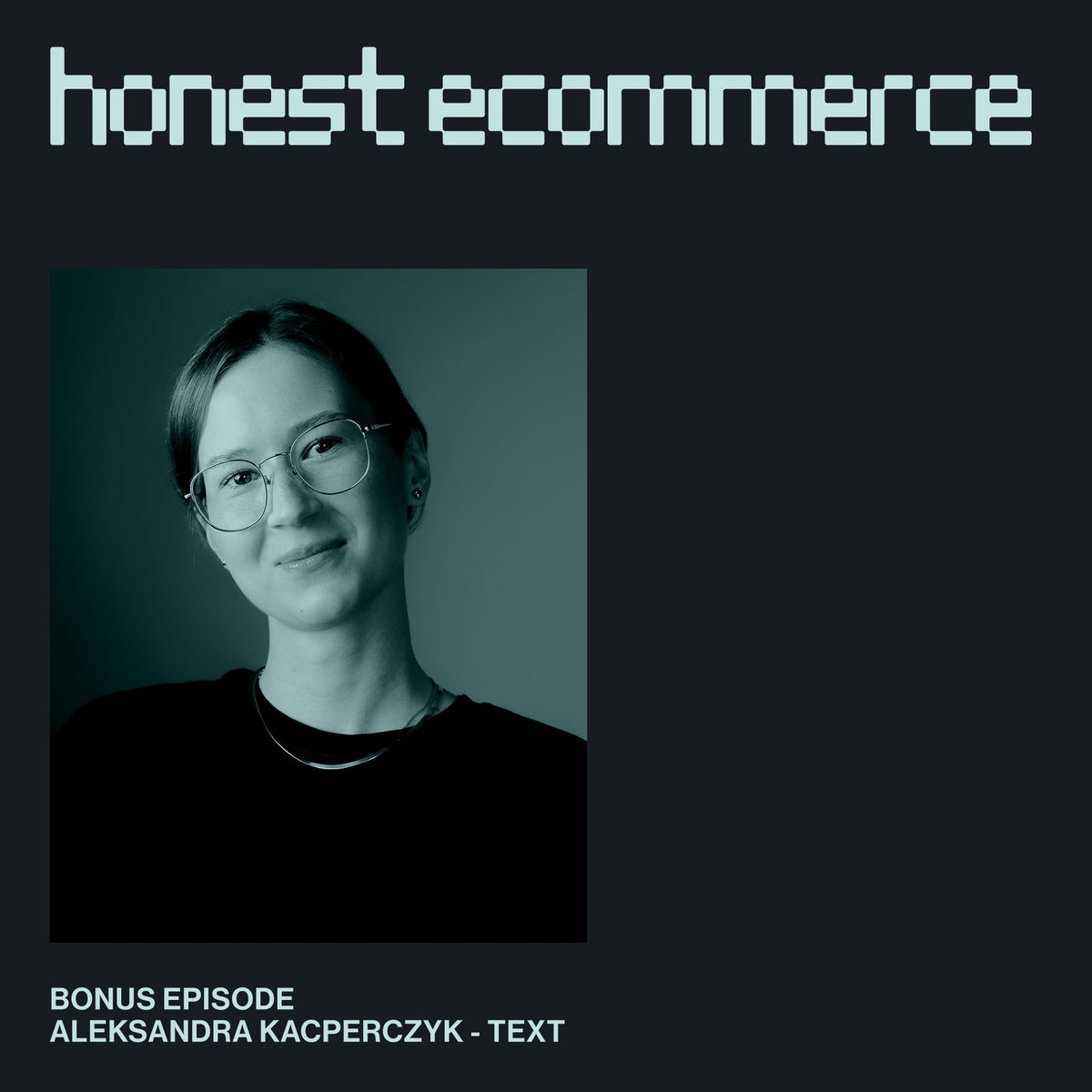
Hey everybody, welcome back to another episode of Honest Ecommerce. Today I'm welcoming to the show the product manager on one of the selling teams at Text. Aleksandra, welcome to the show.
Aleksandra Kacperczyk
Hello everyone, thank you for having me.
Chase Clymer
I'm excited to chat. So for those that don't know, could you quickly talk about the products? Obviously there's Text, there's a few under your umbrella, but what are all the apps that you are kind of interfacing with and helping out with over there at your day-to-day job?
Aleksandra Kacperczyk
Text is the company behind LiveChat, which you might have heard of, some of you, because we've been on the customer service market for over two decades. And some other similar names that will be familiar are Gorgias or Intercom in the same area. And some time ago, approximately two years, I guess, it's been two years, we decided to pivot and to change the way we do customer service.
And then Text, our newest application, which was built with ecommerce in mind.
Chase Clymer
Absolutely. For the sake of our audience, I ask our guests, why should I listen to you? Like, are you an expert? So take me back in time. Like, what have you been doing kind of in your career to end up here, to where we should definitely take what you have to say seriously?
Aleksandra Kacperczyk
Don't take me too seriously, but hopefully I will be able to share with you some valuable insights. So I represent Text, which has been, as I already said, in the customer service industry for nearly 25 years, and we've seen a lot of customer interactions and conversations, and those are huge amounts of data we can learn from. And I would like to share with you our best learnings today.
And as for me personally, I've been in SaaS for almost eight years, a little less in ecommerce. It's been two or three years. But I find this area [or] industry super interesting. I'm very excited. So far it's been the most satisfying part of my career, and yeah, that's why I'm so happy to be on the podcast, to also learn from you.
If you're on a customer support team, you should really stick to the end of the video, because there's gonna be an amazing offer at the end.
Chase Clymer
Absolutely. With your career, did you go to school for this? Was this kind of stuff that you started to pick up iteratively at each new job? How did the kind of evolution of your career work?
Aleksandra Kacperczyk
Well, no, I didn't plan to work in tech at all. It was something that was really unexpected, because I got my engineering degree in biotechnology, so it's not related at all. But I found the basic programming courses we had quite interesting, and I thought, why not check out the tech industry? So I entered into not programming specifically, but into tech.
And from there I started taking on more interesting projects, working with some technical documentation, some marketplaces, third-party apps, and as time went by I got a chance to switch to the ecommerce area, and that's what I did.
Chase Clymer
Absolutely. Yeah. I always like to show folks that there's no right way to kind of get into this fun little ecosystem that we exist in.
Aleksandra Kacperczyk
Definitely not. I've heard so many stories about people, how they got into product, business. Literally everyone has a different background, and very background brings in something new, something fresh, so it all matters.
Chase Clymer
Yeah, the experience is, it's so funny, where I've talked to some people they'll have mastermind groups or something similar where it's like everybody is the founder of an ecommerce brand, right? And then I'll meet other people, they're like, no one can have the same business, on purpose, because the way you think about solving stuff when everyone's doing the same thing becomes a little bit hive-mindy.
Whereas if you have innately different businesses and the way that you're solving things, there could be a more creative solution that exists in a different ecosystem that hasn't been brought into yours.
So obviously there's pros and cons to each approach, but I think basically what I'm saying is go get in one of each.
Aleksandra Kacperczyk
Exactly, exactly. I think that's why you can't really copy somebody else's recipe for success, because your path will have different challenges. Even though you can learn from those, some aspects can be the same. Ultimately, the journey will be different. And if it was so simple to just copy what everybody else is doing, well...
Chase Clymer
Yeah. Yeah, exactly. We do a lot of competitor analysis for clients within CRO, and we have to really preface it for folks to be like, we're not doing exactly what they did. We're just getting inspiration to give us hypotheses to go test and see if this is a good idea for your business. 'Cause there's so much difference, and I've belabored that point.
It's things as simple as, like, how they're structuring sales. You don't know if they're losing money on that sale. You don't have the insights into how much they're paying to acquire a customer. Just do what's best for your business.
Aleksandra Kacperczyk
Yeah, exactly. Mm-hmm.
Chase Clymer
You mentioned earlier that you have 25 years of data to go through, and that you have gone through and you've kind of got some insights you've learned from it. Where do we start? What's kinda the first big unlock or a big interesting learn?
Aleksandra Kacperczyk
Well, I would like to start with, I don't know if it's going to be controversial, but it's my take on customer support these days, is that a lot of conversations that seemingly look like just support conversations are in fact buying decisions in progress, and your inbox, wherever you're handling your day-to-day interactions with customers, is where you can actually sell more.
And that's the starting point, I think, for the conversation.
Chase Clymer
Absolutely. So you're saying that the people that care enough to stop what they're doing and actually open a chat widget or whatnot and have a conversation with you on your online store, are high intent buyers.
Aleksandra Kacperczyk
In some cases, yes. And it can be noticed in various ways. I believe that whenever you're chatting with a customer, or even if you're not chatting yet, even if they're just browsing your store and you're seeing them browsing, you can look for those high intent signals.
Think of a customer who has repeatedly returned to a specific product page, or has been going through one product page to another, and you're noticing these are similar products. You can guess based on that that they're probably comparing these two products, or that they're wondering about something if they haven't yet converted. You can step in, take action, ask them if they need help, hopefully resolve their doubts and help them make a great purchase.
Another example would be returns or refunds questions, which look like simple basic policy questions, but when people ask those they often try to assess how much risk a potential transaction will involve. So it's your chance to establish trust, not only answer and solve the ticket, but actually build trust with that potential customer. And if you establish that foundation, making purchases will be much easier, even if it doesn't happen on the same day.
Chase Clymer
Absolutely. I think with the first part of that, if you see these high intent signals and you reach out to them, I'm assuming, is it like a widget on the store and it's just, blah, I'm a real person, can I help you compare product A and product B? Is it as simple as that?
Aleksandra Kacperczyk
Yeah, it can be like that. It can be a real person, it can be an AI that sees those signals and is instructed to react to them. It depends on what setup you would like to have.
Chase Clymer
Hey everybody, just a quick reminder. Please like this video and subscribe if you haven't. We're releasing interviews like this every week. So don't miss out. Now back to the interview.
Absolutely. Yeah. And then going to the next part of that, a lot of conversion rate optimization is just people not buying because of fear, uncertainty, and doubt. And you had mentioned that then they're trying to de-risk the purchase by asking questions about these policies to see how that lines up against their risk acceptance.
So what you're saying, you can answer their question about your return policy, link them to that policy, but also give them more information about why you're trustworthy. We've got 10,000 five-star reviews. We've sold enough of this product to go to the moon and back. We've got, you know, this, whatever these cool, we were featured in Forbes, we were featured in GQ.
Whatever these social proof elements are, you should also be sharing that. Because that original signal that they kinda flagged was like, I don't trust you enough to think I'm gonna keep this. How do I return it if that is the reality? So then you gotta go, well, here's the reason that people don't return it.
Aleksandra Kacperczyk
Mm, yeah. And even answering such a question timely, not making the customer wait for an answer for a day or two, you're signaling that they can trust you. You will answer them timely, and even if they want to make that return, that will also be handled with priority. So you're actually proving to them that you take their questions and requests seriously.
Chase Clymer
Yeah, absolutely. You take their potential business seriously, and so you're gonna get back to them quickly. I guess that kinda leans into my next question here. And you alluded to it a little bit earlier, which is getting back to people quickly. Some businesses can't afford to staff live chat 24/7 with a human agent. And obviously there's been crazy advances in AI this year. It's everywhere, everyone is talking about it.
So I guess you're in this ecosystem day to day. Like, how are you seeing AI and humans working together, solving these problems for customers in the customer support area?
Aleksandra Kacperczyk
I can share some more insights about how we restructured our own support team and how human agents collaborate with AI to actually serve our customers. So that's also interesting, but I want to start with a more general answer to your question. I think that we're past that moment where AI only automates repetitive stuff, and it's actually skilled enough to handle more independent, more risky transactions potentially, or at least tasks, right? Activities.
And one thing is that it can spot those high intent signals, as I've already mentioned. It can react to them, it can proactively approach customers. So, and if you let AI do that, you're putting a lot of trust on it, because letting someone proactively approach your customers is a sign of trust, right?
But you can make that choice. You can test AI in a way that gives you confidence to let it handle those interactions with your customers. And it can turn out to be beneficial, because it can not only handle high traffic for you, it can answer 24/7, day or night, on weekends. And in multiple languages, which is also a huge benefit.
And I remember chatting with one customer of ours who sells mattresses. And he said that the problem his business had was that customers would reach out to him late at night. And he was surprised by those emails he was getting, or chats. He couldn't answer them because it was in the middle of the night.
And he realized that people were frustrated with their mattresses, and that's why they started going on the internet, browsing mattresses, looking for alternatives, ended up in his store and started asking questions, because picking the right mattress is not so easy. He couldn't handle those questions on time, but imagine that you have an agent who doesn't sleep. You can let it handle those chats, those conversations. So even such an unexpected need can be addressed with AI.
Chase Clymer
Yeah, I think that it is just wild how much we can get off of our plate these days. Have you seen any kind of big claims about lift from AI?
Aleksandra Kacperczyk
Lift in terms of revenue?
Chase Clymer
Revenue, sales attributed to kinda just letting it, you know, all right, we're gonna let this thing kinda do what it can.
Aleksandra Kacperczyk
Yeah, yeah. I've seen some pretty impressive results. For example, there's this one customer of ours, that's a pretty recent success story. It's a Finnish brand, Nuvoo, and they sell business-grade refurbished computers. So a pretty complex business with a lot of technical conversations, I can imagine. I don't know much about hardware, but I imagine it's complicated.
And they had this problem with a lot of traffic coming in on weekends and in the evenings. And every morning, every Monday, their team would start the day with picking up the conversations from the backlog, having to deal with a lot of conversations and unanswered messages.
And they managed to train AI in a way that gives them a very spectacular resolution, 98%. And once they saw that they could trust AI with their questions, they allowed it to recommend products, to be more proactive, to actually approach customers who were in the store just browsing.
And with that they have increased sales by over 400% in a matter of a quarter. So that's pretty impressive. We're very happy for them. They're probably happier. Great story, all in all.
Chase Clymer
Absolutely. So historically it was all human agents, and these things would pile up on the weekends, and then Monday sounds terrible if that was your job, just getting through this backlog and getting caught up and refamiliarized.
It got to a point where they were just kind of letting the AI run 24/7, trying to handle all the conversations, that you said 98% were just... it could just handle them, and then the other 2% obviously would probably get kicked up to a human agent or something like that.
Aleksandra Kacperczyk
Well, actually, in terms of traffic, I think their AI handles 70% of traffic.
Chase Clymer
Gotcha.
Aleksandra Kacperczyk
So yeah, so far as I know, their human support team, who are trained computer specialists, still handle some chats, emails, and phone calls. They still have work, they just have less on their plate. They can focus on more complex cases. Instead of chasing each case.
But the AI, in the cases it handles, in the chats it handles, it's correct, or it returns a meaningful answer 98% of the time. So yeah, we could say that it just has meaningful conversations with customers almost always.
Chase Clymer
Yeah. But there's also something to say, a lot of people that reach out through customer support, they're just not, like, the answer exists on the website and they could just search for it, but they're kind of just being lazy. And I know this firsthand experience, because we run CS on an app that we have, and it's oftentimes just pointing them towards the documentation or pointing them towards something that already exists.
So, like, that's such an easy handoff that it doesn't need to even cross somebody's desk, or dashboard or whatnot, any sort of distraction. That stuff's so easy to do. It's the actual complicated stuff. True bugs, true edge cases, larger accounts that are looking for more hand-holding, things of that nature.
Aleksandra Kacperczyk
Yeah, definitely. I also know that firsthand because I'm the lazy customer sometimes. And yeah, you can automate a lot of those situations where the customer either doesn't want to search for something or is lost. Because a page can be extensive, it can have a lot of subpages. So let's get those questions out of the way. And if that works properly, maybe the AI can help us sell.
Chase Clymer
Yeah. But I think it goes back to the beginning of the conversation that we had, where it's like, if somebody is taking the time to reach out, they are more than interested in making a purchase. So it's like, you should definitely be happy about the opportunity to potentially solve their problem for them with your product.
Aleksandra Kacperczyk
Yeah, if they're reaching out, that's a strong signal. You can also reach out to them, which is actually what got this customer such a high result in sales, because the AI agent started being more proactive. So it started sending chat invitations like, "Hey, I'm seeing you're looking at this page, can I help you with it?" or some more contextual questions, and people would interact with those. And that ended up in those higher sales numbers.
But yeah, customers who reach out to you are already down in the purchase funnel, basically, in the selling journey.
Chase Clymer
Absolutely. They're just looking for a couple of answers. Now, Aleksandra, is there anything that I didn't ask you about that you think would resonate with our listeners today?
Aleksandra Kacperczyk
I would like to encourage merchants to experiment with this mixed model of having human support, human customer service reps, and AI, and not being afraid of combining both and giving the AI, like, authority to talk with customers, because there are ways to make the AI agent sound like your brand, like your customer service, human customer service representatives.
And I know that some business owners are afraid that the AI will be pushy, too salesy. And I completely understand those reservations, because it's up to you as a founder to define how you want your business to be run, and how you want your sales assistants and support reps to talk with customers. But you can totally adjust that experience and make the AI more friendly or more professional, more chatty, or more concise, speaking in your voice.
Basically what I'm trying to say is that you're in charge, you have the steering wheel. You can define how it communicates with the customers, and what it does, how it reacts in various situations. You're the owner and you're the captain of that ship.
Chase Clymer
Absolutely. That all makes so much sense. Now, if I'm listening to this episode and I'm curious to learn more about you and about Text, where should I go? What should I do?
Aleksandra Kacperczyk
You should go to text.com, and I would encourage you to create a free account to test it out and to connect your store. We have an integration that allows you to do that in a minute or less. So it's not a lot of work. And just play with the application and see what it can do for your store, for your business. See all the functionalities, capabilities in action.
See how the AI agent recommends products, how it connects chats with orders that happened in relation to that particular chat. And hopefully you will find value in the information we're giving you and in the capabilities we're offering.
If you're on a customer support team, you can go to text.com, start a chat with our AI agent or support, whoever is responding to chats, and you can mention that you've listened to the podcast, and we are happy to share with you our newest merch, which includes T-shirts and sweatshirts. So just mention you've listened to the episode and we will tell you how to get it. No strings attached.
Chase Clymer
Absolutely. And those are comp, you're gonna give away discount codes for those, right?
Aleksandra Kacperczyk
Mm-hmm. Yes, yes, that's how we get it.
Chase Clymer
Awesome. Aleksandra, I can't thank you enough for coming on the show today and sharing all those amazing insights.
Aleksandra Kacperczyk
Thank you.