Chase Clymer
What are some of the other major shifts that you saw in the past decade?
Aimee Dudum
I would say in-person is becoming more important again, and we've been seeing that over the past couple years. We did a handful of pop-ups last year that really re-solidified for us that in-person experience is extremely important.
Chase Clymer
Honest Ecommerce is a weekly podcast where we interview direct-to-consumer brand founders and leaders to find out what it takes to start, grow, and scale an online business today. Honest Ecommerce is proudly produced by Electric Eye, a Shopify Plus partner helping ecommerce brands sell more with strategic design and development. Visit electriceye.io for more information.
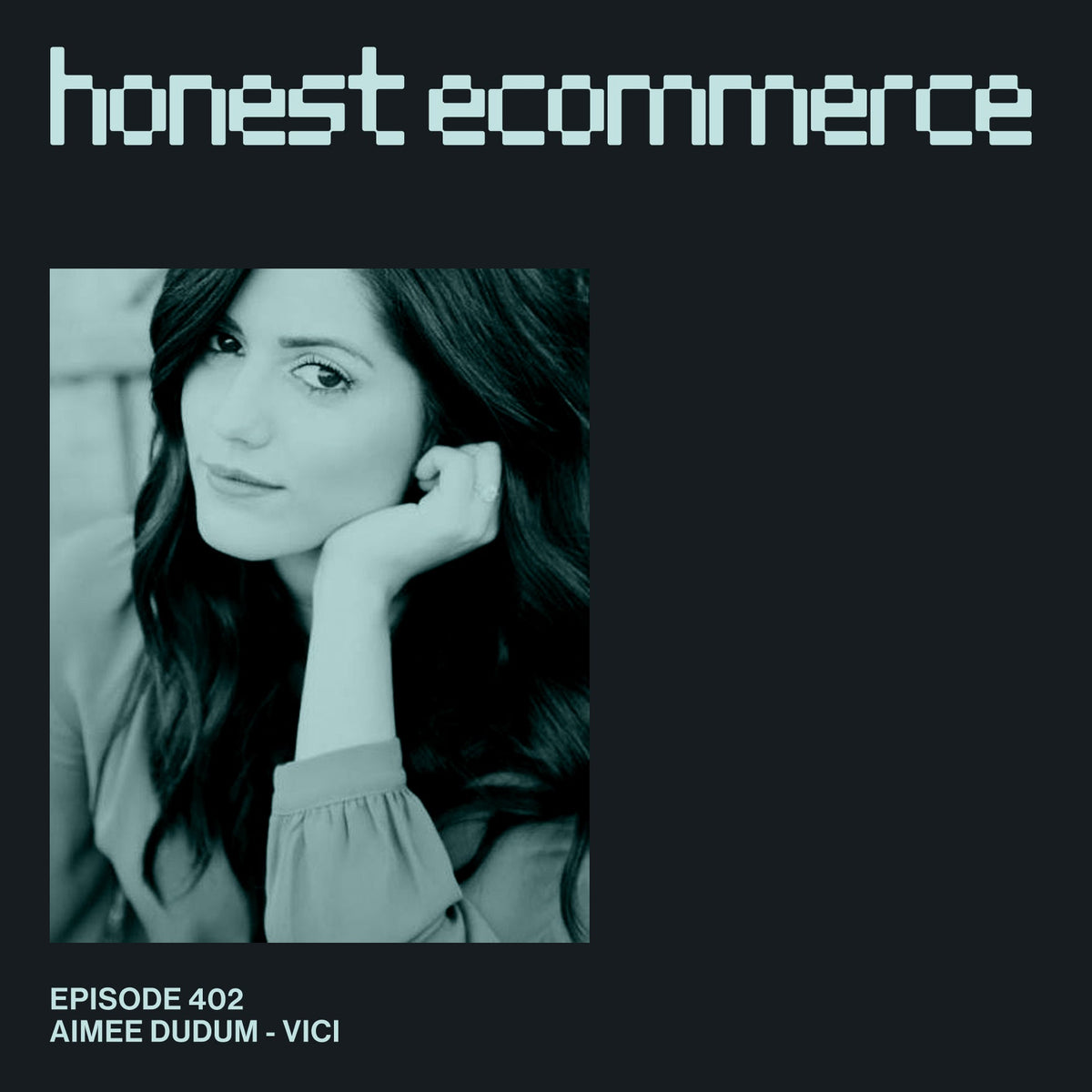
Hey everybody. Welcome back to another episode of Honest Ecommerce. Today I'm welcoming to the show Aimee Dudum. She is the co-founder and chief merchandising and marketing officer at Vici Collection. Aimee, welcome to the show.
Aimee Dudum
Thank you so much for having me, Chase.
Chase Clymer
I'm excited to chat. So for those that are unaware, what are the types of products that you and the team are bringing to market over there?
Aimee Dudum
We are based in California, and we are a website and retail chain that is servicing women across the United States. We are apparel and non-apparel, so dresses, outerwear, jackets, sweaters, boots, jeans, and then also just big within full head-to-toe outfitting for anything she has on her calendar.
Chase Clymer
Absolutely. So I could go there and kinda get the entire look for an event that I'm going to, or a pool party, or Labor Day like we were just talking about.
Aimee Dudum
Yep. Head-to-toe outfitting, style inspiration, and really affordable. Nothing on our website is over a hundred and fifty dollars. We're constantly giving out, obviously, promotions and offers to incentivize our clients. But if you're shopping for weddings, if you're shopping for weekends away, destinations, and even just the casual everyday athleisure she might need, we are that one-stop shop for all of your outfitting needs.
Chase Clymer
Amazing. Now, take me back in time. You know, where does the idea to get into this world come from? What was going on?
Aimee Dudum
Yeah, so this was started by myself and my stepmom Sandy. At the time, we were really looking to create something that allowed both a mother and a daughter to kind of shop in the same space. So think… the destination that Nordstrom is, where you can go in and there's something for every different type of aesthetic and client.
But for us, it was really important to keep it affordable. So a really big focus on quality at an affordable price point. This started sort of after the 2008, 2009 recession, when she was holding her wallet really tight and really thoughtful about what made sense for her to purchase in her life. And we were there to kind of show her you didn't have to spend $180 on a pair of jeans or $100-plus on a top, and how she can sort of mix and match those pieces to maximize her wardrobe.
And together, myself and my stepmom Sandy really provided a styling service to our clients. So making sure when they came in, they were kind of outfitted for, "I just had a baby, I'm going back to work” “I just got divorced” “I lost a bunch of weight." Whatever that moment or that mindset she was in at the time or experience, we were there to kind of show her how to revamp and rebuild her wardrobe.
Chase Clymer
Absolutely. And then we kind of maybe buried the lead a little bit here, but you've been in business for quite some time. So founded back in 2012.
Aimee Dudum
Yep.
Chase Clymer
You know, I guess, what was the landscape like back then as far as traditional retail back then? Was direct-to-consumer at the forefront of your mind? How did that kind of play out in those first couple of years?
Aimee Dudum
Yeah. We've always been digital and social first. So Vici really started before Instagram was a thing. We were on Facebook originally, and we were utilizing both Facebook and Instagram as that sort of product catalog for our assortment.
So you may remember, but organic social used to be a way different thing than it is today. And so you could reach a lot of people very, very easily by posting consistently and sharing content across platforms. So we really utilized both Facebook as well as Instagram, and then later TikTok, to showcase different outfits, different products that we're dropping. And we did this on a daily basis, multiple times a day, and then that fed back into our website.
We did open retail stores. So prior to COVID, we had three retail stores as well. We currently have two, and then we also have wholesale as well. So it's definitely, you know, changed into an omnichannel, but it was always about meeting our customers on social, meeting them digitally, and obviously that can then feed back into the retail stores and vice versa.
Chase Clymer
Do you remember, as you were kind of first getting started and making those first posts, did it feel like it was working, or did it really take a while for the flywheel to actually take off? How did you start to see those signals that, all right, this is a great use of our time, like, this as a strategy is actually working for us?
Aimee Dudum
Yeah, I think we saw pretty early on a great response to the styling, the product, and the outfitting. It took a while for that to obviously translate into sales, but it was clear that we were building a community, growing quickly, and how we would kind of translate onto the website took a bit of time. So we were posting and driving people into our client shopping experience, in-store experience, as well as placing phone orders at the time. That obviously didn't feel scalable. It took some time to say, okay, let me look up how we build a website? Okay, Shopify. That seems really easy. Let's do that.
And so building that piece, you know, took a little bit of time. There was definitely a focus in the beginning on promoting the outfits and having the shopping appointments and shopping experiences in person that then translated to doing it digitally.
Chase Clymer
[Sponsor: Klaviyo]
Most brands outgrow their legacy choices long before they switch. Bad platform decisions do not fail all at once. They fail slowly, then suddenly. First, it is one workaround, then another tool, then another integration that is duct taped on top, and eventually your team is spending more time managing the stack than actually marketing to customers. Eventually, rebuilding is less painful than staying, usually when it starts to show up on the P&L.
That's when scaling brands simplify and standardize on Klaviyo. Klaviyo is the AI-first B2C CRM. It combines your customer data, email, SMS, analytics, and customer experience tools into one platform. So you're not stitching together five different systems just to understand what your customers are doing. Your database updates in real time, your segments update automatically, your flows, campaigns, and personalization all run off the same source of truth.
And that shift is why many brands are moving to Klaviyo. Brands like Dollar Shave Club have reduced total CRM stack costs by over 30% after consolidating onto Klaviyo. Multibrand operators like Marc Fisher have migrated multiple brands and drastically reduced the time required to execute CRM marketing. And brands using email and SMS together inside Klaviyo are seeing massive ROI compared to running channels in separate platforms. The big unlock is simplicity and scale at the same time.
Klaviyo is built for marketers, not for engineers. It is built for online businesses just like yours, and it is built for where ecommerce is going, not where it was five years ago. If you're running email and SMS across multiple tools, or you're on a legacy platform and thinking about your next phase of growth, it's probably time to look at Klaviyo. Go to klaviyo.com/honest and see why hundreds of thousands of brands have already made the switch. That's klaviyo.com/honest. K-L-A-V-I-Y-O dot com slash H-O-N-E-S-T.
Chase Clymer
Now, obviously, there's such drastic differences between how people shop these days as opposed to what they were doing, you know, twelve, fourteen years ago. What are some of the other major shifts that you saw in the past decade?
Aimee Dudum
Gosh, I feel like I'd have to think about, like, the pre- and the post-COVID and even the past few years. But I would say in-person is becoming more important again, and we've been seeing that over the past couple years. We did a handful of pop-ups last year that really kind of re-solidified for us that in-person experience is extremely important.
And we as a brand definitely got comfortable in those post-COVID years with, you know, the online being the bulk of our business and being able to drop product daily and ship out really quickly and efficiently. And I know our customer loves that, but she's also craving the in-store experience.
And then from a new client perspective, I do believe it's really important for people to come in and be able to touch and feel the product, experience the brand in person. So I think both have a lot of value. And right now it's about connecting those two experiences.
Chase Clymer
What do you think is separating ecommerce brands that are growing right now from the ones that are potentially struggling?
Aimee Dudum
I think continuing to evolve. One mistake I made for a while was, like, staying stuck in a mindset of, like, "This playbook works really well, let's keep going with this." And you just have to keep evolving because the landscape is changing so much. There's so much competition. Standing out is really difficult. So your brand needs to keep, you know, reacting and listening to the customer feedback, testing and trying different things to continue to learn and evolve. I do feel like if you stay stagnant for too long, you will fall behind.
So moving quickly on things that you have a lot of conviction about, even if it's just a test. If you have that founder's gut that this could work well, and that instinct, I think it's worth laying out a test plan to try those things.
Chase Clymer
Yeah, absolutely. I think you definitely need to get a playbook that works, but there should be some wiggle room within that playbook, you know, 20 percent or X hours a week or month or a budget of Y to try interesting things, what some people call them moonshots or whatnot.
But you do need to keep trying new things, not necessarily to replace what works, but to often find out what doesn't work. And then the things that do, that can complement what you're already doing, just help build a more sustainable business, right?
You know, unfortunately, social media, especially, like, Meta and now TikTok, like, it's almost, oftentimes it's like they have one channel that they're extremely good at, and the most terrifying thing is the algorithm changes and they just don't like your product anymore. Or what happens to you if you lose that channel, right? So you gotta find these other ways to diversify how you're getting customers into the business.
Aimee Dudum
Couldn't agree more. I think it's so, to your point, those channels are so volatile based on the algorithm. And I look at the testing piece as also de-risking having too many eggs in one basket. And we're a brand that definitely, in hindsight, probably should have moved faster on some things.
TikTok would be a really good example. That channel came up. It's a brand that was mostly static imagery and kind of light in video. When TikTok came about, it was like, wait, how are we gonna get a ton of scale with these videos?
And being someone in my role that is really brand focused, I have high brand standards and want all the content that's put out to be as elevated as possible to represent our brand. And that's not exactly what makes sense for that channel. So that sort of stalled our movement there. We're obviously moving faster now, but in hindsight, not trying to have everything be perfect and doing what makes sense for each channel.
Chase Clymer
[Sponsor: Flowium]
Rising CAC and flat repeat purchase rate quietly erode margin all year. And it never shows up as one big number. It shows up as growth that gets harder every quarter to explain to your board. That's exactly what Flowium fixes. They're a lifecycle marketing agency for Shopify brands. They're Klaviyo Elite Master Partners, and they build the retention systems that move repeat purchase rate and AOV before your Black Friday Cyber Monday acquisition spend even hits the account. Make this your first compounding Black Friday Cyber Monday.
Book your free retention diagnosis call this week with Flowium, six weeks from Black Friday. This is the last window before it's a scramble. Head to flowium.com for more information. That's F-L-O-W-I-U-M dot com.
Chase Clymer
I think that's a struggle a lot of founders have, is they really want to not make a mistake with how their brand is perceived.
Aimee Dudum
Yes. Yes.
Chase Clymer
And not taking any swings at what you're doing over there by any means with the statement. I think a lot of people, brand is important, right? And coming out with a good look. But also, you're not Coca-Cola. You're not a household name. What brand do you actually have that you're trying to defend, right? You just need to make moves, and you need to create noise, and you need to create customer relationships.
Aimee Dudum
Yep, totally agree.
Chase Clymer
Speaking about trying new things, is there anything that you tried this year or you're looking to try as we head into Q4 here, you know, in the next couple of weeks, that are interesting to you?
Aimee Dudum
Yeah. I'd say for this year, the huge growth piece for us has been our partnership with Dillard's. So for a long time, we were direct to our consumer as well as the retail store experience, but really hadn't considered in a major way having a wholesale partner. And Vici has launched in 60 stores at Dillard's nationwide as well as on their website, and then we just confirmed our plans for 2027 to be in a hundred stores.
So finding out that, I think, wholesale, which originally to me felt like maybe we were giving a piece of our brand away and we wouldn't have the control that we needed. We found a great partner in Dillard's, and we're able to build a partnership with them where they're very customer and product focused. Styling and outfitting is extremely important to them.
And then this unlocks an opportunity for Vici to really build its brand awareness. We're just, to your point, one website. We're not Coca-Cola. We don't have the massive scale and brand awareness that a lot of others do.
And so these strategic partnerships, I think, are really important to get your brand name out there and to be aligned with a retailer like Dillard's, where we know quality and the client are super important. So that's been really exciting for us.
Chase Clymer
How did that come about? I'm sure there are listeners out there that are well along, their business is churning out great sales for them, and, you know, they're like, "We should probably look into some relationships like that." So how did it happen for you?
Aimee Dudum
I think we have a lot of brand fans across the world. And I believe that was just an organic outreach of, "We like what you're doing, and we think, you know, there could be a great partnership here." I think a lot of major retailers are also looking at “What are the brands that are making moves?” and what are the brands that have a presence on our social channels that might be important to say, where's our client spending her time? What type of content is she looking at?
And we're definitely a pioneer in the influencer marketing space. We're a pioneer in utilizing social as a demand engine for our brand. So partnering with Vici is definitely gonna unlock for you access to a ton of content and creative that most brands just don't have the infrastructure to...
Chase Clymer
Now, did you get that email, or was that someone else on the team? I'd be like, "Is this real?"
Aimee Dudum
Yeah. We've had partnerships in the past. We've partnered with Nordstrom as well. And I've had partnerships and outreach from a ton of different partners, whether it be Target, Amazon, et cetera. But it's really, really important to me that the partnership is with a like-minded brand that cares a lot about the customer and product quality, and it's just not a spaghetti at the wall, "Let's compete and throw as much product out there and see what sticks." We really wanna make sure it's curation. That's super important for our brand.
Chase Clymer
Absolutely. Helps keep those brand standards high.
Chase Clymer
[Sponsor: Intelligems]
What is the next big idea that could change your business? A pricing change? A new bundling strategy? Adding subscriptions? Tweaking your shipping offer? Most brands make these decisions based on gut feel. They roll out the change, hope for the best, and have no real idea if it helped or hurt their business. Intelligems fixes that. It is an AI-powered testing platform that brings CRO-level clarity to the decisions that actually move the needle.
Not just button colors and headlines, but the big stuff. Pricing, offers, shipping, new apps, even major site changes. Brands like Ridge, Jones Road, and True Classic are using Intelligems to test their most important decisions and see exactly how each one of those impacts profit before they commit. Momofuku used it to test promotional offers ahead of Black Friday and found the version that increased profit by about 28%.
Mott & Bow ran structured pricing tests that drove roughly 30% more incremental profit. We use it at Electric Eye with almost every client we work with. And now Intelligems has a free AI-powered audit that gives you three specific ideas that you can test on your store today. No commitment, no credit card, just three opportunities worth exploring. Head to intelligems.io slash audit and get your free audit in just a few minutes. That's intelligems.io/audit. intelligems.io/audit.
Chase Clymer
Fashion is extremely competitive. I would almost argue maybe the most competitive ecommerce business that you can launch. What do you think will the next three to five years look like for the future of fashion, specifically in ecommerce?
Aimee Dudum
Yeah. I would say continuing to connect that in-person and online experience. How that all happens is to be determined. But I believe we have to be thinking of the mindset to create that surprise and delight and experiential moment on our website digitally, as well as creating surprise and delight when a client comes into our store.
So they have, as you noted, it's so competitive. They have so many options when it comes to, "I need to buy a dress, where do I go? And what website do I go to? Do I get in my car and go somewhere?"
So this omnichannel approach, as well as making sure that we're providing additional value in shopping with our brand. So we're in the phase of laying out how many different ways Vici can provide additional value when she chooses to shop with our brand.
Chase Clymer
It's things that I've seen kind of in the luxury and the fashion space, leaning into where AI and generative is going as far as building unique looks on the fly, and then turning that look into a bundle that you can buy.
And unfortunately, all of that is possible, but computers are kind of dumb. So you gotta think about it first before the computer can actually help you do that stuff. But are there any plans in the future to kinda lean a little bit more into where technology is going?
Aimee Dudum
Yeah, and I would say we are in the exploration phase of, there are so many tools out there right now that in theory all sound wonderful to add turning photos into videos on your site, the bundles. But I feel like the technology's still evolving. There's areas where I want to be a first mover, and there's things that we're already doing, but there's areas where I'm also wanting to see the technology evolve a little bit more before we put it on our website.
But we want to make it easier for her to buy the complete look. We want to make it easier for her to view a product online and see it on many different models and see it in many different views and environments. But I do think we have to be really thoughtful about which tools make sense for our customer and our website.
Chase Clymer
Yeah, I couldn't agree more. There are so many tools out there, and some of them are great and groundbreaking and unique, and some of them are just, unfortunately, just wrappers of a different technology trying to make a few dollars off of selling it in a specific way.
But I do see, as AI is getting more mainstream and tokens are getting more affordable, for lack of a better term, it's like, there's gonna be a lot of interesting stuff coming with AR, I guess, like augmented reality and all that stuff.
And I definitely see shopping from home, the clothes, that's like a whole experience. Now you're taking the dressing room to just their bedroom. So it's like, it's interesting stuff that's happening.
Aimee Dudum
For sure.
Chase Clymer
Awesome. Now, you guys have built an amazing customer base. What do you think modern ecommerce brands still underestimate about community and customer connection?
Aimee Dudum
I definitely can say this from my own personal experience. You can get really caught up in the data side of things. So Vici was a brand that had a super high growth trajectory for many, many years through the COVID and post-COVID years.
And as it got really competitive, that obviously will plateau a little bit. And so you start to kind of question just different areas of the business and really dig into the numbers, obviously, to make sure, you know, no stone unturned.
But I think what I really learned is to not doubt the founder gut and that informed instinct you have from years of building the business. And you have to just make sure you're balancing those two things. You don't want to swing the pendulum either way too much. But I think that balance is what I strive for in my role.
And making sure that I'm always listening to customer feedback. I read social comments, I look at DMs, I stay very, very... I read product reviews, I read site reviews.
And this is a daily and weekly practice I have. I do think it's really important to not be too big to consider how important that feedback is. It often helps me come to a handful of conclusions that then spark really great conversations with our product team or with our site team or with our marketing team.
So I don't think one person's... I obviously take it with a grain of salt when it's very, very specific feedback, but I do try to look for trends there, and I do try to take into account that our client is sharing their feedback and we need to be listening to it. We wouldn't have a business without our customers. So I do think it's important to never outgrow reading feedback, reading comments, reading DMs, and reading reviews.
Chase Clymer
Hey everybody, just a quick reminder. Please like this video and subscribe if you haven't. We're releasing interviews like this every week, so don't miss out. Now back to the interview.
I can't tell you how often we come into working with brands on the agency side of things, especially in conversion rate optimization. It's just like, your customers are telling you exactly what to fix. And so we're immediately diving in. We're like, "All right, let's look at all these customer service tickets. Like, let's look at all the language and the reviews."
And it's like, one, not only are they telling you the improvements that they'd like to see, they're also telling you… there's so much hidden stuff in there. It's like, this is the language that they are using to describe the transformation of shopping with you. That is just straight up an ad campaign that they just handed to you, that you don't have to pay somebody for. Just, like, use their language and use all that stuff kind of back to them.
But yeah, it's wild to me that we'll talk to brands that are doing great, great business, and we're like, "Hey, when's the last time you ran a customer survey? Or looked at the customer service tickets from, like, the lens of how to optimize the experience or the language that you're using on your website?" And they're like, "We aren't." And I'm like, “There's so much free, awesome opportunity here.”
Aimee Dudum
Yeah, exactly. We keep our customer care management in-house. The person that runs that, sits a couple seats away from me. And I really like to just stay clued into what that feedback is, to your point, and utilize that to inform site A/B testing, utilize that to inform our roadmap and really what's important for us.
So the data piece comes from, I think having a strong ecommerce team that can then lay out a testing roadmap, partner with agencies to test different different enhancements to our site or app experience. But I do think it starts with making sure the leadership team is invested in reviewing that feedback, because it's not just something to be managed within customer care. I think at the executive level, it's really important to be listening to that feedback.
Chase Clymer
Yeah, when we're doing larger projects or strategies, oftentimes we're like, "Hey would it be possible to get your customer service team in this conversation real quick?" Because I guarantee you they know patterns that are existing on the website that haven't been brought up yet, because it's not necessarily their job to flag that stuff. But it's wild, the stuff that you'll learn from them. They're like, "Well, yeah," if you just gave them the opportunity to think about it.
We're like, "What would you want to see fixed on the website that would probably get less inquiries from, you know, a customer service perspective?" They'll just, like, "The size chart is goofy for these reasons. We should make this change." It's like, my gosh, put that to the front of the line. Let's go.
Aimee Dudum
Yep, I love that. No, I a hundred percent agree.
Chase Clymer
Awesome. Now, before I let you go here, is there anything I didn't ask you about that you think would resonate with our audience?
Aimee Dudum
I love influencer marketing. That's something I'm really passionate about. A goal of mine is definitely to find ways to create a marketplace experience honing into influencer brands and influencer-driven products. That's something that I think is next on our roadmap that I don't see a ton of brands doing.
There's obviously your Amazon drop type of partnerships, but I truly mean for the influencer to be involved in the actual product development, not just the marketing face of the brand.
Part of what makes Vici really unique is our read-and-react business. So we watch really closely to what's selling and resonating, at a product level, but also at just a trend level and category level. And oftentimes, when something sells really well, we'll think about refreshing it: new prints, new colors, new, you know, new fabrics.
And we'll look at what's top performing for our key brand partners. And so that creator involvement in the product development, not just the selling of the product, is something that I wanna figure out how to do at a larger scale.
Chase Clymer
Absolutely. That's definitely a fun challenge to figure out. Now, obviously, you talked about the amazing products that you and your team are bringing to market over there and your amazing partnership with Dillard's.
If I'm listening to the show, I want to check out more about the brand, where should I go? What should I do?
Aimee Dudum
Yeah. vicicollection.com. That's gonna have everything, a destination list for our retail stores, where our Dillard's stores are located as well. Follow us on Instagram and TikTok at Vici. And we're posting daily and dropping daily. And we have people, as I noted, responding to comments, including myself. So if there's styling or product questions, we're highly responsive across all channels.
Chase Clymer
Awesome, Aimee. Thank you so much for coming on the show and sharing all those amazing insights.
Aimee Dudum
Thank you so much for having me, Chase. It's been a pleasure.