Andrea Faulkner Williams
Equal amount of satisfaction from selling tens of millions of dollars in retail to like $200 a product on a D2C site because we wrote down something, we made a plan, we went out and we did it. And that's what feels good in anything in your life, right?
Chase Clymer
It takes dozens of small goals to actually hit that big goal. And so big goals are scary, and you just have to think about it, and be like, all right, well, what's a smaller, more accomplishable thing that I can do? And that's a great way to really build those stepping stones and get to those larger goals.
Honest Ecommerce is a weekly podcast where we interview direct to consumer brand founders and leaders to find out what it takes to start, grow, and scale an online business today.
Honest Ecommerce is proudly produced by Electric Eye, a Shopify Plus partner helping Ecommerce brands sell more with strategic design and development. Visit electriceye.io for more information.
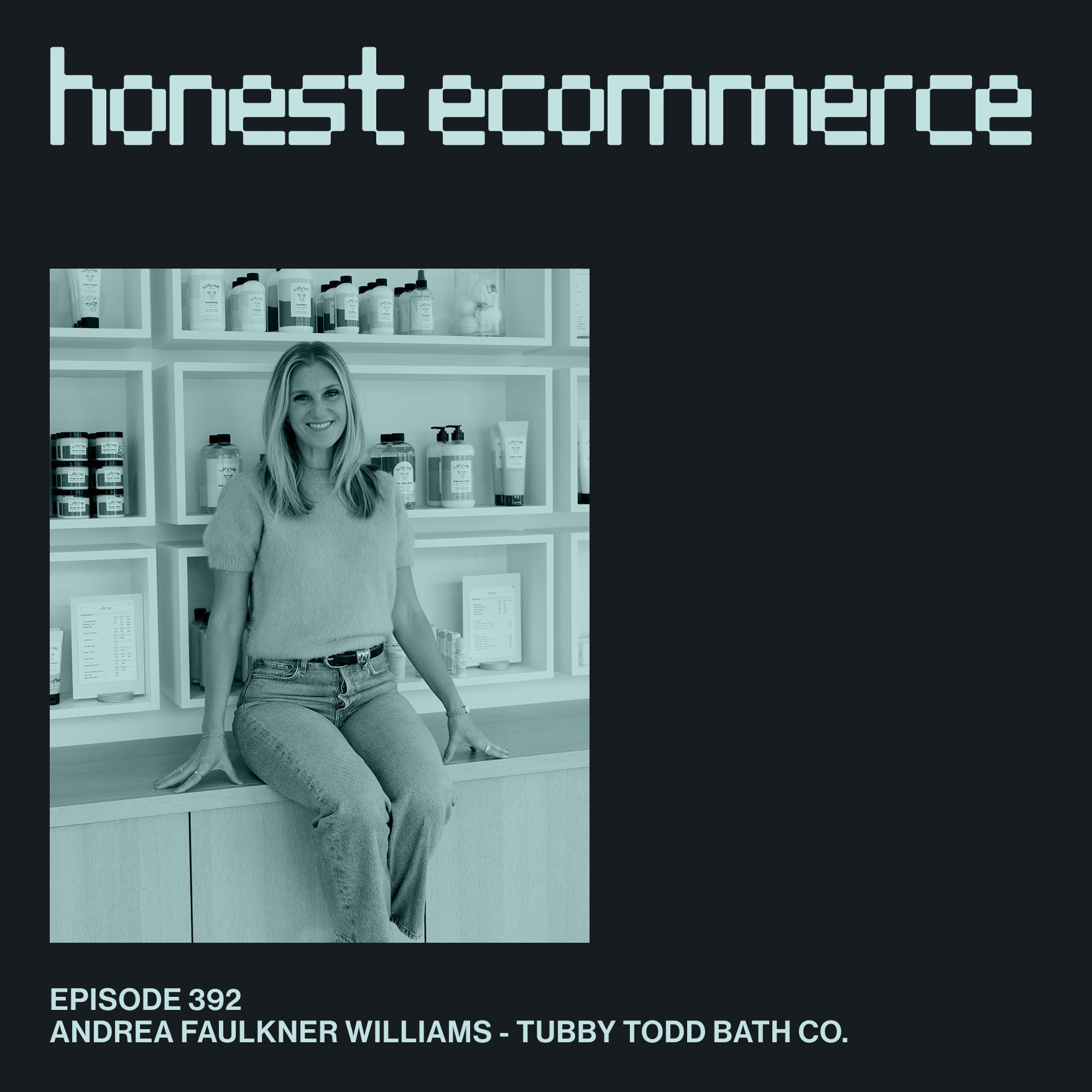
Hey, everybody. Welcome back to another episode of Honest Ecommerce. Today I'm welcoming to the show the co-founder and head mama at Tubby Todd Bath Company, Andrea Faulkner Williams. Welcome to the show.
Andrea Faulkner Williams
Hi, thank you for having me.
Chase Clymer
I'm excited to chat. So, for those that are unaware, could you talk about the types of products that you and the team are bringing to market over there at Tubby Todd Bath Company?
Andrea Faulkner Williams
Yeah, we make the best selling skincare products for little ones and grown ups too. All of them cater to solving problems for people who suffer from any skin sensitivity, from eczema to dry skin, KP, or anything that is making your family irritated. That is what we're taking care of over here.
Chase Clymer
I can confirm adults can use the products. Andrea was amazing, sent me a whole bunch of samples. I now smell better and my skin loves me for it. So take me back in time. Where did the idea to break into this market come from? Was it even that thought out?
Andrea Faulkner Williams
Yeah. I do like to say that my husband and I always wanted to run our own business. And I think that's important to point out, that we always had this dream of being entrepreneurs and providing for our family independently of anyone else. So we didn't just all of a sudden have the idea that we were gonna quit our day jobs and be successful entrepreneurs. This was something I saw modeled in my own home. I was raised by entrepreneurs.
It was actually something my husband and I talked about on our very first date, when he was telling me what he did and what he wanted to do. He was like, "I think it'd be really cool to run my own business. I would love to run it with my spouse or do something as a family." So that was always in my game plan. And we tried many other businesses prior to Tubby Todd. We ran a marketing company, we toyed around with a window washing company, and I had written a few books.
But we had started our family. My husband was working in manufacturing. His name is Brian Todd, which becomes important to the story in a minute. He was pretty frustrated with his day job. And one day on the way home, he called me and said, "We are going to make our own line of children's bath products, and we're gonna call it Tubby Todd. And they're gonna be the best products that you can buy on the shelf." And I was like, let's do it. At the time we had one child, who we wanted to provide natural products for. We were worried about what we were putting on their skin, but we were really disappointed in what was offered in stores. They all felt watery, or not effective, or not even fun to use, anything that was natural, right? There had been a lot of progress in women's and adult beauty as far as natural skincare, but not any progress in the children's space. There were very few brands that were even touching that.
So we started to formulate for a year or two, and in that time we had a second child who was born, and he had pretty bad eczema, nothing we had experienced before. And so we kind of pivoted our purpose to not just creating products that were natural and fun to use, as we were already looking to do, but also something that was effective on dry, irritated skin. So that is where Tubby Todd was born. Our first product was a hair and body wash that we launched in 2014.
And by that time we had no money and no way to purchase product for a retail shelf. So we just decided that we would send it to people we knew who had a digital influence. Influencers were not really a thing yet, but mommy bloggers were. So many of them were mommy bloggers that we sent our first product to.
Chase Clymer
Do you remember what year it was, was it the same year, 2014, when Brian, your husband, called you and wanted to get into the skincare business? And where did he kind of get this idea from?
Andrea Faulkner Williams
Yeah, so that was in 2012. So it was two years prior to launching our first product. It took us two years to formulate, come up with the product, test, reformulate. Like I said, we kind of pivoted a few times over those two years on what we were actually looking to solve. And where he came up with the idea was from his actual job, what he was doing was he worked at a formulation facility that was formulating for other brands. And he saw how the formulation process worked. He was doing sales and marketing there. He saw how brands were working with formulators, what it looks like to manufacture a product. So that really gave us insight into that whole world of manufacturing.
Chase Clymer
Absolutely. I've spoken with some other brands in the past, I don't know if I've actually had this one on the podcast, but I don't want to give away too much about them, but their insight into seeing a market trend happening was they were working with a company that, despite their best efforts, was failing forward. And they said, if anyone else was running this, this would be a $10 million business next year. And they said, well, what's stopping us? So they parted ways with that company and went in on their own, because they saw how things were forecasting and how the market was going. So I think it's worth pointing out to the audience, a way to find a good product could be getting into manufacturing and seeing what is selling for other people, and then finding how that works for your why, which you obviously found with the birth of your second child and the eczema.
But to get back to your story, and not just me explaining things here, so it took you two years to go from "we have an idea" to "we have a product," and the launch was getting it to these mommy bloggers, these mommy influencers. Did you have a dot com, or what were you trying to sell there, or were you just trying to get feedback?
Andrea Faulkner Williams
Over the two years of formulation, we would go and we would look at Whole Foods and we would look at Target. And there were the big brands that all of us have known and probably used when we were children, sitting on 90% of the shelf, maybe 95% of the shelf. And there was one tiny little shelf dedicated to indie brands. And what we noticed is every few months, those indie brands would come on and off the shelf. And we were like, no, we're not gonna be that bottom-of-shelf brand in retail. There's gotta be another way to reach our consumer. So that's when we set up a Shopify site. We set it up ourselves.
We had a few friends that were marketing baby products through Instagram at the time, but they were more like fashion products, like a baby wrap and moccasins. And their example honestly changed our lives, because we were like, well, if they can do it, we've never seen anyone market beauty or skincare products, but maybe that would sell. Let's try it, right? So we set up our site the way that they had done, and then we started to send it to mommy bloggers, eventually influencers. We didn't have any money to pay them, but all we did was say, hey, here's this product that changed our family's life. Because it did, when we started using this hair and body wash on our son Walker, his skin completely cleared up. It wasn't even a lotion or a cream, it was just the wash. That was the biggest change, it was hydrating enough that it made this huge impact on his eczema. And what we found is every person that we sent it to started to talk about it to their network that they had online. And we saw people start to purchase the products. And so from there, the Tubby Todd mom community was born. And that really is the heart and soul of everything we do at Tubby Todd still today. It's these families that live by our products. It's an if-you-know-you-know brand, a community-based brand. And everything we make, from our products to our community to our content, is for them, because they were the people who built us when we really had nothing, right?
Chase Clymer
What is the next big idea that could change your business? A pricing change? A new bundling strategy? Adding subscriptions? Tweaking your shipping offer? Most brands make these decisions based on gut feel. They roll out the change, hope for the best, and have no real idea if it helped or hurt their business. Intelligems fixes that. It is an AI-powered testing platform that brings CRO-level clarity to the decisions that actually move the needle, not just button colors and headlines, but the big stuff: pricing, offers, shipping, new apps, even major site changes.
Brands like Ridge, Jones Road, and True Classics are using Intelligems to test their most important decisions and see exactly how each one impacts profit before they commit. Momofuku used it to test promotional offers ahead of Black Friday and found the version that increased profit by about 28%. Mott and Bow ran structured pricing tests that drove roughly 30% more incremental profit. We use it at Electric Eye with almost every client we work with.
And now Intelligems has a free AI-powered audit that gives you three specific ideas that you can test on your store today. No commitment, no credit card, just three opportunities worth exploring. Head to intelligems.io/audit and get your free audit in just a few minutes. That's intelligems.io/audit.
Now, can I pretend I don't know the answer to this, because I really don't know the hundred percent answer now. Ten years ago, when someone would say "we're a community-driven brand," it kind of meant that they had like a Facebook community of sorts. What does that mean now, to have a community-driven brand, and how do you connect with and talk to your community?
Andrea Faulkner Williams
I have not done a lot of things, I don't have an MBA, I know nothing about venture capital raising, we didn't raise any money, right? But I will say that we had a community-based brand before that was even a term. And it was because we didn't have enough money to go to retail, and we were really too afraid to go out and raise from even friends and family. So the community, those were the people who purchased the product and raised enough for us to purchase our next round of products.
So when I say community-based brand, I mean, yes, we have a Facebook community that has been really important to us, but to me it means being a good friend. So I say to every person, every person we hire at Tubby Todd, I interview them still, and in every interview I say, do not create anything, from an invoice to a label to a product to a customer service response, that you yourself would not send to a friend. All of us have friends who have had babies. So they can all think of a consumer, that's the consumer who's working with us. Don't create or do anything you wouldn't do for a friend. And that is the easiest way to create a community-based brand, to treat people like a friend, right, in everything you do.
So that's what I would say a community-based brand is. What that looks like at Tubby Todd is that we give back 1%, we have, from inception, given back 1% of everything we sell in charitable giving, to either organizations or directly to our community. We are very generous with our returns policy, if you don't like it, we'll refund you if it doesn't work for your family. We try to create experiences in person. We'll see over 15,000 people in person this year, and as a digitally native brand, that's pretty rare. And they're all free events where people can come and just spend time with their family. And all of our content is stuff that we actually want to see, it's educating, it's fun, or it's just like a trend on the internet that we're excited to pass along to our friends, right? So that's what a community-based brand means to me.
Chase Clymer
Absolutely. So you obviously find success with these mommy bloggers, and then it pivots to influencers. I feel like, often when I'm doing these interviews, there is an inflection point where founders either feel it as it's happening, or they look back and it was right around here. When did it feel like the flywheel really started to take off? And what were some of the tailwinds that caused that to kind of really happen?
Andrea Faulkner Williams
So I think that my best advice for entrepreneurs is to have short-term and long-term goals. It's really easy to have those big BHAGs, big, hairy, audacious goals, but those short-term goals are so much more important. We used to have like 10 orders a day, and every day we'd be like, "We have 10 orders a day." We'd have the Shopify alerts coming in on our phone every time we got an order. And then it was 10 by noon. So it's like, did we get 10 orders by noon? And if we didn't, we'd sit down at the end of the month and be like, okay, that's our goal, what do we need to do differently? Do we need to get more people on social media? Do we need to get more people to the website? So having those short-term goals, that's really been the stamina to keep us going.
Okay, to answer your question, when did we feel like, "this is happening"? I think that has happened in different ways at every single turn, because we just entered retail this year. It was in the beginning of 2026 that we went to Target nationwide, and we're now the number one selling baby brand in skincare at all Targets. So that's super fun, super exciting. We waited a really long time to go into Target, 11, 12 years. That was a really long wait. But we knew we wanted to show up there big. And we wanted to give our community the experience we were looking to always give them, where we were offering enough products and just really blowing it out of the water. So now here we are, talking to Target, talking to other retailers, and getting ready for success there.
That looks completely different than it did when we were just trying to hit 10 orders by 12 PM every day. But both of those are equally exciting to me. I have felt an equal amount of satisfaction from selling tens of millions of dollars in retail to selling $200 of products on a D2C site. Because we wrote down something, we made a plan, we went out, and we did it. And that's what feels good in anything in your life, right?
Chase Clymer
Most brands outgrow their legacy choices long before they switch. Bad platform decisions do not fail all at once, they fail slowly, then suddenly. First it's one workaround, then another tool, then another integration duct-taped on top. And eventually, your team is spending more time managing the stack than actually marketing to customers. Eventually, rebuilding is less painful than staying, usually when it starts to show up on the P&L.
That's when scaling brands simplify and standardize on Klaviyo. Klaviyo is the AI-first B2C CRM. It combines your customer data, email, SMS, analytics, and customer experience tools into one platform, so you're not stitching together five different systems just to understand what your customers are doing. Your database updates in real time, your segments update automatically, your flows, campaigns, and personalization all run off the same source of truth.
And that shift is why many brands are moving to Klaviyo. Brands like Dollar Shave Club have reduced total CRM stack costs by over 30% after consolidating onto Klaviyo. Multi-brand operators like Mark Fisher have migrated multiple brands and drastically reduced the time required to execute CRM marketing. And brands using email and SMS together inside Klaviyo are seeing massive ROI compared to running channels on separate platforms. The big unlock is simplicity and scale at the same time.
Klaviyo is built for marketers, not for engineers. It is built for online businesses just like yours, and it is built for where Ecommerce is going, not where it was five years ago. If you're running email and SMS across multiple tools, or you're on a legacy platform and thinking about your next phase of growth, it's probably time to look at Klaviyo. Go to klaviyo.com/honest and see why hundreds of thousands of brands have already made the switch. That's klaviyo.com/honest. K-L-A-V-I-Y-O.com/honest.
I think that the small goals, it takes dozens of small goals to actually hit that big goal. And so big goals are scary, and you just have to think about it, and be like, all right, well, what's a smaller, more accomplishable thing that I can do? And that's a great way to really build those stepping stones and get to those larger goals.
We talked about hitting the goals, but maybe the flip side of that. Anything over the past decade where you're like, yep, we screwed up there, and maybe you guys shouldn't do this, as much as you're allowed to?
Andrea Faulkner Williams
Well, I will say I have had four kids as we built a business. So we had one when we started, one while we were developing the product, and I've had two more. And that's been really hard. It's been awesome, and a dream of my life to be a mom. I wanted six kids, so I feel like I'm only two-thirds of the way there. But my husband told me that we probably should take care of the four we have. Sound advice, but I'm not sure I'm a hundred percent on that.
Yeah, that's been hard. And I have not, on a personal note, I feel like there's a lot of things I wanted to do as a mom that I thought I was gonna be a stay-at-home mom, and I'm not, right? So I've had to change my mentality that way and get a lot more childcare help than I imagined I was going to have to get. And that has been an adjustment. So my life looks a little different than I thought it was going to be, but better than I could have ever dreamt, at the same time. So it's about changing your expectation of what you thought your life was gonna look like. So that would be a personal thing that I really feel I could have done differently.
As far as other mistakes we've made, we've had really great success with our team, we've been really, really lucky with our team, and it hasn't been perfect. There have been some team members that we have hired that have, I don't want to say taken us back, but when there are unhappy team members in the organization, that can really slow you down from hitting your goals. So I would say my advice would be to hire more slowly, to have a very clear job description. I'm obsessed with a clear job description, because we didn't do that well for a long time. Does everyone in the organization agree on what this person is actually going to be doing, right? Hire really slowly, have them do a project.
Especially when you're a young entrepreneur and somebody with a big degree from a school that you could have never gotten into comes and interviews, you can get really starstruck. Like, "they want to work with me, right?" And you might pay them more or bring them in sooner than you were supposed to. We have done that, and that has not been great. And then fire way more quickly. It is the biggest gift to fire people quickly if it's not gonna work.
The mistakes we have made in our organization are common mistakes everyone makes in every organization. When somebody makes a mistake, you need to make sure it's notated for everyone to see, so everyone, from management to the person who's involved in the mistake, understands that they messed up, and that you messed up as a manager in not leading them to do what they were supposed to do, right? Or maybe they didn't know. And that needs to be filed somewhere professionally with HR. So that if two or three or four mistakes are made, eventually it leads to you parting ways.
Both my husband and I have been let go from jobs in the past, and a lot of that was what led us to realize we weren't great employees and we needed to start our own business. And that was a gift that we were given from the universe, to have those failures. Failures are awesome for everyone, but as an employer, it is really hard to fire people, and you feel like a terrible person, especially if you didn't set them up well with a clear job description or a really clear working environment with clear goals to hit, right? So you're like, this is my fault. So I would say we've made mistakes in not firing people soon enough, and that cost us, and them, a lot of wasted time.
Chase Clymer
You have prepped all year, and all that hard work is paying off. Your store is converting, the ads are working, and this is shaping up to be your best holiday season. But your 3PL can't keep up. Orders are backing up, customers are asking where their stuff is, the reviews are starting to turn. All that hard work, all that momentum, undone by a fulfillment partner that can't scale with you. This is a nightmare scenario, and it happens to brands every holiday season.
Enter eFulfillment Service. eFulfillment Service is the 3PL that scales with you. They are family owned, they've been in business for over 25 years, and they're built specifically for growing direct-to-consumer brands. There are no setup fees, no minimums, and no long-term contracts. You only pay for what you use. If you're scared your 3PL can't keep up this holiday season, now is the time to reach out to eFulfillment Service. Go to efulfillmentservice.com/honest and get up to eight weeks of account fees completely waived. That's efulfillmentservice.com/honest.
I think that one of the hardest things about entrepreneurship is building a team. I don't think it is rare, I mean, I think it is rare that I have met an entrepreneur where, just natively, they were instinctually good at delegating and good at hiring. I think it is part of being an entrepreneur, getting too involved in all sorts of stuff, shiny object syndrome, and not delegating, because they want the product or service they are working toward to be the best that it can be, and they never expect anyone else to do it as well as they can. And then, yeah, once you get good at that, you start to delegate more, and it's just so difficult.
We experienced the same thing at the agency. So much of what you were saying, I was just nodding along to, yep, it is super hard, and hire slow, fire fast. You gotta distill that into yourself. And obviously there are conversations that you need to have with the other people on your team. If one person feels a certain way about a certain hire and another one doesn't, how does that get resolved? And you kind of alluded to at the beginning, certain team members creating an odd atmosphere and how that will affect the rest of the team. So much to drill into and distill there.
Andrea Faulkner Williams
Not that that person is not extremely talented and is not going to shine in another organization, they might just not be the right fit for you at that time, right? And that's really important to remember. Also, I think another important thing to remember as an entrepreneur about teams is you are only as good as your team. And we could have never done a fraction of what we have done without our team. Today, now more than ever, Tubby Todd is thriving because of the team that we have, and I am blown away by how brilliant they are, and that they ever trusted us to work with us. They're so, so cool, such cool people inside and out. So I just feel so humbled by them, and I remind myself of that and try not to let my ego get in the way when they do something that I disagree with, to respond in a really good, professional way as you work together for a long time. So it's hard to get it right. So yeah, I've made a lot of mistakes there. There's a lot of people I need to say sorry to. Let me just collectively apologize right here on this podcast. Okay, guys.
Chase Clymer
I'll make sure the word gets out.
41:34
Hey everybody, just a quick reminder, please like this video and subscribe if you haven't. We're releasing interviews like this every week, so don't miss out. Now back to the interview.
Is there anything that I didn't ask you about today that you think would resonate with our audience before we go?
Andrea Faulkner Williams
One thing, I'm talking to college students tomorrow at my alma mater, and one thing I keep thinking about is something my dad told my husband and me when we were desperately trying to get businesses going when we were young. A lot of times, or most of the time, a business comes from, and you kind of mentioned this earlier, if you are somewhere working, like at an investment bank or at a formulator or even at a restaurant when you're 16 years old, and you can put your head down and do a really good job, that's how you're going to become the best entrepreneur, because you'll see the holes in the organization if you're really focused on what you're doing there. You'll see, anything from, "wow, these gloves are really difficult to get on while I'm handling food, is there an opportunity to create gloves that might be easier for people who work at restaurants?" Or, "this payroll system isn't working, and I work in HR at an organization." Those are, I think that is the best way to become an entrepreneur, to go get a job and work for someone else. And it's also the hardest thing to do if you have an entrepreneurial spirit, because you're gonna hate working for other people. But that's the best preparation. So that would be the first thing I would say, go out and get a job if you're looking to start your own business, and work really hard at it, even if you're not great at it. Do your absolute best, and you will figure out a way to start your own business eventually.
Chase Clymer
Yeah, you have to catch yourself in real life, realizing you're settling for things that could be better, and that is where opportunity is. You're like, I wish this product came in this flavor, or this was sugar-free, or it was in this delivery package. But if you just accept that it doesn't exist and you don't pause and go, well, what if I made it exist, boom, there is the opportunity for it.
And like you said, it's not just a product, it's service. You're like, this payroll software is archaic, it's 2026, we've got AI, why can't we make this smoother? So there's opportunity everywhere, and it doesn't need to be an explosive, brand new, radical idea. It doesn't need to be the next Facebook, right? Tubby Todd is just better skincare for a particular ICP, which is children, right? So, obviously you guys have built an amazing product and an amazing business, but it's not a radically insane idea.
Andrea Faulkner Williams
We were not the first people to put silver lotion on a baby. We never said that. The founder of Bloom, I can't remember his name, he said this once in something on Instagram, and I thought it was really humble, actually. He's like, "You just gotta do something that someone else has done, but do it a little bit better. Make it one or two percent better."
Chase Clymer
A little bit better. So if you are listening out there and you have a passion for a particular service or product, go work for your ideal, be like, "I wish I owned this company," or "I wish this was who I worked for," and find what they're slacking on. And then, once enough about that industry and that business, go out on your own.
Plus… Now you look way better to a VC, because you have all that inside information.
Andrea Faulkner Williams
Totally. The other thing I would say is I cannot believe how humbling it is to start something new. Even four years ago we sold 70% of Tubby Todd to a private equity group, and we have loved our experience working with this private equity group. They are wonderful, and we've had phenomenal growth. For the last twelve years, every year we've grown at least 30%. It's been incredible, and we've been very lucky. Recently I decided I was gonna start posting regularly on my personal Instagram. I've posted on Tubby Todd for 12 years, we have 600, 700,000 followers, and then there's TikTok and all the things. But I just haven't posted on my personal Instagram in a really long time. I cannot tell you how humbling it has been. I've put up posts and taken them down, been so embarrassed putting myself out there, wondering what people are thinking about me. And I'm like, who am I? What is going on? It's hard to do something new.
I have not felt that feeling of vulnerability since we started Tubby Todd a long time ago. I'll feel it in spurts here and there when I have to put myself out there professionally occasionally. But it's okay to be afraid when you're doing something new, and it doesn't mean you're doing something wrong. Like most things that are worth anything in life, whether it's achieving a fitness goal, or having a family, or being married, or starting a business, they're hard, and they feel really uncomfortable, right? And I'm grateful for that feeling of discomfort. And I think it's okay to tell people it's okay to be uncomfortable. It doesn't mean you're doing something wrong. And as long as the people around you, in your own family and home, are comfortable with what you're doing, and you've decided together to support one another, just go for it, right? And know that you're gonna feel uncomfortable. So I've been reminding myself of that.
Chase Clymer
Couldn't agree more. And this is something I find myself talking to folks about who are younger in their career, and obviously this also very much parallels your personal life as well, if it's easy, everyone could do it.
Andrea Faulkner Williams
Totally, yeah.
Chase Clymer
Why is it valuable? So that's the simplest way to kind of say, if you want to find success in business and love, whatever, it takes hard work. And that's where you gotta kind of put your head down and focus on it.
Andrea, we talked about how awesome these products are. If I'm a parent and I wanna go check out the products, where should I go? What should I do?
Andrea Faulkner Williams
Go to tubbytodd.com. We're also on Amazon, or Target online, or Target in store. I would start with our Regulars Bundle, I would recommend this from ages newborn to 90. It is a three-step skincare solution for all types of skin, and it's what we have in every bathroom of our home.
First, this hydrating wash, like I said, changed our little one's skin, and it is packed with hydration, unlike most clean-formulated washes. That is because we did not formulate it with an MSRP in mind. Again, we had no retail goals or experience, and we went to a formulator and said, "make your best wash." And she was like, "what, I'm always told with these limitations that it has to be this price." And that is how we created something completely different in the marketplace, specifically for children. So our hair and body wash is the first step of our Regulars Bundle, the three-step process. Then our everyday lotion is a base layer of moisturizer, put that right on after the shower or bath, and it's gonna sink into the skin. And then, spot treating with our All Over Ointment. That's the jar. Did you get one, Chase? The jar of All Over Ointment.
So, two All Over Ointments sell every minute of the day. Let me say that again, two All Over Ointments sell every minute of the day. So it is our best-selling product, and it is a miracle ointment that sits on top of the skin. What makes it different is it is a petroleum-jelly-free salve or ointment, there's not very many of those on the market, but it also heals while it creates a barrier. So it's great for anything from babies with eczema to diaper rash to psoriasis, cradle cap. But it's also great for adults, a lot of people use it as a face mask at night, for acne, sunburns, eczema, dry skin.
Chase Clymer
As somebody who worked at a tattoo shop for eight years, I can guarantee it's great for tattoo healing.
Andrea Faulkner Williams
A lot of people have told me they've used it post-tattoo, like right after getting a tattoo. I don't know.
Chase Clymer
Yeah, lotions are a little bit drying at times for tattoos. The salves are definitely the right call. And you don't wanna use anything petroleum-based, 'cause that actually dries it out, funny enough.
Andrea Faulkner Williams
Yeah, yeah, yeah. So we've had people tell us they use it on the inside of their dog's ears if they're irritated. The uses go on and on and on, and it has been so fun seeing. e have over 50,000 five-star reviews on tubbytodd.com. It's been incredible seeing these products come to life and seeing the community find new ways to use them in their lives.
Chase Clymer
Absolutely. Now, one last thing, as you are trying to put yourself out there more on your personal Instagram, if I wanna learn more from you, where should I go? What should I do?
Andrea Faulkner Williams
Yes, I'm Andrea Faulkner Williams on Instagram. It's mainly me talking about, showing up late to camp registration and begging them to take my children in. So if you want a very relatable journey of motherhood and business ownership, I am the person to follow. And then Tubby Todd on Instagram and TikTok, and swing by tubbytodd.com, we're always doing in-person events. We are going to Boston in the fall for play dates that draw a few thousand families. It's so fun. Everything is free, and you get like a $200 swag bag when you show up, just for coming, 'cause we love you. And come by the Tub Hub in San Diego, we're there anytime you want to stop by.
Chase Clymer
Awesome. Thank you so much for coming on the show today.
Andrea Faulkner Williams
Thank you for having me, Chase. Have a great day.