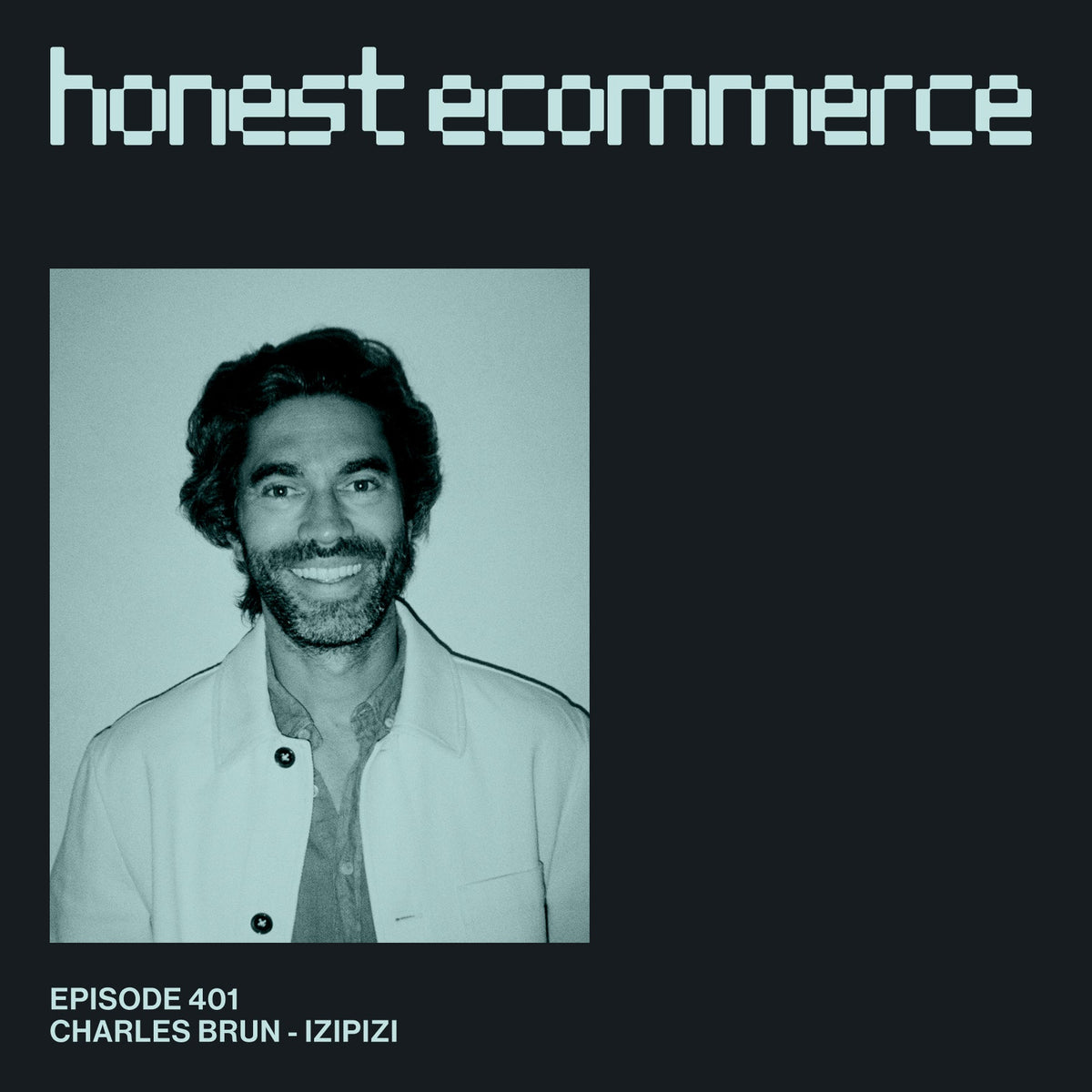
Charles Brun
If you are not on Amazon as a brand, you don't exist and that's nearly every American customer buys a lot on Amazon. I don't want to say nearly everything on Amazon because they are used to Amazon Prime and getting their products the same day.
Chase Clymer
It's letting the customer buy where they want to buy. And especially with experimenting with new brands, you know, Amazon's return policy, for better or for worse, does allow a customer to feel safe in trying something new.
Honest Ecommerce is a weekly podcast where we interview direct-to-consumer brand founders and leaders to find out what it takes to start, grow, and scale an online business today.
Honest Ecommerce is proudly produced by Electric Eye, a Shopify Plus partner helping Ecommerce brands sell more with strategic design and development. Visit electriceye.io for more information.
Hey everybody, welcome back to another episode of Honest Ecommerce. Today I'm welcoming to the show the co-founder of IZIPIZI, Charles Brun. Welcome to the show. Great to see you again.
Charles Brun
Thank you. Hi, Chase.
Chase Clymer
For folks that are unfamiliar, what are the types of products that you and your partners are bringing to market over there at IZIPIZI?
Charles Brun
Yes. We launched the company 16 years ago and we have really cool glasses. We do readers, reading glasses, sunglasses for adults, sunglasses for kids, screen glasses. We even have sleeping glasses to help you sleep better at night, glasses for sports. We say it's glasses for all the family and every moment in life.
Chase Clymer
That's amazing. Now, take me back in time. You have a fun kind of ideation moment of when you decided to kind of explore this category and really dive on in.
Charles Brun
Yes, yes, we are three friends from high school, so we are lucky because we are friends and partners. The idea came from our mum, our mums, originally from Paris. They started to wear reading glasses when they turned 50, 55 years old. And they were complaining on the fact that readers were awful. I think they were ashamed to get a bit older, if I may say, and ashamed having to wear terrible reading glasses, readers.
So we had the idea to develop really cool readers and to only sell them to the fashion stores, design stores, concept stores, optics stores, etc. So at first it was only readers and then we said, okay, let's sell our products to everybody, not only our parents' age population. And that's why we launched cool sunglasses, cool sunglasses for kids also, sport glasses, but every time with a very affordable price, great quality, great design, selective distribution, but affordable price.
Chase Clymer
That's amazing. How long was, you know, the "we have this idea, this would be a cool business" to "you have your first product that you're trying to sell"?
Charles Brun
So we met at high school, we did part of our studies together, it was a business school in Paris. Luckily, we won a competition. So we were in an incubator at first. So when we did our master, we already had the idea. We worked on the idea during the master. We could develop a prototype, test it, see how people liked it. So I would say we had the idea at least one year before we launched.
At first it was a soft launch in the incubator, continued developing prototypes. But the real launch with our current products was in 2012. At first we had other products, but which didn't work really well. So yes, we started the company in September 2010, but I would say the real launch was 18 months after it.
Chase Clymer
Absolutely. So with that launch, I'm assuming it was a finalized product that you were super proud of. And another assumption here is gonna be the incubator made you go out there and get feedback from your ideal customer to make sure that your assumption was correct.
Charles Brun
Yes. At that time, ecommerce was way less developed than today. We had no money to open our own stores. So our first distribution channel was wholesale, selling our products to the best stores. We started with a very famous concept store, fashion store in Paris called Colette, which was at that time the temple of fashion in Paris. It was really hard to get her, but I think we went there maybe 10 or 12 times to push her as much as possible to make sure she would accept to take our glasses and make a test.
But after that, we had the perfect product with the perfect packaging on which we worked so hard with my partners and designers. Yes, and this was a great start. It worked well. And thanks to that, Colette really helped us getting many other stores all around the world.
Chase Clymer
[Sponsor Read: Klaviyo]
Do you know what's going on with Klaviyo? When is the last time you explored what it can do? Klaviyo has been shipping tons of new AI, data, and automation features designed to help ecommerce teams move faster, personalize better, and automate more of the work that used to take entire teams. Most brands are only using a fraction of what is already inside their Klaviyo account. Klaviyo is not just email and SMS anymore, it is your customer data platform, your lifecycle marketing engine, your analytics layer, and now your AI-assisted execution layer all in one place.
That means your customer data updates in real time. Your segments stay current automatically. Your flows and campaigns all run off the same source of truth. And now AI can help predict churn risk, forecast spend, recommend next best products, generate campaign content, and optimize send timing across channels.
The big unlock is speed and efficiency. There are fewer tools to manage, less dependency on engineering, less time moving data between systems, and a lower total cost of ownership across your marketing stack. And brands are seeing real results from leaning further into Klaviyo.
Dollar Shave Club has reported over 30% reduction in total CRM stack costs after consolidating onto Klaviyo. Brands like ThirdLove have seen a 15x ROI from SMS after consolidating channels. And companies like Corkcicle have grown flow revenue over 90% after bringing email and SMS together inside Klaviyo. Across our customer base, almost every single brand we work with today is using Klaviyo.
That is just where serious ecommerce customer data and lifecycle infrastructures are living these days. If you're already on Klaviyo but you feel like you're not getting everything you can out of it, or you're just running multiple tools and want to simplify without losing power, I think this is worth your time. You should head on over to klaviyo.com/honest to learn more. That's K-L-A-V-I-Y-O dot com slash honest to learn more about what Klaviyo can do for you today.
[End Sponsor Read: Klaviyo]
I think one of the harder parts of breaking into any industry, we're obviously talking about fashion and getting to wholesale stores, but this is, you can take this thing and draw parallels elsewhere. It's like once you get the first yes, that really gets the momentum going for all the rest of it.
Charles Brun
Yes. Especially, luckily, it was Colette, which was really well known and it opened doors for us in London, in New York, in Tokyo, everywhere. Thanks to that, we entered the MoMA in New York, for example. Yes, this first yes really helped us. And I remember we spent hours in this store with my partners to observe customers, how they were buying the glasses, the comments they were making on colors, shape, quality, etc., etc. And it helped us to get the best.
Chase Clymer
Absolutely. I do want to circle back though a little bit to you started this business with your friends, right? And I think that a business partnership is one of the hardest things that you're gonna probably end up doing in your life, other than perhaps getting married, with, you know, just interacting with and learning how to deal with people.
And one of the things I've learned in this show and just like being an entrepreneur for over the past decade is co-founders and partners, you know, is establishing swim lanes and, you know, understanding who is responsible for what. How did you and your co-founders learn that hard lesson?
Charles Brun
It's a good question. It's funny because, first of all, we are three and we often heard that three is not easy because we could have two against one and then being in a vicious circle and then arguing. Luckily for us, the number three was great because we like to talk, we like to debate and there was always a majority, but it was not always the same ones.
What was pretty specific is that we are pretty similar. We all did similar studies. There was not one engineer, one designer, one more business oriented. We are three pretty much business-oriented people. So we love sales, but we also all love, we like finance, we like branding, we like marketing. So we like the same things, but we have to divide.
What I think made our partnership a success is that we have always talked a lot, making sure we spend time together, we have fun together, making sure we were equal for everything. Equal in terms of holidays, in terms of salary, equal in terms of time we have to spend on a topic. Or when we talk, make sure we have the same time in which we talk.
For example, we have a rule every Friday morning, we gather to talk about weekly topics, daily topics. And we turn a wheel and it's the wheel who decide who will speak first. Is it Quentin, Xavier, or myself? To make sure it's not always the same one speaking first and putting the emphasis, et cetera, et cetera. So it's our tricks, I would say, which made us successful still after 16 years.
We often say that we are not a couple, that we are a triple, which is a couple out of three. And a bit like a couple, you need things to make sure it works. And you have to entertain and find newness and challenge yourself.
Chase Clymer
What is the next big idea that could change your business? A pricing change? A new bundling strategy? Adding subscriptions? Tweaking your shipping offer? Most brands make these decisions based on gut feel. They roll out the change, hope for the best, and have no real idea if it helped or hurt their business. Intelligems fixes that. It is an AI-powered testing platform that brings CRO-level clarity to the decisions that actually move the needle.
Not just button colors and headlines, but the big stuff. Pricing, offers, shipping, new apps, even major site changes. Brands like Ridge, Jones Road, and True Classic are using Intelligems to test their most important decisions and see exactly how each one of those impacts profit before they commit. Momofuku used it to test promotional offers ahead of Black Friday and found the version that increased profit by about 28%.
Mott & Bow ran structured pricing tests that drove roughly 30% more incremental profit. We use it at Electric Eye with almost every client we work with. And now Intelligems has a free AI-powered audit that gives you three specific ideas that you can test on your store today. No commitment, no credit card, just three opportunities worth exploring. Head to intelligems.io/audit and get your free audit in just a few minutes. That's intelligems.io/audit. Intelligems.io/audit.
You mentioned that ecommerce wasn't a big thing back when you guys were hitting the ground and getting started. You went the wholesale route. When did ecommerce enter the picture for the business?
Charles Brun
Yes, I think it really started to grow after six or seven years, I would say in 2017. For many years, at least at first, we were a bit ashamed to sell online because at that time it was very less popular. And our customers, I mean the stores, were complaining of the fact that we were selling online. And for them, they were seeing it a bit as competition, the bad competition.
And after, it became completely normal. It took us at least six or seven years. Wholesale was great at first because we had no money. And so it was a great way to sell our brand all over the world. Since the beginning, we didn't want to limit ourselves only to Paris or to France. Now we want to sell our products to Europe, to the US, to Asia, etc. We could talk more about the US afterwards, but we quickly realized that wholesale was not enough if we wanted to really develop a brand because we were relying too much on our B2B customers, on the stores.
So after five or six years, we realized we needed to open our own stores. So now we have 30 monobrand stores, plus we have stores with partners and local distributors. So this was 2016, 2017. And at the same time, we really did an emphasis on our website also, making sure it was not only a... that it's a business channel.
Chase Clymer
It's funny that you say that you were experiencing pushback from your wholesale partners because I remember that time pretty well too. That's kind of when our agency got started. And that was something that we were finding from some of our luxury and fashion clients, that they could only grow so much or they were going to hurt the relationship with these, you know, partners that they had built over time.
And obviously I was younger and I saw the writing on the wall. I was like, this is happening, whether they like it or not. You already know that it is kind of... it's happening. So how fast did you see the market, at least over in Europe, kind of switch and start to accept that this is the new normal and you need to let the customer decide where they want to buy?
Charles Brun
Yes.
Chase Clymer
And give them the best experience you can.
Charles Brun
For me, there was a first switch, I would say, 2017-18. But I would say from my experience, the main, the massive change was during COVID. When people realized that they had no other way to buy, stores were closed, wholesale stores were closed, especially in our business in France or in Europe, except pharmacies or some optic stores. Most...
Chase Clymer
Yeah.
Charles Brun
...non-necessary stores were closed. So if you had to buy anything, it was online or nothing. And we suddenly saw our online sales going from 15% to 95%. Today it's 35%. Our online sales represent 35%. But I really saw a switch from COVID.
And then there was the launch of marketplaces also, more and more. You have, of course, Amazon in the US, which is massive. It's less the case in Europe, especially less in France. I see we are still a bit reluctant on these kinds of marketplaces because we like physical stores, relationships with buyers, even if it's changing. But yes, COVID was a massive change.
Chase Clymer
[Sponsor Read: eFulfillment Service]
You have prepped all year, and all that hard work is paying off. Your store is converting, the ads are working, and this is shaping up to be your best holiday season. But your 3PL can't keep up. Orders are backing up, customers are asking where their stuff is, the reviews are starting to turn. All that hard work, all that momentum, undone by a fulfillment partner that can't scale with you. This is a nightmare scenario, and it happens to brands every holiday season. Enter eFulfillment Service.
eFulfillment Service is the 3PL that scales with you. They are family owned, they've been in business for over 25 years, and they're built specifically for growing direct-to-consumer brands. There are no setup fees, no minimums, and no long-term contracts. You only pay for what you use. If you're scared your 3PL can't keep up this holiday season, now is the time to reach out to eFulfillment Service. Go to efulfillmentservice.com/honest and get up to eight weeks of account fees completely waived. That's E-F-U-L-F-I-L-L-M-E-N-T-S-E-R-V-I-C-E dot com slash H-O-N-E-S-T. eFulfillmentService.com/honest.
It definitely, for better or for worse, made a lot of changes to commerce. And, you know, some of them I do like, some of them not so much, but that's not what... we're not here to talk about COVID. Let's switch a little bit here.
You alluded to it a little bit ago about the US expansion, and so we've had quite a few brands on from the States talking about expanding into Europe, but obviously as a... you guys out of Paris, out of France, like, you know, now expanding into the United States, you know, how different was adding the US as a market versus, you know, Germany or England?
Charles Brun
It's a good question. It's funny because at first we feel we are really similar to the US because we learn English when we are very young. We look at American movies, we love American food, American lifestyle. So we feel very close to you. But once we really enter in the US markets, we feel that we are more different than we thought.
As IZIPIZI, we've been in the US for more than 10 years now. At first we were there with a distributor based in the East Coast who was buying our products and selling our glasses to the fashion stores, concept stores, design stores all around the US. I mentioned the MoMA, also Bloomingdale's, Nordstrom, really cool fashion stores in Texas, in California, near the Hamptons, in New York, et cetera, et cetera.
So they did a great job, but we felt after several years that the US was really so important for us and with such a potential that we wanted to open our own subsidiary to get our own team with our own office. And we wanted to open a warehouse in the US also to have stocks in the US to sell to our wholesale customers, but online also because the US pretty quickly became our biggest online market. So we were there since 10 years, but through a distributor. Then we decided to buy back this distributor.
And so we really have a subsidiary since three years now, two years and a half. I went really often to the US and going there, I quickly understood that if we wanted to work, we needed to hire American people. So we have an amazing American CEO coming from a beautiful brand. All our team is, nearly all our team is American, often American and something else, which is funny. We have one or two French people, but usually in the US since many years.
And I went there a lot to meet American people, American customers, understand how they behave, how we behave, how we have to adapt our brand, adapt our products to make sure it was a success. Because you can't just copy-paste what you do in Europe for the US, otherwise it will be a failure.
Chase Clymer
Absolutely. That was actually one of the most common topics. When I went to Shoptalk Europe in Barcelona, met dozens of amazing brands, and one of the more common talking points that we ended up getting onto was how they were like, you know, "We're expanding into the US," very common. The two things they were asking about: 3PL and American team members, or recommendations for certain things.
Charles Brun
Yes.
Chase Clymer
And it was exactly what you said. You can't take what worked in the European market and paste it into the American market. There's just... there's different things about it. Obviously, language is similar, but how you speak about things, it's different. The experience tends to be a little bit different. Expectations about the experience are a little bit different.
And all these brands that I spoke to at that show were just like, "We're not trying to fail our way through this expansion. We need to hire people that know how to do it right." And that was what they were doing.
Charles Brun
Yes. And typically for the US, we decided to launch IZIPIZI on Amazon because I understood going really often there that if you're not on Amazon as a brand, you don't exist and that nearly every American customer buys a lot on Amazon. I didn't want to say nearly everything on Amazon because they are used to Amazon Prime and getting their products the same day or following day. So we launched Amazon for IZIPIZI only for the US.
Chase Clymer
Yeah. Over here, Amazon is a necessary evil. And it's, again, goes back to COVID. And that's kind of one of the things I was alluding to, was the market share that it kind of chomped up. But it's letting the customer buy where they want to buy. And especially with experimenting with new brands, you know, Amazon's return policy, for better or for worse, does allow a customer to feel safe in trying something new.
Then it's, you know, I would say it's your job as the brand to make a product that's so good that they will now seek it out from the source as opposed to using a marketplace.
Charles Brun
Yes.
Chase Clymer
Hey everybody, just a quick reminder. Please like this video and subscribe if you haven't. We're releasing interviews like this every week, so don't miss out. Now back to the interview.
We talked a lot about the wholesale expansion, about the US subsidiary. How was kind of breaking into .com first? Obviously COVID saw a big massive wave, but what were some of the big learning curves or places where you were spending time and energy to really make the .com work for you here in the States?
Charles Brun
Yes, we made a lot of changes on our website. For example, last year we changed the platform to Shopify. We've been on Adobe Magento for many years and we were struggling. Our website was beautiful, but it was tough to have it work on a daily basis. So this is an example of things that we changed.
Since four or five years now, we developed virtual try-on, because it's not easy to buy glasses online. What we see very often is that our customers will discover IZIPIZI in a store and once they know which shape they like, which model they like, it will be easy afterwards to buy a second or third pair online. But the first pair is not so easy because you have to try the shape, make sure it fits you on your nose, etc. Do you like the color or not? So we make sure it's easy to send back and get it refunded also. Virtual try-on helps also. Make it as friendly as possible.
Now we know more and more of our customers. I was saying before, but we have 30 stores, 30 monobrand stores. For now only in Europe. We don't have stores in the US, but we want to open stores in the US. And then we have 30 other stores around the world that we open with local partners in Japan, in the Middle East, in South America, et cetera.
We try to merge these customers, which are the same. They can buy online, they can buy in our stores, they can buy wholesale, in wholesale. So we try as much as possible to track them, follow them, know them, and make sure they have the best customer experience as possible.
Chase Clymer
Absolutely. Yeah. I think when your incentives are aligned to where we don't necessarily care where you buy, we just care that you do buy.
Charles Brun
Exactly.
Chase Clymer
Trying to help the customer navigate their own unique journey to get to the point where they want to as quickly as possible. Be it helping them get into a physical store or, you know, the virtual try-on is obviously amazing. It's having that acceptance of, perhaps we're not gonna have them buy on the .com and get that full margin, but they are gonna buy from us and they are now a customer. Like, that accepting that with a brand of your size is, I think, definitely something that you gotta get to.
Charles Brun
Yes, yes. And we want to be in a win-win situation. We owe a lot to all our wholesale customers. I think for a brand like us, it's important to see it everywhere. So you see it online, you see it in a store, we try to do advertising also, but smart advertising.
And what is good with IZIPIZI is that as our products are really affordable, it's impulsive buying. So we are in the travel retail in airports or train stations. We are in a nice store near your place. You buy it online easily also, you buy it on Amazon. So we try to follow the customers everywhere where they are, whether it could be their hometown, on holidays.
Chase Clymer
Absolutely. Charles, now is there anything I didn't ask you about that you think would resonate with our audience?
Charles Brun
Good question. I think at IZIPIZI we always try to do things in a good way. I was mentioning a good product at a good price with a good distribution network. We are very proud because we have been a B Corp certified three years ago. It's really tough to get B Corp certified. It was a huge work we made to change the materials we use, how we ship our products. Nearly no more plane, only boat shipping from our suppliers to our warehouse, from our warehouse to our customers, et cetera, et cetera. So a big adaptation in our logistics, supply chain, also forecasts.
And when you turn, when you become B Corp, it's not for life. It's for three or four years, I think. And if we want to remain B Corp, it will be even harder. So it's a permanent challenge to make sure we keep being as good as possible with everything we do.
We are labelled as a Great Place to Work also, which I think proves the values of how we deal with our team, how we deal with our partners.
So we are called IZIPIZI. We are proud of our brand name. It's funny because at first in the US when customers see our brand name, they spell it as "izzy-pizzy." And then when they realize it's "easy peasy," they say, "Really cool name." And they remember it. And I think IZIPIZI sounds well and explains who we are. It's easy to work with us. All our customers, when they go on our website, in our stores, we want them to have an easy-peasy experience, a happy, joyful experience. I think we are a joyful brand, joyful people also. So we try to continue this way and even to become better.
Chase Clymer
Absolutely. Now if I'm listening to this show and obviously you're so passionate about these amazing products and then you guys have made them even better, obviously with the B Corp stuff, where should I go? What should I do?
Charles Brun
Yes. So you can go on our website, izipizi.com. You'll see all our ranges, our readers, our sunglasses, our kids sunglasses, our sport glasses. We do really cool glasses for running, golf, sailing, trail, et cetera. I was mentioning our screen glasses to put on your eyes when you are in front of a screen. Even our sleeping glasses to help you better sleep at night. So you'll discover everything on our website. You can easily order online.
You can go on Amazon also. We have our IZIPIZI webpage on Amazon. And then on our website, we have our store locator, which lists all our great customers around the world. And you can enter your zip code or wherever you live and you'll see who are and where are the closest IZIPIZI customers next to your home. And I encourage you to visit them.
I'm sure you'll like the experience and you'll like our products. And once again, it's really, I think it's really affordable prices for the great quality and design. You can check our Trustpilot reviews, which are great also. And I think which explains who we are and how good we try to do things.
Chase Clymer
Absolutely. Charles, thank you so much for coming on the show today and sharing all those amazing insights.
Charles Brun
Thank you very much, Chase. Thank you, bye bye.