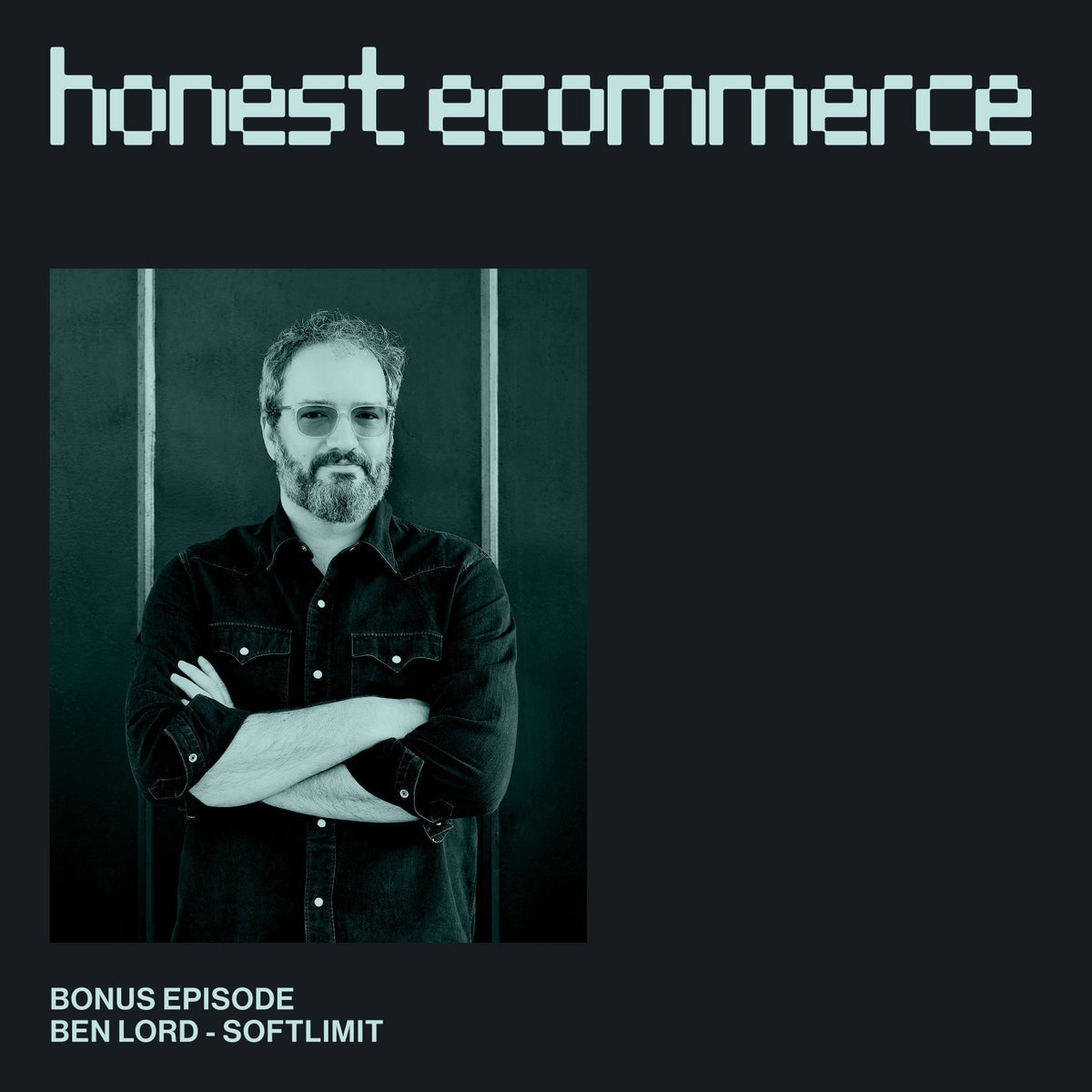
Ben Lord
The thing that labels are able to do and do very, very well, if they're a successful label, is they are creating culture. They are creating that line that creates a direct connection to a fan, and like, the fact that they are not able to own that relationship is just a big mess.
Chase Clymer
Loyal fans buy regardless of the experience, but a better experience does equate to a higher conversion rate as well and possibly higher average order values.
Honest Ecommerce is a weekly podcast where we interview direct-to-consumer brand founders and leaders to find out what it takes to start, grow, and scale an online business today.
Hey everybody, welcome back to another episode of Honest Ecommerce. Today I'm extremely lucky to welcome to the show a competitor, a friend, a founder, a CEO. Ben Lord is the founder and CEO of Softlimit. They are also Shopify Premier Partners over there in New York City. He's a lifelong musician. He spent the last 16 years helping independent record labels and many, many, many awesome D2C brands turn loyal audiences into sustainable ecommerce revenue. Ben, welcome to the show.
Ben Lord
Thanks for having me, Chase.
Chase Clymer
I'm excited to chat. So what are some of the problems that you and the team over there at Softlimit are tackling these days?
Ben Lord
I mean, honestly, the problems never stop, right? But I think the main thing that we're focused on at this point is really trying to help the music industry get a handle on D2C and what it means to be operators in the space.
Chase Clymer
I am unfortunately very qualified to have a very good conversation with you about this topic. But you know, the show isn't about me. The show is about you. So tell me, why should I listen to you out of, you know, the four or five hundred other Shopify experts that exist out there in the ecosystem? How do you know what you're talking about?
Ben Lord
Absolutely. So for me, this is a passion project. I've been involved with music since I was a kid. Started playing drums when I was 10 years old, went on my first tour when I was 13 years old. So I've been in and around music for the majority of my life. All that on top of just being a touring musician and doing the thing and hitting the pavement.
But on top of that, I've also been running an ecommerce agency for the last 16 years. And I'm trying now to kind of combine those two passions, really, and kind of bring it all full 360 and make sure that I'm, like, leveling up the people and the friends that I know in the music industry, the thing that I love more than anything, and trying to give it a solid footing to stand on with everything that I know about the D2C space and the B2B space.
Chase Clymer
Yeah. I love that you have that newfound passion to try to merge those worlds. Mine diverged, maybe, when we started the agency eight years ago.
But I guess a question to you would be, like, we stopped servicing that industry on purpose, and it also expanded a bit beyond that, to where it was creators, artists, YouTubers, rappers, bands, musicians, etc.
We found that, A, they're Shopify stores. They're all becoming Shopify stores. They're all Shopify stores now, basically, if you didn't know that. But they're glorified merch stores, and it doesn't really matter what you do to the website. When they drop a new tour or announce a new album, the merch is going to sell. And so with that knowledge of that one side of it, and then the other is there are infinitely more cooks in the kitchen and nobody wants to pick up the bill, we kind of just politely bowed out of that ecosystem. That's my jaded perspective. Give me a different one.
Ben Lord
Sure. I mean, I've spent years kind of looking at ecommerce websites for these labels and for artists and kind of always noticing the same patterns that you just spoke to. They often look like shit. They often are just glorified merch stores. They're often not easy to use, they're not customer focused. And so I kind of dug in on that and looked for the places where we could fix it.
And you know, we got lucky and started working with a couple of labels out of the gate that have legacy problems that they needed to solve, like Polyvinyl. And you know, so for a company like that that has history, that understands the tech, that is willing to put in the effort and has the interest to evolve with the times and evolve their D2C practice, that's kind of exactly where we want to sit. And those are the types of companies that we want to work with, companies that see themselves as a brand more than just, you know, somebody that happens to put out music. These are stores just like any other store.
And that's exactly where we're trying to bridge the gap, is how do we get these people and these labels to understand that they have something that normal D2C stores would absolutely kill for: loyal fans, loyal audiences, people that are watching their sites for those new drops, for those new tour dates, whatever it may be, that want to buy more of the thing, but they are not being given the opportunity to buy more of that thing. And so that's kind of been our thesis in all of this how do we surface and bridge that gap and make those stores that are willing to go that extra step that much better and able to convert.
Chase Clymer
Yeah, I think that's the exception to every rule, is when you find people that are willing to invest and are willing to listen to an expert. It's surprising, and obviously this goes well beyond music, but it's surprising when you get on the phone with people that are reaching out to an expert and just don't want to hear your advice and just want you to do what they have prescribed to be the solution to their problem, which, in your expertise, you're like, "That's not... I wouldn't do that." You know what I mean? It's wild when that stuff happens.
Ben Lord
Absolutely. We try really hard to avoid the WebMD side of things, and I think we get that more and more now in our industry, especially being the doctor and people coming to you with the prescription. And it's like you need to take a step back and say, like, "Okay, I understand what you're trying to achieve. Let's look at what we actually need to do to get there and, like, what we've seen work in the past versus what hasn't." So yeah, absolutely.
Chase Clymer
I know this because you shared some lovely notes with me, but obviously we're going into the eleventh year of the industry kind of staggering, not necessarily doing the best as it historically did with the insane sales of when vinyl and CD were like... buying physical media mattered way more in the nineties. It definitely now is on a resurgence. What are some of the patterns you're seeing with your clients and the wins that they're getting by listening to your guys' advice?
Ben Lord
Sure. I mean, we're seeing across the board conversion rate lifts, we're seeing across the board average order value lifts. And we're seeing customers sticking around longer and exploring the site longer because they can actually go deeper with the content.
A lot of the sites that we're working on, the legacy platforms that they're on, or just the way that they were set up, they're just broken, plain and simple. You land on a collection page, you have no way to filter other than maybe by artist. You can't filter by the type of thing that you're looking for, if it's a shirt, et cetera. All the things that we know as standard practices in ecomm.
And even going deeper than that, the wins are really coming from the cross-sells and the upsells and post-purchase offerings. All of those things that, again, we, me and you, as people that run agencies that see this all the time, we know this is the playbook. And there is a playbook. There is an operators' playbook to use and to learn from.
And I think that we just want to make sure that that's carried across all of these sites, because the way that the industry's growing, it's kind of... it hit its peak this year. It's a thirty billion dollar industry suddenly. For the first time ever, it's crossed over thirty billion dollars.
And so making sure that the majority of that money can come back to the artist and come back to the label is also part of what we're trying to achieve with everything and all of the work that we're doing. Because the more and more of that that gets handed to third parties, the more separated everything gets, the less data the labels and the artists have about their customers, the less able they are to retarget to them.
And that's just something that I, as an artist myself, I hate. I wanna see all of that going back to the label and to the artist, because then it helps, it compounds.
Chase Clymer
Yeah, absolutely. So two things there. When you say third parties, I'm just gonna throw out some guesses there. Streaming through services such as Spotify or Amazon or iTunes. Does iTunes exist anymore? Is it now just Apple Music? Doesn't matter. But there's that.
And then also buying physical media through the nameless, faceless giant of Amazon. You could also say, like, the Walmarts, the Best Buys, or whatever, where you don't have a direct connection to your customer.
If you could get that same customer to buy on benlord.com, you now have their email, their phone number, their zip code. You can market to them when your tour's coming through town, you can give them exclusive opportunities with new releases, et cetera. That's the experience that you're trying to help these artists and these labels give.
Ben Lord
That's exactly right. Yeah. And it's always the... I mean, the music industry is built on distribution and built on third parties, right? There's no taking that away. There's always going to be the third-party record store or whatever it may be, selling things while a band is on tour. There's always gonna be some level of disconnect.
But the more and more that we can pull that tighter and make sure that it is landing with the right resource and at the right source, the more that the labels and the artists can do with it.
Chase Clymer
That's amazing. Now, going back to what you were saying about the wins that you're seeing for your clients, one thing I saw, what I was thinking about when you said that, is, all right, let's draw some parallels between other business models. Obviously, this is a music-focused conversation, but other types of stores that would probably have similarities would be large catalogues, maybe legacy stores selling other people's brands. That's almost the direct comparison.
Ben Lord
I don't think it's quite a direct comparison because of the kind of ingrained emotional aspect that is music. So I think that the more direct comparison would be things that are media focused, books, etc.
But I think that when you look at a more broad marketplace like Amazon, sure, it's got the right amount of variation to it, but it doesn't have the emotional impact. And the thing that labels are able to do and do very, very well, if they're a successful label, is they are creating culture. They are creating that line that creates a direct connection to a fan, and the fact that they are not able to own that relationship is just a big mess.
Chase Clymer
Absolutely. And I think that I alluded to it earlier when they announce a tour, or there's a new product line that is dropped, that emotional connection immediately transfers into conversion rate. Loyal fans buy regardless of the experience, but a better experience does equate to a higher conversion rate as well and possibly higher average order values.
What are... obviously it depends. It's very specific. But what are some of the commonalities you see across these music clients of how you're increasing their conversion rates or how you're increasing their average order values?
Ben Lord
Direct relationships between products. I think that, again, that's a really easy thing to cross-sell. You're buying a record from artist X, you want to buy the same t-shirt from that artist. Or maybe at the post-purchase you're offering their previous record for 10% off, whatever it may be. Those upsells and cross-sells are working tremendously well across this space.
And I think because they're so obvious. They're staring us in the face. These are the things that people are here for. The fan is there for that artist, and maybe more. And being able to directly connect them to more of that path and that discovery path is huge also.
I mean, one of the things that we built out on Polyvinyl is not just an artist page for every artist, but also… what are the other connections for that artist and for that band? So every band member is in five other bands or whatever it may be.
And so you can just go directly to that other band and kind of follow that thread and follow that person, that musician, to their other projects and kind of take it a level deeper and just discover things that you maybe haven't seen before and get those direct relationships happening throughout the buying journey.
Chase Clymer
Would it be safe to assume that you're doing... you're buying album X, you want t-shirt X, but it's like, people who listen to X also listen to Y? Is that a part of the experience?
Ben Lord
Absolutely. I think as much as we can tailor that, I think that that is where the labels themselves own that piece of curation, and that's where it starts to become that hub. Whereas if you're on a third-party marketplace that is dedicated to music, sure, there's some algorithm that's potentially, throwing you this and this. But when it is already curated by the people that put this out, it becomes that much more powerful of a connection and that much more of a "you will probably like this too, because we are also putting this out." So trying to find those lines that really matter to people.
Chase Clymer
Hey everybody, just a quick reminder. Please like this video and subscribe if you haven't. We're releasing interviews like this every week, so don't miss out. Now back to the interview.
So for the nerds that are listening, shout out to my group chat that it's going to get sent this episode. What's the technology powering some of these decisions? I'm gonna guess, and you're gonna tell me if I'm right or wrong. You've got a favorite cross-sell upsell app, you've got a favorite kind of post-purchase app. A lot of the data part of this is also living in metafields in Shopify.
Ben Lord
That's right. Yeah, we only work in Shopify. So when we're pulling over and when we're having these conversations, we're strictly talking about what it looks like for a brand to be on Shopify. So that's the core piece to the tech stack. Building out those relationships in metaobjects and metafields, absolutely, that is one hundred percent.
Chase Clymer
I think we gotta pause there. The product data, the metafields, do you often find that's the first thing you gotta do with some of these projects, is just clean up the bullshit that they're... like, "All right. These were added by nineteen different interns over the last five years. Let's consolidate, clean this up." A lot of Matrixify fun stuff?
Ben Lord
Absolutely. That was one of the hardest problems to solve for the Polyvinyl site, which had a fifteen-year-old legacy CMS that they hand built with multiple developers across that time period. So getting all of that data into the right places on Shopify was a huge piece of the puzzle that we had to uncover.
The same thing that we're going through now for Merge Records. So absolutely, getting the data in the right places is always the hardest part when it comes to any of these projects, I think.
And so yeah, powering that into the right places on Shopify, whether that be content that should not be in the product description, getting it into a discrete metafield. It’s often people are listing track listings and things like that in product descriptions, and maybe that's not the right place. So on and so forth.
And making sure that, even going a step further than that, we're using the right structured data for music products, and making sure that that's helping with the SEO side of things and the Google-ability of things.
And then beyond that, going a level deeper into the tech stack. When it comes to cross-sells and upsells, we're typically leaning on Rebuy as our tool of choice. We've used it successfully with three of our label projects at this point, with Temporary Residence, with Sacred Bones, and with Polyvinyl. All have had great lifts with it. And that's for post-purchase as well.
Chase Clymer
Well, no, I mean, so you've got the cross-sell and the upsell happening on site in the experience. I know the answer to this, but I'm gonna ask it anyway. Are you also doing that in email, in SMS, whatever other way you're sending a postcard afterwards?
Ben Lord
The interesting thing with that is that fear is probably the wrong word, but there is hesitation in the music industry to do too much marketing sometimes. I know that it doesn't feel like that when it comes to the big players, the majors. But when it comes to independent labels, there's still a lot of fear in capturing a phone number and what to do with that.
And I think it's because people are more honest about how they feel when they get asked for their phone number, and they're afraid then to turn that around to someone else.
But as we all know, it's effective and it works, and it's a tool that we like to try to layer into these projects. Don't just capture email, capture more of that data and use that data. And exactly what you're saying, use it to email them, to make sure that you're getting abandoned cart flows going out to them, and using it for their phones.
Pushing somebody that loves a particular artist an SMS message to their phone that the new album's gonna drop tomorrow is a huge win, or, "Hey, this just went live." So there's these tools that we can use just out of the box very easily that turn directly into conversions that are kind of missed opportunities otherwise.
Chase Clymer
Absolutely. And we're obviously speaking from an ecommerce owned experience, a Shopify store perspective here. But I actually know the other perspective as well, of being in a touring band and working with touring bands. I mean, friends still with these touring bands. We've got a mutual friend that has another agency that takes all of that data when people do opt in. They do give that phone number, they do give that, they allow remarketing, build insane funnels for these musicians to talk directly to their fans.
And I mean, how often are you like, "I didn't know they were in town. It's 2026. Why didn't I get an ad? Why didn't I get an email? Why didn't I get a text? I've been to their last seven shows. How did I miss that show?"
These days, when people are opting into those things, you can help them push that tour and get people in real life to events. You can help obviously push the album release and the new merch releases. But that other step, which is why this is so much fun, is because we're all passionate about these things, is usually because there's a live component of wanting to see them live to enjoy the thing we enjoy.
And so when people do opt into that marketing stuff and it's used the right way, it just makes a lot... it gets more butts in seats and it allows them to sustain their career. It's a perpetuating cycle. Now that their tour is successful, they can make another album, and they can just keep doing it, and you can keep enjoying what you like.
Ben Lord
Yeah, you're absolutely right about that. I think it matters so much to every facet of this. And again, when used properly, this is the thing that connects, the thread between the artists and the fans, and the labels kind of can't hold that power and use it wisely. And yeah, I think that it is the piece of the puzzle that is just missing across the board.
Chase Clymer
I mean, very top of mind now, and even when this comes out, it's gonna be within the last couple of months, there were changes with how streaming works for debuting songs for upcoming releases and how you need a fan club to preview those songs. I know that you and I both have another friend that owns a music app that's very much at the forefront of that.
There's just so much cool stuff that you can do on Shopify as an artist or a label that I am so jealous that you have found people that will allow you to do those things. But yeah, there's just so much opportunity.
Ben Lord
Yeah, and I think the industry's growing up, right? And as we talked about at the beginning of this, it is now a thirty billion dollar industry, and the indies are themselves scaling up, and they are going through rounds of acquisitions and whatever else, just like any other D2C brand.
So it's absolutely the type of thing where the infrastructure is slowly but surely getting built into this as a new surface and as a tool and as a channel that they can actually use and rely on, and not have to be so reliant on third parties where they're kind of renting their own data and maybe get it back, maybe remember to go download that spreadsheet of emails, but have no real context otherwise.
I think that that's kind of a relic of the past, and I hope that the people that we're working with and the labels in general are able to kind of bridge this gap and start using that data wisely.
Chase Clymer
Yeah, I mean, I think you might have just answered that a little bit, but I'm gonna ask it point blank once again to really drive home this point of what you should be doing.
If I'm listening to this and I wanna start a label, or maybe I even started a label and I've put out some releases, or I'm a young artist, or even a little bit more of a mature artist, and it's my career. If I'm like, "Hey, this resonates with me, I wanna take more ownership of all this stuff, and I wanna start thinking like a direct-to-consumer brand and not just a musician with a dot com or a label with a web store," what are the first things I should be doing and taking ownership of and thinking about?
Ben Lord
Email and SMS, absolutely. Understanding that you have loyal customers and loyal fans, even if you are starting out, that is something that you can start building now, what does loyalty look like? I think being able to offer people bundles and cross-sells. You just, plain and simply, need to think like a D2C operator. And I think it's less about, probably, how do I start a record label, and more about how do I make a successful D2C brand, is kind of the thinking behind it all.
Chase Clymer
Yeah. And I'll take that one step further. We're saying this online, but the cool throughput of this is those live shows, and the successful brands are... obviously, everyone's tapping card these days. You want to get through the line, but you need to have a sign-up right then and there to ask people for their credit card or their email.
I'm not... their credit card, but their email or their phone number, to get that back into your system to talk to them again later or retarget them through one of these social media advertising things. Getting that first-party data from an event where someone actually got off their couch, got on the subway or in their car, and went and saw you in a stinky place, you need that person's contact information to sell them more stuff, essentially.
Ben Lord
I mean, talking from my own touring days, which it's been a while at this point, but it used to be that you had your sign-up sheet on your merch table, right? And you would hope that people would put their email down, and then you would hope that, "Yeah, maybe next show we'll make sure to email these people." But there's so much more that you can do with that information now than you could ten years ago.
And being able to put it into the right database and understand that that is your advertising channel, that is your resale channel, that is every little piece of it, is the information that you need to have, and these are your customers.
They're not just your fans, they are your customers, and they are loyal, and it's an engaged audience that you need to hold tight, because D2C brands would absolutely kill for that type of loyalty.
Chase Clymer
Yeah. Absolutely. Ben, I can't thank you enough for coming on and chatting about this. And it's definitely made me remember a lot of emotions about being in this space. A lot of good, you know, some bad, but, you know, we all... onward and upward. If I am picking up what you're putting down and I want to get a hold of you, where should I go? What should I do?
Ben Lord
Absolutely. So, easy to find. Be found at softlimit.com. And we also have a playbook and white paper that I co-wrote with Martina England. That's at music.softlimit.com. And then additionally, we're going to be hosting a panel along with Shopify and Merge Records at Mondo NYC on October 13th.
Chase Clymer
Awesome. This will be out right before then. Ben, thank you so much.
Ben Lord
Thank you. See you, Chase.