Chase Clymer
When small brands are getting into logistics and all this stuff, is there anything super common that they tend to overcomplicate or just make too hard too early?
Neema Frazier
Do not overcomplicate a pack-out. I mean, for a warehouse, the most simple thing you can do is literally give them the clearest instructions on how to pick and pack an order. If it's overcomplicated with, okay, fold the shirt this way, put the insert in that way, okay, we need the water bottle facing exactly logo-out. If there are too many components, it really can overcomplicate things, and that's when human error occurs, and then that's when it leads to inconsistency.
Chase Clymer
Honest Ecommerce is a weekly podcast where we interview direct-to-consumer brand founders and leaders to find out what it takes to start, grow, and scale an online business today. Honest Ecommerce is proudly produced by Electric Eye, a Shopify Plus partner helping ecommerce brands sell more with strategic design and development. Visit electriceye.io for more information.
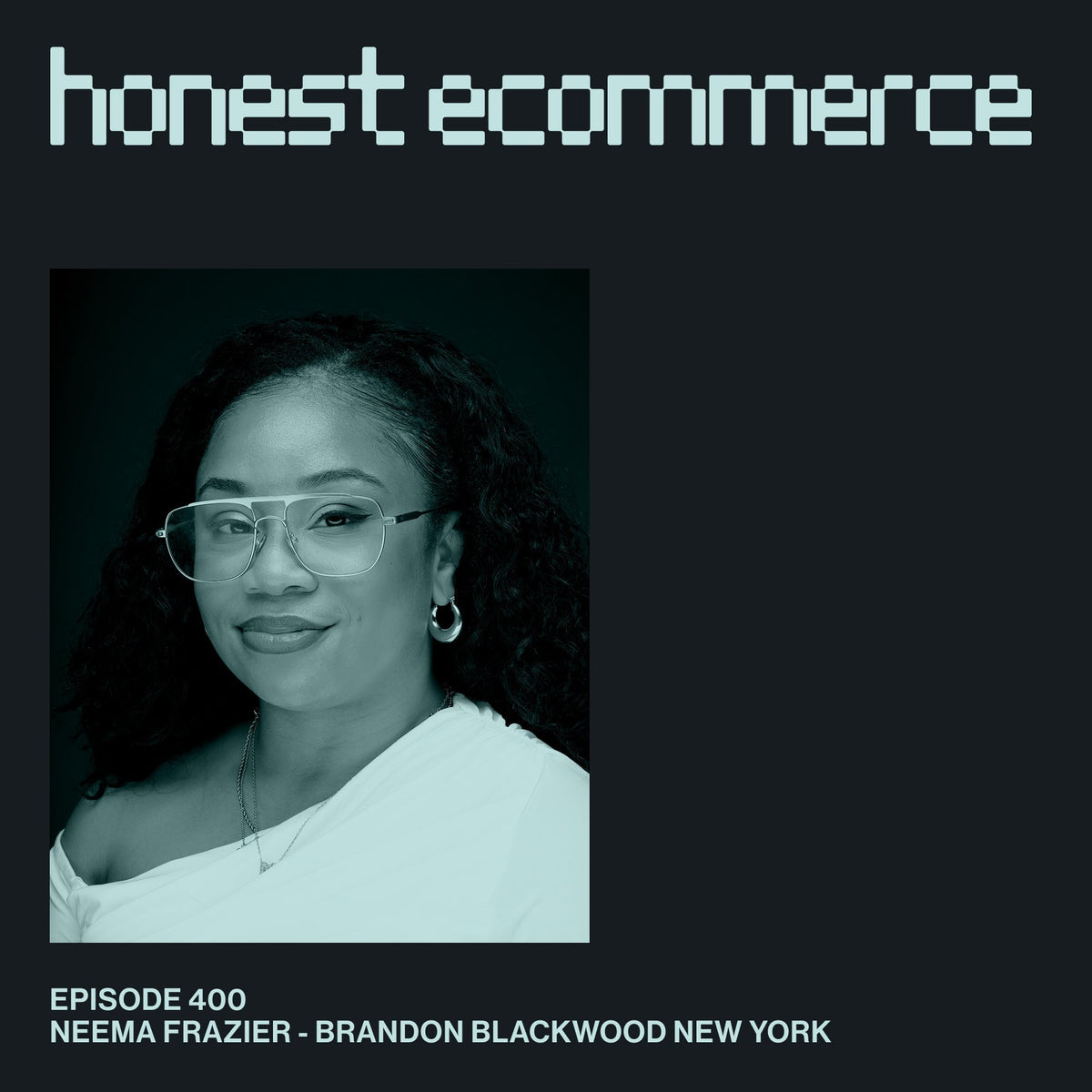
Hey everybody, welcome back to another episode of Honest Ecommerce. Today I'm welcoming to the show Neema Frazier. She is the director of logistics and a founding team member at Brandon Blackwood, New York, where she leads global logistics, fulfillment, and supply chain operations for the recognized luxury fashion brand. Neema, welcome to the show.
Neema Frazier
Thank you for having me. I was so excited to be here. This is so cool.
Chase Clymer
I am happy to chat. We were already having too much fun before this, and we said we just gotta go. So, for folks that are unfamiliar, could you talk a bit about the types of products that you and the team are bringing to market over there?
Neema Frazier
Yes. So, as Chase so lovingly stated, I am a founding member of Brandon Blackwood, New York. I've really been there from the beginning of the operational build-out for the business. I am the director of logistics, so really my main role is overseeing transit operations, warehouse team management, anything freight or transit related. I kind of manage and oversee the scope of work around it.
And so, yeah, that being said, Brandon Blackwood, New York. We offer handbags. We do outerwear, swimwear, footwear, and we also do apparel. But I always say our bread and butter are really the handbags. That really is what put us on the map. And then from there we kind of expanded into the other categories. But yeah, we're accessible luxury. Our price point is very competitive with Coach, with Jack Moose, with Kate Spade. So we offer real leather, genuine leather handbags at an accessible price point.
And it really is so awesome to see the loyalty and the dedication we have with our customers and how they support the brand, the brand story, the business. So it's really awesome to be a part of it. And I'm really, really blessed and just honored to have been there from the beginning and to really support that growth as we expand our SKU count, categories, all that good stuff. So yeah. It's really… Exciting.
Chase Clymer
That's amazing. Now, I guess, take me back in time, take me to the beginning. I'm assuming Brandon... how did you guys connect? How did you end up on the team? And what were the problems that he was facing that he needed someone like you to help him solve?
Neema Frazier
Yeah, so I've actually known Brandon for a really long time. I met him when I was in college. I used to actually be a dancer, I was a professionally trained dancer, and I was dancing at a conservatory, and at the time Brandon would come visit the conservatory really often. He had a lot of friends who were dancers, and yeah, he was just kind of in my sphere. We were always really cool, but we really, really connected more post-grad.
He, at the time, had designed a bag that went viral. And he was at one point just doing fulfillment from his apartment in Brooklyn. And once we had that momentum, he was like, hey, I actually need to get a warehouse. I need to flesh out my operational structure because now I'm really seeing high volume. So essentially he called me in. He knew that I had experience working. I used to actually...
After I sort of closed out my dance career and stopped pursuing that in a more professional way and did it more recreationally, I had a lot more free time, and I started managing a SoulCycle location in Park Slope, Brooklyn. And that's kind of how I got my segue into operational learning and corporate understanding and team communication, team management, budgeting. So I opened a Park Slope studio under, obviously, SoulCycle's team, and I gained a lot of operational experience there, which he was aware of.
So he was like, “Hey, I'd love for you to apply this skill set to my brand. I need someone to come in and lead operations.” And I was like, at first I was a little hesitant because I'd never worked in the fashion space. But then I was like, you know what, Neema, give it a chance and just see what happens. So I told him, I was like, “Hey, I'm open to doing this for two weeks, and if I like it, I'll stay, and if not, no hard feelings.” Because Brandon and I are really good friends, I didn't want to affect our friendship in a negative way.
So yeah, I just was like, “Hey, let's just see two weeks and try it out. And two weeks turned to six years, and I'm obviously still there. So it really was a match made in heaven. I'm really, really happy that I took that chance. So yeah, really the bag went viral, and that's kind of when I came in and was like, “Hey, we need to find a new warehouse, we need to figure out what our CX platform looks like, we need to build out our tech stack.” And so, yeah, I came in and did all of that.
And then I hired out an e-comm coordinator. We worked really closely together to manage inventory, fulfillment strategies, CX communication, all that good stuff. But yeah, it really started with this moment that really catapulted us into this next sphere.
I sometimes feel like we quantum-leaped. It was like one day we were getting, you know, ten orders a day, and the next day we're getting five hundred. So it was really cool to see that leap happen, but also it's like, how do we sustain that?
How do I make sure that we can keep our customers with us? How do I make sure we can keep that rep? How do I make sure that we're sustaining our success? So that really comes down to the operational structure, the 3PL. So yeah, that's really how everything kind of segued into the next phase.
Chase Clymer
[Sponsor: Intelligems]
What is the next big idea that could change your business? A pricing change? A new bundling strategy? Adding subscriptions? Tweaking your shipping offer? Most brands make these decisions based on gut feel. They roll out the change, hope for the best, and have no real idea if it helped or hurt their business.
Intelligems fixes that. It's an AI-powered testing platform that brings CRO-level clarity to the decisions that actually move the needle, not just button colors and headlines, but the big stuff: pricing, offers, shipping, new apps, even major site changes. Brands like Ridge, Jones Road, and True Classic are using Intelligems to test their most important decisions and see exactly how each one impacts profit before they commit. Momofuku used it to test promotional offers ahead of Black Friday and found the version that increased profit by about 28%. Mott & Bow ran structured pricing tests that drove roughly 30% more incremental profit. We use it at Electric Eye with almost every client we work with.
And now Intelligems has a free AI-powered audit that gives you three specific ideas that you can test on your store today. No commitment, no credit card, just three opportunities worth exploring. Head to intelligems.io slash audit and get your free audit in just a few minutes. That's intelligems.io slash audit. intelligems.io/audit.
[End Sponsor Ad]
To me it sounds like you had some skills from the SoulCycle experience, but you were still kind of taking a big leap into something that you perhaps didn't have a mastery in. How much of this was just learning on the fly and figuring it out?
Neema Frazier
Yeah, you know what? I will say a lot of it was. I think in terms of anything related to team communication or team management, I definitely have that down. When it comes to invoice reviews, budgeting, that's not a problem. But really applying my skill set in the fashion space, in terms of SKU management, UPCs, character counts, I learned so many things.
When I tell you, I learned a lot in real time. And that was really the biggest blessing that could happen to me, because now I'm prepared for almost any scenario. I can handle really anything, even when it comes to vendor production timelines, my warehouse SLAs, contract negotiations. I learned so much.
And even the little mistakes that happen, because I have a philosophy where, for me, I feel like I can never fail. Everything I do, any action I take, it's me learning, growing, and understanding. So failure, to me, just does not exist. And so whenever I would make a mistake, or whenever I would come across a hiccup, I was like, “Hey Neema, this is time to learn. This is actually great. This is happening because now you know how to avoid it in the future, and it won't happen again.”
So yeah, I definitely learned a lot in real time. One example of that would be how we manage pre-orders. We tend to have a really big drop, and we'll sell out of a SKU in less than ten minutes. And we're like, “Hey, let's monetize this moment, let's do a pre-order.” Brandon will say, “Hey Neema, I want to put five hundred units available for this particular SKU, let's have this pre-order, let's capture this revenue while we can.” And then we'll obviously go into production and ship everything out in time to get to our customers.
So a scenario like that, I'm like, yeah, no problem, let's do it. But I realized that we need a middleware, like an OMS or an IMS, to hold those orders while we wait for production to be completed.
There were things I wasn't aware of, like certain Shopify guidelines where you can't have an order held for a certain amount of time. It has to sit in another portal in order for it to still be applicable for your revenue. So it was just me understanding how the pre-order flow works. And now I've managed so many pre-orders that I could do it with my eyes closed. But it was definitely a matter of understanding, “Okay, cool, where am I holding these five hundred orders while I'm...waiting for production to be completed?” “Okay, I need to look into having middleware,” “What is middleware? An order management system, or an inventory management system, or an ERP,” “Okay, cool, let me look into that.”
So it was a lot of me problem-solving in real time, putting out little mini fires. And then once those were put out, it was just a matter of making sure they don't come up again. So it was really, for me, the biggest part was finding third-party vendors, software, partners that can really support not only the growth of the brand, but also the sustainability of it, because I want to make sure we have longevity. I don't want just a short-term solution. We want something long-term that can sustain us for years to come, because I knew we were going to do more pre-orders. So it's just me learning and then creating protocol and practices around that new information.
Chase Clymer
Now, do you think that anyone listening to this show could also figure it out?
Neema Frazier
You know, I think yes, I think it's doable. Especially with AI and ChatGPT and all these cool resources we have now. But I think it's definitely possible. I just think that, in terms of my role, operations and logistics, organization is just super important. Organization, and making sure that you're constantly following up with your vendors, constantly being on top of things. That's a big part of it.
And I think across many industries, it's really about building relationships. I think anyone can build a relationship with someone, and I think it's so important to make sure that you're present. Your vendors care about your business, they care about you, and in order for that to happen, you really have to make sure you're building relationships and constantly being present.
I think that's a big part of it too, sometimes people find a software or something that's very automated, and they just go, “All right, cool, plug and play, I'm done, plugged it in, played, we're good to go.” But you still have to monitor it, you still have to manage it, you still have to make sure the relationship is good, because you want to make sure that you're getting the best possible service, and people are not going to support you if they feel like you don't care. So it's really important to make sure that you're maintaining relationships.
So I really feel like the skills, organization, relationship management, just being passionate, taking the initiative, being a go-getter, I think anyone can do it. It's just a matter of having that mentality and also being patient, because it's not always going to work out. There are going to be hiccups, there are going to be things that happen. When it comes to transit, there's always customs issues, or there's a delay, there weren't enough boats, the vessel was full, and I have to wait another week for vessel availability to get my shipment from my vendor to my facility.
So it's just being open to problem-solving and being patient. And as you go, your skill set just grows. So I really think it's possible for anyone, honestly, truly.
Chase Clymer
[Sponsor: Klaviyo]
Most brands outgrow their legacy choices long before they switch. Bad platform decisions do not fail all at once, they fail slowly, then suddenly. First it's one workaround, then another tool, then another integration duct-taped on top, and eventually your team is spending more time managing the stack than actually marketing to customers. Eventually, rebuilding is less painful than staying, usually when it starts to show up on the P&L.
That's when scaling brands simplify and standardize on Klaviyo. Klaviyo is the AI-first B2C CRM. It combines your customer data, email, SMS, analytics, and customer experience tools into one platform, so you're not stitching together five different systems just to understand what your customers are doing. Your database updates in real time, your segments update automatically, your flows, campaigns, and personalization all run off the same source of truth.
And that shift is why many brands are moving to Klaviyo. Brands like Dollar Shave Club have reduced total CRM stack costs by over 30% after consolidating onto Klaviyo. Multi-brand operators like Mark Fisher have migrated multiple brands and drastically reduced the time required to execute CRM marketing. And brands using email and SMS together inside Klaviyo are seeing massive ROI compared to running channels in separate platforms.
The big unlock is simplicity and scale at the same time. Klaviyo is built for marketers, not for engineers. It is built for online businesses just like yours, and it is built for where ecommerce is going, not where it was five years ago. If you're running email and SMS across multiple tools, or you're on a legacy platform and thinking about your next phase of growth, it's probably time to look at Klaviyo.
Go to klaviyo.com/honest and see why hundreds of thousands of brands have already made the switch. That's klaviyo.com/honest. K-L-A-V-I-Y-O dot com slash H-O-N-E-S-T.
[End Sponsor Ad]
Let's pretend that there's an alternate reality where you're looking to help out new brands, et cetera, and I come to you and I've got, we just had this huge hypergrowth moment, things are happening for us, and we need to, we're seeing maybe these operations, we need to polish some stuff up. Maybe I was a founder wearing a million hats, and I just, I don't have, I need help, right? So you come in and help us out.
What are you looking at first to see if there are problems, or where are you going to spend your time in those first couple of weeks and months?
Neema Frazier
Yeah, that's great. So for me, I kind of break it down into three categories: people, process, and data.
So starting with people, you have to really have an understanding of who owns what, who's responsible for what, what SLAs are in place, which is a service level agreement that you have with your 3PL. So for me, I start first with people. Who is accountable for what, and whose role is what? Is that clear?
Because sometimes that line is blurred, and multiple people are working on one thing, or one person thinks they own invoicing and another person thinks they own expenses, it just gets too jumbled up. So I always start with people: who owns what, who is accountable for what, and is that clear? Do we understand whose role is what and who's doing what?
And then from there we go into the process. So from the moment an order comes in to the second it gets delivered to that customer, what is the process? I usually ask, “Hey, just walk me step by step, what is your current process?” And then from there I'll find the gaps in communication or the gaps in efficiency.
Or just determine, hey, from a simplified standpoint, from when the customer clicks checkout to when that order hits the warehouse to when it actually gets picked and packed and a label goes on the box and it goes out, what is that process? What's getting stuck? What's getting duplicated? What's delayed? Where can we find the gap where we can create more efficiency?
And then we go to data. Obviously data is incredibly important, that's how you determine forecasts, and that's how really any of your planning is centered: customer data, inventory, fulfillment, everything.
So for me, making sure that your data is accurate, because I've noticed in the past, especially with warehouses, sometimes... I'm a stickler when it comes to invoicing, when it comes to account management. I look at literally every penny we're spending to make sure it correlates with the work being done at my 3PL. And it's imperative to make sure that data is correct.
So, is our inventory count accurate? Are they telling me, “Hey Neema, I have 150 units of the black Kentuck Trunk in stock, and then I'm looking in Shopify and I only see 70? What's happening here?” So it's just making sure that information is as accurate as possible so that you can make the best possible decisions moving forward.
And then, kind of as a bonus, there's tech stack in relation to the order flow. What is your current tech stack, and is that really helping, is it really optimizing? Because I think now, in the ecommerce sphere, there are so many different software, so many different tech partners, everything from Loop to ReDo to order protection, there's just so many different things.
So you want to make sure that your tech stack is really a match for your business, for your workload, and for your 3PL's capabilities. Because at my previous 3PL, they weren't as equipped as my current 3PL, so they needed a different level of support than my new 3PL needs. I had to adjust my tech stack based on what my warehouse team needs.
And so that also goes back to people, really managing your warehouse team, that relationship, is truly my day-to-day priority. I make sure that I'm on top of them, I'm communicative with them, they know, “Hey, if Neema's emailing us, we've got to get this done by end of day.” They have a level of respect for my role, but also for the business, and they know how I like things done. So, very, very imperative.
So, bringing it back down, people, process, and data. Those are really the top three things I would dive into first. And then from there, obviously, I'd create a plan depending on what the business goals are and what their timeline is.
Chase Clymer
[Sponsor: Flowium]
Two brands can have the same Black Friday Cyber Monday revenue and walk away with completely different businesses. Same top line, different lifetime value, different repeat purchase rate, different margin trend three months out. Revenue tells your board what happened. It doesn't tell them what you built. The difference is whether the retention system was built for the sale or not.
That's what Flowium does. They're a lifecycle marketing agency for Shopify brands and a Klaviyo Elite Master Partner. And instead of running sales as one-off campaigns, they build the infrastructure that turns a first purchase into a habit, and a habit into an advocate, so this year's Black Friday Cyber Monday buyer isn't a one-time transaction. Grab a free retention diagnosis call with Flowium now. Eight weeks out is the last window to actually fix what we find. Head to flowium.com for more information. That's F-L-O-W-I-U-M dot com, flowium.com.
[End Sponsor Ad]
When small brands are getting into logistics and all this stuff, is there anything super common that they tend to overcomplicate or just make too hard too early?
Neema Frazier
That's so... yeah, definitely. I think a lot of brands, especially more luxury brands, have this particular customized experience for each customer, and the price point's a bit higher, so you want to offer this amazing, incredible unboxing experience and all these things. And I feel like it's so important not to overcomplicate a process that is standardized. Do not overcomplicate a pack-out.
I mean, for a warehouse, the most simple thing you can do is literally give them the clearest instructions on how to pick and pack an order. If it's overcomplicated with, okay, fold the shirt this way, put the insert in that way, okay, we need the water bottle facing exactly logo-out. If there are too many components, it really can overcomplicate things, and that's when human error occurs, and then that's when it leads to inconsistency. Because you want things to be as consistent as possible, especially if you have high order volume. And when you overcomplicate a simple process, it just doesn't make sense.
So I think the most important thing is that sometimes luxury brands assume operations need to be highly customized or complicated to stand out. But really, you need to have clear and repeatable processes. That is really how you create consistency, clear, repeatable processes, not complexity around the most simple tasks. I think that's really the key here. And it's also easier to train people that way, it's a lot easier to train people, to measure performance, to identify mistakes, and ultimately scale, if you have clear and repeatable processes.
Chase Clymer
Hey everybody, just a quick reminder: please like this video and subscribe if you haven't. We're releasing interviews like this every week, so don't miss out. Now, back to the interview.
Neema Frazier
So that is what I always, always recommend for really any brand, small, large, medium: keep your processes simple, repeatable, trainable. You measure success, and that's really how you scale.
Chase Clymer
I see something similar on the tech and website side of things. And, not to throw the category under the bus again, but it tends to be luxury brands over-investing in experiences prematurely, is the easier way to say it. They're basically taking money from their bottom line that should be used for growth or other capital investments and investing it into a super highly customized experience.
I'd even argue, they were going headless too fast, they were doing a custom build too fast, they were interjecting all this complexity, like you said, not into the order process as you were mentioning, but into the website process. And they were building technical debt, and they were building in expense line items, people to manage it for them, well before it truly made sense.
And so I'm always so upfront with brands, like, “Hey, you need to make sure that the investments you're making into your experience are also in line with what you can afford.”
Neema Frazier
No, exactly, that's key. It's like staying within budget, and also just understanding. I feel like, to your point, they jump the gun, and it's like, “Hey, we need to hone in on just the simple processes first, and then once we really hit that volume, then we can maybe expand.” But it really starts with truly, what is your bread and butter, stick with clear, repeatable processes so that you can really scale.
And I agree, I think sometimes, especially when it comes to luxury, they think that luxury should be reflected in the customer experience. But really, that's not the case. You want your customer to have the easiest, most simple experience. You don't want it to be too much, because you want them to return, you want it to be as simple as possible. So why overcomplicate something the customer doesn't even need, you know?
Because even recently, I went to an operational summit hosted by a 3PL, and they were so flashy, like, oh my god, we have this customized WMS with AI implemented, and you can have a virtual assistant within your warehouse management system, and there are all these cool tools we have. And I honestly wasn't impressed. I don't care about all these flashy things. I care whether you can pick and pack and get this order out in time. That's what I care about. I don't necessarily need all these fancy tools. I just want you to get the order out, meet your SLAs, and keep my customers happy. That's really all I need.
Chase Clymer
We're talking a lot about fulfillment, and, you know, at a certain point in a young brand's journey, they go, we can't do this ourselves anymore. In your mind, when is that point, or what are some of the indicating factors that are going to be happening where it's like, you guys should really consider making the move?
Neema Frazier
Yeah. I think the best time for a business to scale from in-house fulfillment to a third-party 3PL warehouse, whatever we want to call it, is when your time management is getting skewed. So if your team, or you yourself, are spending more time packing boxes, managing inventory, troubleshooting shipments, dealing with carrier issues on the phone with FedEx, if you're spending a lot of your time doing that versus focusing on strategy and the actual growth of the business, then it's probably time to start looking for a logistics partner, a warehouse partner.
I feel like that's definitely the key component. Typically what I ask founders, because I also consult on the side, I'll ask them, “Hey, do an audit of what your day looks like. What are you spending most of your time on? And what could you be allocating that time towards that's more beneficial to the bigger picture for your business?”
If you're spending a lot of time doing these little things, packing an order, or, my god, you have to go get supplies, you have to go to Uline and order tape, or you're looking at this freight bill, if you're constantly doing those daily tasks and it's taking up so much of your time, then that's when you really need to look for that third-party support in the fulfillment space and find a warehouse partner.
Because really, founders should be spending most of their time looking at the bigger picture, focusing on growth initiatives, and really growing the business. And it's hard to do that when you're spending most of your day picking and packing orders.
So that's really what I say. Do a daily audit. “How am I starting my day, how am I ending my day, and where am I allocating most of my time?” “Okay, cool, how can I reallocate this time to actually growing my business and having a partner I really trust who can get my orders out?” So that's what I always say: look at your time management and really just do an audit.
Chase Clymer
That's amazing. Now, I can't thank you enough for coming on the show here and sharing all these amazing insights. If I'm listening to this and I want to get a hold of you or drop you a line, where should I go, what should I do?
Neema Frazier
Yeah, so, like I said, I'm consulting on the side. So if you want to reach out to me for any new founders, 3PL optimization, or even just auditing or maintenance or any advice, you can find me at neema@brandonblackwood.com. And my LinkedIn... I'm sure I can...
Chase Clymer
I'll have it in the show notes.
Neema Frazier
Perfect. I'm really always available, and I'm always so excited to work with new brands. It really does warm my heart to help a business scale and to see the profitability from choices we make from the beginning that have such an impact long term. That is really what I love to see and love to be a part of.
So thank you so much for even having me on this podcast, this is so cool, and I'm definitely going to send this out and have my friends and everyone take a peek at it, because I think there should be more podcasts on ecommerce and operations, especially as the world of ecommerce is forever growing.
So it's so cool to see that we have platforms like this to really help one another out and share tips and insights and experiences. So this is really awesome. And I'm very excited to see how the rest of the year unfolds as we come to a close, I can't believe 2026 is almost over. It went by so fast.
Chase Clymer
Absolutely. Neema, again, thank you so much for coming on the show today.
Neema Frazier
Thank you, Chase. Have a great rest of your day. I really appreciate this. Thank you.