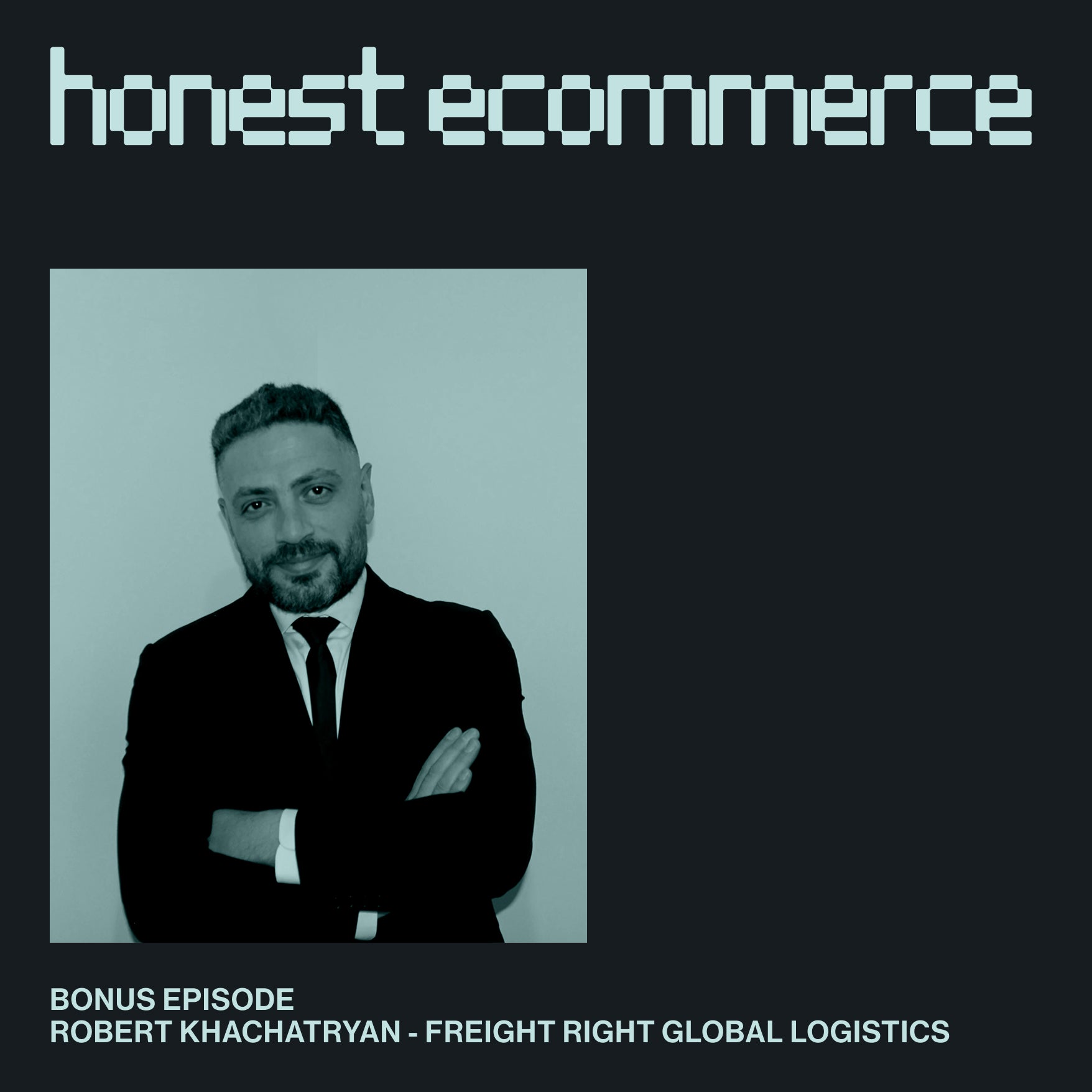
Robert Khachatryan
Their problem was, a lot of people end up on their website from social media. They see a social media ad, it's like a celebrity endorsement. So they'll see the celebrity endorsement, they'll go on the Shopify website, and they type in their address in the UK, and it just says, “We can't ship to your country.” So by the time they submit an email, by the time three days later, they get a shipping quote, they've already moved on, right?
The moment has passed. They found another reformer locally, or they just no longer interested. You lose the sale just because of how long it takes to get back to the customer. And this is basically the problem we endeavor to solve.
Chase Clymer
Honest Ecommerce is a weekly podcast where we interview direct-to-consumer brand founders and leaders to find out what it takes to start, grow, and scale an online business today.
Hey everybody, welcome back to another episode of Honest Ecommerce. Today, I'm welcoming to the show Robert Khachatryan. He is the CEO of Freight Right Global Logistics. They're a globally recognized name in freight and freight technology. Robert, welcome to the show.
Robert Khachatryan
Thank you for having me, Chase. I'm very excited to chat.
Chase Clymer
I have learned a lot about your brand over the last couple of months. So I guess where does your story start in logistics? Obviously, Ecommerce came a little bit later on. But give me the short history of your career that led to the founding of Freight Right.
Robert Khachatryan
Yeah, I mean I grew up in an entrepreneurial family, so my whole life I was either behind the counter or in front of the counter, shoveling snow or whatever. So it was kind of meant to be sooner or later. But it happened sooner than I was planning. I worked at a logistics company here in LA and in 2007, because in preparation for the economic crisis.
Things were collapsing, the company I was working for was going bankrupt and had a few customers basically who wanted continuity. And they pushed me to just branch out on my own and start the company and I kind of took the leap. I got into it with this vision of digital logistics and automating, quoting and things like that. Took a big detour of some 10 years and then came back to it.
Figure out how to automate pricing and how to quote international freight automatically, which was a very complicated problem at the time. And then as a result of that, I started looking into Ecommerce because a lot of our customers were actually selling big and bulky items and they were all quoting it via email. So a customer would reach out from Australia and say, “I want to buy this arcade, how much to ship it”, right?
And then they would email us, start putting together the pricing, get back to them and they would go back to this potential customer. A week later, after many hours of work, they would present a price to the customer in Australia and the Australian customer would be like, “Ah, I don't like it, it's too expensive.” So all of that works with very low conversion rates.
So, being able to automate pricing, took us on this path to “Why don't we actually quote this stuff real time on a shopping cart?” So we don't do all this work for customers who don't want to buy the product. It's out of budget. But also you actually do get the ability to sell to customers who want to buy the product. And that was what led us to this Ecommerce product to be built.
Chase Clymer
Absolutely. Yeah. I think that a lot of the magic that happens in Ecommerce is that it is shortening the time to value. So it's that instant gratification. Which is why Amazon is one of the biggest players out there. It's that instant gratification of why people just buy stuff on it because they know it's there. They know they'll get it. But when you're buying the types of products you're talking about. We're talking about couches and armoires and other large households.
Not even household. They could be sheds or jacuzzis or heck, cars even. I don't know how many people are buying cars straight up at a Shopify store these days, but I'm sure it'll come in the future. But those types of products are completely different to ship than like a t-shirt or some sneakers.
So how did that work? Historically, you walked us through it before, but just really paint the picture of what a lot of these merchants are doing these days when they're selling an oversized product.
Robert Khachatryan
Yeah, think the sad thing is they're not really doing it. So we approached... Well, from the perspective of international sales, at least. So most brands that sell large items that are big and bulky and don't fit into a parcel shipping system. So if you're selling a t-shirt, like you said, or you're selling a gadget or whatever, cosmetics. There's existing infrastructure, you can have UPS, FedEx, DHL accounts, you can have an integration with your Shopify store.
And whether you automatically calculate shipping at checkout or whether you're offering free shipping. Then shopping for the best rate at the time of fulfillment. All of this exists. This infrastructure.
If you're selling bulky, heavy items, this infrastructure is non-existent. So what ends up happening, most of the brands that sell big and bulky items, they only sell them domestically. And even then, it's very hard to calculate shipping.
So a lot of them just bake that into the cost of the product and then offer free shipping. So you'll see most furniture companies offer free shipping. Or they'll offer some nominal fee of let's say $100 to deliver a set of furniture.
Chase Clymer
Yeah, flat rate. Yeah.
Robert Khachatryan
Yeah, which I mean, it clearly costs more than $150 to deliver a furniture set. It's almost impossible to calculate it in real time. Then part, they want to keep the customer experience a little different from adding shipping fees. But this is all the domestic side of it. Now, if you try to sell internationally, it's just basically, it's nearly impossible to calculate shipping instantly.
Because, if you ship, let's say, an arcade game from the United States to Australia. The shipping calculation involves some 27 different line items that need to be calculated. And in the world of Shopify or most other Ecommerce shopping cart systems, you basically have six to 10 seconds to do it. If you take more than 10 seconds, it's a terrible customer experience, right?
Nobody wants to sit there in a shopping cart waiting for the thing to load. But Shopify will actually time you out. So, the complexity of calculating how to ship this thing across the world, clear customs, duty is one thing. And then the technical challenge of doing it fast enough is a whole different level of problem.
So, most brands opt basically not to sell internationally. Most brands, if you go to their shipping policy, will say if you're overseas, contact us and we'll get back to you via email about a shipping quote. So the problem with that is you do so much manual work to get back to this potential customer with a shipping quote and the conversion rate is pretty low actually. So most brands just opt not to do all this work. Because of low conversion rates.
And the time it takes to do it also has a big effect on the conversion rate as well. So one of the brands we spoke to very early on just to sort of validate the idea is this luxury Pilates reformer brand. And their problem was a lot of people end up on their website from social media. They see a social media ad. It's like a celebrity endorsement. So, they'll see the celebrity endorsement, they'll go on the shop for a website, and they type in their address in the UK.
And it just says, “We can't ship to your country.” So by the time they submit an email, by the time three days later, they get a shipping quote, they've already moved on, right? The moment has passed, they found another reformer locally. Or they are just no longer interested. You lose the sale just because of how long it takes to get back to the customer. And this is basically the problem we endeavor to solve.
Chase Clymer
Absolutely. And you mentioned, not only is it like there is the technology component of it.Well, actually, that's where I wanted to go with this. The technology component of it was like a big hurdle to come over. So most people were manually quoting this. How long did it take you guys to build up and string together that first MVP that was trying to automate all this? And how many steps were there? You mentioned just from America to Australia, it's 27 steps. Is that on average? Is that more of a quicker one?
Robert Khachatryan
Yeah. You can basically, it depends on how nuanced you want to get. So you have to calculate. I'll give you a glimpse of what it's like. So if you're shipping, let's say, a big bulky item, let's say it's a reformer or an arcade or an unassembled jacuzzi or a sauna. So you have to calculate the tracking from the fulfillment facility to a consolidation facility. You have to calculate what the consolidation facility is going to charge to receive it, measure it, and put it in a container.
You have export declarations you have to do. Then it's the tracking of that consolidated shipment from the warehouse to the port. Then there's ocean freight. Then there's all of the steps of destination: you have to take the container to a deconsolidation facility and so on and so forth. And everybody charges a fee for it, right?
So this is how you end up with 27 different line items on the quote. And when you're trying to calculate that quote on the fly, it's like a very sophisticated technical problem to do, right? So you could basically just have a very crude model to just predict something. But then you have to be competitive because you're literally having an impact on the conversion of the sale. It's this balancing act between doing it fast and doing it competitively.
Chase Clymer
Hey everybody, just a quick reminder. Please like this video and subscribe if you haven't. We're releasing interviews like this every week. So don't miss out. Now back to the interview.
With this particular problem that you're solving? These larger carriers like UPS, FedEx, DHL, don't they have solutions?
Robert Khachatryan
No. So their main play is parcel. Now, all of those carriers have supply chain and logistics divisions that do bulky freight. But there's not an Ecommerce product. They're not, you can ship containers with UPS, you can ship cargo pallets with FedEx and DHL. But it's not actually FedEx, DHL or UPS. It's the UPS supply chain. It's DHL Aviation and FedEx supply chain solutions, think. These are basically different divisions that deal with commercial shippers.
They deal with factories, they deal with importers and distributors. None of these guys are set up to quote these things automatically even, let alone quote it fast enough. And most importantly, servicing the shipment. Because this type of service is typically designed for commercial shippers.
So the person you're interacting with is a professional logistician. So in the Ecommerce world, you're dealing with a consumer. So freight is not, basically until now, a consumer product. So you can't go to a person in Australia who just bought an exercise machine and explain to this person that, “Oh, you know, the vessel is delayed because of port congestion, because Trump Terry for this or that or the other.”
It's just, the result is terrible customer experience. These consumers, they're laymen. They're not supposed to know any of this stuff. They don't care about any of this stuff. On the logistics and execution side of it, there is a big challenge to actually service the customer where they have an amazing experience. Even though you're going through this very complex supply chain problem.
How do you deliver Amazon level or FedEx level experience while in the background dealing with this super complex global logistics problem?
Chase Clymer
As you were walking me through that, I was thinking about this technology that you guys have built over there... I'm assuming it also helps solve the same problem for some US territories that are also just a little more complex to ship to. First and foremost, like Hawaii, or even getting up to Alaska sometimes is a pain.
So I'm assuming, or correct me if I'm wrong, that you guys have also had the foresight to try to help solve those issues?
Robert Khachatryan
Yeah. And it's interesting. The way it happened is like most software, we're not technically a software company, but our engineering team basically started with a bunch of product interviews, right? We talked to brands, like, “Okay, you how many international inquiries do you get? Is this a problem? Do you want it solved?” Right? And then a lot of times we would approach the interview or the conversation with the brand targeting international sales.
And a lot of times what we would hear back is, “Okay, international is great, but how do we ship to Hawaii? Or how do we ship to Guam or how do we ship to Alaska? We can't even solve that. So yes, we very early on started to think of it as, “Okay, it's not strictly speaking an international problem. It's more of an outside of continental US problem.”
Canada is another example that came up very early on. It's not technically ocean or air freight. It's a trucking problem, but it is a customs and border crossing problem as well. So, Hawaii, Guam, Alaska to some extent. Now, Alaska is very challenging, because you have a lot of cities in Alaska that basically are not easily accessible.
The accessibility varies widely with seasons. So, it's a bit of a different problem. But Alaska we solved, for example, for the major cities. Right? Like Hawaii we solved for all of Hawaii, all of the islands. Guam is arguably the simplest one because it's just small. But yes, that was definitely a pain point, which we didn't initially think about until we actually started talking to brands.
Chase Clymer
Obviously, we're getting super into the weeds about the freight-right solution. But just in building a product in general, you guys took such a straight-up MVP SaaS approach to this. You talked about it just a little bit ago. It's like you were just from day one, you're interviewing who would be potential customers. Like, “Here's an idea we have. What do you think about it?”
And they are just straight up telling you, “Cool, but have you thought about this?” And it's just you are doing what your customers want. And I'm assuming that's what led to the success that you guys have now.
Robert Khachatryan
It's funny with every implementation, we come up against the same sort of phenomenon where we talk to a brand and say, “We can help you sell in the UK or we can help you sell in Australia.” And they're like, “Can you help me ship in the United States?”
And we're like, “Okay, let's hear this out.”
And they're like, “Okay, every time I get a shipment, I have to go and I have to request quotes or I have to go on this other application and create a bill of lading for my domestic shipments.”
And we're like, “Well, for international stuff, if you get an order, we automatically dispatch it. We send you all the documents, electronics and all that stuff.
They say, “Can we do this for the domestic?”
And we're like, “Yeah”, so great. We actually don't care about showing a raise to the customer, but we care about automating the fulfillment on the backend. And that's a problem we solved to solve our other problem. That's already a solved problem for us.
We're like, okay, so there's a whole bunch of brands out there that offer free shipping just because they don't want to charge shipping. But then once they get an order, they still have this manual, very labor-intensive work of actually creating documents like bill of ladings and dispatching trucks and dealing with different TMS systems to shop for rates.
And so we have this whole category of customers who are just asking us to automate this process. So yeah, we constantly come across these new needs and if there's enough of them, like we hear enough customers, mentioning this as a headache, then we will go in and try to build a solution for that as part of the overall Ecommerce enablement suite.
Chase Clymer
Yeah. And here's a thing to all of my listeners. If you have a problem that you think a lot of people are dealing with, just reach out to Robert. I'm sure his team would just be super curious to learn about it if it's in this world of bulky logistical challenges. And I do want to highlight, if you don't ship big old things like this. It doesn't...
You don't understand how annoying this problem is. If you've got an oversized product, if you don't have this software or similar software. And it's not like automated processes aren't there, like shipping a t-shirt, those rates are fixed across America by just how the market works and how mature selling those products is in the industry.
But the rate to ship a table, even within the United States, large, put together a full-size table, not something broken down, that's going to require a truck and maybe a pallet and some more things. That rate will change based upon the season, based upon gas prices, based upon all sorts of stuff. And every time, it's a new quoting process.
Robert Khachatryan
Yeah. And what's other... You just reminded me. The other problem we solved, which initially we weren't thinking about, is by talking to a lot of brands, we quickly realized a lot of these brands import the product. Let's say from a factory in Asia to the United States or to Australia and then they sell it internationally. So you have this logistics cost of bringing the product to your country and then selling it internationally, right?
And then shipping it out. And not to mention that you've paid duties and taxes importing it. And we all know in the United States, that's a lot of money, given the new tariff policy. So we started fulfilling orders from the factory. So we're telling brands, you're a US brand manufacturing in China. If you're selling a product in Australia, we'll just fulfill this from the Chinese factory to your Australian customer.
No longer do you need to have inventory in the United States for that piece of your business, cutting on the logistics cost of it, cutting on duties and taxes that you already paid, right? So that's another feature that came out of basically customer feedback.
And which makes the whole thing sort of also super economical. A lot of times customers like brands are surprised at how basically affordable it is to fulfill a big bulky item from China to the UK or to Australia or even to the United States. Compared to the traditional method of importing, inventorying it and then shipping it out.
Chase Clymer
Yeah. And there's obviously, depending on what's going on in our economy, there's some advantages to shipping from certain places and not importing it at that time. Now, Robert, is there anything I didn't ask you about today that you think would resonate with our audience?
Robert Khachatryan
I think what a lot of brands don't think about is, this is actually pretty easy. So a lot of the American brands we talk to, they're all sort of everybody has tariffs on their minds. If you're selling to Canada, your product is a lot less competitive now because Canadian competitors of yours don't have to pay a tariff.
The solution we're offering is pretty out of the box, right? So you can start selling in international markets in a matter of days without having to go through, finding distributors, setting up entities, dealing with remittances of taxes and duties and all of that stuff. So a lot of the brands we talk to just don't realize that this is like, it's really easy.
And in these times at least for American brands, of challenges competing, given the tariffs. You can actually enable this whole new channel of new markets without too much effort. And that's, I think, one of the most important things I would want your audience to know is there's an easy way to top off your revenue, basically.
Chase Clymer
Absolutely. And when this comes out, it'll be in January 2026. So everybody listening, if this is... If expanding into new markets is on your mind, I feel like you owe it to yourself to at least reach out to Robert and his team. And see if they can't let you understand what they can do for you. All right, Robert, if they're listening to this show and they’re curious to learn more. Where should they go? What should they do?
Robert Khachatryan
Yeah. Go to freightright.com. And there's an Ecommerce section right there on the top menu. Just click on that section. You can explore it. You can contact us. We'd love to hear from you. Or you can reach out to me directly, whether it's on LinkedIn or my information is on the website as well. Always happy to chat with an Ecommerce brand and learn what other problems we can solve.
Chase Clymer
Awesome, Robert. Thank you so much for coming on the show today.
Robert Khachatryan
Thanks for having me.