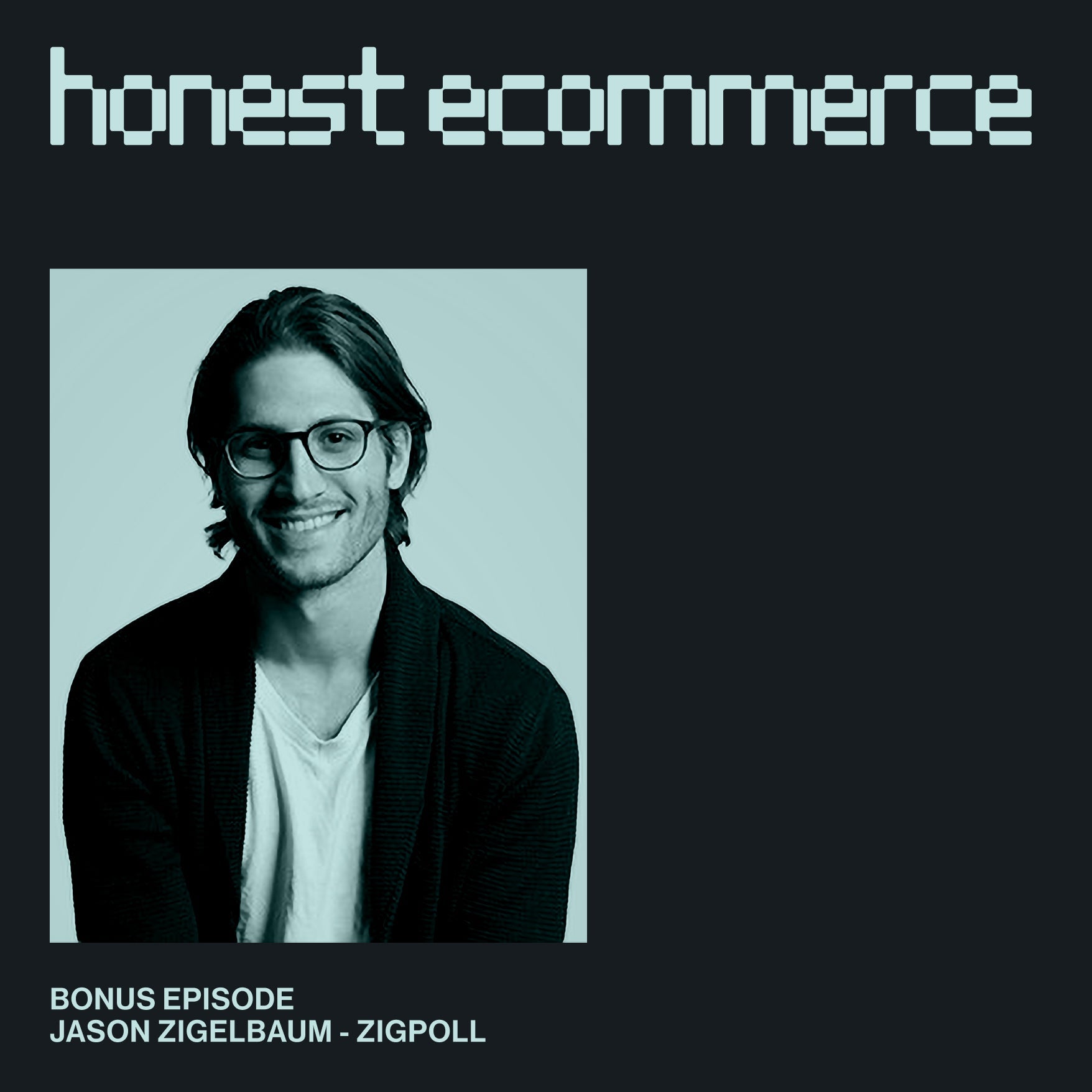
Jason Zigelbaum
You have to know what to ask the machine. And all of a sudden, that is now more important than knowing how to solve the problem, is knowing what to solve and what to ask.
Chase Clymer
Honest Ecommerce is a weekly podcast where we interview direct-to-consumer brand founders and leaders to find out what it takes to start, grow, and scale an online business today.
Hey everybody, welcome back to another episode of Honest Ecommerce. Today, I'm welcoming to show the founder of ZigPoll, an all-in-one Ecommerce survey tool that we use at the agency on almost every client that we onboard and do CRO with, Jason Ziglebom. Welcome to the show.
Jason Zigelbaum
Right on. Thanks for having me, man. I appreciate it.
Chase Clymer
I'm excited. So, all right, quickly at the top, let's just shout out the app. What problem are you solving with the app? What does it do? Why might it be important to my business?
Jason Zigelbaum
Yeah, so ZigPool, the idea is it's a contextual survey tool. So context, something happens, right? So could be for any business, in your case, Ecommerce, right? Someone completes an order, they see a survey, so that's a post-purchase survey. Maybe someone gets the order delivered, an order delivery survey. Or maybe you try to leave the website and that would be like an abandoned checkout survey or an ex-in-attent survey that appears directly on the site.
So the idea is that it's a data collection platform. They offer a ton of analysis tools so you can make sense of what people are saying in context. Then also a lot of delivery surfaces. So you could shoot a survey directly on your website. You can shoot a survey via email, via SMS, or mobile. Lots of different services there that you can connect to key points to get feedback from your customers and iterate and improve your business.
Chase Clymer
Absolutely. So it goes above and beyond. I know that for a while there, creating a quiz was super hot for Ecommerce brands. But this takes it a step further and just adds a few more. You can do a lot with it is what I'm [saying].
Jason Zigelbaum
Yeah, definitely. I'd say it's like a superset of a post-purchase survey tool. So it's like post-purchase. That's one way to use it. But because it's a bit more flexible on the surfaces and the connections, you can use it in a wide variety of ways. And that's what I've seen with a lot of our customers. We have a very long-tail user base.
If people in Ecommerce, if people in SaaS using X and the tensor, downgrade surveys, upgrade surveys, stuff like that. We use it internally for that as well. So it can go across a ton of different verticals. But yeah, it's like a holistic data feedback tool that you can use to learn about your customers in context when they do something with your brand. Or with your product or something like that.
Chase Clymer
Absolutely. Now, when did this experiment start? What was going on? What caused you to launch this, get into surveys?
Jason Zigelbaum
That's a good question. And I'll say this a lot. I use the products to dog food and figure out what to do next. So at first it had nothing to do, like the original idea had very little to do with the way it works and looks now. I think originally back in 2018, “I was thinking, oh, I want to make websites more interactive, more fun.” Similar to a Twitter survey or a LinkedIn survey that pops up being like, ‘Hey, you know, what's your favorite color today or something?’
And, know, it's a cool idea, but people aren't really willing to pay for it. And it didn't make a ton of sense. What did happen was I used the tool internally and people would submit the contact us form and the feedback form. And they would tell me what they wanted from the product. And that led us to post-purchase surveys, which makes sense.
And then the more broad holistic platform where you have events, surface, data collection, and then the last bit is the data analysis and the actions that you can take on it. So it's just a grind, an iterative process of starting in one place, listing to the market and then iterating to get to where are now.
Chase Clymer
Yeah. And now your background, were you in ecommerce first or was it more SaaS? How did it start to align like, oh, wait, this is just fantastic for learning from customers?
Jason Zigelbaum
For sure. Yeah. So professionally, I worked in an agency, an ecommerce agency for a while. And then I quit and I built this Shopify app that helps agencies build websites faster. And then I was like, “Okay, this is good. It's like a base hit, but I want to try another product.” And that was when I started working on ZigPoll.
And it's sort of like, do what you know. So I started with this idea. It could be useful for any website, but I know Ecommerce. So let's create an app for it. Throw it on the shop by App Store. And that was what led us to that Ecommerce vertical and all that self-fulfilling feedback loop that I was just talking about.
Chase Clymer
Absolutely. Yeah. I mean, the feedback loop is wonderful. And I alluded to it earlier that we like to use your tool for CRO. So let's just walk down that avenue real quick. It's like, if I'm a brand, and I want to make my product, my website, my business, etc. better, there's nothing more powerful than just asking your customer about it. So let's just give away the free strategy here. like, what are we... I'll tell people what we're doing and the types of questions we're asking.
And I'm sure that you've got a lot of other examples and use cases that you've seen historically. We just did a wild one together on a project not too long ago. But yeah, let's start simple though. Just the basics. If this is my first time getting into customer surveying, what's the zero to one the simplest thing I can do?
Jason Zigelbaum
For sure. Yeah. So for CRO, I feel like the two no brainers are going to be an exit intent survey. So if someone tries to leave your website and we have a setting so you could make this only appear if they have an item in their cart or not, it's up to you. Frankly, either one works. So someone tries to leave your website and a survey pops up. It says, “Hey, why are you leaving?”
And maybe you have some ideas like too expensive, find what I was looking for, not sure if it will work, depending on your brand and what you sell, those pre-selected options may change. And then most importantly, you add a follow up question, which is, “Is there anything else you want to share?” Make it optional, just open it as a text box.
And if you capture sort of like what will happen is, and this happens 100 % of the time is you'll capture something that you didn't know that you didn't know. So maybe, your website doesn't work on mobile for people using Android. Less than two versions ago or something. That would be surfaced. And so that's just kind of a no-brainer that you can set it and forget it.
And then every once in a while, every quarter, just check in on your data. Find the common trends that come up, and then fix them and plug those holes and that will increase your conversion rate. And then so that's pillar number one. And pillar number two would be just a product page survey. So this is going to be a survey that's going to appear on your website on a product page after 90 seconds, minute and a half, whatever.
That says, “Does this page connect everything you're looking for?” And if the answer is yes or no, you ask a follow-up question with a similar idea, open it in the text box. Is there anything else that you want to share? And the idea is you want to surface whatever is causing hesitation on those product pages and then iterate on that.
So they might say, “I didn't know the size of the product. So maybe your product images are shot on a white background. And so the scale is all off.” So that's going to be like a useful bit of feedback you do. You add some sort of text or maybe you reshoot your images. And then all of sudden, your project goes up. And you just sort of keep that on forever and keep reanalyzing it every quarter. And it tends to just plug any holes that you have on those key moments.
Chase Clymer
As I was listening to you, you were asking questions and supplying the answers. But I was always of the mindset of aways just asking open-ended questions. And not trying to railroad them into something because it might not be what they were thinking. But I mean, guess you've helped hundreds of brands run thousands of surveys.I'm sure we're allowed to agree to disagree. But I just would love your insight on that.
Jason Zigelbaum
Your intuition is totally correct. You don't want to lead the witness. If you say an option is too expensive, maybe even though it wasn't too expensive, you're gonna click it. The reason why we suggest using fixed choices as the first question is there's this sort of... It's a lower lift mentally. So if I see something pop up and it's just a big white box. And now all of a sudden I have to think about what I'm going to put in that box. That's too much. I'm just going to close it.
But if you have a bunch of options,, yes or no, [you’d be more”, “Oh, I'll do that.” And then you click yes or you click no. It doesn't really matter.
Chase Clymer
It's the micro commitment.
Jason Zigelbaum
Exactly. And then the next question is an open-ended one. Well, there's your meat, right? There's your chance. And they're way more likely to fill it out because they took that micro commitment in the beginning. So that's the logic behind putting the fixed choice stuff first.
Chase Clymer
Yeah, absolutely. And it was making sense. Especially with the product page one, right? You're looking to get them to basically [take action]. People don't buy because of fear, uncertainty, and doubt. FUD is the fun thing that people talk about. And yeah, right there on the product page, they're going to tell you some very useful information.
Jason Zigelbaum
Yeah.
Chase Clymer
You mentioned something that I want to bring up because we have clients that don't want to do this for various reasons, right? But you said just let it run forever. Just always be collecting this. Some clients don't want to do that. And I don't understand why. So I guess, what's the argument to let it run forever? Why should we just constantly be collecting this awesome data that's only improving our website? It's hard to come up with that.
Jason Zigelbaum
You need to know what the heck you're doing. Otherwise, you're flying blind. And I say this from experience. I thought I had a great idea with this survey tool that would just be like a Twitter survey on Ecommerce home pages. That wasn't a good idea, right? What was a good idea was listening to the feedback from customers who pushed it into something that's actually useful and morphed it. And it's the same for any business, right?
You think you have a good idea. You think you have this product that's killer, it's amazing. But you got to listen to the market. You got to change. You got to improve it. You have to make it a product. Not only your product vision, but the product vision that people will buy, right? That's the difference. And listening to customers is my opinion, the only way to get from A to B other than just guessing and hoping to hit a bullseye, which isn't much of a strategy.
So that's the reason for collecting. I understand people's hesitation, right? Because everyone's worried about adding a new pop-up to their website. We take a lot of care to not be too invasive. And there's a lot of control and configuration around there and consciousness about that. But I get it if you don't want to make a change, it's going to hurt your conversion rate.
But specifically, exit intent. I mean, the customer is going to leave anyway, it's not really a ton of risk. And product pages, again, it doesn't appear until you've been on it for a minute or two or whatever you want to configure it to be. So there is a ton of risk. But I understand the resistance about wanting to try something new.
However, I do think that collecting data from your customers is really the most important thing to do if you want to improve your business in any sort of meaningful way.
Chase Clymer
Hey everybody, just a quick reminder, please like this video and subscribe if you haven't. We're releasing interviews like this every week. So don't miss out. Now back to the interview.
Yeah, I will just be direct here and say the best clients that we work with and the brands getting the most out of having a mindset for constant iteration are the brands that are constantly asking for feedback. I don't know why you would ever stop that because your website is constantly changing.
So there will constantly be new issues being surfaced by accident. through the fact that these websites are living breathing things. They're not static, epecially in Ecommerce. It's like Shopify pushes an update, breaks an API on some app that's powering something. And now you've got something broken on your website that you're probably not going to notice but a customer might notice faster.
That's just a really simple connection to make. Just so many different iterations of that type of breaking can happen.
Jason Zigelbaum
Absolutely. Yeah, man. I feel like honestly, things are trending faster than ever with all this AI stuff going on. So yes, internally at Shopify, better believe they're using AI to iterate faster and make more changes. Some of those will break. And it helps to have a feedback loop always running so you can catch those issues that in many cases occurred without you doing anything, right?
Like I just was sitting here tilling my thumbs and all of sudden my site's broken. You know, that's unfortunate. It's an unfortunate place to be. But you have to have some sort of alert system, some sort of monitoring system. And you know your customers, it's not, it shouldn't be your first line of defense, but it should still be a line of defense.
And then, on top of that, just technical issues, there's all sorts of other issues that they can surface. About your products, about who your customer is, right? Like, you help identify who actually is buying your product. And that would be like on a post-purchase survey, right?
Chase Clymer
Yeah.
Jason Zigelbaum
If you keep that running, you're constantly getting an improved vision over who your customer is, what they're buying. Different people might buy different subsets of your product offerings. They might buy different values, all sorts of things. They can use to build these customer segments that really move the needle in terms of your target email campaigns. Your target SMS campaigns. Your advertising. It's just incredibly important to know who you're selling to.
Chase Clymer
Yeah, people make a lot of assumptions about who their customer is because a lot of times people think that I'm the founder and this was my problem that I solved for myself. Therefore, everyone is just like me. And that's an insane connection to make when you don't actually know if that's true.
So obviously, surveying your customers and finding more of that demographic information is a fantastic thing to do. And the coolest thing about just surveying in general, and what you're learning here, we do it in a bunch of different ways. So surveying is part of it. But we're doing user testing. We're doing research within GA4. We're actually hiring people to use the website and learn their thoughts on it.
And then going back to surveys again, we're emailing their customers and we're bucketing them out into different buckets. So high value customers, everyone calls them whales. And then single purchasers asking them why they're not a repeat purchaser. There's all sorts of stuff that you can do here. And all it's going to do is give you such good fodder for not just improving the website. That's what my company does really well.
But then you can take all that data and you can use it to build out marketing hooks on Facebook or Metta to launch campaigns there. You can use it to improve your copy on not only the website, but on the product box itself. If you're getting all this feedback that people don't understand a certain specific thing about your product, and it's not on the product page.
They're gonna have that same problem on the shelf if you're in a Walmart or something and they don't understand that. So now you have that problem that has surfaced and now you know you need to also update your packaging to solve for that. So this stuff is useful all over the place, not just on the Ecommerce website.
Jason Zigelbaum
Yeah, exactly. Right. I mean, it's incredibly long tail. It's interesting because originally, I thought this would be a relatively small product. But it just has, it's just kept growing because people come at me with different use cases. like, “Hey, J, can I do this?” Can't do that. Can't do this. Can't do that. And, it just became incredibly clear that this is a tool that is useful across a wide variety of different use cases.
And, it's good to hone in on, one, two or three. But I try to build products that you can use it for all those different things. Get a lot of value out of it as like a singular platform then run analysis on it afterwards. And that's the next step. It's like, “Well, I have all this data. I know who my whales are. I know who my one-time customers are. I know what their hesitation purchase is.” And that's like, “What do I do with that?”
Then you can pipe that data into other third-party tools like a Klaviyo for sending email campaigns. Or Google Analytics or just your if you segment or something like a larger analytics platform. There's a lot of different ways you can send that data and slice and dice it in order to create sort of like actual changes.
Oh, and one thing that actually you haven't been doing that's new-ish is, I don't know if you use Cloud Code or MCPs or anything like that, but we have an MCP server, right? So what I'll do is every three months, I'll look at the feedback that we get from things like our contact us form or like our downgrade survey. Or upgrade surveys to surface trends.
And then, take those trends and then pipe them through directly to Cloud Code in order to create action items and then execute on those action items. So it becomes like a real loop that now with the rise of agentic coding and stuff, you can actually take the action from the trend and really close that loop. And just keep on improving your product without even being that involved. You don't have to write the code anymore. Take a look at it.
Chase Clymer
Yeah. Always look at what AI is doing but trust and verify.
Jason Zigelbaum
It's just this crazy new world that we're living in. All of a sudden, you really should always be collecting data because then you have some direction on how to improve constantly given all these new tools.
Chase Clymer
Yeah, I always find that I'll talk to brands bigger than you think. I'm talking to the audience right now. I'm like, oh yeah, we're talking about what it is that Electric Eye is good at. CRO is an overarching term for just making the website better. But it's like, “Oh, who's looking at your analytics? Who's looking at your heat maps, your user recordings? Who's looking at your polling?”
And it's wild to me to hear so often. They're like, “I have no idea how often that stuff's getting checked. We've got 3 people on this team and we've got such bigger fires to put out.” So I've heard that from dozens of brands in the last year. And obviously, I was like, “Well, we'll do that for you. But also, I do see where AI will be helpful in some of this stuff. Especially just with sentiment analysis, AI rules for that.
We use it already right now and there's no secret sauce here. We know the questions to ask to get to pull the data out of it. But I think a smart person could also do some of these things that we're doing. It's not like we're reinventing the wheel here with CRO. It's just like, get a bunch of data in fine patterns that are looking towards what you want to do.
But yeah. For example, with customer surveys, we did this previously. We used to zig-pull. And we brought it in and it helped surface all these things that we put into... We like to use the PXL framework for prioritizing what we're going to tackle for our clients or run through split tests or whatnot. But yeah, it's a one-two punch now with AI just making what used to be straight up homework a lot easier.
Jason Zigelbaum
Yeah, exactly. I mean, open-ended text analysis. I mean, the fact that you could surface trends from thousands of open-ended text responses. That's something you couldn't do a couple of years ago without manually going through a thousand, a thousand row CSV file.
Chase Clymer
Yeah.
Jason Zigelbaum
You know, just now that you have that sort of next step, it really increases the value of collecting this, this data constantly, right? Cause before it was like, “Why would I leave it on? I'll never know what to do with it.” And that has changed fundamentally with these new tools. So you should sort of always be collecting just, because you will then know what to do that everyone else won't.
Chase Clymer
Yeah. And just because we're talking about using AI and the analysis of the data, one of our newest hires, she was like, “I'm also using it to permutate the problem and solution.” So it's like, well, if this is a problem, what else might be a problem that's adjacent to what this is? That's actually been useful to have. It's like, “Oh, yeah, that's also happening.” And then you can go back into the heat maps or whatnot and find supporting data for that new hypothesis.
Jason Zigelbaum
For sure. And I do that a lot too. And I think the interesting part with all this stuff is you have to know what to ask the machine. Yeah. And all of sudden that is now more important than knowing how to solve the problem is knowing what to solve and what to ask. And so it's just this sort of change in mindset.
Where all of a sudden this data that I've been capturing, it's just become more valuable because I no longer have to worry about the implementation timeline to add this integration. I just need to know which integration to add. And now I do because people tell me what they want.
There's a form that pops up and it says, “What integration you want when you're on the integrations page.” And they'll tell me and then I'll build it. So it just really, at least from my perspective, has increased the value of the product a lot.
Chase Clymer
Yeah. mean, just AI in general, it's just a hammer. And so if you're good with a hammer, you're going to be great with that tool. But if you don't know what you're doing with it, you're not going to be able to really get the results that an expert has. It's just like an effort multiplier. It's not scary yet. There is a future into which it is scary.
Jason Zigelbaum
I'm scared of everything all the time. But yeah, no, I agree. Right now, it's just like a crazy force multiplier if you know what you're doing. If not, it's just a faster way to shoot yourself in the foot. At least from a coding perspective.
Chase Clymer
Or just circle the correct idea because you don't even know what correct looks like. And that's what I see a lot of people doing is wasting time building something subpar or just doing something subpar because it still takes... If you don't know what good looks like, how do you know that what you're making is good? Maybe you're just doing work.
Jason Zigelbaum
Yeah, I completely agree. And I think that's where we're at right now. Hopefully, we stay there for a little while before...
Chase Clymer
Let's make our money before we get run out of business.
Jason Zigelbaum
Who knows? But it's good for right now.
Chase Clymer
Awesome. All right, Jason, before I let you go, is there anything I didn't ask you about that you think would resonate with our audience?
Jason Zigelbaum
Good question. Geez, I don't know. I mean, one thing that's new, that's fun for me is we have... And since we're talking about AI we have this new sort of synthetic survey feature. I actually don't know if you've used it yet or not. I bet you haven't.
It's brand new. So basically, what you can do is you can run, you can build a synthetic survey. So you can use a prompt to ask a question. Maybe it's... Alright. So you're building a new product and you want to know what kind of ad copy or what kind of ad genre you want to pursue, whether it's meta Facebook, whatever.
And then within that direction you want the copy to be. What you could do is you could enter this question, you could give information about who your target audience is, and some information about your brand and the products you're selling, and it will create a survey. So, we're familiar with this part.
But then it will also create a synthetic set of audiences to fill out that survey based on who you think is your brand audience and who you want to target. And then it will fill out the survey impersonating those personas, a thousand times, know, 2,000 times, whatever.
So this gives you an idea of how people would actually respond to this survey without actually having to ask anybody. And so it's using AI and there's no real customer involved. But it's a good way to gut check something before you start and figure out, “Hey, does this direction make sense?” And you can do it instantly. It takes four or five minutes to run.
So I think it's a cool new feature. It's really interesting. And it's just a cool adaptation of the product as it existed to sort of where it's going. Which is more like a general data platform, a structured data platform.
Chase Clymer
Yeah.
Jason Zigelbaum
So, give it try. It's a curious one. I built it on a lark to be like, would anyone want this? Does it work? And it plugs in really nicely. And there's a lot of sort of analysis tools you can do after you run a synthetic survey. Like you can surface trends between the profiles that it creates, which is kind of interesting, right? Because it'll say, “Oh, it turns out people from Idaho in the 20 to 30 demographic tend to respond well to this ad copy versus that ad copy.”
And when you sort of think about how these models were trained, they were trained on real data from people. You're kind of just extracting a unique novel insight from all of this training data that OpenAI and Claude or Anthropic or whateve poured trillions of dollars into. And now you've extracted this insight from it specifically for your use case to validate your hunch.
Chase Clymer
Yeah. No, that's super interesting and I am going to play with it after this. All right, Jason, let the people know where they should go to check out the product and how they can get a hold of you.
Jason Zigelbaum
Yeah. So email me whenever you want jason@zigpoll.com. You can get the product zigpoll.com. We're on the Shopify app store also if you're a Shopify person. So apps.shopify.com/zigpoll. There it is. I think that's it. Yeah. And then always reach out to me. I answer every email. I still do a lot of our customer support. So that's a fun fact. So email me and I'll be happy to chat with you.
Chase Clymer
Awesome. Jason, thank you so much for coming on the show.
Jason Zigelbaum
Yeah. Thanks, man. Thanks for having me.