Chase Clymer
If you've got a fantastic product that's solving a really hard problem for people, maybe ignore what we're saying if you believe that you can really do it.
Nick Nijhof
Yeah, and also the problem is that customers do not always understand what businesses or companies pay to get a product from the fulfillment center to your front door. They all think it's for free these days. Well, actually for business, there's so much money inside. The whole process to get a product to a customer.
Chase Clymer
Honest Ecommerce is a weekly podcast where we interview direct-to-consumer brand founders and leaders to find out what it takes to start, grow, and scale an online business today.
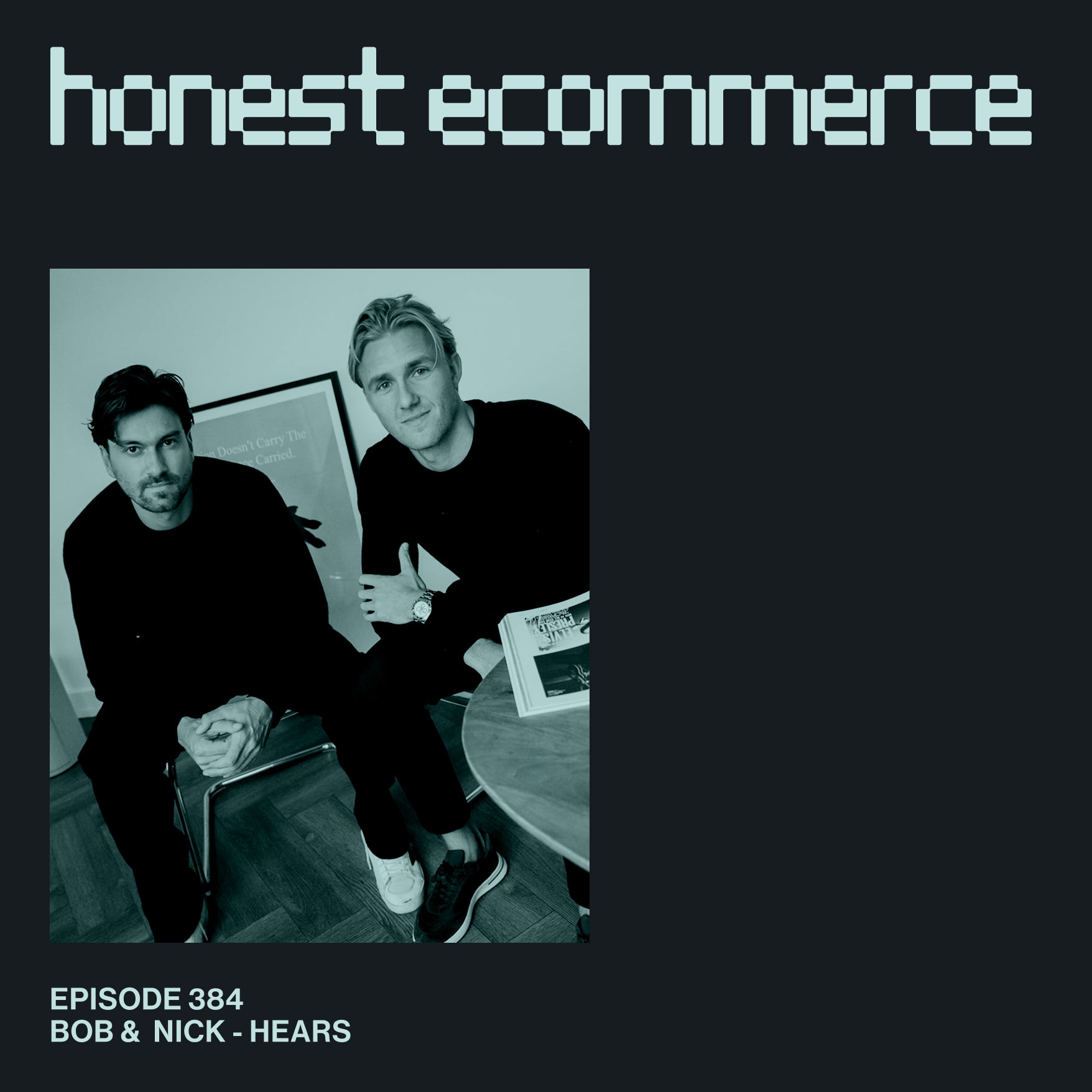
Hey everybody, welcome back to another episode of Honest Ecommerce. Today, I'm welcoming to show not one but two founders of Hears, Bob and Nick. Welcome to the show.
Bob Verlaat
Thank you so much, pleasure to be here.
Nick Nijhof
Thanks, Chase.
Chase Clymer
For those that haven't heard about you. Oh, man, I'm going to do puns all day. For those that haven't heard about you, what are you doing? What's like the top selling product that you guys are bringing to market over there?
Bob Verlaat
Shall I top it off, Nick?
Nick Nijhof
Let's do it.
Bob Verlaat
We launched here about two years ago with the intention of bringing an earplug to market that doesn't diminish the sound quality and still makes you hear clear music and clear voices in loud environments while still protecting your ears, in very, very short explanation.
Chase Clymer
Absolutely. Now, take me back in time. Where did the ideation, how did this come about? What were you guys thinking about?
Bob Verlaat
We, of course, already came from an Ecommerce background. We founded another company called Dore & Rose, which we've been running for about 4 years. So we understood what were the requirements of a good Ecommerce product.
The next product that we wanted to bring to market was already going to be lightweight, not too many sizes, easy to ship worldwide, problem solving, because it would tap the requirements for what we consider a good Ecommerce product. And that went, of course, hand in hand with the desire or the needs that we saw in the earplugs industry, because we saw people wearing earplugs around us.
We went to music events ourselves. We went to concerts, festivals. We went clubbing, we weren't protecting our ears. And the earplugs that we did try, they weren't convincing enough for us to keep wearing them. Many of them were muffling the sound. Some of them looked really ugly. So we had a set of needs in designing an earplug or bringing an earplug to market.
Yeah, we saw the opportunity there and we spent a lot of time researching and eventually developing the earplugs that we wanted ourselves.
We really thought if we could convince ourselves of wearing earplugs, then we could convince a whole generation of people. And yeah, that's what we're trying to do to this day.
Chase Clymer
That's amazing. Now, obviously, with your previous business, the experience makes launching business number two a lot easier. Where did your story start with just Ecommerce in general? How did you get into this industry? How did you cut your teeth? How did you learn the ropes?
Nick Nijhof
Yeah, I think it's also a fun story to just tell that Bob and I have been best friends already since we were 12 years old. We have been living together for 4 years together in Amsterdam as students. And had the both of us on a completely different career path.
I was already in the B2C space, Ecommerce for quite a long time since I was 20, 21. I'm now 29. So you can imagine along the way you have seen, you know, the growth of Eommerce in general, and the changes that have been going on, especially when it comes to Ecommerce. And Bob had a completely different career path. But in marketing, he was the head of marketing for Super73 Electric Bike Company. He brought it from LA to Europe.
And yeah, you know, like we always saw the expertise of each other, the drive, the ambition, the energy that we have put in in our own work. And then obviously always had conversations late evenings, late nights at the kitchen table. And then we always said, if the opportunity gets there, there will be a point that we start something together.
And then obviously, Dore & Rose came across our path, like two young kids without any knowledge just went for it. Had a lot of learnings along the way. And then after three years, that took off basically. And that was also the time that Hears came across. So we could implement basically all the mistakes and all the learnings that we faced in the first three years of doing Ecommerce for our other brand. And then also talking about working with the right partners, working with the right software, working with the right people around us.
We make a lot of mistakes in terms of advertising and how to sell a product actually in the market worldwide. And bringing basically all those learnings when it comes to product market fit advertising. Yeah, from the start. And obviously, here's a completely different approach because we have been used to selling products basically based on white labeling, right? We saw a huge trend coming up.
In the beauty industry, we were like, okay, let's attack this differently. We launched silk pillowcases, but obviously from the shelf and we made our own twist to make it more elegant, to have some additional USPs compared to the rest of the market. Well, here's a product that's developed and produced from scratch, from zero. It's a design that you have never seen before. What Bob said, it's based on our needs, on our personal requirements.
And yeah, that's how we basically went to the drawing board with obviously, people that have knowledge about product designing and all that stuff because, yeah, we were absolutely not experienced with that. So we surrounded ourselves by experts in the field to help us out and to make this happen.
Chase Clymer
Most brands outgrow their legacy choices long before they switch.
Bad platform decisions do not fail all at once.
They fail slowly. Then suddenly.
First, it is one workaround.
Then another tool.
Then another integration is duct-taped on top.
And eventually, your team is spending more time managing the stack than actually marketing to customers.
Eventually, rebuilding is less painful than staying - usually when it starts to show up on the P&L.
This is when scaling brands simplify and standardize on Klaviyo.
Klaviyo is the AI-first B2C CRM. It combines your customer data, email, SMS, analytics, and customer experience tools into one platform, so you are not stitching together five different systems just to understand what your customers are doing.
Your database updates in real time.Your segments update automatically.Your flows, campaigns, and personalization all run off the same source of truth.
And that shift is why so many brands are moving to Klaviyo.
Brands like Dollar Shave Club have reduced total CRM stack costs by over 30 percent after consolidating onto Klaviyo. Multi-brand operators like Marc Fisher have migrated multiple brands and dramatically reduced the time required to execute CRM marketing. And brands using email and SMS together inside Klaviyo are seeing massive ROI compared to running channels in separate platforms.
The big unlock is simplicity and scale at the same time.
Klaviyo is built for marketers, not engineers.It is built for online businesses.And it is built for where ecommerce is going, not where it was five years ago.
If you are running email and SMS across multiple tools, or you are on a legacy platform and thinking about your next phase of growth, it is probably time to look at Klaviyo.
Go to klaviyo dot com slash honest to see why hundreds of thousands of brands have already switched.
And if you want our help migrating your list, moving your data, and configuring your Klaviyo account correctly from day one, we are happy to help.
Chase Clymer
Now, it's such a unique opportunity here to talk about both of the businesses. Going from zero to one, finding product market fit phase. Now, I don't want to really dive super far into Dore & Rose but let's talk about, let's try to speed run the first 3 years.
How did you get started? There are people out there listening right now. They have a good idea for the product potentially. And they're really at that beginning phase. So what were some of the first steps? How did you actually start to sell these white labeled products to strangers on the internet? Just walk me through the 1, 2, 3 that actually got you to sales.
Nick Nijhof
I think especially when it comes to Ecommerce, it all starts with what problem do you want to solve? Because that's eventually how you can attract customers because people are day in, day out, trying to find solutions for problems in their lives.
And that's also how you're able to sell people from behind the screens, you know? And like Bob explained, for us, it all started with a problem that we couldn't find the right hearing protection for ourselves. And we knew about the importance of hearing protection. So I will always suggest it start with finding a problem and what product solves this problem.
Chase Clymer
Absolutely.
Bob Verlaat
You were also asking about Dore & Rose here, right?
Chase Clymer
Yeah, I'm just trying to compare and contrast the figuring it out for business one to what was the learnings that accelerated the growth with business two, because obviously the growth is just massively different.
Nick Nijhof
Yeah. Also to answer your question on what started our first brand and what we focused on is, you can guess it, paid media. We went all in on meta-ads and the first few steps of really understanding how to sell a product and bring the product first time to market was indeed the right problem solving products.
So not just a random product, a problem solving product in combination with paid media and the right paid media strategies, high intensity creative testing. And I have a great website, have a great engine to actually sell it from. To have a very short answer to what were the first steps on bringing Dore & Rose to market because obviously, there's millions of learnings that we eventually implemented in our next brand.
Chase Clymer
Absolutely. Now, was that the concept of making sure your product solves a problem? Was that learned from experience or was that something that you had learned from your previous work?
Bob Verlaat
If I can speak for Nick, he already had some experience in direct response marketing. I was more on the brand side of things. So it was completely new to me to directly go for, like we're talking about four years ago, to directly go for the direct buy and not really building a brand. Just like, here's the problem you have, here is the solution we have, and please buy.
That was completely new to me. So for Nick, it has been an experience for him. For me, it was fairly new. And I think what we thrived was the combination of understanding of branding and direct response marketing. And we apply that to this day.
Chase Clymer
Now I always like to set expectations around just like what it takes to break a brand online with paid media. You don't have to get down to the dollars and cents. But you remember what budgets were like at the beginning as you were testing creatives.
And also, let's tie it to a year when we're talking about Dore & Rose. How you actually got that creative engine off the ground because I think people guess lower than what it actually takes.
Nick Nijhof
Yeah, absolutely. I mean, you can start and try out already. Not even from paid, but also organic, especially these days, you know, like, try to find some content creators that want to try out your product for free.
Let them post on TikTok or Instagram. That's how you can find traction for your product already. But I would say back then, I mean, we didn't have the budget to spend like a couple of hundred bucks a day to test out some creatives.
So we went very carefully and basically every week we took a different approach by a different angle or a different persona. And then at one point, some persona stuck and we knew, okay, we can go double down on this. It's definitely, and the time has been changing, right? So what I said right now, you can start even more affordable by testing organically and what's working organically, like 95% of the time works on pay too.
But like 50, $40 a day, give it some time, let it run. Would give you already enough answers on if the ads or the angle potentially can work from the paid media side. And your question was as well, like how did they change to the current situation? Like how much testing budget or how much do we spend on a monthly basis? Yeah, that goes into the seven figures a month right now, what we spend on paid media.
Chase Clymer
Hey Store Owners -
Do you know how profitable your last BIG decision was on your Shopify store?
Most testing tools make it easy to measure design changes - small tweaks. Headlines. Layouts. Button colors.
But what about the decisions that really move the business?
Pricing changes. Shipping rates. Discount strategy. Even new apps and tools.
Those are usually left to gut feel.
Intelligems brings CRO-level clarity to decisions that live beyond the page.
Brands like Ridge, Jones Road, and True Classics are using Intelligems to test pricing, offers, shipping, and more, and see exactly how each choice impacts profit.
Momofuku used Intelligems to test multiple promotional offers ahead of Black Friday and identify the version that ultimately increased profit by about 28 percent.
Mott & Bow used Intelligems to run structured pricing and offer tests that helped drive roughly a 30 percent increase in incremental profit.
Dossier used Intelligems to run sitewide testing that resulted in about a 7.4 percent increase in profit per visitor across their store.They have a bunch more case studies on their website.
I’m a big fan of Intelligems. We use it with almost every client at our agency, Electric Eye.
We use Intelligems to test major site changes, new theme launches, and throughout ongoing CRO work
So when we are making decisions around design, pricing, offers, ETC, we can be confident that those changes are actually driving more profit for our clients.
So, before you start changing pricing, promos, or major site experiences across your store all willy-nilly, you should test it first.
If you're ready to decide confidently and grow profitably, head on over to intelligems.io and use code "honest" for 10% of your first 3 months. That's intelligems.io Use code “honest.”
Chase Clymer
But you're obviously, you scaled there. You just didn't start there. Bob, you said something earlier when you were talking about tiers and about the product that I wanted to just touch back on. It was a lightweight product. Can you talk about why that was important to you for the second business?
Bob Verlaat
Absolutely. So we have a strategy on where we directly scale our brands worldwide. We want to be able to be sold in basically almost every country in the world. So we set up our ecosystem like our Shopify markets or 3PL. In that way we choose for 3PLs that with which we can m ship internationally very fast and affordable.
So a lightweight product comes with that. If we were selling products that were too heavy, it would have been expensive to fulfill that from one or only very few fulfillment centers. So lightweight was one of the criteria for us to also launch a product and directly scale it worldwide.
Nick Nijhof
It's all about the unit economics as well that comes with a scalable Ecommerce business, I would say. There needs to be enough acquisition costs for your paid media to scale up a business within a short timeframe. Because we have seen many different businesses where either you have a very high cost of goods, but the perceived value is not high enough to get that 75% gross profit margin.
For example, let's say in general, lower cost of goods products can in comparison with higher products have a better perceived value, especially how you position the brand the product in a certain way, which allows you to have a lot more margin to spend indeed on advertising. So it all comes down to unit economics. If it makes sense for your acquisition costs, basically.
Chase Clymer
And just knowing that shipping has a certain perception these days, how Amazon has changed the game there. And free shipping, free returns, all that stuff, it just eats into your margins. And if you had a bulky product or a heavy product, you're getting hit twice with a pretty expensive fee that goes right to the margin in the bottom line.
So it's something to consider, but maybe not if you've got a fantastic product that's solving a really hard problem for people, maybe ignore what we're saying if you believe that you can really do it.
Nick Nijhof
Yeah. And also the problem here is as well that customers do not always understand what businesses or companies pay to get a product from the fulfillment center to your front door. They all think it's for free these days. Well, actually for business, there's so much money inside the whole process to get a product to a customer.
Bob Verlaat
Yeah, and it doesn't mean that you cannot succeed with a heavy product. just a very nice perk to have to have a lightweight product so you can ship it quickly. Ship it everywhere and for reasonable margins.
Chase Clymer
“I have been in business for nearly 20 years, and very few companies I have hired in that time have performed as well as Electric Eye. They have knowledgeable staff, and our project was delivered on time and on budget. Electric Eye has exceeded my expectations, and I look forward to working with them again.”
That is a direct quote from one of our clients at Electric Eye.
Electric Eye is a Shopify Plus partner that has helped over 100 brands migrate, redesign, and optimize their stores since 2016.
If you'd like to increase your conversion rate, average order value, and revenue per session, we are the true Shopify experts you've been looking for.
Right now, we're offering a free diagnostic to qualified brands that reach out and mention the podcast. Visit electriceye.io today to schedule a call and send us a message. Find out why we have over 50 5-star reviews in the Shopify Partner Directory. Again, that's electriceye.io. E-L-E-C-T-R-I-C-E-Y-E.io
Chase Clymer
Now, back in 2024, under Bob's leadership, you guys won a pretty cool award. You want to talk about that a little bit?
Bob Verlaat
That's just not just an MA leadership. Yeah, we were both part of the design process, of course. The red dot design award, I think you're referring to, right?
Chase Clymer
Yes.
Bob Verlaat
Yeah. So yeah, that was a pretty nice thing to receive. Of course, we spent a lot of time on the actual design of the product. It was before we started here, it was one of the criteria, of course, to make it aesthetic. Took a lot of revisions and a lot of good designers. We didn't design it ourselves, of course. There's people who helped us with that. We're not expert designers, but we did. Yeah, we had something in mind that was eventually achieved.
And there's a lot of work being put into the ergonomics of the actual earplug and also how it will sound acoustically from the inside. Yeah, a lot of work went into that in such a small product that people are receiving together with, of course, the filter, which is now also a patented technology. What makes our products eventually so special? So yeah, the whole design is a pretty impressive piece. For that, we received a great award, which was yeah, very well received.
Chase Clymer
It's funny that you said now that technology is patented that makes it special. When people are on Shark Tank and they mentioned they have a patent, that's when you watch the sharks actually start paying attention.
Bob Verlaat
Maybe we should get on Shark Tank.
Chase Clymer
I don't know if you guys need any funding.
Bob Verlaat
We might. There's always room to talk.
Chase Clymer
Absolutely. Let's talk about what makes a patented product so special compared to something else?
Bob Verlaat
Well, first and foremost, there's no one who can copy it. And we have something truly special within the product. There's no other universal earplug that reaches the clarity of sound as with our earplug. So yeah, good reason to have the technology also patented so no one can actually copy it.
So yeah, that's what it means. Of course, there's a lot of other things ah when it comes to copying brands. I don't think you can just copy gears other than the colors and the fonts and sometimes we have a lot of other trademarks around our brand.
But yeah, it's also when it comes to brand, it's also a feeling that you get with the brand that I don't think can be copied. But having the product not being able to be copied, at least the quality of it, that's a nice asset to have.
Chase Clymer
Hey everybody, just a quick reminder. Please like this video and subscribe if you haven't. We're releasing interviews like this every week, so don't miss out. Now back to the interview.
Chase Clymer
So, Hears has been doing a lot of interesting collaborations. Do you guys want to share more about that?
Bob Verlaat
Correct, yes. We've had some quite. One of the criteria for the design before we started was to make an earplug that has the potential to also be branded by other brands. So we wanted to make it recognizable by its design and not necessarily by its logo. And that got us to also, yes, kind of a manifestation to design it in a way so you can also partner.
But it eventually got us to partner with some great festivals and also with one of the biggest nightclubs in the world, Pacha Ibiza. And we recently also partnered with the French designer brand Yves Saint Laurent, which is not the smallest collaboration.
And yeah, there are some great names of artists and great brands in the pipeline that we will partner with. And in this way, we're trying to reach an audience that is initially not necessarily connected to hearing protection, but in this way we introduce them through a brand they're already liking. So yeah, that's a big part of our strategy as well when it comes to building the brand.
Nick Nijhof
And collaborating with YSL proves that you should never give up. I think Bob sent 40 emails before he got the first reply. And I think that's to mention as well.
And also once you have the time to or the opportunity to present your product to another brand, make sure you deliver it on a silver platter. So there's also no room for discussion or they can only say yes. And that's the way you should approach collaborating with other brands, making it as frictionless as possible for them.
The capabilities to create already some 3D designs to show them how the product would look in real life. And that definitely helped us to close deals like Apache or YSL.
Chase Clymer
Yeah, just browsing the website, it is clear that you guys know what you're doing. It is a master class in optimization techniques, obviously featuring the insane amount of reviews that you have. But not only that, you're featuring the partnerships that you have.
The collaborations that you do are just social proof on steroids that these large brands believe so much in your product that they will do it. And that obviously helps customers believe in the product. You've got the reviews, you've got your partners, you've got testimonials, you've got the features and various publications. It's always fun to see a website like this that really knows what they're doing.
Nick Nijhof
Thank you. Appreciate it.
Bob Verlaat
Appreciate that.
Chase Clymer
Oh yeah. It's fun coming from the Ecommerce world and like when you get on a website and you go, oh yeah, these guys know.
Bob Verlaat
We try to like this is of course like a constant building block on creating more credibility, creating more urgency, creating a better offer, creating better design. And it's a constant optimization game, of course, for those starting.
This is not how we started as well. Of course, it's a two-year-old brand, but it's not how the website looked on our first day. And it's also the result of building the other brand, Dore & Rose, for over four years and how we know what is converting and know how to design it in a way that is both a static building brand and converting.
Chase Clymer
Absolutely. Now for those that are listening to the show and they want to go check out the product themselves as an ex-musician, I think I've played over 1,000 concerts in my life. I've been to almost as many outside of that. I 100% understand why the product exists and why it is a good idea to own the product. But anyways, go check out this awesome looking website that we're talking about and the amazing looking product itself. And they got the best URL for it. Hears.com. Nick and Bob, any parting words?
Bob Verlaat
Thank you so much for sharing that. I think we should maybe drop a little discount code somewhere so you can share it with your audience as well. Yeah, thank you so much for having us on your show.
Nick Nijhof
Yeah, thanks, Chase. I appreciate the last few words. And for everyone listening, good luck with building the brand. And it's a fun and exciting journey. And see it not as something very tough, but enjoy the journey. And if you don't see the finish line, but you know your next step, take it and put it into the right direction. So yeah, thanks, Chase. Appreciate it.
Chase Clymer
Absolutely. Thank you, guys.