Catherine Hayden
Amazon is definitely the fastest in terms of revenue growth. And that is one of the most exciting things to see is that you can continue to grow your DTC business while expanding into these other channels because they're just they're a different need. They're a different moment at that point of purchase.
Chase Clymer
I'm a strong believer of just letting the consumer purchase where they want to purchase. Don't try to push them in a particular way.
Honest Ecommerce is a weekly podcast where we interview direct-to-consumer brand founders and leaders to find out what it takes to start, grow and scale an online business today. Hey everybody, welcome back to another episode of Honest Ecommerce.
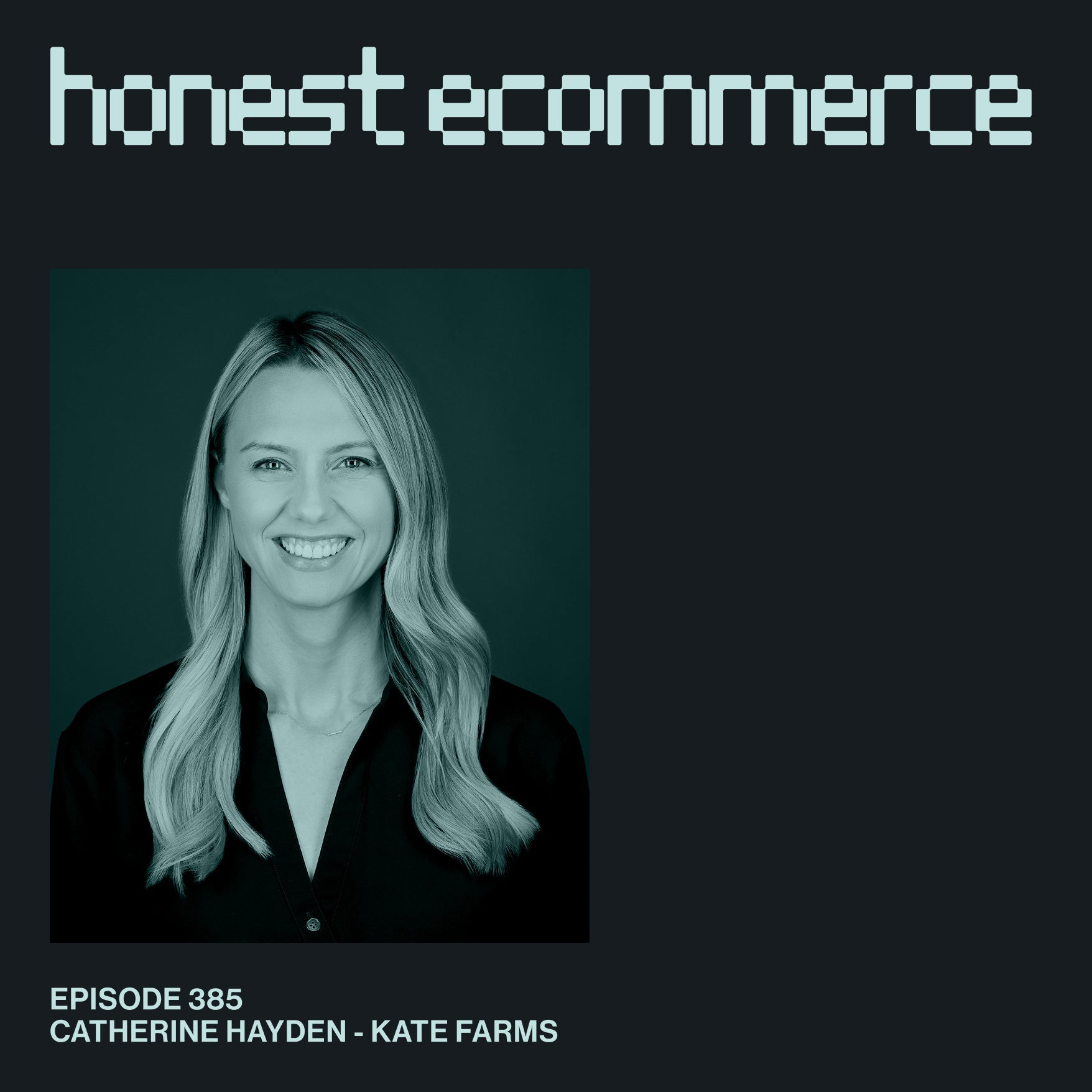
Today, I'm welcoming the show, Catherine Hayden. She is the Chief Marketing Officer at Kate Farms, the number one doctor recommended plant-based nutrition brand. She is scaling a nutrition company rooted in healthcare into a high-growth Ecommerce and omni-channel business with a strong direct consumer and subscription engine. Catherine, welcome to the show.
Catherine Hayden
Thank you for having me.
Chase Clymer
I threw a whole bunch of buzzwords in there. But what are you guys actually selling over there? What products are people buying online or anywhere? Omnichannel business?
Catherine Hayden
Yes, Kate Farms. Kate Farms is one of those companies that I wish more people knew about. And we'll get to that as we chat a little bit. But we're really a foundational nutrition company. And so we have plant-based formulas and shakes. Think from ages 1 to end of life for a wide range of health needs. And as you said, we're available in all the places and channels that you shared. And we've been around since 2016.
Chase Clymer
That's amazing. I guess what else has been around since 2016? Our agency, Electric Eye. So we're twinsies in that regard.
Catherine Hayden
Love that. Love that.
Chase Clymer
So take me back to 2016. I know you weren't there right at the start, but you watched from afar. So talk about what Kate Farms was doing? How did they get things started?
Catherine Hayden
I'm actually going to take you back further than 2016. And I don't know the exact year, but I'm going to take you back to the origin story, which starts with Kate, who's real. And Kate is turning 21 this year. And so you can probably do the math faster than I can. But at 5 years old, Kate was originally diagnosed with cerebral palsy.
And she couldn't eat any food through her mouth. And so she was fed through a feeding tube. And at five, she weighed 15 pounds. And so her parents, Richard and Michelle, out of desperation, really took matters into their own hands because she wasn't tolerating any of the products that were on the market. And so they partnered with clinicians and a vegan chef and this philosophy of, “Gosh, why can't Katie have what you could get at a farmer's market?”
Why can't she have the benefits of plants, fibers, phytonutrients, and all of that goodness, which just wasn't available at the time in the products. And so that really worked for her. And she did amazing. She's still living on Kate Farms today. And so that origin story is a powerful one because when I think back to Kate, since then we have nourished over 600,000 people.
And so you think of the many Kates and folks that need additional nutrition support. It's amazing to see what's happened. And so that was the origin from the roots.
Chase Clymer
Oh yeah, that is amazing. From doing this podcast for so long, it is such a commonplace to see where great business ideas come from personal problems, where the solutions out there do not solve the need that you need to solve. And you know, the entrepreneur mind maybe goes, well, this worked for me. Maybe there's a business here.
Catherine Hayden
Yeah. So let's talk about the business. So in 2016, the idea to commercialize the product came available. And at the time, the first product was complete, the ultimate meal replacement shake. And so same product philosophy, think plant-based, no common allergens, phytonutrient blend, all the goodness I talked about.
And it originally launched in the natural channel. So Brett Matthews had joined at that time as well, who's still currently leading our fearless leader and really started to operationalize the company. And I would say we were in retail for about until Q4 of 2017 when we had started up our Katefarms.com business. We were just starting to get into Amazon.
And a really interesting thing happened. We started to look at some of the purchases and customer purchases on Katefarms.com and realized that there were customers that were buying many, when I say many, many cases a month, like 8 to 10 cases a month. And so you pick up the phone, you email, you call these individuals, and it turned out they were families like Richard and Michelle that couldn't get it covered by insurance. And so they were using cash.
They were paying out of pocket for this. And so that was the moment where the realization from Brett and team, there is a much bigger need in this health needs community that needs to be served, completely shut down the retail business, which was the 95% of the revenue source at the time. And then built and started to build out the medical channel. And that's actually when I joined in February of 2018.
Chase Clymer
Do you know what's going on with Klaviyo? When was the last time you explored what it can do?
Klaviyo has been shipping tons of new AI, data, and automation features designed to help ecommerce teams move faster, personalize better, and automate more of the work that used to take entire teams.
Most brands are only using a fraction of what is already inside their Klaviyo account.
Klaviyo is not just email and SMS anymore.
It is your customer data platform, your lifecycle marketing engine, your analytics layer, and now your AI-assisted execution layer, all in one place.
That means your customer data updates in real time.Your segments stay current automatically.Your flows and campaigns all run off the same source of truth.And now AI can help predict churn risk, forecast spend, recommend next best products, generate campaign content, and optimize send timing across channels.
The big unlock is speed and efficiency.
Fewer tools to manage.Less dependency on engineering.Less time moving data between systems.And lower total cost of ownership across your marketing stack.
And brands are seeing real results from leaning further into Klaviyo.
Dollar Shave Club has reported over 30 percent reduction in total CRM stack cost after consolidating onto Klaviyo. Brands like ThirdLove have seen 15x ROI from SMS after consolidating channels. And companies like Corkcicle have grown flow revenue over 90 percent after bringing email and SMS together inside Klaviyo.
Across our customer base, every single brand we work with today is using Klaviyo. That is just where serious ecommerce customer data and lifecycle infrastructure lives now.
If you are already on Klaviyo but feel like you are not getting everything you could out of it, or you are running multiple tools and want to simplify without losing power, this is worth your time.
Go to klaviyo dot com slash honest to learn more.
Chase Clymer
And it is such an interesting business model because I don't think there are many things about America that people say it's great. One thing everyone agrees on is our healthcare system sucks. Insurance is awful. And you guys bet Kate Farms on that.
Catherine Hayden
We did.
Chase Clymer
You have a product, it sells. You know there's a product market fit here. And so the bet that you're making at this point is, we're going to figure out how to get this approved by insurances and get this. And help these people out. Is that the bet?
Catherine Hayden
That is the bet. And I'll share some early stories from Brett. And maybe the lesson is partnership and understanding your channel partners and how they can help you. And so Brett and the team and all of us started to just ask questions.
And so from Brett's perspective, he wanted to know how do you get covered by insurance? And so he learned about something called a HCPCS code, which for different types of nutritional products, you can get insurance coverage if your product meets those criteria. And so building out a product development team, a quality team, essentially writing white papers to submit for approval through PDAC, and then getting HCPCS code.
Okay, so now you have the HCPCS code. What do you do? So you also need to make sure that your product can get distributed in the medical channel. And so very different from Ecommerce or retail distribution. These are medical distributors that ship to patients' homes. They ship to hospitals. They ship to the medical channel. So think of McKesson, Medline, Cardinal Health at Home.Those would be some of those distributors.
Well, then you go and you talk to those distributors and you learn, gosh, there's another channel partner that we also need to have contracts and work with. And those would be your home medical supply companies. So they are the ones on a monthly basis. Think of a patient, a person who is receiving their prescription products, subscription monthly through their prescription.
So you might be getting oxygen, feeding tubes, pumps and your nutrition as well. And so it started with the insurance code. It then worked through, get the right distribution in the medical channel, make sure that you have a partner who can ship to a patient's home, authorize for insurance, and also start to work your way on hospital formularies, which is a lot of work.
Chase Clymer
It is a lot of work. How long did this game take? Think you figure one thing out, but then you learn, I need to learn these other two.
Catherine Hayden
It's a good question. I would say, and like thinking back to all of our early days fundraising, we disproportionately put resources into building an incredible product and building the co-manufacturing network and all of the resources needed to make sure that the product worked and the quality was always there.
The second piece or place that we invested was really building out the medical sales team. And so you think of your traditional pharmaceutical sales team that's calling on targeted clinicians. We were focused on pediatric GIs and hospitals and oncology clinics and really sharing information about the product at the time.
What was interesting as we built this out, probably it was also very interesting to be building this out during the pandemic when you couldn't be calling in person in offices, that's probably another conversation for another day. But we also realized that not everyone is covered by insurance. Back to your comment on US healthcare. Many individuals do not have nutrition covered under insurance. And so they have to go out of pocket. So at the same time, we had to build an ecosystem, katefarms.com, Amazon, where people could find the product if they were getting a recommendation.
And so that was an interesting juxtaposition to build almost like this medical grade, high trust, healthcare marketing, go to market discipline and balancing that with building a direct to consumer and a modern Ecommerce business.
Chase Clymer
Hey Store Owners -
Do you know how profitable your last BIG decision was on your Shopify store?
Most testing tools make it easy to measure design changes - small tweaks. Headlines. Layouts. Button colors.
But what about the decisions that really move the business?
Pricing changes. Shipping rates. Discount strategy. Even new apps and tools.
Those are usually left to gut feel.
Intelligems brings CRO-level clarity to decisions that live beyond the page.
Brands like Ridge, Jones Road, and True Classics are using Intelligems to test pricing, offers, shipping, and more, and see exactly how each choice impacts profit.
Momofuku used Intelligems to test multiple promotional offers ahead of Black Friday and identify the version that ultimately increased profit by about 28 percent.
Mott & Bow used Intelligems to run structured pricing and offer tests that helped drive roughly a 30 percent increase in incremental profit.
Dossier used Intelligems to run sitewide testing that resulted in about a 7.4 percent increase in profit per visitor across their store.They have a bunch more case studies on their website.
I’m a big fan of Intelligems. We use it with almost every client at our agency, Electric Eye.
We use Intelligems to test major site changes, new theme launches, and throughout ongoing CRO work
So when we are making decisions around design, pricing, offers, ETC, we can be confident that those changes are actually driving more profit for our clients.
So, before you start changing pricing, promos, or major site experiences across your store all willy-nilly, you should test it first.
If you're ready to decide confidently and grow profitably, head on over to intelligems.io and use code "honest" for 10% of your first 3 months. That's intelligems.io Use code “honest.”
Chase Clymer
Yeah, it's almost like we were already here. Why are we back?
Catherine Hayden
Yes.
Chase Clymer
Yeah, exactly. Me, I would have been like, “Why don't we just leave it in the first place?” But okay, so you make all these strides and you really start to make a dent in the medical field, but then you learn that people need this product outside of that. Does it start to break into specific internal channels within the company of people who need to own these certain avenues and the communication with certain types of customers?
Catherine Hayden
Yeah, it's so fascinating. This is something that we still talk about today. There is a lot of emphasis and support on making sure that our medical sales team is as effective as possible. And we're reaching through what we call non-personal promotions, so digital channels, healthcare professionals, doctors, dietitians, those that are recommending and prescribing. At the same time, we have to build awareness with consumers. And I'll share maybe a data point from our early days in 2018.
Very early on when I came, we conducted an annual, like our first brand equity tracker to understand what are the drivers for a clinician to make a recommendation for liquid nutrition products. We also understood on the consumer side what the drivers are. What we learned in probably 2018, 2019 is that the number one reason a clinician was recommending Kate Farms was a patient was asking about it.
And so we had started to build up early days of social community building. were showing up in these Facebook groups where people were talking about, “Gosh, I wish I had a better option. I wish I was free of common allergens. I wish I had a product that I could tolerate.” We also learned that 70% of the category was suffering from intolerance. And so it was almost like this acceptable status quo. And so maybe fast forward on the consumer side, we learned that consumers were making decisions 70% of the time because they were getting a recommendation from clinicians.
And so to your question, there's this healthy ecosystem and balance on how we're communicating, marketing, creating awareness with healthcare professionals. And at the same time, we had to do that with consumers as well. Maybe the piece or the lesson from that is making sure that you're talking about connected audiences. So at early stages, this was not a broad awareness play. We weren't shouting from the rooftops of what Kate Farms was.
We were very specific, and started very early on about tube feeding. Then we got specific about certain conditions, whether it was allergy, GI, oncology. And then you can start to see audiences on both the consumer side and HCP side that have overlap, where you start to find efficiencies in your plans and efficiencies in the work that the marketing team and sales teams are doing.
Chase Clymer
Well, that just reminds me where a really basic analogy is when brands start to spend a lot more on meta ads, right? They double their spend, right? They're really betting on something. You see this halo effect out there to where there's an increase of in-store purchases in the areas that they're targeting. Their Amazon orders go up. So it just goes to show it's like, well, you're making all these strong efforts to reach the consumers.
But through that, the halo effect is these consumers are asking their doctors and now their doctors are getting into your sales probe, opting into your sales leads to the other side of the business.
Catherine Hayden
Yeah, it's this virtuous cycle. I just actually had our lifecycle marketing lead, Ben, pull this point for me this morning. Like, “Ben, what's the number one reason why in our post-purchase survey, why Kate Farms customers are buying on Kate Farms. Like, where did they hear about it?” And 51% are hearing about it from a healthcare professional.
We have this incredibly strong Ecommerce model, but it's being driven by this medical demand, which is quite unique. And there's not a lot of industries where that happens. I think one where I have seen it is infant formula. That's an interesting one where recommendation is coming from a healthcare professional in those early days. But not many others I found like this.
Chase Clymer
So you guys. First bet, first focus was going all in on the medical side of things. And then as things grew and you learned, you're like, all right, direct consumer is now something we're going to focus on. And I'm assuming it's because you had more revenue and more capacity as far as people on the team and people to tackle these problems.
Let's fast forward now. I'd say direct consumers are split out across a few channels. Amazon is not the same thing as your Shopify store, for example. So how did the direct consumer stuff evolve once it became like, this is a priority, this is back in the picture?
Catherine Hayden
Great question. I would say KateFarms.com we often refer to as our home. And so that is the role of education. That is the role of where you get the true Kate Farms experience. Something early on that we invested in that also is within my marketing organization is our customer care team. So we have 20 individuals, 20 plus individuals that are having live connections with people to talk about insurance access issues, to talk about the right product for them to talk about how to navigate our site because we do have a lot of individuals that span a wide range, one to 101.
And so when I think of katefarms.com and the role of that, it really is giving the heart and science, like the heart and science experience. And so we think about that piece of it. When I think about Amazon, we've made some pretty significant changes in the past couple of years. So in 2014, we changed from 3P to 1P, which has really allowed us to reach far more audiences. Very beneficial as we think about bringing new-to-brand customers in. So Amazon right now is bringing in 78% of new-to-brand. And as we think about our retail expansion, so last year, Walmart, we now have additional doors that are coming.
We're going to be launching at another retailer in the next couple of months here. That's going to be another channel that's bringing in awareness and new to the brand. But we're also seeing a migration or a transition back to Kate Farms where they might have first purchases in these other channels. But some are actually ending back up on Kate Farms. The other piece I'll share is we were expecting Kate Farms to slow. We're seeing continued growth.
Amazon is definitely the fastest in terms of revenue growth. And that is one of the most exciting things to see is that you can continue to grow your DTC business while expanding into these other channels because they're just a different need. They're a different moment at that point of purchase.
Chase Clymer
“I have been in business for nearly 20 years, and very few companies I have hired in that time have performed as well as Electric Eye. They have knowledgeable staff, and our project was delivered on time and on budget. Electric Eye has exceeded my expectations, and I look forward to working with them again.”
That is a direct quote from one of our clients at Electric Eye.
Electric Eye is a Shopify Plus partner that has helped over 100 brands migrate, redesign, and optimize their stores since 2016.
If you'd like to increase your conversion rate, average order value, and revenue per session, we are the true Shopify experts you've been looking for.
Right now, we're offering a free diagnostic to qualified brands that reach out and mention the podcast. Visit electriceye.io today to schedule a call and send us a message. Find out why we have over 50 5-star reviews in the Shopify Partner Directory. Again, that's electriceye.io. E-L-E-C-T-R-I-C-E-Y-E.io
Chase Clymer
I'm a strong believer of just like, let the consumer purchase where they want to purchase. Don't try to push them in a particular way. And so that's a bit of our North Star when we're talking through this stuff with clients. I also think that I see that some brands... Gamify isn't the correct term, but they have different offers for different places. Right?
Catherine Hayden
Yeah.
Chase Clymer
And so retail maybe is a little bit more bulk. Or if you want the newest thing, it's only going to be on the dot com. Or if you want the best deal, it's only going to be on the dot com versus Amazon. If you want your prime stuff, Amazon is not going to be as cheap. So there are ways that people go about it. Do you have any sort of opinion or any sort of tips of the trade that you guys are taking?
Catherine Hayden
Yeah. I mean, we're still learning that. I feel like with any fast growing company, you're going to make mistakes early, and would say pricing is something I do think we need to spend more time on. And so launching at retail at a certain price, we learned that lesson the hard way that Amazon is always going to find Walmart's pricing. And how we think through pack architecture, how we think through different products that we are offering. We've also really dialed down our promotions on Amazon.
And so the other piece on that pricing point as if everyone is sort of moving to the lowest price in the market, then promotions are going to be few and far between. I would share a couple of important or interesting stats about our DTC and Amazon business that also speaks to the unique audience and loyalty that we have 83% of our revenue on Katefarms.com is from repeat customers.
And many of those are on a subscription. And so they're on it for 8 months, which is a very long time to be on a nutrition product, if you think of the average. And so one of the things that we thought about was, gosh, first and foremost, the product has to work. Otherwise, people aren't going to use it and not subscribe.
But there are other valuable moments that you can provide. throughout the journey. 10% discount, flexible frequencies in, I'm traveling, I need to postpone my orders, easy order management. That's been one of our biggest learnings that we've had over time as well. And just ongoing communications of the overall value and what the product is delivering, even down to community stories and testimonials.
I would share that all of those things are also really important in terms of retention tactics. On the Amazon side, what's interesting is that we just actually met with our vendor manager, we had a business review, and came to our headquarters in Santa Barbara. And we have one of the highest, we'll call it subscription LTVs in the category.
So when he looked at our subscription LTV versus our one-time purchase, we are actually 12 times. And so he's like, there is something really special that's happening here once a consumer subscribes. And so how do they get them to try it? And because once they do, they stick with it.
Chase Clymer
That's amazing. That's obvious, I always say this on the show. And honestly, I feel like people just stop listening to me at a certain point because I just repeat the same things. But it's true. Especially this one. The number one secret to having a great business is just how good a product is. It's such a cheat sheet. Good marketing can sell junk.
Catherine Hayden
Yeah.
Chase Clymer
But I think bad marketing can sell a good product. It's just such an insanely easier hill to climb.
Chase Clymer
Hey everybody, just a quick reminder. Please like this video and subscribe if you haven't. We're releasing interviews like this every week, so don't miss out. Now back to the interview.
Catherine Hayden
Agreed, agreed. I listened to a couple other of your podcasts from April. Very similar. Very similar stories like products that were created out of a need. Great quality and work. And then it's a dream to market that. So all this other stuff is extra.
Chase Clymer
Well, yeah. Well, since you listened to a couple episodes, is there anything that I didn't ask you about that you think would resonate with our audience based upon some of the other stuff you heard me talk about?
Catherine Hayden
I think we didn't talk about it. And maybe closing thoughts as we, I don't know as Kate Farms heads into this next chapter, an important one. So we actually had a successful acquisition of Danone last summer. And so to be a part of the team from early days, to see the company now a part of the truly only Food for Health, Peer Play, big multinational company that's out there.
So we're working through integration. And as we think about what's next on the horizon, I would say it's about awareness and access. And so I hope that there are some listeners that know Kate Farms, but I would imagine that there are many that don't. And so that's number one. So one of the things we're investing in is we're now at a moment where we can actually build brand awareness with these health advocate audiences.
So again, being very targeted and specific about who we're reaching, but talking about the benefits of Kate Farms. And then I think the other piece for any product that sits at the intersection of consumer and medical or consumer and healthcare is awareness is important, but just as important is access.
That's, you said this point earlier, Chase, where it's where you can find the product. So being available where people shop, being available on insurance. And one of the things that we're continuing to do is invest in clinical research, more recently investing in health economic research to actually show reduction in hospital stay, reduction in healthcare costs where we might actually be able to change the, we'll call it, healthcare landscape and move forward our vision, which is where good nutrition becomes essential to healthcare and available to all.
And so those are, I don't know. It's an exciting next chapter where the first was building a product that works. But now it's really about making the product available and accessible to those who need it.
Chase Clymer
Absolutely. And I'm going to shout it out. obviously...
We talked a lot about the Origins being definitely in the medical space. But they have high protein nutrition shakes on there. They have kids' nutrition shakes there. Go check out obviously, katefarms.com. But as Catherine and I mentioned earlier, it is an omnichannel. So shout out some other places that people might be able to find the product.
Catherine Hayden
Other places that people will find the product are Walmart with some very big expansion. So full chain, almost full chain national this summer for high protein nutrition shake. Kids Nutrition is available at Walmart as well. And in the next few weeks, we will be launching into another large retailer. So come to katefarms.com, share your email, join our socials, follow us and you'll see those updates coming soon.
Chase Clymer
Awesome. Catherine, thank you so much for coming on the show and sharing all those amazing insights.
Catherine Hayden
Thanks for having me.