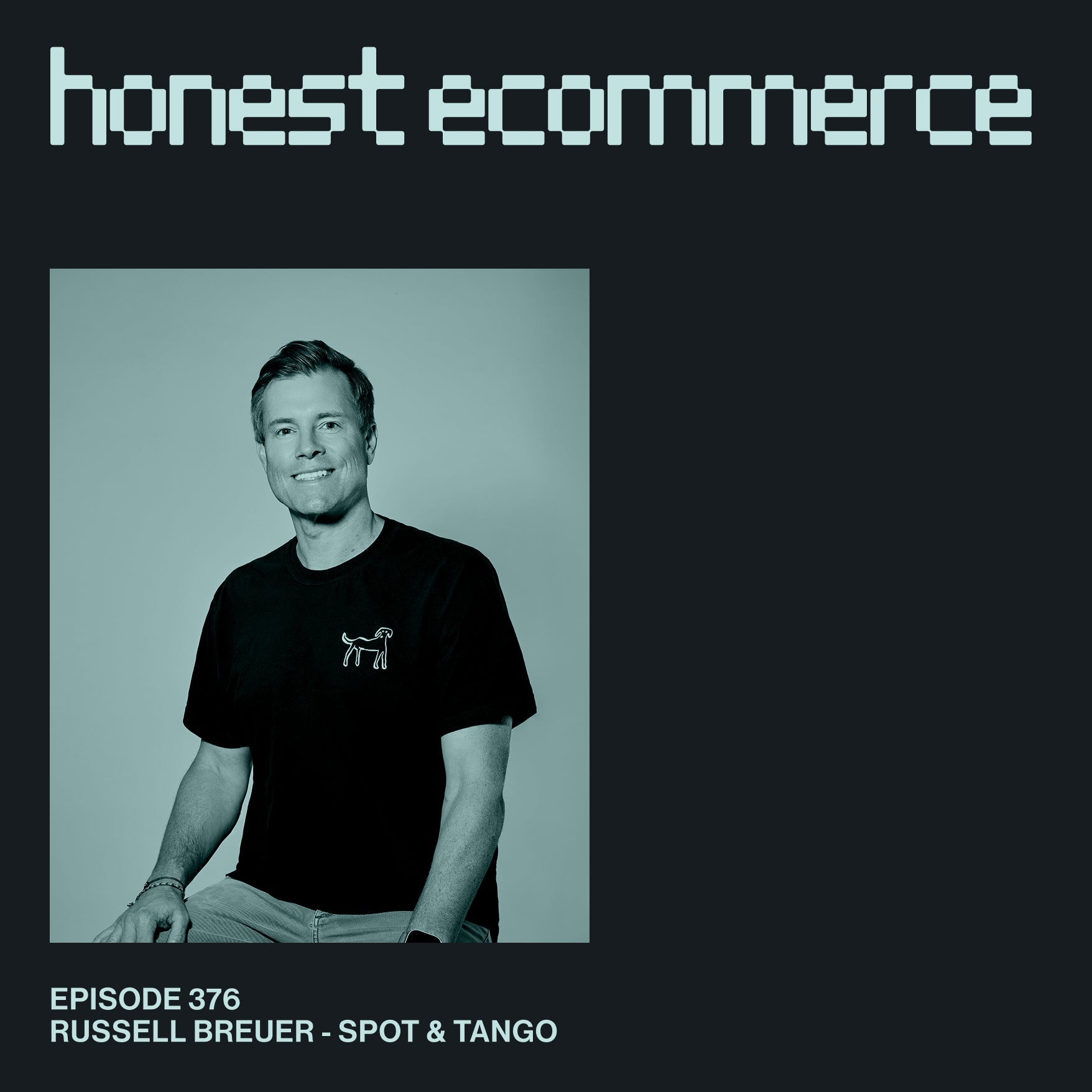
Russell Breuer
There's no better way to figure out if you really have a true business than to do it locally. Like, because people are honest. People are going to tell you like, “I like the product or I didn't.” Or, “I love the product, but your delivery model sucks.” The second you go national third party logistics, distribution, scale, that's where brands make mistakes.
They'll end up paying high fees to store products on the inventory side. They're getting, they're paying prohibitively high prices for FedEx and UPS and last mile carriers because they don't have economies of scale.
Chase Clymer
Honest Ecommerce is a weekly podcast where we interview direct-to-consumer brand founders and leaders to find out what it takes to start, grow and scale an online business today.
Hey everybody, welcome back to another episode of Honest Ecommerce. Introducing Russell Breuer. He is the CEO and founder of Spot & Tango. Russell, welcome to the show.
Russell Breuer
Hey, Chase. Great to be here. Thanks for having me on.
Chase Clymer
Absolutely. We're gonna have a fun one. Russell and I couldn't stop talking before this. So now we're actually going to dive in deep. So for those that are unaware, what are the types of products you're bringing to market over there at Spot & Tango?
Russell Breuer
Spot & Tango, we're a pet health and wellness brand based in New York. In short, we make incredible food for dogs. It's a human-grade pet food brand. So all of the ingredients are of human-grade quality. Think ground beef, ground turkey, ground lamb, fresh fruits, vegetables, things you'd feed your family and your children, we actually give to dogs.
They're all balanced for a dog's dietary needs. They were formulated by animal nutritionists. But food is where we started. That's the core offering. And over our life cycle, we've introduced other ancillary products like treats, supplements, and a new dental care offering called PupGum.
Chase Clymer
That's amazing. Now take me back in time. Where did the idea for this business come from?
Russell Breuer
Great question. So my background is traditional in terms of a management consulting career and then finance. It took me to London for eight years. I moved back to New York. And my wife was cooking fresh human-grade food for our mini golden doodle named Jack. And in fact, my mother-in-law was cooking fresh meals for her golden retriever named George.
And so I must give credit to my in-laws and my spouse for the idea. I've always dreamed of being an entrepreneur and operator and learned a lot about the industry. I learned about the size of industry. There's a pet health epidemic. If you look at the rates of allergies, diabetes, cancer, obesity is a problem in one in three dogs and thought there was something here.
No one in the market was offering a quality of human grade ingredient. Most brands offer what's feed grade. I.e. inferior ingredients, fillers, food, colognes, artificial and synthetic additives as well. And so we started this mission back in 2015, 2016 really as a side gig. And then soon realized that millions of Americans felt the same way about their dog. And I jumped in and scrapped together a little website and off to the races we went.
Chase Clymer
Absolutely. What was the first thing you were selling on that website?
Russell Breuer
So it was our original fresh frozen recipe. So think lean cuisine for dogs. We had a beef, turkey, and lamb recipe. In fact, we, believe it not, we cooked in a studio apartment. It's very cliche but true in those days. And the neighbors tried it and they're friends and friends and family. And all of a sudden, we had 50, 60 customers, which is not material, obviously.
But you can't do that in your home kind of commissary kitchen. So we found an incubator kitchen in Queens. And it was kind of this night and weekend side hustle. I leave my job in Midtown Manhattan wearing a suit. I showed up in Queens and worked like a graveyard shift cooking this food product, which then again, eventually it scaled.
And we started getting a bit more velocity, which others call product market fit to convince me to quit my day job and go full time.
Chase Clymer
Most brands outgrow their legacy choices long before they switch.
Bad platform decisions do not fail all at once.
They fail slowly. Then suddenly.
First, there is one workaround.
Then another tool.
Then another integration is duct-taped on top.
And eventually, your team is spending more time managing the stack than actually marketing to customers.
Eventually, rebuilding is less painful than staying - usually when it starts to show up on the P&L.
This is when scaling brands simplify and standardize on Klaviyo.
Klaviyo is the AI-first B2C CRM. It combines your customer data, email, SMS, analytics, and customer experience tools into one platform, so you are not stitching together five different systems just to understand what your customers are doing.
Your database updates in real time.Your segments update automatically.Your flows, campaigns, and personalization all run off the same source of truth.
And that shift is why so many brands are moving to Klaviyo.
Brands like Dollar Shave Club have reduced total CRM stack costs by over 30 percent after consolidating onto Klaviyo. Multi-brand operators like Marc Fisher have migrated multiple brands and dramatically reduced the time required to execute CRM marketing. And brands using email and SMS together inside Klaviyo are seeing massive ROI compared to running channels in separate platforms.
The big unlock is simplicity and scale at the same time.
Klaviyo is built for marketers, not engineers.It is built for online businesses.And it is built for where ecommerce is going, not where it was five years ago.
If you are running email and SMS across multiple tools, or you are on a legacy platform and thinking about your next phase of growth, it is probably time to look at Klaviyo.
Go to klaviyo dot com slash honest to see why hundreds of thousands of brands have already switched.
And if you want our help migrating your list, moving your data, and configuring your Klaviyo account correctly from day one, we are happy to help.
That's klaviyo.com slash honest, K-L-A-V-I-Y-O dot com slash H-O-N-E-S-T.
Chase Clymer
Yeah. I want to talk about those beginning days just a little bit more though. So you have a product and you said you had 50 customers at one point. Now, was this just referrals and word of mouth or were you trying to put the word out there in a different way?
Russell Breuer
I would say 0 to 1 was mostly word of mouth. We had an Instagram account. Honestly, one of my core channels of acquisition in the early days was Instagram because it was free. Now granted, I wasn't spending dollars on Meta's business platform. Generating Ads was very much like reaching out to people directly or just taking photos of what we had created for this product and the feedback was obviously incredible.
So it was a combination of organic acquisition and then word of mouth and one neighbor tells the other and all of a sudden, “Okay, there's something here.” And that's what we've been seeking. It's like, is there a signal that this is not a bad idea?
Chase Clymer
Yeah.
Russell Breuer
And there was enough to convince us to keep going.
Chase Clymer
Yeah, that's amazing. And were all these deals, were they actually buying it through a website or was it a little more like loose leaf paper handshake than that?
Russell Breuer
Squarespace.com. It was a templated website. We had Squarespace, photos that we took and some friends. In fact, our backend checkout was a system called Foxy Cart, which may no longer exist. Shopify was around but certainly not as pervasive as it is today. So there's a website and we offer small, medium, large plans. That's it.
We gave a recommendation in terms of weight and how much product you should order. But no, so there was a very basic Ecommerce website but hacked together, if you will, by myself and my wife.
Chase Clymer
Yeah. And was subscription a thing or was it just buying in bulk?
Russell Breuer
We offered both. Okay. Once and on subscription, like subscribing. But this was before, I didn't even know what recharge was or Shopify or how to enable it. So it was very much organic. And again, later in the iteration of the company, we then dialed in an algorithm. We personalized the plans. We used recharge and a formal subscription engine.
Now, we're actually fully customized top to bottom on the website. But yeah, again, in the early days, it was like if you got a click in the conversion, someone said, “Gee, this is a really good product.” That was enough to convince us to wake up the next day and keep making products.
Chase Clymer
Yeah. You talked about getting that signal, getting product market fit that made you say, “I'm to go all in on this business, go all in on Spot & Tango.” What was that for you?
Russell Breuer
I would say additional acceleration from that original cohort of more and more people to a point where the business started taking on a life of its own. So we have this incubator kitchen in Queens. had current bike messengers showing up once a week and picking up product and then distributing that throughout the five boroughs.
And in those days as well, we actually sold in pet specialty stores. At our peak, we sold in 14 pet specialty stores in Manhattan and Brooklyn. Actually in New Jersey as well, we had one store. And I met all of the owners of these stores and we had these branded freezers, small, that we installed next to the point of sale.
And I'd go there with my product and say, look, look at us. Here's this product. Here are the wonderful benefits of the product. Here's this freezer. Can I put it in your store? And believe it or not, these people said, “Yes.” Like these retailers, which again, it's a bit of a scary thing. It's like, wow, someone else's job is to sell the product on our behalf.
But the product looked the part. No longer does this happen, but we wrapped it in a pink butcher paper. So there are all these validation moments of like, “Wow, all these retailers said yes.” And it's just me pitching. Okay? I'm the head chef. I'm an accountant. I'm responsible for quality control and customer service. And so it was those moments when I was like, “Wow, now the market's validating what we're doing. Keep going.”
Chase Clymer
Yeah. I do want to call out here. Something that keen listeners might have picked up is that you launched very local. So you weren't shipping or dealing with that just yet.
Russell Breuer
No, we had not figured out how to ship outside of New York. This was like, literally bike messengers, door-to-door. Direct-to-consumer via bike. As in like, that was the means of transportation. In fact, there were moments when I would get in a car and drive into the city and meet like there were various modes of distribution, but no.
We had not figured out box insulation or dry ice, which is really expensive. Generally, a cold chain is expensive, but I would say for an early stage startup, it's prohibitively expensive.
Chase Clymer
Hey Store Owners -
Do you know how profitable your last BIG decision was on your Shopify store?
Most testing tools make it easy to measure design changes - small tweaks. Headlines. Layouts. Button colors.
But what about the decisions that really move the business?
Pricing changes. Shipping rates. Discount strategy. Even new apps and tools.
Those are usually left to gut feel.
Intelligems brings CRO-level clarity to decisions that live beyond the page.
Brands like Ridge, Jones Road, and True Classics are using Intelligems to test pricing, offers, shipping, and more, and see exactly how each choice impacts profit.
Momofuku used Intelligems to test multiple promotional offers ahead of Black Friday and identify the version that ultimately increased profit by about 28 percent.
Mott & Bow used Intelligems to run structured pricing and offer tests that helped drive roughly a 30 percent increase in incremental profit.
Dossier used Intelligems to run sitewide testing that resulted in about a 7.4 percent increase in profit per visitor across their store.They have a bunch more case studies on their website.
I’m a big fan of Intelligems. We use it with almost every client at our agency, Electric Eye.
We use Intelligems to test major site changes, new theme launches, and throughout ongoing CRO work
So when we are making decisions around design, pricing, offers, ETC, we can be confident that those changes are actually driving more profit for our clients.
So, before you start changing pricing, promos, or major site experiences across your store all willy-nilly, you should test it first.
If you're ready to decide confidently and grow profitably, head on over to intelligems.io and use code "honest" for 10% of your first 3 months. That's intelligems.io Use code “honest.”
But I think that what I want to point out here is you are getting that market validation by focusing on an area where you could service it to the best of your ability.
Russell Breuer
That's right. And the low hanging fruit was really the Upper East Side. High population density, high number of dogs, and easy to access for sure. We weren't trying to get over our skis and go big and boil the ocean. It was like, if you want product market fit, look across the street, look down the hall. It's all here and it's easier to service, logistically speaking.
Chase Clymer
Yeah. I just like to point that out for the young entrepreneurs listening to the show that they all want to do nationwide distribution. But sometimes if you do have a more difficult product to ship, like you said, frozen is hard to do, which I'm going to ask, how do you solve it here in a second.
But you can start with a specific niche and then expand out. It's harder to try the shotgun approach and do everything you think that your product can solve for.
Russell Breuer
100 % agree. Well, I'll take a couple of reactions. One is, we're a big believer in fail, fast, fail often. There's no better way to figure out if you really have a true business than to do it locally. Because people are honest. People are going to tell you, “I like the product or I didn't.” Or, “I love the product, but your delivery model sucks.” Or “Delivery is great, product is great, you're too expensive.” Or they'll never order again.
Then you can pull all that data from the NPS scores, having direct conversation. So it's this wonderful way to learn more about the business before. The second you go national, third-party logistics, distribution, scale, that's where brands make mistakes. And they'll end up paying high fees to store products on the inventory side. They're paying prohibitively high prices for FedEx and UPS and last mile carriers because they don't have economies of scale. Right?
So staging is so essential and you don't need… Rome wasn't built in a day. People want overnight success. It doesn't work that way. It's the patient prudent operator. And I will tell you, we learned things in the early days. We made mistakes and we were able to course correct those at a much smaller scale than later when it's very hard to turn the cruise ship around.
Chase Clymer
You can answer this question in any way that you feel comfortable with answering it. But do you remember the size you were to which you could start to sell things either profitably or you knew you just had to take that hit for a little while to start shipping frozen beyond just New York?
Russell Breuer
Sure. That's an interesting question. So we were doing $5,000 of revenue a month in 20... This is like 2017... Before I went full-time. We probably got to about $50,000 of revenue a month and then figured out this delivery model. So I'd say that was... Now granted, in full disclosure, I had raised a small family and friend round of capital to enable some of those decisions.
Margin was not a key consideration point.
Chase Clymer
Yeah. It was distribution and exposure.
Russell Breuer
Yes, margin negative. We were making no money. What was my time worth? God only knows. A lot more nothing but we weren't making anything. It was, we have a product, we know the market's there, we've got to get the product into the hands of more people to build acceleration to unlock potentially raising larger rounds of capital to scale. And finding profitability is not easy. Now granted, if you grow these, it all depends on the growth rate.
If you're a slow grower… If you want profit, grow slow. If your ambition is scale, then growing fast, there's trade-offs, but you need to have a balance sheet to support that. And I think there's a very delicate thread to ensure that you don't [get the] Icarus syndrome, too close to the cloud, and or grow too slowly where you lose the vigor for the business, if that makes sense.
Chase Clymer
No, it makes complete sense to me and I appreciate your honesty and candor in that regard. And the way that you approached it was there isn't a right or wrong way to do it. But if you want to grow fast, profitability is probably not at the top of the list of the outcomes that are necessary. And even to take a step further than that, everyone has to be on board with that. That's involved.
Russell Breuer
That's right. That's right. And honestly, we still debate those topics today. Our company, we've reached scale now. We are still growing 50 % plus year-over-year, which is still a very [big] growth rate. There are trade-offs to growth. It's always a balance of what is the end destination? And oftentimes, entrepreneurs want to build a legacy business for their children, which is like a wonderful thing.
If you raise third party capital, there's like an expected financial outcome of those decisions. And so it depends. You got to make your own bed and lie in it. And so you have to make those decisions early on. And again, like growth profitability, a lot of later stage companies debate that too. Super, super high growth, you're going to sacrifice some profitability. And so the question is how much on both sides of the equation.
Chase Clymer
“I have been in business for nearly 20 years, and very few companies I have hired in that time have performed as well as Electric Eye. They have knowledgeable staff, and our project was delivered on time and on budget. Electric Eye has exceeded my expectations, and I look forward to working with them again.”
That is a direct quote from one of our clients at Electric Eye.
Electric Eye is a Shopify Plus partner that has helped over 100 brands migrate, redesign, and optimize their stores since 2016.
If you'd like to increase your conversion rate, average order value, and revenue per session, we are the true Shopify experts you've been looking for.
Right now, we're offering a free diagnostic to qualified brands that reach out and mention the podcast. Visit electriceye.io today to schedule a call and send us a message. Find out why we have over 50 5-star reviews in the Shopify Partner Directory. Again, that's electriceye.io. E-L-E-C-T-R-I-C-E-Y-E.io
Let's talk a bit about scaling. As you approach that, you expand markets. Now you're shipping the product nationwide. How did you start acquiring customers at scale beyond friends and family?
Russell Breuer
Once I went full-time, it took us a year to really build out Shopify, build a good website foundation. Our growth story, we started testing on Meta and Facebook. Actually, those days, we were probably spending 100 bucks a day and crossing our fingers like, “What's customer acquisition cost?” Oh, we got zero customers. Therefore, it's 100, that's bad.
So keep testing, testing, mostly Meta, Facebook in the early days. And so I experimented with Google, brand and non-brand. TikTok didn't exist. Direct mail is too expensive. And there were a few other apps that we experimented with, but the retention was absolutely terrible. And so there was Meta and Google.
Our acceleration really changed as a business when we launched UnKibble, which is the benefits of a fresh food diet and the convenience of Kibble. So it's all the same ingredient input. So, same mission. Take out water, no water, no cold chain, no insulation, no dry ice. And so that brand is 30-40 % less expensive than a lot of the fresh competitors. And we launched that product in April 2020.
The business went from a few million dollars of revenue to now we're well over 9 figures. Just given how that resonated with the consumer in particular. And along the way, our paid performance marketing budgets have scaled accordingly.
Chase Clymer
Absolutely. So product innovation was one of the things that helped you guys scale.
Russell Breuer
Huge. And that's PupGum. We launched a dental care offering May of 25 called PupGum. It sounds provocative. It may be an idiotic idea. It's like dogs can't chew gum. It's like actually we encourage you to click and learn more. We encourage consumption. It's safe. That's why the product is effective as a post-biotic, which of course reduces the biofilm, which leads to bad breath.
That's a new innovation. We've got two or three other big innovations launching this year as well. Why innovator diets? You've got to stay on the edge, even though we have a hero product. Great. Okay. Let's keep doing that. Let's not get too distracted. But again, staying on the edge of new product development, I think is essential to be relevant in the conversation and to continue to fend off competition.
Chase Clymer
Hey everybody, just a quick reminder. Please like this video and subscribe if you haven't. We're releasing interviews like this every week. So don't miss out. Now back to the interview.
Now we talked a lot about a lot of great ideas that you guys have had and things that you've done well. Is there anything that comes to mind in the 10-year of [business]. Here's a mistake we made. Maybe don't do this.
Russell Breuer
Gosh, how many, how long do you have? I would say the supply chain is very difficult, generally speaking, building out freight and trucks. I would say one of the biggest challenges for us was UnKibble, we launched that product and we grew so quickly. And everyone loves the headline, like your growth rate or revenue and from X to Y, from 100,000 to a million or a million to five or five to 10, whatever the headline, that's all amazing. Operationalizing growth is very difficult.
So at our peak, we outsourced to six co-manufacturers across the country. We had trucks going from California to Baltimore, from Cleveland to Miami, I mean, and everything in between. Warehouses, it was very difficult to manage. Going back to our earlier conversation about margin, there was no margin. We were price takers, right?
So we were trying to establish this foothold. That was a huge challenge. was, in fact, the rationale to insource. We actually built a dedicated facility in Allentown, Pennsylvania, where we produce UnKibble now. And that's been a big game change for us, unlocking the supply chain, allowing supply. But that was like years in the making.
That wasn't like crystal ball build factory day one, because then Kibble is going to be a hit. We launched UnKibble. “Oh, wow, this is hard. Now it's getting harder and harder. The demand is on the roof.” And honestly, the answer was like, we're struggling to fulfill the demand, right?
Execute supply chains. So that was a big lesson for us. It's worked out but it was years in the making of course to correct and being able to enable the growth of that business in particular.
Chase Clymer
Yeah, that's wonderful. Now, before I let you go, Russell, is there anything I didn't ask you about that you think would resonate with our audience?
Russell Breuer
I will just say some of the secret ingredients to building a business. I think it's really important. Team is everything. Honestly, it's finding the really hungry, like-minded entrepreneurs who take a first principles approach to solving problems. Everyone's got problems, right? Now I sound like a commercial, you know, a PSA.
All of these businesses, things break every day. If you build a team, an ops team or finance or marketing and people that have shared the same philosophy, they'll help you get through those moments. That's been one of our [strong areas]. Besides the UnKibble or product or factor otherwise, it's the team that I really emphasize when I talk to other founders or entrepreneurs or otherwise.
It's finding that. Because it's not a one-man show. It's multiple inputs, multiple people. And that's really a key success criteria.
Chase Clymer
Absolutely, Russell. I can't thank you enough for coming on the show today and sharing all those amazing insights. Again, Russell is the founder and CEO of Spot & Tango. Go check out their website. Check out obviously their newest product, PupGum, obviously UnKibble and all the other amazing products they have on there. Russell, anything else before I let you go?
Russell Breuer
Thank you, Chase. It's been fun. Great. Have a great conversation.
Chase Clymer
Awesome. Thank you.
Russell Breuer
Okay, take care.