Breanna Hughes
We had our own personal experiences, but really we rooted our solutions into customer problems by speaking to thousands of people. So before we even launched a product, we spoke to thousands of people through surveys, through interviews that felt like therapy sessions a lot.
And we really understood the customer problem. So that when we went to market, we knew that there was going to be willingness to pay and we were actually solving a real problem for people.
Chase Clymer
Honest Ecommerce is a weekly podcast where we interview direct-to-consumer brand founders and leaders to find out what it takes to start, grow and scale an online business today.
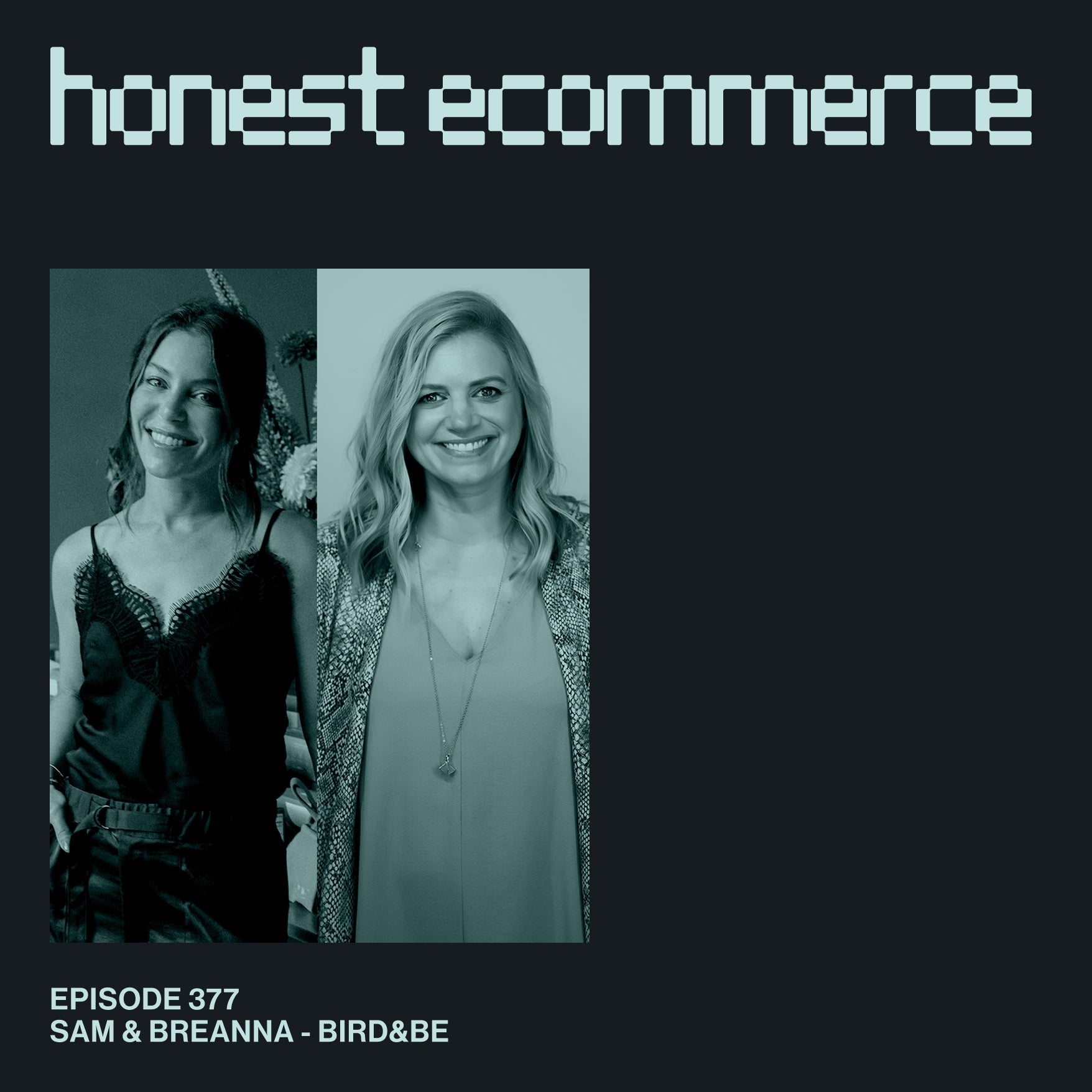
Hey everybody, welcome back to another episode of Honest Ecommerce. Today, I'm welcoming to the show, not one but two fantastic co-founders of Bird&Be. Today, I've got Breanna Hughes and Sam Diamond from Bird&Be. Welcome to the show.
Samantha Diamond
Thanks for having us.
Breanna Hughes
Thanks for having us.
Chase Clymer
Awesome. Well for those that are unaware of the brand, could you quickly just let us know what are the types of products that you're bringing to market over there?
Samantha Diamond
Yes. So we at Bird&Be provide at home tools and compact supplements for both partners at every stage of the fertility journey. And we develop these with the leading fertility doctors in the industry who are on our shared mission to ensure that people are empowered and educated, that they can be proactive. And ultimately, we're working with them to improve access to care across the board.
Chase Clymer
That's amazing. Take me through the journey. Where did the ideation for this product and business come from?
Samantha Diamond
Well, it came from a whole bunch of different people and places that came together in the most incredible way. And each of us has our own origin story. And we met at the apex of all of our despair to create a company that would hopefully help ensure that nobody else had to suffer on their fertility journey the way that we did.
So my story starts in my early 20s, mid 20s, when I was diagnosed with PCOS. And I was actually diagnosed by my then boyfriend and now husband. That sounds weird. But he was in his residency for becoming an OB-GYN and then fertility doctor. So he was the one that first opened my eyes to like, you know, these conditions that I had previously no idea about.
And that started me on a mission of understanding really what proactive healthcare can look like because I was diagnosed so early, I actually had the chance to plan. And fast forward. A few more years later, when I was actually ready to start growing my family, I was having a tough time because of PCOS. And then I also experienced pregnancy loss.
And it was through this experience that I then truly understood how tough and fragmented this journey could be. I was literally living with a fertility doctor and I was still confused about all of the other things that I could do from a lifestyle perspective to support me and optimize my outcomes.
And so that began a pretty heavy period of research and investigation and bringing in some experts who then introduced me to Breanna to try to figure out how we could help other people.
Breanna Hughes
Yeah, so for my story, I was on the other side of reactive care. So I was not aware that I had PCOS and I was undiagnosed for many years and I actually went through a five year infertility journey, including recurring pregnancy loss. I had three rounds of IVF, four embryo transfers and similar to Sam, I just saw the huge problem around fertility education as well as what more I could be doing for my fertility health.
The good news is not only did my infertility experience give me some of the insights into building Bird&Be, but building Bird&Be actually helped me build my family. So three days before we launched to the public, I had found out and I was taking our supplements. I had found out that my fourth embryo transfer was successful and that I was pregnant.
And fast forward to when my son was just over a year old. My husband and I had actually spontaneously conceived our second and we were both taking our Bird&Be prenatal vitamins to help our egg and sperm quality. Not only was I able to kind of take my own infertility experience and inspire to build the company. But the company helped me build my family.
Chase Clymer
Hey everybody, just a quick reminder, please like this video and subscribe if you haven't. We're releasing interviews like this every week. So don't miss out. Now back to the interview.
Breanna Hughes
So I wanted to make sure that what I experienced wasn't unique to me. And actually, the best part about Bird&Be is that we had our own personal experiences. But really we rooted our solutions into customer problems by speaking to thousands of people. So before we even launched a product.
We spoke to thousands of people through surveys, through interviews that felt like therapy sessions a lot. And we really understood the customer problem so that when we went to market, we knew that there was going to be willingness to pay and we were actually solving a real problem for people.
Chase Clymer
Can you talk to me a bit about how you found basically strangers to be a focus group for this product that… Was it even a product yet? This idea you had? How did you do... I feel like there are listeners out there that might be in that position, but they don't know how to find people to ask questions to.
Breanna Hughes
Yeah. So I actually just met with an entrepreneur last week and gave him a whole load on how we did this. And I actually just saw him doing the same. So it's amazing to pay it forward. We actually took out Facebook ads throughout all the different meta platforms. And we had kind of created this fake company and fake brand initially. And set out surveys, ads to fill out a survey that people could win an Amazon gift card if they populated the survey.
We also shared it throughout because I was literally going through IVF and I had experienced infertility. I reached out to admins of hundreds of Facebook groups and laid out what my personal experience was and what we were trying to do. And they allowed me to post these surveys and interview requests in all the different infertility Facebook groups.
So shout out to those admins. They were so supportive. And finally, we also posted on Reddit, Twitter, all over the place to really reach out to people to hear their unfiltered feedback.
Chase Clymer
And you said you got over 1000 responses. How long of a time window was this?
Breanna Hughes
A few months. And the interviews still never end. I'm still interviewing people to this day that are going through a kind of infertility to really make sure that we are constantly hearing our customer problems. While it started in the first few months of building our company, it has never ended.
And we're always listening to customers and conducting generative research to make sure that the products that we build and make moving forward actually solve our customers' problems.
Chase Clymer
Do you know what's going on with Klaviyo? When was the last time you explored what it can do?
Klaviyo has been shipping tons of new AI, data, and automation features designed to help ecommerce teams move faster, personalize better, and automate more of the work that used to take entire teams.
Most brands are only using a fraction of what is already inside their Klaviyo account.
Klaviyo is not just email and SMS anymore.
It is your customer data platform, your lifecycle marketing engine, your analytics layer, and now your AI-assisted execution layer, all in one place.
That means your customer data updates in real time.Your segments stay current automatically.Your flows and campaigns all run off the same source of truth.And now AI can help predict churn risk, forecast spend, recommend next best products, generate campaign content, and optimize send timing across channels.
The big unlock is speed and efficiency.
Fewer tools to manage.Less dependency on engineering.Less time moving data between systems.And lower total cost of ownership across your marketing stack.
And brands are seeing real results from leaning further into Klaviyo.
Dollar Shave Club has reported over 30 percent reduction in total CRM stack cost after consolidating onto Klaviyo. Brands like ThirdLove have seen 15x ROI from SMS after consolidating channels. And companies like Corkcicle have grown flow revenue over 90 percent after bringing email and SMS together inside Klaviyo.
Across our customer base, every single brand we work with today is using Klaviyo. That is just where serious ecommerce customer data and lifecycle infrastructure lives now.
If you are already on Klaviyo but feel like you are not getting everything you could out of it, or you are running multiple tools and want to simplify without losing power, this is worth your time.
Go to klaviyo dot com slash honest to learn more about what Klaviyo can do for you today.
So you do all this research. Was there an initial product in mind or did you come up with the product on the back of the research.
Samantha Diamond
We had initial products in mind and we ended up going to market the exact opposite way we had originally intended. So when we came together at the very beginning to create this company, one of the initial ideas that came from our doctors was all related to flagging what we call reproductive health red flags at home early, early on so that they could expedite their care.
They would know well in advance that they needed to see the doctor. Sometimes flagging symptoms that weren't necessarily physical that they couldn't see. And so the first test idea was around our ovarian reserve screening test. It measures a hormone called FSH. Essentially, it signals how close a woman might be to menopause, which indicates that their egg quantity, their egg count, would be a lot lower than expected.
And this is often silent and it's something that could be measured previously only through blood work. And our doctors had developed a way to measure it via urine, similar to the way you would take a pregnancy test.
And so that was kind of one of our light bulb moments at the beginning, like how can we build a testing suite that could help people understand, “Hey, I shouldn't wait at all. I should not follow this try for a year advice. I should be going to see the doctor right away.” But we launched during COVID.
And COVID was a time where the entire world was doing at-home tests, but not for fertility. They were doing at-home tests, obviously, for COVID. And all of the factories literally around the world that were making these lateral flow assays were specifically focused on making them for COVID. And so we just couldn't get any of those products to market fast enough. Because we couldn't find a manufacturer who is willing to carve out their time and space to make this brand new test.
And so it was through a lot of this research that Breanna had run that we actually realized, well, the number one pain point people are talking about is supplements. They're talking about how much they're spending, how much time. It's taking to actually go down the rabbit holes of the internet, cobble together care, they're listening to their friends, their doctors, their aunts. Well-meaning family members. They are really, really struggling to find out what to take.
They don't know why they're taking it. And some people were taking like 16 to 20 supplements a day. And so that kind of brought us back down to earth for a minute. We didn't have to start with the tests. We really, really took the opportunity to listen to the customers, listen to their pain points, and iterate from that. So what we thought was starting second, what we thought was going to be second, actually came first.
Chase Clymer
How long was the window between, we're going to build a company, and we're doing these interviews, and we're doing these surveys, to you had the first line of products that you were going to attempt to take to market?
Samantha Diamond
It's probably a year. I think Breanna and I had met early on, early days in COVID to try to come up with how we might transform this idea into an actual product. We then started to get our ducks in a row. We then went out to raise money at a similar time as we were doing this research. And very quickly after we raised the money, we started getting our product into actual physical state.
Chase Clymer
Absolutely. So you went out, you raised money. Walk me through what does go-to-market look like with these new products? Obviously, you've got a list of 1,000 amazing people that gave you free advice, basically. You've got your friends and family and hopefully, you've got the support of your investor network. But that only gets you so far. What was the actual block and tackling of how do we market this concept to this ecosystem?
Samantha Diamond
Well, we first actually started with education before we had a physical product. We really built this company on the back of science. And we wanted it as a core value that still stands so strongly today. We wanted to deliver truth and science in a way that would help combat a lot of the misinformation out there and really allow them to find a place on the internet that they could trust.
So all of our content from day one was created by doctors and verified by doctors in various kinds of fields and subfields within fertility from embryology to naturopathic medicine to pelvic floor health, all the way through to reproductive endocrinology and through OB-GYNs.
And so we started off with social media accounts and an online blog through our website that was dedicated entirely to education. And we kind of built up from there towards what would become launch day.
Chase Clymer
Hey Store Owners -
Do you know how profitable your last BIG decision was on your Shopify store?
Most testing tools make it easy to measure design changes - small tweaks. Headlines. Layouts. Button colors.
But what about the decisions that really move the business?
Pricing changes. Shipping rates. Discount strategy. Even new apps and tools.
Those are usually left to gut feel.
Intelligems brings CRO-level clarity to decisions that live beyond the page.
Brands like Ridge, Jones Road, and True Classics are using Intelligems to test pricing, offers, shipping, and more, and see exactly how each choice impacts profit.
Momofuku used Intelligems to test multiple promotional offers ahead of Black Friday and identify the version that ultimately increased profit by about 28 percent.
Mott & Bow used Intelligems to run structured pricing and offer tests that helped drive roughly a 30 percent increase in incremental profit.
Dossier used Intelligems to run sitewide testing that resulted in about a 7.4 percent increase in profit per visitor across their store.They have a bunch more case studies on their website.
I’m a big fan of Intelligems. We use it with almost every client at our agency, Electric Eye.
We use Intelligems to test major site changes, new theme launches, and throughout ongoing CRO work
So when we are making decisions around design, pricing, offers, ETC, we can be confident that those changes are actually driving more profit for our clients.
So, before you start changing pricing, promos, or major site experiences across your store all willy-nilly, you should test it first.
If you're ready to decide confidently and grow profitably, head on over to intelligems.io and use code "honest" for 10% of your first 3 months. That's intelligems.io Use code “honest.”
Breanna Hughes
Piggybacked on top of my personal brand. So I had been speaking out about my infertility experience before it was common to do so. So there was still a lot of stigma around this. I actually didn't really know what I was doing. Like I was live Instagram story, live tweeting my IVF embryo results and I am asked like quite a big following. I leveraged 10,000 Twitter followers, as well as my Instagram account.
And I was sharing these intimate details about what it really looks like going through infertility and was using that as a bridge to make connections with people. And then it was really interesting to see the support rallying behind that when we launched. Because we were able to see our very first customer was actually so coincidentally, or maybe not coincidentally, from the same small town that I grew up in.
I didn't know her. But she and she's still a customer today, a few children later. And so it was really able to leverage that personal connection we had with the community through both of our Bird&Be Instagram channels, as well as our personal brands, to be able to rally support and customers around us in those early days.
Chase Clymer
I want to ask a little more of a binary question about... People always say make content? How much content were you making? How many blogs? How many? What did that look like?
Samantha Diamond
In the early days, it wasn't at the level certainly that we're at today in terms of frequency. We had a tiny team. It was Breanna and I for quite an extended period of time. And we pulled in some folks from our previous lives to help patch together a team that was working very, very fractionally at the beginning. Because we had no money and we really weren't selling any product yet in order to make any revenue to continue to support and sustain the business.
It was as much as we could possibly do with as little as we had. We obviously leveraged the doctors who came in as part of our founding team as much as humanly possible. So we would have them do Instagram and TikTok lives, we would have them film videos. We had them write a lot of the early blog posts themselves.
We kind of, again, we were like Canva and Photoshop, making our own graphics for social media content. Like we were really scrappy. We had a couple of amazing interns.
Breanna Hughes
And you can tell. You can tell if you find the old posts.
Samantha Diamond
It's true. I taught myself Photoshop. I'm by no means a designer and no one should ever let me near Photoshop at all still today. But we did what we had to do. And then it was kind of through these very early days where although we were making some of this early content ourselves, we then began to start relying on a small micro community of influencers in this fertility space to help us with the content.
Not only on our own feeds, but of course, using the information and the products on their own feeds to kind of share what we were doing. And we would be in the DMs. I was personally DMing all of these very, very early [creators]. We call them fertility TikToks. Fertility TikTokers, telling them about the company and our own experiences and how much their stories were resonating.
Because before them, and this is in 2020, 2021, this was like the first time people were talking about their own experiences online in a way that was reaching hundreds of thousands of people. This was revolutionary for fertility and infertility. This has never been discussed on these kind platforms in this way.
And so they were really helping to support us with this content because they were amassing a following, just as Breanna had sharing their own journey.
Chase Clymer
That's amazing. Was there a certain point after launch where things [lead to], you thought to yourself, “I think we're on to something here. This is really starting to work.”
Breanna Hughes
I think it was actually the day we launched. The sheer fact that we launched. So we hadn't even announced that we had launched and we had orders coming in. People had gone to our site, there was no announcement. We're still testing on the site. Thank goodness I tested and made sure that orders could be processed.
But people were processing orders before we were even public about it. And we did have a Globe and Mail, like a huge national newspaper. We did have coverage around that, that definitely amplified our mission and what we believe in. But ultimately, by building a company that was really rooted in solving customer problems, we had product-market fit so early on because we designed our product that way.
We listened to people, we designed a product that solved their problems. There was a huge need. It was so obvious when the research came through. And all the feedback around supplements came through that this company needed to exist. So really, early, early days, were like... The path was very clear that we were on the right path and we had a product that people wanted.
And where the difficulties came were not really around if we were doing the right thing, but really around getting the physical product out, finding the right suppliers, finding the right partners. That's where a lot of the challenges were. And it wasn't honestly in kind of did we build the right product? Like that was so clear early on. Like all of our reviews still to this day are reciting back our mission statement back to us.
And so we've just been really consistent with solving customer problems in a way that they feel heard and supported. And yeah, all the challenges have definitely been around to actually get that product to people.
Chase Clymer
“I have been in business for nearly 20 years, and very few companies I have hired in that time have performed as well as Electric Eye. They have knowledgeable staff, and our project was delivered on time and on budget. Electric Eye has exceeded my expectations, and I look forward to working with them again.”
That is a direct quote from one of our clients at Electric Eye.
Electric Eye is a Shopify Plus partner that has helped over 100 brands migrate, redesign, and optimize their stores since 2016.
If you'd like to increase your conversion rate, average order value, and revenue per session, we are the true Shopify experts you've been looking for.
Right now, we're offering a free diagnostic to qualified brands that reach out and mention the podcast. Visit electriceye.io today to schedule a call and send us a message. Find out why we have over 50 5-star reviews in the Shopify Partner Directory. Again, that's electriceye.io. E-L-E-C-T-R-I-C-E-Y-E.io
It goes to show the effort that you put in upfront in asking questions and just learning from the customer helps you craft such a better product. Also, just having a good product just makes having a business 10 times easier. I don't know how many times I say that on this show. But yeah, just listen to your customers and your potential customers and they can definitely help you out there.
So let's fast forward a little bit to what's going on now. Is there anything that you think is worth mentioning that we might be jumping over real quick?
Breanna Hughes
Yeah. One of my favorite stories is... I won't name any names but when another inflection point of our business was, my florist reached out to me via Instagram DMs and she said, “Hey, Breanna, do you know that my fertility clinic is telling all their patients to take Bird&Be? And she told me that she and her partner had gone to a fertility clinic.
They were about to start IVF and their fertility doctor had said, “Go home for three months and you and your partner should take these Bird&Be supplements.” And we knew through our co-founding team, we had a lot of connections to different fertility doctors and fertility clinics.
But this was really truly organic where they were, this clinic and this doctor were taking it upon themselves to tell their patients to take our product. Because they were hearing about it and seeing other successes in their other patients by taking our products. So, that was another really big inflection point that we always had on our roadmap that we were going to go B2B because we knew we had a very medical science-backed product that was created by doctors.
We just didn't know that we were going to go so quickly. And again, it just showed this true gap in the market. And it was really incredible seeing this organic uptake at different clinics and providers using our product. Which is a consumer-facing product with their patients.
Chase Clymer
That is amazing. Social proof. What's that look like from a business standpoint and functionality? Obviously, you've got the standalone direct-to-consumer website. But how do you roll in this network of clinics and doctors and build that up?
Samantha Diamond
Yeah. So we're one of the only products in the fertility space that adheres to medical college recommendations. And we did a ton of research through our medical team in terms of what needs to be in there, what the doses look like, what studies are there to support it. And we then went out and did two IRB approved prospective studies on our own.
And it's because of the results, spoiler alert, they're very positive. It's because of the results of these studies that we began to get such rapid adoption from doctors. So again, as Breanna mentioned, it started out organically where clinics were hearing about us from their patients. They were starting to see our product kind of pop up and then they were starting to see really, really positive results.
And you can see the results really rapidly in males because of the way our biology works. You know, eggs, you're born with all the eggs you'll ever have. Sperms regenerate every two to three months. And so you can actually see physically in a microscope and a semen analysis, the difference between someone's semen analysis at day zero and someone's semen analysis at month three.
And so when the doctors were seeing how much sperm quality was able to improve over the course of a couple of months when patients were using the product, this kind of just set off this very organic path for us. And so it started off organic and then it became, of course, much more intentional where we're in touch now through our medical team and then through our network and then the ripple effect.
Hundreds and hundreds of clinics, if not thousands at this point where our products are being sampled, our products are being recommended. And it's beyond just what we are physically doing and physically sending off to these clinics. Through our post purchase survey in 2025, we learned that over 10% of our D2C customers are actually learning about us from their provider.
And so this has really expanded beyond what we are physically doing on our own. This really has grown quite significantly. And we see a future where this becomes an even more important channel just because the product is simply the best one out there. The integrity behind how we make it, what's in there, and the evidence that we're creating.
We're in the process of launching 2 more studies this year. Make it so that clinicians are able to recommend it very easily to their patients and feel great about it.
Chase Clymer
That's amazing. Now, before I let you go, is there anything that I didn't ask you that you think would resonate with our audience?
Samantha Diamond
I think one of the coolest elements of Bird&Be and one of our core values around improving access to care come from how we're able to support folks in rural and remote areas. So we know that about 40% of reproductive age females in the US live without any proximity to fertility care. In Canada, here, about 20% of our entire population is rural and remote. There are provinces where you would have to get on an airplane to access fertility care.
So we might take advantage of the fact that in metropolitan cities or high density cities, here in Toronto where I am, LA, New York, Chicago. You could probably get an appointment fairly quickly at a fertility clinic. Outside of that, it's actually quite difficult. So where Breanna lives, she can absolutely not get an appointment with a fertility clinic very quickly and she has to drive five to six hours to her closest lab.
And so we're solving, of course, for the problems that folks are having when they're planning for their journey. But we're also solving this access to care issue through our products and products availability and what they can do. So my favorite example of this is our at-home sperm test. You can literally test your sperm in the comfort of your own home and receive results on your phone in 15 minutes.
And what that does is expedite someone's path to care. Often people are trying at home again for one, two years, sometimes longer, not really understanding that there's an issue here that absolutely requires a doctor and a clinic. And they put it off because it's far and it's inconvenient. And it's gonna take them quite a while to get an appointment, actually physically get to the appointment.
And so if they're able to receive a kit in the mail at home, they're able to learn that, yes, I have an issue very specifically around male fertility. We know that 50% of infertility cases involve male. That is half. Half the time there is male factor infertility involved. We should be testing sperm in general and you can test it at home.
You don't need to wait to go and see a doctor or a clinic as your first step. You can take that first step at home to really give that push, “I need to take this seriously. I need to make this a priority." And then you can start that care immediately through the supplements. And again, we've done studies. We've shown how quickly you can improve from quality.
The improvements start in 30 days. You really see the impact in 3 months. You can start that immediately at home.
Chase Clymer
And you know what? I love it when guests give me just the perfect opportunity for segue. So if I am curious about any of this and I want to learn more about the products, potentially buy some. Where should I go? What should I do?
Samantha Diamond
You can visit us at birdandbe.com. We are also available at Alta Beauty across the US. We'll be in 1,000 stores in the next couple of months. And we're also available on AltaBeauty.com, where you can get same-day delivery of many of these products. We're on Amazon in Canada. We're on well.ca. And of course, we're in fertility clinics across Canada and the US.
Chase Clymer
Awesome.
Breanna, Sam, thank you so much for coming on the show today and sharing all those amazing insights.
Samantha Diamond
Thank you.
Breanna Hughes
Thank you for having us.