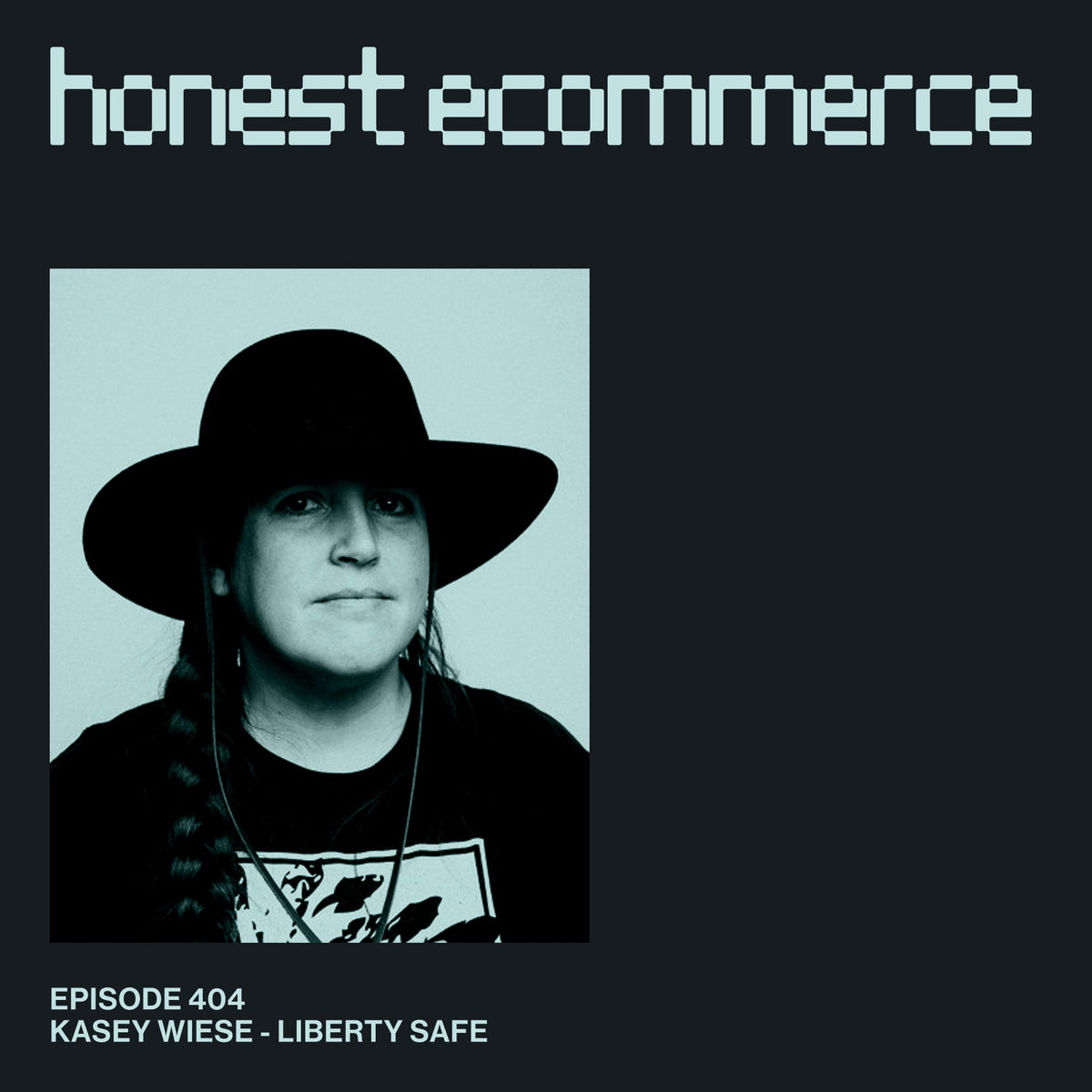
Kasey Wiese
I always say control what you can control. And sometimes with AI you wanna be like, "This makes it so much easier," but just make sure that you're still in control.
Chase Clymer
Absolutely. I mean, I still, at the end of the day, it's human conversations, it's iteration, and it's just trying to be 1% better every day.
Honest Ecommerce is a weekly podcast where we interview direct-to-consumer brand founders and leaders to find out what it takes to start, grow, and scale an online business today. Honest Ecommerce is proudly produced by Electric Eye, a Shopify Plus partner helping ecommerce brands sell more with strategic design and development. Visit electriceye.io for more information.
Hey everybody. Welcome back to another episode of Honest Ecommerce. Today I'm welcoming to the show the Director of E-commerce at Liberty Safe, Kasey Wiese. Kasey, welcome to the show.
Kasey Wiese
Thanks Chase, excited to be here and chat about Honest Ecommerce.
Chase Clymer
Absolutely. So for those that are unaware, let's talk about your current gig. What are the types of products you're bringing to market over there at Liberty Safe?
Kasey Wiese
Yeah. So at Liberty, we are a home and firearm safe company. So pretty much a big metal box, steel box that you put in your house to keep things secure. We really want people to protect what's most important to them. So it could be firearms, it could be heirlooms, it could be documents.
Think about things that are irreplaceable, if you will, things that are really important at that point in your life that you should secure.
We offer a plethora of safes for your needs, anything from small to very, very large for a collector, if you will.
Chase Clymer
Absolutely. And we are absolutely gonna talk about Liberty Safe, but we're gonna save that for a little bit, especially knowing how heavy they are. I'm sure there's some interesting things you have to solve for shipping that product.
Kasey Wiese
Yes.
Chase Clymer
But, you know, your career in ecommerce didn't start there. So I guess take me back in time. Where do we wanna start this conversation?
Kasey Wiese
Yeah, so I think the fun thing about my career path is kind of where I started, which is really early on. I mean, I've been in the ecom lane for twenty years. I got my start with a mom and pop shop in North Lake Tahoe, a ski and snowboard shop. That's really where I started. We showed up on the space, in the digital space, to sell ski and snowboards online, and we were really competing at that time with the bigger guys, but we showed up with a footprint.
We were very small, but we packed a punch, and it was really fun because it was my first foray into data and saying, "Man, I can really impact tomorrow based on what I know today in ecom."
And that was really fun to me because I had kind of been in this marketing, traditional marketing space in my head for so long, like that's where I thought I wanted to be.
Where I was working, there was this need to kind of bridge the gap between marketing and digital. And I stepped into that and I was like, "Okay, this is really cool." So it was really a pivotal point too for me to say, "Okay, nope, marketing's great, but I think I could kind of combine these and go into that digital space," where things are impacted a lot faster.
You see a result a lot faster than you would with traditional marketing, like showing up and doing an event, great, but that return is like months later. Whereas with ecom, I quickly figured out that this was a lot more fun to see results. It was almost that instant satisfaction.
And then I continued actually in that space. I mean, the majority of my career has been in the outdoor industry. And then I went from the retail side to the manufacturer side, and that's primarily where I have been, with one stop at Orvis, which is an apparel and fishing and hunting and dog gear company out of Vermont.
But primarily sitting on the manufacturing side, which has been really interesting too. You have to... you thread a fine line with selling direct to consumer, but then also supporting your dealer network and your specialty retailers. So you're kind of trying not to compete with yourself while competing with yourself at the same time.
And so kind of just meandering through all the ebbs and flows of digital in twenty years has been very interesting. I liken where we are with AI right now to where we were fifteen years ago with SEO. It's this whole thing. And really, at the end of the day, it comes back to content.
And that's where we started. If you went to MozCon back in 2012 or 2014 in Seattle, it was content was king, right? That's all we talked about. And now you're kind of having this conversation with AI and LLMs and how you show up there. Well, it's content based. So it's kind of like everything cyclical in fashion. I think it's somewhat cyclical in ecom as well.
Chase Clymer
Absolutely. I've got already a dozen more questions for you, Kasey. And I knew this was going to be a fun conversation. Take me back to 2006. How are you selling online? What is the software? Is it custom? Was it something? I know it wasn't Shopify. What was it?
Kasey Wiese
So yeah, our front end was custom. And our back end, my goodness. I'm gonna totally botch... I don't even remember what it was, but we had an ERP that we were able to connect to. They were based out of Henderson, Nevada, but I am drawing a blank on what they were called.
But basically we had a web dev guy that, he not only ran, built all the front end and the UX, but he also did all the back-end tech stuff too, of how the connector worked, basically, to make sure inventory was correct on the website.
And I think back to that and the UX and, again, cyclical and things that change, we didn't have filtering. You basically had to just go and kind of crapshoot at what you wanted. But over time, we worked towards that.
But again, I feel like it was, especially in the outdoor industry, it was so early on in terms of adoption of direct to consumer that we weren't road mapping. We weren't testing. We were just kind of shopping on our own and bringing that back to the table, being like, "What if we tried this, or what if we tried that," to try to make the experience a lot better.
But it was a really interesting time and space to be in, where now you have basically all these plug and play, like Shopify, where it's really a merchandiser's dream versus a Salesforce experience, right? But it was very custom built, all in house.
Chase Clymer
Absolutely. Yeah. I've also talked to a few folks that had been around back then. And one of the things was it was always kind of just like a really interesting way to sell online. Some were, saying they were online, but it was actually a, you know, "We had a phone number and you had to call in," and it was more mail order in that regard. Do you remember where you were working when some of the more plug and play type platforms were released, and did you guys adopt them quickly, and how did that kind of change the game?
Kasey Wiese
So from that first role, I went in-house to a pretty prominent ski and snowboard manufacturer in the Pacific Northwest, and that was ten brands under one umbrella. And while I was there, again, home baked CMS everything was done in... we had a web services department. They managed all of that stuff. We were selling completely online too, full cart, you didn't check out. Very interesting business model there.
But that is really when, well, it was Demandware then, it wasn't Salesforce yet. That's when Demandware started to show up into the space and realized that there was money in the outdoor industry and started presenting, "Hey, this is the solution you need." And at that time, the company I worked for, the parent company, was called Jarden Corp, and it was like basically Mr. Coffee and Rubbermaid. And they were moving all of their brands to Salesforce. So towards the end of that role, that's where we were, or sorry, Demandware. That's where we were. We started to kind of go into that Demandware space.
But if you think about it, even then, it was still heavy dev. You still had to have a pretty big dev team in-house, both back end and front end, to make that stuff work. It wasn't where we are with some of the Shopify instances we're seeing now. And even Demandware is starting to try to play into that a little bit more too, for Salesforce.
But towards the end of my role there and then into my next role, I would say about around 2015, 2016 is when that stuff started to really show up for me, in terms of WooCommerce and Shopify started coming in a lot more heavy handed, and that's when they introduced Shopify Plus as this elevated experience for brands that really needed to see growth.
So in my next role, after I left the ski company, the manufacturer there went into a startup outdoor brand. And they were on WordPress with a cart plug-in when I started there. We replatformed to WooCommerce, and then shortly after that we replatformed to Shopify Plus because we needed something else that was... we needed to grow fast, and WooCommerce wasn't gonna do that for us.
So that's when it became clear that these platforms were starting to push back into that marketing and ecom space, where you could kind of tell both stories at once, like on a home page, and it made it easy for the owners of those...
Chase Clymer
[Sponsor: Intelligems]
What is the next big idea that could change your business? A pricing change? A new bundling strategy? Adding subscriptions? Tweaking your shipping offer? Most brands make these decisions based on gut feel. They roll out the change, hope for the best, and have no real idea if it helped or hurt their business. Intelligems fixes that. It is an AI-powered testing platform that brings CRO-level clarity to the decisions that actually move the needle. Not just button colors and headlines, but the big stuff. Pricing, offers, shipping, new apps, even major site changes.
Brands like Ridge, Jones Road, and True Classics are using Intelligems to test their most important decisions and see exactly how each one of those impacts profit before they commit. Momofuku used it to test promotional offers ahead of Black Friday and found the version that increased profit by about 28%. Mott & Bow ran structured pricing tests that drove roughly 30% more incremental profit. We use it at Electric Eye with almost every client we work with.
And now Intelligems has a free AI-powered audit that gives you three specific ideas that you can test on your store today. No commitment, no credit card, just three opportunities worth exploring. Head to intelligems.io/audit and get your free audit in just a few minutes. That's intelligems.io slash audit. Intelligems.io slash audit.
Chase Clymer
As you have kind of grown in your career and grown in your role, what have you seen? Let's narrow the window here. In just the last five years, how have you seen your role, or someone in a similar role to you, how have you seen that position change in the last five years?
Kasey Wiese
Yeah, I think the position is a little muddied sometimes. I think you end up kind of bridging this gap between being a strategist and an operator. But I think what we have now is tools that make the operation side a lot easier than it used to be.
I think we have tools now that really help build the strategy to then hand the operator, whether it's yourself or someone under you. It makes it a lot easier to kind of develop that strategy now. Whereas in the past you maybe had to go through, like a business case and prioritization and stuff.
I think now we're really in a great position of meeting the customer where they are a lot faster because of the advancements in the tools that we are seeing for your tech stack. And I mean, Shopify alone does that easily for small brands. And then I think if you really know what you're doing from an operator standpoint, you can add tools or not, or do some customization on any platform that really gets you where you need to be nowadays. I feel like it's a lot faster. We're moving faster to align with the speed of the customer.
Chase Clymer
Yeah. Not only is the platforms evolving and making it easier to be nimble and to react, but also, for better or for worse, AI is making it easier to be informed, but it's to a detriment. And so I kind of, to that question, with AI coming in and everyone being an overnight expert in whatever they just asked their assistant on our end, we've seen some really interesting exchanges where strategy is being driven by AI that has kind of no clue what's going on. So how would you say our E-commerce, managers like yourself, directors, et cetera, how are they using AI the right way, and then maybe what is like a wrong way to use it?
Kasey Wiese
I think you nailed the wrong way already. I think that everybody's really loaded down right now in ecom. And I don't want to go too far into the weeds, like the economy and kind of where we are, but I think we're all very much like, "My God, traffic, we have this zero click attribution, what are we doing?" And I think there's these instances where it's like, "Crap, I gotta build my 2027 roadmap and my strategy and all this stuff," dump everything into AI, and then they think that they're done. But to your point, there is this... They don't know, they've not done it, they don't have the experience that you as the operator or director do.
So I think that I'm seeing that too, where things are coming out and you're kind of being like, "That doesn't seem right." And I mean, even myself, I've done it where I just need to brain dump and get things organized.
And then it comes back to me and I'm like, "But that's not... no. No, first of all, no." So that's like, I think we're seeing some of that where you almost are leaning into AI as this easy button when in reality you still do need to roll up your sleeves and you do need to do, especially from the strategy side.
And I'll use Liberty Safe as an example, right? I've been having this conversation recently internally of… I've been doing this for a long time. There are tried and true, like, tactics that work, but they're not, right? And I'm saying this from my business. Not necessarily, I can't... I even had these conversations with colleagues that are maybe doing apparel brands.
We have a very unique product. And so there's things where I'd think, "If I merchandise this to the first slot, that's gonna increase conversion." Well, no, that's not necessarily true, because we have such a span of pricing in our offerings. So I am having to now learn again, which I love to do, in a different industry and how those customers react. And sometimes I don't think there's AI for that. I think it's really, you have to understand the customer and you have to dig in.
So while there is this easy button that is so wanted to be used, and everybody's like, "Just use AI, it'll make it easier," I think there are some things that you still have to do yourself as an ecom director or leader.
I will say that I am working towards building agents to basically digest and help with data, though. When you're using Shopify Analytics or GA, GA4, you're using Adobe Analytics and whatever platform, a Triple Whale, you still have all these sources. And so how do you kind of build an agent to distill all that down with action. So you're not in the weeds every day.
And then how do you build that into, like, a dashboard that you can share with ELT? I think that's where we really need to get, is out of the data weeds of how the business is performing and how we can react. That's where I think you need to use AI the most. I think that there's still the human touch for strategy and that kind of stuff for ecom, because we're all still customers ourselves. So understanding that journey needs to be personal.
Chase Clymer
[Sponsor: Klaviyo]
Most brands outgrow their legacy choices long before they switch. Bad platform decisions do not fail all at once. They fail slowly, then suddenly. First, it is one workaround, then another tool, then another integration that is duct taped on top, and eventually your team is spending more time managing the stack than actually marketing to customers. Eventually, rebuilding is less painful than staying, usually when it starts to show up on the P&L.
That's when scaling brands simplify and standardize on Klaviyo. Klaviyo is the AI-first B2C CRM. It combines your customer data, email, SMS, analytics, and customer experience tools into one platform. So you're not stitching together five different systems just to understand what your customers are doing. Your database updates in real time, your segments update automatically, your flows, campaigns, and personalization all run off the same source of truth.
And that shift is why many brands are moving to Klaviyo. Brands like Dollar Shave Club have reduced total CRM stack costs by over 30% after consolidating onto Klaviyo. Multibrand operators like Marc Fisher have migrated multiple brands and drastically reduced the time required to execute CRM marketing. And brands using email and SMS together inside Klaviyo are seeing massive ROI compared to running channels in separate platforms. The big unlock is simplicity and scale at the same time.
Klaviyo is built for marketers, not for engineers. It is built for online businesses just like yours, and it is built for where ecommerce is going, not where it was five years ago. If you're running email and SMS across multiple tools, or you're on a legacy platform and thinking about your next phase of growth, it's probably time to look at Klaviyo. Go to klaviyo.com/honest and see why hundreds of thousands of brands have already made the switch. That's Klaviyo.com slash honest. K-L-A-V-I-Y-O.com slash H-O-N-E-S-T.
Chase Clymer
The way I explained AI to my family, and how it's not going to take our jobs anytime soon, is it's not AI, it's a large language model, and it is an amalgamation of all of the content that you put into it. So by definition, it is only going to be average at best.
Kasey Wiese
Yep.
Chase Clymer
And so if you're outsourcing strategic swings to AI, it's gonna give you a very mediocre strategy, which in this day and age will not help you stand out. And even to that, I see some people, I mean, it's rude. Just don't copy and paste your AI slop to me. At least edit it. You know what I mean? Take away the answers you already know. Take away the answers or the questions that make no sense to your use case or your business at all. Just do everyone that favor.
Kasey Wiese
Yeah. Well, I think it comes back to read it. I think you're right. I think people… they don't read it. They just go “Done deal, copy paste,” and out it goes.
Chase Clymer
Yeah, your AI is gonna talk to my AI and we're gonna be millionaires.
Kasey Wiese
Perfect. When do we start?
But I think that's a great point, and I think you have to be careful. Even when I was at Orvis, we were on the Salesforce Commerce Cloud there, and they had their Einstein AI, and it was kind of like, "You can tell it this and this and this." And I'm like, "But it fully wasn't trained," and so we didn't sometimes leverage it.
And when I left there, they were just... Salesforce was just starting to really push into “You could use it to write your product copy. Because it was sitting on your platform and it knew your product.” I'm like, "Right, but it doesn't know the brand. It doesn't know the voice. It's just gonna black and white bullet it out," right?
And so I think even then, which was, I left there in 20... last year. Losing time. Last year, in 2025, it was still kind of this... It still kinda wasn't there. And I know there's been a ton of advancements, but I do really think that if you're gonna use it, just be smart. Make sure you're double checking that it's saying what you want it to say too, and not just the copy paste.
Chase Clymer
Yeah, exactly. But as I am being a naysayer about it, I am also 100% a defendant of it. We use it all the time. I use it all the time. I think it has helped me in leaps and bounds in things that I do for the agency and for our clients. And it does a great job of, if you have a good idea, helping you expand upon that idea, to help find other angles for that idea.
And so we've evolved how we do CRO at the agency, and some of the tooling that we use to do so. One of the first things we're looking for is, like, does it have an MCP connector? Can we pull this into our… we're a Claude-based company. I feel like everyone has to pick an AI these days.
Kasey Wiese
Pick a lane.
Chase Clymer
So we've got processes and we've got things. Like you said, you get all these data inputs, and now, instead of looking for the answers in three different ways, it's like we're looking for the answer within Claude. And even by driving hypotheses through, it's like, "Hey, here's an idea we have. Can you help us find maybe some stuff to support this, and also maybe to dispute it, throughout all these data sources?" And it's been really fantastic. And really speeding up kind of the ideation part of CRO and coming up with a roadmap. And that's been a huge advantage lately that we found.
Kasey Wiese
And I'm not saying that we don't use it, right? We definitely do. For us, at Liberty, product images, right? Like, we can't shoot every individual safe because, first of all, we don't keep them in inventory. Some of them we do, some of them we don't. So then part of our safe finishes tell the story of the product. If you're spending $8,000 on a safe, you want to know that that gloss is really gloss. And it's really hard to get across digitally.
And we have some AI that we use for our product configurators right now on our product detail pages. They miss the mark. So now I'm going through and I am adding real images. But again, like, it's not feasible for us to shoot every safe in our studio. And also, how do you then tell that story in an inspirational way to the customer so they can see it in their space? Yes, we are gonna implement an AR tool, but there still needs to be that inspiration-aspirational moment on the product detail page.
And so I'm using AI to build those images, where I can take a real room and I can take a real safe and I can put them together, and the output is becoming... We've trained it enough that it's working pretty well. Like, "Nope, the colors can't be too warm, they can't be... it needs to be more natural, not cool, not brown tones, not yellow tones,"
And we're using those a lot for a lot of our content now, not just on the product detail pages. We are using it for, like, performance marketing in ads, or lifecycle marketing and emails and SMS and stuff like that.
So we are trying to fill our content coffers because they are light, and that is one way we can do it when we have a product that isn't, you know, movable, if you will, easily.
And to get into someone's house. Doing an actual in-home product shoot is really hard, and so we have to line those up and make sure we have photographers that understand the brand, et cetera, et cetera. So using AI for us to get that kind of content has been super helpful.
Chase Clymer
Also, I think just something that's against your brand. I'm not gonna show you a picture of where my safe is in my house, right? UGC is kind of extreme... it's just not an ask. You're not asking people to do that.
Kasey Wiese
No. We actually had a conversation once of…I have a social media partner that works with us for organic, and what if we said, "Well, show us what's in your safe," and we're like, "Hard stop. That's not gonna happen with our audience." They're not gonna show us where it is, and they're not gonna show us what's in it either. And it was really more of we wanna see how you're organizing your safe, because we just launched a new product. But great questions, but again, this is why it's important to have that human element in understanding your audience and knowing that there's that line.
Chase Clymer
[Sponsor: Flowium]
Here's the truth, and nobody says out loud during Black Friday week: the real scoreboard for Black Friday Cyber Monday doesn't come out in December. It comes out in March. December just tells you how many people bought. March tells you whether you've actually built something with them, whether they come back, whether they're worth more than the ad spend it took you to get them in the door. That's the number that decides if it was a good Black Friday Cyber Monday or just a busy one.
If you want that March number to look good, the retention system needs to be built now, before the traffic hits, not after. That's what Flowium does. They're a lifecycle marketing agency for Shopify brands, Klaviyo Elite Master Partners, and they build the infrastructure that turns a first purchase into a habit, a habit into an advocate. So every dollar you're about to spend on Black Friday Cyber Monday ads actually pays off. Get your free retention diagnosis this week, three weeks out, this last window before it's too late to implement anything. Head to flowium.com for more information. That's F-L-O-W-I-U-M.com, Flowium.com.
Chase Clymer
I am having fun watching AI get better at imagery. Only kind of where I can see it helping me in my workflows. Outside of it, I'm terrified about weaponization of that type of stuff.
Kasey Wiese
Yes.
Chase Clymer
But oftentimes when we're dealing with clients and stuff, they'll just, they'll be honest with you, like, "Hey, we just don't have good content right now. How can you help us? How can AI help us?" And it's slowly getting there. But that's a conversation I find we're having quite often, like how can AI help us to make the design of this website and the content on this website better without us going out and hiring a photographer or a videographer to help create that content?
And I've talked to a bunch of partners that we have in the space that are kind of at the forefront of that, and what I have heard is you gotta put in a lot of work to get one specific type of thing.
And at the end of the day, currently, and now we're recording this right before Q4 2026, just to put a timestamp on this, because I'm sure it will be a moot point when they release the next version of whatever AI is, but it almost takes as much time to prompt the AI to give you the good output as it would to go do it the right way, or the traditional way. And also just then, depending on what the product is, your use case is, if this product's huge and we don't even carry it in stock half the time, there are reasons to go about it this way.
Kasey Wiese
We have a mix, though. We just did this great couple of PR shoots in Wisconsin. One for John Deere with some safes, one of our marketing coordinators, she lives on a farm, like a ranch. Like, her family's seventh generation Wisconsin cattle farm. Great content.
And then they did a couple other shoots in a house there with a pool. We do mix it, but when you do that, it has to align. You can't make this look one way and your AI images look another way. So that's been the trick.
And we actually have a partner that we use. I'm not dumping this into a Claude or Manus or ChatGPT. This is through a partner that we use. They do a lot of stuff for furniture, like Article or Arhaus, stuff like that. So we're training it and it's learning.
But to your point, yeah, it took a while for me to get it to where it wasn't funky, or it would change under our locks it says "Made in the USA," and it would change it to make it look almost like it's made in USSR, and I was like, "This is weird."
So we can still... but we take every single output that we like and we send it to the photo team, and they make sure the locks look right, they make sure the logos and the artwork look right, and they will refresh that if needed. But yeah, this again is why still jobs are safe for now 'cause it's never gonna get it right.
Chase Clymer
Absolutely. And obviously your job is safe, but let's pretend like it wasn't and you had to start at a new company tomorrow. What is your playbook for the next 90 days? You're coming in and, you know, you're probably hired to solve a problem, but what are you looking to do over that first 90 days?
Kasey Wiese
Yeah, my first thing is always path to purchase. Where are the hiccups, where are the sticky points? I'm gonna dissect that funnel from all the way through. And I'm gonna, not only that, I'm gonna look at what's driving to those funnels. I think there's this huge thing about, "Okay, well, are your ads dropping people to the right place?" And that's a very big thing. Is there a disconnect. So I'm always gonna start with the funnel, because that's gonna tell me where people are dropping off, and then diagnose from there.
And it could be where… it could land back in a, "Hey, we need to redesign a website," or, "Nope, we can do these quick things and this is a quick fix. But in six to eight months we might want to start to kind of budget something else in to address this." But I'm always gonna start at the funnel, because that's where your growth comes from, especially if it's gonna be revenue.
And then on top of that is, who is in the funnel, and what are we showing them? What's that intent? And are they seeing the right content at the right time? And again, I think this goes back to what I said earlier. AI is… the LLMs, that's what they're looking for, is content. And so we know people are changing how they search. They're having conversations with Google instead of just saying something "near me" or whatever, "This is what I need." They're having those conversations. So I think you have to make sure that content is answering those questions for those people, or you're not gonna be there. And so kind of that full funnel diagnosis is where I always start.
Chase Clymer
Absolutely. I think that we do it on our end. Well, obviously, because we're under the gun as an agency. It's like, “You have to do good work quickly or we don't trust you.”
So anyways, we do it kind of… I always try to say ‘closest to the money’. So we start at checkout and then, like, reverse from there. And just to give it to everyone that's listening, so it's checkout, and then we actually do post purchase and side cart and in checkout. Those are all kind of… we're looking at those.
Then we're rolling back to your main product page templates and PDPs, then collection page, then home page, about page, and any page just getting some exorbitant amount of traffic for some reason, maybe a high performing blog page or other kind of ancillary kind of page around, I don't know, content, like you said, right?
Kasey Wiese
Yeah.
Chase Clymer
We do that. And then that's kind of where our specialty ends. We're not really super getting into funnels. We are doing a lot of landing page stuff. To take it a step further, we would love to talk to the marketing teams, like, "All right, what ads are you... what do these ads look like, and where are they..." You're sending a super branded ad with a celebrity influencer to just… a basic landing, a basic product page that has no connection between that celebrity and the offer... it's like, “Whoa, you can easily make this better.” Just build a landing page that features that same content, right?
There's some low hanging fruit that just, it's obvious to us, but it's also, these brands are moving so fast, and oftentimes these teams are so disconnected, it's hard for them to be like, "You're right, that is the best way to do this." It just wasn't… There's so much going on.
Kasey Wiese
Yeah, there’s so much going on, and I think too, when you... so going back to that 90 days, what does that internal process look like too? Where do you sit within the team? Where do I sit within the team? Where is the marketing team? Who owns what? And understanding process too, because I think even in the companies with the best process in place, there’s still gaps.
And I think even when I was at Orvis, we would have those conversations about, where are you landing this? So when we would do creative playbacks, where we’d see everything the creative team had put together for a season launch, really cool, but where do you plan on landing customers for that? And so from the ecom side, we were really in tune with that, to be like, “That doesn’t make sense now, though, if you’re gonna drop them here, here, and here.”
Or they would assume something existed when it really didn’t. “We don’t have a landing page for that,” and be like, “No, we don’t, because A, that’s not what we need,” or whatever, some sort of answer.
So I think it’s really... and yes, you’re right. Start where the money is. And that is where, why are people not checking out, is where, why aren’t they completing, is where I start with that funnel. But definitely gonna always look at that first, because that’s how you... you can find that low hanging fruit really fast, or you can find a very big leaky bucket.
Chase Clymer
Hey everybody, just a quick reminder. Please like this video and subscribe if you haven’t. We’re releasing interviews like this every week. So don’t miss out. Now back to the interview.
You just gave me an idea, talking about the team would build out this awesome content for a drop, or the next iteration of the product line. And well, where are we dropping the customer, and how are we using that stuff? That goes to, instead of solving once, think about it in a way to solve forever, in a sense.
So when we come in and start working with a brand, sometimes we’re like, “Hey, we don’t need a landing page for this one time. Let’s have a landing page strategy for every time.” What are the common ways you’re trying to market on the calendar? You’re usually launching a collection, and let’s build out a landing page collection. Here are the common elements about these.
And so now you’re building a template once that... now you don’t need to hire us to do it for the next version of it. You can just clone it and change the content out, and it just makes everything a little bit faster and a little bit more efficient. And with doing things more than once, you find the ways to optimize it, and it just gets better and better and better.
Kasey Wiese
Hundred percent. And I think what that comes down to is prioritization, though, too. So when you have leadership coming to you in mid season and being like, “Why aren’t these selling?” And it’s like, “Well, because marketing didn’t prioritize us for that content to be built,” or whatever. And so I think there is that instance of not everything gets a landing page, and that is a sometimes very big friction point between ecom and marketing.
They want to tell these big fluffy stories. And I’m like, “That’s cool, but I have goals I have to meet. So we can do some of this, or we have to prioritize what gets a landing page experience versus what just drops to a normal collection.”
Chase Clymer
Yeah.
Kasey Wiese
You have to start to draw some lines in the sand, or we’re just gonna have websites built with landing pages.
Chase Clymer
Yeah, that’s very much inside baseball of working at a big company. Everyone has, unfortunately, everyone has the vision, and they should be on board with the vision of the company. That’s why you’re hired, that’s why you’re there, that’s why you’re giving them your time and the energy.
But also it’s like, “Yeah, but my job is measured by this KPI and yours is measured by that, and they are not aligned right now.”
Kasey Wiese
“No, they are not aligned. And while I love enthusiasm, can we compromise here?” And so sometimes there’s that instance where you might have two ad sets. But the message is different. This is a “learn more” versus a “shop now.” And you’re dropping them to two different places, and both can take the customer to either place. So if you’re dropping them to a PDP, you can send them via an internal link to the landing page, and vice versa.
Chase Clymer
Kasey, is there anything I didn’t ask you about that you think would resonate with our audience before I let you go today?
Kasey Wiese
No, I think that was a really fun conversation. It definitely, I think AI is just such a huge topic these days, and I just think the one thing that everybody is just... I always say control what you can control. And sometimes with AI you wanna be like, “This makes it so much easier,” but just make sure that you’re still in control.
Chase Clymer
Absolutely. I still, at the end of the day, it’s human conversations, it’s iteration, and it’s just trying to be 1% better every day. And that’s what we’re seeing, the brands that we’re working with that are actually making impactful improvements now heading into Q4. AI has only made the roadmap longer, but we’re still sitting down, picking one thing, doing it right, and moving on.
Kasey Wiese
Yep. Exactly. Exactly.
Chase Clymer
Awesome. Kasey, if I am listening to this podcast and I want to check out Liberty Safe or potentially add you on LinkedIn, where should I go? What should I do?
Kasey Wiese
libertysafe.com. And one quick note on that, we are a US manufacturer, so very keen on supporting American workers, which is awesome. LinkedIn, Kasey Wiese.
Chase Clymer
Awesome. Thank you so much for coming on the show today.
Kasey Wiese
Thanks, Chase. It was great to be here. We’ll chat soon.