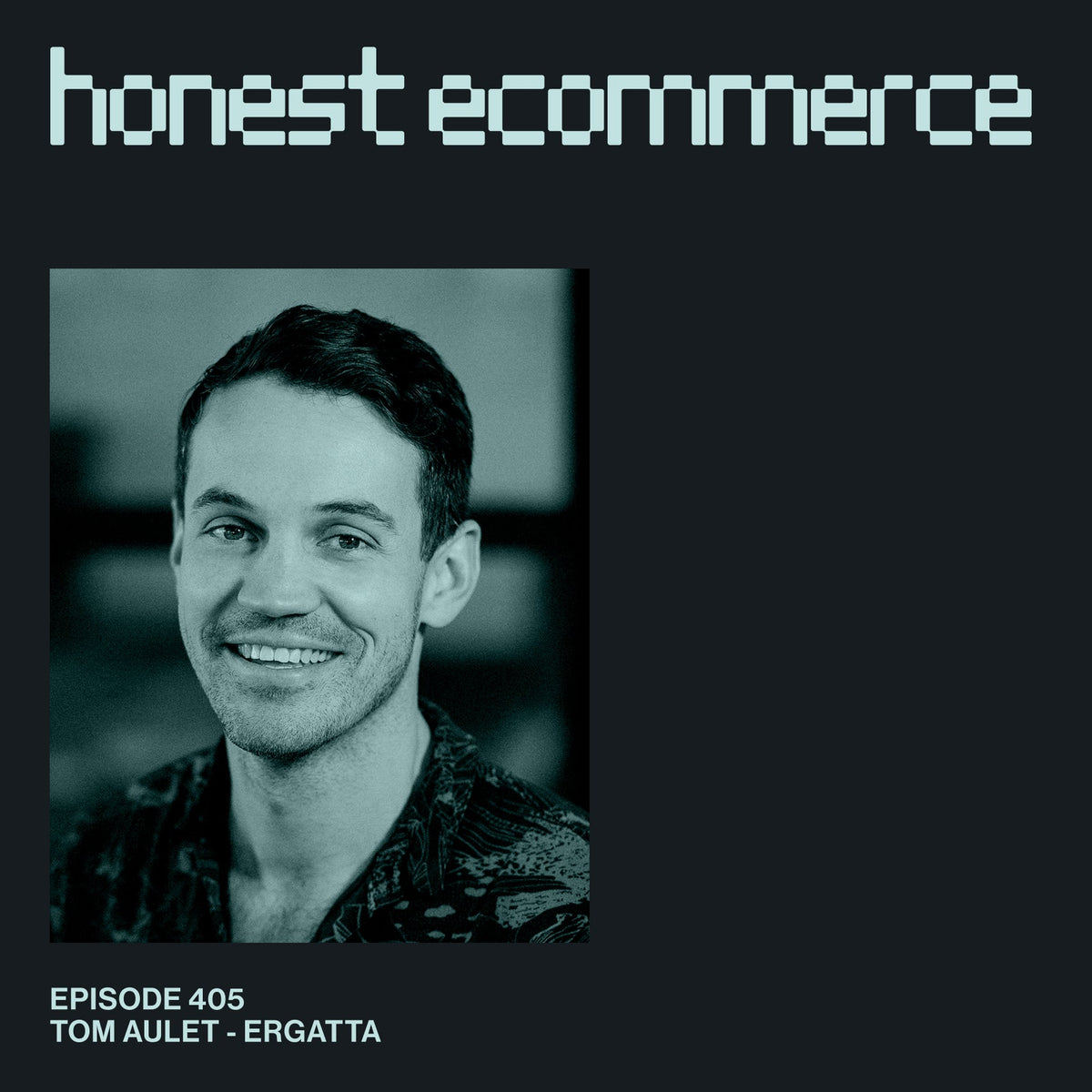
Tom Aulet
The one thing I'll mention that's kind of more interesting that I just loved and everyone on our team loved and was just so informative and so helpful and so colorful was we set up, we called it HDYHAU. It was like How Did You Hear About Us qualitative survey. And it was basically after you purchased, you'd get a plain text automated email that looked like I wrote it that would come from me and my email address.
Chase Clymer
Absolutely. I'm a huge fan of surveying at the agency. We do so much CRO over here, and it's immediately we go, all right, we're launching surveys, and we're gonna email some recent purchasers, we're gonna email, there's a lot of different strategies that we do, but the post-purchase is just so easy. They've already bought, just ask them.
Honest Ecommerce is a weekly podcast where we interview direct-to-consumer brand founders and leaders to find out what it takes to start, grow, and scale an online business today.
Honest Ecommerce is proudly produced by Electric Eye, a Shopify Plus partner helping ecommerce brands sell more with strategic design and development. Visit electriceye.io for more information.
Hey everybody, welcome back to another episode of Honest Ecommerce. Today I'm welcoming to the show the co-founder and CEO of Ergatta, the leading game studio for home fitness, Tom Aulet. Welcome to the show.
Tom Aulet
Thanks, Chase. Appreciate you having me here.
Chase Clymer
Absolutely. It's been a long time coming, as we were joking about a few minutes ago. But let's just get into it. For those that are unaware, what does the leading game studio for home fitness mean? What are you guys bringing to market over there?
Tom Aulet
Yep. So practically we sell a series of rowing machines with gaming content attached to them. So they're beautiful rowing machines, are made out of wood, they're designed to look like furniture, they store compactly, they go in the home, and then they have a tablet on them and a content experience on them, I think Peloton or similar. But rather than that content experience being classes and instructor-based content, it's gaming-inspired content.
So when you're rowing, when you're working out, you are playing one of several different games. You might be racing against other people in the community. You might be moving through 2D space, avoiding obstacles, collecting tokens. You might be doing any one of several different game experiences that entertain you, motivate you through the workout and keep you hooked coming back, much like a video game or a sports or something like that.
Chase Clymer
Absolutely. So that's amazing. So just, and obviously I don't want to distill it down, but some people in the audience are as dense as I am. So if we wanted to make it really simple, it's Peloton, but a rowing machine, but games instead of instructors.
Tom Aulet
Yes, exactly. Well said.
Chase Clymer
Awesome. Great idea. Where did it come from? Take me back in time.
Tom Aulet
Yeah. I've always wanted to start a company. I've always been really, really pumped to do that. And frankly I'm surprised it took me so long to do it. I worked for other companies for a decade before I did it.
First I found the people I wanted to start a company with, two people that I worked with for many years, and we would meet every week and come up with business ideas. So the founders happened before this specific concept. And then we honed down and we had two or three concepts that we were really excited about. And the one that became Ergatta was rowing machine content subscription, but a different type of content than classes.
Chase Clymer
Yeah, how do we be unique? How do we differentiate?
Tom Aulet
Right. And then that was the concept. And how we fleshed that out, the biggest answer I have for you is what we call primary market research. So we did hundreds and hundreds of interviews with would-be customers, and we did a lot of survey work to hone in on exactly who our customer would be, what the nature of their problem and need was, and what was likely to be able to solve that need.
So we really honed down on who was not addressed by classes, who didn't want classes, but who still wanted to work out and what would work for them. What were the times in their life where they were in the best shape? What motivates them to get out of bed in the morning? What else gets them through workouts or inspires them to be active or achieve other things?
That was the biggest. We obviously did a bunch of talking to investors in the space, talking to industry experts, internal strategy sessions, all the other stuff. But the real unique insights came from that primary market research and really the qualitative information from those interviews and that survey work.
Chase Clymer
You mentioned the co-founders came before the company. Talk to me about that. How did you identify what a good co-founder would be? How many co-founders do you have over there on the team? Just talk about that process a bit.
Tom Aulet
Yeah, there's three of us. We needed to work really well together, communicate really well together. There needed to be no surprises in terms of what type of people we were and how we worked together and what our strengths and weaknesses were. We had to give each other energy and we all had to get along.
And the way that that happened was it was my favorite technical and non-technical person that I worked with at my last company for years. So it was a good skill set match and we all worked well together individually and as a group. So it was very de-risked. There were just not a lot of surprises. We had done a lot of different types of work together, and our skill sets complemented each other. We gave each other energy, and we communicated well.
And then we also went through this process to come up with business ideas and flesh them out together before we signed contracts incorporating a business together and allocating shares across the group. So that was how I went about it. I was lucky enough to have worked with them before and knew who they were and knew that it was gonna work well.
Chase Clymer
Absolutely. Yeah. Finding a good business partner is just like anything in life, a good partner in anything, even in marriage and whatnot. You gotta make sure that the communication is there. You can have tough conversations.
And then another thing that I always like to point out when we're talking about these types of things on the show is you need someone that has strengths where you have weaknesses or enjoys doing things that you maybe don't do, because if you guys, or gals or whatever, are both good at something and not good at the same things, then there's gaps in your team and also why do you need them.
Tom Aulet
Yeah, totally. I agree with that to a large degree, but I also think you guys just need to get along and communicate well and work well together and give each other energy, and you can hire to fill gaps, you can bring in investors or advisors to fill gaps. You obviously need to have someone that's good at sales, have someone that can code, you need some basics on the team. But you can always close gaps later, I think, as long as you all get along, communicate well, work well together.
And I believe you have to date before you marry, and starting a business with someone is very, there's a lot of legal paperwork similar to marriage, so it's an intense commitment and you wanna know who you're getting into bed with.
Chase Clymer
[Sponsor: Klaviyo]
Do you know what's going on with Klaviyo? When is the last time you explored what it can do? Klaviyo has been shipping tons of new AI, data, and automation features designed to help ecommerce teams move faster, personalize better, and automate more of the work that used to take entire teams. Most brands are only using a fraction of what is already inside their Klaviyo account. Klaviyo is not just email and SMS anymore. It is your customer data platform, your lifecycle marketing engine, your analytics layer, and now your AI-assisted execution layer, all in one place.
That means your customer data updates in real time. Your segments stay current automatically. Your flows and campaigns all run off the same source of truth. And now AI can help predict churn risk, forecast spend, recommend next best products, generate campaign content, and optimize send timing across channels. The big unlock is speed and efficiency.
There are fewer tools to manage, less dependency on engineering, less time moving data between systems, and a lower total cost of ownership across your marketing stack. And brands are seeing real results from leaning further into Klaviyo. Dollar Shave Club has reported over 30% reduction in total CRM stack costs after consolidating onto Klaviyo.
Brands like ThirdLove have seen a 15x ROI from SMS after consolidating channels. And companies like Corkcicle have grown flow revenue over 90% after bringing email and SMS together inside Klaviyo. Across our customer base, almost every single brand we work with today is using Klaviyo. That is just where serious ecommerce customer data and lifecycle infrastructures are living these days.
If you're already on Klaviyo but you feel like you're not getting everything you can out of it, or you're just running multiple tools and want to simplify without losing power, I think this is worth your time. You should head on over to klaviyo.com/honest to learn more. That's K-L-A-V-I-Y-O dot COM slash HONEST to learn more about what Klaviyo can do for you today.
Chase Clymer
At the start of the business, you mentioned that you did quite a bit of research and surveying. Talk to me. How did you find people to talk to? I think there are a bunch of people out there with great ideas. And I think that validating it by talking to your ideal customer is a great thing to do. So how did you do it?
Tom Aulet
Yeah. I just had no shame. So you start with your network, you start with who you know. So you just talk to people that fit, people in your professional network, personal network that fit the profile, then ask them at the end of the call to introduce them to two or three people that would be interested or excited by this. I would also go to the gym and just approach random people.
I remember I went to Equinox in Williamsburg at the time. And I would just go there and I would walk up to people that were getting on the treadmill or the rowing machine or the bike and be like, “Why do you do this? What do you find boring or interesting about it? What would entertain you? Would you be open to this type of thing?”
I would just approach random people and then once you had someone on the hook, ask them if they had any other people that they'd be willing to introduce me to, and then I built up a file of, it was four or five hundred people of would-be customers that fit our ICP, that were interested or engaged, that would give us time, or generally would answer questions.
And that was our first little customer pile that we sold to, that we would go to, to poll, to test concepts, to do some live prototype reviews, stuff like that. So that was how I approached it, how we approached it.
Chase Clymer
Absolutely. And I want to point out here, you were not sitting behind a computer doing this. You went to where your customer was. You had awkward conversations with them. I think it's something that's come up before here. At the beginning you have to do the things that can't scale and you just have to do the work.
Tom Aulet
Yeah, totally. 'Cause you get biased data from people that are in your network. It's worth doing, but you get less biased data by just walking up to random people that are about to get on a treadmill and asking them questions, in my experience. So I think you need both.
Chase Clymer
All right, so you're getting all this awesome data from chatting with folks out in the real world. How long does it go from we have this idea of a better rowing machine with some sort of elevated content model to we have this beautiful rowing machine with this well thought out gaming strategy? What was the timeline?
Tom Aulet
The concept we had, it was September 2018. We incorporated February 2019. So three months of fleshing it out, and then everyone was on board, and then we had to quit our job, sign docs, et cetera. And then we actually delivered products a year later, Q1 2020. And then we did pre-sales and alphas and betas throughout 2019, but shipping a final GA hardware product with everything at full price was Jan, Feb 2020.
Chase Clymer
That seems pretty quick. Did you guys already have an in with the ecosystem or did you collaborate with people that had familiarity there?
Tom Aulet
We didn't have an in. None of us came from the fitness industry. Software you can build and ship relatively quickly and iterate on. The biggest challenge there is obviously hardware. And that was not our strength or our interest.
And our big unlock there was we built a partnership with a manufacturer close by that had manufactured a lot of rowers and shipped a lot of rowers that were similar to what we wanted and already cut ahead, gone down the cost curve, had all the component parts and inventory on site, had all the supplier relationships, and we obviously had to tweak that and source a tablet and do some other stuff.
But that was the big unlock in terms of speed to market, was the WaterRower, and the manufacturing partner's called WaterRower. They're based in Rhode Island. We could drive there in four hours from New York.
It helped us get to market much more quickly because we could see them in person, we could go to their factory, we could iterate on stuff really quickly with them. And they had done a lot of the work that we could just build on top of and tweak the things that we wanted to tweak. So that was the biggest unlock in terms of the speed to market.
Chase Clymer
Absolutely. Yeah. I always say, with anything, building a product, building a brand, us building the agency. Hire someone that has done exactly what you want to do before.
Tom Aulet
Yeah. Right.
Chase Clymer
That's the biggest cheat code to all of this.
Tom Aulet
Totally.
Chase Clymer
[Sponsor: Intelligems]
What is the next big idea that could change your business? A pricing change? A new bundling strategy? Adding subscriptions? Tweaking your shipping offer? Most brands make these decisions based on gut feel. They roll out the change, hope for the best, and have no real idea if it helped or hurt their business. Intelligems fixes that. It is an AI-powered testing platform that brings CRO-level clarity to the decisions that actually move the needle.
Not just button colors and headlines, but the big stuff. Pricing, offers, shipping, new apps, even major site changes. Brands like Ridge, Jones Road, and True Classics are using Intelligems to test their most important decisions and see exactly how each one of those impacts profit before they commit. Momofuku used it to test promotional offers ahead of Black Friday and found the version that increased profit by about 28%.
Mott & Bow ran structured pricing tests that drove roughly 30% more incremental profit. We use it at Electric Eye with almost every client we work with. And now Intelligems has a free AI-powered audit that gives you three specific ideas that you can test on your store today. No commitment, no credit card, just three opportunities worth exploring. Head to intelligems.io/audit and get your free audit in just a few minutes. That's intelligems.io slash audit. Intelligems.io slash audit.
Chase Clymer
Something that's also about this idea and a lot of ideas out there, it's not groundbreaking as far as the technology or the physical hardware, but it's just a novel idea. So it's an iteration on something that already exists. So we can get there pretty quick. We just need to find people that have done this before.
Tom Aulet
Totally. And what I would add to that is know what your special sauce is and what it isn't. And our special sauce wasn't hardware and manufacturing. What it was fundamentally was this gaming content. No gaming content for cardio existed out there. So that had to be good. We couldn't outsource that. That had to be innovative. That had to work really well.
And then the second thing was just packaging it all together, marketing it effectively. As you said, it's bringing things that exist out there together into a single brand and value proposition that is compelling for people.
So hardware wasn't our special sauce. So we were willing to partner with someone and outsource it and iterate lightly on something that existed out there in the market that was proven. Whereas a lot of our competitors were like, no, we need to be like Apple and own everything soup to nuts and design from scratch a rowing machine and manufacture it in Taiwan and take two years to get it. And that just wasn't our approach to that.
Chase Clymer
Well, the funny thing about Apple is they did not own all of it at the beginning. They slowly started to build out those components. They only got on their own silicon in the past decade. I remember when they launched it, which is fantastic. Don't get me wrong. It's an amazing product. And I'm glad it entered the space to make other people innovate. But yeah, their older stuff was just parts from IBM.
Tom Aulet
Yeah, totally.
Chase Clymer
Back in the nineties. So you gotta get your feet into the market and you're not gonna be some insane vertically integrated business overnight.
Tom Aulet
Right. You're not gonna be a vertically integrated closed ecosystem brand that owns everything in your first year of existence. You gotta start somewhere and then build on that.
Chase Clymer
Let's talk about that first year though. So you find this partnership. The other half of it is the gaming content.
Tom Aulet
Yeah.
Chase Clymer
How does that iterate? And what is the first, I guess, is it an app? Is it an experience? What are you calling it in your sales process? And what did you launch with?
Tom Aulet
Yeah, so technically speaking, it's an app. It's an Android app that lives on an Android tablet that sits on a rowing machine. We called it a digital membership or digital experience. We still call it that. And the MVP was three different rowing experiences, two games and then a basic open row, free row situation.
So one game was races. It was a multiplayer game where you raced against other people, which looked like a simplified version of Mario Kart, but with a refined design. Another one we called Pulse, which was a single player game that was to get into different power zones and hold it for a certain period of time, basically interval-based training, gamified interval-based training. And then this more basic open row, free row experience that had a sleek but very simple digital visualization of your speed data, your cadence data, whatever.
And then within each of those two games, there were hundreds of workout options. So you'd pick a couple of different workouts or courses or whatever you want to call them. So that was the MVP.
And the most fun thing, or maybe one of the most fun things, was coming up with the games and testing and iterating on them and building them. There just wasn't a real playbook for gaming content on cardio equipment. And we just followed software product management best practices.
And we would come up with concepts and test them before we wrote a line of code, live with people, get responses, get reactions, and then build super basic prototypes, put them on a couple hundred rowing machines that people would test, and we would look at abandon rate data, completion rate data, and then we'd get a lot of qual, survey-based feedback from them.
So it was very iterative. We defined core product principles up front. It's like, what is this and what is this not? And then within that boundary, we could brainstorm, we could come up with a bunch of stuff. And then we would test it, iterate on it, and get a bunch of customer feedback along the way before rolling it out. So it was pretty de-risked by the time it was out there.
Chase Clymer
Yeah. That's amazing. So you got this whole thing pretty well fleshed out and you're ready to go to market. You said you launched with a pre-order campaign. Was that correct?
Tom Aulet
So we launched a, I forget what we called it at the time, a pre-sale or a soft launch or something where you could buy the rower and pay for it, but it was gonna ship in two or three months or whatever. And we launched that during the holiday 2019.
But before that, and this is maybe interesting to you and your followers, is the way that we got our first 500 customers and that we had this install base of beta testers that had rowing machines in their home with tablets and our app installed that were willing to test all these products, with the hardware in their basement or whatever, was that WaterRower had hundreds of thousands of rowing machines in homes already.
And the reason that they were willing to do this partnership with us was that their customers were asking them for digital solutions, digital products, and content. And that wasn't what they were good at.So we said we can solve that problem for you, and that was the core of the partnership.
And so what they let us do was email their customer base and say, “Hey, do you want digital products?” If so, you can buy a little tablet to bolt onto your existing rowing machine for 200 bucks, 300 bucks, whatever it was, which was basically the cost, and you can test out for free this Ergatta app. And so we acquired first 250 and then 500 customers with no marketing dollars, with just having WaterRower send an email to their install base, or a subset of their install base, and selling them tablets at cost.
Because you can get people to test software on their phone or on their computer relatively easily. But if it has to be on a rowing machine with a tablet, it just gets harder and it's hard to acquire those customers. 'Cause people aren't gonna buy a $2,000 rower from a brand they've never heard of without a lot of press or affiliate or reviews or what have you. So that was what got us off the ground, and those became ultimately our first 500 subscribers over the course of 2019.
And then we did a pre-launch around holiday 2019 and then we started to ship and did our hard launch, and this is funny, our actual launch where we did press and promised shipping within one to two weeks was March, I believe it was March 20th, 2020, and New York shut down for COVID, I think two days later or two days before. It was right around the time that COVID lockdowns started, which was crazy.
Chase Clymer
[Sponsor: eFulfillment Service]
You have prepped all year, and all that hard work is paying off. Your store is converting, the ads are working, and this is shaping up to be your best holiday season. But your 3PL can't keep up. Orders are backing up, customers are asking where their stuff is, the reviews are starting to turn. All that hard work, all that momentum, undone by a fulfillment partner that can't scale with you. This is a nightmare scenario, and it happens to brands every holiday season. Enter eFulfillment Service.
eFulfillment Service is the 3PL that scales with you. They are family owned, they've been in business for over 25 years, and they're built specifically for growing direct-to-consumer brands. There are no setup fees, no minimums, and no long-term contracts. You only pay for what you use. If you're scared your 3PL can't keep up this holiday season, now is the time to reach out to eFulfillment Service. Go to efulfillmentservice.com/honest and get up to eight weeks of account fees completely waived. That's E-F-U-L-F-I-L-L-M-E-N-T S-E-R-V-I-C-E dot com slash H-O-N-E-S-T. eFulfillment Service dot com slash honest.
Chase Clymer
Inopportune time to launch in the moment, but I believe there was quite a big home fitness boom during that. So once people got used to what was happening, I'm assuming you guys saw a bit of an increase. And how were you getting in front of those folks? Were they just actively, organically seeking out in-home solutions or were you also doubling down and getting into paid media, earned media? What was your go-to-market strategy? How are you getting more eyeballs on this?
Tom Aulet
Yeah, it was iterative. So first we'd obviously set up a website and email, all our owned channels. Then we got into earned, so we did a big press event, I remember, at CES in Jan 2020 that got our first 10, 15 legit press hits. CNET and Engadget, whatever it was.
And then if you Google Ergatta, you're like, this is a legit brand and I can get reviews from credible sources that I've heard of. And then we started to slowly scale up paid media from there, starting with Google, Facebook.
But basically what we found out pretty quickly was the way that people would find out about us, was they would start searching for home fitness or home cardio or home rowing machines. And then that was the start of their discovery process. And then we would show up in press roundups that would rank well, in paid search ads, in YouTube videos that would rank well, whatever it was. But that was the trigger. It was a non-brand generic search term for home fitness equipment that would eventually lead them to Ergatta and eventually to a purchase.
Chase Clymer
Yeah. It's definitely a considered purchase. I would say it leans a little bit more towards luxury, just where it sits in the market. I'm assuming that's an interesting customer journey and you already mentioned a bit about it, but how did you set up the feedback loop to learn about how to improve your marketing, where to spend your dollars?
Tom Aulet
Yeah. We did a lot of normal best practice stuff. The one thing I'll mention that's more interesting that I just loved and everyone on our team loved and was just so informative and so helpful and so colorful was we set up, we called it HDYHAU. It was a How Did You Hear About Us qualitative survey. And it was basically after you purchased, you'd get a plain text automated email that looked like I wrote it, that would come from me and my email address, that was like:
Thank you so much for finding and purchasing Ergatta. We're an early stage startup, our early customers mean the world to us. If you have two minutes, I'd love to hear from you on a couple of questions. And it was, how did you find out about us? What were your biggest hesitations? Were there any reviews or materials that were particularly persuasive? And what got you over the hump? And is there anything else I should know?
And I would read every single one. Everyone on the marketing team and product team would read every single one. I would often respond back to them and ask clarifying questions, and then all of those responses, and they were all qualitative, would get dumped into one single doc. And then we'd iterate on the questions over time. And the response rate was super high at first and went down over time.
But that was how we got just this super rich, colorful, qualitative picture of who our customer was, how they found us, what were hesitations, what was persuasive, what would get them over the hump, how considered it was. Was it a week, was it a month, was it a quarter, was it a year? What was our competition? Was it just nothing or was it another rowing machine or was it Peloton?
And all that was just fascinating. And that was how we got the core basics of who our customer was, what our journey looked like, and what our marketing strategy should look like and consider.
Chase Clymer
Absolutely. I'm a huge fan of surveying at the agency. We do so much CRO over here. And it's immediately we go, all right, we're launching surveys, and we're gonna email some recent purchasers. There's a lot of different strategies that we do, but the post-purchase is just so easy. They've already bought, so just ask them, ask them some clarifying questions. And some of it is about the store and the experience, the bundle, the offer. All of the stuff is useful to create those optimizations.
And it's also something that we're always saying, all this information we're learning that we're using to optimize a store, you can just give to your marketing team to help write better ad copy. It's useful in all these different places.
Tom Aulet
And give your product team to understand the customer better. It's just such a rich and interesting data set for everyone, particularly the qualitative storytelling component of certain survey work.
Chase Clymer
Hey everybody, just a quick reminder. Please like this video and subscribe if you haven't. We're releasing interviews like this every week, so don't miss out. Now back to the interview.
So the name of the show is Honest Ecommerce, and the conversation thus far has been you guys have had home runs left and right, knocking things out of the park, making the right choices. I know the truth though. Did you guys make any missteps along the way that you can share?
Tom Aulet
Yeah. Definitely. The biggest one that I wish I could get back and that I tell people is just we raised too much money. We have a great business. It's very profitable. It's super consistent. We're clearly solving a market need. Our customers really, really like our products. There's a growth engine, there's a retention engine, there's a word of mouth engine, blah, blah, blah. But it's not a billion dollar IPO business.
With the venture-backed startup space, there's this notion that you should raise as much money as you possibly can. And there's this gravity that pulls you towards, I'm gonna run a $20 billion public company or whatever it is. And the right goal for us, for this type of business, was probably a $50 to $100 million outcome rather than a $10 billion outcome. And that points you towards a specific capital structure and a specific amount of cash to raise.
And we raised $35 million. That was in retrospect too much. And honestly, that wasn't my goal. It just became such a hot space at the time. And there was just so much demand, and all the energy was just raised as much as you can at as high a valuation as you can.
And that's the one I would take back. I'd be clear about how big is this business gonna be realistically and what is my goal, and then work backwards from that. How much money should I raise so that I can get there, and that when I get there it's lucrative for all of our shareholders, common, preferred, employees, everyone.
Chase Clymer
Absolutely. Yeah. And I think that a lot of our audience can read into that a bit more and make their own evaluation about that statement. And I think that's the first time anyone on the show has said something like that. So I truly appreciate that level of transparency there.
It might help some people about to raise right now and on the fence about asking for more, or they might have a number in their head that they think it should be. And so hearing it from somebody that's been in their shoes five, ten years down the line, I think that's super amazing.
Tom Aulet
Great. And even now, if it's a software business, you could probably get it off the ground for even less than you used to be able to do. So I think being super careful about how much money you raise and how big the outcome is really likely to be, and sticking to your guns despite all the pressure in the venture ecosystem to say our TAM's a trillion dollars and we're gonna IPO for a hundred billion dollars in five years, whatever it is. It's just not realistic for every business, obviously.
Chase Clymer
Absolutely. Now, is there anything I didn't ask you about, Tom, that you think would resonate with our audience?
Tom Aulet
Ecommerce and growth marketing tends to be such a quant game. And the quants, people that are super quantitatively driven, tend to do well. And it can be a very data-driven enterprise, which is great. And I'm all for that.
But I think having a clear perspective on what your brand is and how it shows up, and having a specific design aesthetic that aligns with how you're pricing your product and who your customer is, and keeping that consistent over time is super, super, super important.
And that's not really a quantitative thing. That's knowing who your customer is and what their problem is and how you're solving it and how you're pricing your product, and matching that to a brand identity and a product marketing strategy that is consistent over time and that you don't change with new data.
I think we have gotten a lot of credit for having a premium design-forward brand that people want, that has some lifestyle appeal, that has some luxury appeal that our competitors don't have. And that's been as big a part of our marketing success as channel optimization, creative optimization, conversion rate optimization. I think that really mattered a lot. When you do interviews, when you read the qualitative survey data, it's clear that that matters to people a lot. And that's registered with our leads, with our customers as well.
And that wasn't intuitive to me because I come from a very acquisition, quant-driven marketing background. And the brand was always, that seems soft and fluffy and a waste of money, but it really wasn't. And having a clear concept of what your brand is and how you're gonna show up from a visual design, product marketing, messaging perspective, and being consistent about that, not changing it with the winds, was a good thing for us.
Chase Clymer
Absolutely. I think that that's something that really makes sense at the kind of investment that the product is for the customer.
Tom Aulet
Yeah.
Chase Clymer
The value is subjective, and the one thing that increases perceived value, and you could look right at Apple for this again, coming up twice, is their aesthetic and their design is 100% also in line with the value of the product. You could argue that you can get the same performance out there of similar products for less price, but the packaging design, the experience, the unboxing, the store you get it at, that isn't the same experience.
Tom Aulet
Totally agree. Apple's a great example.
Chase Clymer
They tend to be a great example across the board.
Tom Aulet
No, they seem to keep coming up.
Chase Clymer
Awesome. Tom, I cannot thank you enough for coming on the show today and sharing all those amazing insights. Thank you.
Tom Aulet
Thank you so much, Chase. This has been great. I'll come back anytime. I appreciate you having me on. It's been great.
Chase Clymer
Awesome. Thank you so much.
Tom Aulet
Thanks, Chase.